Betsy Andrews

Happily married couples gone wild!

Middle-aged Penthouse Forum has become an improbable voice for family values -- as long as you turn your wife over to the cable guy.

  • more
    • All Share Services

Happily married couples gone wild!

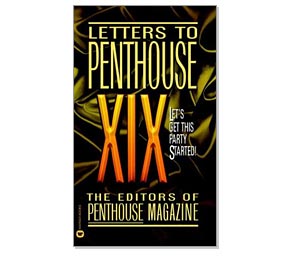
“Letters to Penthouse XIX” is shocking. The 19th collection of letters from Penthouse “readers” (that is, actual readers and the editors who imitate them), culled from the fabled Forum section of the magazine, delivers a bit of everything for the average libido: fellatio, cunnilingus, vaginal sex, anal sex, exhibitionism, voyeurism, dominance, toys, group sex, in the home, in the office, in the car, on the beach, in the bleachers. Oh, yeah … yeah … yawn.

Time has passed since the Penthouse Forum offered cutting-edge titillation; 384 pages of sucking and fucking, with a smattering of edgier nastiness, really isn’t all that in an era of the Super Bowl flash — or, more important, the Internet, where a video of a famous hotel heiress is available for quick download for $50, and porn bloggers explore predicaments Penthouse readers could never imagine. The impact has devastated Penthouse, whose publisher filed for Chapter 11 last summer, and many bet on a complete overhaul by a new owner. It’s been a humbling fall for Penthouse, which burst on the scene 40 years ago, a Playboy imitation that dallied on the edge of kink. America’s definition of that edge, though, has changed radically; Penthouse’s really hasn’t.

What is most interesting about “Letters to Penthouse XIX” is that the magazine’s readers, apparently, haven’t changed much either. I would go so far as to say that, contextualized, the majority of the “reader” encounters in “Letters” amounts, shockingly, to an affirmation of family values.

There are 69 stories in “Letters to Penthouse XIX” (get it?). In 39 of those stories, a committed, most often married, heterosexual couple gets it on, and whether they’re alone or, more likely, some hot stud or sex kitten has joined them, the sex reinforces the man and woman’s relationship with each other. Chapters bear matrimonial titles like “His Wife Surprises Him by Showing Up at His Hotel in Sexy Undies, and in Heat,” “Nothing Excited Him More Than Seeing His Wife Get It On With His Best Friend,” “And They Thought Bringing the Wives Would Spoil Their Just-Guys Weekend” or, for Pete’s sake, “A Beautiful Quarter Century Only Affirms the Love They Share Together.” A typical beginning to a hot group grope goes, “Recently my wife and I tried swinging as a means of spicing up a long-time monogamous marriage. It worked like a charm.” In stories throughout sections called “Clusterfucks,” “Three for All,” “Open Season” and “Someone’s Watching,” the protagonist sets up a scene with a third and maybe a fourth (or, in the case of one prodigious wife, a tenth), to satisfy a desire shared by his or her significant other who, in more ways than one, gushes his or her consent. Sometimes a guy’s wife goes nympho on him, and he happily gets to watch, jacking off while she gets serviced by a dude with a huge dong. Or his wife goes lesbo, and he joins in, screwing her while she eats out her big-breasted friend. Even when the wife hasn’t scored her husband’s prior consent, the pokings of an errant prick prime the marital pump. In “Want to Spice Up Your Marriage? How About Seducing a Delivery Guy?” the narrator’s husband walks in on her “fuckfest,” and the result is elevating: “It was the first time in months his cock had gotten hard for me…”

The session usually ends with the wife indulging the husband in a loving, reassuring screw. Even when the husband hasn’t been privy to the preceding action, the fuck at the finale affirms the nuptial purpose of the extramarital play: “As she glanced down at the dried come that had dripped down her thighs, a feeling of pride overcame her. On this night she had been the sexy, desirable woman that her husband had dreamed of. Obviously being a little slutty had its rewards. It was with a feeling of fulfillment that she got dressed and returned to our room. After hearing the story, I was so turned on that I was about to burst. Seeing my dilemma, Peggy smiled and removed her dress, saying, ‘Well, I’ve been fucked twice tonight — but I bet I can be even more slutty with my own husband!’ And she proceeded to prove that she could. That experience really changed our sex life.” In the only story in the book in which a husband blatantly cheats on his wife, we’re led to believe she’s such a shrew that we hardly blame the poor bastard: “I’m married to a jealous, insecure, conservative, homophobic woman who only likes to fuck every other month, which frankly isn’t enough for me.”

Not that the woman sitting next to me on the subway reading the New Testament, Matthew 12, while I read “Three Male Strippers and One Curious Wife Make His Vacation Extremely Exciting” wouldn’t have tried to cast the demons out of me had she known what I held in my lap. The sex in the book is hardly monogamous, and despite the bucket-loads of fertile, unsafe jism shooting out of unsheathed cocks into all manner of unprotected orifices, it is certainly not intended for procreation. And there are a few surprising transgressions of the het guy norm, including straight, married men sucking dick, and one venturesome fellow going bottom-up for a bona fide bisexual encounter. But, where even casual encounters between singles can elicit expectations of the forever-after fuck, the book as a whole ultimately reaffirms the hegemony of the stable heterosexual couple. (A former editor at Penthouse told me that, as she recalls, a number of letters were written from prison, which adds a particular poignancy to the longing for a hot married life.) In other words, despite Penthouse magazine’s infamously failed turn toward hardcore in recent years, “Letters to Penthouse XIX” is just the type of tame stuff savored by Penthouse readers, who former “Leg Show” editor Dian Hanson recently told the Globe and Mail were “married men 36 to 50, seeking a little spice.”

She might have said they’re married white men because, if this volume is any indication, the most disappointing preoccupation of the Penthouse readership is a fetishization of a racist stereotype, the “big black” stud. In “She Meant to Be a Faithful Wife, But She Lusted After Big Black Men,” a Caucasian couple goes to a hip-hop club, where they pick up Leroy, who has a “gigantic” member, tears at the narrator’s dress “savagely,” and who talks like he’s in a blaxploitation flick: “You can’t handle it, mama. This big black cock would split your little white belly in half!” Since race isn’t always a part of the scene, some of the protagonists in the book could be African-American, but the color of the cock is only noted when it’s black and it’s not the protagonist’s. All of the book’s nice couples, it would seem, are white.

Where a couple encounters an African-American lover — all of whom are male in this book — their sex life is saved, and their marriage is reinvigorated by the potency of black “manhood.” “He Wanted to Give His Wife a New Experience with Someone Bigger, Younger and Blacker” ends, “Since that session with Brad, our marriage and our sex life has been better than ever. We are considering a second session with him one of these days, but neither of us is in a hurry. Julie says she is grateful for the experience, but I am the one she loves. My advice to all you guys is to give this kind of gift to your wife, at least once. You’ll never regret it, and she will love you all the more.” In other words, “all you guys” are white, and the story provides racist reassurance to its white male readership that the black stud, mighty though his prowess may be, is servant to the assertion of white male romantic and sexual hegemony. He may have the white wife for a session, but only insofar as the experience serves to reaffirm her commitment to her white husband.

Still, porn is porn. Enough bump and grind, and it gets you horny no matter what the set-up. “Letters to Penthouse XIX” could drive anyone who doesn’t want to pay for sex to hump a spouse they haven’t paid attention to in years. And whether white married couples doing it turn you on or not, you might want to pick up a copy of “Letters” — with savior-investor Marc Bell and his group, PET Capital Partners, promising to clean up the bankrupt smut rag and turn it into a Maxim-type lad book, the days of the Penthouse Forum could be numbered. And the “Letters” series, with its spouses and the quaint encounters that make their “marriage and sex life much happier,” could become an antique.

The sound of one hand slapping

A new book explores the history of masturbation -- and why the finest minds of the 18th century suddenly freaked out about it.

  • more
    • All Share Services

Apparently I’ve been doing it wrong, or by the lights of the gatekeepers of Western morality, I’ve been doing it right, if I must do it at all. Either way, I blame the school nurse. Mrs. Hirshman was a little truck of a woman with a supposedly enlightened perspective. (I might as well have capped that “e,” for as UC-Berkeley history professor Thomas Laqueur explains in “Solitary Sex: A Cultural History of Masturbation,” Enlightenment thinkers were totally freaked out about masturbation.)

They were freaked out about masturbation because it engaged the imagination in ways that disengaged the self from society. Onanism, as they called masturbation, was premised on fantasy, and fantasy dissolved social reality; it would lead to the downfall of the socioeconomic order. So, when Mrs. Hirshman told us that it was A-OK to jerk off, just so long as we didn’t go ahead and fantasize when we were doing it, she was, unbeknownst to herself or to any of the boys and girls in my ninth grade health class, teaching from within a framework of anxiety in continuance since the Enlightenment.

She was a regular Samuel Tissot (we’ll get to him), that Mrs. Hirshman, and she screwed up my masturbatory technique for years to come. Up until Mrs. Hirshman, I had fantasized while jerking off — pirates and bandits and sundry molesters — and after Mrs. Hirshman, I didn’t. As the person of Mrs. Hirshman displaced that of a peg-legged captain in my mind’s eye, the prospect of guilt kept me from my fantasies. It did not stop me from masturbating. I simply focused, instead, on myself. And so I have remained, an entirely narcissistic jerk-off.

As Laqueur paraphrases the 1930s Freudian, Laura Hutton: “If a single woman must masturbate to relieve tension,..(n)o fantasy at all cost, and ‘get over it and forget about it.’” If any self-service was acceptable, the kind bereft of imagination, and as logic would have it, pleasure, was the only acceptable kind, because the limit on pleasure marked the limit on self-sufficiency; a wanker would still need to make relationships with others in order to satisfy his desire for pleasure, and so the engines of society would keep on firing, the markets would remain peopled, the economy would not collapse. And, yet, it turns out, the opposite is true. Bereft of fantasy, I don’t need anybody but myself to get it on; I’m autonomous, even, from the images manufactured in the Enlightenment thinkers’ beloved marketplace.

Even when I’m in a relationship with someone I find utterly delicious, when I’m alone, I’m alone. I am, at that moment (and thus eternally, for anti-onanistic theory was absolute), the utterly autarkic onanist that everyone from Jean Jacques Rousseau to Sigmund Freud was so uptight about. Thus, having digested the entirety of Laqueur’s massive treatment, I cannot now discern whether my narcissistic brand of masturbation would be more or less disturbing to the pre-20th century morality police than the diddler with the vivid imagination.

By now, you may be confused. Well, welcome to the wanking world of cultural history. I was confused until halfway through “Solitary Sex.” Form meets content with Thomas Laqueur, and so the layman might be wise to take him at his word when he writes, “There may be more detail here than some readers will find necessary … ; skip to Chapter 4 to get back to the story of sex with oneself from the eighteenth century on.”

Those of us who aren’t as turned on by history’s daisy chain of names and dates can skip all his poking and stroking and go right for the money shot, the gist of which is this: Around 1712 in London, a quack named John Marten anonymously published a book on the subject so as to market his own remedies for the alleged epidemic of onanism. “Onania” was a shrill, salacious and blatant bit of hucksterism. And yet it hit a nerve. It went into multiple printings, launched a cottage industry of torturous curatives and sent the Western world’s intellectual establishment into an anti-onanistic fit. The famed French physician, Samuel Tissot, claimed that the newly coined “self-pollution” was the cause of any number of diseases. Rousseau thought it a fatal addiction. Kant called it worse than suicide. And so on through Freud, who “traced anxiety neurosis, obsession, narcissism, hysterical vomiting, repressed memories of infantile sexuality, and, arguably, guilt itself to the psyche’s confrontation with” masturbation.

The hysteria was new. Prior to the 18th century, no one was all that bothered by masturbation. What with wives and prostitutes and boy tutees at hand, the Greeks thought it below the average (read: male) citizen, but if one must, one must. Talmudic scholars, reflecting Jewish anxieties about the survival of the tribe and the coming of the messiah, worried themselves over procreation. The Biblical rebel, Onan, refused to come inside his widowed sister-in-law because the resultant child would be considered his dead brother’s and not his. But, despite lending his name to a term for solitary sex, his sin was not masturbation but the spilling of the family seed. The church was so in a froth over sodomy that masturbation got short shrift.

The changes that occurred in the 17th and 18th centuries to hyper-problematize masturbation were, according to Laqueur, the secularization and democratization of society and the concomitant rise of market capitalism. As the hierarchical order overseen by God was eclipsed by modern civil society, the individual took precedence, and self-determination came to the fore. The authority that regulated social behavior was no longer outside the self; it was the self. Reason became primary, and for the sake of the burgeoning market with its many peddled goods, so did its antithesis, desire.

The tensions were built into the relationship between social order and the self, democracy and market. Within “give me liberty or give me death,” anarchy loomed. Too much self-determination, and all hell broke loose. The individual expression of the “dark underbelly of civil society” was the errant hand on one’s own hot spot: “All those capacities and possibilities on which masturbation thrived — imagination, the desire for luxuries, reading, privacy — were those most necessary to the new political and social order … The struggle against masturbation through education and through medical bullying was thus a struggle to keep the freedom and the desire on which the new order was predicated within ethically livable bounds.”

Privacy and private pursuits, of which jerking off was the ultimate, were necessary for the production of individual desire but were dangerous to the reproduction of social relationships. Autonomous self-gratification, fueled by the imagination, threatened to bring the markets to a halt. But if the imagination was so dangerous, then how could the medico-moralists of the modern era account for jerk-offs like me who take pleasure in masturbation without the fantasies? The answer is, they didn’t, and neither does Laqueur. The O.G. of anti-onanism, John Marten, insisted that “one could not commit [masturbation] ‘free of mental impurity.’” As Laqueur puts it, “imagination is everywhere in eighteenth-century thinking.” There was no pleasure without it.

But what happens to imagination, and to pleasure, when we get past Freud to the late 20th century, the era of “the liberation of masturbation,” when we’re even enlisted to lend a naughty hand to worthy fundraising efforts like the May 18th Masturbate-A-Thon to raise money for AIDS? From the Boston Women’s Health Book Collective to the New York Jacks to the Internet, Laqueur provides evidence to show that we’re living in the age of communities of masturbation. No longer simply a solitary act, masturbation has become “a new form of sexual sociability,” and though Laqueur claims it is “rooted in the celebration of the imagination and its infinite possibilities,” the private imagination all but drops out of his analysis of the late 20th century. Far from “a way of reclaiming the self from the regulatory mechanisms of civil society and of the patriarchal sexual order,” today’s “(m)asturbation creates the sort of self that can live ethically in the social world.” The wildest of private practices has somehow been domesticated in a warm and fuzzy group yank. It makes me yearn for the lone perv in the dirty raincoat. And, basically, I don’t buy it.

This is where Laqueur’s analysis seems to lead us: to a tremendous reduction. The problem lies, I think, in the endeavor to manufacture grand theory. Laqueur is a smarty pants, yes, and his book is enormous. And, yet, in the drive to find the proverbial fingerprints on the genitalia, complexity is lost. Laqueur makes much of the marketplace in the construction of the modern, bourgeois self. But the evolving marketplace of the 18th century was far from monolithic. The phenomenon of the bourgeois purse — the consolidation of Anglo-European, middle-class wealth — was born of a complexity of socioeconomic processes. It was a period that saw the displacement of the peasantry, imperialism, immigration, slavery. Beyond the rare appearance of a self-abusive farmer’s daughter or two, the low-rent protagonists of these global upheavals are nowhere found in Laqueur’s narrative, hands down their pants or otherwise. In fact, in 496 intellectually lubricious pages, there is (outside of the pro-masturbation political victim, Dr. Jocelyn Elders) not one mention of an individual of African descent.

The book gives the impression that the medico-moral policemen of the Enlightenment were unconcerned about the sexuality of the enslaved peoples among them. And yet, we know this to be untrue. Particularly in the 19th century, when politically motivated rape fictions unleashed Reconstruction lynch mobs on black men, depictions of black sexuality by whites who wielded the pens were serious business, and if these folks had nothing at all to say about blacks jacking off, the reader would like to know about it and understand why. The same goes for immigrants and for the indigenous peoples encountered through colonial expansion. After all, these were the days in which Paul Gaugin was getting it on with those libertine Tahitians and Melville’s Ishmael was learning how to handle his harpoon at the hands of his “bosom” bed-fellow, Queequeg. And, if Laqueur is correct in labeling masturbation “the first truly democratic sexuality,” would it not follow that the tensions played out in the Industrial Revolution between democracy and an increasingly complex class system would find their way into the greased palms of the huddled masses?

Laqueur’s book, despite its provocative material, is rather traditional history. Its subject is bourgeois culture. Old-school history’s subject used to be the bourgeois sausagefest. Bourgeois women have somehow finally earned our place at the circle jerk. But no one else really seems to count.

History, the discipline, also accounts for one reason the reader might find herself rummaging up her skirt when she’s supposed to be engaged with the text. History, as a study, is obsessionally evidentiary. Sometimes the slog through is downright boring; there are just too many cum stains and swollen clits catalogued here. Or, rather, there are texts about cum and clits. And the details of private lives are recorded not in medical self-help books, but in diaries, in songs and jokes and letters, in material objects. After swallowing so much spillage from the pens of the hegemonic, I longed for a deeper dig into other kinds of data.

It is only when he gets to the 20th century that Laqueur really investigates other evidence, namely pro-masturbatory artworks influenced by the feminist and gay rights movements, but by then, “(i)t is too late in the day to say much more about these images than that they exist …” and that they incorporate concepts of masturbation extant from the 18th century. Thus Laqueur threatens to frustrate the reader, as if he had come prematurely, 200 years previous, while the reader is left waiting for a contemporary climax.

The story of masturbation in the 20th century remains to be fully told. Now that Laqueur has unzipped the fly, someone should out with the details about, for example: fascinations and anxieties over pretty young things and their pretty things, from Brooke Shields’ “Pretty Baby” to Calvin Klein ads to recent art world wünderkind, Ryan “The Kids Are Alright” McGinley, and his much-touted, Whitney-exhibited photographs of his nubile friends jerking off; voyeurism, exhibitionism, the stroked cock as advertisement, entrapment and the homophobic policing of public bathrooms and city parks; the masturbatory implications of hip-hop’s crotch-grabbing posture; and, as our man mentions in the final pages of his text, the sticky keys and the dubious measurements of the “well-hung” Internet stud.

Of course, critique is easy for me to spurt out, sitting here variously mouthing and wanking off. I did not spend countless hours distilling from the dross a grand theory of why self-service makes us nervous. One must give Thomas Laqueur his due. His book furthers our understanding of the linkages between sexual anxiety, regulation of the self and the market economy at a pivotal time in the development of modern capitalism. And, as the fallout of my junior high health class illustrates, the anxieties Laqueur illuminates are still very much with us. Given the scholarly weight of both Laqueur’s rep and his engorged tome, it is hard to see how subsequent analysts can fail to grapple with “Solitary Sex.” As the carefully researched theory of an imminent academic, it is, by its very nature, seminal. And there is, indeed, an awful lot of seed to feed upon here.

Continue Reading Close

Grad school jerk-offs

What is the connection between solitary study and private pervdom?

  • more
    • All Share Services

It is 1993. I am working on my thesis for a master’s in anthropology from the City University of New York. We are staying in a friend’s co-op, sitting for his gigantic tabby, Ludwig, a creature of four left paws. As Ludwig paces the high, thin ledge that rings the living room, jostled precious objects fall to the floor, and he watches them drop. I pace the office rug in tiny circles before the computer. I am caught on a sticky theoretical point. My brain is burning. I am pacing. Ludwig is pacing. Objects are falling. The burn travels the length of my body and lodges between my thighs. Ludwig paces. Objects tumble. I sit down and, spreading my legs on the folding chair before the text, finger my clit to orgasm. Then, as my lover sleeps in the loft above the ledge that rings the living room, I unstop the course of argument. I write, “The danger lies within the social proscriptions to which pleasure-seeking is subject.” Later my advisor will respond in the margins, “If this is the case, it is a fairly narrow range of ‘danger’ relatively speaking.”

- – - – - – - – - – - -

The year is 1812. For the past hundred years, since the publication of the seminal pamphlet “Onania, or the heinous sin of self-pollution, and its frightful consequences in both sexes considered, with spiritual and physical advice to those who have already injured themselves by this abominable practice,” doctors and social theorists have wrung their hands over masturbation. In this year, Dr. Benjamin Rush will pen “Diseases of the Mind.” He will caution young men that the ills of masturbation should be avoided through “close application of the mind to business, or study of any kind.” But Jean Jacques Rousseau has already recognized the danger of solitary study. In “Emile,” he has warned the tutor to never leave his student alone, lest he discover “that dangerous supplement.” Others advocate the opposite of study. “The lad who plays vigorously, even violently … possesses a great bulwark of defense against sexual vice,” writes one author, “especially in its secret form.”

Enlightenment thinkers concurred that jerking off led to stunted growth, bodily weakness, blindness, venereal disease, insanity and death. Clinicians imposed treatments ranging from cold baths and bland foods to shackling, clitoral burning and tubes lined with metal spikes fitted over the penis. Masturbation phobia spurred the growth of the psychiatric and gynecological industries. The proverbial ink was spilled. But as to the underlying relationship between study and self-abuse, the experts didn’t agree.

- – - – - – - – - – - -

Dana is a Ph.D. candidate in criminal justice whose jerking off took off when she entered the program three years ago: “I found from the second I was in grad school it increased so, so much. I had to read so much, and then my hand would move to my legs, and then I’d read more. It would be like, ‘You have to get to page 45, and you can jerk off again.’ And then you set another goal.”

Chris was recently awarded a Ph.D. in English for a dissertation on the complications of closure in Shakespeare’s middle comedies. He tells me that, in the midst of the “isolating” doctoral, “My masturbation practices became more prominent. I became more of an exhibitionist, looking at my own body so much more regularly in a narcissistic mirror and getting off on it.”

Anne is a Ph.D. candidate in anthropology at a German university. “When I was so intensely writing my thesis in my study every day,” she recalls, “it really struck me. I was so — how you say — horny? It kept me from concentrating to want to have sex so much. I felt it got in the way. I really wanted to put some ice cubes between my legs. Masturbation was the only way to get back to concentrating.”

The masturbation habits of these young scholars seemed to increase with their intellectual work, as a distraction and a study aid, a side effect and an escape. But what was really happening? Was it simply a study break like any other — a break from the brain and a reminder of our bodily existence? Could a run in the park or sugary snack have done the same thing? Or is the connection between thinking and self-touching more integral, as Puritan scholars once preached?

In their introduction to “Solitary Pleasures: The Historical, Literary, and Artistic Discourses of Autoeroticism,” Paula Bennett and Vernon A. Rosario point out the “rich network of connections between solitary, non-procreative eroticism and autonomous, imaginative production,” i.e. the euphemistic “mental masturbation.” Study itself was not so much suspect as a certain type of study that entailed “the self-pleasuring imagination.” For Bennett and Rosario, the solo study that mirrored masturbation was politically dangerous — a rebellion against the powers that be.

“I could not read the Federalist Papers without jerking off,” an up-and-coming social scientist at a Midwestern university confesses to me about her student years. “I recognized that they were in some ways truly brilliant and also totally boring to me. And I think there probably was also a way in which I wanted to say, ‘Fuck you, Founding Fathers.’ Imagine the horror that they would have experienced if they found that young women were treating the Federalist Papers with such irreverence.”

According to Eve Kosofsky Sedgwick, in her chapter in “Solitary Pleasures,” it is exactly this kind of irreverence that remains the feared product of the creatively inclined masturbatrix. All of Western patriarchy might go to hell if she puts her hand in her basket. As if to confirm this theory, the National Review argued in a 1997 article, “It is easy to see why people are drawn to the culture of masturbation, and why traditional societies have striven to forbid it. For it is the enemy of social reproduction.”

- – - – - – - – - – - -

In researching this article, I put out a call for informants on an academic list-server. I write that I am “exploring a casual theory about the relationship between grad studies and self-pleasuring.” I receive an outraged reply. Noting stress of study, oppressive work conditions, low pay, poor job market, death of tenure and lack of dignity, my critic takes issue with my use of the word “pleasure” in association with graduate school. He wants me to report on the “more meaningful” struggles of politicized grad students to transform the academy. He does not want me to write about masturbation. I telephone Betty Dodson, the widely acclaimed “Mother of Masturbation.” Dodson, whose 1974 book “Sex for One: The Joy of Self Loving” has been reprinted numerous times, says she would encourage my critic to jerk off. “It’s what will get him through what he’s suffering with including exercise, breathing and nutrition,” she explains. “He needs to stop and masturbate and get into a habit of it, ritually.”

Of course, I would not argue that the revolution should be usurped by the hand job. Neither would Dodson. “Masturbation is not a substitute for anything, it’s the real thing,” she says, but maintains that it channels and regenerates the creative energy it takes to grapple with the academy. As Rachel, a recent graduate of the Naropa Institute’s Jack Kerouac School of Disembodied Poetics puts it, “Whenever I was stuck on a point — I would be thinking, thinking — I’d masturbate, and it would be like, Eureka! Jerking off is a brainstorm.”

In an era when graduate students live with an increasing sense of financial doom and professional pressure, the evolving obsession with masturbation and independent thinking has a historical logic as well. A fourth-year medical student who has finished her class work told me that when she was grappling with departmental pressures, jerking off helped: “You deal with being in this atmosphere where you feel isolated from these people, and you have no community. I created fantasies about people — professors, other students — that I was in no way attracted to. It was a way of processing how to work out a sort of ambivalence or feelings of isolation from the environment and the community.” In other words, it is free therapy for the overly self-conscious but nonetheless oppressed scholar.

These graduate students who bashfully and enthusiastically confess their private maneuverings describe masturbation as a kind of defense against the academy’s assaults upon the self. Says Caroline, a graduate of George Mason University’s MFA program and frequenter of academic conferences, “There’s so much competition and aggression in the room, people either have to start slapping each other or having sex. There’s so much aggressive sexuality, I can see where you’d want to be alone. It’s safer.” Chris wonders if his dissertation was so “over-abstracted” that he had to become increasingly more “perverted in [his] masturbatory practices to compensate.”

“I did it today,” confesses Kim, a classmate of Dana’s. “I just read and jerked off. Then I went to sleep. Honestly, a lot of things I read really bore me, so I think about sex a lot.” Jerking off, in other words, plugs the gap between an expectation of pleasure in the message and the reality of the tedium of the means. So much for the Rushian anti-onanistic rote fantasy. “I remember,” says Sarah, the med student, “distinctly being amazed that I could masturbate to texts that are so dry. I’d try to keep reading them because I was supposed to be studying, but I had to drop off and turn to something else in my mind.”

On the other hand, critical enjoyment in the text can be enhanced by self-pleasuring. One American Lit and Literary Theory candidate remarks, “I’ve found that I occasionally masturbate, when I’m called upon to concentrate on particularly difficult texts — say, Derrida’s ‘On Grammatology’ or a few of the articles in ‘Margins of Philosophy’ … I do find the intellectual gymnastics and proliferating wordplay of such texts sexually erotic, or am simply set off by a particular word or phrase in the text.”

But, if study makes one horny, why not score with the sexy post-structuralist who sits next to you in the theory seminar? An informant e-mails me a joke: A grad student finds a talking frog. The frog says that if it’s kissed, it will turn into the perfect lover. The student puts the frog in his or her pocket, and the frog says, “Hey, what’s the deal?” The student responds, “I’m in grad school so I don’t have time for a lover. But a talking frog is pretty cool.” Metaphorical implications of a croaking wet reptile in one’s pants notwithstanding, the necessary solitude of academic study gives rise to the occasion to pleasure oneself. It also becomes a fertile breeding ground for sexual fantasies. “I have always had sexual fantasies involving libraries,” Laura confesses. “Maybe it’s my background in English,” echoes Bill, who specializes in 20th century poetry and critical theory, “but I like words. More specifically, I love to hear what turns other people on. E-mail definitely facilitates that — I’m surprised at how many women I’ve known who have been willing to tell me very explicit stories about their sex lives (real or imaginary) in e-mail messages.” “Three words,” says Graham, a Ph.D. candidate in English. “Free Internet access. I bought one of those spray cans that cleans between the keyboard keys.”

It is true that the academic job market sucks, that graduate school involves pain and that the philosophers of New Puritanism want our hands out of our pants. But despite that, the academic and the autoerotic will continue to be commingled. Bill explains, “I think most people have similarly ambivalent feelings about academics and masturbating. Both are regarded as self-indulgent and useless, set in opposition to the ‘real’ world of sex or business. On the other hand, both are certainly becoming more popular, in part because of economic and technological changes. Most people believe it’s difficult to get a decent job without a bachelor’s or even graduate degree. Likewise, fears of HIV, a general turn against casual sex and the availability of e-mail, online porn, video rentals and mainstream erotica mean that masturbation occupies a more prominent role in our culture than it ever has.”

As we trace the shared trajectory of the academic and the autoerotic, we sift through layers of oppression and repression to finger the hot button of pleasure that defines the self at the heart of the two pursuits. Rachel recalls, “One paper I masturbated a lot through was the Hassidic archetypes because I was tying a lot of things together — singing, stories, mythology. A lot of my impulses were coming together. It was emotional, creative and particularly Jewish.” In other words, it was particularly Rachel, and her jerking off was, as that wanker Walt Whitman would say, the song of herself.

Boredom and interest; pleasure and pain; isolation and engagment; procrastination and work. Dialectics, notes Georges Bataille, are always deeply erotic. I’ve come home from a day of reading about she-bop and pulling one’s pud at the Research Branch of the New York Public Library. I have thrown in a brief side trip to the CUNY Graduate Center across the street, where I spent four years in a Ph.D. program in anthropology before dropping out to pursue an MFA. I am feeling nostalgic and horny and reluctant to write. I open my underwear drawer and pull out the Conair “Family Masseuse” with the long white handle and large black knobby round head that I had the man in the turban pull down off a shelf behind the register at Wholesale Liquidators. It has been plugged in and is well-charged. I turn it onto high, spread eagle on the couch and jerk off twice in rapid succession to its 2.4-volt buzz. Before I sit down to my computer to write, I revisit my old master’s thesis. The sentence my advisor chose to ignore that followed the one she critiqued is, “Pleasure is proliferated throughout the process of self-creation in the face of oppression and in response to the social contradictions engendering people’s lives.” In other words, pleasure has everything to do with who we are. It is an argument that I masturbated to come to. I might well have been writing specifically about myself and my fellow grad students. And the fact that my advisor missed my point is, well, precisely the point.

Continue Reading Close