Broadsheet Staff
The year in feminist infighting
The movement was alive with debate in 2009
Feminists spent plenty of time fighting this year. There were the usual inter-generational debates as well as scrappy battles over various ladyblogs. Some might see all this infighting as a sign that feminism is in dire straits, but, as Salon’s Rebecca Traister argued earlier this year, it’s proof that the movement is alive and kicking, despite having been declared dead many times over. With that particular health barometer in mind, we’ve taken a wistful look back at the past year and chosen our favorite examples of feminist debate — may we have many more in the New Year!
“Lift and Separate” by Ariel Levy: When it comes to feminism, we suffer “from a cultural memory disorder,” which has watered-down feminism’s meaning, Levy argues in a piece for the New Yorker. It’s must-read material for anyone who cares about feminism’s real history:
If feminism becomes a politics of identity, it can safely be drained of ideology …. If a demand for revolution is tamed into a simple insistence on representation, then one woman is as good as another. You could have, in a sense, feminism without feminists.
“Amber Waves of Blame” by Katha Pollitt: Speaking of historical accuracy, Pollitt takes on the the myth of feminism as equivalent to “mothers and daughters fighting about clothes”:
Media commentators love to reduce everything about women to catfights about sex, so it’s not surprising that this belittling and historically inaccurate way of looking at the women’s movement–angry prudes versus drunken sluts–has recently taken on new life, including among feminists.
“My big feminist wedding” by Jessica Valenti: Think brides face a lot of pressure on their wedding day? Try being a feminist bride. When Valenti, the founder of Feministing.com, blogged about her “adventures in feminist wedding planning,” everything from her chosen dress color to whether she should use gender-neutral language in the ceremony was up for debate. Ultimately, though, she concluded in a personal essay for The Guardian”
When our friends and family give us strange looks when we discuss our non-proposal, or the hyphenated last name options for our future children, we just smile. Because whether it’s an old-fashioned aunt or a stranger online, we realise that the only opinion that matters when it comes to our marriage is ours.
“The Trouble With Jezebel” by Linda Hirshman: In an incendiary piece for Double X, Hirshman argued that Jezebel writers’ tales of drunken sex and STDs were bad for young women:
Women can pretend they’re female chauvinist pigs, but it’s still women who are more sexually vulnerable to stronger men, due to the possibilities of physical abuse and pregnancy. These Jezebel writers are a symptom of the weaknesses in the model of perfect egalitarian sexual freedom; in fact, it’s the supposed concern with feminism that makes the site so problematic.
“Faux Outrage Over Slutty Feminists Is F-cking Hurting America” by Anna: Of course, neither Hirshman’s piece, nor an Observer article summarizing the modern feminist motto as “sex, drink and fashion,” would go without comment from Jezebel’s writers. Anna wrote:
There is less interest in actually parsing the work of young feminists and more interest in stupid shit that fits a headline-worthy, time-honored, ultimately dishonest narrative: That women who drink alcohol, have sex, and talk or joke about it occasionally are committing Crimes Against Womanity …. Fuck the patriarchy: With all this slut-shaming and victim-blaming, maybe it’s fuck the matriarchy.
“My Newborn Is Like a Narcotic” by Katie Roiphe: As we wrote in Broadsheet, Roiphe’s Double X essay about the intoxicating first weeks of new motherhood “is so eloquent as to practically induce spontaneous lactation” — but for others, it induced something more along the lines of a brain aneurysm. That’s because she went far beyond expressing wonderment at her newborn’s delicate eyelashes:
One of the minor dishonesties of the feminist movement has been to underestimate the passion of this time, to try for a rational, politically expedient assessment. Historically, feminists have emphasized the difficulty, the drudgery of new motherhood. They have tried to analogize childcare to the work of men; and so for a long time, women have called motherhood a ‘vocation.’ The act of caring for a baby is demanding, and arduous, of course, but it is wilder and more narcotic than any kind of work I have ever done.
“Slap on a pink ribbon, call it a day” by Barbara Ehrenreich: She had us at the first sentence: “Has feminism been replaced by the pink-ribbon breast cancer cult?” In typical Ehrenreich fashion, she is razor-sharp and fearless in her takedown of the uproar over new mammogram guidelines:
Instead of the proud female symbol — a circle on top of a cross — we have a droopy ribbon. Instead of embracing the full spectrum of human colors — black, brown, red, yellow, and white — we stick to princess pink. While we used to march in protest against sexist laws and practices, now we race or walk “for the cure.” And while we once sought full “consciousness” of all that oppresses us, now we’re content to achieve “awareness,” which has come to mean one thing — dutifully baring our breasts for the annual mammogram.
Best of Broadsheet 2009
Part 2: Sex, lies and scandal -- from Rihanna to Letterman, there was plenty!
It’s the second day of Broadsheet’s link-giving holiday, which means another shiny … blog post for you to read. Yesterday we served up our best missives of the year on the topics of reproductive rights and motherhood. Now, we present to you our favorites on sex, lies and scandal — and, this year, there was plenty to choose from on that front.
“She’s So Beautiful and Nice. How Do You Hit Her?” by Judy Berman: You might ask, What the hell does being pretty have to do with being hittable? At least that’s what we wondered when folks started invoking domestic-violence stereotypes in reaction to Chris Brown’s assault on Rihanna.
Continue Reading CloseBest of Broadsheet 2009
Part 1: Sarah Palin, myths about teen moms, and the tragedy of George Tiller's murder
It’s that time of year when we Broadsheet writers leave behind our laptops for two days of holiday hobnobbing. But we would never completely abandon you, dear readers: We’re leaving you with our favorite posts of the year. We’ve made our list and checked it twice (we already know who’s naughty and nice), so please enjoy this present (or lump of coal, in some cases) made especially for you.
Continue Reading CloseA feminist! In the Vows section!
Jessica Valenti's wedding gets a write-up in the Times -- and garners a wild range of responses
Not long ago, I mentioned Jessica Valenti’s big feminist wedding as a way into discussing the campaign for marriage equality. That, I figured, would be the end of our dissection of the Feministing founder’s nuptials. After all, we’ve written plenty about how her decision to marry Andrew Golis of Talking Points Memo has fueled conservative criticism and feminist debate. On numerous occasions, Valenti herself has publicly addressed the running commentary on her wedding. So, what more is there to say, really?
Continue Reading CloseWhat’s in store for the women of “Mad Men”?
Will Betty commit suicide? Will Joan leave her wretched fiance? Predictions and requests for our fave TV females

AMC
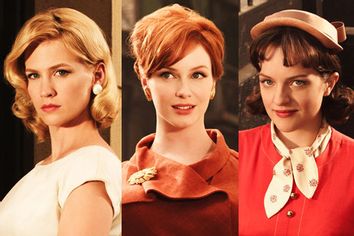
January Jones, Christina Hendricks and Elizabeth Moss on “Mad Men.”
One of the many joys of “Mad Men” is watching the female characters basically live out the dawn of modern feminism. Last night’s season premiere didn’t tell us too much about the three heroines at the show’s core — Betty is hugely pregnant, Peggy is still struggling for respect in the workplace and Joan is itching to bolt Sterling Cooper for wedded whatever — but we do finally know which time period they’ll be reenacting for the next three months: It appears to be late spring-early summer 1963, just months before the rupture that will tear through the country on Nov. 22, 1963. It’s a fertile time for women’s history: Betty Friedan’s “The Feminine Mystique” was published in February 1963, only days after Sylvia Plath took her own life. We asked the Broadsheet staff to prognosticate how history might intersect with fiction this season as well as what they hope for the characters — and fear.
Continue Reading CloseWho’s your favorite John Hughes heroine?
A round table on our favorites, from Molly Ringwald's misfit, misunderstood Andie to Ally Sheedy's defiant weirdo

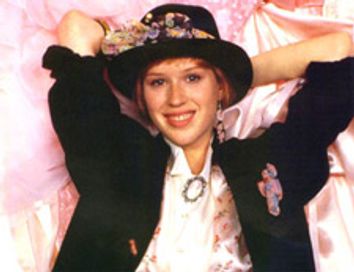
Molly Ringwald in “Pretty in Pink.”
The ’80s was an era defined by pristine, gleamy-toothed beauties like Cheryl Tiegs and Christie Brinkley, raspy bombshells like Kathleen Turner and Kelly McGillis. The decade’s sirens were slender and tall and fabulous and, more often than not, blond. And into that mix wandered Molly Ringwald. Bookish, pouty, peculiar in her prettiness. A redhead, no less. And with 1984′s “16 Candles” she became the poster girl of brushed-aside, crushed-out, pissed-upon teen girldom.
Continue Reading ClosePage 1 of 2 in Broadsheet Staff