Bryan Keefer

The blowhard next door

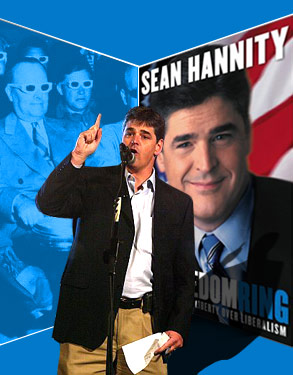
The boyish Sean Hannity seems poised to inherit Rush Limbaugh's mantle. And he isn't letting little things like facts get in his way to the top.

  • more
    • All Share Services

The blowhard next door

If you don’t already know who Sean Hannity is, you will. If you are already familiar with the ubiquitous conservative pundit, prepare to see a lot more of him. The 40-year-old co-host of Fox News’ “Hannity and Colmes” (as the conservative foil to liberal Alan Colmes) is a young, telegenic face in a graying-man’s game. His show is already the third-highest cable news show, trailing only Fox’s “O’Reilly Factor” and CNN’s “Larry King Live.” His radio show, which went into syndication late last year and airs in the crucial 3-to-6 p.m. “drive time” slot, draws 10 million listeners. And he seems poised to follow the gilded paths of Fox colleague Bill O’Reilly and, quite possibly, Rush Limbaugh, who has been the standard-bearing conservative spokesman for nearly two decades.

Eventually, Hannity will “be bigger than Limbaugh,” Michael Harrison, the publisher of the radio industry’s Talkers magazine, predicted to People magazine earlier this year. It’s not difficult to see why. While no less partisan, Hannity’s scrappy, boy-next-door delivery would seem to have a broader appeal than that of the more dour Limbaugh.

So now comes his next step. Following the multi-bestselling Limbaugh and O’Reilly, Hannity has decided to make the leap to print with his new book, “Let Freedom Ring.” The climate, it appears, could not be better. Already this year, Ann Coulter’s “Slander” and Michael Moore’s “Stupid White Men” have been runaway No. 1 bestsellers, proving that ink on paper is one foolproof way to break out as a partisan pundit. And sure enough, Hannity’s book, released just last week, has already made its way to the top of Amazon.com’s nonfiction bestseller list.

But in “Let Freedom Ring,” Hannity seems to be following another regrettable trend in modern punditry: Never let facts stand in the way of a good partisan screed. That was the dirty truth behind “Slander” and “Stupid White Men,” and Hannity continues it with his book, a poorly researched effort full of blatant falsehoods and highly distorted versions of the truth.

Early in the book, Hannity grants that the “vast majority of liberals are good, sincere, well-meaning people. They love their kids. They love their neighbors. I am sure most love their country.” The rest of “Let Freedom Ring,” however, is devoted to attacking liberals as a threat against America. Indeed, Hannity frames a war against liberals as part and parcel of the war against terrorism: “The Left may be sincere, but they’re sincerely wrong. And they must be challenged and defeated if we are to win this war on terror and preserve our way of life for this and future generations.”

But Hannity’s claims often stray into the realm of myth. He scores some points with his criticism of the outrageous rhetoric thrown by some liberal commentators, such as James Carville and Bob Herbert, but Hannity gets his facts wrong again and again, especially, and not surprisingly, when it comes to Democratic politicians.

Numerous lies abound, for instance, about former President Bill Clinton. Hannity cites an oft repeated lie that in a speech at Georgetown University, “Clinton seemingly blamed the vicious terrorist attacks on you and me and all Americans.” Citing a passage from the speech in which Clinton noted that Europeans and Americans had engaged in atrocious acts in the past, such as the Crusades and slavery, Hannity says Clinton is providing a “justification for radical Islamic terrorism” and an “apology for terrorism.” This criticism had a bold, but short-lived, life span last fall, when conservative critics leapt to attack Clinton based on a slanted article in the Washington Times before actually reading what he had said. The speech itself makes it clear that the former president didn’t note these historical events to excuse the attacks of Sept. 11 but merely to illustrate that killing innocent noncombatants has a long history. Other conservatives who picked up this tick had the class to correct their attacks with the truth. Now, 10 months after this myth was corrected, truth doesn’t seem to be much of a concern for Hannity.

“Let Freedom Ring” also accuses Clinton of “not effectively going after Osama Bin Laden” and suggests Clinton should have sent “a covert team over to the Middle East to take out Bin Laden.” But Clinton, of course, did attempt to kill bin Laden with a cruise missile attack in 1998 and authorized several other overt and covert measures targeting the terrorist leader. He just failed. But such a claim could also be made thus far against President George W. Bush.

Without citing a reference, Hannity also states on the first page of his chapter on taxes that “the tax burden on American families is at a record high, having skyrocketed during the Clinton-Gore years.” Hannity most likely arrived at this figure — and this is a guess; footnotes are irregular and sometimes incomplete — using deceptive calculations that simply divide total taxes collected by the government by the number of families. But the progressive nature of our income tax system means that the national tax burden is not evenly divided among families. Tax receipts naturally went up in the 1990s as the economy grew rapidly and more citizens were pushed into higher tax brackets. Yet a study from the left-leaning but well-respected Center on Budget and Policy Priorities found that the share of income paid in federal taxes by the middle 20 percent of families declined from 1995 to 2000, when it stood at its lowest level since 1979.

Hannity continues this faulty logic in repeating the canard spread by the Tax Foundation that, under Clinton, “tax freedom day” (the day when Americans have paid off their tax bill for the year) was pushed back from April 20 to May 1. Once again, this is a lazy use of averaging to make higher incomes (that is, more people moving into higher tax brackets) look like an increase in tax rates for average citizens.

In other cases, Hannity can’t even interpret the data from his own sources correctly. In a discussion of President Ronald Reagan’s economic policies, he claims that “had all of Reagan’s budgets been adopted federal spending would have been 25 percent less on a cumulative basis.” This statement is immediately followed by a chart, reproduced from a Web site that shows that the total difference between federal budgets enacted from 1982 through 1989 and those proposed by President Reagan was $197.3 billion, or 2.7 percent (the 25 percent number on the chart is based on a flawed method of compounding the difference between each year’s budget).

When discussing Democratic opposition to Bush’s tax cut, he accurately quotes House Minority Leader Dick Gephardt, D-Mo., who stated in April 2001 that “at a time when key indicators tell us that there is an economic slowdown, the president has sent a plan that ignores the needs of average Americans and provides a blueprint to fulfill a campaign promise to cut taxes first no matter what.” Amazingly, Hannity follows this quote with an accusation: “Can you believe these statements? Not even the most liberal of economists will argue for tax increases during a recession.”

Gephardt, however, didn’t argue for a tax increase in that quote — or in any others during the Bush tax-cut debate. This is a blatant distortion designed to equate opposition to Republican tax cuts with support for a tax increase. And in an attack that would certainly come as a shock to those who took part in the radical New Left movement of the ’60s, Hannity devotes eight pages to his contention that Senate Majority Leader Tom Daschle is “a New Left Democrat” and “arguably the most ideologically intransigent New Left liberal to ever serve in the Senate leadership.”

The New Left was, as Hannity himself admits earlier in the book, a radical movement that wanted to largely dismantle capitalism and the U.S. military. To back up his use of this label on Daschle, Hannity cites only a list of 10 votes over a 23-year career in which Daschle voted against increased defense spending and missile defense, against the Persian Gulf War, and for a nuclear freeze. One of the cuts Hannity cites Daschle voting for is a minuscule $329 million. Missing from the list, of course, are all of the defense budgets Daschle voted for, including this year’s, which included nearly $30 billion in increased spending — hardly the action of a New Left radical.

The lies continue in Hannity’s chapter on the environment, where he focuses on the dispute over the Arctic National Wildlife Refuge. He states that the U.S. Geological Survey said ANWR could yield up to 16 billion barrels of oil. But in March a Washington Post reporter interviewed a geologist at the USGS who said the total was closer to 3.2 billion barrels. Even the highest estimate given by Sen. Frank Murkowski, R-Alaska, during the congressional debates was 10.2 billion barrels.

But then, Hannity is repeatedly at odds with reality in this chapter, stating that ANWR oil would make the United States “far less dependent on foreign oil” and noting Teamsters president Jimmy Hoffa Jr.’s assertion that drilling would create 735,000 jobs. A Miami Herald article citing data from the USGS, the Department of Energy and the Congressional Research Service, however, stated that, at its peak, ANWR would produce less than 5 percent of daily U.S. oil consumption and create between 60,000 and 130,000 new jobs. Yet Hannity, in typical style, uses these falsehoods to make the broad claim that “it is difficult to point to another issue in modern American history where a major political party’s rhetoric is so divorced from reality.”

Distortions and lies are par for the course throughout “Let Freedom Ring” because, without them, Hannity wouldn’t be able to make the continual stream of over-the-top accusations against liberals: They “loathe and ravage so many of our core values and traditions”; they “told us global warming and gays in the military were top priorities, well above securing our nation”; and “after we defeat our last foreign enemy, we will still face threats to our freedom, largely from left-wing extremists in our own country.”

On “Hannity and Colmes,” Hannity often seems to roll over the timid Colmes with his bluster. When his words are frozen on the page, though, there is no disguising what they are: poorly argued propaganda.

With the 51-year-old Rush Limbaugh’s profile fading, and only the 53-year-old Bill O’Reilly (who doesn’t toe Limbaugh’s conservative line nearly as well as Hannity) equaling him in popularity, Hannity seems on the brink of becoming America’s leading conservative pundit. “Let Freedom Ring” is troubling evidence that Hannity won’t let a little thing like truth get in the way of his rapid ascent.

Cooking up a conspiracy

Bob Novak's phony conspiracy -- that Clinton "cooked the books" on the U.S. economy -- falls apart on scrutiny.

  • more
    • All Share Services

When the Commerce Department’s Bureau of Economic Analysis issued its revised estimates of corporate profits and economic growth for the past few years, prominent conservative commentators were quick to suggest that the Clinton administration had falsified the bureau’s earlier reports for political purposes. A look at the facts, however, shows they’re wrong.

BEA reported on July 31 that corporate profits for 1999 and 2000 were substantially lower than it had previously estimated. Since actual data from the Internal Revenue Service is typically not available for about a year and a half after it is filed, forecasters use other publicly available sources to make early estimates of corporate profits (the bureau’s methodology is also publicly available). For 1999 and 2000, data from the IRS indicated that corporate profits were much lower than BEA’s previous estimates, which had been based on overly optimistic projections. Given that both the data and the method used in calculating the estimates are entirely transparent, however, falsifying them for political purposes is virtually impossible.

Yet some commentators took those revised numbers to mean that the earlier estimates had been intentionally fabricated. Chicago Sun Times columnist and “Crossfire” co-host Robert Novak led the charge with a column on Aug. 8. Novak wrote: “Hidden in the morass of statistics, there is proof that the Clinton administration grossly overestimated the strength of the economy leading up to the 2000 election. Did the federal government join Enron and WorldCom in cooking the books?” Novak suggested later in the piece that “although a political motive for Democratic cooking of the government’s books is there, nobody — including Bush administration officials — alleges specific wrongdoing … Nevertheless, such discrepancy in earnings statements by corporate executives today would warrant a congressional subpoena.” Novak repeated the charge — and the insinuation of illegality — on CNN’s “Crossfire” that night, asking, “Was the Clinton administration cooking the books, or was it just incompetent bureaucrats? … The motive: Claim a fictitiously vibrant economy for Al Gore to run on. Private corporation executives who cooked the books that way are called to account, and may do the perp walk to prison.”

Rush Limbaugh also teed off on Clinton in an extended attack (Windows Media only) on his radio show Aug. 8, basing his charges on Novak’s column. Alleging that “Kenny Boy and Jeffrey Boy at Enron did nothing compared to Billy Boy and Al Gore,” Limbaugh suggested that “the state of the economy leading up to the election of 2000 was overstated by 30 percent by the Clinton-Gore campaign — they lied by 30 percent how strong the economy was.” Claiming that the data was intentionally falsified, Limbaugh suggested Clinton and Gore were “trying to steal control of the country by misreporting, out-and-out lying about the state of the economy going into the 2000 election cycle.”

Others also picked up the thread. While claiming that “I don’t believe in conspiracies,” Martin Hutchinson of United Press International wrote:”If this was a conspiracy, the liberal Democrat staffers in the [Bureau of Labor Statistics], the liberal Democrat staffers in the BEA, and Greenspan, heavily influenced by his liberal Democrat wife, would have engineered the statistics and monetary policy to make it seem like a fantastic and unprecedented boom had occurred in the late 1990s, ending around the time Bush was elected in November 2000 … But isn’t it strange that the above economic scenario appears to be exactly what’s happening. Must be a coincidence, of course …”

A Washington Times editorial on Aug. 12 used the same line, insinuating a conspiracy: “There is no evidence that Clintonistas infiltrated the BEA to produce these colossally false profit reports. At the same time, there can be no doubt that the supreme beneficiary of these conveniently timed false profit reports was none other than President Clinton’s designated successor: Al Gore.” The Times went even further, suggesting: “In hindsight, we now know, the falsely reported surging profits from the second half of 1998 through the first half of 2000 fueled the soaring stock market. This, in turn, generated wealth, which financed greater consumption. It also encouraged the massive over-investment, which, given the rapidly deteriorating economy evidenced by the downwardly revised growth figures for 2000, probably prevented the economy from falling into recession during a presidential election year.”

Yet as syndicated columnist Bruce Bartlett pointed out in an Op-Ed that ran in the Washington Times the next day, “Even if [Clinton and Gore] had wanted to do such a thing [falsify profit estimates], the way the data are constructed would have made it impossible to do so. Moreover, the Commerce Department’s data on profits have little, if any, impact on stock prices because they come out only with long lags. Also, the data are for the economy as a whole, not individual companies.”

Had Novak only researched the numbers before drawing his conclusions, this latest phony political conspiracy might have been avoided entirely.

Hungry for more Spinsanity? Click here.

Continue Reading Close

The patriot patrol strikes again!

Questioning a possible war with Iraq is equated with supporting Saddam.

  • more
    • All Share Services

With the invasion of Iraq under discussion, several commentators have made troubling first attempts to define opposition to a war as subversive and dangerous. The strategy directly echoes attacks on dissent in the wake of Sept. 11, questioning the patriotism and good faith of those who raise legitimate — and important — issues.

Leading the charge are two highly influential pundits: Andrew Sullivan and Rush Limbaugh. Last week, Sullivan vaguely suggested that articles in the New York Times and Los Angeles Times on the growing debate over invading Iraq and congressional hearings on the subject are part of a “campaign to protect Saddam’s weaponry.” He also suggested that such arguments opposing the war constitute “appeasement” of Saddam. This emotionally charged analogy to pre-World War II European policy toward Nazi Germany is too pat: Deciding not to invade Iraq is not obviously comparable to actively granting territory or other concessions in exchange for peace.

Limbaugh extended those allegations to their logical extreme last week, claiming [Windows Media Player audio] that “It is obvious now that the New York Times has launched an effort to thwart America’s war effort.” He continued by suggesting that, assuming the Pentagon is not intentionally leaking plans in an effort to deceive Saddam, “[The Times is] publishing detailed military options and plans under consideration by the Pentagon, which could end up harming or killing God knows how many young American soldiers. They’re giving aid and comfort to our enemies.” Of the Times’ sources, Limbaugh commented, “I know we have a bunch of traitorous types in the State Department, but I never thought they existed at the Pentagon.”

A close, and much nastier, cousin of this argument is the suggestion that Democrats want a war in Iraq — but want it to fail in order to harm Bush politically. Frank Gaffney, a syndicated columnist and president of the Center for Security Policy, made exactly this point on CNN’s “Crossfire” last week, suggesting in response to a question about leaks of potential attack plans, “I suppose it’s because there are people who want the president’s policy to fail in Iraq, and who keep leaking this information.” [emphasis added] National Review’s Rob Long makes a similar suggestion in the Aug. 12 issue, writing in a fictitious diary entry by Sen. Chris Dodd, D-Conn., that “some kind of quagmire in Iraq, with tens of thousands of American casualties and international scorn, is just not something I can really count on, unfortunately.”

Attacking the patriotism and motivations of those who question aspects of the war on terrorism has been an all too common tactic since Sept. 11. It has also been devastatingly effective at quieting dissent. One can only hope that the debate over whether and how to invade Iraq is not truncated by the same kind of chilling rhetoric.

Hungry for more Spinsanity? Click here.

Continue Reading Close

Throwing the book at her

The bias Ann Coulter documents best may be her own.

  • more
    • All Share Services

The rise of Ann Coulter’s new book, “Slander: Liberal Lies About the American Right,” to the top of the New York Times bestseller list may be a shock to some, but the controversial pundit’s scathing rhetoric and outspoken conservatism have helped position her as exactly the sort of figure who sells books. More polemic than argument, “Slander” is riddled with factual errors, egregious misrepresentations and a constant stream of broad, inflammatory claims about liberals, as numerous critics have been quick to point out. Yet despite the limits of her one-sided argument, she actually offers a troubling lament for the state of our political discourse — even as she contributes to its decline.

Coulter began her career as a pundit during the investigation and impeachment of former President Bill Clinton. An attorney, Coulter aided Paula Jones with her legal case and later wrote a book on Clinton titled “High Crimes and Misdemeanors.” Since then, she has written a syndicated column and made frequent television appearances.

Coulter is self-consciously inflammatory. As she told the Sunday Times of London recently, “I am a polemicist. I am perfectly frank about that. I like to stir up the pot. I don’t pretend to be impartial or balanced, as broadcasters do.” It is exactly that kind of invective which has earned her so much publicity.

“Slander” has already come in for heavy criticism over her factual errors and distortions. Throughout the book, for example, she relies heavily on quantitative searches of the Lexis-Nexis news database to support her assertions about the media’s bias and its unfair treatment of conservatives, making at least 15 such claims. At first blush, these bits of evidence seem to provide strong support to her arguments. Yet very serious questions have been raised about her methodology. <p

The American Prospect’s weblog, Tapped, noted that Coulter’s claim that “Between 1995 and 2001, the New York Times alone ran more than one hundred articles on ‘Selma’ alone” is demonstrably false. Tapped also reported the inaccuracy of her claim that “In the New York Times archives, ‘moderate Republican’ has been used 168 times,” while “There have been only 11 sightings of a ‘liberal Republican.’” But a search in the New York Times’ own archive found 22 hits for “liberal Republican” since 1996; in a search of the Times archives for “all available dates” in Lexis-Nexis, the weblog found 524 such citations.

Bob Somerby punctured Coulter’s argument that the New York Times reveals a liberal bias by having used the phrases “Christian conservatives” or “religious right” 187 times during, roughly, the 2000 calendar year, while never using the phrases “atheist liberals” or “the atheist left.” Somerby found that the New York Times compared favorably with the conservative Washington Times, which had 151 references to “Christian conservatives” or the “religious right” in 2000 — along with, of course, no references to “atheist liberals” or “the atheist left.”

Coulter also repeats several well-debunked myths in her book. Particularly striking is her relentless repetition of the claim that former Vice President Al Gore falsely suggested that he was the inspiration for the book “Love Story” — a claim Coulter makes four separate times. As Robert Parry noted in an article in the Washington Monthly, author Erich Segal told the New York Times in a Dec. 14, 1997, article that Gore was indeed part of the inspiration for the main character in the novel. Gore did mistakenly say that the character of Jenny had been based on his wife Tipper, but he based this comment on an incorrect report in the Nashville Tennessean.

Another favorite tactics of Coulter’s is the use of deceptive paraphrases to distort others’ viewpoints. Blogger Scoobie Davis has noted that Coulter misrepresents the views of Frank Rich and Bruce Ackerman on the war on terrorism. Early in the book, Coulter writes that “New York Times columnist Frank Rich demanded that [Attorney General John] Ashcroft stop monkeying around with Muslim terrorists and concentrate on anti-abortion extremists.” The column that she cites, however, makes no such argument. Coulter also writes that “Yale law professor Bruce Ackerman recommended dropping the war against global terrorism (‘declare war at the first decent opportunity’!) and instead concentrate on ‘home-grown extremists.’” Yet Ackerman’s column suggests a cautious approach to a global war on terrorism, not “dropping” it, and nowhere does he advocate concentrating on domestic terrorists instead of international terrorists. Coulter’s paraphrases are both wild distortions.

Another problem plaguing “Slander” is the deceptive way Coulter uses footnotes to lend a false sense of legitimacy to questionable points. To take one example, in her discussion of media treatment of former Sen. Bob Packwood, R-Ore., she provides a list of 10 quotes alternating between positive coverage prior to his political demise following allegations of sexual harassment, and negative coverage afterward. Coulter introduces the list with the claim that “What happened to Packwood is a stunning example of the media’s power both to destroy and protect … In the case of Packwood, the media’s good dog/bad dog descriptions were applied to the exact same human being.”

To the casual reader, the list must seem fairly damning. Yet if one flips to the back of the book and checks her sources, it turns out that her claim about “the media” rests on a very small sample. Rather than the 10 different articles the casual reader would assume Coulter is quoting, she relies on one article for four of the five negative quotes, a second for three of the five positive quotes, and a third for the other two positive quotes. In all, the list comes down to four articles — thin evidence at best for the broad suggestion that coverage of Packwood proves “[t]here is no intellectual honesty whatsoever in media descriptions of politicians,” which she makes two paragraphs later.

Coulter’s use of quotes from liberal commentators as proof of media bias is equally problematic. She disregards the importance of conservative commentators, by writing, for example, “Rush Limbaugh is not the president, the vice president, or a Massachusetts senator. He’s not the New York Times. He’s not ABC, NBC, or CBS.” Coulter also tells us that “What conservatives object to is not liberal opinion commentary, but rather ostensibly objective news coated with smears.” Yet much of her evidence for media bias and unfair attacks on conservatives comes from the opinion columns of liberal pundits. Particularly damaging is the way in which she bases broad comments about “the media” in at least two places exclusively on opinion columns. Writing that “the media quickly sketched out the larger themes” about Bush’s intelligence, she cites the Kansas City Star’s Steve Kraske and the New York Times’ Maureen Dowd and Thomas Friedman to support the contention that the media portrayed George W. Bush as dumb — all of whom are columnists.

In all, Coulter offers more than 40 citations of columnists and pundits to support her assertion that conservatives are treated unfairly by the mainstream media. Though most of these quotes are identified as coming from commentators, and some of her examples are certainly outrageous, the danger is that the casual reader may interpret many of these as evidence of reportorial bias. If read carefully, however, much of her evidence reveals little more than then banal fact that liberal pundits and the New York Times editorial page are critical and often unfairly dismissive of conservatives and their policies. Using Coulter’s methodology, one could easily string together quotes from conservative pundits and Op-Ed pages to make the case that the media treats liberals unfairly, rather than conservatives.

In addition to her troubles with facts, Coulter also engages in what my co-editor Brendan Nyhan has called “some of the most consistently emotional, subrational jargon in national politics.” Throughout “Slander,” she uses what Nyhan identifies as her three favorite tactics: various names and issues used solely to rile her readers’ emotions; vicious, sweeping attacks on “liberals”; and loaded language and nasty insinuations disguised as rational arguments. Former President Bill Clinton comes in for some of the harshest treatment; she refers to the “pizza boxes, women’s panties, and other detritus of the Caligula administration,” describes his “adolescent cramming in all-night slumber parties, leaving the place littered with pizza rinds and women’s panties” and refers to him as “IMPOTUS” and “the felon.” Coulter even uses “clintonized” as an adjective without a capital letter, genericizing the name into an attack as others have done. Nor is she above simple name-calling, referring to Katie Couric as “the affable Eva Braun of morning TV” and referring to Tom Rosenstiel of the Committee of Concerned Journalists as “Concern Propagandist Rosenstiel.”

Coulter also pummels nonsensical straw-man caricatures of political opponents throughout the book. Most obvious and striking is her treatment of “liberals.” Without ever bothering to define exactly who she intends the term to include (at various points it includes Andrew Sullivan and Republican-turned-Independent Sen. Jim Jeffords, R-Vt.), she makes sweeping judgments:

“Even Islamic terrorists don’t hate America like liberals do.”
“[T]he left is itching to silence conservatives once and for all.”
“[I]f Americans knew what they [liberals] really believed, the public would boil them in oil.”
“”Principle is nothing to liberals. Winning is everything.”

Of course, in Coulter’s asymmetrical political world, conservatives are universally good:

“[A]lmost all serious debate takes place exclusively among conservatives.”
“[C]onservatives in America are the most tolerant (and long-suffering) people in America.”
“[W]hen right-wingers rant, there’s at least a point: There are substantive arguments contained in conservative name-calling.”

Coulter’s style of argument is often based on jargon and invective rather than substance. Consider this dismissal of claims of conservative bias in the media:

“A ‘study’ analyzing the New York Times’s coverage of the 2000 presidential race conclusively proved that ‘this “liberal bastion” published 50 percent more anti-Gore articles than anti-Bush, and nearly twice as many pro-Bush article as pro-Gore.’ Claims of ‘conservative bias’ in the media at large are amusing oddities. But a claim that the New York Times has a conservative bias can be explained only by the sheer joy liberals take in telling lies. This is how liberals flaunt their massive control over news in America. The fact that everyone knows they are lying is part of the fun. They take insolent pleasure in saying absurd things, like college radicals giving revolutionary speeches at their parents’ dinner table: We will raid their wine cellars and have their women!”

Nowhere does Coulter engage the actual substance of the study. Instead, she places key words in quotation marks (“study,” “conservative bias”) to make them appear to be untrue, and makes reference to broad stereotypes of liberals. Finally, she rams home the suggestion that liberals lie by repeating it twice, then coining a jargon phrase (“We will raid their wine cellars …”) which she repeats later in the book. None of this has anything to do with whether or not the New York Times ran more stories that were critical of Bush or critical of Gore; it has everything to do with appealing to preconceived notions about the media — notions Coulter herself has helped to construct.

Yet if readers can leave aside all of these problems (admittedly not an easy task), Coulter is actually driving at something important about the state of political debate in the media. She’s right, for example, that left-leaning politicians and editorial pages sometimes mount sophisticated and unfair rhetorical campaigns against their political enemies. The example she chooses — attacks against former Speaker of the House Newt Gingrich and his policies — is exactly on point. She also chooses other examples to good effect, such as Rep. Charlie Rangel’s equation of Gingrich’s policies with those of Nazi Germany. Absurdly, though, she steadfastly refuses to admit that conservatives can be guilty of exactly the same thing — an asymmetry so glaring that only the most partisan readers can accept it at face value.

A surprising amount of what Coulter has to say about the conduct of contemporary political debate rings true. “Instead of actual debate about ideas and issues with real consequences,” Coulter writes, “the country is trapped in a political discourse that increasingly resembles professional wrestling.” Likewise, she derides “arguments by demonization” and argues that “[l]ies and personal attacks are deeply corrosive of public debate and democratic compromises.” She correctly observes that perceptions and falsehoods promulgated in the media have a self-reinforcing quality: “Cliches, biases and outright lies are constantly reinforced through the media echo chamber.” But given how she herself uses these tactics throughout the book, even Coulter’s more astute observations raise obvious charges of hypocrisy.

Yet “Slander’s” sales, alongside those of Coulter’s political opposite, Michael Moore, reveal something sad and important about the state of the country: Those with a talent for inflammatory rhetoric rather than facts have their fingers on the pulse of contemporary political debate.

Continue Reading Close

Do as I say

Crybaby Republicans on judicial holdups: It's not fair!

  • more
    • All Share Services

The GOP staged a number of events last week designed to pressure Senate Democrats to confirm President Bush’s judicial nominations. In the process, it highlighted how the battle over judicial nominees has shifted from considering the records of the nominees to controlling perceptions of the confirmation process. Conservatives hope that by framing the debate in terms of “fairness” and asserting that “Tom Daschle and the Democrats are not letting the Senate work,” as Senate Minority Whip Don Nickles did Sunday on Fox News, they can force Democrats to ease their opposition to some of Bush’s nominees.

But coming from Republicans — who used similar tactics against President Clinton during his two terms — the charge lacks the righteousness needed to be anything more than a transparent P.R. tactic.

The intensity of the battle has been building steadily since Democrats took control of the Senate last May. It reached a new plane in March, when Democrats on the Senate Judiciary Committee scuttled the nomination of Charles Pickering for the 5th Circuit Court of Appeals along party lines and after a protracted battle between partisan interest groups. On Thursday, Senate Republicans aggressively pushed the line that the battle over judicial nominations was about simple fairness. Observing the one-year anniversary of Bush’s first 11 judicial nominations, Sen. Trent Lott, R-Miss., suggested that giving hearings to Bush’s nominees was “a matter of simple fairness, and I think the American people understand that justice delayed is justice denied.” Sen. Jon Kyl, R-Ariz., echoed that sentiment in a press conference, claiming, “It’s time that the Democratic majority play fair with the president, play fair with the American people, and play fair with these nominees and give them a hearing.”

Fairness, however, is a matter of interpretation. Republicans complain that the Senate has confirmed a lower percentage of Bush’s nominees (just over half) than it did under Clinton (60 percent) in the same time period, and note that eight of Bush’s first 11 nominees have yet to receive hearings. Democrats counter that they have confirmed 52 nominees, more than the Republican-controlled Senate did under Clinton in 2000, 1999, 1997 or 1996. As Ron Brownstein points out, both sides can make substantive arguments. The relative fairness of the Democrats’ treatment of Bush’s nominees depends on how you decide to slice the numbers.

Republicans have also contended, repeatedly, that there are too many vacancies on the federal bench. Bush suggested Thursday that “we have a vacancy crisis in America. There are too many seats that aren’t filled with judges, and, therefore, America hurts, America is not getting the justice it needs.” Sen. Orrin Hatch, R-Utah, also suggested in a press conference that the 84 current federal vacancies represent “a crisis in our federal courts,” and Sandy Rios, president of the conservative group Concerned Women for America said, “The Senate Democrats claim to protect justice, but their own refusal to schedule hearings for qualified nominees is a treacherous twisting of the rules of the game.” Yet those charges are also matters of political expediency. When Clinton suggested there was a vacancy crisis in 1999 (when there were 67 federal vacancies, just 17 fewer than now), Hatch, then chairman of the Senate Judiciary Committee, was quick to dismiss the complaint.

Other rhetoric has been less ambiguously deceptive. One particularly popular tactic, employed on Thursday by both sides, is to try to identify the other side as extremists or ideologues. Writing in the Washington Times, Thomas L. Jipping suggested that the “far-left troops” of Ralph Neas of the People for the American Way “are fighting for a judiciary that will impose his political agenda rather than follow the law.” American Conservative Union (ACU) chairman David A. Keene claimed in a press release that “America suffered through the extreme left’s misrepresentations, distortions, and lies as Judge Charles W. Pickering of Mississippi … was subjected to intentional misstatements by left-wing fringe groups and their Senate Democrat allies, simply because he is Conservative.”

On the other side of the aisle, Sen. Patrick Leahy, D-Vt., framed Bush’s nominees in the same way, claiming that “the President, at an earlier period, said he wanted to be [a] uniter and not a divider. But he has sent the Senate several nominees who divide Americans and who divide the Senate, and those nominations will take longer.” Sen. Chuck Schumer, D-N.Y., struck the same chord: “Nominate ideologues willing to sacrifice the interests of many to serve the interests of a narrow few, and you’ll have a fight on your hands. It’s that simple.” All of this is simply an attempt to define the terms of the debate by defining one’s opponents, rather than engaging on a productive level.

But the key charge is one of obstructionism. ACU’s Keene made reference to “the obstructionist tactics of Democrat Senate Majority Leader Tom Daschle and Democrat Senate Judiciary Chairman Pat Leahy” and claimed that they, “in concert with the other Democrat members of the Senate Judiciary Committee, have conspired to thwart the Senate from performing its Constitutional duty to provide ‘advise [sic] and consent’ to the judicial nominations of the President of the United States.” Nickles wrote in an op-ed on Monday that the Democrats are indulging in “controlled foot-dragging” and “organized stonewalling.”

Meanwhile, Nan Aron of the liberal Alliance for Justice reversed the charge, claiming that “after years of obstructing President Clinton’s judicial nominees, some Republicans are now threatening to shut down the Senate simply for doing its job — carefully scrutinizing all candidates for these prestigious lifetime positions.”

Republicans seem intent on continuing this campaign to paint themselves as the partisan victims of a Democratic Senate intent on holding up conservative nominations. The problem they have in gaining any sympathy, however, is their inability to show that they behaved any better in the past.

Hungry for more Spinsanity? Click here.

Continue Reading Close

Sticks and stones

Liberal name-callers have a new favorite catchphrase: The "Enron conservative."

  • more
    • All Share Services

Though the Enron controversy has largely faded from the front pages, some liberal activists are doing their best to exploit the scandal in a novel way. Hoping to leverage the negative associations carried by the company’s name — corporate greed, questionable political favors, disappearing retirement savings for workers — activists have coined the term “Enron conservatives” in an effort to discredit conservative policies. Though this phrase is just the latest in a long line of Enron-related rhetoric, it is especially notable because it is being so aggressively marketed as a potential campaign 2002 slogan by a single individual: Robert Borosage of the Campaign for America’s Future (CAF).

Campaign for America’s Future is an influential liberal interest group that counts among its founders a number of prominent liberals, including AFL-CIO president John Sweeney, Clinton labor secretary Robert Reich, Jesse Jackson and economist James K. Galbraith. (Disclosure: Andrew Stern, president of SEIU, is also a founding member of CAF; I am currently employed as a researcher for SEIU.) Its latest conference featured a similar lineup of heavy hitters, including House Minority Leader Dick Gephardt, D-Mo., House Minority Whip Nancy Pelosi, D-Calif., and Sen. John Edwards, D-N.C. When Borosage speaks, he has the ear of the liberal establishment. Borosage has a history of pushing cheap associations between the Enron scandal and conservative policies. In a Jan. 30 article, he suggested that “the Republican House passed an Enron stimulus package,” and he claimed that President Bush’s energy package was an “Enron energy plan.” The idea, as Democratic National Committee spokeswoman Jennifer Palmieri put it, is that Enron is a shorthand way of suggesting that Bush “cooks the books, uses rosy economic scenarios and doesn’t worry enough about the human side of the ledger … It was so hard to explain it before. Now you can explain it.”

“Enron conservatives,” the latest variation on the Enron theme, was coined in early January by Salon columnist Arianna Huffington. Huffington suggested that “during his run for the White House, Bush fought long and hard to convince us that he was a new breed of conservative — a compassionate conservative. But recent events make clear that he is actually the standard bearer of a far more coldhearted breed. Call them the Enron conservatives.” Huffington continued with an explicit definition of this new bit of jargon: “Enron conservatives are people who use political money and connections as levers to free themselves of all accountability to laws, regulations and responsibility — even to their own employees. Simply put, they are people who consistently, shamelessly and aggressively put their self-interest above the public interest.” The juxtaposition of “compassionate conservative” and “Enron conservative” is rhetorical counterspin at its finest, breaking the association between conservatives and “compassion” and replacing it with the far more sinister “Enron.”

Borosage used the new slogan in an article titled “Enron Conservatives” published in the Feb. 4 issue of the Nation. He picks up right where Huffington left off: “It is Enron’s rise that lays bare the hypocrisy of modern conservatives — call them Enron conservatives. Enron conservatives fly the flag of free markets but actually use political and financial clout to free themselves from accountability, rig the market and then use their position to ravage consumers, investors and employees. These are not the small-is-beautiful compassionate conservatives George Bush advertised in the election campaign … Enron conservatives make the rules to benefit themselves.”

He continues with a series of sound bites that, taken together, read like political talking points: “Enron conservatives prefer plunder to production,” “Enron conservatives in Congress passed the President’s tax cut,” “The leading Enron conservative is W. himself,” “Enron conservatives don’t violate the rules; they change the rules to suit themselves” and “Enron conservatives don’t see why corporate lawlessness should get in the way of government largesse.” Clearly, he intends the catchphrase as a way of defining conservatives and attacking the policies they favor.

Borosage has publicized the term with zeal. In a March debate sponsored by the American Prospect, he repeated part of his Nation article almost word for word, claiming that “[t]he adherents to this ideology, let us call them Enron conservatives, are different than traditional Tory conservatives who believe in flag and family. They are different than compassionate conservatives who care about community or charity.” Once again, Borosage is attempting to break the associations between conservatives and positive values such as “family” and “community.” In his closing remarks, he further complained that “the Enron conservatives who are flying this banner of free markets are using political clout to create rules to rig the rules so they can profit,” and called for “getting rid of the Enron conservatives in office.”

With his latest use of the term, Borosage has broadened the rhetorical attack to include issues such as education that are completely unrelated to the Enron scandal. In an April 11 speech (16K PDF) to a conference sponsored by Campaign for America’s Future he used the term 13 times. Framing current policy debates as “a choice between progressive reform and Enron conservatism,” Borosage presented a number of false dichotomies designed to frame large social issues as “Enron conservatives” vs. liberal policy prescriptions. Asking his listeners to “put the case to the American people,” Bosrosage suggested a number of slogans: “Invest in education or let Enron conservatives starve even the reforms they celebrated last year,” “Launch a drive for energy independence … or let Enron conservatives push their Big Oil energy plan,” “Make worker rights and environmental protection central to our trade accords or let Enron conservatives foster a global race to the bottom” and “Political reform to get big money out of politics … or let Enron conservatives continue a politics where private interests dominate our public life.”

With the term “Enron conservatives,” Borosage is articulating an aggressive liberal public relations strategy for the November elections that is remarkably similar to the one pioneered by Newt Gingrich’s political action committee (GOPAC) in the early 1990s. GOPAC focus-tested individual words, then circulated memos advising congressional Republicans on word choice. Recommended words to provide maximum negative contrast included “destroy,” “sick,” “pathetic,” “liberal,” “waste,” “corruption” and “greed.” Positive contrast words included “opportunity,” “moral,” “courage,” “principle,” “dream” and “freedom.” Many liberals were quick to criticize these tactics when Gingrich used them. Now at least some are openly embracing them. Hungry for more Spinsanity? Click here.

Continue Reading Close

Page 1 of 2 in Bryan Keefer