Carolyn Magner

When they were bad

My daughter is exiled and we suffer a season in hell.

  • more
    • All Share Services

When they were bad

This time last year, my happy, friendly seventh-grade daughter was voted off the island. The stars aligned, the dice rolled, the ballots were cast and she was “it.” She went from being a member of the “in crowd” to becoming its designated exile. She was talked about, hated, despised, not invited, ridiculed but mostly, most cruelly, ignored.

“I don’t exist,” she explained to me softly.

“Why?” I yelled to the heavens. “Why you? Why me, the mother of you? What have we done?”

I found out about the smear campaign when I read a batch of saved e-mails my daughter left open on the family computer. She’d never done that before, so I figured she wanted me to read them. She did and I did and it hurt. The electronic missives went beyond mean to breathtakingly evil and they were attached to extensive buddy lists. It seemed that everyone knew about this except me.

I should have known. The phone never rang anymore, my daughter’s grades were dropping and she had a hard time getting up in the morning. I constantly asked what was up. Finally, e-mails in hand, I asked again, “Are the girls mad at you?” She stared at me with old, sad eyes and said, “Yes.”

What to do? Press for information? Sympathize? Call the mothers? Or do I do what I want to do and murder a bunch of girls for being spiteful adolescents?

Sound bitter? Well, I was a girl once. I survived — just barely — being left out of a chick clique. I know that sisterhood can suck. Plus, I’ve read Margaret Atwood’s “Cat’s Eye” and Mary Pipher’s “Reviving Ophelia,” and I know that raising girls is not for the fainthearted. But even an educated veteran of girlie bullying doesn’t think it’s going to happen to her daughter. And when it does, she realizes that the only thing to do is hope, pray and stick pins in dolls — whatever gets you through.

I sought counsel from a wise and crusty high school teacher who advised that I stay out of it, adding, “What doesn’t kill her, makes her stronger.” OK, but what if it did kill her? It crossed my mind more than once when I couldn’t wake my daughter in the morning. My heart racing, I would bend over to feel her morning breath on my cheek until finally her eyes would open and she’d begin telling me all the reasons she couldn’t go to school.

The car pool line was the worst part of the day. I would pull up to see my daughter standing alone on the curb, scanning cars with wounded eyes. The rest of the girls huddled a regulation 10 feet behind her. Every time one of them climbed into a car, the rest would wave goodbye, making phone call hand signals and typing motions signifying, “Call me, e-mail me, we’ll get right back on it as soon as we get home.”

My daughter would walk slowly to our car, a tight smile glued on her face. She’d get in, lock the doors and turn her body toward the window. Then she would cry great gulping sobs of despair and misery and hopelessness. Sometimes, I’d want to laugh, sputtering something like, “Oh baby, if you think this is bad …” Mostly I’d grip the steering wheel in cold, white rage.

I gave it a month. I promised my daughter that the clique would wear itself out by Thanksgiving. I was wrong. Fueled by e-mail and instant messages, the campaign intensified and the fall semester crept by in excrutiating real time. My daughter’s transgressions were never completely defined. She’d beg for explanations: “Am I mean? Am I ugly? Did I say or do something wrong?” But there was never an answer. Her tormentors would roll their eyes and sigh as if to say: “If you don’t know, then you are more dense than we thought.”

Even the fringe girls, those not quite in the clique, started avoiding my daughter. Under strict orders from the reigning queens to not speak to, look at or, God help you, sit near the victim, they complied until finally, the cheese stood alone.

I find myself in a group of can-do moms, who tend to make things happen — and stop happening. I’ve watched them storm into the principal’s office demanding different teachers and disputing grades. I’ve had mothers try to enlist me in various fix-it campaigns, from banning science projects to changing reading programs. I have declined to participate, mostly because I’ve always been afraid to tempt the fates. So I don’t interfere. I never call other mothers or make appointments with principals. I try to stay out of my children’s quarrels and petty grievances. I don’t believe in fixing science projects any more than I believe in fixing problems. And, while I would have tried anything during this debacle, I didn’t want to make things worse.

My husband, meanwhile, couldn’t get over it: “Why do they do this?” he demanded again and again. “Because it gives them power, sickening, glorious, intoxicating power over another human being,” I would say. “They don’t think she’s really suffering. They don’t imagine her pain. They are just damn glad it’s not them and so they participate. They instigate. They fuel the fire, fan the flames and all of it bonds them closer. Sometimes they are sickened by it, their conscience aches and they put themselves in the victim’s Nikes. Eventually, they convince themselves she deserves it. And ultimately, they are terrified of becoming the next victim. So, they do what they have to.”

I couldn’t determine who was the queen. I’d pick one and then it would be another one who was uncommonly cruel that day. I kept thinking it would end. It didn’t. I lectured constantly: “When you come out of this, you won’t be the same. You will never participate in this kind of thing. You will be stronger, you will be tougher, you will be nicer to those less smart, pretty and talented than you.” She’d nod but I know she didn’t believe me. Heck, I didn’t believe me.

I read up on warning signals of teenage depression. I went into chat rooms where teens poured out their angst and suggested ways to kill themselves. I locked up the booze, threw out prescription medications, made sure she ate, watched to see if she swallowed, followed her to the bathroom. I slowly lost myself. I avoided friends, didn’t go to parties and suffered along with her. How long could it last? How long could welast?

I bargained with God. I told him I’d go to church more, pray harder and keep more commandments if he’d take this from her. I blamed myself. I hadn’t hosted enough sleepovers. I didn’t play tennis with the other mothers. I didn’t go out to lunch with the ladies. I worked too much. I wasn’t a popular mother.

There were kindnesses along the way. Random phone calls from other mothers. One friend sent a plant with a note saying, “By the time this blooms, it will be over.” Childhood friends from the other school in town started dropping by, calling. A track coach asked her to run for the team. A school guidance counselor asked her to volunteer at a crisis center, filing papers and making coffee. I was pitifully grateful for each of them. A truism struck home with staggering force: “You find out who your friends are.”

These gestures provided the first rays of light in a long, dark stretch. Volunteer work gave my daughter something to focus on other than her own misery; track made her part of a team. Old friends provided evidence that she was not unlovable.

The holidays arrived and things were less than merry. My daughter didn’t get invited to Christmas parties; her name wasn’t on any gift swap lists. She stayed close to my side, rarely venturing out. We both thought the spring semester would be better; but just in case, we started talking about switching schools, even though she’d been at this one for less than nine months.

We had made the decision to try private school after sixth grade, mostly because the public middle school was plagued with problems related to overcrowding and discipline. My daughter had lots of friends at the private school; they were in dance together and played softball in the same league. The plan was to enjoy these friendships at school, along with small classes and more athletic opportunities.

And the transfer worked like a charm. My daughter had a tight group of friends upon arrival at the private school — they picked up where they left off during the summer. But when she was arbitrarily exiled a couple of months into the school year, it occured to me, as I wrote the spring tuition check, that I was paying big bucks for this horror show.

My daughter started spending time with girls from the other school. I started to go out some, see old friends, have dates with my husband. Life started to feel a little more normal, less of an ordeal. My daughter started to lose her black circles and haunted look. I stopped waking in the night. The season of hell began to run its course, like a bad case of the flu. But none of us were unscathed. Not my daughter, not me and not the perps.

Finally, despite the signs of ditente, my daughter decide to quit the private school and go to the public school. The decision gave her something to hold on to, something to negate the feelings of hopelessness. An end was in sight. All of the messy social and economic issues dogging the public schools seemed puny compared to the ugly motives behind the private school freeze-out. I worried briefly that changing schools was a cowardly quick fix, but the decision felt right as soon as we made it.

Strangely, the girls were shocked by my daughter’s decision to flee. Prompted by teachers and parents, they tentatively asked her why she was leaving. Nobody thought it had gone as far as it had. My daughter had done the stoic thing — held her head high and kept her tears in check. Her response to their bizarre expressions of concern was equally calm: “I’m outta here,” she said. “I’m leaving you to torture each other.”

A year later, my daughter’s life is entirely different. She is happy and busy with friends, school work and activities. One of the former torturers is now being tortured. She calls my daughter and cries mournfully. I watch, fascinated, as my daughter murmurs sympathy, invites this onetime foe to spend the night, offers her a shoulder to cry on. How can she forgive so easily? Or was forgiveness the most valuable lesson? Perhaps, like the teacher so strangely predicted, it ends up being a good thing, something that makes her tougher, better, stronger in the long run.

I know I’m different. Not tougher, not stronger but changed somehow. It has finally sunk in. There is no immunization against hurt. There is no protection against cruelty. For all the things I can do for her, saving my daughter from life’s hard twists is not one of them. Tough lesson all the way around.

Furthermore, if it’s really the worst thing that ever happens to her, she’ll indeed be lucky.

Bosom buddies

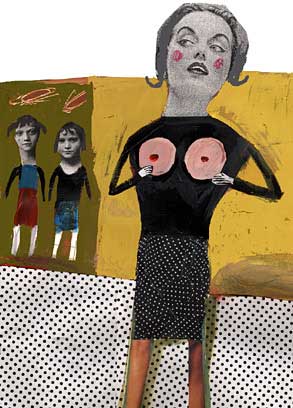
I wanted a new pair of boobs. But how would I tell my daughters that their Barbie-bashing mom wants to look just like her?

  • more
    • All Share Services

Bosom buddies

I have always been flat-chested. It didn’t used to bother me. I was always more gamine than beach bimbo, more Audrey Hepburn than Pamela Anderson, anyway. But I do live in a “Baywatch” kind of town, and eventually, I started to realize that there was a reason that those who were stacked attracted more attention in their bikinis.

Two very prominent reasons, in fact.

So, last spring, I started tossing around the idea of getting a boob job.

I consulted with my friends, family, husband and colleagues. I debated the issue with surgically enhanced feminists and flat-chested soccer moms.

But the two most important opinions were those of my 10- and 14-year-old daughters. Sure, it was my life and my decision, but they were at that impressionable age and I didn’t want to give them the wrong impression.

I’ve always told my daughters that real feminism means the freedom to make your own choices. But I’ve also always been a Barbie-basher, and I am known for my fierce lectures during which I rip up fashion magazines, rant against Madison Avenue and preach the joy of accepting one’s body just the way it is.

What to do? Can you be a good mother and a hypocrite at the same time?

Surgically enhanced mothers of young daughters tell me they struggled with the same issues but went ahead and had the procedure done anyway. Martyr mothers, my least favorite category of moms, said it would ruin my daughters for life and cause them to suffer from anorexia, low self-esteem and promiscuity.

Sigh. Surely I could wrest a decision from somewhere in the middle?

Why did I want big boobs, anyway? Was it a midlife crisis? I don’t think so. I’ve been married to the same guy for 18 years and we have hot, frequent, innovative sex. Being a smart guy (as well as politic), he declared membership in the good-legs, tight-butt club years ago, assuring me that big, bouncy breasts were somewhat distasteful to him. His prepared statement on the boob question: “Do whatever you want to do. I’m behind any decision you make.”

But then, on Valentine’s Day, he casually dropped a bonus check into a card. “New boobs. Get them if you want them,” he said.

I leapt out of bed, eyes blazing. “You want me to get them, don’t you? I knew it!”

I turned to my next source of male opinion, married guys. After all, these are the only kind of guys I know and I needed some unbiased opinions.

A smooth-talking attorney friend was the first to throw a cloud of doubt on the venture. This guy loves to ogle big-breasted women. We can’t stroll down the beach without him asking every few seconds, “Are those real? Come on, they are real. Tell me, are they real?”

And I patiently point out, pair after perky pair, “Nope, they are not real. Trust me.”

When I mentioned I might buy myself a pair of bosom buddies, he put his drink down and stared at me, completely shocked.

“No, no, no!” he protested, coughing, sputtering. “Not you. You are the least likely person to ever do something like that. You are,” he sucked in his breath, concentrating hard to find the right words, “you are so, so, anti-cheesy.”

Argggh, the cheese factor. It’s what I’ve been dancing around the whole time. I’ve seen those women with athletic, svelte bodies who are suddenly wrecked by highflying, tall-standing, hard-looking boobs. As out of place as a hooker at an ordination.

He had zeroed right in on my deepest weakness, the fear of being cheesy. I can’t bear the sight of blond hair with black roots, tanning-bed tans, cheap white shoes, blue eye shadow, TransAms, acrylic nails, lipstick on teeth, thongs and big hair. Not only would I be sending my daughters to the streets, but I would look the part when I bailed them out of jail.

Although I wasn’t any closer to making a decision, I made an appointment with the plastic surgeon to talk things over. He was dry, factual and businesslike, and said I had to get the C cup.

“No,” I said firmly, “I don’t want a C cup. I want a B cup. I don’t want to attract any attention with those puppies.”

“My dear,” he said laconically, “then why do you want them?”

Oh drat, another good question.

Because I want to look good in an evening dress? Because I want to buy a lacy, sexy bra or nightgown? Because I want clothes to look good on me instead of just hanging there like a tablecloth on a picnic table? Because I want to do something incredibly selfish for myself?

That day, I made my decision. I scheduled the surgery and fled.

“But you’ve never cared before,” pointed out a friend just recovering from breast reduction surgery. Most of my big, droopy-chested friends recoil at the thought that I want to add to something they want knocked off. “Why now?” she asked, staring enviously at my boys department T-shirt. I still had no answer.

Finally, one day, I was busted. My 14-year-old daughter overheard an entire boobs-or-no-boobs conversation.

“If it will make you feel better about yourself, then do it,” she said primly, the product of years of public school self-esteem-building programs. Then she came up with the winning suggestion. “Wear a Water Bra and see how you like it.”

Ah, outta the mouth of babes. Why didn’t I think of that?

That was all it took. I wore a jiggly, C-cup Water Bra under Lycra shirts for a month.

It was amazing. It was incredible. Boys of all ages went positively loopy. At first, it was amusing. The kid at the fast-food joint, the guy at the grocery store, the friend at work and the pilot on the plane all became instant servants to my any whim.

Then it started to get a little irritating. Is this what I wanted? Men looking straight at my chest instead of my eyes? Strangers saying things like, “Are you happily married?”

There were other aggravations. Clothes looked cheap, buttons popped off blouses and all my T-shirts got stretched out. When I passed myself in a mirror, I thought: Whoa, who is that woman? And do I want to know her?

I noticed women were not as friendly. The saleslady at the Gap asked me how much they cost. The orthodontist’s receptionist averted her eyes. It was somewhat disconcerting to be judged by a pair of knockers.

Things got worse.

My daughters started to complain. “It’s, like, so gross, Mom,” said my young teenager right before she refused to go to the mall with me, the place where I was ogled the most. My 10-year-old put a pair of tennis balls in her bathing suit and glared at me in stony silence. I got the point.

Next, my husband started to get grouchy. “What is it with guys?” he snarled as the waiter stuttered through our order.

Closer to a decision, I strutted my stuff to lunch with the lawyer. Just for his viewing enjoyment, I wore a low-cut, slinky, black sundress. He stared at the gel-filled decoys.

“Damn. You did it,” he said glumly.

But when he heard it was only an experiment, he cheered up. “So, you definitely are not going to do it?” he asked. Before I could answer, his eyes glazed over and his jaw went slack. The waitress, who was wearing a low-cut, slinky, black sundress, leaned over the table and put his tea in front of his plate. “Are they real?” he whispered.

“Not real,” I assured him, lying through my teeth. He sighed.

The next morning, I canceled the surgery. That afternoon my 10-year-old confessed that she had thought I would die during surgery. That night my husband confessed that he really, really liked me the way I was. The next day, my teenager asked if she could borrow the Water Bra for her first day of school.

“Absolutely not,” I said, and launched into a “Love your God-given body” lecture.

Continue Reading Close