Dan Shapiro

The news that changed everything

My wife and I bantered about a broken disposal and our daughter's braces. Then came the diagnosis

  • more
    • All Share Services

The news that changed everything

Terry, my wife, and I are on our way to the big-box home store. Last year she gave me a home improvement book. In the book, people like me cut perfect circular holes in walls with handsaws for duct-work and installed high-voltage solar wind turbines on their own. I could no sooner do this than build you a rocket ship.

My wife’s father was good with tools. You could give Ron a pile of leaves and a ball peen hammer and get back a new deck or those cabinets you wanted in the master bathroom. Give me a tile saw, a pile of tile and a perfect square to lay them down and you wouldn’t get a recognizable pattern on the floor even if I was given all of geological time.

Now she’s complaining about my driving but I’m not listening. I’m actually a very good driver, though I occasionally have premature turnage. I turn too early. I’ve tried thinking about baseball and rare birds but I can’t help it. 

We drive into the hot-tub store, one stop too early, and I try to fake it, suggesting that maybe we ought to look at hot tubs, but Terry points out that we already have a hot tub and it works just fine and I suggest it’s never too soon to think about replacing it given the new Oxygenators that self-clean but she’s heard these sorts of creative noises before. I have to navigate the minivan in a K-turn so that we can pull back out into traffic (while she sighs loudly) and into the home store lot which is an awkward sort of live-with-your-screw-up-for-a-while experience. 

Our disposal has recently suffered a violent death involving a nail and my wife. This could have been dangerous, a nail traveling at high speeds through the kitchen, but instead, the nail just quietly executed the disposal. How Terry managed to get the nail down into the drain and then turn on the disposal still confuses me, but I am told it involved a planting box.

Terry refuses, under most circumstances, to acknowledge any mistakes, which drives me nuts. Her father was critical, she has pointed out, and she learned early to defend herself. My parents were more ooey gooey feel-good-about-yourself Free to Be You and Me Our Bodies Ourselves the ’60s are over but our kids deserve to feel great kind of people. As a result, I am fully in touch with my flaws and simultaneous grooviness. I would like Terry to apologize for assassinating the disposal, but this is as likely as my starring in a Tarantino movie.

As we walk into the vast catacombs of the home store, I clutch a yellow sticky with the model number of the dead disposal. In my pocket, I have photos of how it’s installed so I can show it to the experts. I do not fear asking for directions. In fact, of the two of us, I am far more likely to ask for help than my wife, who feels that she generally knows it all already. She is, in fact, terrifically competent. Annoyingly so. Blindfold her, spin her around in the middle of a new city and she will point in the direction of the city’s major attractions. “That way is the Jefferson Memorial, the National Aquarium is over there, we can hit the Phillips Collection on our way to the Smithsonian Air and Space museum if we head northwest, which is that way.” Bitch.  

She takes my hand and pulls me toward minor unseen kitchen appliances, which have their own section and display. Here are disposal dishwasher connection kits, power cord accessory kits, standard mounting gaskets, biocharge cartridge replacements, and a full display of disposal drain outlets in bronze, polished brass and even chrome. Who knew that disposals were so complex?

This particular section of the store has seen less attention than the paint displays that we walked through to get here. In the paint section, there are smiling cardboard cutouts of schlubs painting perfect sunrooms and there’s a whiteboard on an easel advertising free interior painting workshops. In contrast, only a few of the products in this section are labeled and there are some rubber hoses and plumbers’ putty that appear to belong a few rows over. Unless I need that stuff too? 

“Do we need the putty?” I ask Terry.

“No.”

“Are you sure?”

“I’m sure.”

But I’m not sure. I sacrifice another hundred masculinity points and go find a skinny man in a bright orange apron who is helping an elderly woman select the right chain saw. Terry waits, holding the model she thinks we need in her hands.  

When he’s available I show the photos of our dead disposal. I hold the photo as if showing him a missing child. I anticipate some sympathetic noises; I am, after all, sharing the death of a loved appliance. But he laughs a barroom laugh and reminds me that putting in a disposal is the easiest thing in the known universe, “Come on, man, my 10-year-old daughter could put in a disposal!” 

“Great! When can she come over?” I ask, but Terry elbows me in my pelvic bone — which hurts! – and I smile weakly as we head to the register carrying the new disposal. 

- – - – - – - – - – - 

I will not, fortunately, have to install the disposal immediately. After the home store we have to pick up Terry’s mammogram results at the Breast Center and then I’m dropping her at the hospital where she works as a nurse practitioner before picking up our daughter Alexandra from school and taking her to the orthodontist.

Orthodonture is primitive. All of these wires and glue just to line up teeth that will inevitably start their gradual movement toward one another again. I’m certain that a few thousand years from now archaeologists will giggle at our primitive attempts to keep teeth straight. Braces will occupy the same museum booth as Chinese foot binds, African lip stretchers and circumcisers. But I have strict instructions from Terry not to offer my opinions on orthodonture to anyone in the waiting room or on the staff. And especially not to use the words “circumcision” and “braces” in the same sentence. OK, I get it, I say.

So we drive to the Breast Center and I resist making the obvious wisecracks about what else could happen in a Breast Center. When she gets back in the car, Terry tells me that they want her to come back in six months to get another mammogram no matter what the results, which is standard operating procedure, I understand. We drive down to the hospital while she fumbles with one of her earrings, which keeps leaping from her ear. Before she gets out of the minivan I say, “Hey, try not to kill any other appliances today.” 

And she points at me. “No harassing the orthodontist, seriously. Do not compare braces to circumcision, got it?” I nod submissively.

As she walks away she glances over her shoulder and struts, just for a moment, swiveling her hips with exaggeration.  

Damn, I like that.

 - – - – - – - – - – -

In the moment before the world shatters into shards, we’re consumed with disposals, braces and the soft slope of hips. We bicker with a self-righteous tone about a wrong turn into a hot-tub store or the premature death of a kitchen appliance. And then, in the cosmic game of shoots and ladders, we land on the wrong square and hurl downward, cheeks blown out, eyes tearing.           

The next afternoon I would see Terry’s mammogram with its constellations of dangerous stars strewn near and far. I’d see the concern and hear those words again — chemotherapy, radiation, surgery.

I should have enjoyed the banter as I pulled into the hot-tub store, laughed more when the disposal died, welcomed the chance to stand in an orthodontist’s office consumed with the cost of straight white teeth. 

But I didn’t. I am not arrogant enough to believe that the universe recognized my need to learn another lesson about maintaining perspective, not spiritual enough to see it as part of some higher power’s plan. Instead I just sank to my knees and wished I had embraced those micro-moments more, saw them for what they are — the threads of my life. My good life. 

Why me?

Why not you? Misery makes the world go round, and nobody gets a free pass.

  • more
    • All Share Services

Why me?

I can’t talk about this at work, but I’m tired. Tired of patients with illnesses moaning that this shouldn’t have happened to them. Tired of their asking the fates to explain why they’ve been singled out for solitary anguish. Tired of the relentless vocal vacuums that can suck the life out of a medical team faster than HMO reimbursement forms and billing sheets.

As a psychologist working in an academic medical center, I see patients facing all kinds of medical disasters — cancer, HIV, multiple sclerosis, diabetes, sickle cell anemia. I understand when they lapse briefly into stunned disbelief after being diagnosed, wondering why they, of all people, have been chosen to suffer. I battled cancer for five years and drifted from time to time into feeling sorry for myself. But I did not — many of my patients do not — drop into the bottomless gorge of self-pity. And I am exhausted by the ones who do.

“Why me?” is the mantra. “Why me?” the FAQ.

With Shakespearean flair, they cultivate the subtleties of injustice, the unfairness of victimhood, their cries very often emanating from the cozy confines of fantastic lives free of adversity.

O Great Orb, why hast thou turned thy face of lightness and grace from my shoulder? Why, oh why, me?

Oh, please. Why not you?

Allow me to say the things I haven’t said in the psychiatry outpatient clinic or bone marrow transplant unit, at the diabetes support group or the healing center. Here goes:

Everything on this planet moves through time in the same way. Through periods of crisis and periods of calm. Evolutionary biologists like Stephen Jay Gould called this punctuated equilibrium. And it doesn’t matter if we’re talking about species, civilizations, dinosaurs, countries, unions, families, or individuals; their time on the planet will be marked by the same pattern. Crisis. Calm. Crisis. Calm.

It’s easy to maintain equanimity when we’re in periods of calm. It’s how we behave during periods of crisis that demonstrates the degree to which we understand the cosmic order of things.

But those who demand “Why me?” aren’t just ignoring the order of the universe; they’re also suffering from an overdose of American culture. All the facets of our society send us insidious messages telling us that if we behave correctly, life will treat us gently. From O magazine to the billboards on I-95, the message is the same: Out there is a product, mantra, diet or attitude that will inoculate us from the slings and arrows of real life. Sneakers will help us fly toward basketball baskets; breath-freshened flirtiveness will win us fun, attractive friends; meditation in the right yoga togs will shield us from stress.

Of course, we can’t blame Madison Avenue alone. Medical and psychological experts tell us that if we lose weight, eat well, eliminate stress, quit smoking, and talk gently to our spouses, we can avoid crisis. We only need to think optimistically and we can ascend from any hole. Our religious institutions teach us that if we tread gently we will be rewarded with tranquillity and bliss. Our educational institutions teach us that knowledge can protect us. Everywhere we look, our culture is sending us the message that if we comply, we will be spared anguish.

I have bad news.

A brief study of history shows that we have put ourselves behind the cosmic eight ball. Mass extinctions, the growth and contractions of empires, sudden evolutionary leaps, even our children’s growth spurts, all show the same thing: If you live on this planet, you will experience periods of calm broken up by periods of intense crisis and radical change. No life is spared.

Unfortunately, we live in a culture that has the memory of a boll weevil.

Since many of our most intense crises happen while we are interacting with the medical system, the attitude of practitioners is illuminating. In other countries, medical systems embrace the concept that crisis and calm are a part of all lives.

Ayurveda, the medical and philosophical system in India, recognizes that all of life is balanced; there is illness and health, happiness and misery, and success and failure. The goal of ayurveda isn’t the elimination of all the negative facets of life: It’s the attainment of enlightenment in which the individual soul realizes how connected it is to the universal soul and rises above pain and sorrow.

In the Tao te Ching, Laotzu writes that opposites are intertwined. There is no calm without crisis. Chinese medicine, Buddhist psychology, Sufism, and Japanese Morita therapy all embrace crisis as a part of life.

But in the United States, many health professionals view ailments the same way soldiers view causalities: “If he’d been more careful he wouldn’t have gotten blown up.” I’ve seen physicians, repeatedly exposed to terrible things happening to good people, who still cling to the idea that if their patients had done something different — lived better, thought better, exercised more — those things wouldn’t have happened to them. Sometimes it’s true. But often it’s not.

The sad truth is that crisis is a part of life that we can’t always control, the part that causes us to change and, with any luck, learn. Circumstances beyond our control prod us forward — hobbled or reeling from attendant pain — and always will, no matter what gurus, advertisers, preachers, professors or fed chiefs promise. Welcome to our planet.

So when you get your next flat tire, break your arm or learn that you have arthritis: Complain bitterly, shake a fist at the heavens and then remember your connection to the rest of humanity, to the rhythm of the orb. Calm is next — you can count on it. Until then, clutch someone’s hand and get on with it.

Continue Reading Close

A nauseating ruling

Clarence Thomas says marijuana has no medical use. Maybe he'd like to try my cancer

  • more
    • All Share Services

A nauseating ruling

Thirty minutes after my chemo infusions, the surges and swells would start and grow until the whole sky was gray and the waves were capped with a vicious silver. Chemo nausea isn’t like any other kind. It’s relentless. It’s driving. Every flu is packed together into a hurricane.

A body that knows it’s been poisoned fights back. It’s willing to expunge — by all means necessary — every ounce of toxin to survive.

I learned this the hard way. I tried chemotherapy without weed the first time around, even though a friend who’d had the same chemotherapy said I shouldn’t go it alone. “Chemo’s grim, man,” he muttered into the phone. “Get weed.” I tried my chemo regimen without weed. Once.

From then on I didn’t captain a chemo boat without smoking a pinch of the magic herb immediately after. And it was magic. It steadied the seas on contact. Cleared the sky. From that first pull of smoke through my lungs I was back to a glassy sea, the same glassy sea most people take for granted.

I’m sure Clarence Thomas takes it for granted.

Through five years of treatment for Hodgkin’s disease I relapsed twice, had the maximum dosage of mantle radiation one person should be allowed to enjoy in a lifetime, absorbed 12 chemotherapy agents in a variety of colors and means of infusion, and had surgery nine times. Medications were responsible for rashes, mouth sores, warts, headaches, nausea, vomiting, dry heaves, bone pain, gut pain and shingles. My temperature climbed as high as 106.5 and I had rigors, which are violent, full-body shakes of Victorian proportions.

I peed blue from the dyes I drank to go under scanners; once all the hair on one side of my leg stopped growing. The medications made me manic and agitated, depressed and somnolent. I was an insomniac and at other times unable to stay awake. I had a voracious appetite and anorexia. I was unable to think and at other times felt every sensation so vividly, so clearly, that I thought someone had turned up the volume on the world.

I had Adryiamycin, Bleomycin, Cytoxan, DTIC, Nitrogen Mustard, Prednisone, Procarbazine, Vincritstine, Vinblastine and VP-16. I’ve taken percoset, demerol, morphine, ativan, restoril, dalmane and halcion.

Oh yeah, and marijuana.

Weed was one of the few drugs that offered relief. It didn’t knock me out or speed me up, it didn’t destroy my heart muscle or take out my hair, it didn’t slow my thinking or slur my speech. It didn’t attack my bowels or make my fingers numb.

It did give me some peace.

It did settle my stomach.

It did revive my appetite.

It did not lead to an addiction.

It did not cost a lot of money. (Partly because my mom grew it for me in her backyard.)

It worked.

Clarence Thomas thinks I’m wrong, or depraved, or faking it. Writing for the court, he said, “In the case of the Controlled Substances Act, the statute reflects a determination that marijuana has no medical benefits worthy of an exception.” He noted that the act is based on the assumption that marijuana has “no currently accepted medical use.”

By that definition, I’m a crazy drug addict. In fact, I’m a doctor. Hell, I’m even a faculty member at a respected medical school. But hey, you don’t have to take my word for it. Just up the street from Clarence Thomas’ office there’s a group of scientists who’ve taken a careful look at my magic weed.

In 1998, under pressure from the public to investigate the medical use of marijuana, the Office of National Drug Control Policy funded a study by the Institute of Medicine, which appointed an independent review panel. The Institute of Medicine asked 11 scientists to review the evidence for the effectiveness of marijuana as a medicine.

In the process of preparing a report, the panel used scientific reviews, public hearings and reports from other agencies, and enlisted the assistance of numerous advisors and reviewers. In March 1999 it concluded that marijuana is effective in four circumstances: for reducing nausea and vomiting from chemotherapy, for reducing rapid weight loss from AIDS, for alleviating some types of pain and for treating muscle spasms associated with multiple sclerosis.

The Institute of Medicine also found that in 1996 roughly one-third of the U.S. population had tried marijuana but only one-twentieth of the population used it regularly. Of the regular users, very few developed a dependence or abuse problem in which their lives were interrupted by the drug. Few smoked pot after age 34. The study also found that people who do try harder drugs tend to have a co-occurring psychiatric disorder or a family history of psychopathology including alcoholism, and that marijuana usage is not a significant cause of harder drug use.

As a doctor, and a cancer patient, I find this information to be extremely relevant, if not crucial. I would have thought that a judge in Mr. Thomas’ robes might also find it useful.

How about this: A lot of people argue that medical use of marijuana will lead to a perception that marijuana is safe. In the 1920s and 1950s there was a similar concern that physicians’ increased prescription of opiates would lead to high rates of addiction. In fact, despite the much greater potential for biological addiction to opiates, there’s been no black market swell in opiate use. People still accurately perceive, despite the legal prescription use of opiates, that they are not safe or harmless.

In fact, what we do know — particularly those of us who are doctors — is that too many people suffer needlessly out of fear of addiction when they need these drugs the most.

The folks at the Institute of Medicine have written that “few people begin their drug addiction problems with misuse of drugs that have been prescribed for medical use.” A careful look at states and countries that have decriminalized marijuana shows that there is no evidence that such actions lead to increased use.

I learned this privately, without benefit of distance or government funding, in that dark little room where I fought the side effects of chemotherapy.

May you, Justice Thomas, never have to find out the hard way.

Continue Reading Close

“Mom’s Marijuana”

When I was diagnosed with cancer, my mother just said yes to growing 11-foot pot plants in her backyard garden.

  • more
    • All Share Services

My parents always kept a small plot of land in the backyard as a garden. It was roughly the size of an average bedroom. Pretty small. But they hovered around that garden all spring and summer. They plowed, fertilized, hoed, mulched, and sampled the soil. They watered. They pinched leaves. At night they pointed to pictures in books and seed magazines, which eventually accumulated and took over the dining room.

And then, a few months later, there was a crop of something. Usually a crop of mutant something. One year it was zucchini. Thousands of zucchini crawled out of the garden as if cast in a late-night horror film. Neighbors came home to anonymous zucchini breads, pies, and cakes delicately balanced inside of screen doors or stuffed into mailboxes. Dad kept a huge zucchini next to his bed in case there were intruders.

I was diagnosed with Hodgkin’s disease in April, the planting month. Dr. Brodsky talked with his arms crossed in front of him, listing the chemotherapy agents I would be taking and their side effects. Prednisone. Procarbazine. Nitrogen mustard. Vincristine. The latter two would cause nausea and vomiting. It sounded unpleasant.

A few nights before I was scheduled to start treatment, I called a friend, the only person my age I knew who’d had cancer. He muttered five gruff words into the phone: “Chemo’s grim, man, get weed.”

I trotted into the living room and nonchalantly announced to the family that I was going to buy marijuana to help with the nausea and vomiting.

There was an oppressive silence, punctuated only by the rapid tapping of my mother’s finger on an armchair. Then she began, her voice carrying that staccato edge she generally reserved for my father. She told me in no uncertain terms that there would be no drugs in the house. She berated me about the dangers of illicit substances, the horrors that visit lives filled with addiction, and swore to me that her roof would never shelter a drug user. She ended her diatribe with an outstretched finger.

With the vigor of an adolescent with a cause, I argued back that for me, marijuana would be medicine, the only medicine that could temper the violent treatment I faced. That it wasn’t addictive, and that my body would soon process toxins far more dangerous than marijuana. At the end of our conversation we were where we began. I knew my mother. Once she was entrenched in a position, argument was futile. I retreated.

I still wonder what happened to her during the night. Maybe she studied the pamphlets the doctors provided, maybe she woke up in a sweat, the remnants of noxious dreams about her son and chemotherapy still etched in her mind’s eye. I don’t know. But I do know this. The next morning my mother ran her finger down the “Smoke Shop” listings in the phone book. She called a number of establishments, asking detailed questions and jotting down words like bong, carb, and water pipe. Then she gathered her keys and purse, and 30 minutes later was walking down the aisles of a head shop called Stairway to Heaven, taking notes and carefully checking the merchandise for shoddy workmanship. My mother is a Consumer Reports shopper.

I was sitting on the ground in the backyard when my mother’s car pulled into the driveway. A few moments later she appeared on the back porch waving a three-foot bong over her head. She proclaimed her find with the same robust voice she’d used for years to call my brother and me to dinner: “Is this one okay? They didn’t have blue … ”

When I entered the house she delicatelv handed me the bong and some money. She brushed dust from my shoulder and softly told me to do whatever I needed to get the marijuana. After a quick phone call I left to make my purchase. When I returned with the small Baggie my mother asked to see it. I felt a sharp adolescent fear, conditioned from years of living under my mother’s vigilant eyes. I handed it over. She looked into the small bag. Incredulous.

“Where’s the rest of it?” she asked.

“That’s it, Ma,” I said. She squinted at me. “I swear, Ma. That’s it.”

She murmured quietly, “Honey, give me the seeds.”

I thought of huge zucchinis.

When my father learned of my mother’s plan he clipped two articles out of the paper with the titles “Police Raid Yields Results” and “Drug House Seized.” He put them under a magnet on the refrigerator and underlined the worst parts. That night, as we prepared for dinner, Mom read them, nodded soberly, and said, “Bring them on.”

That summer my parents plowed, fertilized, hoed, mulched, and sampled the soil. They watered. They pinched leaves. And that August the mutant crop arrived. Ten bushy plants grew over 11 feet tall in our backyard, eclipsing the sunflowers in front of them. Far more weed than I could have smoked in a lifetime.

- – - – - – - – - – - -

The Gainesville airport is small. It doesn’t even have a tower. There are two gates and you can see both from the airport lobby. It’s a humid night, the air heavy with sweat and the occasional mosquito. Gainesville is a college town and the airport is filled with college wear. There are a lot of baseball caps, ponytails, and shorts. People sit reading or watching tiny televisions built into kiosks scattered through the lobby.

Football is on television. I’m watching the second half of a depressing Patriots game when I see their plane coast down outside the windows. I stand up with the others and we gather around the gate. Then, a little while later, I feel a familiar comfort as I spot my father’s bobbing bald head. And then Mom. That confident stride I’d know anywhere. Her purse strap runs across her body like a crossing guard’s reflector and for a moment she looks as if she’s in uniform. Before I realize it I’m cutting through the small crowd and into their arms. Both of them at once. Big tired smiles. My cheeks feel hot.

We stand quietly at the baggage conveyor. A few bags arrive and we pull them off the belt. Then more. And more. Mom has never been an efficient packer. It’s more important to be prepared for any eventuality than to be able to fit one’s luggage into a standard-sized vehicle like, say, a U-Haul. The sixth bag arrives. It’s roughly the size of a Buick.

“Jimmy Hoffa’s body is in there?” my father suggests.

“Don’t be a wise-ass,” my mother says. I grunt under the weight.

The inquisition starts on the drive. My parents haven’t been to Gainesville before. Or our new apartment. Is there any place to get good bagels in this town? Is the biopsy still scheduled for Thursday morning? How long will I be in the hospital? Since I haven’t had any other symptoms, couldn’t it just be a cyst or something? I look tired — have I been going to classes? Do I want my father to drive? Maybe I shouldn’t have carried the bags? How’s graduate school, is it harder than Vassar?

Dad and I lug the baggage into our new apartment. We carry in the Jimmy Hoffa bag together. When we finally manage to get it in, we are both laughing at its weight. Indignant, Mom directs us to drop it in the kitchen.

“It’s hot,” Mom says, working the knob on the air conditioner. “Maybe we can go to Payne’s Prairie or Ginnie Springs tomorrow, before you meet with the physicians?” she asks. My parents always do this. No matter where I am, they know more about the place than I do. Where every historical site is, how many Apaches were relocated there in the 1880s, and, of course, where they might find a red-bellied plover. Payne’s Prairie is a large swamp south of Gainesville. At the time, I hadn’t heard of it. Or Ginnie Springs, where, according to my mother, crystal-clear blue water rises out of the limestone.

There’s knocking and the front door swings open. “I want you to finally meet Terry,” I say. Mom stops fiddling with the air conditioner and stares. Terry walks in. She is all smiles. There are warm introductions. We chat for a few minutes and then I go to my new hall closet to find towels, leaving Terry and my parents alone in the kitchen. I’m digging through bath towels when I hear Terry, her voice much louder than usual.

“OH MY GOD, is that what I THINK it is?”

“What?” I hear my mother say softly.

“Oh my God. OH MY GOD! DANIEL!” Terry yells.

What’s wrong? I walk briskly back to the room, matching washcloths in my arms. I arrive in time to see my mother yank, and finally free, a massive, plastic Ziploc baggy from the Hoffa bag.

I know immediately that I have never seen this much marijuana crammed into such a small space. It must weigh a pound. The corners of the bag are splayed out and soon it’s going to give birth to its contents.

Terry asks softly, “You didn’t check that through …” She looks from my mother to me and then to my father.

“No one searched my bag,” Mom says, flat. Then she sets the marijuana down in the middle of the kitchen table and walks over to the stove. She lifts my teapot and begins to fill it with water.

“We’ve got plenty more hanging in the attic if you need it. So, Terry … have you been to Ginnie Springs?”

Continue Reading Close

Humanitarian aid

Tomorrow, he would be sterile; today he needed to collect his sperm. And I had to teach him how to do it.

  • more
    • All Share Services

Humanitarian aid

Fifteen-year-old Michael sat up in bed, his body wracked with spasms of nervous laughter. It wasn’t supposed to be funny. I wanted my explanation to be matter-of-fact. Medical. Scientific. I didn’t want any taint of adolescent shame following us into the room.

I certainly didn’t want it to be anything like my first lesson in masturbation, which had taken place in the gym shower room. Another boy and I were the only ones left. He began pumping his fist up and down, grimacing, rolling his eyes back in his head. (He was only faking, but I didn’t know that at the time.)

Then he looked at me and said, “Are you a whacker?”

I didn’t understand.

“Well, are you or aren’t you?” he demanded.

I walked out of the shower, grabbed my towel and dressed as fast as I could, his taunts echoing through the locker room while I struggled to lace up my sneakers.

I didn’t want Michael to feel any of that confusion. I didn’t know his level of experience, but I hoped that with a few simple instructions, we could just get the job done.

I instructed him to make an OK sign with his hand and put it beneath the head of his penis, then move his hand up and down on the shaft. I was about to explain ejaculation and the donation cup when his damn smile hooked me and dredged up my memories of adolescence, familiar and awkward.

These days I see a lot of patients on the bone marrow transplant unit. As a hospital psychologist who has survived a bone marrow transplant myself, I spend much of my time teaching patients how to endure the physical and psychological challenges of bone marrow transplantation. I call it cancer boot camp. I teach my patients to be active members of the medical team, to ask questions, to stay out of bed as much as possible.

When we first met, Michael was sitting cross-legged and silent on his bed, like a gentle monk. He was about to begin the chemotherapy he would have to endure for the next six days. At the end, he would get his bone marrow back.

Michael’s room was clearly the room of a new patient. Unlike the rooms of most adolescents on the transplant unit, where these young warriors live for up to three months, Michael’s room was still barren. There were no posters of Shaq or Peyton Manning on the wall. No Sega Genesis attached to the hospital television. No soccer magazines, football helmet puzzles or CDs piled in the corners behind the I.V. poles and whirring machines.

We talked for a few minutes about the chemotherapy, and he asked me, as my patients often do, about my experience.

For many years I didn’t tell my patients that I had endured my own bout with cancer. I explained to my supervisors that I didn’t want to distract patients from the business at hand, and, after all, everyone’s path is different.

But there were other, more powerful reasons. Each time I began to talk about my treatment, I would feel a sudden heave in my chest, like the time I’d climbed too high on a rock outcropping and felt the ledge starting to give way.

As time passed, it grew easier. And now, eight years after my last treatment, the transplant coordinators who introduce patients to the unit tell them that there is a psychologist available who has had a bone marrow transplant.

So I told Michael what I remembered about being patient, and gave him my lecture about staying as active as possible and some advice for coping with isolation. Then Michael asked if I had children. It was a good question. Many of the chemotherapy agents used in bone marrow transplants cause permanent sterility, and his would definitely make him sterile. Next to the possibility of a relapse, fertility issues are the No. 1 concern of cancer survivors.

“Michael, did you freeze sperm?” I asked him.

He lowered his head and studied his hands, turning them over slowly.

“No,” he said. “There was too much other stuff to do.”

He explained that his parents had wanted him to bank his sperm, but with so many other urgent matters to attend to — insurance and medical clearances, jobs paused and school arrangements for siblings — it still remained unfinished business. And probably pretty awkward business, I thought to myself.

After I left his room I paged my wife, a nurse practitioner who works on the bone marrow transplant unit, and explained the situation. She phoned the attending physician and, together, they decided to postpone the transplant for a day. It was an expensive decision — each day a patient stays on the transplant unit costs thousands of dollars.

That afternoon a laboratory Ph.D. from reproductive endocrinology appeared in Michael’s room. As Michael listened, the hunched man in baggy clothes baritoned some clipped words about “the specimen,” alcohol wipes and timing. Then he made a quick exit, telling the nurse to have “the specimen” brought to his lab immediately after “collection.”

As the afternoon passed, Michael’s nurse noticed that the donation cup still sat, unused, on his bedside table. She asked him why he hadn’t used the cup.

“Won’t it hurt?” he asked.

“Won’t what hurt?” she replied.

He pointed at the donation cup. She stood staring at him. Then she realized he had no idea what to do.

“Oh, I see,” she said.

The nurse appeared outside my office at 5 o’clock. I was checking my mail and getting ready to leave. I had just noticed that my favorite Macintosh catalog had arrived when a plastic donation cup landed on its multicolored cover.

I looked up to see Maria, Michael’s nurse, walking away. She called back over her shoulder, “The team talked about it. He doesn’t know what to do. You started this; you finish it.”

“But …” I stammered.

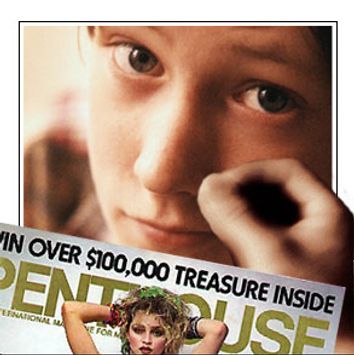
Still, my assignment was clear. An hour later I found myself in Michael’s small, barren room. And I’d already had my first embarrassment of the evening. After Maria left, I had driven down the street to the Quik-Mart, where I purchased a Penthouse for Michael. I didn’t know his sexual orientation, but I hoped the magazine would have something to offer him, regardless of his preference.

I was standing in line with the magazine clutched under my arm when the chairman of pediatrics came through the door. He nodded at me in recognition, noticed my purchase and quickly headed to the opposite side of the store. I wanted to yell, “It’s for a patient!” — but I realized, just in time, that such a protest would not help.

Sitting across from Michael, I tried to be as stoic as possible. When his laughter subsided, I told him I was going to give him a great gift.

“I’m sure you’ve heard about this,” I started, “but just for my sake I’m going to tell you every detail so I know you understand.”

After I had finished the portion of my lecture devoted to technique, I gave him the magazine and told him to find a page with pictures that he found stimulating.

“You have to hold the magazine open with just one hand,” I began. “When you find yourself getting excited, a feeling of release building, drop the magazine and concentrate on capturing the sticky stuff that comes out of your penis in the cup. You can do it. I’ll be guarding the door. No one’s going to walk in on you.”

He nodded like a soldier given an important assignment. I assumed my post outside his room.

A moment later he knocked at the door. When I opened the door, he stood there in his pajamas.

“I can’t do it.”

“What’s wrong?” I asked.

“It’s not gonna hurt?”

“Nope.” I said. “Anything but.”

He went back into the room.

A few moments later, he knocked again. I opened the door.

“I must be too nervous.”

Realizing my omission, I replied, “You know, it takes a while.”

“It does?”

“Oh yeah, it should take a long time — at least 20 minutes, probably 40. I should’ve told you that already. Go back in, relax, take your time. No rush.”

Four minutes later the door opened and Michael’s hand emerged, holding the cup. I took the cup. Before the hand disappeared into the room its thumb moved — a thumbs up.

Clutching the cup, I raced down the hall toward the reproductive endocrinology lab.

That night, at home, the phone rang. It was dinnertime and it took me a few rings to get the receiver to my ear. I listened as the clinician with the baritone listed the features of Michael’s sperm, its count and motility, all of it good. Michael’s sperm had been successfully frozen in liquid nitrogen. When he was ready, chances were good that he’d be able to use it to have a family.

When I hung up, I lifted Alexandra, my 2-year-old, the product of sperm I froze in 1987, to her chair at the kitchen table and spread a napkin in her lap.

Continue Reading Close

Fighting to die

I've read about therapists who brilliantly talk people out of killing themselves. But when a patient paged me to say goodbye, I was just scared and pissed off.

  • more
    • All Share Services

Fighting to die

My patient wants to kill herself.

She carries a knife in her backpack. She plans to plunge it into her heart. “And I could do it,” she tells me quietly, with a confidence that makes me shift in my chair. She’s in chronic pain, has been since the accident to her leg six months ago, but now, she says, it has broken through, so piercing she can’t focus, can’t think of anything but death. My job is to keep her alive while my colleague, a pain specialist and friend, works to find something effective. “There’s too much left to try,” he has told me.

She’s 34. Before the accident she was a prominent attorney, fiercely bright, racing toward partnership with the single-mindedness of a Navy cutter. Meeting her today, you’d think she was a soccer mom, auburn hair framing high cheekbones, a golf shirt with a tiny jelly stain from one of her kids’ sandwiches on her sleeve. She has that familiar, weary attractiveness, like so many of the women in my age group.

I want to hospitalize her. “Yes,” she tells me, sounding like a lawyer, “you can make me do the 48 hours in-house, but as soon as it’s up I’ll tell them I feel better, the whole thing seems like a dream now. And once I’m out I’ll do what I planned.”

“And,” she says softly, lowering her eyes, “if you hospitalize me against my will I won’t work with you again.”

This isn’t one of those cries for help I’ve come across before: shallow cuts on the inside of an arm or taking a few too many pills. I know she’s serious. She has been rehearsing — driving to an isolated spot with the knife in her backpack, drinking heavily and holding the knife over her chest.

When I was finishing my training at McLean Hospital, a psychiatric hospital affiliated with Harvard, a girl on one of the open-door units hanged herself from a fire escape. She was in one of my groups. She’d gathered her bedsheets and quietly walked outside. They found her a few hours later. She was only 17. And now, sitting here in my office, I can see her face, her eyes and the gentle slope of her cheek, as if she’d just left.

“Could you page me if you’re about to do it?” I ask.

She won’t answer.

Our session did not start gently with talk about weather, parking or the slowness of the elevator. She followed me from the waiting room to my office, sat down, dropped her backpack and muttered, “What is there to say?” It has been like this lately. She starts with “Why am I here?” or “You can’t really help me.” And her hopelessness fills my office like a cloud of suffocating ink.

She knows my history. That my training as a psychologist was interrupted by cancer. That I’ve had a bone marrow transplant. That I’m familiar with pain and the hopelessness of a horrible prognosis. I’ve been writing a book that has gotten some publicity, and some of my patients have heard about it. One afternoon she came in and said, “So, you’re a writer.” I swallowed hard. Therapy, after all, is about the client. It’s not supposed to be about me. She asked about the strange title, “Mom’s Marijuana,” and I explained as best I could about my illness and about my anti-drug mother growing marijuana in the backyard to help me. I tried to redirect her, but like a cross-examining attorney, she peppered me with questions. Eventually, she knew the skeleton of my story.

Initially, it helped. My history legitimized me. She listened when I told her she was more capable than she thought of tolerating the harsh side effects of her medications. But now she resents it. She has lamented, “I must seem terrible to you; you fought so hard to live, and here I fight to die.” And she has been right.

I’ve struggled with how to help her find a hope that I never really lost. Even when I was certain that I was going to die, even when it was confirmed by physicians, at least an ember of hope burned. Until now, I’ve believed that, with grit and hope, we can endure most things. It has been true for my patients, though not for her. For the first time in my career, I can’t understand a patient. And so I’ve withdrawn to the safety of psychological theory and science.

I’ve tried cognitive-behavioral and dynamic approaches. Existentialist. Humanist. Interpersonal. I’ve referred her to a psychiatrist, who has put her on antidepressant after antidepressant. I’ve consulted my old mentor. But her mood has continued to march downhill. And the bottom is coming up to greet us, fast and dark. I feel a frantic urgency rising in my chest.

Now she calls me judgmental because as I talk I wag a finger. I invoke her children: Have you taped photos of them to the knife? No. Could you assure versions of yourself 10 and 20 and 30 years older that you’re doing the right thing? No. And then, in the quiet between us, I feel as if I’m trying to sell her a car she doesn’t want.

She counters, “You’ve no right to judge. You can’t feel my pain, my losses.” She’s right and her truth stings. “You’re disgusted with me.” No, I want to say, but I am disgusted, and tired. “You affect me,” I tell her. “Powerfully. I’ll be devastated if you kill yourself. So don’t do it.” And inside I’m trembling for her and those children. And maybe myself, too.

I know I’m not supposed to let her see my disgust, my frustration, my anger, but they have seeped out. I find that in this foxhole of intensive care psychiatry, I do things I don’t do elsewhere. I share what I feel for her, even when I don’t want to — especially when I don’t want to.

Before she leaves she gathers her backpack and sighs. She stands up, thanks me for not hospitalizing her and whispers a promise. She’ll page me if she’s about to kill herself. She opens my door, then turns back toward me, curiosity in her face. “What will you say if I do page you?”

“Don’t worry about that now,” I tell her. But as the door closes I wonder too.

Twelve hours later, I am suddenly awakened. “What’s happening?” I wonder. Oh. I’m in bed. It’s still night. What’s that sound? Then I see the familiar outline of my pager and the little light flashing on the screen. My heart is pounding. The clock says 2:17 a.m.

I get up and carry the pager into my study, where there’s a cellphone and our house phone. I can call the police on one while talking with a patient on the other. I dial and the paging operator tells me to hold on. It’s bright outside. There must be a full moon. I can see deep into the desert.

Then I hear her voice. “Sorry to wake you up,” she says, “but I promised.” Her voice is unmistakable. Monotone. It has been that way for months. When I first started working with her I phoned to confirm our appointment time and heard her answering machine, taped before her accident. She sounded strong, giggling a little, with the sound of children and a yapping dog in the background. But in our first session, she spoke slowly, her words like plodding little soldiers.

“Where are you?” I ask. It’s my first job to find out where she is so I can send someone there. I turn on my cellphone. 911?

“Not so fast — let’s talk first.” Then I can hear it. Her enunciation is off. She said, “Lez talk first,” as if her brain is sending signals and her lips can’t keep up. I search my mind for the substances she has on hand. Painkillers, tricyclic antidepressants and, probably, alcohol. A lethal combination.

“What have you taken?” I ask.

“Nothing too serious,” she says. “Some vodka. But it gave me a headache, so I took a few Tylenols, just four, I promise.”

There’s silence on the line. “What are you going to do?” I ask.

“Haven’t decided,” she answers. We sound so businesslike, you’d think we were contemplating a shopping decision.

Silence again. “I think I’m going to do it this time,” she says softly.

“You paged me to say goodbye?” I ask, an edge rising in my voice.

“I paged you because I promised.” The hair on my arms stands up. I start to dial on the cellphone and then realize she hasn’t told me where she is.

And at this moment, I don’t know what I’m doing. I’ve read accounts of psychologists and psychiatrists talking people out of killing themselves in the middle of the night. The professionals always sound brilliant, eloquent. Every argument for living is so surprising and persuasive. But right now, those accounts seem merely fantastic. I’m just an overeducated man with a cellphone.

“It’s lonely, isn’t it? Out there,” I offer. My primitive attempt at empathy falls flat. “Look, um. If you’re about to die, then I’m getting off the phone. I’m not interested in being your witness.”

“I don’t want you to witness it,” she says. There’s a long pause. “This is euthanasia,” she tells me.

“Bullshit.” My anger spills out. “You don’t know that we won’t be able to find something to help with the pain. It’s selfish. You killing yourself would devastate me and your husband and your children.”

I hear a quick, controlled exhale. Is she crying? I decide that she is.

“I was pretty set on it tonight. I’ve been in a great mood all afternoon, just knowing I was going to do it tonight. It’s the first time I’ve been happy in months. Shit.”

“You can always kill yourself tomorrow if you still want to,” I offer. Then I hear a quick snort and a tired laugh, and then I’m laughing too.

“That’s ridiculous,” she says, still laughing. Then she’s suddenly serious. “You’re stalling. You’ve been stalling.” She catches me still laughing. I have to switch gears quickly and I feel tenuous, as if the cliff beneath me is starting to crumble.

“You’re right,” I admit, “I’ve been stalling. And now I’m going to get off the phone and you’re going to be alone. And you get to choose. There’s nothing I or anyone else can do to stop you from killing yourself. I’m not going to send the police out looking for you or call your husband or anyone else. I know there’s a part of you that wants to die tonight. I know that death sounds like a relief to that part of you. And I’m guessing there’s another part of you that wants desperately to live. And tomorrow, if you’re still alive, I’ll be in my office waiting for that part to show up.”

When she came in the next day I wondered if she’d been kept alive by the soothing smell of the desert, of jasmine and creosote. Or maybe it was a snapshot memory of her husband and children. Or maybe it was that someone else who’d also suffered thought she could survive. Or maybe it was something I said.

A few weeks later, when the crisis had passed, she wanted to talk about it. “You know,” she started, “you were a major pain in the ass that night. And you didn’t say a damned thing that was useful.” Then her voice changed. “But you were so scared and pissed off — like you really cared.”

“I don’t really,” I said. She looked startled.

And then we were laughing.

Continue Reading Close