Deanna Bellandi

Rahm Emanuel sworn in as Chicago’s new mayor

"It is time to take on the challenges that threaten the very future of our city" said the former White House chief

  • more
    • All Share Services

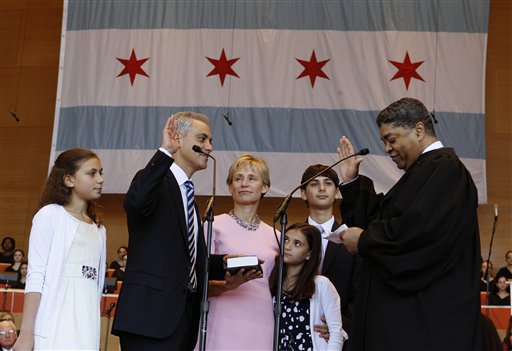
Rahm Emanuel sworn in as Chicago's new mayorRahm Emanuel takes the oath of office of Mayor of Chicago from Timothy C. Evans, Chief Judge of the Circuit Court of Cook County during inaugural ceremonies Monday, May 16, 2011 in Chicago. Watching are from left, daughter Ilana, wife Amy Rule, daughter Leah and son Zacharia. (AP Photo/Charles Rex Arbogast)(Credit: AP)

Rahm Emanuel was sworn in Monday as Chicago’s first new mayor in two decades, a historic power shift for a city where the retiring Richard M. Daley was the only leader a whole generation had ever known.

The former White House chief of staff took the oath of office at downtown’s Millennium Park, one of the signature accomplishments in Daley’s efforts to transform Chicago from an industrial hub into a gleaming global tourist destination. He planned to head to City Hall later to the fifth-floor office that was Daley’s lair for 22 years.

“We must face the truth,” Emanuel said in his inaugural speech. “It is time to take on the challenges that threaten the very future of our city: the quality of our schools, the safety of our streets, the cost and effectiveness of city government, and the urgent need to create the jobs of the future.”

“The decisions we make in the next two or three years will determine what Chicago will look like in the next 20 or 30.”

Emanuel inherits a city with big financial problems. His transition team predicted a $700 million budget shortfall next year, but because of some controversial decisions by Daley — most notably the push to privatize parking meters — he has limited ways to pay for school improvements or repair the city’s aging infrastructure.

In his speech, Emanuel walked a fine between bluntly assessing the city’s problems without being directly critical of the departing mayor.

“From the moment I began my campaign for mayor, I have been clear about the hard truths and the tough choices we face. We simply can’t afford the size of city government that we had in the past, and taxpayers deserve a more effective and efficient government than the one we have today.”

Emanuel also showed that he would not be shy about wading into national politics, referring to efforts in other Midwestern states to eliminate union rights for many public employees as part of budget cuts.

“I reject how leaders in Wisconsin and Ohio are exploiting their fiscal crisis to achieve a political goal. That course is not the right course for Chicago’s future,” he said.

Emanuel, who represented Chicago in Congress before he went to Washington to become Obama’s senior aide, made his mayoral ambitions known more than a year ago during an interview on Charlie Rose’s PBS talk show, saying it was “no secret” that he wanted to run for mayor if Daley did not seek re-election.

When Daley announced last fall that he would not seek a seventh term after 22 years in office — a longer tenure than any other mayor in the city’s history — some wondered if Emanuel had some prior knowledge when he made that comment.

But if he did, that didn’t stop him — just days before Daley’s stunning announcement — from renewing his lease with the tenant who rented his Chicago home while the Emanuels lived in Washington.

That decision to rent his house was at the center of the biggest obstacle standing between Emanuel and the mayor’s office: the legal battle over whether he was a resident of Chicago and eligible to run for mayor.

The fight ended with an Illinois Supreme Court ruling in his favor — but not before an appellate court panel knocked his name off the ballot, citing his time away from the city.

Once that issue was out of the way, Emanuel simply steamrolled over his opponents.

Branded as a Washington outsider by other candidates, Emanuel didn’t miss an opportunity to remind voters that, unlike his opponents, he had friends in high places, even as he sought to convince Chicagoans that he was one of them.

Armed with a $14 million campaign war chest that dwarfed those of his opponents, the only question in the last weeks of the race was whether Emanuel would get enough votes to avoid a runoff.

Emanuel, who kept his temper and his famously profane vocabulary in check during the campaign, ended up collecting 55 percent of the vote. In his last election campaigns, Daley was accustomed to collecting more than 70 percent.

Emanuel seemed to allude to his reputation when he spoke about school reform.

“As some have noted, including my wife, I am not a patient man,” he said. “When it comes to improving our schools, I will not be a patient mayor.”

Once elected, Emanuel wasted little time putting his administration together, bringing with him a number of people from his days in Washington.

For key posts, he went far outside the city. He hired the schools chief in Rochester, N.Y., to run the city’s massive education system. He went to Newark, N.J., to find his police superintendent rather than promoting from within. And where Daley hired a local newspaper reporter as his press secretary, Emanuel hired his away from the U.S. Department of Agriculture in Washington.

In his speech, Emanuel thanked Daley for his service to the city, noting how the “world class” park where he was speaking had once been an abandoned rail yard and “nagging urban eyesore.”

“A generation ago, people were writing Chicago off as a dying city,” the new mayor said. “They said our downtown was failing, our neighborhoods were unlivable, our schools were the worst in the nation, and our politics had become so divisive we were referred to as Beirut on the Lake.”

When Daley took office in 1989, “he challenged all of us to lower our voices and raise our sights. Chicago is a different city today than the one Mayor Daley inherited, thanks to all he did.”

Emanuel’s swearing-in completed an interesting role swap between City Hall and the White House: Emanuel’s replacement as Obama’s chief of staff is the outgoing mayor’s younger brother, William Daley.

In a mark of Emanuel’s continuing ties with Washington, Vice President Joe Biden attended the inauguration, as did William Daley, Secretary of the Treasury Timothy Geitner and two other cabinet secretaries.

Emanuel sworn in as Chicago’s new mayor

Richard M. Daley leaves office after 22 years as the former White House Chief of Staff is inaugurated

  • more
    • All Share Services

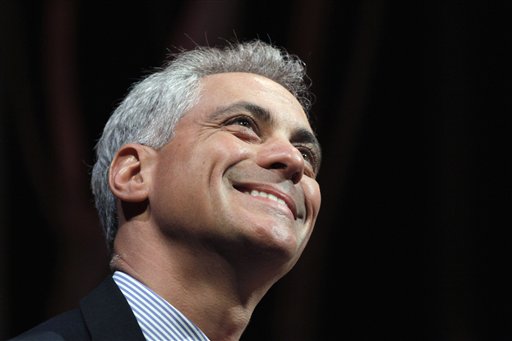
Emanuel sworn in as Chicago's new mayorFILE - in this file photo taken Wednesday, April 27, 2011, Chicago Mayor-elect Rahm Emanuel smiles as he answers questions at a discussion about how the arts contribute to the development of a thriving region during The Arts and Culture in Action event at the Goodman Theater in Chicago. When Emanuel takes over as mayor on Monday, May 16, he will infuse Chicago City Hall with hip vibe as he inherits a vibrant city from outgoing Mayor Richard M. Daley. (AP Photo/M. Spencer Green, File)(Credit: AP)

Former White House chief of staff Rahm Emanuel was sworn in Monday as Chicago’s first new mayor in two decades, a historic power shift in a city where the retiring Richard M. Daley was the only mayor a whole generation of Chicagoans have ever known.

Emanuel was sworn in during a morning inauguration ceremony at the popular downtown Millennium Park, one of the signature accomplishments in Daley’s efforts to transform the city. Emanuel later planned to head over to City Hall and, for the first time since he was elected in February, walk into the fifth-floor office that was Daley’s lair for 22 years.

“We must face the truth,” Emanuel said in his inaugural speech. “It is time to take on the challenges that threaten the very future of our city: the quality of our schools, the safety of our streets, the cost and effectiveness of city government, and the urgent need to create the jobs of the future right here in Chicago.”

“The decisions we make in the next two or three years will determine what Chicago will look like in the next 20 or 30.”

Emanuel’s swearing-in completes an interesting role swap between City Hall and the White House: Emanuel’s replacement as Obama’s chief of staff is the outgoing mayor’s younger brother, William Daley.

In a mark of Emanuel’s continuing ties with Washington, Vice President Joe Biden was in attendance at the inauguration, as was William Daley, Secretary of the Treasury Timothy Geitner and two other cabinet secretaries. Also scheduled to be there were the ambassadors of Mexico and six other countries.

Emanuel inherits a city with big money problems. Not only has Emanuel’s transition team predicted a $700 million budget shortfall next year, but because of some controversial decisions by Daley — most notably the push to privatize parking meters — he has limited avenues to fund efforts to improve schools and repair the city’s aging infrastructure.

It’s a challenge Emanuel has not shied away from.

Emanuel, who represented Chicago in Congress before he went to Washington to become Obama’s senior aide, made his desire to be mayor known more than a year ago during an interview on Charlie Rose’s PBS talk show, saying “it’s no secret” that he wanted to run for mayor if Daley didn’t seek re-election.

When Daley announced last fall that he wouldn’t seek a seventh term after 22 years in office — longer than any other mayor in the city’s history — some wondered if Emanuel had some prior knowledge when he made that comment.

But if he did, that didn’t stop him — just days before Daley’s stunning announcement — from renewing his lease with the tenant who rented his Chicago home while the Emanuels lived in Washington.

That decision to rent his house was at the center of the biggest challenge standing between Emanuel and the mayor’s office: the legal battle over whether he was a resident of Chicago and eligible to run for mayor.

That fight ended with an Illinois Supreme Court ruling in his favor — but not before an appellate court panel decided that Emanuel’s time away from the city made him ineligible to run and knocked his name off the ballot.

With that out of the way, Emanuel simply steamrolled over his opponents. Branded as a Washington outsider by other candidates including former Sen. Carol Moseley Braun and former Chicago schools president Gery Chico, Emanuel didn’t miss an opportunity to remind voters that, unlike his opponents, he had friends in high places, even as he sought to convince them that he was one of them.

There was the campaign stop by former President Bill Clinton and the visit to Chicago by the Chinese President Hu Jintao — a visit, Emanuel reminded reporters, that included a private meeting between the two.

Armed with a $14 million campaign war chest that dwarfed those of his opponents, the only question in the last weeks of the race was whether Emanuel would get 50 percent of the votes plus one vote to avoid a runoff.

Emanuel, who kept his temper and his legendary profane vocabulary under wraps during the campaign, ended up collecting 55 percent of the vote. In his last election campaigns, Daley was accustomed to collecting more than 70 percent.

Once elected, Emanuel wasted little time putting his administration together, bringing with him a number of people from his days in Washington.

For key posts, he went far outside the city. He hired the schools chief in Rochester, N.Y., to run the city’s massive school system. He went to Newark, N.J., to find his police superintendent, choosing the head of that department rather than promote someone already in the department. And where Daley hired a local newspaper reporter as his press secretary, Emanuel hired his away from the U.S. Department of Agriculture in Washington.

In his speech, Emanuel thanked Daley for his service to the city, noting how the “world class” park where he was speaking had once been an abandoned rail yard and “nagging urban eyesore.”

“A generation ago, people were writing Chicago off as a dying city,” the new mayor said. “They said our downtown was failing, our neighborhoods were unlivable, our schools were the worst in the nation, and our politics had become so divisive we were referred to as Beirut on the Lake.

“When Richard M. Daley took office as mayor 22 years ago, he challenged all of us to lower our voices and raise our sights. Chicago is a different city today than the one Mayor Daley inherited, thanks to all he did.”

Continue Reading Close

Illinois governor to abolish death penalty

Eleven year moratorium on death penalty will officially transition into abolition after expected bill-signing today

  • more
    • All Share Services

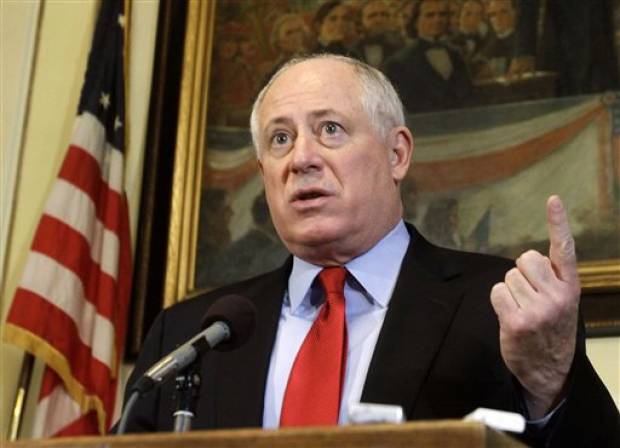
Illinois governor to abolish death penaltyFILE - In this Jan. 12, 2011 file photo, Illinois Gov. Pat Quinn speaks with reporters in his office at the Illinois State Capitol in Springfield, Ill. Quinn could make a decision as early as this week with a bill abolishing the death penalty. The Chicago Democrat is a supporter of the death penalty but has upheld the state's 11-year-old moratorium on capital punishment imposed by one of his predecessors. (AP Photo/Seth Perlman, File)(Credit: AP)

Democratic Gov. Pat Quinn has said he supports capital punishment if it’s fairly applied, but one of his Republican predecessors felt so uneasy about the state’s power to mete out the ultimate punishment that he placed a moratorium on executions that has lasted for the past 11 years.

On Wednesday, Quinn plans to abolish Illinois’ death penalty at a signing ceremony in his capital offices, according to two sponsors of the legislation, State Rep. Karen Yarbrough and state Sen. Kwame Raoul, who said they were invited to witness the event.

“It’s going to happen,” Raoul said.

Quinn’s signature would make Illinois the 16th state without capital punishment when it takes effect July 1. But a decision to sign has not come easily.

Quinn’s office declined to comment Tuesday about his intentions, but he has said he personally supports the death penalty when properly implemented and would make a decision on the bill based on his conscience.

“I’ve heard from many, many people of good faith and good conscience on both sides of the issue. And I’ve tried to be very meticulous and writing down notes and studying those notes and books and e-mails. They’ve really spoken from the heart. I’ve been very proud of the people of Illinois,” Quinn said recently.

Among those the governor consulted with were prosecutors, murder victims’ families, death penalty opponents and religious leaders. Quinn even heard from retired Anglican Archbishop Desmond Tutu of South Africa and met with Sister Helen Prejean, the inspiration for the movie “Dead Man Walking.”

Illinois Attorney General Lisa Madigan appealed directly to Quinn to veto the bill, as did several county prosecutors and victims’ families. They said safeguards, including videotaped interrogations and easier access to DNA evidence, were in place to prevent innocent people from being wrongly executed.

But death penalty opponents argued that there was still no guarantee that an innocent person couldn’t be put to death. Even Quinn’s own lieutenant governor, Sheila Simon, a former southern Illinois prosecutor, asked him to abolish capital punishment.

Illinois’ last execution was in 1999, a year before then-Gov. George Ryan imposed a moratorium on capital punishment after the death sentences of 13 men were overturned. Ryan cleared death row before leaving office in 2003 by commuting the death sentences of 167 inmates to life in prison.

If Quinn were to sign the bill, it is unclear how that would affect the 15 inmates currently on Illinois’ death row.

New Mexico was the most recent state to repeal the death penalty, in 2009, but new Republican Gov. Susana Martinez wants to reinstate it. The District of Columbia also doesn’t have the death penalty.

Prosecutors would still be able to seek the death penalty and juries could still impose it until the law took effect.

Associated Press writer John O’Connor in Springfield contributed to this report.

Continue Reading Close

Chicago voters cast “Daley”-less mayoral ballots

The big question: Will heavy-favorite Rahm Emanuel get the 50 percent of votes needed to prevent a runoff election?

  • more
    • All Share Services

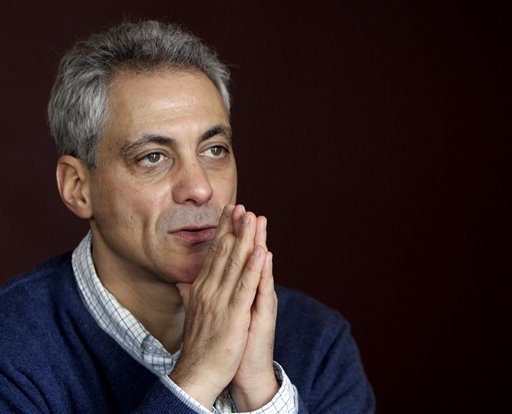
Chicago voters cast Chicago mayoral candidate Rahm Emanuel talks to reporters during an interview at 42 degrees North Latitude coffee shop in Chicago, Saturday, Feb. 12, 2011. (AP Photo/Nam Y. Huh)(Credit: AP)

Chicago voters cast ballots in a mayoral election Tuesday that didn’t include the name “Richard M. Daley” for the first time in decades — a contest that will bring new leadership to a city facing some of the most daunting economic challenges in its history.

The six candidates spent Tuesday morning still pushing for votes, shaking hands with surprised commuters and diner-goers and pleading their cases for why they should be picked to succeed the retiring Daley, who will leave office this spring after 22 years on the job.

“This is a critical election for the future of the city of Chicago. We’re at a crossroads,” front-runner Rahm Emanuel said as he greeted commuters at a South Side train station.

The campaign began last fall when Daley — with his wife ailing, six terms under his belt, and a future of fiscal challenges facing Chicago — announced he wouldn’t seek re-election.

The candidates who rushed in to fill that void included Emanuel, President Barack Obama’s former chief of staff; former U.S. Sen. Carol Moseley Braun; former Chicago public schools president Gery Chico; and City Clerk Miguel del Valle.

Emanuel led in the polls and in fundraising since he announced he was running last fall, and his confident, no-nonsense style resonated with many voters. Chico finished second in most of the polls, ahead of Braun and del Valle but far behind Emanuel.

To win Tuesday, a candidate must secure more than 50 percent of the vote, or face a runoff against the second place finisher on April 5.

Whoever wins will give the city a mayor unlike any it has had before: Emanuel would be Chicago’s first Jewish mayor, Braun would be its first black woman mayor, and Chico or del Valle would be the city’s first Hispanic mayor.

Justin Blake, a 42-year-old black general contractor who chatted with Emanuel on Tuesday, said voting for him was a no-brainer because of Emanuel’s “knowledge of what’s going on, not only here locally but worldwide.

“He’s been right up there with the president; why wouldn’t you vote for somebody who’s got that much collateral behind him?” Blake said.

Mark Arnold, 23, an auditor voting at a downtown polling place, said he is excited at the prospect of change.

“I think Daley’s done a lot of good things, but at the same time I just feel like the city right now, it’s kind of like a good old boys’ club,” Arnold said, saying the election would bring in “someone with new ideas who’s been in other places.”

Daley has been criticized for allowing the city to spend beyond its means, and Chicago’s finances were further damaged by the economic downturn of the last few years. The new mayor will have to quickly decide on a politically unpalatable strategy for improving city finances that may well involve raising taxes and cutting services and public employee benefits.

The five-month campaign took many unusual turns, even for a city where voting from six feet under is part of election lore. But after a race that included a challenge of Emanuel’s right to call himself a Chicagoan going all the way to the Illinois Supreme Court and Braun accusing another candidate of being strung out on crack cocaine, some voters complained they had not heard enough about where the candidates stood on the issues.

Some said they were focused more on the candidates’ resumes and influence.

“Daley had connections,” said Terrence Trampiets, 66, a North Side resident intending to vote for Emanuel. “You have to have that to get things done.”

Daley’s lock on City Hall had left many voters complacent. His decision at age 68 not to run again unleashed a sudden flurry of potential interest in running from nearly two dozen politicians, including the county sheriff, congressmen, state lawmakers and members of the City Council.

But the campaign focus quickly shifted from City Hall to the White House when Emanuel announced he was interested in the job — weeding many lesser-known candidates in the process.

That was followed by a sometimes weird tussle over whether Emanuel was a city resident and therefore even eligible to run because he had not lived in Chicago for a full year before the election, as required by law. He had lived in Washington working for Obama since soon after giving up his North Side congressmen’s seat in 2008.

The residency challenge turned into a spectacle that saw Emanuel on a Board of Elections witness stand in a makeshift courtroom in the basement of a downtown building being grilled for a dozen hours by regular Chicago residents with some very irregular questions, such as one from a man who asked if Emanuel had been involved in the 1993 Branch Davidian siege at Waco, Texas, when he worked for the Clinton administration.

Several tense days followed when an appellate court ordered Emanuel’s name thrown off the ballot, before the state’s Supreme Court stepped in and definitively ruled that Emanuel was a resident and could indeed run for mayor. Until then, Emanuel’s rivals had painted him as an outsider.

Meanwhile, a group of African-American leaders, including the Rev. Jesse Jackson, decided that their best hope of electing a black mayor was to convince all but one of the major black candidates to drop out of the race. Both U.S. Rep. Danny Davis and State Sen. James Meeks, the pastor of a megachurch on Chicago’s South Side, ended their candidacies and threw their support behind Braun.

The city’s first black mayor was Harold Washington, who was elected in 1983. The first woman mayor was Jane Byrne, elected in 1979.

The black consensus effort marked a return to the spotlight for Braun, who last won election in 1992 when she became the first African-American woman to win a U.S. Senate seat. She had largely been out of the spotlight since she announced a longshot bid for the Democratic nomination for president in 2004.

But Braun made headlines when, after rival Patricia Van Pelt-Watkins wondered aloud at a debate about Braun’s absence from public life, Braun shot back that the reason Van Pelt-Watkins didn’t know what she’d been up to was that she had been “strung out on crack.”

Van Pelt-Watkins said afterward she’d had a drug problem years ago, but denied ever using crack, and Braun later apologized. But she often showed sharp elbows during the campaign, in particular during exchanges with Emanuel. Some polls had her stuck in single digits or the teens while Emanuel scored well above 40 percent.

The other two main candidates, Chico and del Valle, have throughout the campaign struggled to get media attention, in large part because the fight over Emanuel’s residency took center stage. A sixth candidate, William “Dock” Walls, is also running.

Associated Press writer Lindsey Tanner contributed to this report.

Continue Reading Close

Court halts ballots without Emanuel’s name

The State Supreme Court offers some good news to the Mayoral candidate with one month before the election

  • more
    • All Share Services

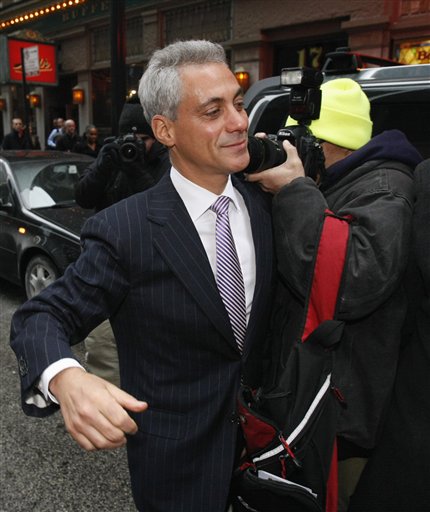
Court halts ballots without Emanuel's nameFormer White House Chief of Staff Rahm Emanuel leaves a news conference in Chicago, Monday, Jan. 24, 2011, where he responded to an Illinois appeals court ruling that threw him off the ballot for Chicago mayor because he didn't live in the city in the year before the election. The court voted 2-1 to overturn a lower-court ruling that would have kept Emanuel's name on the Feb. 22 ballot. (AP Photo/Charles Rex Arbogast)(Credit: AP)

The Illinois Supreme Court on Tuesday ordered election officials not to print any mayoral ballots without Rahm Emanuel’s name while the justices consider whether to hear an appeal from the former White House chief of staff.

Emanuel has asked the court to overturn a lower ruling that threw him off the ballot because he had not lived in the city for a year. His attorneys called Monday’s decision “squarely inconsistent” with previous rulings on the issue.

The high court’s order appeared to buy some time for Emanuel. The Chicago Board of Elections had said it would begin printing ballots without his name as early as Tuesday, with the election less than a month away. Absentee ballots were to be sent out within days.

Messages left for election officials were not immediately returned.

There was also no immediate word on whether the high court would hear Emanuel’s appeal or when the justices would decide whether to accept it.

“I’m confident in the argument we’re making about the fact that I never lost my residency,” Emanuel said Tuesday at a campaign stop where he picked up an endorsement from the Teamsters Joint Council.

In their appeal, Emanuel’s attorneys called Monday’s ruling “one of the most far-reaching election law rulings” ever issued in Illinois, not only because of its effect on the mayoral race but for “the unprecedented restriction” it puts on future candidates.

His lawyers raise several points, including that the appeals court applied a stricter definition of “residency” than the one used for voters. They say Illinois courts have never required candidates to be physically present in the state to seek office there.

By adopting this new requirement, the court rejected state law allowing people to keep their residence in Illinois even if they are away doing work for the state or federal government, the appeal said.

Emanuel, a former congressman who represented Chicago, was gone while he served as President Barack Obama’s chief of staff for nearly two years.

The new standard also sets a “significant limitation on ballot access” that denies voters the right to choose certain candidates, the appeal said.

Just hours after Monday’s ruling, the campaign to replace retiring Mayor Richard M. Daley began to look like an actual race.

For months, three of the main candidates struggled for attention while Emanuel outpolled and outraised them, blanketed the airwaves with television ads and gained the endorsement of former President Bill Clinton, who came to town to campaign for Emanuel.

Former Sen. Carol Moseley Braun, city Clerk Miguel del Valle and former Chicago schools chief Gery Chico suddenly found themselves in the spotlight — and trying to win over Emanuel supporters who suddenly may be up for grabs.

Even as Emanuel vowed to fight the decision, Braun urged voters to join her campaign “with your time, your effort or your money.”

“I’m extending a hand of friendship to all the Chicagoans who have been supporting Mr. Emanuel and all those who haven’t made their minds up yet,” she said. “Going forward, we pledge to work to create a city great enough to provide opportunity for every family. But we can only do this if we come together.”

Reporters surrounding Chico outside a restaurant asked him if he was a front-runner — something that seemed inconceivable last week when a Chicago Tribune/WGN poll showed him with the support of just 16 percent of voters surveyed compared with a whopping 44 percent for Emanuel. The same poll showed Braun with 21 percent support, and del Valle with 7 percent.

“I’m trying to get every vote I can from everybody in this city,” said Chico, who released records last week showing he had just over $2 million at his disposal, about one-fourth of the money available to Emanuel.

In their 2-1 ruling Monday overturning a lower court decision, the appellate justices said Emanuel met the requirements to vote in Chicago but not to run for mayor because he had been living in Washington.

Challengers to Emanuel’s candidacy argued the Democrat did not qualify because he rented out his Chicago home and moved his family to Washington to work for President Barack Obama for nearly two years. Emanuel — who quit his job and moved back to Chicago in October after Daley announced he would not to seek a seventh term — has said he always intended to return to Chicago and was living in Washington at the president’s request.

Emanuel’s lawyers promptly asked the state’s highest court to stop the appellate ruling and hear an appeal as soon as possible. Lawyers also asked the court to tell Chicago election officials to keep his name on the ballot if it starts to print them.

Appellate litigation attorney Christopher Keleher said it’s likely the court would rule against Emanuel.

“I can tell you from experience that getting a reversal from any Supreme Court is difficult — even more so when you’ve got a truncated time frame,” Keleher said.

But Emanuel said he was forging ahead.

“I have no doubt that we will in the end prevail at this effort. This is just one turn in the road,” Emanuel said Monday, adding that the “people of the city of Chicago deserve the right to make the decision on who they want to be their next mayor.”

If he doesn’t win the appeal, the race takes on a whole new dynamic. In a city with huge blocs of black, white and Hispanic voters, the Chicago Tribune/WGN poll showed Emanuel leading among all of them, even though his three top rivals are minorities.

Laura Washington, a local political commentator who writes a column for the Chicago Sun-Times, said if Emanuel is out, Chico, who is Hispanic, could be the big winner in terms of fundraising.

“Rahm has the establishment support, the civic leaders, business community, the money class. And Chico is as close to that type of candidate as anyone,” Washington said. “They’d take Chico as a second choice, easily.”

But Braun would be the big winner among black voters, she said. The recent poll showed Emanuel with the support of 40 percent of black voters compared with 39 percent for Braun, even though two other prominent black candidates dropped out of the race to try to unify the black vote.

But 27-year-old Thurman Hammond, who is black, said he never cared for Braun and planned to vote for Emanuel “because he was part of the Obama camp.”

If Emanuel is not on the ballot, Hammond said, he’ll have to do his “homework” on other candidates.

Del Valle, another Hispanic candidate, said Emanuel’s quandary bodes well for the other candidates, regardless of what the court does.

“Now voters see there’s an opportunity to look at the field and give candidates either a second look or in some cases a first look,” del Valle said. “People are going to pay more attention to the other candidates.”

——

Associated Press writers Don Babwin, Deanna Bellandi, Sophia Tareen and Michael Tarm contributed to this report.


Continue Reading Close

Feds shuts down bank owned by Giannoulias

Regulators make Illinois Democrat's Senate bid uncertain after they seize his failed bank

  • more
    • All Share Services

Federal regulators shut down the bank owned by Illinois Treasurer Alexi Giannoulias’ family on Friday, setting up an expected but daunting challenge in his bid to keep President Barack Obama’s old Senate seat in Democratic hands.

Broadway Bank, which was heavy into real estate loans and lost $75 million last year, had been given until Monday to raise about $85 million in new capital, but the Federal Deposit Insurance Corp. announced at the close of business Friday that Broadway was among four banks, all in Illinois, that had failed.

Giannoulias, 34, worked at the bank as a senior loan officer until he ran for treasurer four years ago. He has tried to take some of the political and public relations sting out of a collapse, acknowledging the bank is likely to fail but blaming the bad economy. He also said it was financially healthy when he left four years ago.

But his Republican opponent, U.S. Rep. Mark Kirk, has made the bank’s finances a central issue in their Senate race and will continue to focus on Giannoulias’ “reckless decision-making” at Broadway, Kirk spokeswoman Kirsten Kukowski has said.

Giannoulias’ campaign and Democratic insiders have maintained he can still beat Kirk, a moderate Republican and an officer in the Naval Reserves. Democrats outnumber Republicans in Illinois, and Obama remains a popular figure in the state.

And on Friday, the White House said Obama intends to help Illinois Democrats “up and down the ballot.” Giannoulias campaign chairman, U.S. Sen. Dick Durbin, said the White House has asked about the state of Giannoulias’ campaign.

Joey O’Neill, a Broadway customer for 20 years said Friday that he won’t hold the bank’s failure against Giannoulias.

“They’ve always been good to me,” O’Neill said before the bank closure was announced.

All of Broadway’s deposit accounts, excluding certain brokered deposits, were transferred to MB Financial Bank. The accounts will be available immediately, and the former Broadway Bank locations will reopen as branches of MB Financial Bank, N.A. during regular business hours, the FDIC said.

Two other Chicago banks and one in Rockford, Ill., also were closed, the FDIC announced.

Customer accounts are insured by the FDIC up to $250,000.

——

http://fdic.gov/

Continue Reading Close