Edith M. Lederer

UN Security Council meets on Syria massacre

  • more
    • All Share Services

UNITED NATIONS (AP) — The U.N. Security Council held an emergency meeting Sunday afternoon to hear a briefing from the head of the U.N. observer mission in Syria on the massacre in the town of Houla, with Russia questioning whether Syrian tanks and artillery were responsible.

Russia’s deputy U.N. Ambassador Alexander Pankin told reporters as he headed into the closed-door meeting that “there is substantial ground to believe that the majority of those who were killed were either slashed, cut by knives, or executed at point-blank distance.”

Britain and France had proposed issuing a press statement condemning the attack on civilians and pointing the finger at the Syrian government for Friday’s massacre which left more than 90 people dead. But Russia told council members it could not agree and wanted a briefing first by Gen. Robert Mood, the head of the unarmed U.N. observer mission. Russia called for the emergency meeting to hear Mood’s report and consider a possible Security Council press statement.

Russia, which considers Syria its closest Mideast ally, has used its Security Council veto power to block resolutions raising the possibility of U.N. action against President Bashar Assad. The assault on Houla was one of the bloodiest single events in Syria’s 15-month uprising against Assad’s regime.

Mood said in a statement Saturday that U.N. military and civilian observers who went to Houla counted more than 32 children under the age of 10 and over 60 adults among the dead. He said the observers confirmed from examination of ordnance found at the scene that artillery and tank shells were fired.

U.N. Secretary-General Ban Ki-moon and his predecessor Kofi Annan, who is serving as the joint U.N.-Arab League envoy to Syria, issued a joint statement condemning the “indiscriminate and disproportionate use of force” in violation of international law and Syrian commitments to stop using heavy weapons in populated areas. They demanded that the Syrian government stop using such weapons.

The Syrian government on Sunday denied responsibility for the Houla massacre, blaming the killings on “hundreds of heavily armed gunmen” who also attacked soldiers in the area.

Russia’s Pankin said “the number of those wounded does not correspond to what you would expect in terms of destruction — You cannot have one or two houses destructed (cq) and 500 wounded with shrapnel.”

“We have to establish whether it was Syrian authorities … before we agree on something,” he said.

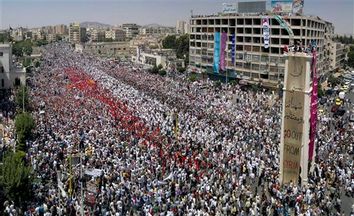
Activists from Houla said Saturday that regime forces had peppered the area with mortar shells after large demonstrations against the regime on Friday. That evening, they said, pro-regime fighters known as shabiha stormed the villages, gunning down men in the streets and stabbing women and children in their homes

Britain’s U.N. Ambassador Mark Lyall Grant told reporters that from the information his government has gathered “it seems quite clear that the massacre in Houla was caused by a heavy bombardment and by government artillery and indeed tanks.”

“And I would expect the briefing we’ll receive from Gen. Mood today will confirm that. And if that’s the case, we condemn it utterly,” he said.

Both Pankin and Grant said the attack represents a violation of international law regardless of who is responsible.

The Houla attacks have sparked outrage from American and other international leaders, and renewed concerns about the relevance of a 6-week-old international peace plan negotiated by Annan that has not stopped almost daily violence despite the presence of more than 250 U.N. observers. The U.N. put the death toll weeks ago at more than 9,000. Hundreds have been killed since.

UN Security Council to meet on Syria massacre

  • more
    • All Share Services

UNITED NATIONS (AP) — Diplomats say the U.N. Security Council will hold an emergency meeting Sunday afternoon to discuss the recent massacre in the Syrian town of Houla that left more than 90 people dead.

The diplomats say Britain and France had proposed issuing a press statement condemning the Houla massacre, but Russia told council members it could not agree and wanted a briefing first by the general heading the U.N. observer mission in Syria.

The diplomats, speaking on condition of anonymity, say the briefing by Maj. Gen. Robert Mood was being arranged. Russia called for a council meeting to begin at 2:30 p.m. (1830 GMT).

The U.N. and others have issued statements appearing to hold the Syrian regime of President Bashar Assad responsible. The Syrian government has denied responsibility for the Houla killings.

Rwandan orphans find hope in village

  • more
    • All Share Services

Rwandan orphans find hope in villageThis photo provided by DKC Public Relations, Marketing & Government Affairs, shows Innocent Nkundiye and Claude Irankunda, residents of the Agahozo Shalom Youth Village in rural Rwanda, performing at the offices of Liquidnet Holdings in New York, on Tuesday, May 22, 2012. Their village is modeled after youth villages established in Israel to help World War II orphans. About 500 young people live in "families" _ 16 to a house, with a house mother or father, and big sister or brother. (AP Photo/DKC Public Relations, Marketing & Government Affairs)(Credit: AP)

NEW YORK (AP) — From a teenager who was a month old when her parents were killed in Rwanda’s genocide to a young man inspired to become a doctor, hundreds of orphans have found hope for the future in a special village outside the Rwandan capital.

Now, the South African-born, New York woman who founded Agahozo Shalom hopes the village can be a model for orphans around Rwanda and the rest of the world. Anne Heyman brought five of the young people from the village to New York this week, where they helped raise money and met with Rwanda’s U.N. Ambassador Eugene-Richard Gasana.

“The dream is that others will come and see what we are doing and understand that there is a systemic solution to the orphan problem that plagues much of the developing world,” Heyman said.

Heyman got the idea for the village at a 2005 dinner when she and her husband were seated at a table with Paul Rusesabagina, the Rwandan hotel manager made famous in the movie “Hotel Rwanda” for trying to protect Tutsis and moderate Hutus targeted in the 1994 slaughter of at least 500,000 people.

Her husband asked Rusesabagina what Rwanda’s biggest problem was.

Orphans, he replied.

Heyman, a former New York assistant district attorney and mother of three, thought of the thousands of Jewish children orphaned by the Holocaust who were resettled in youth villages in Israel. She believed that model could work in Rwanda, where there are more than 610,000 orphans, including 95,000 orphaned by the genocide, according to the U.N. children’s agency UNICEF.

So after that dinner conversation, Heyman started raising money and making contacts in Rwanda and Israel. She founded Agahozo Shalom, which combines the Kinyarwanda word agahoza meaning “tears are dried” with the Hebrew word shalom which means “peace.”

She collected donations from Liquidnet Holdings, the electronic stock-trading firm founded by her husband Seth Merrin, and other foundations, companies and individuals. With $12 million and help from the American Jewish Joint Distribution Committee, the first 125 high school students arrived at the 144-acre (58-hectare) village in January 2009.

The village, about 50 kilometers (30 miles) from the capital Kigali, is now home to 500 young people who live in “families” — 16 to a house, with a house mother or father, and big sister or brother. They get health care and plenty of emotional support, Heyman said.

Heyman’s goal is to integrate the orphans into a community, giving them families and individual attention as well as a full school curriculum including music, art and sports. They are expected to use the education and skills they are learning to help other struggling Rwandans, whether by building houses, growing crops or teaching.

“The philosophy of how we do things is really the same for every orphan in the world,” Heyman said, “and so whether the kids are orphaned by AIDS, conflict, genocide, they’ve been abandoned by the world, the solution is really the same.”

Gasana, the Rwandan ambassador, suggested that Heyman partner with UNICEF, the U.N. children’s agency.

“It’s a good model I think to sell everywhere in the world,” he said.

In New York, the young Rwandans performed music at a fundraiser that brought in about $500,000 on Monday, Heyman said.

To select new members of the village, Heyman said Agahozo Shalom sends letters to Rwanda’s mayors asking them to identify 10 orphans who meet specific criteria, all based on vulnerability, including a lack food or shelter or someone to take care of them and emotional problems. There is no medical or academic testing, she said.

Sitting around a table in the ambassador’s conference room, the five young people talked about their difficult lives before going to Agahozo Shalom village.

Peace Grace Muhizi Umutesi, 18, lost both her parents to the genocide when she was a month old. She then lived with her aunt, who has five children, for 10 years. The family was so poor that sometimes they missed meals. Nobody had ever asked her what she wanted for her future until she was interviewed by Agahozo Shalom.

“I didn’t have any dream in me. I was just studying for studying, not studying for being someone in the future,” she said.

Now she is singing, and studying math, economics and computers. She dreams of being a famous singer and a software engineer.

“They told us ‘if you see far you will go far’. … That’s made me strong,” she said.

She said Agahozo Shalom “is like my family” and added: “I feel very powerful and I know that if something is good it is wonderful and if it goes wrong it is an experience.”

Pascasie Nyirantwari, 21, who lost her father in the genocide and her mother to illness seven years later, said she had no hope for the future when she came to the village from an orphanage. She will be part of the village’s first high school graduating class in November and wants to continue singing and acting and study interior design.

“Now I have a hope for tomorrow,” she said.

Innocent Nkundiye, 19, also lost his father in the genocide and his mother struggled to raise him and his brother. He went to school but didn’t do well. Now, he’s studying math and science and wants to be a doctor. He said that when the local physician in his district died, the women cried because they didn’t know who would take care of them when they got pregnant.

“So because of that, I got a dream,” Innocent said. “Maybe I can change something, and I can solve these problems … and I said I have first of all to do something that can make me a doctor. So I chose math, biology and chemistry to study — and I will be a doctor.”

Continue Reading Close

Diplomats: UN experts say NKorea violates sanction

  • more
    • All Share Services

UNITED NATIONS (AP) — An expert panel’s report says North Korea continues to violate U.N. sanctions, citing possible attempts to ship arms to Syria and Myanmar and illegally import luxury goods, U.N. diplomats said Friday.

Two Security Council diplomats, speaking on condition of anonymity because the report has not been released, said the panel concluded the violations “illustrate elaborate techniques” used by North Korea to evade the discovery of its sanctions-busting.

The Security Council imposed sanctions against North Korea after its first nuclear test in 2006 and stepped up sanctions after its second test in 2009 to try to derail the country’s rogue nuclear weapons and ballistic missile programs.

The report to the council committee monitoring sanctions is expected to be discussed by the 15 council members and could be changed before it is finalized. The panel’s previous report in May 2011 has not been released because of objections from China, which has close ties to North Korea. The reports use the country’s official name, the Democratic People’s Republic of Korea, or DPRK.

The panel’s latest assessment said member states did not report any violations involving the transfer of items related to nuclear, chemical or biological weapons or ballistic missiles, “but they did report several other violations including illicit sales of arms and related material and luxury goods,” the diplomats said.

“These cases provide ample evidence that the DPRK continues actively to defy the measures in the resolution,” the diplomats quoted the report as saying.

The panel said it couldn’t confirm recent media reports and academic papers citing possible ongoing missile cooperation between North Korea and other states, especially Iran and Syria, the diplomats said.

But they quoted the panel as saying this “would be consistent with reports of the DPRK’s long history of missile cooperation with these countries and with the panel’s observations.”

In assessing the impact of sanctions, the panel concluded that “although the resolutions have not caused the DPRK to halt its banned activities, they appear to have slowed them and made illicit transactions significantly more difficult and expensive,” the diplomats said.

The panel cited a number of cases including a report from France in April 2012 about its interception in November 2010 of “an illicit shipment of arms-related material originating from the DPRK and destined for Syria,” the diplomats said.

The shipment contained brass discs and copper rods used to manufacture artillery munitions and aluminum alloy tubes useable for making rockets, the diplomats quoted the report as saying.

The report referred to two North Korean ships heading for Myanmar — one in June 2009 and the other in May 2011 — which the U.S. has said were suspected to be carrying weapons or missiles, one diplomat said. The first turned back, apparently after it became aware it was being tracked, and the second headed home after being challenged by a U.S. Navy destroyer.

The panel also found that activities carried out under a 2008 memorandum of cooperation between the armed forces of North Korea and Myanmar could violate sanctions, the diplomat said.

Continue Reading Close

UN urges massive support for Afghan forces

  • more
    • All Share Services

UNITED NATIONS (AP) — The United Nations has been urging participants at this weekend’s NATO summit to provide “predictable, massive, long-term support” for Afghanistan’s security forces to promote stability and ensure that the country is never again a base for international terrorism, the U.N. envoy to Afghanistan said Friday.

In the run-up to the summit in Chicago, the U.N. has been sending “a very strong message” to countries that are — and are not — part of the NATO-led coalition in Afghanistan that the heavy investment of the last 10 years, including thousands killed, must not be lost, Jan Kubis said in an interview with The Associated Press.

Ahead of the withdrawal of foreign forces from Afghanistan in 2014, Kubis said, the NATO summit should deliver “a clear commitment of individual countries” — not just general political pledges — to contribute as much as possible toward the $4.1 billion annual goal for the Afghan security forces for many years to come.

Unless there is significant financial support for Afghanistan, “we might face a nasty situation once again, so it’s a common strategic interest of all of us,” he said.

Kubis, who will be accompanying U.N. Secretary-General Ban Ki-moon to Chicago, said support must also come from regional countries that will be meeting in Kabul on June 14 to discuss confidence-building measures in combatting terrorism, the narcotics trade and promoting investment. Pakistan, China and Iran will attend, he said.

“Afghanistan will be firm and stand firm and stable only if there is support from regional countries,” he said.

Kubis said Ban will also assure summit participants that U.N. is prepared to continue its programs to help Afghanistan move towards democracy and to channel support for Afghan security forces, notably the police.

Asked whether whether the transition from international to Afghan-led security forces is taking place too quickly, Kubis said “it’s for Afghanistan to determine.”

“At this time I would say it’s a managed process, even a well-managed process,” he said. “We see and we hear positive results and our expectations are that the process will continue.”

He said “there are always risks and anxieties” when an international force leaves, but “I would say that’s a natural development.”

Despite the anxiety in Afghan society, he said the 2014 pullout will means “they have full responsibility for the future of the country and that is always a healthy process.”

Continue Reading Close

UN imposes sanctions on 3 NKorean companies

  • more
    • All Share Services

UNITED NATIONS (AP) — The U.N. Security Council imposed sanctions Wednesday against three North Korean state-owned companies to punish Pyongyang for last month’s failed rocket launch, which violated existing U.N. sanctions.

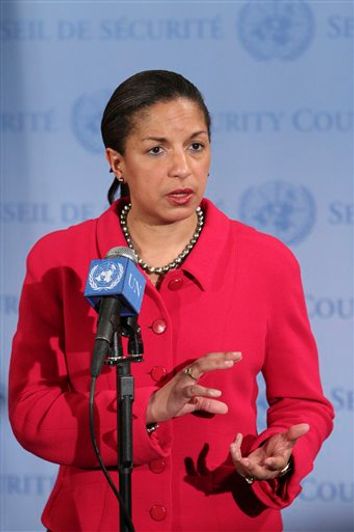
U.S. Ambassador Susan Rice announced that the council’s committee monitoring sanctions against North Korea approved the new sanctions and ordered all countries to freeze the assets of the three companies which are “very much involved in … illicit missile and nuclear programs.”

She identified one of them as the Green Pine Associated Corporation. Council diplomats identified the other two as the Amroggang Development Banking Corporation and The Korea Heungjin Trading Company.

Rice said the sanctions committee also approved updates of items and technology to the Missile Technology Control Regime list and the Nuclear Suppliers Group list, and approved a new work plan for the committee’s panel of experts. The lists were last updated in 2009.

The Missile Technology Control Regime, a group of 34 countries, monitors the transfer of missile equipment, material and related technologies that can be used to deliver weapons of mass destruction. The Nuclear Suppliers Group comprises countries which have established export rules to prevent the proliferation of nuclear weapons.

“Taken together, we view this as a strong and credible set of new sanctions,” Rice said.

The Security Council unanimously approved a presidential statement on April 16 strongly condemning North Korea’s failed rocket launch on April 13. The council gave the sanctions committee — which includes all 15 council members — 15 days to prepare new additions for the sanctions list.

The European Union proposed about 40 additions and the United States, Japan and South Korea also submitted lists — but China, North Korea’s closest ally, did not respond until just before the deadline Tuesday night, diplomats said, speaking on condition of anonymity because talks have been private.

China approved the three additions, and the sanctions committee agreed to the additions Wednesday, the diplomats said.

The Security Council has imposed two rounds of sanctions against North Korea, after its 2006 and 2009 nuclear tests.

Before Wednesday’s additions, the sanctions blacklist included eight entities — six trading companies, a bank and the General Bureau of Atomic Energy — and five individuals.

Continue Reading Close

Page 1 of 4 in Edith M. Lederer