Long before her son Michelangelo’s first birthday, Dana Commandatore began to suspect he was different. The other babies she knew babbled animatedly to everyone in sight. Michelangelo, though, never took much interest in children his age, and by the time he was 18 months old, he still wasn’t speaking. Determined to find out what was wrong, Commandatore took her son to the pediatrician. “They sent us for a hearing test. The technicians were trying to put the headphones on and Michelangelo wouldn’t let them do it,” she recalls. “One tech said to the other, ‘It seems more like autism than a hearing problem.’ I turned around and said, ‘What?’”
When Michelangelo’s autism diagnosis was confirmed soon after, the verdict was more of a relief than anything else — it seemed to suggest a clear course of action. “We knew who he was,” Commandatore says. “Now we knew what to do.” In the process of scouring the Internet, she stumbled across Web sites run by autistic adults who advocated a school of thought they called “neurodiversity.” Autism was not a “disease,” their reasoning went, but a “neurological variation” that ought to be as respected as a difference like skin color or sexual orientation. The Centers for Disease Control and Prevention estimates that the prevalence of autism spectrum disorders in the U.S. is about 1 in every 150 8-year-olds.
The advocates’ core message — that autistic people should be celebrated for their uniqueness, not aggressively “normalized” — struck a chord with Commandatore. She began learning more about the movement and went to hear Ari Ne’eman, president of the Autistic Self Advocacy Network, give a lecture. “I am not a person at all who joins groups. I’m not religious,” Commandatore says. “But when I found Ari’s Web site and saw him speak, he put into words what I had been thinking.”
Like the deaf culture movement before it, the so-called autistic culture movement continues to gain traction, boasting thousands of adherents among parents, patients and healthcare professionals. And the rhetoric is often as strident as anything out of the deaf-pride movement. Some autistic people even use the pejorative term “curebie” to refer to people who hope for a cure for the condition. Organizations like Autism Network International view efforts to cure autism as similar to misguided efforts to cure homosexuality and left-handedness.
As its associated swag — buttons and T-shirts proclaiming “I am not a puzzle, I am a person” — suggests, the movement aims to redefine autism as something to be valued and protected, not obliterated. Proponents insist that forcing autistic people to behave like “neurotypicals,” a term that borders on insulting, squelches the very qualities that make them unique. “The real ends for autistic people should be quality of life, full access in society, the kinds of things we support and are working for,” Ne’eman says. “Parents have been told that the way to approach these things is to support research for a cure, but our belief is that that’s not the most effective paradigm.”
In other words, Jenny McCarthy can go jump off a cliff. While the Hollywood comedian’s claims that childhood shots cause autism may be well-intentioned, Ne’eman says, her message has a pernicious and probably untrue implication: If we stopped giving kids “toxic” vaccines, autism wouldn’t exist. Not only does this message distract from pragmatic efforts to get autistic kids the social support they need, it implies that autistic children are inherently less valuable than their normal counterparts. “The cure paradigm sends a message that there is somehow a normal person under the autistic person, and that’s a significant denial of who we are.”
But it’s not just anti-vaccine diatribes that raise autistic culture crusaders’ ire. Their primary target is something much broader and more insidious: the general therapeutic approach to autism in the medical community. Many autistic rights advocates have spoken out against applied behavioral analysis (ABA), the most common type of autism therapy, developed by UCLA psychologist Ivar Lovaas in the 1960s and ’70s, with the goal of helping autistic children achieve “normal intellectual and educational” functioning. The therapy, which uses repetition and rewards to reinforce new skills, is geared toward extinguishing autistic behaviors such as “stimming” (making repetitive body movements) and failing to make eye contact. One sign of the treatment’s success, Lovaas suggested, might be for school personnel to perceive an autistic child as “indistinguishable” from his or her normal peers.
Approaches like this miss the point entirely, says Kathleen Seidel, the webmaster of Neurodiversity.com and the mother of a child on the autism spectrum. Instead of trying to coerce autistic kids to behave like “neurotypicals,” therapists should focus on helping them deal more effectively with the non-autistic world. “A person’s nervous system is not fundamentally going to change — an autistic person is going to remain autistic throughout his or her lifetime,” Seidel says. “And it can be very problematic and a source of stress for an autistic child to have to suppress certain mannerisms.”
Equally problematic, says Dora Raymaker, a Portland, Ore., artist with autism, is the tendency for medical professionals to impose “normal” behaviors on autistic people — even when those behaviors do not necessarily improve their ability to function. Rather than undergoing continual and grueling speech therapy, Raymaker has fought to express herself via text chat, the communication medium with which she feels most at home. “If we’d done this interview on the telephone you would have been lucky to get much more than disjointed, stuttering, completely non sequitur responses from me,” she told me in an instant-message conversation. “But because you allowed me to do this interview through text-only media where I can slow down, really understand you, and bypass my difficulties with spoken language, I’m able to give you intelligent, on topic answers.”
The key assumption that underlies much autistic culture discourse is that any autism-related limitations can be worked around and dealt with in a way that does not compromise the autistic individual’s core “personhood.” When such workarounds are found, Raymaker asserts, the concept of a “cure” becomes irrelevant. “Do I need a pill to make me suddenly able to have phone conversations, or do I need you to be able to find a middle ground that bypasses my disabilities?”
Some parents and therapists counter that this kind of active opposition to suppressing autistic symptoms is a niche crusade — one mounted by a small, visible group of high-functioning autistics who don’t represent the autistic population at large. If a child stages screaming outbursts in the classroom or has trouble stringing together a complete sentence, New Brunswick lawyer Harold Doherty argues, does it really make sense to treat that child’s condition as “a different neurological way of being,” instead of a disease that imposes severe limitations?
“Some of these advocates oppose a cure and they appear in court proceedings. In all these cases, they’re talking about other people’s children,” says Doherty, whose son Conor is autistic. “Who gives them the authority to represent autistics? What does Ari Ne’eman know about Conor? He has no real investment in my son’s life. There’s a denial in this movement of the challenges of more autistic individuals. It’s not a feel-good story to talk about kids who are smashing their heads into things.”
The question of whether autism should be considered a medical condition or a variation in neural wiring isn’t just one of semantics. If autistic-rights advocates win their court battles, many treatment programs could stop receiving government money. In 2004, for instance, autistic-rights crusader Michelle Dawson convinced the Canadian Supreme Court to overturn an appeal that would have provided state funding for ABA therapy. If similar legal efforts succeed in the U.S., says Massachusetts psychologist Teresa Bolick, autistic children could be hampered in acquiring the skills they need to interact with the world.
“One of the main dangers of saying, ‘This is not a developmental disorder,’ is that federal and state governments don’t usually fund intervention for differences,” Bolick says. “Parents say, ‘But what if his natural personality is to be a hermit? What if my son just wants to be like Thoreau?’ I say, ‘You know what, if he wants to be Thoreau, that’s terrific.’ But we need to give people the skills so they can choose whether to be like Thoreau or like a more social person.”
Bolick adds that the justification many autistic culture advocates give for slamming ABA — that the therapy is condescending and attempts to turn autistic children into people they’re not — is strained and largely outmoded. “If we look at contemporary ABA, we see tremendous attention to the individual and tremendous appreciation for personality,” she says. “Old-fashioned behavior modification has the reputation of using aversives and denying individual freedoms, but that’s not the way good treatments are anymore. For the most part, reinforcement is driven by what the kid wants to do. One kid loves it when his teaching assistant draws for him, so he’ll do anything if she’ll draw.”
Ne’eman disputes the accuracy of this portrayal, citing cases in which autistic children were abused and restrained in the name of “therapy.” “There are very significant problems with the way in which intervention is approached,” he says. “The founders of ABA quite unabashedly practiced the use of aversives, including electric shock, and this is something that continues to this day.”
In some cases, inappropriate therapeutic interventions may be a catalyst for antisocial behavior, says Ann Bauer, a Salon essayist who recently wrote about her autistic son Andrew’s violent outbursts. “I believe deeply that one contributor to Andrew’s recent behavior is a system that treats him inappropriately,” Bauer says. “We had an overworked and apathetic state caseworker who consistently placed my son in homes developed for people with IQs of 70 or below because she couldn’t see the difference between this and high-functioning autism. I’m not sure I wouldn’t have gone insane myself if housed in such a place.” Still, she does not solely blame the system for Andrew’s furious rampages. “This is not to say that I don’t hold my son responsible for his behaviors. He behaves cognitively and socially in a way that is completely out of sync with the rest of our world. I guess what I’m saying is, it’s complicated. Is there something wrong with him or something wrong with society or both?”
In theory, neurodiversity advocates fall squarely into the something-wrong-with-society camp. The problem isn’t that they or their children are defective, their thinking goes, but that society simply isn’t capable yet of giving them the accommodations they need. In practice, though, many pro-neurodiversity families take a more nuanced stance on therapy and treatment than heated message-board debates might suggest. Safeguarding a child’s dignity and teaching him to navigate a neurotypical world, they reason, don’t have to be mutually exclusive. “Michelangelo has had a form of ABA three times a week,” Commandatore says, “but it is so loose and we control and guide it. We just say, ‘Look, we don’t stop any stimming behavior.’ But that doesn’t mean you let him do whatever he wants. If he’s stimming and hurting something, you have to stop that. You have to realize what is important and what isn’t.”
Arriving at such realizations is easier said than done. While the autistic culture movement may come off as dogmatic at times, Commandatore says the question of how to raise autistic kids in the spirit of neurodiversity has no clear-cut answer. Her child-rearing strategies don’t radiate from a single ideological core — they’re more cobbled-together, day-by-day solutions to various issues that crop up. Instead of trying to train her son out of his personality quirks, such as strong reactions to loud and sudden noises, she says, “We’ve given him headphones that he can use in public, these big 1970s speaker headphones. If he starts to panic, he asks for his headphones and we give them to him.” She and her husband have also taught Michelangelo how to do deep-breathing exercises whenever he finds himself in a stressful situation, as he did this winter when his first-grade class began preparations for a holiday singing performance. “He was nervous. He said, ‘Mama, I don’t want to sing.’”
Rather than making her son practice the songs over and over until they became rote, as some therapists might recommend, Commandatore decided to give him a choice. “I said, ‘Look, if you don’t want to try this, you don’t have to. I just want you to go up there and stand with your friends, and remember that Mama and Papa love you and we will be here for you.’” Though Michelangelo was skeptical, he agreed to give it a shot. When it came time for his moment in the limelight, he closed his eyes and took a deep breath. A smile slowly spread across his face as he burst into song.
Like most globe-trotting jaunts, Betchart Expeditions’ Warming Island tour was designed to appeal to potential customers’ desire to see new places: “Join us on this wonderful adventure of discovery!” But Warming Island isn’t just new in the generic unfamiliar-territory sense. It actually is new — younger than Beanie Babies, Miley Cyrus and George W. Bush’s presidency. Following decades of climbing temperatures in the Arctic, Warming Island calved off the east coast of Greenland three years ago, like an ice chunk crumbling from a melting snow pile.
Going to Warming Island is your best chance to see the effects of global warming up close and personal, says explorer Dennis Schmitt, who discovered the island on an ocean voyage in 2005. “Satellite images show that in 2002, this island wasn’t there, and in the year 2005, it broke away,” says Schmitt, who serves as a guide on board one of Betchart’s vessels. “On this trip, you can sail right through the area and see what is left of the ice shelf. You can see a geological event that just happened.” The voyages are also designed to raise awareness of climate change, though Schmitt hastens to add, “We don’t have a doctrinaire view where we’re trying to sell people on global warming. There’s nothing politically correct about this.”
To hear Al Gore and the Union of Concerned Scientists talk, global warming is one of the worst catastrophes ever to befall humankind. But for Betchart and a growing number of other companies worldwide, climate change is more of a mixed bag. It may be bad for the planet, but it’s giving rise to windfalls unimaginable during cooler times. Tourist jaunts to Warming Island are just the tip of the iceberg (literally!), as the Arctic thaw has attracted a vast range of profit seekers, including real-estate investors, shipping firms and oil magnates.
Take Pat Broe, a businessman from Denver, who bought the Canadian Hudson Bay port of the town of Churchill for $7 in 1997, back when it was nothing more than a chunk of tundra suspended in ice. Over the past decade, Broe has seen his investment appreciate in ways less cynical observers never dreamed it would. As the northern Canadian ice pack diminishes, a shortcut shipping lane that was once purely hypothetical — the overseas passage from Churchill to Murmansk in Siberia — inches closer to becoming one of the most important trade routes on the planet. Right now, the route is only in business from July until October. But if current warming trends continue, it should soon be open for most of the year. Canadian officials estimate the increased shipping traffic will net Churchill upward of $100 million a year, and Broe — the first to see economic potential where once there was only permafrost — will be the prime beneficiary. (The media-shy Broe did not respond to a request for comment.)
Three thousand miles away, in the northern Norwegian town of Hammerfest, hundreds of would-be oil tycoons are waiting for the ice to turn to slush so they can send their drill bits underground. The Arctic area they hope to tap is estimated to contain 25 percent of the world’s oil and gas reserves — a quantity that, at today’s prices, would be worth over $2 trillion. In preparation for the coming black-gold bonanza, according to TheSmartSet.com reporter Sara Blask, Hammerfest has undergone an overnight transformation. The main street now boasts a yoga boutique, a hot-tub purveyor and a natural-foods store. The top two floors of the Nissen Hammerfest Center, a mammoth new shopping plaza, swarm with so much activity that the area has been dubbed “Mini Wall Street.” There are at least 10 salons to choose from — approximately one for every 1,000 residents. Hotels can run upward of $300 a night. “Nobody disputes that the last reserves of oil, gas and fisheries are up here,” the town’s environmental advisor, Tom Eirik Ness, told Blask when she visited last year. “This will be a very hot area in the future.”
All of this frenzied activity — the sold-out Warming Island cruises, the behemoth building projects, the yuppification of the tundra — seems encouraging from a purely financial standpoint, particularly against the backdrop of a flat-lining global economy. But global warming opportunists have a big P.R. problem. Like the planners who created the Love Canal community, they can give the impression of building on something rotten. One particularly flagrant example: Last year, investment bank UBS launched a Global Warming Index. Investors can buy exposure to the index just as they might to a more traditional index, like the Dow Jones — an act tantamount to placing a bet that global warming is going to happen. If warming happens, the investors accrue income; if global temperatures fall, their bet flops and they lose money. “There’s something sick about this whole process — the idea that we can profit from impending doom,” says Mark Lynas, author of “Six Degrees: Our Future on a Hotter Planet.”
The possible perils of global warming commerce go beyond the idea that it’s unseemly. There’s no getting around the fact, for instance, that each of Betchart’s Warming Island voyages pumps thousands of pounds of carbon dioxide into the atmosphere, exacerbating climate change even as guides warn passengers about it. In general, a warming world is likely to be more sensitive to the environmental damage that will accompany increased tourism and economic activity in the Arctic, according to Bob Willard, author of “The Sustainability Advantage.”
“As you get increased traffic in the Arctic, the risk of a severe accident happening is higher,” Willard says. “Because of the cold temperature, the longevity of the impact will be increased — bunker fuel oil is very thick, and when it’s cold, it gets thicker. When the Exxon Valdez hit the fan, that cost billions of dollars, and the damage is still very evident. These companies all swear on a stack of Bibles that they’re going to take every precaution. But things happen.”
The prospectors themselves, of course, see things differently. If global warming is going to happen anyway, what harm is there in finding — and exploiting — the silver lining? Under a free-market system, somebody’s going to rush in and fill the profit niches that materialize as a result of climate change; assuming otherwise is like expecting teenagers to toe the abstinence-only line. What’s more, they say, while creating global-warming-fueled profit engines might seem callous, it can be a practical way of helping the planet’s inhabitants adapt to a new climatic reality.
“Trips like this increase environmental awareness,” says Sharon Giese, who took Betchart’s Warming Island voyage last year. “It isn’t just preaching to the converted — it keeps people aware that problems exist and that scientists aren’t just blowing smoke about the problem.” Ilija Murisic, executive director of hybrid derivatives trading at UBS, thinks his Global Warming Index will help inoculate businesses against the worst effects of climate change. “Let’s say you’re an airline company that goes from Alaska to the Caribbean,” he says. “Global warming could change the pattern of the seasons so that every time you’re planning to serve tourists, they won’t travel, and you have all this capacity that goes unused. By investing in this index, you can protect yourself from those kinds of losses.”
What often gets lost in the back-and-forth between global warming opportunists and environmentalists is that the differences between the two groups aren’t always as clear-cut as they seem. The continuum from climate change profiteering to green technology’s Holy Grail — shoring up the planet and turning a profit at the same time — can be an exceedingly gradual one. “There’s profiteering from climate change, and then there’s profiting,” says Tim Juliani, a business strategy fellow at the Pew Center on Global Climate Change. “Profiting from climate solutions like cleaner coal is certainly something we have to see more of. If companies don’t profit from climate change in ways like this, we’re not going to see the kinds of changes on the planet that we need.”
As environmental economists often report, profiting from the threat of global warming by developing alternative energy sources could boost the world economy in a big way. And as energy expert and Salon contributor Joseph Romm points out, those technologies, properly employed, could reduce carbon emissions and arrest catastrophic global warming in the coming decades. So the essential question to ask in separating bona fides from profiteers isn’t whether a business model seems savory but whether it supplies some tangible, overriding benefit beyond lining its proponents’ pockets. A venture needn’t actively halt or stamp out CO2 production to be beneficial. “If you step way back, there are really two important efforts under way,” Willard says. “One is to mitigate the threat of climate change, and the other is to adapt to it. We want to keep the focus on prevention, but the fact is that we need both mitigation and adaptation efforts.”
While Schmitt stresses the benefits of the Warming Island voyage — “The clients like being part of a voyage that isn’t just tourism, but also research” — he senses it’s important to tread carefully, and not just because the glaciers are slippery. “I don’t think we’ll do this voyage continually,” he says, adding that he hasn’t made a dime from his participation. “It’s fine for this year, but too many of them could veer in the direction of being hypocritical.” (Incidentally, plans for a 2009 Warming Island voyage are being put on hold until Betchart can find a boat with good underwater sonar. Arctic captains say venturing through uncharted waters without doing depth measurements could be dangerous.)
Still, when Schmitt thinks about the big things to come as the Arctic ice pack continues to dissipate, the possibilities warm the cockles of his explorer’s heart. “You can’t sail to the upper east coast of Greenland right now, but there are several places there that are going to emerge in the next decade. There are things that look like islands in the ice.” Like the would-be magnates biding their time in places like Churchill and Hammerfest, Betchart Expeditions will have to wait to see how many opportunities now mired in the deep freeze emerge right on schedule.
Continue Reading
Close
Encompassed by pastoral green fields, the headquarters of GTC Biotherapeutics looks like any other New England farmstead. But its serenity is deceiving. Behind barn doors, the farm’s most valuable employees — a herd of pygmy goats from New Zealand — are working round the clock, their milk glands churning out hundreds of gallons of high-grade pharmaceutical compounds.
The white gold extracted from the goats’ udders will someday command big bucks in the American healthcare marketplace — or so GTC hopes. The company’s genetically modified animals possess a human gene that allows them to produce milk rich with a protein called antithrombin, which helps prevent blood clots from forming and staves off related conditions like heart attacks and strokes.
Tom Newberry, GTC’s vice president of corporate communications, leads me into a corrugated-metal hutch. Goats enclosed in pens train inquisitive rectangular pupils on us and poke their heads through the bars. “They’re looking for a handout,” Newberry says, chuckling. But we can’t give these goats kibble or even a pat on the head; that would be a breach of strict sanitary regulations.
ATryn, GTC’s goat-derived antithrombin, cleared its first regulatory hurdle in 2006 when the European Commission approved it for sale in all 25 European Union countries. This past fall, GTC successfully lobbied the U.S. Food and Drug Administration to designate ATryn as a “fast-track product,” making it eligible for accelerated review on this side of the Atlantic.
But GTC is out to prove it’s no one-trick ruminant. Staff scientists have created transgenic goats that can churn out a smorgasbord of human proteins, including compounds that halt tumor blood-vessel development and blood-clotting factors for hemophiliacs. Protein-based human antibodies that protect against all kinds of diseases — from SARS to incurable cancers — could be next in the dairy pipeline.
A bevy of biotech companies is crowding the drug market with takes on the transgenic-remix concept. Origen, located in Burlingame, Calif., is developing a transgenic production line that employs chickens instead of goats as drug incubators. The company has bred birds that produce a range of human anticancer proteins and other antibodies in their eggs. In Athens, Ga., AviGenics is using a transgenic-chicken system to make a protein compound that stimulates the bone marrow to make more white blood cells — essential in helping cancer patients bounce back after chemotherapy.
“Transgenic drug technology has been in the incubation stage for a long time,” says Robert Kay, president and CEO of Origen. “But within the next five to 10 years, we should be seeing many new products in the clinic and pushing their way toward approval.” Future drug-producing menageries, he predicts, will include pigs, cows and rabbits.
While these transgenic pioneers might seem to be cruising toward FDA approval, the road is hardly without obstacles. To the frustration of executives like Kay and Newberry, most of the snags are not financial or logistical but arise from people’s reflexive reactions — as in, Omigod, they’re putting human genes into animals! It’s “The Island of Dr. Moreau” made real.
But the revulsion to transgenic animals is more than reflexive; some animal biologists say biotech companies are overselling the safety of the resulting drugs. Meanwhile, ethicists question whether we should be restyling animals as drug producers at all.
GTC transforms goats into drug factories thanks to a recently perfected biological sleight of hand. Once a goat embryo is artificially fertilized in the lab, technicians zero in on the portion of the goat’s genome that codes for a sugar found in goat milk and insert a human gene that codes for a naturally occurring protein. When the animal reaches maturity and begins producing milk, every cup of the white stuff contains large quantities of the therapeutic protein, which can be chemically extracted in pure form. “The mammary gland is nature’s way of making proteins that are nutritious for offspring,” Newberry says. “All we’re doing is placing extra DNA coding in this natural pathway.”
Before transgenic breeding, pharmaceutical companies normally extracted such protein compounds from donated blood plasma. But to get the same kilogram of antithrombin that a single transgenic goat produces each year, you’d have to get 50,000 people to donate blood — a time-consuming process with its own inherent risks. “It’s so bloody expensive, excuse the pun,” Newberry says, “and the Red Cross just got hit with another set of fines for insufficient screening. Now, would you rather have a drug derived from human blood donors, or from our goats, given that we know where they slept last night?”
That question ignores a key fact. “Using goats for drug production has unpredictable effects, and the genetic inheritance of the modified genes is not a given — 90 to 99 percent of the animals bred are killed immediately because they don’t incorporate the desired gene,” says Jessica Sandler, director of the regulatory testing division at People for the Ethical Treatment of Animals.
Creating transgenic animals does indeed have a high failure rate. With the technique known as pronuclear injection, only about one to 10 of every 100 attempts results in transgenic offspring, producing a high number of animals typically earmarked for euthanasia. The more sophisticated nuclear-transfer method that GTC uses ensures that virtually 100 percent of viable offspring are transgenic. Still, the transgene does not always land in the targeted section of the genome, and some offspring end up with severe birth defects for reasons that are still not well understood.
Tom Regan, a philosophy professor emeritus at North Carolina State University and author of “Empty Cages,” sees the death and suffering of defective animals as a grave ethical misstep. “The animals used for these purposes are in fundamental ways like us — their behavior tells us they’re like us, evolutionary theory tells us they’re like us,” he says. “What we have with transgenic research is another incentive for reducing animals to something whose purpose for being in the world is to serve human interests. And that’s fundamentally flawed.”
Others contend that raising animals to produce drugs is no crueler than raising them for agricultural purposes. “I’ve been involved in this for a long time, and the animals we have are positively spoiled,” says dairy scientist Robert Bremel, founder of transgenics company ioGenetics. “If the drug product is innocuous to the animals themselves, they do fine.”
Debates over animals’ welfare and self-determination aside, there’s the question of whether transgenic animals will produce drugs that create unexpected side effects in humans. “We have to be careful about the activation of retroviral or pathogenic agents,” says Doug Gurian-Sherman, a senior scientist with the Union of Concerned Scientists’ food and environment program, adding that human drug products derived from animals could potentially pass on such pathogens to recipients.
Spurred by similar worries, the National Academy of Sciences’ research council formed a committee to assess the safety of animal biotechnology products. “The mere fact that something is produced by a genetically altered animal does not make it harmful,” says John Vandenbergh, a biologist who chaired the committee. “But there was concern that some of these new proteins could induce allergic reactions in people.” The report the committee issued in 2002 recommended controls to keep transgenic animal products out of the food supply. (GTC adheres strictly to such standards, Newberry says: “We don’t sell our milk, and we give our dead goats to a licensed contractor that incinerates them.”)
To be sure, squeamishness about human-animal hybrids has a storied pedigree: Geryon of Dante’s “Inferno,” who dwells in the lowest circles of hell, is a fearsome crossbreed with a human face and a scaly tail. But is equating chimerism with fallen virtue still justified? What rules should govern foisting part of the genetic code that makes us human — no matter how small — onto chickens, goats and rabbits?
“With chimeras, we are challenging our concepts of what it means to be ‘human,’” bioethicist Linda MacDonald Glenn, a former ethics fellow at the American Medical Association, said in a 2003 speech. “We need to be prepared to ask, ‘How can we preserve our human rights and dignity despite the fact that our “humanness” may no longer be the exclusive possession of Homo sapiens?’”
Today, Glenn still struggles with questions about what “humanness” signifies. “If you say, ‘Humans are the ones who can reason,’ what happens when you have a child who’s born with mental deficiencies?” she says. “It’s insulting to say that child’s not a person. On the other hand, there are also animals that have high cognitive abilities.” The lack of a clear-cut distinction between humans and animals, Glenn says, makes it difficult to justify the process of drastically modifying animal genomes, though she feels some genetic alterations may be appropriate if they stand to improve human health and well-being significantly. “We are all interconnected. It’s important that we treat the goats with respect, because they’re really not that far away from us.”
In Newberry’s view, this kind of deep-waters philosophy is unwarranted. He scoffs at the implication that GTC’s operations are even in the Dr. Moreau ballpark. “People say, ‘Are they breeding centaurs out there, some kind of man-goat beast?’ No, of course not. We put a control sequence in the transgene to make sure it’s only turned on during lactation. And there’s a big difference between manipulating a single gene, like we’re doing, and manipulating a whole chromosome. Treating them the same is like saying, ‘I moved my brother-in-law into his new apartment with a pickup truck. Now I’m going to move all of New York City with that same truck.’”
Despite the deeply ingrained public perception that, darn it, there’s something just not right about this kettle of fish, companies like GTC may succeed if they can make a lights-out case for the medical necessity of their products. After all, even conservative grande dame Nancy Reagan became a stem-cell research crusader once she realized the treatment was the best hope to reverse her late husband’s Alzheimer’s.
“The bottom line is that people do these trade-off calculations,” says Edna Einsiedel, a communications professor at the University of Calgary. The World Organization for Animal Health commissioned her to write a 2005 survey report assessing the tenor of public opinion regarding transgenic animals. “There seems to be a hierarchy in terms of preferences — people view medical-related applications more positively than food-related ones. But there’s still some discomfort with the idea that you’re taking genes from one species and putting them into another. People ask things like, ‘What kind of animal will you end up with?’” At the same, Einsiedel continues, “Sometimes when you explain things to people in greater depth, their initial reluctance can change.”
Naturally, Newberry is at the ready with examples illustrating how transgenic drugs can transform patients’ lives. If hemophiliacs had an unrestricted supply of factor-7 protein — a drug that currently costs more than $1,000 a milligram — courtesy of his goats’ mammary glands, the drug “could be used as a prophylactic, not just a rescue therapy,” he says. This development, he adds, could markedly improve sufferers’ prospects, as they’d no longer have to endure the pinpoint bleeds that cause debilitating joint damage over time.
In reality, though, transgenic drug development simply isn’t far enough along for the public to perceive it as a medical grand slam. Being able to treat clotting disorders more cheaply and effectively is great, but whether transgenic medicines will ever vanquish intractable tumors or keep drug-resistant tuberculosis in check is still an open question.
Still, extrapolation — warranted or not — is one of the things visionary firms do best, and GTC is no exception. The company’s current full-tilt focus is on shepherding ATryn through the FDA approval process. When Newberry looks ahead, he likes to picture the day when GTC’s goat herd will become the pharmaceutical equivalent of a soft-drink machine, dispensing a vast array of life-giving substances on command.
“You can make hundreds of different proteins this way, and the system is linearly scalable: If you need more, you breed more,” he says. “This is like ‘Back to the Future.’ It’s Buck Rogers combined with farming, the oldest trade known to man.”
Continue Reading
Close
Gregory Benford thinks Al Gore‘s a good guy and all, but he also thinks the star of “An Inconvenient Truth” is a little delusional. Driving a hybrid car, switching your bulbs to compact fluorescents and springing for recycled paper products are all well-meaning strategies in the fight against global warming. But as UC-Irvine physicist Benford sees it, there’s a catch. Those do-gooder actions are not going to be effective enough to turn the temperature tide, and even incremental political changes like reducing greenhouse gas emissions and mining alternative fuel sources are not forward-thinking enough. “I never believed we were going to be able to thwart global warming through carbon restriction,” Benford says. “Carbon restriction requires nations to subvert short- and midterm goals for a long-term goal they’ve read about online, and that’s just not going to work.”
As an alternative, Benford has cooked up a plan that amounts to a manmade Mount Pinatubo eruption. He has proposed shooting trillions of tiny particles of earth into the stratosphere, where they will remain suspended to help blot out incoming solar rays. Dirt is cheap, chemically unreactive and easily crushable, he argues, making it a simple matter to test this strategy on a small scale over the Arctic before total global deployment. This plan might seem a little too sci-fi to take seriously — fittingly, Benford moonlights as a Nebula-winning novelist — but he’s far from the only scientist to lobby for a so-called geoengineering fix.
Researchers all over the world have begun advocating large-scale climate control strategies that sound like something “The Simpsons’” Mr. Burns might endorse, including erecting sun-blocking mirrors in deep space, spraying tiny droplets of sulfur or ocean water into the atmosphere to deflect sunbeams, and seeding the oceans with iron to spur the growth of CO2-sucking phytoplankton. When a panel of scientists addressed the ethical implications of geoengineering at the annual American Association for the Advancement of Science conference in February in Boston, it was a clear sign of how far this seemingly out-there field has advanced toward legitimacy.
While no proposed geoengineering fixes have yet been tested on a global scale, all of them have the irresistible lure of immediacy. Once deposited, CO2 can linger in the atmosphere for more than 100 years, meaning it will take decades or centuries for emissions-reduction policies to cool the planet significantly. Geoengineering, on the other hand, could potentially send global temperatures back to preindustrial levels within only a few years, bringing the Arctic melt to a screeching halt and keeping extreme weather patterns and rising sea levels associated with warming in check. “Every simulation that’s been done shows that geoengineering doesn’t bring the climate back perfectly,” says Ken Caldeira, an ecologist at Stanford University, “but you could put sulfur in the stratosphere right away and it would be colder next year.”
Hubristic to the nth degree? Riskier than a tightrope ballet? Absolutely. Even geoengineering’s proponents concede that. “The history of intervening in complex systems to correct them is not good,” says Caldeira, who has cautiously endorsed future geoengineering research. “You always think you know how the system’s going to respond, but we should assume that if we start doing this, there are going to be some ugly surprises.”
While researchers can’t predict the exact trajectory a geoengineering scheme spiraling out of control would take, the scenarios they’ve proposed so far are downright apocalyptic. “Aerosol clouds do block out the sun, but they could also produce regional climate change and reduce the Asian monsoon rains,” says Alan Robock, an environmental scientist at Rutgers University. “That would threaten water and food supply for billions of people.” Likewise, a poorly designed deep-space mirror could put swaths of the planet in shade, devastating crops. Further, spraying too much sulfur into the atmosphere could produce enough acid rain to decimate forests around the world. Multiply the effects of every past human-intervention horror show, from kudzu to Chernobyl to cane toads, by a thousand, and you begin to grasp the potential fallout of a geoengineering venture gone bad.
But advocates contend that climate engineering — despite its Frankensteinian specter and attendant risks — is far preferable to the alternative: launching a suite of well-intentioned emissions-control measures that go belly-up, allowing warming to proceed virtually unchecked. “I know of no realistic person who thinks carbon dioxide emissions are going to do anything but grow,” says Pete Geddes, executive vice president of the Foundation for Research on Economics and the Environment. “Most European countries are not meeting their emissions goals, and of the ones that have, it’s because their economies are collapsing. In the United States, this notion that we’re going to reduce our emissions by 80 percent is pure fantasy.”
To be sure, the degree of emissions control required to stave off warming’s worst effects will require almost monastic global discipline. A Geophysical Research Letters paper published last year warned that if greenhouse gas emissions are not curtailed to at least 60 percent below current levels by 2050, the world will see warming of more than 2 degrees Celsius within the next century, enough to submerge low-lying coastal areas and drive polar bears and Atlantic salmon to the brink of extinction. By comparison, Kyoto Protocol targets — which many countries are failing to hit — require participating nations to reduce emissions to at least 5 percent below 1990 levels by 2012. That’s better than nothing, says Boston University visiting law professor Jay Michaelson (who wrote a seminal geoengineering article for the Stanford Environmental Law Journal), but it still doesn’t make enough of a dent in the problem. “Even with the most assertive emissions-reduction targets, we’re not talking about a real reduction in CO2 levels, we’re talking a reduction in the rate of growth,” says Michaelson. “Either we have to question the nature of industrial society, or we have to consider other solutions.”
Robock dismisses this as an overblown doomsday scenario; lowering temperatures through emissions limits alone, he says, is still more than feasible. “Every time a geoengineering proponent says reducing emissions is impossible, that reduces the will of society to solve the problem.”
But purely scientific disagreements about geoengineering are just the tip of the melting iceberg. Questions of usefulness and necessity aside, grand-scale sun-blocking schemes feel dubious in part because they challenge our intuitive sense that large-scale wrongs can be atoned for only with equally large-scale sacrifices. Drastic emissions cutbacks require drastic lifestyle changes, like taking shorter showers and scrapping the Hummer. Such changes feel right because they’re a little painful; putting the squeeze on ourselves is suitable penance for the collective sin of spewing tailpipe fumes into the atmosphere for the past 100-plus years.
Geoengineering, by contrast, seems like an undeserved dispensation, a free-lunch promise that technology can whitewash our past transgressions. Let’s go on a fossil fuel binge, never mind the CO2 hangover; scientists will cure it by blotting out the light and fertilizing the oceans! “It’s like giving alcohol to a drunk; you’ve got a knife in your drawer so you can put in a new liver if he ever needs it,” said Dale Jamieson, director of environmental studies at New York University, at February’s AAAS conference.
Still, even the most skeptical scientists concede that it makes sense to consider geoengineering as a last-ditch option, a kind of nuclear football that can be deployed if warming becomes too dire — if Manhattan threatens to slip under the waves, say, or if the Fertile Crescent shows signs of turning into a barren wasteland. “We need to do more research to figure out whether geoengineering is possible in an emergency situation,” Robock says.
Assuming for a moment the patient might need a new liver someday, who’s going to perform the transplant? Existing international laws could complicate the procedure; a 1977 United Nations convention prohibits countries from using environmental modification techniques that could have “widespread, long-lasting or severe effects” on any other nation. That means that if a government-funded geoengineering scheme has the potential to disrupt global weather patterns, countries whose interests stand to be affected could legitimately shut it down. And that’s leaving aside the thorny question of how to achieve climate-engineering consensus on a global scale. “Whose hand would be on the thermostat?” Robock says. “What if India wants it cooler and Russia wants it warmer?”
Which states emerge triumphant in squabbles like this may end up being a moot point. The 1977 U.N. convention, like so many drafted during that era, places no specific restrictions on the activities of private citizens. Since geoengineering measures tend to be much more affordable than emissions-reduction ones (dirt and sulfur aren’t exactly hot commodities), a future Bill Gates or Richard Branson could theoretically kick off an artificial climate-cooling program with little or no input from the rest of the world. “The cost to spray particles over the Arctic would be a couple hundred million dollars a year; and for the whole planet, it’s a few billion a year,” Benford says. “That’s the thing that terrifies geoengineering’s opponents — that this is at least a thousand times cheaper than anything else.” Indeed, the strategy’s very accessibility may be what makes it the most perilous. Who’s to say some rogue entrepreneur, however well intentioned, won’t plunk down part of his multibillion-dollar nest egg to send up a fleet of sulfur-spraying planes, putting the Northern Hemisphere under a perpetual cloud and touching off other climatic consequences yet to be foreseen?
Still, taking the giant — and, in Benford’s view, necessary — global leap of committing to geoengineering fixes may require private-sector intervention, as no society today seems willing to put so much faith in a single technological solution. “Everybody talks about [geoengineering] as though it’s a matter of mass action, but I don’t think it is — I don’t think it can be,” Benford says. “The reason nothing’s being done is that governments are ever slower to act.”
But putting our fate in the hands of a flash-in-the-pan environmental dabbler with money to burn is especially risky given that adopting a geoengineering venture would be like putting the planet on methadone. It might save us from hitting climatic rock bottom, but it would also require fastidious commitment to a treatment program with no real end in sight. Whether any entity, commercial or governmental, would be able to carry out the necessary upkeep for millenniums — independent of regime changes, cultural shifts and shadowy future catastrophes — is still an open question. “Only one or two organized bodies have been able to carry down their traditions for a thousand years,” Benford says. “It’s a challenge for our civilization. Future societies are going to have to place their trust in a technological enterprise as they never have before.”
But all that’s far enough in the future that it still feels reassuringly abstract. For now, geoengineering gurus like Benford are concentrating their efforts on the most immediate task at hand: securing funding to test their grandiose plans in the Arctic and other trial venues. It’ll be an audition, a chance for these off-off-Broadway productions to prove that they deserve a place on the biggest stage of all — and the results of the demo round could help determine what life on this planet will be like for the next thousand years. “Is geoengineering a pipe dream, or something that could actually save the future of mankind?” Michaelson says. “We need to figure out which one is true.”
Continue Reading
Close
Flash forward to 2009. Eight people, two pilots and six civilians who have anted up $200,000 for tickets, settle into La-Z-Boy-style seats aboard Virgin Galactic‘s SpaceShipTwo for a two-hour suborbital space flight. To be sure, SpaceShipTwo’s planned jaunt to more than 68 miles above Earth’s surface will be the space-tourist version of a kiddie roller-coaster ride; passengers will experience only a few minutes of free-floating weightlessness and won’t be allowed to venture out on spacewalks. Still, Virgin’s maiden voyage seems poised to usher in the private space-travel era that basement rocket-builders have anticipated for decades. Company reps hope suborbital transit will prove a potent gateway drug, enabling Virgin and competitors like SpaceDev to expand their service to the moon. Dutch architect Hans-Jurgen Rombaut has already hatched plans for a four-star lunar hotel.
The prospect of large-scale commercial space travel is music to the ears of Dennis Hope, who has been anticipating this era for more than a quarter-century. The Nevada-based entrepreneur — who styles himself as a latter-day Columbus with Murdochian marketing aplomb — is the founder and self-proclaimed “Head Cheese” of Lunar Embassy, an online portal that parcels out moon land for less than it costs to stay overnight at a Motel 6. For $19.99, Hope’s pie-in-the-sky sales pitch promises that you too can snap up your very own one-acre lunar plot. And with the Earthbound real-estate market cratering, who can resist the growth potential? A split-level overlooking the Sea of Tranquility, a condo at the foot of the Archimedes mountain range — the possibilities are endless.
Until a couple of years ago, no one paid much attention to Hope and other space-plot peddlers like Lunar International and the Lunar Registry; they were widely regarded as a few planets short of a solar system. Besides, the idea of claiming land in outer space or exploiting its resources remained chiefly theoretical. These days, with Virgin et al. charging full speed ahead, private citizens could feasibly start taking regular jaunts to the moon by 2020 or so. But the real money is not in the pleasure rides. With crude oil nearing $100 a barrel, entrepreneurs focused on petroleum alternatives are looking at the green cheese in a whole new light — and that has lunar real estate agents envisioning asteroid showers of money raining down on them.
Lunar soil is rife with platinum group metals, which are exceedingly rare on Earth and are key to helping hydrogen fuel cells operate efficiently. Then there’s the real golden ticket: helium-3, deposited on the moon’s surface by radioactive solar winds. When combined with deuterium, an isotope of hydrogen, helium-3 can initiate fusion reactions so potent that scientists estimate a single space-shuttle load of the stuff could power all the homes and businesses in the United States for a year.
“The moon contains 10 times more energy in the form of helium-3 than all the fossil fuels on the Earth,” former Indian President Abdul Kalam told attendees at 2004′s International Conference on Exploration and Utilization of the Moon. Gerald Kulcinski, director of the University of Wisconsin’s Fusion Technology Institute, thinks helium-3 could potentially power future long-distance space travel, though it could take decades before a commercial helium-3 reactor becomes available.
Since the moon’s resources could fetch billions of dollars in the Earth marketplace, Hope says, it should be a no-brainer for shrewd real-estate buyers to set aside some petty cash and snag a piece of the action. Best of all, the entire scheme is perfectly aboveboard from a legal standpoint — if you take Hope’s word. The 1967 Outer Space Treaty, the most recent piece of widely ratified United Nations legislation on moon property ownership, states that territories beyond the Earth cannot be owned by national governments, but it does not specifically prevent private citizens from making land claims. The 1979 Moon Treaty attempted to close this loophole by forbidding ownership of any extraterrestrial property by any organization or person, but the treaty quickly died on the vine; only 13 U.N. member nations ever ratified it.
After the Moon Treaty tanked, Hope sent letters to the the U.N., the United States government and the Russian government, declaring his ownership of the moon. He has taken their lack of response as carte blanche to go ahead with his grandiose appropriation scheme. His plans include establishing the first helium-3 mining operations on the moon by 2011 (NASA, by contrast, won’t mount its next manned lunar landing until 2019) and forming a “democratic republic sovereign nation,” the Galactic Government, in which his property-owning customers will enjoy voting rights. If other nations infringe on the territory he has claimed, he will view their incursions as acts of war.
“The U.N. has had plenty of time to acknowledge our claims of ownership,” Hope says. “Who are they to tell us we can’t do this?” He cites first-claimant-takes-all precedents set during the homesteading era as justification for his planned land grab. “Look at the United States when it first became a country. Land acquisition was frequently done on a remote basis. We’re just going by the precepts of our forefathers.”
Unsurprisingly, most space law experts reject Hope’s claims. Ram Jakhu, a space lawyer at McGill University, thinks Hope made a mistake in assuming the Moon Treaty’s demise made his venture legitimate. In fact, the Outer Space Treaty, ratified by the United States and 97 other nations, already covers all the necessary bases because its prohibition against government space property ownership applies to individual citizens as well. “The Outer Space Treaty is public law, and as such, private citizens are subject to it,” Jakhu says. “It doesn’t matter if you go and put your own flag up there. The treaty is very clear and broad and denies the claims of any property owners.” Virgiliu Pop, a member of the International Institute of Space Law and author of “Unreal Estate: The Men Who Sold the Moon,” agrees. “People like Dennis Hope have no legitimate basis whatsoever for what they are doing. If states cannot appropriate extraterrestrial realms, neither can their nationals.” Hope fires back by dismissing their dismissals. “That has no credence. That’s just their opinion. We don’t need the recognition of the world.”
While many legal experts have written Hope off as a loon, Rosanna Sattler, chair of the space law group at Boston firm Posternak Blankstein & Lund, counters that regardless of whether his dubious venture passes international muster, it exposes some glaring omissions in existing space-property legislation. When the Outer Space Treaty was drafted more than 40 years ago, it’s unlikely the possibility of lunar commerce ever crossed legislators’ minds; all space exploration then took place under governmental auspices, and private space travel was as foreign a concept as portable personal computers. “I don’t think we want anyone up there unless there’s some more concrete framework in place,” Sattler says. “The $64,000 question is: Is the Outer Space Treaty flexible enough to allow commercial development, or are there gaps and holes, things that have to be done to amend it?”
The issue at the core of the debate is whether owning extraterrestrial land is a necessary prerequisite to culling its resources, and the aging Outer Space Treaty does little to clarify the matter. “If I’m an entrepreneur who goes to Wall Street and says, ‘Will you invest in my lunar mining company?’ Wall Street will say, ‘Wait a minute, the law is not clear here. You can’t appropriate that space,’” Sattler says. “It’s like if you drafted all this legislation about the tail of the elephant, and then you find out about the elephant itself and go, ‘Oh my God.’”
The international community’s failure to acknowledge the newly burgeoning commercial realm in space stems from a long-standing schism in the U.N. between established space powers and up-and-coming nations outside the extraterrestrial fray. While countries uninvolved in space exploration tend to favor laws, like the failed Moon Treaty, that explicitly forbid any ownership or private use of outer-space territory, space heavyweights like the United States, Russia and China, with an eye toward future commercial gain, have shied away from such blanket declarations. As a result of this stalemate, the moon retains many of the trappings of the wild frontier: It’s unspoiled, partially ungoverned, and flush with resources — the ultimate prize for opportunists like Dennis Hope.
To dispel some of the confusion, Jakhu says individual space-faring nations need to seize the initiative and place concrete limits on how businesses and private citizens can conduct themselves on lunar soil. “Anyone who wants to transmit video over the airwaves needs a license. People who want to conduct mining operations [on the moon] should have to get a license as well,” he says. “It’s in the best interest of the United States to direct the use of the moon in an organized manner.”
Sattler points to existing laws regarding use of the oceans as a blueprint for national governments to follow as they draft lunar legislation. The U.N.’s Convention on the Law of the Sea, for instance, established an International Seabed Authority that grants licenses to businesses that wish to conduct mining operations in deep-sea areas that do not belong to any country. A specialized tribunal handles any resource-allocation disputes that arise. “We need to say, ‘People can take moon resources, but you have to go through this procedure first.’ This shouldn’t be like the Gold Rush, where people just got on a horse and made a claim,” Sattler says.
Regardless of which way the legal winds end up blowing, Hope has posted profits of $10 million and growing since the Lunar Embassy set up shop in 1980. If the entire premise behind his venture — that his land claims are rightful and enforceable — turns out to be rotten, does that make him the author of one of the most remarkable scams in recent history? Perhaps so, Sattler says, but the reason Hope’s never gotten nailed on fraud-related charges is that the law expects consumers to maintain a healthy skepticism in dealings with hucksters like him.
“Someone might make an argument for a class-action claim on behalf of the buyers, under some sort of consumer protection act,” Sattler says. “But a fact finder might discover that buyers’ reliance on Hope’s representations was not reasonable given the preposterous circumstances.” In other words, legal authorities would regard buyers as having bought into an obviously absurd claim, and so when it comes to reclaiming their money, they would be out of luck. Hope has also avoided legal scrutiny by labeling his products “novel gifts,” though he maintains this does not affect the legitimacy of customers’ Lunar Embassy land deeds.
Of course, claims like Hope’s have long been regarded as preposterous because, short of teleportation, there was no physical means of enforcing them. But if Hope or any other like-minded “landowner” actually makes it to the moon in a Virgin Galactic-style craft and starts forklifting lunar dirt into barrels to be spirited back to Earth, the international legal community will no longer be able to brush lunar land claims aside.
Steve Durst, a Palo Alto-based space publisher who has purchased several “official” lunar land deeds from Hope and others since the 1970s, thinks whoever manages to set up the first drilling operations or prefab condos will hold sway over the lunar economy, despite Earth-based authorities’ objections. “You can be cynical and say it’s not a question of law, it’s a question of who actually gets there first. Possession will be nine-tenths of the law.” This view has some legal credence; Pop acknowledges that corpus possidendi — the ability to take physical possession of a claimed territory — has historically played a key role in establishing ownership.
In almost every scenario, Hope comes out looking a lot shrewder than his detractors admit. Ironically, the fact that his venture smacks of insanity works in his favor. If his bid to reach lunar soil somehow succeeds, he’ll have undeniable clout in determining how the moon and its resources are to be administered, particularly given the current lack of cut-and-dried international regulations. But even if his bid flops, the Lunar Embassy’s profits will continue to mount year after year, boosted by a never-ending stream of Internet buyers and legitimized by a legal system that’s inclined to give Hope a pass because of the seeming ridiculousness of his claims.
Naturally, Hope is pulling for the former outcome. In the meantime, he’s banking on an improbable scientific breakthrough that will catapult him and his landowning customers ahead of potential competitors — literally. “We’re working on a craft that will send 400 people to the moon in a half-hour,” he says. “I can’t tell you about it.” But Hope’s apparent lunacy is deceptive. Although he may not be able to get to the moon in less time than it takes to watch an “X-Files” rerun, that doesn’t mean he’ll never get there at all. “Theodore Roosevelt said to walk softly and carry a big stick,” he says. If Hope or one of his fellow entrepreneurs drills the first helium-3 mine or lays the first foundation near Tycho Crater, the global community will be forced to decide whether — and how — to strike back.
Continue Reading
Close
It was the beginning of November, with finals just a few weeks away, but papers and tests were the last things on Derek Archer’s mind. He and other Patrick Henry College students had been busy knocking on 5,337 doors, making 1,400 phone calls, and stuffing reams of fliers under windshield wipers — all on behalf of Jerry Kilgore, Virginia’s 2005 Republican candidate for governor. One day before the election, the teenaged Archer — unable to bear the thought of inactivity — stood up to address the other campaigners. “If you’re not faithful in the small things, when it comes time to say, ‘Hey, I want to be president of the U.S.,’ God will not grant you those things,” he told them. “So let’s knock on those doors and make those calls, okay?”
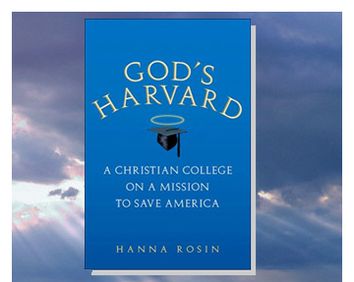
Archer’s rally-the-flock instincts might seem unnervingly precocious, but then, galvanizing the right-wing masses is exactly what he’s being trained to do, in the same way that conservatory students are coached to sail through effortless arpeggios. “God’s Harvard,” Washington Post writer Hanna Rosin’s account of the year and a half she spent on Patrick Henry’s campus in Purcellville, Va., is an in-depth account of the grooming process students like Archer undergo. Like Regent University (disgraced Bush aide Monica Goodling’s alma mater) and Liberty University, Patrick Henry exists for the sole purpose of transforming fundamentalist kids with intellectual chops into America’s future conservative leaders. On paper, at least, the school is ahead of the curve: Since its founding in 1999, its graduates have worked for almost every Republican congressperson, and every year, the 300-member student body scores as many White House internships as Georgetown’s.
More than 80 percent of Patrick Henry’s students — average SAT score 1320 — hail from households where parents approach child rearing like a controlled experiment, home-schooling their offspring to deflect ungodly outside influences. Patrick Henry’s founder, Republican activist lawyer Michael Farris, has sought out these hothouse kids ever since the school’s inception. In his mind, they are the ideal clay from which to mold leaders who express the certainty of their convictions as clearly on the congressional floor as they do in the pulpit. “In conservative circles,” Rosin writes, “homeschoolers are considered to be something of an elite group — rough around the edges but pure in their focus, capacity for work, and ideological clarity.”
Most Americans, if they’ve heard of Patrick Henry at all, relegate it to the same category as schools like Bob Jones University — institutions designed to churn out a never-ending supply of cheerleaders for Christ (prominent Bob Jones alums include TV preacher Billy Graham and “Left Behind” author Tim LaHaye). But Rosin shrewdly pinpoints how Patrick Henry’s mission diverges from that of its less plugged-in fundamentalist peers and why those differences matter. Farris doesn’t just want to produce students who are on fire for the Gospel — he wants to train them to occupy the highest offices in the land, to upend the conventional wisdom that seizing worldly power requires compromising spiritual principles. He doesn’t want “adapters who bend to the will of the mainstream,” Rosin asserts, but “shape-shifters who can move between two worlds with their essential natures intact.”
On the surface, Farris has succeeded with flying colors. It’s only a matter of time, some Hill staffers think, until the first president from Patrick Henry is elected. But shape shifting is a tricky prospect, and Rosin is most compelling when she explores the ways Farris’ vision sometimes unravels as students navigate between the outside world and the college’s insular bubble. Filmmaker Mark Shane is one of the school’s most impressive graduates; he got a White House internship his sophomore year, then nailed down a summer job working for a major television network. But when he returned to campus in the fall, his very success at carrying out Farris’ dictate — making a mark in the secular world — seemed, ironically, to cast a shadow over him. He lost his position as resident advisor, and he started to forgo chaste dorm gatherings in favor of clubs that served up alcohol and exposed flesh. He professed to have kept his faith — “If people are partying and the Holy Spirit says, ‘Get out,’ I have to get out” — but when Rosin pressed him about how he managed to reconcile his lifestyle with his beliefs, he hit a wall. “I don’t know,” he shot back. “I’m only twenty-one years old.”
Patrick Henry professors know that the complicated two-step between secular and religious realms is likely to result in what students call “stumbling,” intellectual as well as moral. Rosin’s explanation of how the faculty gird their young charges against this danger reads like a crash course in Orwellian doublethink. Biology teacher Jennifer Gruenke answers students’ questions “on two levels: one for the secular world and one for Christians.” She assigns them a biology textbook that features a sizable section on primate evolution, but she also endorses the biblical account of creation. Many students feel comfortable shuttling between these two disparate worldviews, a good illustration of how compartmentalized thinking can blot out contradiction. (In this respect, they seem like heirs to Enlightenment philosopher Francis Bacon, who wrote that science and religion should be “kept separate and never mingled or confounded.”)
Patrick Henry’s perennial charge to its students — that they learn to occupy incompatible spheres simultaneously — resonates in unique ways among the school’s female population, and Rosin is an astute chronicler of the fallout. Young women who might have gone to Harvard or Yale had they been raised in other households must reconcile their own desire for high-powered careers with the Christian subculture’s expectation that they retreat into submissive wifely roles.
Though Farris has paid lip service to the importance of educating women, campus rules enforce traditional notions of inequality between the sexes (women are not allowed to lead morning chapel, for instance). It’s “The Feminine Mystique” all over again, with a fundamentalist spin, and many Patrick Henry women cope by retaining only partial awareness of the conflicting messages the school sends. Rebekah Stargel, a blond campus athlete whose Florida legislator father wrote the original Save Terri Schiavo bill, told her parents starting at age 2 that she wanted to join the CIA. She lived in St. Petersburg and studied Russian in pursuit of that goal. When she spoke with Rosin, her visions of the future were downright schizophrenic. “I don’t like the idea of being someone’s wife,” she said. “But I do wanna have like fifteen kids. And I want to homeschool them all.”
It’s easy, based on the book’s title alone, to assume that Rosin is out to demonize the young evangelicals at Patrick Henry, to damn them in the scathing light of their own inflexible beliefs. Indeed, a journalistic hack would have no trouble portraying these kids as miniature Jerry Falwells, not strictly by compromising accuracy but by cherry-picking significant details. (Archer, for instance, dates his conversion to age 6 and writes editorials with tag lines like, “I implore you, my fellow Christians. Do not stand here idle.”)
But Rosin is a better and more honest writer than that. Despite her own aversion to fundamentalist dogma — at one point she states, point blank, that she doubts any of her subjects would ever moderate their views enough to win her vote — she steers largely clear of political ax-grinding. There’s no Al Franken-esque invective against the GOP elite; instead, Rosin approaches her investigation in a more detached, anthropological spirit. Like Naomi Schaefer Riley, who wrote about faith-based campuses in 2004′s “God on the Quad,” Rosin does not seek to pass judgment on the brave new world she is observing, but to probe participants’ complex motivations in order to get a better sense of how it operates. Accordingly, her protagonists come off not as ideologues programmed to the nines, but as vulnerable human beings evaluating their place in life.
One of the book’s subjects, Sarah Chambers, lived with Rosin and her husband, Slate editor David Plotz, for a few weeks while completing an internship in Washington. Chambers grew so attached to the couple’s young children that she gave their daughter a white model horse that she herself had cherished as a girl. One evening, Plotz challenged her: Since our family hasn’t accepted Christ, do you think we’re going to hell? Chambers had to reply. “Yes,” she said finally. “But I’m not jumping up and down with joy about it.” It is at moments like these that Rosin’s narrative rises above the level of culture-war dispatch and becomes, instead, a rare window onto the turmoil that results when convictions anchored in the abstract are exposed to the messiness of reality.
Such evergreen observations aside, it’s impossible not to feel like Rosin’s timing is just a little bit off. The 2006 midterm purge of congressional Republicans and the accompanying surge of anti-Bush sentiment — the born-again president’s approval rating now hovers around 30 percent — have diminished the odds that Patrick Henry students will make an immediate impact on the political landscape. Still, the new breed of savvy evangelical the school is producing will outlast temporary power shifts; the days when religious leaders courted irrelevance by questioning a Teletubby’s sexuality are over. Despite the difficulties involved, students like Archer and Chambers are learning to grasp the delicate balancing act that’s required to straddle two worlds, the importance of assuming protective coloration to ascend within the secular hierarchy. Those outside their narrow sphere would do well to pay close attention.
Continue Reading
Close