Gina Arnold

Badass girls on film

Is it a good thing when women beat the crap out of men at the movies?

“Never hit a girl” is a familiar adage of Western civilization, a mother’s mantra that has been traditionally enforced at least on celluloid, if not in the privacy of people’s homes. Girls hitting boys, however, has never been taboo at the movies, and in the past year, several popular films have exploited its potential as a guaranteed crowd pleaser.

One of the strangest examples of the trend comes in one of the worst movies. In “Miss Congeniality,” Sandra Bullock plays a geeky FBI agent working undercover as a beauty pageant contestant whose “talent” consists of inviting a male colleague (played by Benjamin Bratt) onstage with her and then, to the great amusement of the pageant officials, beating him senseless.

That Bullock, her beribboned black hair twisted into Danish buns over each ear, is dressed in a micro-miniskirt version of a dirndl complete with huge frilly petticoats and knee-high stockings only adds to the fun. And each time she nails Bratt — in the solar plexus, intestines, nose and groin — the audience, both in the movie and in the movie theater, is on its feet cheering.

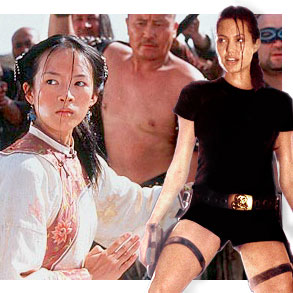
It is the exact same reaction that comes at the point in “Charlie’s Angels” when the Angels pound on an evil henchman to the tune of the Prodigy song “Smack My Bitch Up.” Likewise during “Crouching Tiger, Hidden Dragon,” when the flowerlike Jen (Zhang Ziyi) wrecks the putative bridgework of an entire barful of Chinese thugs.

These are familiar scenes in recent movies, as well as in TV shows like “WWF Smackdown!” “Buffy the Vampire Slayer” and “Xena: Warrior Princess.” Modern video games, like stereotype maker and breaker “Tomb Raider,” featuring sexy ballbuster Lara Croft (who will be portrayed by Angelina Jolie in “Tomb Raider,” the movie), are full of them. This brand of gender-bent havoc is new to a zeitgeist that has been consumed for most of the last century with an entirely different paradigm of feminine mystique.

At least it is new to unsuspecting Americans. In Asia, female cartoon heroines like Lara and martial arts movies featuring nonanimated women action heroes are quite common. “Crouching Tiger” star Michelle Yeoh is, of course, the premier figure in these, but there are many other female Jean-Claude Van Damme types working in Asia, including American karate champion Cynthia Rothrock, who has been a wildly popular action hero in Hong Kong since 1992.

But the woman as action hero is practically a brand-new concept on this side of the Pacific — at least, woman as popular action hero. Until now, the majority of films that cast women in starring action roles have died a sad death at the box office. (We draw a veil over Pamela Anderson’s 1996 bomb, “Barb Wire,” in which the big-bosomed one played a “Crouching Tiger”-like freedom fighter. Or perhaps we should lift the veil just long enough to point out that this film’s extreme unpopularity — and the absurdity of Ms. Anderson in the role — proves how radical a change in cultural perception has occurred since then.)

Barring the occasional Linda Hamilton à la “Terminator” gal to come down the pike, the world of film has usually consigned women in fight scenes to clonking bad guys on the head with vases — and even that has been considered rather feisty behavior compared with the more common image of victim, rescuee or occasional scary man-dyke whose ability to clock the hero is a sure sign of her moral degradation.

Oddly, television has long been a haven for women action heroines. Emma Peel, Agent 99 and Lindsay Wagner as the Bionic Woman are early forerunners of the genus, followed by Xena, Buffy, Dana Scully and now Max, the stunningly beautiful, genetically altered, kickboxing action heroine of Fox’s new series “Dark Angel” (although the latent lesbianism included in some of these ladies — Xena/Gabriel, Buffy/Willow — somehow makes their feats seem less threatening).

Movies, meanwhile, have generally reduced women crime fighters to gun-toting cult jokes: Tamara Dobson in the 1973 trash classic “Cleopatra Jones” and Pam Grier as the title character in 1974′s “Foxy Brown.” A best-case scenario for a female role with guts is that of the smart but duplicitous double-crosser, like Catherine Zeta-Jones in “Entrapment” or a rudely named James Bond heroine/enemy, famously portrayed by Grace Jones (as May Day) and Yeoh (as Colonel Wai-Lin), among others.

Unfortunately, even those women are exceptions to the general filmic portrayal of Woman as Invader of the Soul, a character arc that has long been a staple of American action movies. Sure, she is often disguised as the protagonist, but in fact, her role is that of enemy, temptress, bitch/goddess, what-have-you. That is (apparently) why she must be chased and terrorized and, eventually (if she’s good and submissive, and not bad and bitchy), saved by someone like Mel Gibson.

With few exceptions, that’s been the drill for action movies in the past decade. Indeed, for most of the Reagan-Bush era, one could hardly set foot in a movie theater without seeing a woman terrorized, menaced, raped and sometimes even killed for viewing pleasure. The correlation between the administration and the sensibility may not be clear, but there has certainly been an escalation of violence toward women in the movies. Prior to 1980, women may have been chased and victimized, but they were seldom skinned alive.

One very plausible theory suggests that this type of movie was the direct result of a late-20th century phenomenon known as the angry white male, which was, we are told, a byproduct of feminism, sexual liberation, the downsizing of the economy and the shutting down of factories and farms across the nation, not to mention the general sense of frustration caused by gender-empowering concepts like the ERA, EOE and RU-486, as well as stricter penalities for sexual harassment, domestic violence and deadbeat dadism. Who wouldn’t be pissed off?

The film world’s answer to the AWM’s perceived powerlessness was the fem-jep catharsis — fem-jep being short for “femmes in jeopardy.” It was coined in 1974 to describe a certain type of bondage pornography and then adopted by Hollywood as shorthand for a movie featuring a terrorized woman.

Another creative outlet of the AWM has been the vengeful, misogynistic and wildly popular music of bands like Guns N’ Roses, Eminem, Limp Bizkit and three-quarters of the rap acts that have topped the charts over the past 10 years. The AWM theory also does much to explain the emotional meltdown at Woodstock 99, where there were eight reported rapes, two deaths and 123 people hospitalized — not to mention numerous eyewitness accounts of groping, touching, sodomy, molestation and rape by instrument in the mosh pit and the portable toilets.

What does this have to do with cinematic women warriors of 2001? A lot, I think, because the badass women who have arisen, slowly, throughout the ’90s are one road on a map of the confusing psychological landscape of these times. They are a reaction to oppression — or at least a transmogrification of the angry white male into the docile white wuss. Either way, the fact that these women have emerged from anime-ridden imaginations of savvy film directors is not nearly as startling as the fact that they are being received in a positive fashion.

“Crouching Tiger, Hidden Dragon” is on track to become one of the higgest-grossing foreign language films ever shown in America — commanding hourlong waits in line at the theater — which is amazing when you consider that it is essentially a movie about the voluntary emasculation of a male action hero. (You know: Chow Yun Fat gives his powerful “sword” — nudge, nudge — to a lady whom he is incapable of sleeping with; she fights over it with another lady and gives it back to him, and he drops dead.)

Judging by the ecstatic reception of “Tiger” in the malls of Middle America, one can assume that audiences are thrilled to see women assuming physical superiority over men. And it doesn’t take a genius to make the following leap of logic: Perhaps the sight of women beating people up is pleasurable to men because it reinforces their secret belief that women are the ones in control of our society.

And heck, maybe women are. At least enough progress has been made in the battle of the sexes that women can now be seen as aggressors without being jokes or asexual — and that is a good thing. But there’s a not-so-thin line between crouching and hiding and kicking some male ass. It’s worth bearing in mind that the fount of all female action heroines is China, and China is not known for its equal treatment of the sexes. Perhaps “Crouching Tiger, Hidden Dragon” is a triumph of guilt-driven fantasy. To envision women as warriors at that time is the imaginative equivalent of, well, envisioning women as warriors now.

Today’s America may not be as oppressive as the Ming dynasty, but for all the Lara Croft-inspired imagery one sees in movies today, the examples of such prowess in real life are disappointingly few, and that could become a problem if the boys begin to perceive girls as fair targets.

There is some evidence this has already happened. Dreadful news stories about boys ganging up on junior high school girls have begun to emerge, while in Susan Faludi’s recent book “Stiffed” — a now-familiar treatise on the powerlessness of the modern American male — a teenage member of a gang called the “Spur Posse” explains why he and his buddies prey so cruelly on their female classmates. “Girls,” he says, “have all the power. If you hear a girl scream, are you going to come running? Yep. But if you hear a guy scream, who comes running? Nobody.”

Girls, he adds, “are going to start getting up their courage in a couple years and going head to head with the guys. Fighting them and shit. And girls are going to have to get knocked out. That’s how it’s going to be, dude.”

The interview took place in 1994, and in a twisted way, at least half of this prediction has come true — at least in the movies. No longer are women being portrayed solely as victims in action flicks; more and more, they are becoming the avenging angels, law enforcement agents, evil villains and lethal weapons. They used to be the moral force behind many a complex plot twist; now they are a physical force as well. They are the iron fist, coming down hard on the working man, whether he deserves it or not.

Is this a good thing? Well, yeah, in a way, if only because there are few things more enjoyable than watching the impossibly fragile Ziyi battle Chang Chen in a bloodless duel on horseback in the sands of the Gobi Desert in “Crouching Tiger.” Even Bullock and Bratt’s faceoff on the training mat of their police academy has its lowly appeal to the baser senses.

In fact, what these scenes and others like them have is an entirely new sensibility toward violence. In them, violence isn’t violence as we know it. This violence lacks testosterone, but it also lacks the viciousness that we tend to associate with fighting, leaving in its place an almost healthy feeling of catharsis. There’s even a sense of beauty to some of the sequences. Stripped of danger and cruelty and the ugly and mean competitiveness that taints the violent actions of the male world, these fight scenes can be watched with total equanimity. They feel liberated from the bonds of gender and the tyranny of fear.

That is one way of reading the situation. Another way, however, is more sinister, because most of these scenes are sexually charged. Bullock beats up Bratt in order to seduce him (a wooing tactic she also is shown using — albeit unsuccessfully — on the playground at the age of 9). The Angels use karate like cheap perfume. And for Ziyi and Chang, there is little difference between fighting and making love.

In all these movies, love and violence seem more closely allied than ever, and that development, though shamefully appealing to our primitive side, is dangerous. For if women can beat down men in the movies, how long will it be until the reverse becomes perfectly acceptable — first in the movies, and then in real life?

Dance of the sugar plum anorexics

A mother sues the San Francisco Ballet School to demand diversity of body type.

Last week, as the presidential fracas hogged the headlines and the Middle East fell to pieces, a scintillating bit of news broke without much fanfare: The mother of a little girl in San Francisco sued the San Francisco Ballet School on the grounds that her daughter’s rejection from their program violated her (the daughter’s) civil rights.

According to the school, Fredrika Keefer, 8, “did not have the right body” to even audition for the ballet school’s program. According to Krissy Keefer, the child’s mother and the director of a local dance troupe, Fredrika is “exceptionally talented.” This clash of aesthetic evaluation caused Keefer to file a complaint with San Francisco’s human rights commission. The complaint alleges that the ballet school, which is the recipient of $550,000 in city funds per year, has violated the new San Francisco ordinance that prohibits discrimination against people based on their height and weight.

On the face of it, this dispute has all the elements of a classic “only in San Francisco” brouhaha. It’s local. It’s liberal. And it’s redolent of some of the yuckier modern values that have made this particular place at this particular time the subject of much criticism. (The vast sense of entitlement felt by women like Keefer being only one of the yuckiest modern values that come to mind.) Although in her own dance career Keefer is known as a proponent of socially relevant dance programs, she is not — alas! — a great showpiece for modern mommyhood.

Among other things, Keefer has just held up her child’s body for critical public scrutiny, heedless of the damage that such a move could do to her kid’s psyche. Moreover, she has said she’ll drop the suit if Fredika gets accepted to the school, which leads one to believe she is much more of a litigious bully than a social crusader.

Neither of these stances is easy to defend, but even so there are some ways in which Keefer’s suit looks perfectly justified. Given that the ballet school takes public funds, what better way to strike a blow for feminism than to sue a place which is busily institutionalizing anorexia in the name of Art, Beauty and Tradition?

The fact is, the San Francisco Ballet School, like all other serious classical ballet organizations, fetishizes women who are thin, willowy and fragile. It is upholding values and standards of beauty that are frankly reprehensible, by creating an atmosphere where there is only one correct female body type — and that one is all but unattainable.

Says ballet school spokeswoman Diane Kounalakis in defense of the school’s policy of weeding out students by their physical attributes: “We are not a recreation department.” And she has a point: Recreation departments tend to promote the health and welfare of their attendees. Three years ago, one of the S.F. Ballet school’s graduates, Heidi Guenther, died of anorexia while dancing with the Boston ballet. Subsequent investigation has revealed that this tragic scenario is endemic to the field: A recent PBS documentary, titled “Dying to be Thin,” singles out ballet as an area rife with eating disorders.

And so the debate over Fredrika Keefer rages on — and mostly, it must be said, not in the child’s favor. Last Saturday, San Francisco Chronicle dance critic Octavio Roca defended the ballet school on the grounds that to lower its professional and educational standards in the name of democracy would merely promote “the mediocre and the bland.” “Classical ballet,” sniffs Roca, who trained at the Ballet Nacional de Cuba, “… calls for superhuman technical training and aptitude as well as for extraordinary qualifications. That is why so few people are able to do it.”

The Keefers, he implies, just want their own way, which they are couching in political terms for the sake of expediency. And this may be so. But his argument (and that of the ballet school) is equally disingenuous. Roca calls the school’s strictures against chunky girls “responsible, moral and correct,” but a close analysis shows that the school’s attitude is not so much elitist as merely hard-boiled.

Surely there are plenty of ballet schools with less-stringent admission policies, where even chunky children are imbued with a love of the art of dance; and where the goal is to help girls reach their own dance potential; but the San Francisco Ballet School does not seem to be on that wavelength. It seems instead to be bent on churning out a line of employable ballerinas, presumably, to its greater glory.

As a former college diver and current high school diving coach, that attitude really offends me. I have been the victim of too many coaches whose job security depended on my performance in the pool not to see through this self-serving attitude; moreover, as the coach of a sport that is just as dependent on height, weight and strength ratios as ballet is, I have my own beautiful theories about the necessity of perfect proportions.

Like ballerinas, divers are entirely at the mercy of the laws of physics, which means that body proportion is a component that can never be ignored. Nevertheless, as a coach, I am constantly confronted with inappropriately proportioned divers: teeny gymnast girls who can’t hold the board down long enough to get any spring; heavy girls who fall like bowling balls into the water, and worst of all, my private nemesis, the Tall Skinny Boy.

The Tall Skinny Boy is a menace to any sane diving coach, and yet one year I had five boys pushing 6 feet, each more gawky than the last, including a 14-year-old who stood 6-foot-2. He had feet like soup tureens, a small pot belly and a center of gravity that I swear was in his butt. Everyone who dropped by the pool always said the same thing when they saw him dive: “Why isn’t he going out for basketball?”

I’d sigh. “He did go out for basketball this fall. Diving is his spring sport.”

For a long time one boy, Jesse, was my most trying pupil. At first he couldn’t walk down the board evenly, point his toes, or get into a proper tuck position, and even his most controlled front jump landed him nearly in the shallow end of the pool. The team I coached was loaded with divers, so I could have pulled the plug on him at any moment, and believe me, the temptation was there.

I thought the case was pretty hopeless, but a few months later Jesse won the JV boys’ division of our league. The reason? He was the kid who liked diving best, so he worked the hardest and thought about it the most. In the end, he found ways to defy gravity’s pull — by lengthening his last step and shortening his hurdle, for instance. He did dives the way his body type dictated, not the way I was taught to teach them, and that was perfectly OK with the judges.

Of course, Jesse’s progress at diving exactly represents the “recreational department” mentality that the San Francisco Ballet School has such contempt for. Their ruling philosophy is much more reminiscent of the Soviet-era sports programs in which the children of Eastern Bloc nations were screened in nursery school for participation in sports. Parents — then and now — may wish their children to take part in the rarefied world of ballet as a reaction to the sort of false glamour that surrounds it — the hazy, pink illusory force field that the balletic powers-that-be have managed to maintain over many years. Apparently, that very mystique is crucial to ballet’s survival, for, in order to snake charm the parents of its new recruits, it must remain unattainable: aloof and exclusive, fixated on an ideal that no one can realistically achieve.

Survival, perhaps, is the ballet’s justification for what amounts to preserving itself in aspic. But it is a silly justification, and one that is doing it no darn good, because its “pure” method and exalted standards are not calculated to produce artistic genius. Artistic genius, as dancers like bipolar Nijinski, stocky Anna Pavlova and built-like-Mack-trucks Mikhail Baryshnikov and Mark Morris have proven time and again, comes not from a slender physique, but from some inner place of inspiration. It comes from the heart, the brain and the soul.

Is it possible to tell from a single audition if an 8-year-old — one who does not conform to the ballet school’s strict demand for “a well proportioned body, a straight and supple spine, legs turned out from the hip joint, flexibility, slender legs and torso and correctly arched feet” — has this extra fire? Perhaps not. Maybe Fredrika Keefer, who recently starred in her modern dance troupe’s production of the Nutcracker, has it, and maybe she doesn’t. I don’t think the ballet school should admit her on that off chance, but I do think their policy of not even auditioning girls with the “wrong” bodies is as shortsighted and as wrong-headed as the East German policy in the early 1970s of feeding female Olympic swimmers loads of steroids to ensure their phenomenal growth in strength and size.

After all, some of those girls won medals, but many others didn’t. Win or lose, their health was permanently impaired, their children born with defects, their government and mentors (eventually) covered with shame, and really, all for nothing, for as often as they won, they were beaten just as frequently by athletes who grew up training part-time through the recreation departments of America.

Of course ballet is not a sport, and its performers don’t take steroids. (They take laxatives and purgatives and amphetamines, instead.) But if ballet wishes to claim the higher title of Art instead of Athletics, there is even more reason to believe that an unconventional, even oddly shaped practitioner — a ringer, in fact — could add some indefinable element of grace or meaning to its annals. The history of art has shown that this is always the case.

Besides, the opposite of uniqueness — in body type, in technique, in movement and in personality — is conformity. The San Francisco Ballet School may be well within its rights to exclude Fredrika Keefer from its ranks for not conforming to its ideal, but to the true artist, conformity is sterility, and sterility equals death. Perhaps that’s why the public has fallen away from ballet in the last century, turning to warmer and more expressive art forms instead. The public may not know much about dance, but it knows when the starved, disciplined and perfectly plastic motions it is watching are the moves of automatons rather than artists.

Continue Reading Close

What's so funny about peace, love and understanding?

The worlds of pop and pomp collide at the Nobel Peace Prize concert in Oslo

Have you ever felt like the whole point of this planet is merely to act as a stage for big showbiz productions? Judging by the profusion of entertainment-oriented events in the sociopolitical complex, there may be some truth to that view. For the past five years, the Nobel Peace Prize has been awarded at the Oslo Town Hall on the anniversary of Alfred Nobel’s death, in conjunction with a pop concert meant to be, in the words of Nobel Institute director Geir Lundstadt, “a musical tribute to peace in general and to the peace laureate of the year in specific.” (Past concerts have featured Jewel, Sinéad O’Connor, Mariah Carey and Boyz II Men.) When it was announced earlier this year that the lineup would include the Cranberries, it fueled speculation that the peace prize winners — then unannounced — would be the Irish entrants, John Hume and David Trimble, as indeed turned out to be the case.

Although this year’s concert was somewhat overshadowed by the Amnesty International benefit concert held in Paris the night before, which drew the world music press to its gates with a bill boasting Radiohead, Peter Gabriel and Bruce Springsteen, the Nobel Peace Prize lineup featured Alanis Morissette, Shania Twain and Phil Collins, as well as several well-known international acts.

One has to wonder if the Nobel laureates are as edified by Twain’s presence as she is by theirs. During last Friday’s three-hour event, there were many times when I eyed both Trimble, Hume and His Royal Highness, King Harald of Norway, and wondered what they were thinking. Well, I can only imagine what they were thinking about Shania Twain, who’s extreme prettiness overshadows anything else she does. But is there not an unintentional trivialization that takes place when you add pop to pomp? Though that was my initial thesis, when the concert was over I had to revise my thesis. The Nobel Prize may have dignity on its side, but pop music has a power all its own — a power that can, in certain situations, work its own kind of miracle.

The concert was a relatively intimate gathering, attended by about 2,000 extremely well-heeled Norwegians in smart black coats and boots. But with regard to eclecticism, it had Lollapalooza beat by miles — some of the world’s biggest pop acts, like India’s Pandits ShivHari and Africa’s Oumou Sangare, delivered a fitting homage to the peace process that the Nobel Institute attempts to honor and facilitate.

But make no mistake: It was corny. Cornier than Christmas, cornier than “Cats,” even. I think I cried about 17 times, the first time when Trimble and Hume came into the arena together. Then I cried for the king, because earlier in the day I bought a postcard of him as a sweet little boy on a horse — and now, it turns out, he’s bald. Then I cried for the little boys in sailor suits who sang “God Save the King” in Norwegian. And it was all downhill from there. I managed to stay dry-eyed for the Cranberries and Phil Collins, but just barely. I choked up again when poor President Clinton came on the video screen to congratulate the laureates, and the audience audibly snickered. Luckily, Clinton had learned a sentence in Norske, and when he uttered it — “thanks and God bless” — the giggles turned to cheers.

- – - – - – - – - -

Norway, it seems, is an irony-free zone, which may be why the Nobel Peace Prize is bestowed there. Few non-Norwegians could stay as straight-faced as host Ase Kleveland (apparently Norway’s homegrown version of Joan Baez) did while delivering pious platitudes like “the prize is a flickering flame of hope in the violent darkness” — especially given the failed efforts of recent Nobel Peace Prize laureates, including, sadly, Hume and Trimble. But it must be even harder to utter such platitudes while introducing dopey pop stars who sing mostly stupid songs about sex.

Possibly the worst offenders of decorum were the Cranberries, who opened the concert by unabashedly plugging their upcoming LP. The Cranberries are a surprisingly apolitical band, unless you think of the lovelorn lyrics of songs like “Dreams” and the new “Promises” as a kind of Big Picture take on the Betrayal and Unease of Being Irish. That, however, was a bigger leap of faith than I was willing to make, especially when confronted with Dolores O’Riordan in an itty-bitty gold tank top, leather pants and one of those faux fur coats à la “Velvet Goldmine.” But the lyrics to “Dreams” (“And Oh my dreams, it’s never quiet as it seems”) did remind me of Trimble’s somewhat dark and pessimistic acceptance speech, in which he pointed out that the peace process in Ireland is a long way from being enacted: “[That doesn't mean that] I don’t have dreams — I do — but I try to have them at night.”

The pragmatic Trimble, unswayed by the sappy romantic idealism of Nobelliousness, was probably not the proper audience for the pop fluffiness that followed — particularly the next act, gorgeous Norwegian boy-toy Espen Lind. He sang a song called “Pop From Hell” that was equal parts Bauhaus and Ace of Base. After him, however, the concert became increasingly sentimental. First James Galway and Phil Coultier did “Danny Boy” (which they also performed at the acceptance ceremony). They were followed by Twain, who’s ultra-glamorous version of new country music is just about as far from real country as real country is from the 17th century Irish folk music from which it evolved. I saw a review in the Norwegian paper the next day that referred to Twain as “plastikkdame,” a word that doesn’t really require translation. Nevertheless, her rendition of “You’re Still the One I Want” was pretty moving; having been worked over by Kleveland and an endless slide show of Belfast terrors, I got all choked up during lines like, “They said we’d never make it/but look how far we’ve made it.”

Enrique Iglesias, the Shania Twain of Latin America, was equally fabulous, especially the way he made the words “por favor” last for 15 syllables. Collins, accompanied by a slide show of homeless people, sang two of his “socially conscious” songs, “Both Sides of the Story” and “Another Day in Paradise” — and even that didn’t make me nauseous. Numerous Nobel laureates addressed the crowd via video. A bunch of young schoolgirls sang “O Come All Ye Faithful” directly to Hume and Trimble, who stood awkwardly in front of them with their hands clasped, looking like they hated life.

Presently, Bono came on the video screen to tell us he felt “blessed” that the Nobel Peace Prize went to Hume and Trimble, and that “for the first time in years in Ireland, it feels like the future is more vivid than the past.” A-Ha came on next and rocked my world, and finally Morissette closed the show with “Baba,” “Uninvited” and “Thank U.” As had been the case with Twain’s performance, here Morrisette’s songs were infused with deeper meaning. “How ’bout not blaming you for everything? How ’bout finally forgiving?” she sang, staring straight at Hume and Trimble. “Thank you terror. Thank you disillusionment. Thank you clarity. Thank you frailty. Thank you consequence …” In a single, pure moment, pop idiocy rose right above rhetoric, and somehow it all made sense.

Continue Reading Close

Liquor Giants

every other day at a time -- matador; something special for the kids -- blood red vinyl

The Liquor Giants played in San Francisco last week, opening for the Young Fresh Fellows. Just before they went on, a guy in the pool room said to me, “So who are the Liquor Giants, anyway?”

“Do you remember a band called the Pontiac Brothers?” I said, tentatively. Now at any other gig in the world, this query would have drawn a big fat blank, but this being a Fellows show, and thus full of people for whom 1987 is a crucial year in pop, the guy’s face lit up. “Fiesta in la Biblioteca!” he chanted, and rushed into the main room, where the Giants — led by former Pontiac Brothers guitarist Ward Dotson, with former PoBro singer Matt Simon on drums — were playing a searing yet hilarious set of songs drawn from their two new LPs comprising originals like “Beautiful Flo” and “Riverdale High” as well as covers like Bowie’s “When You’re a Boy,” Carole King’s “Locomotion” and the Move’s “Fire Brigade.”

It was a fairly epiphanic performance, recalling certain glorious days of yore, and it was made all the more poignant because Dotson is one of rock’s great secret heroes. A founding member of the Gun Club, he took a back seat in the PoBros, though their best moments — “Be Married Song,” for example — were when he sang. In the Liquor Giants, however, he is the front man, and one of those rare beings who can combine wittiness and sincerity into an almost heartbreaking mix.

“Every Other Day at a Time” is the Liquor Giants’ fourth LP, and it’s much less Replacementsy (not to mention less Stonesy) than their previous work. Not for nothing does this band cover a song called “Beatles, Please Come Back”: Their music is suddenly Beatlesesque, drenched in huge dollops of Beach Boys harmony laid over chiming guitars and achingly pretty tunes. “Dearest Darling” and “Caroline” have obvious “Pet Sounds” damage, but not every song is quite that catholic: “I’ll Never Mind,” “Medicine Ball Game” and “Multicolored Hipshake” combine similarly simple ’60s tunes — the Hollies often pop to mind — with a far more modern idiom (i.e., “Swinging and cursing as usual,” “Who’s crapping out now?” and “It’s so amusing when you know that you can break me down”).

What Dotson has discovered is a way to make relevant an extremely purist musical stance on pop — a feat he manages by turning up the emotional intensity on songs that would otherwise sound feather-light. He’s also got one of those clever but twisted minds that can make the dopeyist lyric sound poignant, which is a great help when it comes to imbuing Dusty Springfield covers with meaning. Indeed, Dotson’s ability to do this trick is so highly developed that the band has just released “Something Special for the Kids,” a record of obscure covers released on the equally obscure Blood Red Vinyl and Discs label.

According to the liner notes, the impetus behind “Something Special” can be “chalk[ed] up to self-indulgence or perhaps a hankering to bug others.” The record includes songs from a huge range of sources, including the Turtles, the Idle Race, Burt Bacharach, Jeff Beck, the aforementioned Springfield and an all-but-unknown Christian group called the Sons of Thunder; it hearkens back to the type of mid-’80s “the DeFranko Family Were A Lot Better Than They’re Ever Given Credit For” mind-set that eventually led to the plethora of ’90s tribute LPs (not to mention the current overpraise of Hanson). Those LPs have all but wrecked the idea of cover songs, but anyone brought up in the school of hard ‘Mats will still take great pleasure in “Something Special.” An even greater number of people could take pleasure in “Every Other Day,” however, so here’s hoping that they somehow find out about it.

Continue Reading Close

Propellerheads

Decksanddrumsandrockandroll

The day I arrived in London this February, they were holding a huge protest march in Hyde Park — the largest such political gathering in over a decade. Were the English outraged by the Irish peace process, the possible bombing of Iraq or the government’s recently proposed welfare cuts? No. The issue at hand was fox hunting. The protesters, it seemed, were FOR it.

This, then, is the new Britain under Tony Blair: rich, mobile, conservative and seemingly trivial at heart. And a country that is politically trivial-minded is bound to be culturally trivial-minded as well. True, veneration of the Spice Girls and Oasis in the media has waned considerably of late — Kate Winslet is the Girl of the Period now — but they’ve left some slightly sinister legacies: a massive xenophobia (propagated by the success of Britpop and the “Cool Britannia” movement), a bunch of lame imitators and an inflated sense of importance about so-called “djay culture,” aka “electronica,” as it’s called in America, by those who can’t (or won’t) differentiate between things like house, ambient and drum ‘n’ bass.

Not that there’s anything wrong with djay culture — but it has its limitations. And if you take away the Verve, Pulp and Propellerheads, today’s British music scene is all about rap, techno and sampling, i.e., record production rather than songwriting. Stereophonics, Goldie, Aphex Twin, Alabama Three, Chemical Brothers, Roni Size, Fatboy Slim — all are leaders of their own little packs. The latest genre is titled “decks and drums” — or, as Propellerheads’ new LP is called, “Decksanddrumsandrockandroll.”

Propellerheads are the most ambitious of this type of project currently on the market, and also the most well-received. At last month’s South by Southwest music and media gathering in Austin, Texas — always a bellwether of journalistic cabal-making — the Propellerheads show was almost as anticipated and well-attended as that of (Saint) Sonic Youth. This is particularly impressive in Texas, where old-fashioned things like guitar playing and narrative structure and heartfelt lyrics are still highly prized by critics, and songwriters like Jimmie Dale Gilmore, Lucinda Williams, Iris Dement and Mark Eitzel are still rulers of the roost.

A collaboration between Alex Gifford and Will White, Propellerhead is the exact opposite of that type of artistry. But the reason the record is so popular is fairly evident in its grooves. “Decksanddrums” contains a wonderful single called “History Repeating” that is thus far the most mainstream-sounding techno recording on the market. Featuring a vocal by Shirley Bassey (who sang the theme to “Goldfinger”), it may well become the “Walk This Way” of electronica.

That said, Propellerheads may not be the breakthrough the British say they are. After all, their main inspiration is James Bond theme music, as heard on the Bassey number and the tracks “On Her Majesty’s Secret Service” and “Spybreak.” But besides being a rather limited wellspring of possible samples, that’s hardly a unique source to draw on. Portishead have been lifting James Bond theme music for years. So, too, did the Sneaker Pimps on their wonderful 1997 single “Six Underground.” And Moby just did a medley of James Bond theme remixes on his record “I Love To Score.”

Propellerheads also borrow heavily from loungy “bachelor pad” music (Esquivel, Herb Alpert), which recently has made heavy inroads in the indie world, and this has proved a fruitful foundation on which they add guitar and bass-heavy, Chemical Brothers-style beats. The band is much more upbeat than most trip-hop bands (particularly the doom and gloomy Portishead) and the tracks sometimes even have lyrical content. The track “Velvet Pants,” for example, is a clever comment on club culture on which a girl intones, “He’s got a nice body/he’s wearing velvet pants,” while a beefy club owner intones, “Send the kids down.”

In short, Propellerheads are not as ambient as DJ Shadow, nor as disco sounding as Moby or the Crystal Method — and the result is much more appealing. Moreover, their guest stars — De La Soul, the Artist blah blah blah Prince, the Jungle Brothers and Bassey — are far more original and than those used on the Prodigy’s “Fat of the Land.” The result is a deeper and livelier record that may even assimilate itself with fans of more mainstream genres.

According to various English pundits, the current underground dance club/rave scene is as meaningful to its participants as punk or grunge was to its adherents, and will be just as influential in the long run, but I find this hard to believe. English djay culture is absolutely steeped in drugs (mostly E and its derivatives). With few exceptions, the music truly needs that all-night drug boost to be understandable and enjoyable. And no matter what the media says, it’s dance music, pure and simple — and dance music has never had a long shelf life. When it comes to longevity, my bet’s on Austin, where narrative, melody and good old-fashioned heart still count.

Continue Reading Close

Sharps and Flats: Madonna

I know a 15-year-old girl who calls her gym teacher “Mo.” It’s short for “Madonna,” and as you might imagine, it’s not a term of endearment. I recently asked her whence she derived this epithet, and she said, “‘Cos she’s just like Madonna — she’s got bleached hair and wears stretchy exercise clothes and is all ’80s-ed out.” To kids who were born in 1983 — the year that Mo’s self-titled debut came out — Madonna, despite all her innovations and subversions and gender groundbreaking, is nothing more than a slightly rattled femme fatale, the kind of woman who dresses too young for her age.

Of course, this happens to everybody. But somehow I thought that with all her stylistic flexibility, Madonna, like David Bowie before her, would be exempt from the process. And in some ways, thanks in part to all those costume changes, she is. Madonna is not quite yet a caricature of herself, unlike Robert Smith of the Cure, Boy George or Michael Jackson (all of whom also had hits in 1983); nor is she a somber and wrinkly dinosaur, like Neil Young, Bruce Springsteen or Bono.

After all, unlike those artists, Madonna’s contributions have been more than just musical: One way or another, she’s pretty much been directly responsible for the broadening of sexual mores in American media over the past decade, paving the way for things like the sight of Jimmy Smits’ butt on “NYPD Blue” and Ellen coming out of the closet, as well as the more sexually explicit cheerleading routines at football games and the blatant use of the word “penis” on television news.

Now some of those things are good, some are bad and most are fairly unimportant. But an enlightened individual can see the connection between those things and the fact that the general population today is less fearful and better equipped to confront without flinching things like AIDS, teen pregnancy, condom-use and abortion — and for that, Madonna should be proud. She always strove to be more than a pop star, and given that her chosen field of play has been dance-pop, the fact that she’s succeeded at all is a pretty awesome achievement.

People sometimes question Madonna’s input on her albums, citing the numerous musical collaborators cited on their sleeves as proof that she is merely some kind of manipulative conductor of other people’s talents. But Madonna must contribute something beyond mere vocals, because her body of work over the years is emotionally and artistically cohesive; it sounds like the work of one artist, and “Ray of Light” is no exception. That said, where Madonna has shown the most growth in the last few years has been as a singer. On a strictly technical level, her singing on “Evita” was wonderful, and on “Ray of Light” it’s even better, a pure and evocative stream of sound.

Produced by ambient artist William Orbit (who remixed “Erotica” and “Justify My Love,” in addition to songs by Peter Gabriel and Depeche Mode), the record seeks to push the bounds of electronica a bit — and does a much better job of it than similar efforts by U2, Bowie and the Rolling Stones, for whom “going electronica” meant “hire the Dust Brothers and be done with it.” Unfortunately, the ideas are much more interesting than the reality. Gone are Madonna’s usual indelible grooves and hooky melodies; in their place is a spooky amalgam of technical skill and sentimentality, a strangely inert combination.

“Ray of Light” is also clearly inspired by the trip-hop of Portishead and Sneaker Pimps, but where those bands match their detached musical vision with bleak, deadpan vocals, Orbit’s soundscapes don’t quite meld with the sweet, lyrical romance that is Madonna’s forte. The single, “Frozen,” is a good effort — and I appreciate her super-literal interpretation of trip-hop’s innate emotional coldness — but elsewhere, the concept falters. “Skin” and “Candy Perfume Girl” have disco backgrounds barely diluted by lots of dubby samples, drop-outs and sporadic acoustic guitar and string additions.

“Ray of Light” seems unlikely to capture the attention of those 15-year-old girls who haven’t really journeyed with Madonna beyond the “Material Girl” phase of her existence: It’s simply not upbeat enough. Moreover, it’s sentimental lyrics just miss being sophisticated enough for real trip-hop fans: “Give yourself to me” and “Freedom comes when you learn to let go” are pretty banal things to put into such eerie music. Likewise, “Kiss me, I’m dying” sounds like an outtake from a Garbage song.

But “Ray of Light” is certainly not garbage, by any means. It is a flawed but beautifully crafted piece of conceptual art, and it does have some highlights. One of the best songs is the title cut, which is sung in a much higher key than most of the other songs and thus lacks the pomposity that seems to be Madonna’s main contribution to the ambient genre. “Shanti/Ashtangi,” which uses Indian raga beats and Sanskrit, was inspired by Madonna’s newfound love of yoga (or perhaps a familiarity with the trendy band Cornershop), and despite its New Age affectations, it’s the song with the most compelling groove on the album.

That’s about as sexy as Madonna gets on “Ray of Light”; she has removed all mentions of earthly love as the wellspring of lust and passion and replaced them with more spiritual reflections on the Power of Love. But alas, these very reflections work to negate some of the best aspects of her art. “God has sent me a gift,” she sings on the LPs smarmiest song, “Little Star,” “of flesh and blood.” Such a corny sentiment seems terribly conventional — but then, despite her ability to piss off David Letterman, Madonna has always been kind of conventional at heart. Indeed, her success has lain partly in the fact that she’s never underestimated how easy it is to shock America. If she hadn’t combined her slight subversions with the conventional imagery of Catholicism, she’d never have gone anywhere at all.

Madonna also makes being a 39-year-old woman look pretty darn good. But that, alas, is not enough. To be a truly evolved human, Madonna would have to change mentally as well. According to her most recent Vanity Fair snow job, having a child has caused Madonna to reassess her values, a process that — according to VF’s unctuous reporter — emerges on “Ray of Light” as the inevitable “newfound maturity.” But Madonna’s insistence on finding herself proves to be a boring theme, and “Ray of Light” has an irritatingly saintly atmosphere. “When I was very young/nothing really mattered to me/but making myself happy,” begins, “Nothing Really Matters.” Guess what Madonna has learned? “Love is all we need.” There is also, she says later, “no greater power/than the power of goodbye.” Huh? “Mer Girl” is a lengthy and far too expository piece of writing in which Madonna twitters, “I ran through the forests/I ran past the trees/I ran and I ran/I was looking for me.”

If having a child has allowed Madonna to find herself, then more power to her. But sometime around 1995, the lady began to lose me. When she began blah-ing on at length about her great admiration for and identification with Nazi sympathizer Eva Peron, I started to feel a little queasy about her intellectual integrity. I really needed “Ray of Light” to be a good LP to put the lady back on her pedestal — but unfortunately, once that chink of doubt creeps in, it stays there, an entirely unwelcome guest. I’m not ready to recant on Madonna just yet; but I’m beginning to think that maybe, when it comes to pure pop, the 15-year-olds really do know best.

Continue Reading Close

Page 1 of 2 in Gina Arnold