Hannah Tepper
The porn identity
From Lisa Ann to Dale Dabone, performers choose their names for a reason. We spoke to the experts about why
(Credit: Salon) What makes a good porn star name? As the childhood game goes, you can combine your first pet with the street you grew up on to find yours. (In my case, it’s Max Harvard.) But the truth is, some names just sound porn-y: For women, it’s names like Amber, Tiffany and Britney. For guys, it’s Lance, Brock and Butch. But what makes these names pornier than, say, Edith and Barnaby? What makes a porn name work?
While pornographic film has ostensibly been in existence since the birth of the moving image, the porn star name did not take hold until the 1970s, when the rise of adult theaters and the emergence of full-lenth mainstream porn films such as “Deep Throat” (1972), “The Boys in the Sand” (1971) and “The Devil in Miss Jones” (1973) created a new space for pornographic actors and actresses to become popular icons. Some argue “Deep Throat’s” Linda Lovelace was America’s first household “porn name.” Other porn stars like Bambi Woods, Seka and Johnny Wadd followed suit.
Porn icon Annie Sprinkle, who has been in the industry for the past 38 years and has worked in films big and small with costars such as Sharon Miller, Harry Reems and Vanessa Del Rio, remembers the process of shedding her old name for a new porn one and a new persona in 1973. “I didn’t want to use my real name, Ellen Steinberg. That was not sexy,” Sprinkle recalled. “I was lying in bed, I needed new name, and I heard a voice that said, ‘Sprinkle.’ I liked that word because I’ve always liked swimming and I fancied myself a mermaid,” Sprinkle remembers. This porn-name-as-rebirth story is common among the stars who choose to leave their old identities behind and rechristen themselves. The most practical reason for the porn name, however, is to keep family and friends unaware of the porn star’s new line of work, one that would be an unwelcome surprise to many family members.
“My name helped me to totally change who I was, what I didn’t like about myself, and become who I wanted to be. You can change your consciousness by changing your name and you can change other people’s perceptions about you.” For Sprinkle, the name also preceded her onstage reputation. “I didn’t pick my name because I like golden showers, but I came into that. People assumed that I was golden shower girl because I had a name like ‘Sprinkle.’”
But the porn industry, and porn names, have changed drastically since the 1970s. Annie Sprinkle recalls trends in the names of female porn stars through the ’80s, ’90s and 2000s. “The big trend was doing a takeoff on celebrity names like Angelina or Jennifer, but that came in the ’80s and ’90s. Many girls take on celebrity names, funny names, super-explicit names, elegant classy names, or girl-next-door like ‘Sunny Leone.’ But all of these names imply sexual fantasies.”
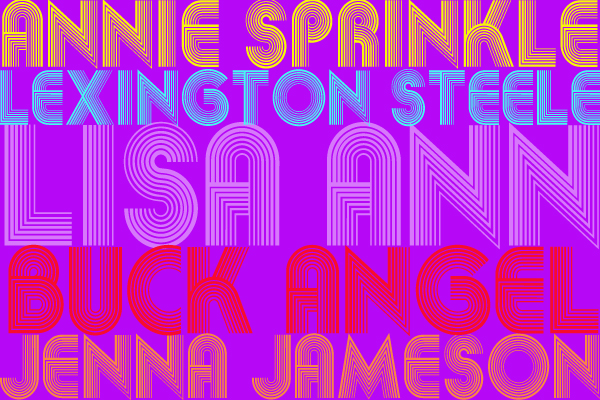
Today the major names in porn include Jenna Jameson, Alexis Texas, Sunny Leone, Joanna Angel and Lisa Ann. Female porn star names often subtly or not-so-subtly indicate aspects of a performer’s sexuality or physical characteristics, using puns, tongue-in-cheek allusions or direct references to famous porn stars of the past. They can be serious or funny, sultry or playful, original or generic. In the straight and gay porn world, men tend to go for hyper-masculinity. Famous male performers include Nick Manning, Francois Sagat, Jack Lawrence, Lexington Steele, Dale Dabone and Tyler Knight.
The Internet shifted the way adult film stars named themselves. Steven Hirsch, founder and co-chairmen of Vivid, explains that today domain names have serious influence over what an adult film star will choose to be called. “This is not 20 years ago. These girls have agents and managers and their names are well thought out,” Hirsch explained. “The actresses understand the value of websites, they understand the value of social media, and nowadays they want to own the dot-com equivalent of their name.” The studio rarely if ever intervenes in the process. “In the past we have helped a few of the girls pick their name, but at this point most of the girls that come into the studio are fairly well set on a name before they even meet with us.”
For Arnold Zwicky, a professor of linguistics at Stanford University who writes and blogs about the linguistics of porn, a porn star’s name is a huge part of his or her persona. “[In the case of men] the names will most commonly have a one-syllable first name ending in a consonant and a two syllable, initially accented last name,” said Zwicky. Think Buck Williams or Scott Hardon. “A lot of those first names are chosen to evoke social domains of high masculinity, like cowboys, or they are more directly phallic, like Lance and Rod,” Zwicky explained.
Jack Shamama, a porn writer and producer who has seen many young gay male stars through the process of choosing a name, believes there is a direct correlation between trendy baby names and porn stars’ names. “One of my nieces’ names was a really popular baby name, and two or three years later suddenly all of these porn stars started cropping up with the same name. Afterwards I looked up statistics on the popular babies’ names for that year, and I noticed that a lot of porn stars had mirrored those statistics pretty closely. For gay men, since they are not having children, they take the names that their family members are giving their kids.” Shamama also noticed that gay porn stars tend to reappropriate the names of important people from their past, “someone who they either had a crush on, or someone who has impacted them positively or negatively,” said Shamama. “It can even be the name of a guy who picked on them in school.”
But a porn name is, in the end, just a marketing gimmick — and a successful porn performer needs to be a good, well, performer. As Hirsch puts it, “Ultimately it’s about the girl; how good she is, if she can act, how good the sex is, and how she connects with the audience. It’s less about the name than any of those other things.”
The scientific argument for being emotional
New research shows that our feelings are more important to our health than we ever thought. An expert explains
(Credit: Salon/DG Strong) At the end of his second year of Harvard graduate school, neuroscientist and bestselling author Richard Davidson did something his colleagues suspected would mark the end of his academic career: He skipped town and went to India and Sri Lanka for three months to “study meditation.” In the ’70s, just as today, people tended to lump meditation into the new-age category, along with things like astrology, crystals, tantra and herbal “remedies.” But contrary to what his skeptics presumed, not only did Davidson return to resume his studies at Harvard, his trip also marked the beginning of Davidson’s most spectacular body of work: neuroscientific research indicating that meditation (and other strictly mental activity) changes the neuroplasticity of the brain.
Continue Reading ClosePraying to be skinny and straight
An expert explains what evangelical weight-loss and ex-gay movements say about America -- and us
(Credit: iStockphoto LincolnRogers) Fatness and gayness have a few things in common: They are both highly charged social issues that can anger people in ways few other things can. To many people, they both represent a sinful inability to control urges – in the case of fat folks, to eat food, and in the case of gay people, to have sex. In evangelical circles, however, fatness and gayness are not just stigmatized, they are actively fought.
In her eloquent new book, “Seeking the Straight and Narrow: Weight Loss and Sexual Reorientation in Evangelical America,” Lynne Gerber examines the ways these two separate issues interact in that most morally stringent segment of American culture. A University of California, Berkeley, scholar in residence whose work emphasizes intersections of sexuality, bodies and health in contemporary Christianity, Gerber spent more than three years documenting evangelical weight loss and ex-gay culture, primarily in two evangelical ministries, First Place, a weight loss group, and Exodus, an ex-gay ministry with aims to train gays into straightness. Along the way, Gerber unpacks the historical influence of evangelicalism on American society, while providing a thoughtful look at real people struggling to change.
Continue Reading CloseThe evolution of American debt
Over the last century, over-borrowing has gone from shameful to commonly accepted. An expert explains what changed
(Credit: Lightspring via Shutterstock) In the US today, debt is ubiquitous. Whether it’s paying back thousands of dollars in student loans, using your Visa card for a pack of gum when you’re out of cash, or taking out a mortgage on a first home, it’s been woven into our financial system so tightly, that even when we suffer the sometimes cruel and unusual detriments of borrowing, we have little to no realistic impetus to stop. But it wasn’t always this way. In fact before the 20th century, debt was a taboo, feared, shameful, and kept in the shadows. So what events and institutions brought debt from its meager beginnings to its central role in American life?
Continue Reading CloseWhy we make bad decisions
From Occupy Wall Street to online dating, our surroundings can dictate the choices we make. An expert explains
(Credit: VLADGRIN via Shutterstock) What role do our surroundings have in the choices we make? Consider the fact that we are more likely to commit a “random” act of kindness toward a person who has already done something kind toward us. We are less likely to help someone in serious trouble when we’re in a crowd, or choose different professions based on the sound and spelling of our first names. It turns out the context in which we make our decisions has a huge impact on their outcomes.
In his new book “Situations Matter: Understanding How Context Transforms Your World,” author Sam Sommers, an associate professor of psychology at Tufts University, looks at what context can teach us about everything from test questions to romantic partners to career choices. Sommers offers a fascinating glimpse into the way our most important judgments are framed by the world around us.
Continue Reading CloseWhy women need fat
Evolution shows that women's dieting beliefs aren't just unrealistic -- they're unnatural. An expert explains
(Credit: iStockphoto/oonal) On any given day, more than half of women in the U.S. are on a diet. In hopes of slimming their figures, millions take on Atkins, South Beach, Lean for Life or Hollywood 48. Some never eat after 5 p.m.; others only eat Subway sandwiches. While the diet industry has a less than noble reputation, it’s clear that American women, far more than men, remain obsessed with dieting. But what can evolutionary biology tell us about gender difference and eating habits?
In a new book called “Why Women Need Fat,” Steven J.C. Gaulin, an evolutionary biologist, and William D. Lassek, a retired doctor of public health at the University of Pittsburgh, explain the science behind women’s unique relationship to their diet. In the book, Lassek and Gaulin make a surprising argument for a more positive outlook on fat and illustrate the differences between the ways women and men gain weight. Think of it as the evolutionary biology diet.
Continue Reading ClosePage 1 of 2 in Hannah Tepper