Ian James

Venezuela’s Chavez back on the air after silence

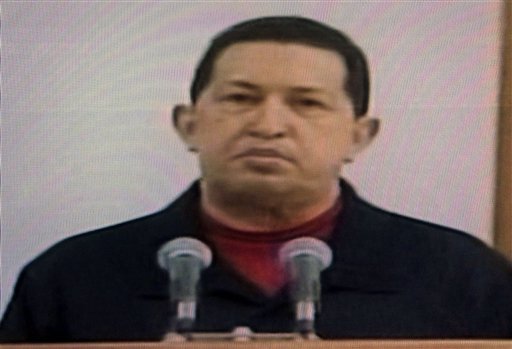
CARACAS, Venezuela (AP) — Venezuelan President Hugo Chavez said on Monday that he expects to return to Venezuela in the coming days after finishing his latest round of cancer treatment, and is looking ahead to this year’s election campaign.

Chavez spoke in a telephone call aired on state television for the first time since he traveled to Cuba a week earlier. During the past week, he instead communicated with supporters through messages on Twitter.

“The opposition isn’t going to win presidential elections in Venezuela, never, ever again,” Chavez said. “We’re going to give them a devastating knockout.”

“I’m not campaigning still,” Chavez said, adding that he is carrying out his duties from Cuba “but in a special situation, from which I will emerge in the coming days and I will soon be there.”

Chavez noted that the presidential campaign will last three months ahead of the Oct. 7 vote, when he will go up against rival Henrique Capriles.

“I aim to get close, for us to get close, to 70 percent of the vote,” Chavez said. “We’re going to work very hard.”

He also criticized his political rivals saying they lack organization and a clear political project.

The 57-year-old president has been in Cuba since April 30 undergoing his latest round of radiation therapy treatment. He began the radiation treatments in Cuba in late March after an operation in February that he said removed a second tumor from his pelvic region.

Chavez’s longer absences from the public eye and uncertainty surrounding his illness have recently fed rumors in Venezuela that cancer could interfere with his re-election hopes.

But Chavez on Monday expressed optimism saying that in “the next period from 2013 to 2019, with the grace of God, we’re going to refine much more the construction of socialism.”

“We have to keep strengthening our leadership, and… when I say leadership it’s not only the leadership I exercise, but rather collective leadership,” Chavez said.

He also stepped into international affairs, saying he hopes the victory of Socialist Francois Hollande in France’s presidential election “marks a turn” for the country. Chavez called the outgoing administration of incumbent Nicolas Sarkozy “a terrible government” that had acted in concert with the U.S.

“Look at how the French government ended up, subordinated to the Yankee empire,” Chavez said, criticizing the French government’s role in last year’s conflict in Libya.

Venezuela’s Chavez active, upbeat on TV in Cuba

In this photo released by Miraflores Press Office, Venezuela's President Hugo Chavez, left, kisses a crucifix beside his daughter Rosa in Havana, Cuba, Monday, April 23, 2012. President Hugo Chavez reappeared on television Monday after an eight-day silence, scoffing at rumors that his health took a turn for the worse and saying he plans to be back home Thursday after his latest round of cancer treatment in Cuba. (AP Photo/Miraflores Press Office/Estudios Revolucion)(Credit: AP)

CARACAS, Venezuela (AP) — Venezuelan President Hugo Chavez appeared in video images for the first time in 10 days on Tuesday, chatting with aides and relatives in an upbeat outdoor encounter that allowed him to show supporters he remains vigorous despite his cancer treatment in Cuba.

The video, which was shown on Venezuelan television, displayed Chavez playing “bolas criollas,” a Venezuelan game similar to lawn bowling. It was Chavez’s first appearance in video since he traveled to Cuba on April 14 for his latest round of cancer treatment.

Chavez wore a track suit as he talked and laughed with his elder brother Adan and Foreign Minister Nicolas Maduro in a garden in the edited images shot on Monday. Chavez put an arm around one of his daughters and gave a high-five to his grandson.

“I feel very, very happy within this treatment process,” Chavez said. “We continue in the treatment, facing the difficulties, governing, making decisions on policies.”

Chavez also made a telephone call to the television station on Monday, saying that he plans to be home Thursday. Earlier in his Cuba stay, Chavez had communicated only through messages on Twitter and other written statements.

Chavez urged supporters not to pay attention to rumors about his health, saying: “to foolish words, deaf ears.”

The Venezuelan leader began radiation treatment in Cuba in late March after undergoing an operation in February that removed a second tumor from his pelvic region. The first tumor was taken out last June, and he then underwent chemotherapy.

Chavez has kept secret some details of his illness, including the type of cancer and the precise location of the tumors.

Chavez is running for re-election in October, seeking another six-year term.

In his typical fashion, Chavez chided the U.S. government and also praised Venezuela’s voting system. He echoed remarks a day earlier by Tibisay Lucena, the president of Venezuela’s National Electoral Council, who said Venezuela’s voting system is sophisticated, trustworthy and transparent.

“If someone has proof to the contrary, I ask them to bring it out,” Chavez said. “But I say there’s no other electoral system on this planet that’s as transparent, as efficient, as good, as ours.”

President Barack Obama said recently that, as with elections in any country, the United States wants to see free and fair elections in Venezuela. Lucena responded on Monday when asked by a reporter, saying she hopes the upcoming U.S. elections are transparent and that she believes Venezuela’s automated voting system is more thoroughly audited than elections in the U.S.

Chavez praised her comments saying: “That’s one of the responses for the empire and for Mr. Obama.”

“How is … Obama going to say he hopes there are transparent elections? We hope there are transparent elections in the United States,” Chavez said. “Obama, take charge of governing your country. That’s one of the problems in this world, that the United States wants, tries to continue dominating the world. No, the world is now too big for the United States.”

Continue Reading Close

Cancer hasn’t dimmed Hugo Chavez’s electoral hopes

In this photo released by Miraflores Press Office, Venezuela's President Hugo Chavez speaks during a televised program from the Miraflores presidential palace in Caracas, Venezuela, Wednesday April 11, 2012. Chavez returned to Venezuela Wednesday night and said he's "doing well" following cancer treatment in Cuba. Chavez flew to Cuba last week for his third round of radiation therapy. Pictured left is Venezuela's Vice President Elias Jaua. (AP Photo/Miraflores Presidential Office)(Credit: AP)

CARACAS, Venezuela (AP) — With less than six months left until Election Day, Venezuelan President Hugo Chavez has hardly hit the campaign trail. Instead, he has been consumed with his fight against cancer, repeatedly traveling to Cuba for treatment and publicly vowing to defeat his illness.

While cancer would end the presidential ambitions of many politicians, Chavez’s struggle against the disease has in fact become his main rallying cry. Cancer could serve as a political asset if his health holds through the October vote, and that’s the big “if” hanging over Venezuelan politics.

Last week, Chavez offered his starkest outlook yet as he wept while holding hands with his parents at a Mass and then pleaded to Jesus Christ to give him more life.

“Give me your crown, Christ,” Chavez said in live footage broadcast nationwide. “Give me your cross, 100 crosses. I’ll carry it, but give me life because there are still things left for me to do for these people and for this homeland. Don’t take me away yet.”

Chavez said later that he has faith in a “miracle” as he undergoes radiation therapy in Cuba following two surgeries that removed tumors from his pelvic area.

So far, what appears to be a serious life-or-death crisis hasn’t dented his political support. To the contrary, one recent poll showed Chavez with a lead of 14 percentage points over rival Gov. Henrique Capriles. The poll by the firm Datanalisis had a margin of error of 2.5 percentage points.

Chavez has managed to hold on to support even while his main image has been that of an ailing president climbing or descending airplane stairs on his frequent flights to and from Cuba for treatment. On top of that, many Venezuelans are supporting him despite 25-percent inflation and one of the worst homicide rates in the world.

Information Minister Andres Izarra, one of Chavez’s key aides, said on Monday that the president won’t be out campaigning door-to-door like his rival because “he doesn’t need to.” Izarra also said Chavez’s spirits are being lifted by his supporters.

“That love of the people, it’s arisen like a balsam, like part of his medicine, like part of his treatment to completely recover,” Izarra said during a televised speech.

On Friday, Chavez is expected to rally his supporters on the 10th anniversary of his return to power after a short-lived 2002 coup, and he has drawn a parallel between his cancer fight and his survival during that coup, when he was restored to the presidency amid large pro-Chavez street protests.

“At that time, the love of the people rescued Chavez from the edge of death,” Izarra said. “This time the love of the people is also rescuing Chavez from a particular health situation, in which if it weren’t for that love, I’m sure his ailments would perhaps be greater.”

Eduardo Gamarra, a Latin American studies professor at Florida International University in Miami, said compassion elicited by Chavez’s illness “has naturally played to his advantage in the electoral process.”

“Not only President Chavez but certainly his supporters and certainly the people handling his political campaign are taking full advantage of it. And I think it would be crazy for them not to do so,” Gamarra said.

Chavez’s illness also presents a challenge for the opposition, Gamarra said, because it might appear “cold and callous” to attack a seriously ill leader.

For both sides in Venezuela’s divided political landscape, Chavez’s illness has the potential to be a game-changer. The subject of what would happen if Chavez were to die is taboo among his political allies, as leaders of his United Socialist Party of Venezuela insist that Chavez will be their candidate and that there is no backup plan.

In the meantime, Chavez is adeptly using the uncertainty to once again cast himself as the protagonist in a larger narrative, at times evoking his own tragic hero, 19th century independence leader Simon Bolivar, who survived an assassination attempt and then resigned the presidency amid failing health. Many historians believe Bolivar died of tuberculosis,

At a televised meeting this week, Chavez said the independence leader had been “left without people, left without soldiers.”

“What a painful end,” Chavez said.

In speeches and rallies, Chavez has regularly shouted the slogan: “We will live and we will win!” It appears to be both his personal mantra and his political bet.

The odds of that bet remain unclear. Since he announced his diagnosis last June, Chavez has kept secret specifics about his illness such as the type of cancer and the precise location of the tumors that have been removed.

Some medical experts say based on Chavez’s accounts, it’s very possible his cancer could come back yet again.

“The tumor is recurrent, and to us that indicates that his chances for a cure are minimal because in cancer care, the best treatment is the first treatment,” said Dr. Julian Molina, an oncologist at the Mayo Clinic Comprehensive Cancer Center in Rochester, Minnesota. He noted that Chavez underwent surgery for a second tumor in February, indicating that his chemotherapy was ineffective.

Other medical experts say that depending on the type and grade of Chavez’s cancer, the outlook might not be so grim.

Given Chavez’s treatment regimen, he could have a soft-tissue sarcoma, said Dr. Steve Hahn, professor of radiation oncology at the University of Pennsylvania’s Perelman School of Medicine.

“It’s not necessarily pessimistic,” Hahn said. “If he had a low-grade sarcoma, then he really has very little chance of it spreading elsewhere and the radiation, if it prevents it from coming back in the pelvis … that should pretty much hopefully be the end of the story for him, end of the story meaning control of his disease.”

Chavez’s face has at times appeared puffy during his cancer treatments, and in September he acknowledged taking steroids along with other medications. Doctors say steroids can be prescribed as an anti-nausea medication to cope with the effects of chemotherapy and can help increase appetite and energy levels. Molina noted that excessive steroids use can spur side effects such as fluid retention, mood swings and increased blood pressure.

“It’s always possible that they gave him a short course of steroids, he felt good, and then he requested that, you know, keep on this. It’s very hard when you’re a president and you have the powers to say ‘this is what I want to do,’” Molina said.

The dearth of hard information about Chavez’s illness, as well as the fluctuations in his tone and appearance, have fueled speculation and rumors about Chavez’s health in the Venezuelan media and on the street.

Chavez, for one, has urged political allies not to waste time responding to the gossip.

Chavez communicated with the nation on Wednesday through several messages on his Twitter account while finishing his latest round of radiation treatment in Cuba.

“I’m putting on my combat boots!” one of the messages read. “Wait for me!!”

That night, Chavez made yet another homecoming at Caracas’ airport, smiling as he descended the airplane stairs next to one of his daughters and saying he was doing well. He appeared vigorous as he chatted with aides at the presidential palace and reminisced about the 2002 coup during a televised talk that ended nearly an hour after midnight.

Chavez’s legions of supporters have shown intense loyalty to their hero, regularly gathering at government-organized events to pray for his health.

On a downtown Caracas avenue, lampposts have been festooned with banners showing a healthy Chavez smiling and wearing the red beret of his years as an army paratrooper, along with the slogan: “Onward Commandant!”

At one recent pro-Chavez rally outside the presidential palace, Magalys Martinez said she’s optimistic Chavez can overcome his illness.

“He very much wants to live,” said Martinez, herself a cancer patient. “For this illness, what he needs to have is ambition to live.”

Another supporter at the rally, 63-year-old Bernarda Mena de Palacios, said she’s thankful to Chavez for a government-run education program that helped her earn her high school diploma.

“We’re praying for the president,” she said. “I have faith he’s going to come out victorious. We can’t lose a president like him.”

___

Ian James on Twitter: http://twitter.com/ianjamesap

Continue Reading Close

Death of consul’s daughter spurs Venezuela outcry

Chilean Consul in Venezuela, Fernando Berendique, right front, helps to carry the coffin with the remains of his 19-year-old daughter Karen to a waiting hearse, in Maracaibo, Venezuela, Saturday March 17, 2012. Berendique said his daughter was shot early Saturday, while riding in a vehicle with her brother and another young man, when the trio ignored a command to stop by police at a checkpoint, fearing the officers might be robbers. The Prosecutor General's Office says in a statement that 11 police officers are under investigation for their roles in the death. Berendique's daughter is reported to have died after suffering three bullet wounds. (AP Photo/Fabiola Portillo)(Credit: AP)

CARACAS, Venezuela (AP) — The killing of a Chilean diplomat’s teenage daughter by police is reigniting concerns among Venezuelans about excessive force by officers and their frequent involvement in violent crimes.

Nineteen-year-old Karen Berendique was riding in a vehicle with her older brother and another young man when police at a checkpoint opened fire early Saturday in the western city of Maracaibo, said her father Fernando Berendique, Chile’s honorary consul in the city.

He said they disobeyed a police command to stop, fearing the officers might be robbers.

Twelve police officers were detained and are under investigation, the Justice Ministry said.

Radio program host Beatriz Navas said Sunday that she thinks the case illustrates the deep concerns many Venezuelans have about police misconduct.

“I wouldn’t have stopped and they would have killed me, too,” Navas said. “The problem is that we don’t believe in the police.”

She criticized the widespread practice by police in Venezuela of setting up such checkpoints, saying officers should instead be investigating crimes.

President Hugo Chavez’s government expressed condolences to the family as well as to the Chilean government, and pledged that those responsible will face justice.

“We reject and repudiate this type of bad police practice,” judicial police chief Jose Humberto Ramirez said.

He said the officers were in the area to investigate car thefts and hadn’t set up cones as police typically do for checkpoints. Ramirez called the shooting inexplicable.

“They’ll have to respond in criminal court,” Ramirez said.

Violent crime is widespread in the country, which has one of the highest murder rates in Latin America.

Venezuelans have long been distrustful of the police. The government began building a new national police force in 2009, saying it was part of an effort to professionalize the police.

Justice Ministry Tareck El Aissami said in 2009 that the authorities believed police were involved in 15 to 20 percent of all crimes, particularly kidnappings and murders.

The Justice Ministry said in a statement Saturday that the government will “continue promoting the radical transformation of police forces, deepening the implementation of the new police model: human and professional.”

Opposition politicians joined in the criticism over Berendique’s killing.

“They shoot first and aim later,” Ricardo Sanchez, an opposition lawmaker, said at a news conference Sunday.

He said that many questions remain about the behavior of the officers who opened fire on the Chevrolet TrailBlazer and that police officials should be summoned for questioning before the National Assembly.

Berendique’s father told reporters Saturday that his daughter was on the way to see some friends when she was shot.

“They left and four blocks from my house they intercepted them,” Berendique said, saying the officers didn’t show any identification. “They told them to stop. The kids got nervous because it was night. The least that could have been expected is that the police would have turned on the lights (of their patrol cars). They didn’t do it and they fired.”

“The first impact was in the windshield, while my son was desperately backing up,” Berendique added. “Seeing that Karen was unconscious and wounded, he stopped. The officers identified themselves and said they fired because they didn’t stop the car.”

Police said the university student suffered three bullet wounds, including one to the head.

Berendique said the car appeared to have been hit by six bullets. He suggested his daughter’s killing is symptomatic of bigger problems in Venezuela.

“Crime is killing us,” said Berendique, who has lived in Venezuela three decades. “I don’t think Venezuela deserves this.”

In a downtown plaza in Caracas on Sunday, Francisco Rodriguez was taking a stroll with his two young children and said the death of the consul’s daughter worries him and reinforces Venezuelans’ distrust of the police. He noted police have been arrested for involvement in kidnappings and other crimes.

“This is a case that obviously is going to make a lot of noise due to the person involved, but this is happening to common citizens all the time,” said Rodriguez, a publicist. “The problem is that the people who are supposed to defend and protect us from crime act like this.”

The Venezuelan human rights group Provea said in its annual report in November that the country’s security forces were responsible for 173 deaths during the past 12-month period, including seven victims of “excessive force,” 15 victims of “indiscriminate use of force,” and others who were executed, tortured or died due to other cruel treatment.

“We have to get rid of the bad police,” said Maria Leon, a retired clothes seller who called the latest shooting a travesty.

The government, which has not released detailed annual murder statistics in recent years, has said the murder rate last year was 48 homicides for every 100,000 inhabitants, one of the highest rates in the region.

The Venezuelan Violence Observatory, an organization that tracks crime, said its tally of police homicide figures totaled more than 19,000 killed during 2011. Roberto Briceno Leon, the group’s director, said that was the highest annual number on record in the country of 29 million people.

Kidnappings have also been on the rise. In an unrelated incident in November, Chile’s consul in Caracas was the victim of an “express kidnapping,” and was released by his captors two hours later. He was shot and wounded during the ordeal.

___

Associated Press writer Jorge Rueda contributed to this report.

___

Ian James on Twitter: http://twitter.com/ianjamesap

Continue Reading Close

Chavez makes energetic homecoming after surgery

Venezuela's President Hugo Chavez waves to supporters as he embraces his daughter Rosa Virginia from a balcony at Miraflores presidential palace in Caracas, Venezuela, Saturday March 17, 2012. Chavez returned to Venezuela Friday nearly three weeks after undergoing cancer surgery in Cuba. (AP Photo/Ariana Cubillos)(Credit: AP)

CARACAS, Venezuela (AP) — President Hugo Chavez held an energetic homecoming celebration on Saturday, rallying thousands of supporters from a balcony of the presidential palace after nearly three weeks in Cuba for cancer surgery.

Chavez turned the event into a campaign rally, vowing to win re-election in the Oct. 7 presidential vote and demanding unity from his followers, denouncing a state governor who recently broke ranks with his party as a “traitor to the revolution.”

“This battle is hard and will be hard, but we’ll win it,” said Chavez, who gesticulated energetically as he spoke or listened to expressions of loyalty while standing for more than an hour. The crowd below chanted: “The people are with you!”

Chavez waved, blew kisses and raised a fist when he appeared on the balcony, then took the microphone and sang along with a Venezuelan folk song while a band played.

“Long live Venezuela!” Chavez told the crowd, flanked by his aides. He reiterated that his latest cancer surgery in Cuba had been successful, and said he feels a “commitment to you all to live.”

His supporters cheered, beat drums and waved flags. Some in the crowd wore T-shirts with Chavez’s face emblazoned on them. Others said they’re praying for the president’s health. Many of the president’s supporters said they fully expect Chavez to overcome his illness and win re-election.

“We know the world is worried about President Chavez,” said Carlos Morgado, a 59-year-old artist who has painted murals of the president. But Morgado said he thinks Chavez is looking strong and “he’s also capable of combatting death … and beating death” after leading a socialist government for 13 years.

Chavez came down firmly on Saturday against Monagas state Gov. Jose Gregorio Briceno, who was suspended from Chavez’s party on Wednesday after making critical remarks about the president of the National Assembly.

“He’s a counterrevolutionary,” Chavez said. “I knew that was going to happen.”

The Venezuelan leader arrived home on Friday night looking haggard but expressing optimism that he will overcome cancer.

Chavez spent three weeks in Cuba, leaving many Venezuelans wondering about his long-term prospects and about how his health will evolve ahead of the election. Chavez has kept secret some details of his illness, such as the type of cancer, spurring speculation.

The president has said his Feb. 26 surgery in Cuba removed a tumor from the same location in the pelvic region where another tumor was removed in June.

After he was diagnosed with cancer, Chavez underwent an initial surgery in June that removed a tumor the size of a baseball.

He then had four rounds of chemotherapy and said tests showed no signs of any cancerous cells. But last month, he announced he was returning to Cuba for surgery to have a lesion removed.

Chavez has described the most recent tumor as measuring about 2 centimeters (0.8 inches). He has declined to identify the precise location where the tumors appeared.

He next plans to undergo radiation therapy, although it’s unclear how soon that will begin.

The 57-year-old leader is seeking another six-year term in the October presidential vote. His rival, 39-year-old state governor Henrique Capriles, has criticized Chavez’s secretive handling of his cancer, saying that if he were president, his health would “be a matter of public knowledge.”

“We welcome home the government’s candidate,” Capriles said while making door-to-door pre-campaign visits in Aragua state. “I wish him good health. He shouldn’t forget that in this contest ahead, at least from our part, what we’re doing is going house-to-house. It’s not insulting anybody.”

Chavez called the opposition “the bourgeoisie.” He referred to Capriles as the candidate of “the Yankees.”

“The beating we’re going to give the Venezuelan right, the beating we’re going to give them, that beating is going to be memorable,” he said.

___

Associated Press writer Jorge Rueda contributed to this report.

___

Ian James on Twitter: http://twitter.com/ianjamesap

Continue Reading Close

Iran Leader Defends Nuclear Program On LatAm Trip

Venezuela's President Hugo Chavez, left, and Iran's President Mahmoud Ahmadinejad hold hands during a welcoming ceremony at the Miraflores presidential palace in Caracas, Venezuela, Monday Jan. 9, 2012. Ahmadinejad visited with Chavez as tensions rose with the U.S. over Tehran's nuclear program and a death sentence against an American man convicted of working for the CIA. Venezuela is the first leg of a four-nation tour that will also take Ahmadinejad to Nicaragua, Cuba and Ecuador. (AP Photo/Ariana Cubillos)(Credit: AP)

CARACAS, Venezuela (AP) — Iranian President Mahmoud Ahmadinejad defended his country’s nuclear program as he began a four-nation tour of Latin America, joining his ally Venezuelan President Hugo Chavez in accusing the U.S. and its allies of using the dispute to unjustly threaten Iran.

Both leaders dismissed U.S. concerns about Iran’s intentions in the Middle East and its growing diplomatic ties with Chavez and his allies in Latin America.

“They accuse us of being warmongers,” Chavez said. “They’re the threat.”

Both leaders planned to travel to Nicaragua on Tuesday for the inauguration of newly re-elected President Daniel Ortega, and then Ahmadinejad will also visit Cuba and Ecuador.

The Iranian leader is using the visit to tout relationships with some of his close friends shortly after the U.S. imposed tougher sanctions on Iran over its nuclear program.

Washington and other governments believe Iran is using the nuclear program to develop atomic weapons. Chavez and his allies back Iran in arguing the program is purely for peaceful purposes.

Chavez accused the U.S. and its European allies of demonizing Iran and using false claims about the nuclear issue “like they used the excuse of weapons of mass destruction to do what they did in Iraq.”

Ahmadinejad dismissed the accusations about Iran’s nuclear program in general terms.

“They say we’re making (a) bomb,” the Iranian leader said through an interpreter. “Fortunately, the majority of Latin American countries are alert. Everyone knows that those words … are a joke. It’s something to laugh at.”

“It’s clear they’re afraid of our development,” Ahmadinejad said.

Adding to the U.S.-Iran tensions, Iranian state radio reported Monday that a court in Iran convicted dual U.S.-Iranian citizen Amir Mirzaei Hekmati of working for the CIA and sentenced the former Marine to death. Neither Chavez nor Ahmadinejad referred to the case.

They joked that their relationship shouldn’t cause any concern. Ahmadinejad said if they were together building anything like a bomb, “the fuel of that bomb is love.” Chavez played on the same theme, saying Iran has been helping manufacture an “atomic bicycle” at a plant in the country.

The Venezuelan leader said Iran’s assistance has helped his country build 14,000 homes as well as factories that produce food, tractors and vehicles. Government officials signed two agreements promoting industrial cooperation and worker training.

Chavez said both Venezuela and Iran are peaceful countries that weather a battery of suspicion and accusations by critics.

“When we devils get together … it’s like they go crazy,” Chavez said.

Laughing, Chavez said Ahmadinejad is traveling through “the axis of evil of Latin America.”

Iran finds itself under increasing pressure in the standoff over its nuclear program, and in response to the latest U.S. sanctions has threatened to blockade the Strait of Hormuz, an important transit route for oil tanker shipments.

The U.N. nuclear agency on Monday confirmed that Iran has begun enriching uranium at an underground bunker to a level that can be upgraded more quickly for use in a nuclear weapon than the nation’s main enriched stockpile. That development has increased fears among U.S. and European officials about Iran’s nuclear ambitions.

Beyond voicing criticism of the U.S. on his tour, Ahmadinejad is also likely to look for ways to use his Latin American alliances to diminish the impact of sanctions on Iran’s oil industry, said Diego Moya-Ocampos, an analyst with consulting firm IHS Global Insight in London.

However, Moya-Ocampos predicted that “Venezuela is going to be very careful not to push its relationship with Iran beyond the U.S. tolerance limits,” so as not to risk being hit with more U.S. sanctions.

Last year, the U.S. imposed sanctions on state oil company Petroleos de Venezuela SA for delivering at least two cargoes of oil products to Iran.

Venezuelan Oil Minister Rafael Ramirez told reporters the government had not made any oil-related agreements with Iran.

Asked about the sanctions against Iran and its threats to block the Strait of Hormuz, Ramirez said OPEC, to which both countries belong, could not get involved in the issue.

“Any action that Iran takes in defense of its sovereignty is a matter of Iran,” Ramirez said.

___

Associated Press writers George Jahn in Vienna, Nasser Karimi in Tehran, Gonzalo Solano in Quito, Ecuador, and Fabiola Sanchez in Caracas contributed to this report.

Continue Reading Close

Page 1 of 2 in Ian James

www.salon.com/writer/ian_james/index.html