Jake Tapper

The skeletons and suits in Sharpton’s closet

The controversial political leader and Democratic presidential candidate delivers a pointed warning: If you attack me, you risk being sued.

With the threat of a defamation lawsuit against an obscure GOP state representative from Michigan, the Rev. Al Sharpton officially gave the political and media worlds notice on Thursday: If you intend to write negative things about the activist and fledgling Democratic presidential candidate, you had better be certain that you have your facts straight. But it’s unclear whether Sharpton’s team has as firm a hold on the ugly realities of his past as their threat would seem to indicate.

Sharpton’s attorney, Michael Hardy, told Salon on Thursday that Sharpton is serious about the lawsuit against Michigan state Rep. Marc Shulman, and will likely file it if Shulman doesn’t apologize within the next month for the allegations he made in a letter to a fellow Michigan politician.

Shulman, offended by Sharpton’s invitation to keynote a local African-American community dinner, cited actions and quotations attributed to Sharpton that, in his view, illustrated bigotry. They included seemingly anti-Semitic quotes by Sharpton from the 1991 Crown Heights affair where tensions between blacks and Hasidic Jews resulted in riots and a murder, as well as a reference to “Socrates and them Greek homos” allegedly from a 1994 speech. Hardy acknowledged that the threatened lawsuit was just as much — if not more so — about firing a warning shot across the bow of those who may attempt to use Sharpton’s controversial, occasionally demagogic past against him.

“Absolutely, we’re sending a message,” Hardy said. “It’s not so much Rev. Sharpton as it is those of us around Rev. Sharpton who support him and want to protect his reputation.” Opponents and reporters should know: “You can say whatever you want to” about Sharpton, “you can criticize him and you can satirize him, but if you’re going to make allegations about him you had better be accurate or we will be there to challenge you on it.”

Sharpton has emerged as one of the more litigious presidential candidates in recent memory, having sued myriad politicos and media outlets for defamation, including the New York Post, HBO, former New York City Mayor Rudolph Giuliani, and the Republican National Committee. Only his 2000 federal suit against the RNC and its then chair, Jim Nicholson, resulted in Sharpton’s receiving an apology; in none of the above suits has he been awarded a cent in damages.

The move is an unusual one, to say the least, as it assures media coverage focusing on allegations that Sharpton has been anti-Semitic, anti-white, and in general a rabble-rouser, if only to parse which ones are correct, which are false, and which are in the eye of the beholder. While no credible political observers think Sharpton has a chance to win the Democratic presidential nomination, he does stand to be at least a minor force in the primaries, raising issues of importance to some African-American and liberal voters. The threatened lawsuit thus implies a certain acceptance that many voters already have negative perceptions of Sharpton and it’s worth more to raise his controversial past so as to correct — or at least fuzz — the record than to avoid it altogether.

At this early point in the campaign, Sharpton is, at least according to polls, just as credible as some of the “top-tier” candidates pundits have anointed. According to a Quinnipiac University poll of Democratic voters earlier this month, Sharpton lags behind Connecticut Sen. Joe Lieberman, Missouri Rep. Dick Gephardt and Massachusetts Sen. John Kerry on a national level. But, embarrassingly for their campaigns, he is in a statistical dead heat with Florida Sen. Bob Graham, North Carolina Sen. John Edwards, and former Vermont Gov. Howard Dean for fourth place. In South Carolina, where African-Americans could make up one-third of the Democratic primary voters, Sharpton consistently polls in the middle of the pack, ahead of Graham and Dean. Some in the media have speculated that the candidacy of former Ambassador Carol Moseley Braun, who is also black, is a strategy by some in the Democratic Party to divide the black vote and thus lessen Sharpton’s importance in the primaries and caucuses.

Sharpton is — as former Vice President Al Gore said during a March 1, 2000, primary debate when asked to condemn some of Sharpton’s more incendiary contributions to Bartlett’s — “undeniably a person to whom some people in [New York] city look as a spokesperson.” With Sharpton as an actual presidential candidate, many Republicans are licking their chops at the prospect of his competitors walking the line between condemning some of Sharpton’s more offensive contributions to civic discourse while not offending minorities who make up much of the Democratic base.

This may have been at least a factor behind the May 1 letter that Shulman, the Republican chairman of the Michigan Legislature’s appropriations committee, wrote to Derek Albert, chairman of the Michigan Democratic Party’s Black Caucus. Shulman took issue with the Caucus’ selection of Sharpton as keynote speaker at its May 9 awards dinner. Citing a number of allegations of anti-Semitism, Shulman accused Sharpton of “fostering anti-Semitism, racism, and hate.” Such allegations are by no means new, and many are fairly credible. The Sharpton legal team charges that Shulman’s sources — he quotes from conservative sources such as syndicated columnist Mona Charen, Jay Nordlinger of the National Review, and a book called “Democrats Do the Dumbest Things” — do not represent “fair, true, accurate or balanced reporting.”

As with almost anything in the post-Clarence Thomas world of American racial politics, this dispute is not without its glaring ironies. Sharpton, of course, was himself sued for defamation by former Dutchess County assistant district attorney Steven Pagones, after Sharpton and other advisors to then-15-year-old Tawana Brawley falsely accused Pagones of kidnapping and raping Brawley in 1987. In 1998, Pagones was awarded $345,000 in damages, $65,000 of which Sharpton was to pay. Sharpton refused to do so. However, in March 2001, a number of black business leaders including Johnnie Cochran, former Manhattan borough president Percy Sutton, and Earl Graves Jr., the president of Black Enterprise magazine, agreed to pay Pagones on behalf of Sharpton. Pagones did not return a call for comment.

It seems certain that at least one group of Sharpton-watchers was already on notice — the RNC. In 2000, the RNC was attempting to tie Vice President Al Gore to Sharpton, who has a fairly strong base of black support in New York City and has thus had Democrats like Gore and Sen. Hillary Clinton, D-N.Y., line up to give him awkward, hypocritical smooches. “Al Sharpton is a racist anti-Semite with blood on his hands,” one RNC spokesman said to The Jewish Week in 2000. “He is the David Duke of the Democrat Party. Why has Al Gore and most of the Democrat Party embraced this hate-monger?”

But a March 11 letter to the Washington Post by RNC chairman Jim Nicholson seemed to cross a line. Nicholson accused Sharpton of inciting “the Crown Heights pogrom against Jews in Brooklyn” in 1991 where, Nicholson charged, “Sharpton set off four nights of rock- and bottle-throwing attacks on Jewish homes, culminating in a mob surrounding a young Talmudic scholar, Yankel Rosenbaum, and stabbing him to death.” He also insinuated that in 1995 Sharpton incited “a massacre at Freddy’s Fashion Mart in Harlem” where, “following a Sharpton-led demonstration, one protester set the store on fire, killing seven people — most of them black and Hispanic.”

These were direct allegations of crimes — and Sharpton sued for $30 million. In March 2001, the RNC issued something of an apology, writing that the organization “did not intend to state that Reverend Sharpton’s involvement in the Crown Heights events led to the death of Yankel Rosenbaum. Nor did the letter mean to imply that Reverend Sharpton had any direct communication with the person who burned down Freddy’s Fashion Mart. The RNC regrets any such misunderstanding.” No money was awarded, but Sharpton told reporters at the time that cash was not the point — his reputation was far more valuable.

Shulman’s allegations seem far less incendiary than Nicholson’s, in that no actual crimes were alleged. Shulman quotes Sharpton from a college speech in which he allegedly referred to Africans having “taught philosophy before Socrates and them Greeks homos ever got around to it.” The quote appeared in a December 1995 story in The Forward, a Jewish newspaper, and was based on a videotape of a 1994 appearance Sharpton made at Kean College in New Jersey. Sharpton told the Forward that “Homo is not a homophobic term, but I think even the reference is irresponsible and I don’t do that any longer.” Asked about the quote by Tucker Carlson on CNN’s “Crossfire” in May 2002, Sharpton said, “I don’t know that you’re quoting me properly or not.”

A second excerpt from Shulman’s letter alleges that Sharpton showed up at a Hasidic funeral condemning “diamond merchants” and spread a false rumor that a Jewish-owned ambulance refused to treat Gavin Cato, an African-American boy accidentally killed by a car driven by a Hasidic Jew in Crown Heights in 1991. (The Jewish-owned Hatzolah ambulance arrived and, following police instructions, took away the Hasid and his family; a city ambulance arrived moments later. In the riots that followed, Yankel Rosenbaum was killed amidst much anti-Semitic rhetoric.) Attorney Hardy says that Shulman’s accusation is based on unfair and out-of-context paraphrasing. “If Rev. Sharpton used the term ‘diamond merchant,’ he may not have used it in the context that Shulman is portraying it in.”

But according to a thoroughly reported January 1993 account in Commentary magazine, at Cato’s funeral, Sharpton implied that the car accident was intentional, and compared the closed Hasidic community of Crown Heights with apartheid South Africa. “The world will tell us he was killed by accident,” Sharpton said. “Yes, it was a social accident … It’s an accident to allow an apartheid ambulance service in the middle of Crown Heights.” He spoke about South Africans sending diamonds “straight to Tel Aviv and [making] deals with the diamond merchants right here in Crown Heights.” He charged that “The issue is not anti-Semitism; the issue is apartheid….” Sharpton added that “we’re not anybody to be left to die waiting on an ambulance.”

Shulman’s third Sharpton quotation, for which the only source appears to be the National Review — “If Jews want to get it on, tell them to pin their yarmulkes back and come over to my house” — is “not an accurate quotation,” Hardy said. “The whole letter is fairly inaccurate in terms of what may have been said at the time.” Sharpton’s team will search the archives to ascertain what the actual quotes were, Hardy said. “The burden will be on us to demonstrate that [the quotes were inaccurate].”

Shulman could not be reached for comment. But a spokesman from his legislative office in Michigan told the Associated Press that “we’re confident that we’re on strong constitutional grounds. Certainly anyone running for president should expect criticism … and those quotes are in the public domain.”

Even Hardy acknowledges that a lawsuit against Shulman “has all sorts of obstacles,” not only because Sharpton is a public figure, or that Shulman’s letter appears to be private correspondence that Sharpton has done more to publicize than anyone else, but because Hardy would have to prove malicious intent. “Obviously by footnoting [the alleged quotations in his letter], Mr. Shulman was aware he is walking on dangerous ground. Otherwise why would he footnote?”

Even if this entire brouhaha is intended only as a warning for reporters and pols, it’s unclear whether it will have that effect. Last year Sharpton filed a lawsuit against HBO seeking $1 billion in damages for airing an FBI surveillance tape in which Sharpton spoke to an undercover FBI agent posing as a drug dealer. Sharpton sued HBO, HBO Real Sports, AOL Time Warner, former Colombo crime family boss Michael Franzese (whom the segment was about) and journalist Bernard Goldberg, also well known as the author of “Bias,” a book that examined alleged liberal bias in the media. That lawsuit is being held in abeyance, Hardy says. “There’s some discovery being done in terms of getting all the [surveillance] videotapes from the government.”

More relevantly, on Feb. 19, 1997, Rudolph Giuliani’s campaign manager, Fran Reiter, said that Sharpton “incited riots, he has engaged in criminal conduct and he now seeks to run for mayor.” Sharpton subsequently sued Reiter, Giuliani and the New York Post. But the case was thrown out of court in October because, as the judge ruled, “In the realm of political expression, the broadest protection is provided to discussion of public issues and debate on the qualifications of candidates.”

Let the games begin.

The hyping of Saddam’s WMD

Last August, Bush said Saddam merely "desired" weapons of mass destruction. A month later, as he began selling the Iraq war, his tone suddenly changed.

After touring the Andrea Foods pasta factory Monday in Orange, N.J., President Bush spoke to Garden State business owners at the Wyndham Newark Airport Hotel, where he decried the “revisionist historians” who seemed to be questioning whether “Hussein was a threat to America and the free world in ’91, in ’98, in 2003,” the president said.

“He continually ignored the demands of the free world, so the United States and friends and allies acted.” One thing was certain, Bush said to applause, “Saddam Hussein is no longer a threat to the United States and our friends and allies.”

A nonpartisan analysis of who, exactly, has been a “revisionist” on the subject of Iraq’s weapons of mass destruction, however, reveals that politicians from both parties have revised their positions — and often more than once. Both Democrats and Republicans have displayed a constantly shifting rhetorical pattern that makes it impossible to figure out what, if anything, either side ever concretely knew about Saddam’s weapons programs.

The one consistency: Their statements, miraculously, always seemed to fit their political agenda.

Though a minority in the United States seems to care if WMD are ever actually discovered — regardless of the White House’s assurance, as spokesman Ari Fleischer declared in April, that WMD were “what this war was about” — it has greater resonance in the world at large. Most Americans seem pleased enough that a brutal tyrant like Saddam has been toppled, despite much confusion among the public as to what role Saddam played in 9/11, with 44 percent of those polled by Knight Ridder in January stating that “most” or “some” of the 9/11 terrorists were Iraqi. The international community is not of the same opinion, and Bush allies and opponents alike have criticized the administration for overstating the urgency of the threat. Congressional hearings will soon be underway in Washington to examine this question, because there was certainly an escalation in terms of what the administration said that it knew, month by month, throughout 2002. Whether that escalation was based on new and possibly shoddy intelligence data, or the political needs at the time, is a matter for the committees to resolve.

Before the war, though, it wasn’t just the Bush administration flogging the WMD menace. “We know that [Saddam] has chemical and biological weapons today, that he’s used them in the past, and that he’s doing everything he can to build more,” presidential aspirant Sen. John Edwards, D-N.C., told the Center for Strategic and International Studies on Oct. 7, 2002. “Every day he gets closer to his long-term goal of nuclear capability. We cannot allow Saddam Hussein to have nuclear weapons.” There was an urgency to Edwards’ call; on the Senate floor on Sept. 12, Edwards said that Saddam’s nuclear capability “could be less than a year away.”

Edwards at the time was trying to shore up some bona fides, his good looks and Southern demographic appeal already a given. Edwards is always quick to remind listeners of his membership in the Senate Intelligence Committee. But since the fall of Baghdad — particularly when campaigning for the would-be Iowa primary voters, many of whom opposed the war — Edwards has been more discreet. Speaking to lefty Democratic activists in Iowa at the end of May, Edwards said, according to the Des Moines Register, that when it comes to the missing WMD, he believes “people in this country are entitled to an explanation. Do we have intelligence information that is inaccurate? Was there a distortion of information?” In an interview with the newspaper he sounded like a rube fresh from the used-car lot, upset about the Pinto he was hoodwinked into buying. “I listened to our intelligence operatives tell us over a long period of time about the weapons of mass destruction in Iraq,” he said.

Sen. Joe Lieberman, D-Conn., has also found himself questioning the Bush administration for taking the same position he himself has long held. In October 1998, Lieberman reported on the “chilling news from Baghdad.” With the inspections program “disintegrating,” Lieberman said, it would only be three months after inspections ended that Saddam would “begin building missiles to carry the weapons of mass destruction we know he still has, and he will surely restart or finish his nuclear weapons program.” Introducing the Iraq War Resolution on Oct. 2, 2002, Lieberman declared that Saddam “has continued, without question, to develop weapons of mass destruction and the means to deliver them on distant targets.”

But a few months later, Lieberman sounded as though he did have a question or two.

Campaigning in Iowa earlier this month, Lieberman asked whether intelligence agencies “had it right or whether the administration was overstating the case” about Iraqi WMD. “Those questions ought to be answered, because America’s credibility is on the line,” he said.

Down the street, at the White House, the shift in rhetoric has been a mirror image of Lieberman and Edwards’ journey from conviction to circumspection. Indeed, the Bush administration’s evolution of rhetoric from the beginning to the end of 2002 is nothing short of remarkable.

First, there was a shift from carefully describing what the administration thought Saddam might have, to firm declarations that Saddam had WMD. Then came an arms buildup: The claims of what Saddam allegedly had started with chemical, then went to biological, and then nuclear, weapons.

Ending the regime of Saddam Hussein had been a dream for various hawks in the Bush administration long before Inauguration Day 2001, of course. Indeed, many in the administration of the president’s father, George H.W. Bush, thought it a mistake to have refrained from doing so at the conclusion of the Gulf War in 1991. But it wasn’t until the horrors of 9/11 that the idea really began to gain serious traction within the administration of George W. Bush, more than a decade later. The World Trade Center and the Pentagon sites were still smoldering when, the day after the attacks, Vice President Dick Cheney and Defense Secretary Donald Rumsfeld suggested attacking Iraq. “Why shouldn’t we go against Iraq, not just al-Qaida?” Rumsfeld asked, according to Bob Woodward’s “Bush at War.”

Deputy Defense Secretary Paul Wolfowitz, meanwhile, told the president that there was anywhere from a 10 percent to 50 percent chance that Iraq was involved in 9/11. After much internal debate on the matter, Bush decided that the focus needed to be on al-Qaida and Afghanistan.

Bush declared, according to Woodward, “I believe Iraq was involved, but I’m not going to strike them now. I don’t have the evidence at this point.” In his well-received Sept. 20, 2001, address to the joint session of Congress, Bush’s only mention of Iraq was to contrast the pending war on terror and its ambiguities with the 1991 Persian Gulf War.

Operation Enduring Freedom in Afghanistan came and went, and by the time of his 2002 State of the Union address, Bush was laying out a case against Iraq, Iran and North Korea, the “axis of evil.” But the case against Saddam that the president laid out that evening was relatively modest. The charges against Iraq were that it flaunted its hostility toward the United States, “support[ed] terror,” and had used poison gas against the Kurds more than a decade earlier. Regarding WMD, all Bush said was that the regime had “plotted to develop anthrax, and nerve gas, and nuclear weapons” — not that it had them. Bush noted, ominously, that Saddam had kicked out United Nations arms inspectors and thus was “a regime that has something to hide from the civilized world.”

Other matters held the president’s attention throughout the early part of 2002: corporate scandals, the continued hunt for Osama bin Laden, cracking down on al-Qaida, and the flagging economy. Internal debates may have been waged behind closed doors at the White House and in the Pentagon, but the administration was generally fairly reticent on the matter.

A chronological analysis of Bush administration statements from early 2002 until the war began in March 2003 reveals a stark ramp-up in rhetoric.

March 21, 2002: After Cheney returned from a 10-day swing through the Middle East — where he tried, but failed, to secure commitments from nine Arab nations to support military action against Iraq — he told reporters that the leaders were nonetheless “uniformly concerned about the situation in Iraq.” The issue of WMD was a primary reason for this concern, he said, but not because Iraq clearly and unequivocally possessed WMD.

Like the United States, Cheney said, the nine Arab nations were concerned because they had seen “the work that [Saddam] has done to develop chemical and biological weapons” as well as “his pursuit of nuclear weapons.”

But what Saddam actually possessed was unknown.

Cheney also referred to Saddam’s use of chemical weapons against the Kurds prior to the first Gulf War, in 1988. In what must stand as the only time in United States history that a Republican vice president urged reporters to read that week’s New Yorker, Cheney referred to writer Jeffrey Goldberg’s “devastating piece” on the chemical attacks, which had killed thousands of Kurds.

One day later, at a joint press conference with Mexican President Vicente Fox in Mexico, the president continued with the administration’s talking points, saying that Saddam was “a man who refuses to allow us to determine whether he has weapons of mass destruction, which leads me to believe he does.”

Three months later the administration’s cautious tone changed abruptly.

June 10: On a trip to the Middle East in June 2002, Rumsfeld abandoned the allegation that the Iraqis were merely plotting to develop WMD. “They have them,” Rumsfeld declared in Kuwait, “and they continue to develop them, and they have weaponized chemical weapons.”

Rumsfeld went on to argue that the Iraqis had “an active program to develop nuclear weapons. It’s also clear that they are actively developing biological weapons. I don’t know what other kinds of weapons would fall under the rubric of weapons of mass destruction, but if there are more, I suspect they’re working on them, as well.” Though by then the administration had declared “regime change” to be its goal for Iraq, Rumsfeld wouldn’t specifically comment on administration plans. “What might take place prospectively is not … for me to be talking about,” he said.

Behind the scenes, of course, plans for the war were underway. In April, at a Central Intelligence Agency training base in Virginia, Iraqi and Kurdish opposition forces were told by government officials that the decision had been made to topple Saddam’s regime. On June 19, the head of U.S. Central Command, Gen. Tommy Franks, briefed Bush on the war plans to date.

Nonetheless, Bush said very little about Iraq.

June 24: Bush delivered a major address about the Middle East, but he focused almost entirely on issues involving Israel and the citizens of the West Bank and Gaza. His only reference to Iraq came when he stated that “every nation actually committed to peace” must “oppose regimes that promote terror, like Iraq,” as well as “block the shipment of Iranian supplies” to terrorist groups like Hamas, Islamic Jihad and Hezbollah.

During that era, it seemed to be up to Rumsfeld to lay out the case for attacking Iraq, which he eagerly did.

July 30: Rumsfeld added a frightening new type of WMD to the list of Iraq’s arsenal. “They have chemical weapons and biological weapons,” he said, “and they have an appetite for nuclear weapons and have been working on them for a good many years, and there’s an awful lot we don’t know about their programs.”

Throughout the summer, Democratic officials, as well as some Republicans, had been asking myriad questions about the administration’s plans; they were met with relative silence, since the official line was that no decisions had yet been made. But in August, war opponents got a boost when high-profile members of Bush’s father’s administration began denigrating the administration’s case for war.

August 15: Gen. Brent Scowcroft, the elder Bush’s national security advisor, channeled Cassandra in a Wall Street Journal Op-Ed, warning that a war against Iraq would lead to catastrophe. “Saddam would be likely to conclude he had nothing left to lose, leading him to unleash whatever weapons of mass destruction he possesses,” Scowcroft wrote, among other predictions. Asked about the various criticisms on Aug. 16, while at his Crawford, Texas, ranch, the president said that he was listening carefully to what was being said. “There should be no doubt in anybody’s mind,” Bush said. But, he said, “America needs to know, I’ll be making up my mind based upon the latest intelligence, and how best to protect our own country plus our friends and allies.”

And the fact was, he said, Saddam “desires weapons of mass destruction.” Desires — not possesses. Even though Rumsfeld had reiterated a month earlier that Saddam had those weapons, Bush was still being cautious in his diction.

Was this caution because “the latest intelligence” didn’t state that Saddam actually possessed WMD? Or that it hadn’t gotten from Rumsfeld’s desk to the White House yet? Or because it was too early to begin the process of having the president lay out his case? It wasn’t clear, though it was around that time that White House chief of staff Andrew Card told the New York Times that the White House hadn’t really begun rallying the country to the cause of war against Iraq because “from a marketing point of view, you don’t introduce new products in August.” This campaign would happen, the administration made clear. It was still up in the air whether the president would seek the approval of either the Congress or the United Nations, but as spokesman Ari Fleischer said at the time, “the president knows that in a democracy it’s vital to have the support of the public if he reaches any point where he makes decisions about military action.”

August 26: In the first major speech from a White House official to declare that Iraq had WMD, Cheney spoke to a friendly crowd at the 103rd national convention of the Veterans of Foreign Wars. The convention, nicely enough, was being held in Nashville, Tenn., a state that Bush and Cheney had won even though it was Al Gore’s home state. Cheney probably couldn’t have dreamt up a more receptive and appropriate audience for the speech he was about to deliver at the Gaylord Opryland Hotel, where he would declare unequivocally, “Simply stated, there is no doubt that Saddam Hussein now has weapons of mass destruction.”

These were biological and chemical in nature, but they weren’t even the greatest threat, Cheney said. “Many of us are convinced that Saddam Hussein will acquire nuclear weapons fairly soon,” he warned. “Just how soon, we cannot really gauge. Intelligence is an uncertain business, even in the best of circumstances.” And though he didn’t say it, Cheney could have had only so much confidence in the intelligence agencies. Before the Gulf War, intelligence officers told him that Saddam was anywhere from five to 10 years away from having a nuclear weapon. After the war, however, Cheney was told that Saddam might have been within a year of getting a nuke.

With that speech came a clear shift in rhetoric, though it varied depending on the audience.

Sept. 12: Before the U.N. General Assembly, Bush demanded that Iraq “immediately and unconditionally forswear, disclose, and remove or destroy all weapons of mass destruction.” He detailed the specific types of WMD: “tens of thousands of liters of anthrax and other deadly biological agents for use with” various delivery systems. U.N. inspectors reported, Bush said, that Iraq “likely maintains stockpiles of VX, mustard and other chemical agents.” The nuclear question remained up in the air, Bush told the skeptical international audience, but Saddam “employs capable nuclear scientists and technicians” and the country “retains physical infrastructure needed to build a nuclear weapon.”

Oct. 7: Bush traveled to Cincinnati, Ohio, to outline the Iraqi threat. No longer were WMD hypothetical. “Iraq’s weapons of mass destruction are controlled by a murderous tyrant,” Bush declared. “Iraq could decide on any given day to provide a biological or chemical weapon to a terrorist group or individual terrorists” — mustard gas, sarin gas, VX nerve gas, anything from its “massive stockpile of biological weapons” — that would “allow the Iraqi regime to attack America without leaving any fingerprints.”

To many in the media and international community, however, the evidence behind those claims was still amiss.

Oct. 11: One day after the House of Representatives did the same by a vote of 296-133, the Senate voted 77-23, as CNN reported unflinchingly, “to authorize President Bush to attack Iraq if Saddam Hussein refuses to give up weapons of mass destruction as required by U.N. resolutions.” Many members spoke openly about how the prospect of Saddam with nukes was a decisive factor.

Jan. 7, 2003: At a Pentagon briefing, Rumsfeld was asked if the U.S. had “current evidence that Iraq has weapons of mass destruction, or is it just a strong suspicion?” Rumsfeld responded, “There’s no doubt in my mind but that they currently have chemical and biological weapons.” Regarding nuclear weapons, he said, “We do not have evidence that they have nuclear weapons,” though the United States did have “evidence that they have had a nuclear program that was robust and that they were very skilled in denial and deception.”

Asked if there existed any current evidence behind these claims or if the claims were based on Iraq’s possession of some of these weapons in the past, Rumsfeld said he didn’t “think that if it were the latter the president would be saying what he’s saying or the director of Central Intelligence would be saying what he’s saying.”

Jan. 23: Speaking before the Council on Foreign Relations, Rumsfeld deputy Wolfowitz said “Time is running out” no fewer than four times.

Jan. 28: In his State of the Union address, Bush noted that the International Atomic Energy Agency reported in the 1990s that Saddam “had an advanced nuclear weapons development program, had a design for a nuclear weapon and was working on five different methods of enriching uranium for a bomb.” Bush also repeated one highly disputed piece of intelligence regarding Iraq’s nuclear weapons, saying that U.S. intelligence had reported that Saddam had “attempted to purchase high-strength aluminum tubes suitable for nuclear weapons production.” The administration had been making the claim for months, though IAEA director Mohamed ElBaradei argued that Iraq’s explanation that the tubes were for the manufacture of 81-mm rockets was credible.

“While it would be possible to modify such tubes for the manufacture of centrifuges, they are not directly suitable for it,” the IAEA report stated. The president also noted that the “British government has learned that Saddam Hussein recently sought significant quantities of uranium from Africa,” a reference to documents that the administration has since acknowledged were forged and should not have been cited.

Irrefutably, there were credible claims made about Saddam’s WMD program, and it is entirely possible that there were myriad WMD scattered throughout the country, contrary to international law. Many, if not most, administration claims are entirely believable. What is fascinating, however, is to watch the evolution of the threat assessment, which often had a great deal to do with not only the venue but also the specific administration official making the case.

Feb. 5: Secretary of State Colin Powell’s address to the United Nations did not offer startling new evidence of an Iraqi buildup.

March 16: On NBC’s “Meet the Press,” Cheney told Tim Russert that Saddam “has, in fact, reconstituted nuclear weapons.”

March 19: The president announced that the war had begun.

The next topic to shift, of course, was no longer which WMD Saddam had but rather where they were — or if anything at all would ever be found.

March 30 In the second week of the war, Rumsfeld is asked on ABC’s “This Week With George Stephanopoulos” if he was surprised that no WMD had yet been found, being that coalition forces already controlled so much of the country.

“Not at all,” Rumsfeld said. Coalition forces controlled substantial portions of the country, but those “happen not to be the area where weapons of mass destruction were dispersed.” Don’t worry, Rumsfeld conveyed. “We know where they are,” he said. “They’re in the area around Tikrit and Baghdad and east, west, south and north somewhat.”

In April, President Bush lowered the evidence bar, stating in an interview with NBC’s Tom Brokaw that the United States would find not WMD but evidence of WMD programs. By May 4, Rumsfeld was telling “Fox News Sunday’s” Tony Snow that the administration “never believed that we’d just tumble over weapons of mass destruction in that country,” since Iraq had spent so much time hiding its weapons.

Recent weeks have seen a number of confusing and seemingly contradictory statements from the White House. Speaking to Polish TV on May 30, the president flatly declared that the hunt was over. “We found the weapons of mass destruction,” Bush said. “For those who say we haven’t found the banned manufacturing devices or banned weapons, we found them.” The president was referring to two trailers that Kurdish forces found in late April near Mosul, ones that the CIA has ruled, “probably” were designed to produce biological weapons, though that claim has been disputed within the CIA.

Since that Polish pronouncement, however, the president has taken great pains to speak precisely about the trailers, telling cheering soldiers in Qatar on June 5 that coalition forces had found “two mobile biological weapons facilities which are capable of producing biological agents,” not quite an announcement of the discovery of a smoking gun. Last week, Bush stated precisely that “Iraq had a weapons program; intelligence throughout the decade showed they had a weapons program,” and that he is “absolutely convinced with time we’ll find out that they did have a weapons program.” Asked to explain the shift in rhetoric that transpired as the president hopped from Poland to Qatar, spokesman Fleischer claimed that the president uses the terms “WMD” and “WMD programs” interchangeably and thus there never was any shift at all.

Perhaps the most revealing conversation, however, came on May 27, when Rumsfeld made another sharp rhetorical turn before the Council on Foreign Relations. There he was asked where the disconnect was between the outfitting of tens of thousands of coalition troops with chemical and biological weapon suits and the failure of any of these weapons to be used. Rumsfeld’s response didn’t seem to indicate that there was much intelligence behind the claims. He reached back to “facts” that preceded the first Gulf War. “We know the Iraqis used chemical weapons against the Iranians,” he said. “We had facts. We know they used chemical weapons against their own population and killed tens of thousands with chemical weapons.” Second, Rumsfeld said, intelligence agencies picked up “people chatting with each other,” saying things like “Don’t mention these words” and “Don’t say that.” Bearing in mind the past chemical weapons programs, the administration concluded that “they were talking about these programs in one way or another.”

“Now, what happened?” Rumsfeld asked. “Why weren’t [the WMD] used? I don’t know.” The Iraqis may have “decided that they would destroy them prior to a conflict,” he said. “I don’t know the answer.”

Continue Reading Close

McCain calls for hearings

He still believes weapons of mass destruction will be found -- but says Congress should investigate whether intelligence was cooked.

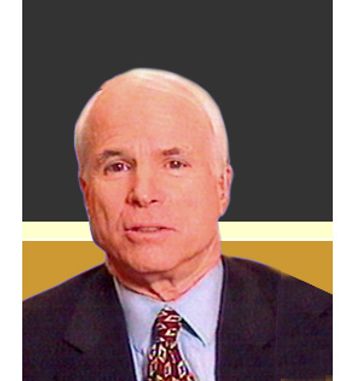
On Wednesday evening, Sen. John McCain, R-Ariz., the No. 2 Republican on the Senate Armed Services Committee, continued his call for hearings on prewar intelligence about Iraqi weapons of mass destruction. But he’s also downplaying it as a standard postwar congressional review.

“I hesitate to reach any conclusions until I have complete information and all sides of an issue are heard,” McCain said in a telephone interview with Salon.

A supporter of the war, McCain says he is confident that evidence of WMD will be found. He allows, however, that media accounts of intelligence officials accusing the Bush administration of twisting intelligence to justify an invasion reinforced his belief that the Senate needs to review the entire war, top to bottom. This would include not just questions about WMD, but friendly-fire incidents, the president’s use of discredited forged intelligence during his State of the Union address, the “brilliant” battle plan, and on and on.

With some Democrats calling for hearings as soon as possible — and many Republicans trying to stymie such requests, arguing that arms inspectors should be permitted more time to hunt for WMD — McCain told USA Today on Tuesday that the Senate hearings should take place as soon as possible. Sen. John Warner, R-Va., the chairman of the Armed Services Committee, has told the committee’s members that hearings will be held in approximately two weeks.

On Wednesday, however, the chairman of the Senate’s Select Committee on Intelligence, Sen. Pat Roberts, R-Kan., said that his committee’s hearings would be a closed-door affair. Information would be made available to the public only “when the committee deems it appropriate,” Roberts said, according to the Associated Press. Calls for more than that were “simply politics and for political gain,” he said.

The issue — a potentially embarrassing one for the Bush administration, which justified the war in Iraq by painting a picture of a clear and present threat from Saddam Hussein’s weapons of mass destruction — isn’t going away anytime soon. Bush’s war coalition partner, British Prime Minister Tony Blair, is facing a political fight in England, and other allies are asking tough questions about whether U.S. intelligence was accurate — or misrepresented. And while the White House has sought to extricate itself from the controversy by lowering expectations as to what evidence might be found, or some intriguing wordplay, the Intelligence Committee’s vice chair, Sen. Jay Rockefeller, D-W.V., fully stepped into the fray on Wednesday, charging that he thought it an open question “whether they [Republican Senators] really want to get to the facts of what actually happened.”

Though McCain — who has been something of a thorn in President Bush’s side since the two fought tirelessly, sometimes bitterly, for the GOP presidential nomination in 2000 — backed the war, his call for hearings seems to place him more on the side of Rockefeller than on Roberts’. Salon caught up with McCain on Wednesday afternoon to get his thoughts on the controversy:

As the No. 2 Republican on the Armed Services Committee, have you been privy to WMD intelligence that the rest of us haven’t seen?

No.

Why haven’t any WMD been found yet?

I don’t know, but I still believe that it’s there. And why do I believe that? Because it was there in 1991. It was there in 1998, according to the U.N. inspectors and according to President Bill Clinton. And why in the world would the guy [Saddam Hussein] obfuscate and commit self-immolation if he had nothing to hide? It doesn’t make any sense.

Do you think it ultimately matters if we find them or not?

I think it probably matters to the Europeans. I think most Americans support the president after they saw the 9- and 10-year-old boys come out of prison and the mass graves and other testaments to the oppressiveness of this regime. But I think it matters to our European friends.

Does that matter at all, whether or not the Europeans are mad at us?

I think it matters. We’re always concerned about world opinion. But is it a terrific blow? No, I don’t think so.

One argument goes that U.S. credibility matters a great deal, and if we lose that over this WMD affair, perhaps we won’t even have the British or Australians on our side when we next think we need to fight as we did in Afghanistan and Iraq.

That’s an assumption I’m not willing to make. I believe we will find evidence of weapons of mass destruction.

Rep. Henry Waxman, D-Calif., has been upset because intelligence that had reportedly been widely discredited — forged information saying that Iraq tried to buy uranium from Niger — was cited by the president in his State of the Union address. Do you think he has a point? Do you share his concern?

I think he has a point and I think it’s one that should be addressed, but I hesitate to reach conclusions until I have complete information and all sides of an issue are heard. Congressional hearings and oversight are an appropriate way to do that. Henry Waxman is a fine man, and I admire him. He is also known as pretty partisan Democrat. We have to take everything into consideration.

On Wednesday, Senators Warner and Roberts and Congressman Porter Goss [R-Fla.], chair of the House Select Committee on Intelligence, said that they intended to limit the review of prewar intelligence on Iraqi WMD to intelligence documents provided by the Bush administration and will hold only closed hearings. Is that the best way to go about this?

It may be appropriate for the Intelligence Committee because of the classification of the stuff that they handle. But Senator Warner, who as you know is the chairman of our committee, is going to start hearings in a couple weeks — an open hearing with General [Tommy] Franks [the former commander in chief of U.S. Central Command]. I think we need a review of the entire conflict, of which WMD will be a part. We always do post -conflict oversight hearings so we can learn lessons. I’d like to know more about the tragedy of the friendly fire incidents that happened, I’d like to know more about what went into the brilliant strategy. The issue of weapons of mass destruction is just one of many.

Ahmad Chalabi, part of the administration-backed three-man leadership council for the Iraqi opposition group, the Iraqi National Congress, recently denied allegations that he gave the U.S. any bad intelligence on Saddam’s WMD. According to the Philadelphia Inquirer, Chalabi said that “We gave very accurate information, and we produced people who we handed over to the United States who told them very significant things. The weapons of mass destruction are in Iraq.” Do you believe Chalabi about this and do you trust him in general?

In general I have no reason to mistrust him. I’ve been at meetings with him, but I’ve never discussed this issue with him, so I’ve never drawn any particular conclusion. I think he’s a source of information and one that should be evaluated with all the others. I certainly don’t disbelieve him.

His critics have argued that his opposition to Saddam was so strong — and justifiably so — that perhaps he was given to exaggerating the threat so as to better secure the support of the U.S. for toppling the regime, so he could then return to Iraq and head up its government. And some say the Bush administration relied too much on his information.

I have no information on that. I was never brought into those kinds of meetings, so it’s impossible for me to make a judgment on it.

Some say that the Bush administration oversold the danger so as to better rally the nation toward war. Even some supporters of the war are beginning to say that — on Fox News Sunday, William Kristol, editor of the Weekly Standard, allowed that while the war was still just and prudent, he was “very skeptical” that WMD would be found. He went on to say that “it is fair to say that if we don’t find serious weapons of mass destruction capabilities, the case for urgency, which Bush and Blair certainly articulated, is going to be undercut to some degree.” Kristol was one of your big supporters during your presidential race, doesn’t that give you at least a moment for pause?

I just think — as I said — I think we will find weapons of mass destruction. Now, I think it’s entirely appropriate now that regime change has been orchestrated — and though the danger is certainly not over, the mission is “accomplished” — it’s appropriate to have a hearing.

Though White House spokesman Ari Fleischer said Wednesday that hearings were an appropriate part of Congress’ oversight role, it seemed at first that the administration didn’t want the Senate to hold any hearings on this. Have you heard from the White House about your call for hearings?

No, and I don’t know of any disagreement. John Warner has already scheduled the first hearing.

Beginning last fall, the media has told story after story of senior intelligence officials saying that the administration pressured their agencies to cook information to better sell the urgency of the war and the danger posed by Saddam’s regime. What was your response when you read those stories?

Well, I thought it was another reason why we should have hearings on the entire issue of weapons of mass destruction. It’s an issue that needs to be addressed. But I hesitate to jump to conclusions without complete information.

You’ve been a big supporter of this war. Didn’t the stories concern you, make you wonder if perhaps you too had been misled by twisted information, as these officials told reporters?

It made me believe, again, that we need to have hearings and look at this issue. Look, it disturbed me when we heard of young people killed by friendly fire. We need to find out if any of that was at all unavoidable. It concerned me during those few days when we were bogged down. A lot of things concerned me throughout the conflict. It’s why we have congressional oversight.

What would you say to someone who had lost a loved one fighting in Operation Iraqi Freedom and was upset that the WMD had not yet been found?

I would say that, I hope you’ll have patience, No. 1. No. 2, we appreciate your loved one’s sacrifice, and that sacrifice was not in vain because the people of Iraq have been freed from one of most brutal dictators on earth and will now have a chance for freedom they never would have had while he was in power.

The Associated Press counted more than 3,400 Iraqi civilians killed in the war. Was it worth it?

When you look at the size of the conflict, the losses — as tragic as they were –the losses both civil and military were remarkably low.

According to polls, the American people don’t seem to care much about this issue. Why don’t they seem to, and why does the media seem so interested in it?

I’m not sure the American people don’t care. I think they may be reserving judgment until they have complete information. It’s the media’s job, of course, to raise these issues and they’re playing their usual vital watchdog role.

Why would Saddam destroy his WMD before the war, as Defense Secretary Donald Rumsfeld speculated he might have done?

I do not know. But I don’t know why he refused to cooperate with the inspectors. I never knew why he invaded Kuwait! There’s a whole lot of things Saddam Hussein did that I never understood.

I know you think the WMD will be found, but if they aren’t, will that change anything?

I’m assuming something will be found. It’s hard for me to speculate about nothing being found.

But if they aren’t, will there be any long-term effects either domestically or internationally?

I don’t know. I really don’t know the answer to that. I know that most Americans feel it was justified with or without the discovery of weapons of mass destruction. Whether or not that would change over time, I just don’t know.

Continue Reading Close

What the definition of “WMD” is

The White House helpfully explains what the president meant when he claimed weapons of mass destruction had already been found.

When President George W. Bush says “cow,” does he really mean “milk”? Does he use the terms “light bulb factory” and “light bulb” interchangeably? According to White House press secretary Ari Fleischer, when the president declared two weeks ago Friday that “weapons of mass destruction” had indeed been found in Iraq, he was merely using a term — as he has on myriad occasions — that he wields as a synonym for weapons of mass destruction programs as well.

This was a most remarkable Fleischerian pronouncement, if for no other reason than it’s been clear that the president, since making the May 30 declaration on Polish television that WMD had been found, has been quite exact in not repeating the claim in his subsequent statements about WMD. Last week he told cheering soldiers in Qatar, with painstaking precision, that coalition forces had found “two mobile biological weapons facilities which are capable of producing biological agents,” a distinctly ambiguous proclamation. On Monday, Bush stated with single-minded clarity that “Iraq had a weapons program; intelligence throughout the decade showed they had a weapons program,” and he is “absolutely convinced with time we’ll find out that they did have a weapons program.”

Fleischer’s explanation comes at a time of mounting criticism at home and abroad for the president, who urgently and credibly sold the war in Iraq as a necessary task in the face of an imminent threat from Saddam Hussein’s biological, chemical and possibly even nuclear weapons — ones it was imperative the U.S. not allow to be used or given to terrorists. “Intelligence gathered by this and other governments leaves no doubt that the Iraq regime continues to possess and conceal some of the most lethal weapons ever devised,” Bush said on March 17.

In the weeks since, administration officials have grown increasingly nonplused at the lack of credible evidence so far that Iraq had WMD at the ready. In this context, Fleischer’s remarks appear to be not only an attempt to explain away a presidential misstatement, but perhaps more than that: a way to argue that the president never meant that there were WMD pointed at the U.S., just WMD programs. Asked about the clear shift in rhetoric on Tuesday, Fleischer offered an interesting explanation of what his boss meant when speaking to Polish TV. “As you know from listening to the president on this issue repeatedly, when the president talked about weapons programs, he includes weapons of mass destruction in that,” Fleischer said. Apparently, when President Bush uses the term “weapons of mass destruction” he also means programs to create WMD.

On its face this doesn’t seem to fit with the president’s interview with Polish TV, where it seemed pretty clear that Bush was specifically discussing weapons of mass destruction, and it appears to be a significant backing off from his May 30 pronouncement. “We found the weapons of mass destruction,” Bush said. “For those who say we haven’t found the banned manufacturing devices or banned weapons, we found them.”

Regardless, this is the White House’s explanation. Asked why the president was so precise on Monday, saying “weapons programs” three times in a row, Fleischer said, “I don’t think you should make anything of it, because I know what the president meant. When he said ‘weapons programs,’ he includes weapons of mass destruction, as you heard him say on numerous occasions.”

But the White House reporter apparently hadn’t heard the president use the non-synonyms as synonyms “on numerous occasions.” Seeming incredulous, the reporter tried to clarify: The president used “WMD” and “WMD programs” “interchangeably”?

“That’s correct,” Fleischer said. “He did” so on Monday, he added.

This nifty new definition of WMD would apparently include the two trailers Kurdish forces found in late April near Mosul, ones that the CIA says “probably are designed to produce” biological weapons, though that claim is disputed within the CIA. Still, if one accepts that the trailers are the real deal, and one accepts Fleischer’s Tuesday explanation, then it’s clear that the trailers constitute not only evidence of a WMD program but the WMD themselves. Problem solved. While of little apparent concern to the American people, the issue of whether the U.S. casus belli was based on erroneous or twisted intelligence information about Iraq’s weapons stockpiles has emerged as an international issue for the White House and the nation at large.

President Bush did use the term “weapons of mass destruction program” in his April interview with NBC’s Tom Brokaw, but that seemed to mark a time when the president was setting the bar lower in terms of the standard of proof he was demanding. The investigation of suspect sites in Iraq by coalition forces would prove that Saddam Hussein “had a weapons of mass destruction program,” he said to Brokaw. The same day as the interview, at an Abrams Army Tank plant in Lima, Ohio, Bush noted that “whether he destroyed them, moved them or hid them, we’re going to find out the truth.” The shift back in April was seen in other administration pronouncements as well as in well-timed leaks to the New York Times of officials saying that the WMD may have been destroyed before the war.

On Fox News Sunday, William Kristol, editor of the conservative Weekly Standard, said that “people like me, who were hawks, said the war was both just, prudent and urgent.” The war, in Kristol’s estimation, was still just and prudent. “But it is fair to say that if we don’t find serious weapons of mass destruction capabilities, the case for urgency, which Bush and [British Prime Minister Tony] Blair certainly articulated, is going to be undercut to some degree.”

That, of course, depends on what your definition of “WMD” is.

Continue Reading Close

How Ashcroft beats a full House

Critics deride his appearances before Congress as "carefully orchestrated," but he manages to come away from every face-off stronger than before.

Last Wednesday, Attorney General John Ashcroft had a challenge before him. He would appear the next day before a relatively hostile House committee, and he wanted to avoid any “Ashcroft Faces Intense Grilling” headlines in the papers.

The last time Ashcroft appeared before the House Judiciary Committee, Sept. 24, 2001, seems like a different era. The committee comprises members of Congress who had voted against the USA PATRIOT Act — which gave law-enforcement agencies broad powers almost immediately after the 9/11 attacks in an attempt to prevent similar catastrophes — as well as those who proudly voted for it, together with a few members whom he saw as revisionists: those who voted for the bill but who have since become critical of both it and Ashcroft. To add insult to injury, only two days before last week’s testimony, the Department of Justice’s inspector general issued a harshly critical review of the Justice Department’s post-9/11 detentions of illegal immigrants.

So the day before, Ashcroft began to prepare. He held a private meeting with 10 U.S. attorneys from around the country to gather anecdotal information he could use. He skipped the annual White House radio-television correspondents dinner, where he was to be the guest of Fox News. And he honed a very aggressive opening statement — including the proposal of three new anti-terrorism laws — that in many ways made the House committee his own turf. He wasn’t going to “just sit there and be a punching bag,” according to a Justice Department source.

To a large extent, the plan worked. “Ashcroft today asked Congress for much tougher powers to fight the war against terror,” CNN’s Lou Dobbs reported that evening. “Ashcroft said that the PATRIOT Act has weaknesses, weaknesses that terrorists could exploit.” The New York Times proclaimed: “Ashcroft Seeks More Power to Pursue Terror Suspects.” The Atlanta Journal-Constitution ran the headline “Federal Death Penalty Use Grows; Bombings Likely to Be Capital Cases.”

These were assuredly not the headlines that Ashcroft’s critics on the House Judiciary Committee had been dreaming of the night before. Before the hearing, after all, Democratic staffers were handing out fliers alleging that the PATRIOT Act had been misused in a number of ways. Clearly, Democrats had hoped to draw a little blood.

The three key proposals highlighted by those headlines were only a part of what happened at the hearing, of course. Ashcroft was pointedly questioned about his post-9/11 policy and actions not only by Democrats but also by the Republican chairman of the committee, James Sensenbrenner Jr. of Wisconsin. But, by and large, Ashcroft managed to go to the committee, get his message out, and quite possibly emerge stronger than before.

“Oftentimes there are some members of Congress who think that they’re going to bloody him up, but at the end of the hearing they are consistently disappointed at their inability to land any blows,” says a source close to Ashcroft. The source says that isn’t necessarily because of Ashcroft’s political skills, however, “but because of how out of touch these members of Congress are with the American people. A lot of time, the more they attack him on some of these issues, the stronger his support becomes.”

The hearing was, one Democratic Senate staffer groused this week, “archetypical Ashcroft.” The staffer, who asked not to be identified, surmised from his Ashcroft-watching experience that the attorney general “knew he was in for some close questioning by some of the representatives and that a new death penalty for terrorists would likely be in any headline about the hearing.” His presentation was therefore “clearly orchestrated to capture the headline and swamp the pent-up frustration by committee members over the Justice Department’s lack of cooperation.”

That isn’t a strictly partisan perception. There are Hill Republicans who — albeit somewhat more admiringly — also viewed Ashcroft’s testimony as a clever way to outmaneuver their committee. Some note that they have issues not only with the three proposed laws — a new death penalty isn’t likely to deter the suicidal terrorists of al-Qaida — but also with the fact that Ashcroft didn’t present them with copies of the proposed laws, making it difficult to prepare or to comment on the laws before Ashcroft spoke.

It was just the latest move by a man whose considerable political acumen many have — sometimes begrudgingly — come to appreciate.

The source close to Ashcroft claims that “overall the media coverage of the PATRIOT Act is done in a negative light.” Ashcroft believes, the source said, that in his rare appearances before the House and Senate Judiciary committees, it is crucial to keep his opponents from getting the upper hand and instead to “remind the American people that terrorism has not ended and to make the case for what he’s doing on the war on terrorism.” In a December 2001 hearing before the Senate Judiciary Committee, Ashcroft similarly stole his questioners’ thunder by bringing with him an al-Qaida training manual that he deftly wielded before the cameras.

While a repeat performance with the training manual seemed unlikely, Ashcroft knew that some members of the House committee smelled blood. Tensions predated the inspector general’s report: Ashcroft had been scheduled to testify before the committee last summer, but when he refused to offer his written testimony ahead of time, as is customary, Sensenbrenner angrily canceled the hearing. In a June 2002 interview with CNN, Sensenbrenner said that in its attempt to prevent terrorism, law enforcement didn’t need “to throw respect for civil liberties into the trash heap.” On April 1 of this year, Sensenbrenner and the ranking Democrat on the Committee, Rep. John Conyers of Michigan, submitted some tough questions to Ashcroft. Most recently, after Sen. Orrin Hatch, R-Utah, chairman of the Senate Judiciary Committee, floated the idea that Congress should consider making the USA PATRIOT Act permanent — the bill is due to expire in 2005 — Sensenbrenner told the Milwaukee Journal Sentinel, “That will be done over my dead body.”

Sensenbrenner spokesman Jeff Lungren downplays any personal issues between his boss and Ashcroft. “Everyone recognizes that there’s always a tension between Congress’ interest in getting information and the Department of Justice’s — or any agency’s — general reluctance to share all sorts of information with Congress,” he says. Sensenbrenner and Ashcroft have a fine working relationship, Lungren insists, meeting every “six or eight weeks or so.”

At last week’s hearing, though, Sensenbrenner declared his support for the controversial USA PATRIOT Act to be “neither perpetual nor unconditional.” Sensenbrenner, who unlike his Senate counterpart Hatch has sought an aggressive oversight role for his committee, spoke against “short-term gains which ultimately may cause long-term harm to the spirit of liberty and equality which animate the American character.” In that spirit, he and others on the House Judiciary Committee had some rather probing questions for the attorney general. Sensenbrenner was most irate about Ashcroft’s revision last summer of the so-called Levi guidelines, introduced by Ford administration Attorney General Edward Levi, which prohibited FBI agents from investigating demonstrations and religious services covered by the First Amendment unless “specific and articulable facts” indicated criminal activity. That Ashcroft revised these guidelines with zero consultation with Congress had the chairman most upset.

Others had bones to pick, too. Rep. Maxine Waters, D-Calif., was worried about the way the Justice Department was using the Foreign Intelligence Surveillance Act. Her fellow California Democrat, Rep. Howard Berman, brought forward issues in the inspector general’s report about the “hold until cleared” policy — whereby illegal immigrants are held in custody until it can be proved that they have no terrorist ties, a complete reversal of the judicial system’s presumption for American citizens that they’re innocent until proved guilty.

“You said in your statement, ‘We must not forget that our enemies are ruthless fanatics,’” said Rep. Bill Delahunt, D-Mass. “But the solution is not for us to become zealots ourselves so that we remake our society in the image of those that would attack us.”

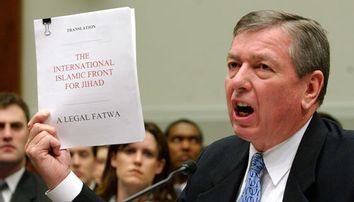
But regardless of the occasionally heated rhetoric from his congressional inquisitors, nothing seemed as compelling as the life-or-death situations the attorney general was able to describe. Listing the names of victims of 9/11, as well as of soldiers who had died in Afghanistan and Iraq, the attorney general reminded the panel of the continued threat of terrorism, mentioning a recent fatwa — “The Legal Status of Using Weapons of Mass Destruction Against Infidels” — issued by a Saudi imam with links to al-Qaida. What seemed to get the lion’s share of the media’s attention was Ashcroft’s request for more powers, because, he said, the law “has several weaknesses which terrorists could exploit, undermining our defenses.”

Justice Department spokeswoman Barbara Comstock says Ashcroft was merely trying to communicate some ideas for follow-ups to the PATRIOT Act, as requested by Congress in January. After an in-house document containing ideas for follow-up legislation to the PATRIOT Act was leaked that month — the infamous “PATRIOT II” — members of Congress told the Justice Department that “we want to discuss these things with you when you want to revise the act,” she said. “So we’re like, Here are some things to start the dialogue back and forth.” Comstock doesn’t see the proposals as controversial, and she points out that one provision from PATRIOT II was inserted into the Amber Alert bill earlier this year and passed into law: a legal tweak including airplanes in the definition of mass-transit vehicles. Previously, a U.S. district judge had struck down one of the many charges against Richard Reid, the would-be shoe bomber, ruling that an airplane did not legally constitute a “mass transit” vehicle.

Ashcroft’s first proposal would change the 1996 anti-terrorism law against providing material support for a terrorism group to include those who train with terrorists, like the so-called Lackawanna Six. The question about whether the current law, which prohibits providing “personnel” to terrorists, also prohibits providing one’s self has prompted different answers from different courts: The 9th Circuit Court of Appeals upheld a ruling that the prohibition against providing “training” or “personnel” to a designated terrorist group was unconstitutional, the court argued, because the terms weren’t “sufficiently clear as to allow persons of ordinary intelligence a reasonable opportunity to know what was prohibited.” In July 2002, U.S. District Judge T.S. Ellis III of Virginia disagreed with the 9th Circuit in a ruling against “American Taliban” John Walker Lindh, ruling that the statute was not vague, since “personnel” clearly applies to those who put themselves under the “direction and control” of a terrorist organization and “does not extend to independent actors.”

“We must make it crystal clear that those who train for, and fight with, a designated terrorist organization can be charged under the material-support statutes,” Ashcroft said at the hearing. However logical that may seem, it is at the very least disputed in the courts, and it is not so crystal clear that Congress’ intent with the 1996 law was intended to be a blanket criminalization of any contact with a terrorist group. The April 1996 House-Senate conference committee report on the bill, according to Hatch’s office, stated that “material support” did not include providing terrorist groups with medicine or religious materials.

The second provision would allow the death penalty in cases when terrorists sabotage a national defense installation, a nuclear facility, or an energy facility, resulting in deaths. The third provision would make defendants in terrorism cases — alongside organized crime, drug offenses and gun crimes — eligible for pretrial detentions, Ashcroft said.

Justice Department spokeswoman Comstock reports that “during the hearing when he brought up those three provisions, there was no push-back.” The committee didn’t say much — or ask much — about them, she says, which makes sense to her since they seem so logical. “A lot of these provisions, when people talk about them individually, they’re just common sense. You know how people say they don’t like Congress but they like their congressman? People say they don’t like the PATRIOT Act, but when you ask them what don’t they like about it and you go through the specifics of the bill, their reaction is different.”

But when Ashcroft described his proposed new laws, they did not exist in paper form for the Judiciary Committee. That made any real debate about them essentially impossible. Sensenbrenner spokesman Lungren says that his boss will defer commenting on the proposals until he actually sees them. “We don’t get wrapped up in any concern about proposals until they are sent up,” he says. In that vein, the PATRIOT II draft didn’t concern Sensenbrenner, Lungren says. “There are people hired at the Department of Justice and their job is to throw ideas at the wall as to the best way to fight the war on terror. Some stick and some don’t.”

But Tim Edgar, legislative counsel of the American Civil Liberties Union, was quicker to be critical of the proposals. Even before diving into the specifics, Edgar says “those three things that he mentioned were all PATRIOT II provisions” — even though the Justice Department insists that the leaked January document was a very rough work in progress, still being evaluated and critiqued.

More specifically, Edgar supports the 9th Circuit court’s interpretation of the 1996 anti-terrorism law’s definition of “material support” and opposes broadening the definition. “The government has been forced to make a somewhat strained argument” in the Lackawanna case, Edgar says, where the six Yemeni-Americans, who have all pleaded guilty, were “going to attend what they thought was paramilitary camp, which turned out to be a terrorist training camp.” (As part of their plea agreements, many of the defendants dispute Edgar and admit having more knowledge of where they were going.)

The original law focused on supporting a terrorist group, not merely associating with them, he says. “It’s already a crime to engage in any kind of conspiracy to harm Americans,” Edgar says. “This proposal would eliminate the need for them to show someone actually intended to do something wrong.”

Regarding the other two acts, the ACLU already opposes the death penalty and pretrial detentions when it comes to those accused of being part of organized crime, or committing drug or gun crimes. The Justice Department’s argument that if these tools can be used against mobsters they should certainly be available to wield against terrorists makes little sense to him — he characterizes it as saying “If the law’s really terrible in one area, we should extend it to every area.” A Democratic Senate staffer says that the new death penalty proposals at first blush seem odd — in that al-Qaida bombers tend to be suicidal to begin with — as well as possibly redundant. “It seems somewhat symbolic,” the staffer says. “It’s very unlikely that if there were an act of terrorism that killed people, the government could not find a federal death penalty punishment for it.”

Those criticisms weren’t voiced at the hearing, of course, because the committee wasn’t prepared. Throughout the post-9/11 era, the attorney general has fought his critics like the all-elbows scrappy pickup basketball player he proves himself to be in occasional games at the DOJ gym. “The A.G. gets what this is all about — preventing another terrorist attack,” says his deputy chief of staff, David Israelite. “And if the price for doing that is attacks from a bunch of editorial boards and a bunch of liberal members of Congress, so be it.”

On October 3, 2001, when Ashcroft thought Senate Democrats were unnecessarily dilly-dallying over passage of the PATRIOT Act, he slammed the “rather slow pace” at which the Democrats were proceeding. “Talk won’t prevent terrorism; tools can help prevent terrorism,” he said to his former Democratic colleagues, adding that his comments were “to describe to them the kind of urgency that I feel that is necessary.” At a Senate hearing two months later, Ashcroft decried “those who scare peace-loving people with phantoms of lost liberty,” to whom he said, “Your tactics only aid terrorists.”

Ashcroft later said that he wasn’t referring to any members of Congress with that charge; regardless, he didn’t say anything quite as harsh to his opponents in Thursday’s hearing. But he wasn’t exactly subtle, either. His opening statement relayed how, during Operation Enduring Freedom, “on the wind-swept plateaus of Afghanistan, some American military commanders read a list every morning to their troops — names of the men and women who died on September 11. It was a stark reminder of why they were there.” He then proceeded to list some of the 9/11 victims, taking great care to pronounce their names correctly. His prepared remarks spelled them out phonetically: “Joseph Maffeo [maf-FAY-o],” the document read. “Manny Del Valle [del-VOL-lay]. Charles E. Sabin [SAY-bin].”

Going on to name soldiers who had died in Operation Enduring Freedom and Operation Iraqi Freedom, as well as conjuring forth the memory of the “343 firefighters and 71 police officers [who] died in the line of duty,” Ashcroft reminded those assembled that the bill so many of them were eager to pick apart had passed the House of Representatives 357-66 and the Senate 98-1. He pointedly noted that “despite the terrorist threat to America, there are some — both in Congress and across the country — who suggest that we should not have a USA PATRIOT Act.” Unquestionably referring to Sensenbrenner, among others, Ashcroft noted that “others who supported the act 20 months ago now express doubts about the necessity of some of the act’s components.” Making no bones about it, Ashcroft said, “Our ability to prevent another catastrophic attack on American soil would be more difficult, if not impossible, without the PATRIOT Act.”

His responses to questions from the committee continued the trend. About the inspector general’s criticisms that there were serious problems with the way illegal immigrants were detained in the months immediately following 9/11, Ashcroft said, “You have to remember what the situation was in New York. When this was happening, ground zero was still smoldering; the FBI was operating out of a parking garage following a lot of leads and uncertainty about what might happen next — not only what happened last.”

After nearly five hours of testimony, Sensenbrenner told Ashcroft he could go “put his feet up.”

“I know that you feel like coming before us is like appearing before the Inquisition,” Sensenbrenner said, sounding slightly defensive. “I think this shows that the system is working.”

It seems to be working well for Ashcroft. His theoretical new powers not yet committed to paper, no one in Congress seems willing to organize opposition against them. And he continues to stand, relatively unopposed.

Continue Reading Close

Weapons of mass deception

The Bush administration goes into full spin mode and Tony Blair battles to save his political life, as charges mount that they lied their way into war.

At the Senate Republicans’ weekly policy lunch on Tuesday, Vice President Dick Cheney reassured the assembled lawmakers that the administration had credible evidence, in the months leading up to the war, to assert that Iraq did indeed harbor weapons of mass destruction.

Before the war, Cheney asserted, the administration was positive that the weapons were there and that Saddam Hussein was refusing to acknowledge that. It wouldn’t make any sense otherwise, he said; why would Saddam refuse to cooperate with arms inspectors if he didn’t have anything to hide? Why would he lead his country into war?

Cheney was received warmly, and it was pointed out in the meeting that new inspectors were heading over to Iraq. Maybe WMD would be found soon, after all.

That the supremely confident vice president even felt the need, in a room full of loyal Republican officials, to reassert that the administration wasn’t lying is an acknowledgment that the as yet undiscovered WMD is emerging as a major problem, even if polls indicate that a majority of Americans still don’t seem to care. And Cheney’s attempt to allay any fears — in what is, by all accounts, an extremely admiring coterie of senators — is but one recent example of the administration’s slow but steady realization that the failure to find any WMD could pose a real problem for the Bush administration and the United States in general. From the Pentagon to the British House of Commons to President Bush’s appearance Thursday in Qatar, the American and British governments are responding, sometimes reeling, in the face of some harsh accusations.

It already looked like it was heading toward an investigation. On Sunday, the Republican chairmen of the Senate Armed Services and Senate Intelligence committees — Sen. John Warner, R-Va., and Sen. Pat Roberts, R-Kan. — seemed to be gearing up for a joint investigation into the pre-war intelligence on Iraqi WMD, but both appeared to back off such a call on Tuesday, particularly after Warner had a private meeting with Cheney. Warner and Roberts then argued that the committees should privately read the materials the CIA was about to present to them for private review before launching an investigation. But on Wednesday afternoon, the Democratic vice chair of the Intelligence Committee, Sen. Jay Rockefeller, D-W.V., took issue with that plan. “I strongly disagree with the notion that we should wait to decide on a formal investigation until we complete a review of CIA documents regarding WMD and Iraq,” Rockefeller said. “This limited approach clearly falls short of the important oversight responsibilities entrusted to the members of this committee.”

A source familiar with the situation tells Salon that Cheney and Warner “are old friends; no one’s pressuring anyone.” That doesn’t mean, of course, that Warner isn’t inclined to help Cheney. As of Thursday, Senate sources told Salon that it was still undetermined how the Senate would handle the matter and that at least a few weeks would pass before the two committees decided what — if anything — would happen.

Across the pond, British Prime Minister Tony Blair has had a harder time fishing for allies. At the House of Commons on Wednesday, Blair was essentially called a liar, and accused of telling intelligence agencies to add less-than-credible information to a September dossier stating that Saddam could launch a WMD attack within 45 minutes. “These allegations are not going to go away,” Conservative leader Iain Duncan Smith railed. While Conservative and Liberal Democrat Party forces are demanding an investigation into pre-war intelligence about Iraqi WMD, they are joined by several members of Parliament from Blair’s own Labor Party. Blair faces two inquiries into the pre-war intelligence on the Iraqi WMD — and there are no doubts that these investigations will actually occur.

Some of the charges against the two governments are unfair — as with a Wednesday account in the British newspaper the Guardian that twisted the words of Deputy Defense Secretary Paul Wolfowitz. Sometimes the charges are tenuous, as with a pending Vanity Fair story that conservatives charge misquoted Wolfowitz and took his quotes out of context.

But in leading their nations to war, Bush and Blair presented compelling cases to many as to why Iraq needed to be disarmed immediately — “We don’t have a lot of time,” Wolfowitz said to the Council on Foreign Relations in January, “time is running out.” But the cases don’t seem to be holding up. And experts, prominent Republicans among them, are willing to point out the problem with that. The WMD “is the real reason the U.S. went to war,” says Lawrence Korb, an assistant secretary of defense in the Reagan administration and national security studies director for the Council on Foreign Relations. If it turns out that no WMD are found amid accusations that the Bush administration and Blair governments misused intelligence information, “that will have long-term ramifications with our allies,” Korb says.

Referring to a Pew poll released this week indicating that international public support for the United States has significantly slipped — with majorities in 13 of 20 foreign nations surveyed holding an unfavorable view of the United States, and majorities in seven out of eight Muslim countries expressing the fear that the U.S. might threaten them — Korb says the affair “feeds into the problem we already had with the rest of the world. People think we’re making up the rules as we go along, and that we think that might makes right.” This could have far-reaching implications on the future of American foreign policy, including our ability to wage the “war on terror.”

What would Korb advise the administration? “Come clean,” he says. “I’d tell them to admit what they knew, what they didn’t know, and to stop playing games with us.”

Korb also suggests that this affair could seriously affect the ability of the U.S. government to function efficiently. “What this administration has done to military and intelligence professionals in government is disgraceful,” he says, citing Army Chief of Staff Gen. Eric Shinseki, who was publicly rebuffed by Wolfowitz and Defense Secretary Donald Rumsfeld after predicting — correctly, it now seems — that it would take “several hundred thousand troops to keep the peace in postwar Iraq.” Korb also cites the formation earlier this year of Veteran Intelligence Professionals for Sanity, a group of a few dozen former intelligence officials from Army Intelligence, CIA, FBI, Defense and State Departments, to protest what they saw as a misuse of intelligence for the purposes of building a case for war. “This will also have long-term ramifications,” Korb says.

On the VIPS steering committee sits 27-year CIA veteran Ray McGovern, one of President Ronald Reagan’s intelligence briefers from 1981-85, who still has many contacts within several intelligence agencies. McGovern tells Salon that he believes the Bush administration’s pressure on and manipulation of intelligence agencies was “worse than the Gulf of Tonkin,” when President Lyndon Johnson falsified information in order to secure authorization to escalate the Vietnam War. At least back then it was done “in his quick, manipulative way,” McGovern says. “This was so premeditated.”

McGovern, who opposes the war in Iraq, says “the intelligence just wasn’t there, so in such a case the president who wants to pursue this war and his advisors will either manufacture it or cook whatever is there to the recipe they want to pursue.”

Korb and McGovern are just two such voices in a chorus of seemingly credible, if mostly anonymous, critics. On Thursday, a senior CIA official told the Washington Post that Cheney and his staff “sent signals, intended or otherwise, that a certain output was desired from here.” There was the story about Powell, first reported by U.S. News & World Report, preparing for his testimony before the United Nations in February and so exasperated with dubious information provided to him that he threw the documents in the air and declared, “I’m not reading this. This is bullshit.” There’s the Time magazine story reporting that an Army intelligence officer said Defense Secretary Donald “Rumsfeld was deeply, almost pathologically distorting the intelligence.” On Thursday, the Wall Street Journal quoted a State Department intelligence official who said of the pre-war WMD information that “much of it wasn’t very solid, and the fragmentary information sometimes produced fierce internal disagreements about its meaning.” Then there was the individual from the Defense Intelligence Agency who told the New York Times that “the American people were manipulated.”

Similar statements and charges are being made to the media in London by British government and intelligence sources. On Wednesday, Blair faced an angry crowd at the House of Commons calling for an inquiry into whether his administration misused intelligence information. An influential BBC report from last week quoted a “senior British official” accusing Blair of exaggerating items from an intelligence dossier released last September that stated that Iraq had “military plans for the use of chemical and biological weapons, including against its own Shia population. Some of these weapons are deployable within 45 minutes of an order to use them.”

The official said that the Blair government wanted intelligence to make the 50-page document “sexier” than an earlier version, so they added the “deployable within 45 minutes” detail, even though that information came from only one source, and intelligence protocol requires that most key information have two reliable sources before it is released. “Most people in intelligence weren’t happy with the dossier because it didn’t reflect the considered view they were putting forward,” the unnamed official said to the BBC.

Additionally, two of Blair’s former Cabinet officials — Robin Cook and Clare Short, both of whom resigned because they opposed the war in Iraq — accused Blair of misleading the public. “I have concluded that the prime minister decided to go to war in August sometime and he duped us all along,” Short said. “There was political spin put on the intelligence information to create a sense of urgency.” She said that Blair “duped,” “misled” and “deceived” the British people.

Since early May, Britain’s Parliamentary Intelligence and Security Committee has been looking into the reliability of the intelligence. But on Wednesday, the Conservative leader, Smith, said that wouldn’t suffice. “The prime minister will only let that committee see the intelligence reports he wants them to see,” he said, since “it reports directly to him, and he can withhold any part or all of its reports.”

On Wednesday, Blair agreed to cooperate with the House of Commons Foreign Relations Committee, which announced that it sought to investigate the pre-war intelligence on WMD. Blair asserted that he had “absolutely no doubt at all that … the clearest possible evidence of Iraq’s weapons of mass destruction” would be found. He reminded listeners of the track record of his accusers. “In the end, there have been many claims made about the Iraq conflict, that hundreds of thousands of people were going to die, that it was going to be my Vietnam, that the Middle East was going to be in flames and this latest one, that weapons of mass destruction were a complete invention by the British government.”

Still, Smith hammered the matter home, declaring that “nobody believes a word now that the prime minister is saying.”

As for the specific intelligence charge, Blair stood firm, characterizing the BBC report as “completely and utterly untrue.” While the leader of the Commons, John Reid, blamed the BBC leak on “rogue elements” within the intelligence agencies, Blair said that he had “spoken and conferred with the chairman of the Joint Intelligence Committee,” and was confident that “there was no attempt at any time by any official or minister or member of [my] staff to override the intelligence judgments of the Joint Intelligence Committee, and their judgments — including the judgment about the so-called 45 minutes — was a judgment made by the intelligence committee and by them alone.” He also disputed that it came from one source.

But on Thursday, the Financial Times reported that the information came from one “senior Iraqi officer on active service within the country’s military.” Additionally, on Thursday, Lord Healey, former chancellor and deputy leader of the Labor Party, called on Blair to resign if WMD are not found.

To watch President Bush, you would hardly know his chief global ally was teetering on the brink. Sleeves rolled up casually, a beaming Bush thanked 2,500 cheering American, British and Australian troops at the Army base at As-Sayliyah, Qatar, Thursday for ensuring that “no terrorist network will gain weapons of mass destruction from the Iraqi regime.” As if there were no worldwide clamor demanding to know where, exactly, these WMD are, Bush expressed confidence that the WMD would turn up soon enough. “He’s got a big country in which to hide ‘em,” Bush said. “Well, we’ll look. We’ll reveal the truth.”

It was notable, however, when Bush added that U.S. forces had already located “two mobile biological weapons facilities which are capable of producing biological agents.”

This was an accurate detail — but it was one that diverged wildly from his description the week before of those labs as “the weapons of mass destruction” themselves. The labs “probably” were designed to produce biological weapons, according to the Central Intelligence Agency, though no evidence yet exists that they were.

But that didn’t stop the president from telling Polish TV last Thursday that “We found the weapons of mass destruction … For those who say we haven’t found the banned manufacturing devices or banned weapons, we found them.”

The fact that the president backed off this claim so significantly is no small matter — and it fits in with the pattern of behavior that has emerged in the last few days as the administration and its allies begin to deal with these accusations. On Wednesday morning, two senior Pentagon officials took the step of holding a press conference for the express purpose of denying that their organization had told intelligence officials to lie; in message the press conference recalled nothing so much as President Nixon’s assertion that he was not a crook.

Stories that Pentagon officials were told to drum up evidence to support WMD claims, as well as provide proof of a link between Iraq and al-Qaida, “are beginning to achieve the status of urban legends,” said Undersecretary of Defense for Policy Doug Feith, who was joined by Bill Luti, deputy undersecretary for special plans and Near East and South Asian affairs. Feith and Luti were responding to various media reports about a number of matters. Feith, who rarely speaks to the press, confirmed reports that he had fashioned a small intelligence team — one that critics said was a far more bellicose alternative to assessments coming in from the CIA and DIA — but disputed that it was there to accomplish anything other than “review this intelligence to help digest it for me and other policymakers.”

At the U.S. Embassy in Tokyo on Tuesday, Wolfowitz, too, felt compelled to respond to some of these charges. It has only been 11 weeks since U.S. troops first crossed the Kuwaiti border, he said, and “11 weeks is a very short time.” There are still Iraqi soldiers killing Americans, “it is not yet a secure situation and I believe that probably influences to some extent the willingness of Iraqis to speak freely to us.”

Many in the GOP seemed to see the calls for an investigation as purely sour grapes by Bush-hating pacifistic Democrats. “They just can’t accept the fact that the president, through his moral leadership, is right in the war on terror, and he was right going into Iraq,” House Majority Leader Tom DeLay, R-Texas, told reporters at a press briefing. “They pick at every little thing they can to try to undermine this president and where he is taking us on this war on terror … They do it for their own political gain.”

DeLay is not without his point. A careful reading of many of the stories gaining traction out there makes it clear that in some cases the Bush administration is facing dubious — even ludicrous — charges. The left-wing Guardian charged on Wednesday that Wolfowitz had declared oil to be “the main reason for military action against Iraq” thus, the paper said, “confirming the worst fears of those opposed to the U.S.-led war.” But the transcript indicates that this story was based on a misquote. Wolfowitz had been asked why he felt economic sanctions would work against North Korea but not Iraq, and he answered that Iraq quite simply was too independently wealthy for sanctions to achieve their results. “Let’s look at it simply,” he said. “The most important difference between North Korea and Iraq is that economically, we just had no choice in Iraq. The country swims on a sea of oil.” North Korea, on the other hand, “is teetering on the edge of economic collapse,” providing “a major point of leverage.” The Guardian took the brash “sea of oil” quote out of context and made it seem as though that was the reason Wolfowitz supported going to war in Iraq as opposed to North Korea.

A separate Guardian story alleging the Robert Ludlum-esque “Waldorf transcripts” of a February conversation between Secretary of State Colin Powell and British Foreign Minister Jack Straw, in which they express grave doubts about the intelligence, has been denied by Straw, who says he wasn’t even in New York’s Waldorf Hotel on the day of the alleged conversation. The story was “completely untrue,” Straw said. Notably, the Guardian hadn’t actually obtained a copy of the “Waldorf transcripts,” but rather had been told of them by “diplomatic sources.”

On Thursday, the Guardian seemed to retract the story, writing that “Straw has now made it clear that no such meeting took place. The Guardian accepts that and apologises for suggesting it did.”

A less clear-cut situation presents itself with the Vanity Fair story, which was hyped by the magazine’s skilled publicists as Wolfowitz “contradicting the Bush administration” by telling the magazine “that weapons of mass destruction had never been the most compelling justification for invading Iraq.” But a closer read of the Wolfowitz interview transcript — provided by the Department of Defense — reveals this to be a bit of overhype. Wolfowitz also said that “for reasons that have a lot to do with the U.S. government bureaucracy we settled on the one issue that everyone could agree on which was weapons of mass destruction as the core reason, but … there have always been three fundamental concerns.” Those were Iraq’s WMD, support for terrorism and the “criminal treatment of the Iraqi people.”

Wolfowitz’s assertion that the WMD issue was focused on for reasons having to do with the “bureaucracy” may be “the height of arrogance,” as Korb assesses. But it doesn’t seem like the scandalous “contradiction” with Bush policy promised by the magazine.

Similarly, the magazine’s assertion that by removing Saddam the U.S. could withdraw its troops from Saudi Arabia was similarly hyped as an “unnoticed but huge” reason for the war. But Wolfowitz, according to the transcripts, said that such a withdrawal was an “unnoticed — but it’s huge” difference from prewar geopolitics. “Their presence there over the last 12 years has been a source of enormous difficulty for a friendly government,” not to mention “a huge recruiting device for al Qaeda,” Wolfowitz said, and “lifting that burden from the Saudis is itself going to open the door to other positive things.”

Other reports are more nebulous and hard to determine. At the Central Intelligence Agency, director George Tenet insisted in a May 30 statement that “integrity and objectivity” marked “exactly what was done and continues to be done on intelligence issues related to Iraq.” But the New York Times reported on Wednesday that the CIA has launched an internal review to determine whether its intelligence officers miscalculated the threat posed to the U.S. by the Iraqi WMD program. One CIA official suggests to Salon that the Times is the one exaggerating. “There is a review going on,” she confirms, but insisted it originated from an agreement between Tenet and Rumsfeld before the war started. “It’s just good government to review.”

While it doesn’t seem as if any of this has yet changed domestic politics — Bush has a 64 percent approval ratings, according to a May 30-June 1 Gallup poll, with 56 percent agreeing that the war was “justified even if the U.S. does not find conclusive evidence that Iraq had WMD” — some Democratic presidential candidates have begun expressing concern, and even outrage.

On Thursday, presidential candidate Rep. Dennis J. Kucinich, D-Ohio, organized 29 other Democratic members of Congress to introduce a resolution in an attempt to force the administration to turn over the intelligence relating to Iraqi WMD. In California, another candidate, Sen. Bob Graham, D-Fla. — former chairman of the Senate Select Committee on Intelligence — said “it would raise serious questions about the political leadership that engaged in that manipulation and the misleading of the American people.”

Both Kucinich and Graham voted against the Iraq war resolution, which gave the president authority to wage the overseas effort. But even war resolution supporter Sen. John Edwards, D-NC, expressed some reservations about this issue on Saturday in Iowa. “I think people in this country are going to be entitled to an explanation,” he said, adding that if in the end “we haven’t found the weapons we need to figure out why.”

Far more outspoken is Rep. Henry Waxman, D-Calif., who for months has been asking the administration how it could have used forged information that Iraq tried to purchase uranium from Niger in its own dossier, up to the point that President Bush referenced the argument in his January 2003 State of the Union address. While others are focused on the chemical and biological WMD, Waxman tells Salon that he is convinced that without the fear that Saddam was close to obtaining nuclear weapons the U.S. would not have fought the war in Iraq. “The most powerful argument that President Bush made to take the country to war was that Iraq was soon to become a nuclear power and that would change things dramatically — Saddam Hussein would have the ability to blackmail other countries in the region and it also meant that any other kind of military action we might have to take against them in the future would be far more serious,” Waxman says. “It was the reason, quite frankly, that brought me to vote for the resolution.”

Waxman has sent the administration several letters in order to find out “if the president was given information his intelligence people knew to be false” or whether “he was willing to ignore the information and go out and make a statement he knew to be false. Or there’s some third explanation.” The subsequent response from a “low-level” State Department employee “said something to the effect that, ‘We were aware that this is not accurate information, but when we heard other countries repeating it we thought they knew something we didn’t know. But later, we found out it was based on the same thing. But we acted in good faith.’” In any case, American and British troops are ramping up their searches — the U.K. just sent 100 of its elite soldiers, many of them expert in interrogation, to the region, while the U.S. is looking forward to the arrival on Friday of an International Atomic Energy Agency inspection team to see if any uranium is missing from the looted Tuwaitha nuclear complex. Hundreds of sites have yet to be searched, there are prisoners who remain to be interrogated. It may well be that the discovery of the WMD is just a matter of time.

Unfortunately for the U.S., that won’t likely put an end to the dispute. On Thursday, Hans Blix, the former United Nations chief arms inspector, cast some doubt on the coalition inspection teams. Says Blix, “Anybody who functions under an army of occupation cannot have the same credibility as an independent inspector.”

Continue Reading Close

Page 1 of 93 in Jake Tapper

www.salon.com/writer/jake_tapper/index.html