Jodi Mardesich

Cancel Gay Pride until we have marriage equality!

What can same-sex rights advocates learn from the Mormons? The director of a documentary on Prop 8 explains

  • more
    • All Share Services

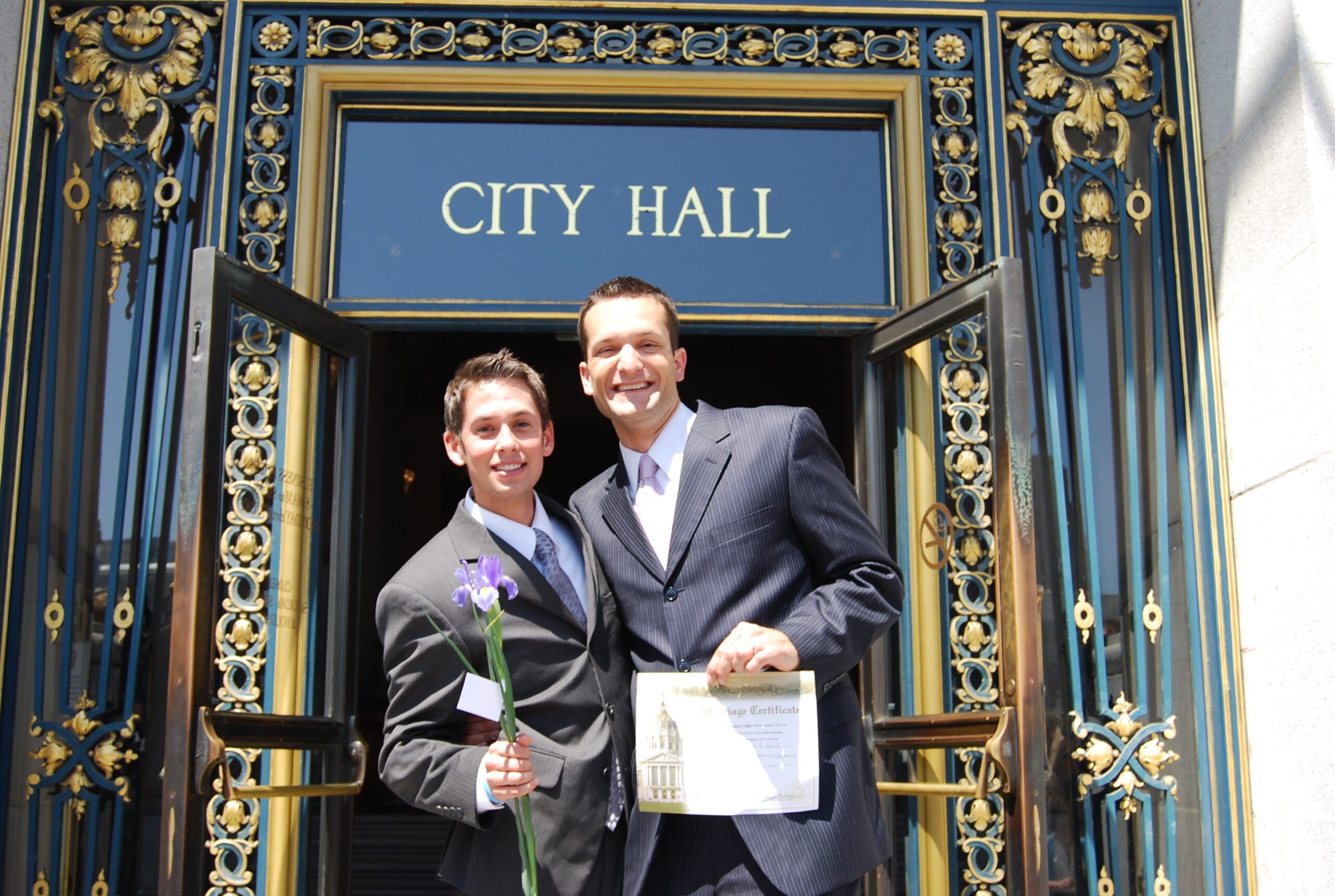
Cancel Gay Pride until we have marriage equality!A still from "8: The Mormon Proposition": Tyler Barrick and Spencer Jones, former Mormons ostracized by the church for their marriage.

“You are a mighty army. Let us be strong in defending our position. And we do so in the name of the Lord Jesus Christ. Amen.”

So begins “8: The Mormon Proposition,” director Reed Cowan’s documentary about the influence that the Mormon Church had on California’s ballot initiative outlawing same-sex marriage, the notorious referendum still being contested in court today. (Closing arguments in the federal case against Proposition 8 wrapped last week, but a decision isn’t expected anytime soon.)

Narrated by Dustin Lance Black, the Academy Award-winning screenwriter of “Milk” — who, like Cowan, grew up gay in the Mormon Church —”8″ documents how the church marshaled its members worldwide to protect traditional marriage. The documentary focuses on the story of former Mormon Linda Stay, a mother who wants equality for her two gay children, and of her son Tyler Barrick, who marries the love of his life, Spencer Jones. Both men are former Mormons ostracized by the church for their relationship. The film also shows, through leaked documents, how the church worked behind the scenes to raise funds — more than 70 percent of the money raised for the Yes on 8 campaign came from Mormons, though Mormons are only 2 percent of the state’s population — and to donate time, going door to door in their communities asking their neighbors to vote. It’s the same blueprint for political success the group used in Hawaii in 1998, when their efforts led to a constitutional amendment banning same-sex marriages. The film also veers into the church’s dark history with homosexuality: trying to cure gays through electro-shock therapy and even lobotomies.

Salon spoke with director Reed Cowan on the phone.

You were working on another film about the suicide and homelessness of Utah teenagers before you switched your focus to Proposition 8. What made you take a step back and ask: What’s causing all this?

I’m very sensitive to the plight of young people in crisis. Whether it’s bullying or building schools for kids in Africa, I’m a wuss where kids are concerned. I became aware of the sad fact that Utah has one of the highest rates of teen suicides in the country, especially young males, and 80 to 90 percent said they were kicked out of their homes after identifying as being something other than straight. Very quickly after I began that film, Proposition 8 was bubbling, and I saw my church getting really involved. I stopped production on the one film and said look, Proposition 8 is the greatest manifestation of bigotry being taught from the pulpit. Let’s start with Proposition 8.

How did you find the people who told their stories?

There were articles in Salt Lake City about the film, saying, “If you have a story to tell, show up at this place and time.” We had lines around the building from sunup to sundown. We took no dinner breaks, no nothing. There were plenty of people, but we focused on Linda Stay. Linda drove from St. George to be part of this. It was quite lovely. After meeting Linda, we had to meet her boys. [Her son Tyler Barrick and his husband, Spencer Jones, were married in San Francisco in June 2008, in the brief period when their marriage was legal.] We had the stars of our film.

And you were able to find a common thread, connecting the story of this gay Mormon couple, who are being criticized for their marriage, to Tyler’s family’s polygamist past. Did you know about the polygamy connection when you chose Tyler and Spencer?

No. The tie to polygamy came from a dream. That sounds crazy. I know I’m showing my Mormon-ness by acknowledging this, but I had a dream about Tyler. I dreamed he was surrounded by Mormon pioneer-looking people, and he was introducing them as his relatives. I called Linda the next day and asked, “Do you have Mormon pioneers who were polygamists in your family?” She said, “I had the same dream last night.”

The Mormons got their start, their clout in this world, because Linda’s great-great-grandfather [Frederick Granger Williams] gave them the land in Kirtland [Ohio, where the Mormons settled after they were chased from New York, in part because they practiced polygamy], and the financial clout to get started.

Why are Mormons so opposed to same-sex marriage?

In their own words: “Indeed we are compelled by doctrine to speak out.” What is that doctrine? That they are the only true church. That the belief of that church requires men to marry women — in a Mormon temple. And from there, men becoming gods themselves with polygamy in the afterlife. Gays interrupt that Mormon plan for heaven.

Some critics have called the film unbalanced and anti-Mormon. Why wouldn’t the church tell their side of the story on camera?

They told my co-director [Steven Greenstreet], “We don’t want to talk. We’re not going to go on the record. We don’t want to be front and center with the gay community.”

Right. And you can hear him say in the background, “You already are.”

I told Buddy Blankenfeld, “I think your church is going to look bad. You have the right to respond. The Huntsmans are my dear friends. All your members deserve a chance to hear their church respond.” He said, “You don’t understand. We are more about searching out stories that make us look good. This isn’t about journalism. This is about making us look good. We don’t participate in that which doesn’t make us look good.”

To the people who say the film isn’t balanced, I say: “You try to make this film.” From the onset I was told nobody would speak, not even the gay Mormons. The fact that we got anybody to speak is a damn miracle. To me it’s balanced. It’s simple mathematics. Somebody should watch this film with a stopwatch. Count how many minutes Mormons speak. I would say 70 percent of the film is Mormons on camera, speaking in their own words. We didn’t give as much time to gay people as Mormons. We are aware of Internet hits and where they’re coming from. On Rotten Tomatoes, it’s getting beat up by Mormon bloggers.

In the film, one of the Mormon men on video says, “God tells us what to do. We have the means to make it happen.” It sounds like he’s saying the end justifies the means.

It’s dirty pool. Part of the ideology is they’d rather have some collateral damage than the grandiose end of society that would happen if gays get their rights.

In the opening stanzas of the Book of Mormon, they have a moral dilemma — How do we kill, how do we slay this person? That’s the answer: “It is better that one man should perish than that a nation should dwindle and perish in unbelief.” It’s the same thing, the same mindset.

Let’s talk about how Mormons influenced the election. The No on 8 camp actually raised more money than the Yes side, despite the last heated push by the Mormons that brought in millions of dollars in the last few weeks. On the basis of money alone, the No on 8 side should have won. Yet there’s not much talk about the value of the time and energy Mormons put into the campaign.

Nobody does it better than the Mormons. Money is one thing. What outsiders don’t understand is the volunteer aspect: the “means and time” trigger language that comes from the temple, and how it literally played to their obedience.

Their greatest asset is the obedience of their people. They had people signed up to go street by street and house by house. They knew who to take with them and were extremely organized.

What is it about those two words, “time and means,” that triggers obedience?

You’re told in the temple that what you are about to do, your eternal salvation hinges on it. God will not be mocked. Then you see a character named Satan who basically threatens to take away your eternal salvation if you don’t live up to covenants you’re making. When they used the trigger language of the temple, most of the Mormon faithful got it. Your salvation and the salvation of humanity depends on it. It’s inferred that you will lose everything if you don’t obey.

The film mentions one family, the Pattersons, who withdrew $50,000 from their children’s college fund. Was there any backlash against that call for extra money? They’re already donating 10 percent [tithing], and now they’re expected to pay double or more?

Those who participated in it gave willingly.

Some people who didn’t pay or who were vocal against Proposition 8 were released from their callings [lay jobs in the church]. Did anyone lose their membership?

They were not out and out threatened; however, the message was clear.

Why is the threat of losing everything so great?

You can’t go to heaven unless you’re a Mormon.

What can gay rights advocates learn from the Mormons?

First of all, I hope we will learn that no battle that is won with misinformation is worth winning. I would hope the gay community would not resort to playing dirty pool. When we win, we want to win clean. What we can take out of their playbook is organization and passion. I would like to propose to the entire worldwide gay community that they cancel gay pride events until we have marriage equality. All those thousands of people who go to gay pride, those are bodies that could put on a shirt and go into the neighborhood and tell their story. We should wait until we have equality to have our party. In the meantime we volunteer the same passion and air miles and participation and really channel that same participation into our fight for equality.

In an interview you gave at the Sundance screening of “8″ — which, presumably, was attended by a lot of Mormons, since this was Utah, after all — I was struck by your inclusionary stance toward the audience. You said, “We may not agree, but we are the human community that needs to come together to see the damage that was done by Proposition 8 and others like it.” Has the film helped bring the two sides together into a constructive dialogue, as opposed to the vitriolic shouting and name-calling depicted in the film?

I call this America’s holy war. On both sides you’re going to hear the weeping and wailing and gnashing of teeth. Once the battle is over and the bodies are on the field, and they return and think about it and talk about it — in many parts of the country we’re not there yet. However I believe in some parts of the country, the fires have died down and people are beginning to talk.

In “8,” you accuse the church of not declaring the full extent of its donations. Activist Fred Karger filed a 2008 suit with the California Fair Political Practices Commission. This month, the commission ordered the church to pay a fine of more than $5,000 for not reporting about $37,000 of “in-kind” donations — nonmonetary contributions, such as time church employees spent on the campaign. Is this progress?

To frame that, it’s unprecedented. It shows our film has credibility. I think ultimately Mormons deserve for their church to wrong the rights. If they will learn from their mistakes — their sins — it will be a better organization. They can get back to what it’s about, which is being a church.

Did you follow the closing arguments in the Proposition 8 appeal last week?

With tears in my eyes. It’s been beautiful. I felt like we were on to something and was stunned in the end. I’m cautiously optimistic.

Is there anything you wish you could have included in the film?

I would have loved to include an apology or explanation from the Mormons. It simply wasn’t offered.

“8: The Mormon Proposition” opens in select theaters on June 18 and comes out on DVD July 13.

Jodi Mardesich is a former Mormon who lives in Salt Lake City.

Gay marriage in the Heartland

How same-sex unions triumphed in Iowa, and what other states can learn from the victory.

  • more
    • All Share Services

Gay marriage in the Heartland

Iowa is known for its sweeping cornfields and pigs, fed by those vast amounts of corn. The landlocked state in the heartland isn’t exactly recognized as cutting edge or socially progressive, though its presidential caucuses do tend to predict the outcome of presidential races, as they did most recently with the selection of Barack Obama.

But with its Supreme Court decision in Varnum v. Brien, making it the third state to legalize same-sex marriage, Iowa is shedding its image as cornfed conservative. After the decision was announced April 3, about 1,000 people rallied in Western Gateway Park in Des Moines to celebrate, and Iowans showed their personality by toting signs, like “Corn Fed and Ready to Wed,” and even nodding to the coast: “This One’s for You, California.”

California, which at one time seemed destined to be the first state to legalize same-sex marriage, meanwhile awaits a decision from its Supreme Court on the validity of Proposition 8. The controversial ballot initiative, passed by a narrow margin in November, outlawed same-sex marriage, which had just been legalized via a California Supreme Court decision the previous May.

In fact, in the space of five days this month, the number of states where gays and lesbians can legally wed doubled, when Vermont and Iowa joined trendsetters Massachusetts and Connecticut. Vermont’s approval of same-sex marriage on April 7 was not surprising. After all, Vermont pioneered civil unions in the U.S. in 2000.

Vermonters have had nine years to observe that allowing gays and lesbians to enter into legally binding partnerships did not herald the end of the world. Fire and brimstone didn’t rain down on the land, plagues didn’t smite their iconic maple trees and most important of all, children in these nontraditional families were just as well-adjusted as their peers with straight parents.

The paths to legalizing same-sex marriage are quite different in Iowa, Vermont and California. Iowa, like Massachusetts in 2004 and Connecticut in 2008, relied on Supreme Court decisions to change the law. Vermont’s law, on the other hand, was voted in by the state Senate and House of Representatives, promptly vetoed by Gov. Jim Douglas, and then overridden by the Vermont Legislature. At first glance, the Iowa Supreme Court’s vote may appear surprising, especially to the-world-revolves-around-me Californians, but Iowa has an impressive history of pioneering civil rights legislation.

Iowa abolished slavery in 1839, 26 years before the passage of the 13th amendment in 1865. Iowa disallowed separate but equal racial segregation in schools in 1868, 85 years before the U.S. Supreme Court’s decision in Brown v. Board of education outlawed it nationally. And in 1873, Iowa again protected racial minorities, extending anti-discrimination to public accommodations, 91 years before the U.S. Supreme Court. Iowa was also the first state to allow women to practice law. “I think Iowa’s tradition played a big role in the victory,” said Camilla Taylor, lead counsel for Lambda Legal, which represented the couples seeking to marry in Iowa.

It’s a good thing that laws aren’t always left to the people. In Iowa, if the amendment had been put to a popular vote, as it was in California, it probably would not have passed. According to a University of Iowa Hawkeye telephone poll just before the Iowa Supreme Court vote, 26.2 percent of respondents said they supported gay marriage, and 27.9 percent opposed marriage but supported civil unions, while 36.7 percent opposed both. However, the younger voters were more accepting. Talk about a generational divide — among voters under 30, 60 percent supported gay marriage, and 75 percent supported formal recognition of gay relationships.

California’s position on marriage equality has lobbed back and forth. It has been defined through popular vote (2000′s Proposition 22, which defined marriage as a contract between a man and a woman), a maverick decision (San Francisco mayor Gavin Newsom’s short-lived permission in 2004 for gays and lesbians to marry) and a Supreme Court decision annulling those marriages. And that was just the beginning; in 2008, a Supreme Court decision reversed Proposition 22 and allowed same-sex marriages again. Then came another popular vote — Proposition 8, which reversed the Supreme Court ruling and left about 18,000 couples who wed between May and November of last year to wonder if their marriages are valid.

Despite California’s reputation as freethinking and liberal — it was the first state to recognize domestic partnerships in 1999 — it has its own conservative heartland, the Central Valley, and Republican enclaves like Orange County that tarnish that reputation. Public opinion is divided — some polls show the majority opposing same-sex marriage, while others show the opposite. But polls in Iowa, California and Vermont show that among the younger voters, the majority favor marriage equality. All three states have this in common: They have a history of being on the forefront of civil liberties legislation.

California was the first state to dismantle anti-miscegenation laws in 1948 with Perez v. Sharp, 19 years before the U.S. Supreme Court outlawed it in Loving v. Virginia — a very unpopular ruling at the time. The first Gallup poll on the subject, ten years after California’s landmark decision, revealed an astonishing 94 percent of Americans still opposed interracial marriage. Even ten years later, after the federal decision, 72 percent opposed it, according to Marriage Equality USA. Vermont never enacted anti-miscegenation laws, and was the first to abolish slavery.

The decision in Loving v. Virginia relied on the concept of equal protection found in the U.S. Constitution and that of all 50 states. It calls marriage one of the “basic civil rights of man,” and states that “to deny this fundamental freedom on so unsupportable a basis as the racial classifications embodied in these statutes, classifications so directly subversive of the principle of equality at the heart of the Fourteenth Amendment, is surely to deprive all the State’s citizens of liberty without due process of law.”

Supporters of same-sex marriage believe it is a civil rights issue, and hope that the courts will enforce existing laws. “It’s not that we need a new constitution,” said Evan Wolfson, executive director of Freedom to Marry. “We just need a renewed commitment. Properly enforced, the existing equal protection would require equality.” So what worked in Iowa and Vermont? Activists and legislators made the issue personal, taking a cue from Harvey Milk, who advocated that people tell their stories.

One Iowa, an organization formed in 2006, just after Lambda Legal filed Varnum v. Brien, began holding forums across the state, in big cities and small towns, bringing together same-sex couples, legal scholars and people of faith to talk about the importance of marriage equality. Justin Uebelhor, communications director for One Iowa, said the group recognized the need to build support for marriage equality.

“We needed those folks to contact their elected officials,” he said, which they did, both before and after the vote. Lambda attorneys used a new strategy when they filed the case in Iowa: They included children of the couples as plaintiffs. They also called psychologists. “We took a lot of care in making as complete a record as possible of the social science of gay and lesbian parenting,” Taylor said. In light of the New York court’s 2006 decision against same-sex marriage that relied in part on “intuition” that children would be better off with a mother and a father (how many families lack one of those?), Lambda included statements from child development and other experts to make the case that children of gay and lesbian parents are just as well-adjusted as children of heterosexual parents.

This strategy to make things personal appears to be helping. The National Organization for Marriage launched a $1.5 million advertising campaign that included broadcasting the fear-mongering “The Gathering Storm,” which claims that same-sex marriage will infringe the rights of straight people. The video, denounced by gay rights activists, is intended to encourage Iowans to pass a law to dismantle the ruling.

When the embarrassing audition tapes showed up on YouTube, revealing that the people talking about their fear of the darkness were actors, NOM requested the video’s removal. To undo the Supreme Court’s ruling, Iowans would have to amend their constitution. So far, Iowans have not persuaded legislators to introduce a bill to negate same-sex marriage in the state. In order to change the state constitution, the Legislature must vote on the issue in two separate years. It appears unlikely that the current Legislature, which is about to end its 2008-2009 session, will vote on it, meaning that it could be changed by 2012 at the earliest.

Vermont activists, including an organization called Vermont Freedom to Marry, took a similar approach. “We had frank discussions with people: I am gay and I am your neighbor and I am your farmer and I want the same rights that you have,” said Jason Lorber, an openly gay state representative from Burlington. “In California, I don’t think those discussions took place.” California has a population of 38 million. Vermont, at 600,000, is smaller than San Francisco.

Now, attention is turning back to California, where the state Supreme Court is expected to make a ruling by early June on whether Proposition 8 is valid. The California constitution can be changed in two ways: through amendments and revisions. The amendment process is designed for ordinary changes, and can be done through the Legislature or through a signature collection that leads to a vote of the people. “California has an unusually low threshold for changing the constitution,” Wolfson said.

The California Supreme Court is currently deciding whether Proposition 8 was simply an amendment or a revision that should have gone through a more rigorous process. “It’s hard to imagine anyone considering the idea of equal protection a mere amendment,” Wolfson says. “Writing out the rights of a minority is a revision.” And if it was a revision, it’s invalid, Lambda’s Taylor said. “We firmly believe it is a revision — it redraws equal protection to permit the exclusion of some people from the guarantee of equality based on a simple majority vote.” Yet in a hearing March 6, it appeared that some Supreme Court justices were hesitant to go against the will of the people. Their decision is expected by early June.

Adding to the momentum, this Thursday, New York’s Gov. David Paterson plans to introduce legislation to legalize same-sex marriages in the state.  “We’ve got New Hampshire coming up for vote, New York and New Jersey. We’ve got momentum on our side, and we’ve got time on our side,” Lorber said. “When you talk to youth, they just don’t even get what the controversy is all about.”

Iowa’s choices in recent presidential caucuses have made it a bellwether of sorts in presidential races — hence the saying, “As Iowa goes, so goes the nation.” The Iowa decision is important precisely because it’s in the heartland, Taylor said. “It highlights for the nation that marriage equality across the country is inevitable. It’s simply a matter of time and we still have some years to struggle, but we’ve turned the corner as a nation.”


Continue Reading Close

Proposition 8 made me quit the Mormon church

I have been a Mormon my whole life. But after the church's campaign of hatred to ban gay marriage, I finally renounced my membership.

  • more
    • All Share Services

Proposition 8 made me quit the Mormon church

I cried with joy when I heard that Barack Obama won the election, but that joy didn’t last long.

If not for the Mormon church and its campaign of hatred, California’s Proposition 8 — which would take away the right of men to marry men, and women to marry women — wouldn’t even be on the ballot. And without the millions of dollars it guilted and coerced its members to donate, the proposition most likely would not have passed on Nov. 4.

I blame it all on the Mormons.

Look at the database that the San Francisco Chronicle published. Look at all the money that came from out-of-state. Mormon Alan Ashton, one of the founders of the processing system WordPerfect (with its humble roots in Orem, Utah), donated $1 million just days before the election. One million! To be fair, his co-founder, Bruce Bastian (who is gay), donated $1,010,000 for the opposition. All this for a ballot initiative affecting a state in which neither of them even lives.

It seems like lifetimes ago, but I used to be Mormon. My mother converted to “the church,” as they call it, when I was only 7. My father, a devout Catholic (despite being excommunicated when his first marriage was annulled), opposed her conversion. As a child, he had some sort of religious experience that left him in awe of the pageantry and the symbolism of Catholicism. When he saw that Book of Mormon the missionaries had given my mother (way back in 1968), he was rightly threatened — first by her interest and then by her eventual conversion. Some 40 years later, they are still married, despite this major incompatibility. She is a true believer, and he isn’t.

I suspect that my father’s opposition to the church made me want to be part of it even more. It was forbidden! It was odd and exotic. I longed to go to church with my mother. It was mysterious, secret and possibly wonderful.

I think what happened is that, when my dad was faced with having to baby-sit us on Sundays while my mom went to church, he finally relented. My brothers and I were then introduced to the weirdness — the strange “hymns” (“Jesus wants me for a sunbeam, to shine for him each day!,” which might sound familiar to fans of Nirvana) and the doctrine, which I have to admit made me feel special. We had the Truth. We had the Secret to Life and the blueprint to return to Heavenly Father (God) after death. Again, I was only 7. Mormons believe that when you reach the age of 8, you are accountable. Eight is when you’re smart enough to know what’s right and wrong.

I’ve thought about this a lot over the years. I adored my mother. She was beautiful. She was my teacher. She taught me how to eat with a spoon, to drink from a cup, to walk, to talk and even to wipe my own ass. When she told me about God and Jesus and Joseph Smith, who was I to question or doubt?

After a few years, when my youngest brother was about to turn 8 (the age of accountability, and thus the age at which you can be baptized), my father finally relented. He interviewed each of us to make sure we knew what we were committing to. By this time, I was 11. I wanted to get dunked (baptism by immersion to wash away your sins).

I stayed with it all until college. (Brigham Young University, of course — was there any other option?) I even spent 18 months as a Mormon missionary. The “prophet” called me to go on a mission to São Paulo, Brazil, so I was sent to the missionary training center (MTC) in Provo, Utah, to study Portuguese. Two months later, when my Brazilian visa still hadn’t arrived, they sent me to San Diego to wait — and, of course, proselytize. After three months in San Diego, teaching in English (translating the rote lessons we had learned in the MTC from Portuguese to English), they decided to reroute me to Uruguay. I never thought to wonder why the prophet got my calling wrong. Never mind that I’d spent five full months studying how to convert people to Mormonism in Portuguese. When my group finally got to Montevideo, they gave us two weeks to learn the missionary lessons (complete with handy flip charts) in Spanish. My poor brain was tripped up trying to translate the lessons from Portuguese to English and then to Spanish. I was so confused. After just two weeks of Spanish training, they sent us out “into the field,” as they call it. Two months later, they made me a senior companion and gave me a “greenie” — a brand-new missionary, who happened to be the niece of Gordon Hinckley,  a man who eventually became the prophet. She knew even less Spanish than I did. We were so lost. Still, I eventually converted 35 people. (Cringe.)

The reason I went on a mission gets to the heart of my failure to marry. I had a boyfriend in high school whom I introduced to the church. He wanted to marry me. I thought I loved him but wasn’t really sure. I was worried I was too young, that I didn’t really know what love was — so I fasted and prayed about it, which is what you’re supposed to do to get an answer from God. But I didn’t get an answer. Absolute silence.

So I fasted some more and went to the rooftop of my dormitory. I prostrated myself on the roof, under the stars, and begged God to tell me what I was supposed to do.

Still, nothing.

I took that “nothing” as a “no.” So I turned my boyfriend down. He then did what good Mormon boys are supposed to do — he went on a mission. While proselytizing somewhere in Ohio, he died.  Scott was born with a heart defect and had had open heart surgery as a child. When I knew him, he seemed healthy. He had a thin, wiry build. He surfed and ran. Before he left on his mission, he went to a Mormon cardiologist, who proclaimed him fine; I don’t think he was fine. After he died, his mother shared his journals with me. He was out running when he had a heart attack. A congenital weakness. He was only 23.

I know it wasn’t my fault, but I felt responsible. What made it worse was that I had I convinced myself that we were going to get back together when he got home from his mission. We were writing love letters. This all seemed part of the eternal plan — he was supposed to go on a mission, all good Mormon boys do. Marrying someone who wasn’t a returned missionary meant you were somehow defective or unworthy.

The only way I knew how to deal with my grief was to sublimate it. I decided to finish his mission for him. (Can you see the brainwashing?) So I became a missionary, too.

Being a missionary was a very convenient way of not having to deal with my grief. Being a missionary was all about serving others. I wasn’t supposed to really exist; I was just a vessel through which the Lord worked. I was supposed to find the worthy people who were ready to hear the gospel. I started to have doubts, though. One of my converts was a black woman who had been living with a man for years. They had four children together. (Back story: I got my conversion numbers up by cherry-picking people in situations like this.) He had been baptized but was “inactive.” If I could convince her to get baptized, and she stayed faithful for a year (and he got reactivated, duh), they could all be sealed together in the temple as an eternal family, which is the ultimate goal of all Mormons. Plus her baptism and the baptism of their four children? Bingo! Five baptisms! Very impressive on the weekly reports.

This woman (I wish I could remember her name) was intrigued. Our lessons were all about the happy proposition of being in the True Church and obeying the commandments so that she and her entire family could get back to God eventually. But there was a snag. She wanted to know why the Mormon church had discriminated against black members until the 1970s. White men could hold the priesthood (the power to perform rituals like baptisms), but black men were only granted that right in 1978, well after the civil rights movement. Why?

I told her I didn’t know why, but I would find out. So I searched the scriptures. I looked in the Book of Mormon. What I dug up was not pretty. The Book of Mormon talks about righteous people having white skin and sinners having dark skin. When the dark-skinned evil people repented, their skin turned white. How was that supposed to help me explain things to her? Digging, researching and investigating is not a good idea if you’re a Mormon. You tend to find out things that don’t make sense. All I could come up with was that either God was racist or that Joseph Smith (who supposedly translated the Book of Mormon from the mysterious golden plates, which the angel Moroni had given him and then conveniently taken away) was a racist. Why did it take until June of 1978 for God to tell his prophet that all worthy men (of course, only men) could have the priesthood? We’re talking 10 years after the civil rights movement! Not finding anything helpful, I used the basic argument on her — that there were things we didn’t know but that they would be revealed to us eventually, if we were worthy. We had to have faith. It worked for her, and she was baptized.

When I got home from my mission, I got a high-profile calling. I got to teach the Gospel Doctrine class in Sunday school in my BYU ward! This meant that I was anointed, spiritual, chosen. The lesson books handed out to all teachers come from church headquarters. Every Gospel Doctrine teacher is supposed to teach the same lesson, on the same subject, on the same day. You follow the manual. Period. Being the budding intellectual, starting to learn to think for myself, I wanted to add to my lessons; I wanted to supplement the simplicity with profound tidbits I found on my own. So I’d start with the planned lesson and do a little research. And week by week, I researched myself out of that calling. After a couple of months I resigned.

I tried to stay under the radar for the next 18 months, until I could finish my course work and graduate. I moved every semester, trying to keep them from discovering that I was an apostate. If discovered, I would be expelled. Not exactly what the college experience is supposed to be.

So many times, I’ve wished that I had “come out.” I have a good friend who was expelled a few weeks before graduation. Her roommates turned her in to the Standards Office because she was sleeping with her boyfriend. By that time, I was also sleeping with my boyfriend. I no longer lived the Word of Wisdom. (OMG, I actually drank.) And I certainly didn’t believe that the president of the church was the prophet of God. I cowardly hid out to keep my status and finally get my B.A.

After I graduated, I went to work for a local company, Novell, so that I could be near my boyfriend. (I still had that hope that I would get married!) Still, I didn’t have the courage to tell them that I no longer believed in the church.

Year after year, when seeing their impressive membership numbers — 7 million members! 8 million members! 9 million members! the fastest-growing religion in America! — I cringed but didn’t have the courage to stand up and say that I was no longer One of Them.

The day after the election, I wrote my letter of resignation.  I sent it to the membership office of the church, telling them that I am no longer One of Them. They have to take me off their rolls. I can’t stomach being counted as One of Them. I despise what they have done in Hawaii, in California, in Arizona, in Florida. They are actively working to strip gay people of their rights. They want to define marriage as a union that can only take place between a man and a woman.

The Sunday evening before the election, I took part in a candlelight vigil in Salt Lake City.  About 300 people gathered peacefully to listen to three Mormon mothers speaking out against the hatred of the proposition, and of their disappointment in their church’s influence over its members, who donated millions of dollars (estimates put the total at at least $15 million). Members all over the country sent contributions for a ballot initiative in another state. On Wednesday, the protest became larger, with thousands of Utahans carrying signs and walking around Temple Square.

In Los Angeles,  where my gay cousin lives, protests at the Mormon temple drew larger, more angry crowds every day. When I spoke to him on Sunday night, my cousin could barely talk after days of shouting. He sent me text updates from the protests, like, “No more Mr. Nice Gay.”

Proposition 8′s passage has invigorated the gay community, culminating in a national day of protest this Saturday in cities in every state. Join the Impact details the events.

I spent much of the ’90s as a lesbian, in committed relationships with women. It doesn’t matter that I’m now in love with a man. I support the rights of gay couples to define their relationships in the traditional sense, if they so choose. I despise what the Mormon church has done to restrict the definition of a family. Love should be celebrated where it is found, whether it’s between a man and a woman, or a woman and a woman, or a man and a man. Period.

My dad says I need to get over my anger toward the Mormon church. I wish I could. Maybe if it someday becomes inclusive, and stops hating, I will get over my anger.

Continue Reading Close

Let’s make a toast to failure

At a South of Market "unlaunch" party, laid-off dot-com workers celebrate the start-up that could have been.

  • more
    • All Share Services

Not so long ago, dot-com parties were spirited celebrations of a start-up’s life cycle, marking milestones like Web site launches, the receipt of fat checks from venture capitalists, a move into new offices, even anniversaries. But times have changed. Welcome to the latest class of dot-com gathering: the wake.

Friday night, a handful of former employees of the Ocean Channel opened their empty South of Market live-and-work space to throw an “unlaunch” party.” Ocean.com — described as the site for “everything ocean” — never surfaced. But plenty of mourners and partyers in search of free drinks came to lament what could have been — and commiserate about their own job losses.

It was hard to tell that the $3,500-per-month loft — about the size of a comfortable studio apartment — had been home to a bustling Web start-up only weeks before. Desks, chairs, computers, printers, copiers and assorted office detritus had been auctioned off on eBay. The floor-to-ceiling shelves covering one wall were bare, save for three small boxes of now-useless business cards. Even the phones were disconnected, forcing the party’s hosts to trek downstairs to let in guests who announced their arrival via cellphones.

Listening to Ocean.com’s former employees describe their site’s would-be niche, you can almost chart the company’s trajectory from idealism to shipwreck. Describing the Ocean.com venture as “the Discovery Channel for water,” Vin Diec, former vice president of operations, sounded sad: “I thought we had a sure thing,” he said.

Their intentions were good. Passing a tray of toasted bagel bites from Costco, Jonathan Bates, former vice president of product development, recalled how he had joined Ocean.com following a string of go-nowhere Internet experiments, including a stint at Comedyworld.com. Before Ocean.com, Bates was just another Internet cynic: “My heart wasn’t in it at all.” He was considering opening up a falafel stand in midtown Manhattan when a call from Matt Comyns hooked him. “He said this would be environmental, that we’d educate the next generation about the ocean,” Bates said. “We had a commitment to being pure, clean and good. It would be about educating children and doing good, not necessarily offering e-commerce at every turn.”

That kind of earnestness may have moved investors in February, but by March they were singing a different tune. Venture capitalists “don’t have the patience,” said Comyns, a senior vice president at CNet who had served as an angel investor and board member at Ocean.com. “Before, it was the sky is the limit. Now they don’t have three weeks, let alone three years, to see you get to profitability. The risk was too great.”

Comyns didn’t want the Ocean Channel to be another cash-hemorrhaging start-up like Space.com. “Who wouldn’t love $60 million,” he mused, “but we knew we had to start somewhat small.”

Comyns was convinced that a tightly run content company could support itself on advertising. But before that could happen — and before Ocean.com could acquire the $4 million in series A funding it needed to create the broadband programming its founders envisioned — the start-up went through $500,000 in seed funding.

A sizable chunk went toward the purchase of the domain name alone. More precious cash was funneled into the production of the gorgeous bit of Flash animation that greets visitors to the expensive URL.

Apparently, only the San Francisco office has closed. The founder and CEO of Ocean.com, a marine biologist from Santa Barbara, isn’t ready to give up on the dream just yet. Michael Hanrahan (who, strangely, was not invited to the wake) says he’s still trying to raise money for his “ocean portal.” But wooing investors has always been a challenge.

Despite the interest Comyns and Bates said they received from V.C.s, none were willing to fund the site. “It did have aspirations to be a do-good vehicle, and with certain investors it resonated really well,” explained Comyns. “But it wasn’t enough, at least during this time period.”

It was time to cut bait.

There were no candles burning, no floral arrangements, no morose organ music. Even though almost everyone had been touched by the downturn, the guests were able to laugh at others’ tales of woe.

“I just got laid off,” said Jennifer O’Donnell, who until three weeks ago had been a site producer at E-greetings.com. (Vin Diec burst into laughter at that. “I interviewed there!” he said.) E-greetings executives called an all-hands meeting and told employees they’d meet individually with their managers to learn whether they were in or out. “I walked into the room and saw the box of Kleenex and a white envelope and I knew,” Jennifer said brightly, as though she was describing what she had for lunch rather than her layoff. “It’s not so bad because it’s happening to all my friends,” she said. Her next gig? She wants to join another dot-com.

One partygoer — a principal in his early 30s at an Internet advertising firm — related how he had been preparing a case study of one of his clients at an upcoming industry conference; it would now be a eulogy. The client? Pets.com. O’Donnell regrets its demise. “I adopted a kitten this summer and ordered a bunch of stuff from them,” she said.

The Internet needs more Jennifer O’Donnells.

Despite the initial cheer, a palpable gloom set in at the unlaunch party as the evening wore on. The turning point came when one partyer started handing out brochures for a Web job-hunting resource called Flipdog.com. “A lot of us here are in between jobs,” he explained. People started heading for the door.

“It’s a bad time to be in the content business,” Bates said wistfully. After a second he added, “It’s a bad time to be in the Internet business.”

Continue Reading Close