John Glassie

Hunter S. Thompson

The godfather of gonzo says 9/11 caused a "nationwide nervous breakdown" -- and let the Bush crowd loot the country and savage American democracy.

  • more
    • All Share Services

Hunter S. Thompson

He calls himself “an elderly dope fiend living out in the wilderness,” but Hunter S. Thompson will also be found this week on the New York Times bestseller list with a new memoir, “Kingdom of Fear: Loathsome Secrets of a Star-Crossed Child in the Final Days of the American Century.”

Listening to his ragged voice, there is some sense that Thompson, now 65, has reined in his outlaw ways, gotten a little softer, perhaps a little more gracious now that he’s reached retirement age. “I’ve found you can deal with the system a lot easier if you use their rules,” he says. “I talk to a lot of lawyers.”

But do not be deceived. In “Kingdom of Fear” and in a telephone interview with Salon from his compound in Aspen, Colo., Thompson did what he’s always done: speak the truth about American society as he sees it, without worrying much about decorum. “Who does vote for these dishonest shitheads?” he writes, referring to the people currently occupying the White House. “They are the racists and hate mongers among us — they are the Ku Klux Klan. I piss down the throats of these Nazis.”

That’s his enduring attitude in this new age of darkness: a lot more loathing than fear.

The godfather of gonzo believes America has suffered a “nationwide nervous breakdown” since 9/11, and as a result is compromising civil liberties for what he calls “the illusion of security.” The compromise, he says, is “a disaster of unthinkable proportions” and “part of the downward spiral of dumbness” he believes is plaguing the country.

While the country’s spinning out of control, Thompson says his own lifestyle has been a model of consistency. He still does whatever the hell he wants. In fact, his new book was supposed to be a “definitive memoir of his life,” a long look back by the man who rode with the Hell’s Angels, who experienced the riots at the 1968 Democratic Convention, and who has smoked more cigarettes, driven more fast cars, fired more weapons and done more drugs than most living people, let alone most living authors. But the book is much more than memoir.

Thompson has long been an outspoken and vigorous champion of civil liberties, at least since a well-publicized 1990 case in which he was charged with sexual and physical assault and possession of illegal drugs — charges that were ultimately dropped due to an illegal search and seizure.

Of course, the writer has distrusted power all his life, and it may come as no surprise that he now believes the administration is “manufacturing” the Iraqi threat for its own political gain and the economic gain of the “oligarchy” (read: the military-industrial complex).

Perhaps Thompson’s most disturbing charge is aimed at the American people — only half of whom exercise their right to vote. “The oligarchy doesn’t need an educated public. And maybe the nation does prefer tyranny,” he says. “I think that’s what worries me.”

In the end, however, Thompson is not and has never been that easy to pigeonhole. He’s friends with Pat Buchanan and has a lifetime membership in the National Rifle Association. In his own mind, if not in others’, he is “one of the most patriotic people I’ve ever encountered in America.”

Your new book, “Kingdom of Fear,” is being called a definitive memoir — although almost all of your books seem to be autobiographical in one way or another. What’s the difference between the written accounts — of drug use, run-ins with the law, sex, fast cars, guns and explosives — and real-life events?

I don’t really see any difference. Telling the truth is the easiest way; it saves a lot of time. I’ve found that the truth is weirder than any fiction I’ve seen. There was a girl that worked for me a long time ago, who graduated third in her class from Georgetown Law School, and was from some kind of uptown family in Chicago, and instead of going to work for some big-time firm, she came to Aspen and ends up working for me out here in the wilderness. A year or so later her mother or father were coming out to visit. I’ve had some understandable issues with parents — really all my life. And I’d be worried about my daughter, too, if she’d run off with some widely known infamous monster. And so I asked her — just so I could get braced for this situation, meeting the parents and having them come to the house: “Given what you know about me and what you hear about me, which is worse?” She finally came out and said there was no question in her mind that the reality was heavier and crazier and more dangerous. Having to deal with the reality is no doubt a little more traumatic.

Indeed, your author blurb says you live in “a fortified compound near Aspen, Colorado.” In what sense is it fortified and why does it need to be?

Actually, I live in an extremely pastoral setting in an old log house. It’s a farm really. I moved here 30 years ago. I think the only fortification might be my reputation. If people believe they’re going to be shot, they might stay away.

Yes, I understand you’re a gun enthusiast, to put it euphemistically. But do you support more restrictive gun laws? Do you support a ban on assault weapons?

I have one or two of those, but I got them before they were illegal. In that case, if I were sure that any tragedies and mass murders would be prevented, I’d give up my assault rifle. But I don’t really believe that. Do I have any illegal weapons? No. I have a .454 magnum revolver, which is huge, and it’s absolutely legal. One day I was wild-eyed out here with Johnny Depp, and we both ordered these guns from Freedom, Wyo., and got them the next day through FedEx. Mainly, I have rifles, pistols, shotguns; I have a lot of those. But everything I have is top quality; I don’t have any junk weapons. I wouldn’t have any military weapon around here, except as an artifact of some kind. Given Ashcroft and the clear blueprint of this administration to make everything illegal and everything suspicious — how about suspicion of being a terrorist sympathizer? Goddamn, talk about filling up your concentration camps. But, yeah, my police record is clean. This is not a fortified compound.

So, just to clarify, how do your views stack up with the NRA’s?

I think I’m still a life member of the NRA. I formed a gun club out here, an official sporting club, and I got charter from the NRA. That made it legal to have guns here, to bring guns here, to have ammunition sent here, that sort of thing. I’ve found you can deal with the system a lot easier if you use their rules — by understanding their rules, by using their rules against them. I talk to a lot of lawyers. You know, I consider Pat Buchanan a friend. I don’t agree with him on many things. Personally, I enjoy him. I just like him. And I learn from Pat. One of the things I’m most proud of is that I never had anybody busted, arrested, jailed for my writing about them. I never had any — what’s that? — collateral damage.

But speaking of rules, you’ve been arrested dozens of times in your life. Specific incidents aside, what’s common to these run-ins? Where do you stand vis-`-vis the law?

Goddammit. Yeah, I have. First, there’s a huge difference between being arrested and being guilty. Second, see, the law changes and I don’t. How I stand vis-`-vis the law at any given moment depends on the law. The law can change from state to state, from nation to nation, from city to city. I guess I have to go by a higher law. How’s that? Yeah, I consider myself a road man for the lords of karma.

In 1990, you were put on trial for what you call “sex, drugs, dynamite and violence.” Charges were eventually dropped. Since then, you’ve been outspoken on Fourth Amendment issues: search and seizure, the right to privacy. I assume you’ve taken a side in the civil liberties debate that’s come up in the aftermath of 9/11?

It’s a disaster of unthinkable proportions — part of the downward spiral of dumbness. Civil liberties are black and white issues. I don’t think people think far enough to see the ramifications. The PATRIOT Act was a dagger in the heart, really, of even the concept of a democratic government that is free, equal and just. There are a lot more concentration camps right now than Guantanamo Bay. But they’re not marked. Now, every jail, every bush-league cop can run a concentration camp. It amounts to a military and police takeover, I think.

Well, as some have pointed out, Lincoln suspended habeas corpus during the Civil War. Is some suspension of civil liberties ever appropriate or justified in a time of war?

If there’s a visible, obvious threat like Hitler, but in my mind the administration is using these bogeymen for their own purposes. This military law is nothing like the Constitution. They’re exploiting the formula here: The people are afraid of something and you offer a solution, however drastic, and they go along with it. For a while, yeah. My suspicions are more justified every day with this manufacturing of dangerous killer villains. The rest of the world does not perceive, I don’t think, that some tin-horn dictator in the Middle East is more of a danger to the world than the U.S. is. This country depends on war as a primary industry. The White House has pumped up the danger factor because it’s to their advantage. It’s to John Ashcroft’s advantage. There have always been pros and cons about the righteousness of life in America but this just seems planned, it seems consistent, and it seems traditional.

What do they get out of it?

They get control of the U.S. economy, their friends get rich. These are not philosopher-kings we’re talking about. These are politicians. It’s a very sleazy way of using the system. One of the problems today is that what’s going on today is not as complex as it seems. The Pentagon just asked for another $14 billion more in the budget, and it’s already $28 billion. [Defense spending in the 2003 budget rose $19.4 billion, to $364.6 billion]. That’s one sector of the economy that’s not down the tubes. So, some people are getting rich off of this. It’s the oligarchy. I believe the Republicans have never thought that democracy was anything but a tribal myth. The GOP is the party of capital. It’s pretty basic. And it may have something to do with the deterioration of educational system in this country. I don’t think Bush has the slightest intention or concern about educating the public.

Many people would say you’re un-American and unpatriotic.

I think I’m one of the most patriotic people that I’ve ever encountered in America. I consider myself a bedrock patriot. I participate very actively in local politics, because my voice might be worthwhile. I participate in a meaningful way — not by donations, I work at it.

Well, what do you prescribe? What do you advocate?

All the blood is drained out of democracy — it dies — when only half the population votes. I would use the vote. It would seem to me that people who have been made afraid, if you don’t like what’s happening, if you don’t want to go to war, if you don’t want to be broke, well for God’s sake don’t go out and vote for the very bastards who are putting you there. That’s a pillar of any democratic future in this country. The party of capital is not interested in having every black person in Louisiana having access to the Ivy League. They don’t need an educated public.

So what took place during this past election?

I believe the Republicans have seen what they’ve believed all along, which is that this democracy stuff is bull, and that people don’t want to be burdened by political affairs. That people would rather just be taken care of. The oligarchy doesn’t need an educated public. And maybe the nation does prefer tyranny. I think that’s what worries me. It goes back to Fourth Amendment issues. How much do you value your freedom? Would you trade your freedom for some illusion of security? Freedom is something that dies unless it’s used.

This is coming from someone who’s described himself as “an elderly dope fiend who lives out in the wilderness” and also as a “drunken screwball.”

A dangerous drunken screwball.

Right. Sorry. So why would anybody listen to you?

I don’t have to apologize for any political judgments I’ve made. The stuff I wrote in the ’60s and ’70s was astonishingly accurate. I may have been a little rough on Nixon, but he was rough. You had to do it with him. What you believe has to be worth something. I’ve never given it a lot of thought: I’ve never hired people to figure out what I should do about my image. I always work the same way, and talk the same way, and I’ve been right enough that I stand by my record.

But is there a sense in which your views are, by definition, going to be seen as fringe views — views that can just be discarded?

That is a problem and I guess “Fear and Loathing in Las Vegas” might have colored the way people perceive me. But I haven’t worried that people see me as “dope fiend,” I’d rather get rid of the “elderly” rather than the “dope fiend.”

What’s the best example of something you were right about?

Christ, the Hell’s Angels certainly. Police agencies regarded that book as a major primary resource on motorcycle gangs. I started covering presidential politics after I realized how easy it was to manipulate the political machinery in this county — or almost officially doing it — by running for sheriff. I saw that there might be some serious fun in politics. I covered Goldwater’s convention in 1964. And I went from Nixon to Kennedy to Nixon. I wanted to have some say in events, just for my own safety.

You have famously attached yourself to the word “fear” since you wrote “Fear and Loathing in Las Vegas.” Now you’ve written “Kingdom of Fear.” Will you explain?

This country has been having a nationwide nervous breakdown since 9/11. A nation of people suddenly broke, the market economy goes to shit, and they’re threatened on every side by an unknown, sinister enemy. But I don’t think fear is a very effective way of dealing with things — of responding to reality. Fear is just another word for ignorance.

You write in “Kingdom of Fear” about the passing of the American century –

That’s official, by the way. The American century was the 20th, so sayeth Henry Luce. And when it ends, Christ, you can’t avoid thinking: “Ye Gods!”

To whom or what is the 21st century going to belong?

That’s something I have not divined yet. Goddammit, I couldn’t have told you in 1960 what 1980 was going to be like.

You’ve also referred to your beat as the “Death of the American Dream.” That was the ostensible “subject” of “Fear and Loathing in Las Vegas.” Has it just sort of been on its deathbed since 1968?

I think that’s right.

A lot of people would argue with you about that anyway, and believe that the American Dream is alive and well.

They need to take a better look around.

But in a way, haven’t you lived the American Dream?

Goddammit! [pause] I haven’t thought about it that way. I suppose you could say that in a certain way I have.

You said back in 1991 that you were “as astounded as anybody” that you were still alive. Still drinking, smoking and doing drugs?

I guess I’d have to say I haven’t changed. Why should I, really? I’m the most stable neighbor on the road here. I’m an honest person. I don’t regret being honest. I did give up petty crime when I turned 18, after I got a look at jail — I went in there for shoplifting — because I just saw that this stuff doesn’t work. There’s a line: “I do not advocate the use of dangerous drugs, wild amounts of alcohol and violence and weirdness — but they’ve always worked for me.” I think I said that at a speech at Stanford. I’ve always been a little worried about advocating my way of life, or gauging my success by having other people take up my way of life, like Tim Leary did. I always quarreled with Leary about that. I could have started a religion a long time ago. It would not have a majority of people in it, but there would be a lot of them. But I don’t know how wise I am. I don’t know what kind of a role model I am. And not everybody is made for this life.

In fact, you’ve experienced more than your share of dangerous situations. You’ve been beaten by the Hell’s Angels. You were in the middle of the 1968 Democratic Convention riots. You’ve been shot at. What’s going on with that?

By any widely accepted standard, I have had more than nine lives. I counted them up once and there were 13 times that I almost and maybe should have died — from emergencies with fires to violence, drowning, bombs. I guess I am an action junkie, yeah. There may be some genetic imperative that caused me to get into certain situations. It’s curiosity, I guess. As long as I’m learning something I figure I’m OK — it’s a decent day.

Is there anything you regret?

That goes to the question of would you do it again. If you can’t say you’d do it again, it means that time was wasted — useless. The regrets I have are so minor. You know, would I leave my Keith Richards hat, with the silver skull on it, on the stool at the coffee shop at LaGuardia? I wouldn’t do that again. But overall, no, I don’t have any regrets.

The man from Neen

Miltos Manetas, who sent 23 invisible U-Haul trucks to the Whitney Biennial, explains the "art" movement that's out to change the way we perceive technology, intellectual property and moving vans.

  • more
    • All Share Services

The man from Neen

During the last month or so, artist Miltos Manetas publicized his big plans for the Whitney Biennial exhibition, which opened March 7 — plans that included Flash animation and 23 U-Haul trucks. This was really going to be something, observers of art said, especially considering that Manetas wasn’t actually selected for inclusion in the show and that his idea was lightheartedly subversive of the contemporary art exhibition. At the Biennial’s opening gala on March 5, however, Manetas’ desire for attention was revealed to be far greater than most people had ever imagined.

The Greek-born Manetas and his cohorts had claimed to be getting 23 U-Hauls ready to display Flash animation pieces by 200 young designers, programmers and assorted digital artists. On the night of the Whitney’s party, the trucks were to drive around and around the museum (which takes up a block on the Upper East Side of Manhattan), diverting the attention of the invitation-only guests.

As it turned out, it was all a hoax. Or rather, “It went great!” as Manetas says. “The trucks were not there, of course. The U-Haul idea was only an advertisement” for what he calls a para-site exhibition of Flash works at www.whitneybiennial.com (not .org), a domain he registered for the purpose. “They were invisible trucks,” he says. “We would have never made them in real life even with the most great sponsoring.”

The Great Whitney U-Haul Scam is only part of what Manetas calls a “worldwide artistic movement” that has been a few years in the making. In 1999 Manetas was one of an increasing number of artists who used software, the Internet and other digital media to make and display — or who used those media as the subject of — their work. Manetas himself had produced traditional oil paintings of wires, cables and computer hardware, created short looped fragments of video games such as “Tomb Raider,” and exhibited computer-generated “screen grabs,” among other things. But he was impatient with critics and curators who had yet to come up with a really good “-ism” for this new generation of creativity.

After securing financial assistance from a nonprofit called the Art Production Fund, Manetas went out and hired Lexicon Branding, a California firm responsible for creating such product names as Powerbook, Pentium, Zima, Swiffer and Dasani. Lexicon’s assignment was to create a name for this new movement.

The word Manetas wanted was “not exclusively about technology in art, but more about the style, about the psychological landscape,” he has explained. “We have two kind of lives now — a real life and a simulated one. I wanted to give a name to this psychology.”

In May 2000, during a packed press conference at the Gagosian Gallery in Manhattan — and a panel of people like Harvard cognitive scientist Steven Pinker ready to provide (tongue-in-cheek) analysis of the term — Manetas unveiled the new word. Actually, it was the squeaky, synthetic voice of a Sony Vaio that made the announcement.

The word was “Neen.”

In his subsequent Neen Manifesto, Manetas declared that the term represented “a still undefined generation of visual artists. Some of them may belong to the contemporary art world; others are software creators, web designers and video game directors or animators.” He later added: “The identity of a NEENSTER is his state of mind. Because he will publish everything on the web, his state of mind reflects on the public taste. NEENSTERS are public personas.”

Since then, the public persona that is Miltos Manetas has been busy, both holding up and working under the Neen umbrella. In the midst of the Napster debate, for instance, he established www.iamgonnacopy.com, described as “a Neen place against intellectual property and copyright.” And last year, in a storefront space in the Los Angeles gallery district on Chung King Road, he set up the so-called Electronic Orphanage, which he says is “a black cube where a large screen is left white for projections.” When galleries on the street have openings, he says, “EO [shows] a piece commissioned for the occasion …. The rest of [the] time, it’s a studio where people (the Orphans) are ‘working’ on Neen and other screen ideas.” He is also planning Electronic Orphanages in Shanghai, China, and in Goa, India.

Full disclosure: This interview was conducted via e-mail over the past couple of weeks, the bulk of it between “work” on the fictional U-Haul trucks before the hoax was revealed. This part of the interview, the vast majority of it, stands as it did before March 5 — the day of the Whitney’s opening gala. Manetas had no scruples about letting the New York Times run with the fake story on March 4, but Salon had a chance to ask some follow-up questions after the opening-night festivities — or lack thereof.

Let’s start with Neen. Is this indeed an art movement, or something else?

Neen is a name to evoke a movement. It’s not only art. It’s also social and philosophical/lifestyle. Actually, there are two names: Neen and Telic.

Hold on! You had a big press conference and you unveiled “Neen.” Everything has been Neen. Please explain.

Here’s some background: Almost two years ago, we commissioned from Lexicon Branding a new word which was supposed to define any artistic experience relative to the computer screen. In fact, they proposed [to] us “Telic,” a very convincing and sophisticated term invented by the human staff of the company. But we decided to acquire, and introduce, a name which their machines coined. This was “Neen,” a palindrome created by a computer program after they [fed] it with words such as “screen” and let it run the different combinations. Neen, which by coincidence in old Greek means “exactly now, not a second later,” was a controversial name. Only a few people felt that it was proper to call themselves Neensters and [call] what they do Neen, and this was because most of us, myself included unfortunately, are still doing a lot of Telic.

Are you now saying that choosing “Neen” was a mistake?

No!!! Our times are Telic. But we want to see more Neen happen.

What’s the difference? How do you define Telic?

Telic is [related to] the tools which help us design the world and see things in a perspective. Telic is constructive: Anything related with a job is Telic. People [who] are busy with aesthetics, but who also have jobs and clients, are Telic. But sometimes these Telics produce very important Neen. It’s usually a small detail which they hide inside the nightmare of their job. Telic is serious: It makes sense or it’s a “sense wannabe.” People recognize it easily and trust it.

And Neen?

Neen, instead, is Telic that went nuts: You wouldn’t believe that it’s possible and even [those] who [make] it cannot easily repeat it. But Neen looks great. There are a few 100 percent Neensters, people without a specific profession who linger around us. Telic is Giacometti, Neen is Fontana. Nature is Telic and miracles are Neen. [But] miracles which have a purpose become Telic.

Can you show me a few examples of Neen?

Neen is Telic that went wrong. Unpredictable Telic. A thing you cannot decide if it’s worth it or not but it impresses you anyway and you cannot live without it. [Here's an] egomaniac who made a round Explorer window and put himself in the center of the net-world. Boyinstatic.com has a gold frame. It’s a Neen color when you see it on the Web. Biribiri.com is a computer which says “Whoops” like somebody who gets surprised. The screen blinks. This is the guy who designed whitneybiennial.com. [He's] 21 years old: a Neenster. Also: lonliness.org, lostpixel.com, magicrobot.org, maiueda.com, mikecalvert.org, whitetrash.nl and uncontrol. This is looking in real time directly inside the public subconscious. A window. It’s the most cool public project I have ever seen. They should install it permanently in Times Square!

How about some examples of Telic stuff?

[It's] intellectual and aesthetic stuff related with the computer screen. The best of those. Serious and focused. Professional. These people — gratisdesign.com, jetset.nl, futurefarmers.com, ourmachine.com — are doing great stuff, but they have a profession and their things seem destined to respond to a demand. This ruins the Neen in them and lets Telic prevail. Also, some of them are using a lot of references of ’70s design and déjà-vu: That’s Telic. Golan Levin [does] music and Neen [which equals] Telic. But he is one of the best artists around anyway. We love his Telic! Turux.org could be Neen, maybe they are. But they look somehow Telic.

Is the Neen stuff better than the Telic stuff?

Definitely. We should all try to be more Neen than Telic. But Telic is important. This interview is Telic, Neen doesn’t really speak.

So, you aspire to Neen?

Yes, because I like surprises and disorder.

Are you the leader of this movement? You came up — or hired someone to come up — with a name for it after all.

I see myself more as the cleaning lady of the movement instead of a leader.

But you are spearheading the activities related to Neen — or Telic.

Yes: In our age, cleaning ladies also do propaganda.

What is the objective of the propaganda?

To change [the] situation and be useful, in a non-useful way. Glory is the simulation of such a strange usefulness.

Since a few years ago, when you hired Lexicon Branding to find the right word for this stuff, people wondered if this wasn’t a big conceptual piece or, alternatively, a big joke. Are you the Andy Kaufman of the art world?

If you say so …

Let me put it another way: Are you serious about all this?

I am never serious or not serious. And all this is not conceptual: It’s life in progress. Also, I detest jokes: They are ’90s art.

I can only partly understand that, because while I know what it’s like to be neither, most of the time I am either serious or I am not serious. And I’m afraid that this makes me both un-Telic and un-Neen. What do you say? Are people Neen or Telic?

Of course they are. It’s a matter of style. There is a simple factor for somebody to be Neen: He should not have a job. It’s not enough, but it’s a beginning. But he should not live a miserable life either.

Well, what about the un-Telic or un-Neen things out there? You don’t just dismiss them do you?

There is UnNeen and UnTelic stuff that interests me. The New Yorker for example.

Are there perhaps thousands of such things you like? It’s a big world.

Yeah: really a lot. There is a whole “Beigë” culture which includes fashion, Muslim people, sports, post-Marxism and a lot of art that we like for different reasons, such as Alex Katz and many others.

I don’t think I will go down the “Beigë” road. Let’s go back and get some background for a minute. You were born in Greece?

Yes, 1964.

Tell me briefly about your childhood and how you got to this point?

Boring environment, no [relationship to art]. Just decided in 1985, after I saw a Jackson Pollock book, to do art because it seemed easy. I left to go to Italy in 1986, came to New York in 1995. Started painting. Started work with video games — to find art subjects — in 1995. I was the first artist to paint a laptop and Lara Croft, according to The [London] Guardian. I made enough [of a] career, [was] bored, went to L.A., opened the Electronic Orphanage, started adventures, Neen, and here I am.

Yes, the Electronic Orphanage. Please explain it and why you’re doing it?

Until today, there is not any great way to show digital art. In galleries and museums it seems pathetic, and on the Internet it does not affect the majority of the public, which doesn’t know how to click well yet. I decided to create the [least] worse [thing], a physical space where people can spy over the shoulders of the creators and get an idea [of it]. It’s on a road which hosts many art galleries, so there is a public which is looking for amazing visual stuff available already — you don’t have to invite the people. It’s like installing a Web site in the actual city.

It’s also a club where people can meet and realize projects and conspiracies — aesthetic ones. We are now preparing an E.O. in Goa, India, and another in Shanghai, China. Then, people [will be able to] move from one to the other, it becomes a network. I see E.O. as a very specialized search engine, a Google which checks for geniuses.

And now you’re doing this project with the U-Haul trucks and WhitneyBiennial.com. Why?

Because the domain was available. It was the official show’s unconscious desire. I see all this as a commission by them. Like a Coca-Cola advertisement where they left a little window open: You can put your mark there.

What kind of people have you invited to do work for this project? Are they better or more interesting than the artists chosen for the “real” Biennial?

I invited of course many who I consider great. The best of them are not in the W.B., but this is not the point. The point is to collect many little different voices and start a new song.

Why Flash animation?

Because it’s easy and everywhere. Like oil painting in the past.

How does the Whitney feel about your dot-com biennial?

Apparently they are cool. I don’t know, I don’t really care. They haven’t sent me any lawyers yet …

What’s the matter with the Biennial? People love to complain about it. But there’s a lot of digital and new media work in it, some of which must be Telic or Neen. Isn’t it any good?

I love the Whitney Biennial: They always have great works there. They are family. I am not against them. I just want to use them.

Use them for what?

For propaganda … free [access to the] public. We have to learn to use institutions in an alternative way. It’s not fun anymore to do things with them. Of course we will keep doing [something] because they give us money. But every time they do something, [we should] try to open them to unknown factors. Deviate their intentions. We don’t only live anymore in the “Society of the Spectacle,” we are spectacle.

So it’s fair to say this is about getting attention?

Of course it is for attention! Why else [would] a person like me set up a show? I am not a curator … But I also want to see a beautiful experiment happen and give a reason to my friends to do beautiful stuff.

Is “art” a bad word these days? Is trying to create “art” a bad, or dull, or old idea?

Art is OK: It’s classic.

Well, what is art? And do you try to create it?

I don’t try: I do. I don’t really want to, because I am lazy, but that’s life …

How does the iamgonnacopy.com fit in to the Neen or Telic view of things? You’d like to see copyright eliminated? Why?

Copyright and intellectual property are some of the most urgent social [issues]. People don’t realize it but we live now in a time where images and ideas are replacing nature: We should be able to move freely inside this nature, and the main reason is that a part of it is inside ourselves. We are made up of logos and pictures, books and music. The images of paintings, once published, belong to everybody and the same is true for the songs by Beatles or the Coca-Cola logo. If I have a dream which is a collage of all that, I should have the right to do whatever I want with them.

Isn’t it more complicated than that?

I believe that copyright and intellectual property are really black and white issues. It’s like slavery: Either you consider that all people should be born free, or you want some of them under the control of others. Information is like people: It has its own life, separated by its creator. Nobody should own his/her information, at least after he/she made it public and therefore he/she exchanged it with fame and other bonuses.

So I assume Neen is not copyrighted? And I can do anything I want with it?

Yes, indeed.

I don’t know, suppose I headed an organization of homicidal maniacs or neo-Nazis, and we decided we liked Neen as our new brand name, and we stole it and made huge money off of Neen T-shirts that supported our ability to kill people, wouldn’t you want the legal power to stop us from using it?

Of course not. It’s part of the game: Words bring us to an unpredictable version of reality. They are cultural software, not Yellow cabs.

On one hand, you seem like a fan of commercial culture. On the other, you seem to be against some of the things that drive it. How do you see it?

There is no such a thing as commercial culture. All culture is commercial and a few commercial objects are culture. I am interested only in those, wherever they come from.

What kind of system of government would you prefer?

I don’t care as long as it respects the freedom of the Internet. If they start to limit it, I will just move to another country. The Internet is like drugs: We should not lose a second chance to experiment freely and methodically with our inner self.

Through Neen and the Electronic Orphanage, you’re working with a lot of young people. What’s the best quality they share?

The fact that they absolutely ignore the heroes of the past century. I was speaking with a Japanese girl and I said something about Karl Marx and she asked me, “Who is he?”

“You don’t know K.M.?” I said. “What about Lenin?”

She said, “Oh, yes, I’ve heard about him. Isn’t he a friend of Che Guevara?”

Now, this girl is a very smart one and I am sure that she will collect the info she needs about all those people, if she needs it. Not like myself and my friends who know about Marx but we never read any of his books.

What’s the worst shared quality?

There is nothing bad about them which [wasn't bad about] the generations before. They are an upgrade and upgrades are always better.

But aren’t we bringing kids up in a more superficial world and aren’t they themselves more superficial in some ways?

The world is superficial even if you live in a forest. You receive all information via your senses, which are a bad translation, an illusion. Your question is like a movie hero, who while he is playing on the fake set of the “Titanic,” is wondering if there is a danger [of drowning]. There are not any seas around his boat, and in the same way, there is not any absolute reality in our world. The only reality is our theories about reality.

What’s your vision of the future?

There are all possible versions of the future and according to quantum physics all of them will be realized. I don’t understand what future you are talking about. There is a version where 23 U-Hauls will surround the Whitney next week and a version where nothing like that will happen. We don’t really know in which one we will participate, we can only envision the possibilities.

- – - – - – - – - – - -

All right. It’s now Wednesday, March 6, and I just found out that the U-Hauls were a hoax! People who expected to see these trucks with screens driving around the Whitney were seriously fooled. I was fooled! Tell me what you have to say about it.

It went great! The trucks were not there of course. The U-Haul idea was only an advertisement for the [online] show. They were invisible trucks. We would have never made them in real life even with the most great sponsoring. I don’t believe in such ’80s and ’90s art. I believe in the Internet. The real U-hauls are the Web sites where the exhibition can be found. But people loved the trucks, so we diffused [this] news to give them something to visualize.

And I assume you view this — the evening, duping me and others — as a success?

The event went great. Many people showed up at the museum. We were there to explain to them that the U-Hauls were invisible and I was helping them to enter the Gala, where you were not welcome without an invitation. Inside the museum, many people were talking about the U-Hauls as if they had seen them! It was amazing! People would walk out to check for them. Also, most of the artists of the show liked the fact that the U-Hauls where invisible.

Other than playing on the idea of contemporary art and the emperor’s new clothes, will you elaborate on the purpose?

We have to create new ways to show art. The real space is not so important anymore. The new, really international space for the arts, accessible by everyone, is indeed the Internet. But we should also create new urban legends to support us. The invisible trucks was one of these urban legends.

Are you sure it wasn’t that you just couldn’t make the U-Haul idea happen?

I never tried. I hate art made with everyday objects. I like classic forms. I got inspired for the tactics that I used in the promotion of this show, from the film “When We Were Kings” about Mohammed Ali. If you have to battle with something bigger and more powerful than you are — the museum establishment — you’d better let your adversary believe that you will use techniques which he can understand, and then simply do nothing, just let him collapse under his own weight.

Earlier you said jokes were ’90s art. Wasn’t this a joke of a kind?

It was not a joke at all. It was a powerful new way to invert the situations. Because of the Internet, some of the importance of real estate and what real estate represents — to the Whitney Museum and to any museum — is passed to the online estate, the dot-com. The old world, art dealers, media, etc., are terrified by this new condition at least as much Europe was terrified by the progress of America, but ultimately it will be a positive charge for both worlds.

There is nothing ironic [about] the invisible U-Hauls; they were there, because the Internet pages that host my show are everywhere. Just imagine a building full of screens with all the works of my show on it and you get the picture: a lot more interesting than the official show. Made out of nothing but pure creative spirit and collaboration, with budget [of] zero, in less than a month. It’s a good show just because it could not be bad; the official show is not even bad, it’s just a regular show, some bureaucratic extravaganza which will feed a small and tired art world for the next two years and then it will repeat itself.

Did you ever have any doubts or misgivings about essentially lying to the press?

I don’t feel that I lied: I gave them what they wanted to hear. The press is not an objective observer; it’s just another producer of simulation. They wanted the “U-Haul Manetas” and that’s what I gave them, but there was no reason to actually do the U-Hauls. Just declaring it to the press was enough.

The invisible U-Haul idea seems like it operates in a much larger realm than the online show of Flash animation works it was intended to promote. Are you sure that digital tools are your main medium? Perhaps you are really a conceptual artist after all.

Digital is not a tool; it a landscape. In the case of WhitneyBiennial.com, the best way to visualize this landscape was to surround the museum with 23 invisible U-Hauls. So, I did it. Sorry.

Continue Reading Close

Flesh, robots and God

Are they becoming us or are we becoming them? One of the world's leading roboticists discusses the machines in our future -- their ability to think, feel, reproduce and achieve personhood.

  • more
    • All Share Services

Flesh, robots and God

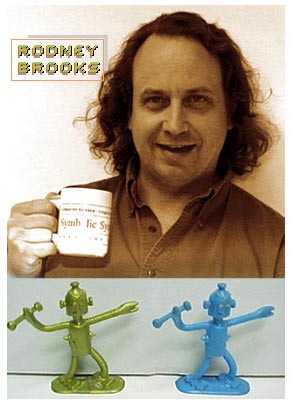
Rodney Brooks built his first artificially intelligent machine when he was just 12 years old, in his boyhood home in South Australia. He recalls in his new book, “Flesh and Machines: How Robots Will Change Us,” that this homemade computer of his “could play tic-tac-toe flawlessly.”

Not surprisingly, as a grown-up, Brooks is now one of the world’s leading roboticists. Director of MIT’s 230-person Artificial Intelligence Laboratory and founder and chairman of his own robotics company, Brooks has presided over some of the most important developments in the field that fascinates and perhaps frightens everyone who has ever seen “2001: A Space Odyssey.” Indeed, among other things, his company iRobot developed the Sojourner technology used to take samples and capture images from Mars in 1997. “The first mobile ambassador from Earth to another planet,” he points out, was “a creature constructed of silicon and steel.”

It’s almost easier to list the academic distinctions and areas of expertise that Brooks doesn’t have rather than the other way around. Suffice it to say he’s a Ph.D. who did stints at Stanford, Carnegie Mellon and MIT before joining MIT’s faculty in 1984. He has been the Cray lecturer at the University of Minnesota, the Mellon lecturer at Dartmouth College, the Hyland lecturer at Hughes, and the Forsythe lecturer at Stanford and on and on.

He has published books and papers on model-based computer vision, robot assembly, autonomous robots, micro-robots, planetary exploration, artificial life and humanoid robots, to name just a few.

Brooks starred as himself in the Errol Morris documentary film, “Fast, Cheap and Out of Control,” which was named for one of his own scientific papers. The film, Brooks writes, “featured me and three other misfits (a lion tamer, a topiary gardener and a keeper of naked mole rats).” After a five year gap between filming in 1992 and first seeing the film in 1997, Brooks says he was “appalled” because he saw that he “hadn’t had a new idea in five years.” Whether this is true or not, he seems to have had one since.

Let’s start with a little status report on robot technology.

Artificial intelligence has been pretty successful in hidden applications that we don’t notice: from airline reservation systems to voice recognition. We all use some form of AI system everyday, but we don’t really think of them that way. Now, the fantasy that we’ve had about these intelligent humanoid robots that we interact with isn’t here yet. But I think of our time as being like 1978 for home computers. There have been robots in factories for some time, but they are now just starting to poke their head into everyday life. We have the robotic toys that we have all seen. Now there’s a lawnmower from Friendly Robotics, and Electrolux is selling a domestic housecleaning robot in Sweden. We’re going to see more and more of this.

But is there a future for robots beyond serving as gardeners and maids?

Robots are going down oil wells, where they increase yield over man-managed wells by a factor of 2. Some robots, autonomous robots, are being used in the military for bomb disposal and reconnaissance. So we’re seeing more of these high-end uses, and they are going to trickle down more and more into everyday life. For instance, we already have certain driver assistance systems in some of our cars. And automakers are planning 2005 and 2006 models that have robotic perception systems that sense the road and sense the driver and can take some corrective driving actions if needed. Those sorts of things are not going to look like robots per se, but they use robotic technology — in the same way that our cars are now full of microprocessors, but we hardly notice them.

When does artificial intelligence stop being artificial?

You know, we really have this term because it was a way of differentiating us from the machines. But a lot of what goes on in artificial intelligence labs around the world is an attempt to understand human intelligence. So it really is the study of natural intelligence — and then re-implementation. There’s a lot of interaction between AI researchers and neuroscientists, cognitive psychologists and so on. It’s a continuum.

What’s the best example of machines that can be said to learn?

There are different sorts of learning. In my lab, humanoid robots learn the sorts of things that we subconsciously learn about how to control our bodies — knowing where our arm is and where our head is. That sort of learning is very common in our robots. Then there’s a higher level of learning such as identifying patterns in massive amounts of data. This is not robotics so much as artificial intelligence, but machine learning techniques have made big jumps in the last three or four years and are in use for all sorts of scientific understanding. But there’s stuff in the middle: For example, 12 years ago I’d never seen a cellphone, but after I saw a couple of them I could recognize any cell phone. That sort of learning, we’re not good at [instilling in robots].

The idea of humanoid robots really captures everybody’s fascination. Will they be living among us someday?

In the labs, there’s been a big resurgence of interest in building humanoid robots over the last 10 years, especially in Japan but also in Europe and the United States. You may have noticed that a humanoid robot from the Honda Corporation rang the Stock Exchange bell [on Feb. 14]. Now, that was pretty much totally operated to do that. But there has been a lot of work in the labs on building humanlike robots with human emotions, human form and the ability to communicate on a sort of cross-cultural level: Saying “Uh-huh” and nodding, and making eye contact, recognizing facial expressions and processing voices. So certainly that’s becoming more and more plausible in the labs. Whether we ultimately decide we want robots with human form wandering around our houses is really an open question. I can’t quite decide.

What would the time frame be?

In the short term, they’re not going to have that form just because they’re too expensive. The robots we have in houses are going to be more tin can sorts of robots. How it all plays out in a 20-year time frame is pretty hard to predict.

I just saw “Westworld” on cable, in which Yul Brynner plays the entertainment park robot, a black-hatted gunslinger, who then turns into a very deadly, real killer. What are the chances that we’ll create monsters?

Hollywood has picked up on the idea that there are going to be these robots which are super-intelligent and take things into their own hands. Well, we’re not going to build a robot like that from scratch. Over the next 20, 30, 40, years, we’re going to build robots incrementally, one after the other, and we’re going to decide the things we like having in our robots and things we don’t. We’re not going to build robots that all of a sudden can be so smart that they can take over the world. We’re going to decide when we don’t like uppity robots and we’ll put controls in them.

What about the other Hollywood scenario in which some fiendish genius builds a kind of Frankenstein robot?

I think that’s sort of like somebody building a 747 in his backyard. I don’t see it happening.

What do you see happening?

As these technologies become more and more available, we’re going to start implanting them in our bodies. So we as humans are going to drift in the robotic direction, as the robots get more intelligent. Where that ultimately leads is a little harder to predict. But it’s not going to be something that’s going to jump up and surprise us. We’ll be making those decisions along the way.

You mentioned the word “emotions” a moment ago. Do you really mean that these machines will be having genuine emotions or even that we will perceive them as such?

That’s an interesting question for us philosophically. We as humans have had to deal with some blows to our egos over the last few hundred years. You know, five hundred years ago, we had to give up the notion that the Earth was the center of the universe, and with Darwin, most of us had to give up the idea that we were fundamentally different from animals.

And now?

And now what we’re left with is the belief that we’re better than machines because we have emotions. You know, when Gary Kasparov was beaten by Deep Blue, he said, “Well, at least it didn’t enjoy beating me.” I certainly think, as most molecular biologists think, that we are fundamentally machines. We’re made out of bio-molecules that interact in a rule-like manner. So if we are emotional machines, then I don’t see any reason, in principle, why we can’t build silicon and steel machines that have emotions.

Well, will we?

As I mentioned, in our labs we have machines which everyone will agree certainly display emotions and act as if they have emotions. It’s going to be a matter of time, as it has been with accepting evolution, before we come to attribute real emotions to these machines.

In fact, you write about the possibility of attributing “free will, respect and ultimately rights” to robots.

I think these are issues that within this century are going to start to come up, yes. What will it take to give personhood to them at some point? What will they have to exhibit to us?

You suggest in your book that we have an unfair bias against machines.

We’ve seen this same thing throughout human history. In the 19th century, the British and many Americans didn’t attribute personhood to people from Africa. Germany declared Jews as non-persons. Of course, robots are different than the examples I just gave, in part because they can’t interbreed with us. But it’s a similar feeling.

Maybe it will come down to the fact that we have meat for brains and they have circuitry and silicon?

Yes, ultimately I think that will be the only thing left. But I don’t think that will even be left because we’re going to be putting silicon and steel in our bodies. We’re already starting to do that. Tens of thousands of people have artificial cochlea implants with direct connections to their nervous systems that allow them to hear. It’s going to happen more and more. You know, I say to my kids: You rebel against me by having a stud put in your tongue, but your kids are going to rebel against you by getting a wireless Internet implant — and they’re going to be instant-messaging their friends while you think they’re talking to you. I think that is fairly inevitable. Where exactly that leads is hard to say.

Let’s go back for a second because you’re saying as much about humans as you are about machines. Is there anything special about human beings — our consciousness, or what people call our souls?

I’m hypothesizing — and I think most biologists hypothesize the same thing — that we are nothing more than bio-molecules interacting. Now, within that organization, there’s obviously a specialness to us which gives us consciousness, which a rock doesn’t have. But, again, in principle, I don’t see at this point why we couldn’t build a machine that had those attributes. Whether we are smart enough to build such a machine is another question.

Perhaps we really will be sharing the earth with conscious humanoids

I believe that’s where we will end up. But even though a raccoon has good manipulation capabilities, nobody thinks a raccoon is smart enough to build a robot raccoon. And maybe we’re just not smart enough to build a robot human. That could be.

Would such robots have the desire to survive and the capability to reproduce themselves?

We certainly don’t know how to build such machines, but I don’t see why that shouldn’t be possible.

On the flip side of things, there’s this sci-fi hope out there that human beings will be able to download their minds into machines to live beyond their mortal bodies.

I don’t know whether that’s going to be possible. It may be that our individual consciousness is so tied up with our own individual brains and development that in the foreseeable future, i.e., the next three or four hundred years, we’re not going to be able to do that. That’s an unknowable for us.

What problems or challenges are taking up your own brain space these days?

This is not something I am personally working on, but the big open question is in computer vision or robot vision. Over the last few years, our vision systems have gotten really good at tracking moving objects, recognizing faces and recognizing human bodies. But they are still quite lousy at things that a 2-year-old can do: tell whether someone is old or young, tell whether that’s a cup in front of them or a tape dispenser or a telephone. They just can’t do those things. And we’ve been trying to [teach robots to] do them for 40 years. So, I’m looking for two or three young Einsteins to come along and figure out what needs to be done there. Because I think we just haven’t got it.

While that search is on, what are you doing?

You know, people have been asking me for a long time these questions about whether robots can really have emotions, what’s really lifelike and what’s living. And so I’m interested in a more fundamental question: What’s the difference between living matter and non-living matter — way down at even the bacterial level? What are the organizational patterns that make something alive? My hypothesis is that there’s some deep scientific understanding that we haven’t yet hit upon. That’s what I’ve been working on over the last year or so.

Essentially: “What is life?”

Yes, what is life? Now, I recognize that one or two people have worried about this before. This is not a new question. But I hope we’re coming at it from a few new angles. I have a research group devoted to this and this is what I’m working on. I think that until you actually do something you don’t know how close you are.

Needless to say, there are a lot of people who already have their answer, namely God.

Of course a lot of people will think that, but as an atheist I am convinced there is a material explanation. In earlier times God was responsible for moving the sun across the sky every day, but later we learned that asking how the “sun moved” wasn’t even the right question. I expect that there is a similar “answer” to the difference between living and non-living matter.

Continue Reading Close

Oldest living surrealist tells all

Dorothea Tanning, painter, sculptor, writer and wife of Max Ernst, counsels young artists: "Keep your eye on your inner world and keep away from ads, idiots and movie stars."

  • more
    • All Share Services

Oldest living surrealist tells all

Dorothea Tanning’s paintings and sculpture are featured in “Surrealism: Desire Unbound,” a major exhibition that opened Feb. 6 at the Metropolitan Museum of Art in New York. She is one of the only surviving members of the movement that, more than 60 years ago, turned the perceived world — as well as the art world — on its ear.

“As for still being here,” says Tanning, 91, “I can only apologize.” And as for surrealism, maybe the movement itself should apologize to Tanning for casting such a long shadow over her subsequent efforts as a painter, sculptor and printmaker, and more recently, as a writer and poet.

Today, she still paints and draws, and attends exhibitions of her work from the last few decades — images that almost always evoke the female human form. But mainly she has been building a literary career for herself enviable to any young writer.

Her poetry has appeared in many publications, including the New Republic, the Yale Review, Partisan Review and the Paris Review. Last year, she was selected for inclusion in “The Best American Poetry 2000.” And last fall, Tanning published “Between Lives: An Artist and Her World,” a memoir of her long, heady and, one must say, romantically bohemian time on Earth.

Born in 1910 in Galesburg, Ill., Tanning moved by herself to Chicago at the age of 20 to study painting, where she met her “first eccentrics,” she writes in her memoir. “They float through antic evenings to the sound of jazz and the tinkling of glasses containing icy drinks.” A few years later, alone again on a bus and with no planned accommodations, she went on to New York.

In Manhattan, eking out a living doing advertising illustrations and trying to paint on the side, she “ate curry powder sandwiches, took Hindu dancing, read the ‘Bhagvad Gita’ and Emily Dickinson, impartially.” She also went to see the 1936 “Fantastic, Dada, and Surrealism” show at the Museum of Modern Art. She was well aware of the movement, “but here, here in the museum,” she writes, ” … are signposts so imperious, so laden, so seductive, and yes, so perverse that … they would possess me utterly.”

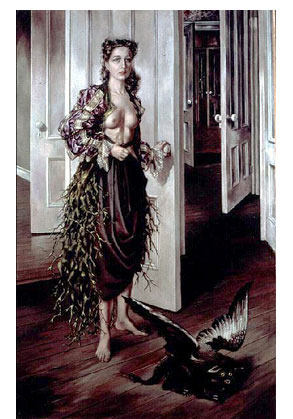
Her subsequent paintings caught the eye of gallery dealer Julien Levy. These include the well-known 1942 self-portrait “Birthday,” which showed her bare-breasted in a skirt of roots and a Elizabethan-looking jacket, surrounded by doors and thresholds, and with a rather strange friend: a lemur with wings. Through Levy she fell in with the French surrealist expats and other emerging artistic types such as, as she recalls, “Yves Tanguy, Max Ernst, Kurt Seligman, Bob Motherwell … Peggy Guggenheim, Max Ernst, Max Ernst.”

She and the dadaist icon Ernst became inseparable, and soon got married in a double wedding with photographer and painter Man Ray and Juliet Browner. Tanning found herself part of an inner circle that included André Breton, Marcel Duchamp, Joan Miró and René Magritte, and became friends with figures such as Salvador Dali, Pablo Picasso, Joseph Cornell, Dylan Thomas, Truman Capote and choreographer George Balanchine.

After the war, she and Ernst moved to France, where they lived for 28 years. Tanning’s work from this period is included in the collections of the Museum of Modern Art, the Tate Gallery in London, the Georges Pompidou Center in Paris, the Menil Collection in Houston, the Philadelphia Museum of Art and many others. During the ’40s and ’50s, she also created costume designs for Balanchine. She began making sculptures in the early ’70s — fabric and cloth pieces that conjured up limp ballet-dancing forms.

Tanning moved back to New York in 1979 after Ernst’s death. Among others, she found a friend in Pultizer Prize-winning poet James Merrill. It was Merrill “who more than anyone at that point of my life, made me realize that living was still wonderful even though I felt that my loss, Max, had left nothing but ashes,” she says. “So if I took up brushes again, and the pen, to work for 20 more solitary years — and am still at it — it was Jimmy who made me want to, and so proved himself right.” Tanning began to write and published her first book in 1986, a collection of reminiscences called “Birthday,” after her most famous painting.

“Youth is certainly the big Y word around here these days,” she says. Nevertheless, she is “not disappointed. I think I’ve been a renaissance man — if he could have been a woman.”

At the age of 91, how do feel about carrying the surrealist banner?

I guess I’ll be called a surrealist forever, like a tattoo: “D. Loves S.” I still believe in the surrealist effort to plumb our deepest subconscious to find out about ourselves. But please don’t say I’m carrying the surrealist banner. The movement ended in the ’50s and my own work had moved on so far by the ’60s that being a called a surrealist today makes me feel like a fossil!

Surrealism must have had a strong appeal for you at the time.

When I saw the surrealist show at MOMA in 1936, I was impressed by its daring in addressing the tangles of the subconscious — trawling the psyche to find its secrets, to glorify its deviance. I felt the urge to jump into the same lake — where, by the way, I had already waded before I met any of them. Anyway, jump I did. They were a terribly attractive bunch of people. They loved New York, loved repartee, loved games. A less happy detail: They all mostly spoke in French. But I learned it later.

You came to New York to be an artist in the midst of the Depression — just got on a bus one day from Chicago — with no plan and without knowing where you would stay. I don’t imagine there were many young woman doing that. Did you see yourself as a pioneer?

Not a pioneer but headstrong. Now when I look back, I’m amazed at my stupid bravery, going off like that with just $25. My head was full of extravagances, I’d read Coleridge and a lot of other 19th century dreamers and I had to be an artist and live in Paris. So New York was on the way. I finally got to Paris, just four weeks before Hitler started his March. Americans were told to go home; I went to my uncle’s in Stockholm on a train with Hitler Youth. I got the last boat out of Gothenburg in September of 1939. In 1949, I went back to France and stayed there for 28 unbelievable years.

You write in your recent memoir that, even in those days the art world was “a kind of club based on good contacts, correct behavior, and certain tactical chic.” How chic were you in those days, Ms. Tanning?

Chic! I didn’t have any money to throw away on frivolities. I wore discount $5 dresses from a wonderful place on Union Square called Klein’s. Also thrift shop stuff. A few of us took to wearing old clothes, but they had to be really old, from another time, way back. We’d show up in these rags as if it were perfectly natural. You had to be deadly deadpan about it. One of these appears in my painting “Birthday.” It was from some old Shakespearean costume.

Well, excuse me for this, but “Birthday” is among other dreamlike things, a topless self-portrait. Is it fair to say that at that time, 1942, people thought you were immodest?

Well, I was aware it was pretty daring, but that’s not why I did it. It was a kind of a statement, wanting the utter truth, and bareness was necessary. My breasts didn’t amount to much. Quite unremarkable. And besides, when you are feeling very solemn and painting very intensively, you think only of what you are trying to communicate.

So what have you tried to communicate as an artist? What were your goals, and have you achieved them?

I’d be satisfied with having suggested that there is more than meets the eye.

In your memoir, you advise pretty girls who want to be artists to get ready for a lot of frustration. How frustrated were you?

I don’t want to give the impression that I was a beauty. Just the same, I always noticed a curious reaction as if there were something unnatural about a really nice-looking girl doing something dead serious. It may be different today. Or maybe there are more pretty girls.

Is there any specific advice you can give to artists and writers cursed with good looks?

Yes. Keep your eye on your inner world and keep away from ads and idiots and movie stars, except when you need amusement.

I imagine you have struggled with the label of being a “woman artist” as well as the “wife of” Max Ernst, who was a founder of surrealism and a seminal figure in 20th century art. Would things be different for you today?

Yes and no. You need fortitude and patience. This goes with a big dose of indifference to the art world; you absolutely need that indifference. If you get married you’re branded. We could have gone on, Max and I, all our lives without the tag. I never heard him use the word “wife” in regard to me. He was very sorry about that wife thing. I’m very much against the arrangement of procreation, at least for humans. If I could have designed it, it would be a tossup who gets pregnant, the man or woman. Boy, that would end rape for one thing. And “woman artist”? Disgusting.

Many people have been using the word “surreal” to describe the events of Sept. 11th. The horrors of the world wars were a factor in bringing about dadaism and surrealism. Do you think artists will have a similar impulse now?

“Surreal” has become such a buzzword. There may be a need for something equally moving but certainly not for going back to something. Anyway, yes, there is certainly a need for hard and different thinking after what has happened and before what may happen.

But what kind of thinking? You’ve lived through the Depression and several wars. What is the role of art in such times?

Art has always been the raft onto which we climb to save our sanity. I don’t see a different purpose for it now.

What do you think of some of the artwork being produced today?

I can’t answer that without enraging the art world. It’s enough to say that most of it comes straight out of dada, 1917. I get the impression that the idea is to shock. So many people laboring to outdo Duchamp’s urinal. It isn’t even shocking anymore, just kind of sad.

As you mentioned, there was a lot of shock value in the work of the dadaists and the surrealists that you fell in with. Was that somehow different?

In its beginning, surrealism was an electric time with all the arts liberating themselves from their Snow White spell. There is a value in shaking people up, meaning those who have forgotten to think for themselves. Shock can be valuable as a protest. Like the dada fomenters, sitting there in the Cafe Voltaire in 1917 — their disgust with the world they lived in, its lethal war, its politics, its so-called rationales. Shock had value at that time. But ideas and innovation will always prevail without any deliberate effort to shock.

What about folks like Dali, walking his lobster on a leash?

Dali used his silly shenanigans to get publicity, to which he was extravagantly addicted. He made some sublime paintings, he was a master painter and his exhibitionist tricks didn’t enhance him as a person or as an artist. It was a pity really.

What’s your take on recent controversies at the Brooklyn Museum: the “Sensation” exhibition, the elephant dung and the more recent Last Supper in which the artist portrayed herself, nude, as Jesus Christ?

The Brooklyn show was blatantly shock-hopeful. And our mayor took the bait like a fish. I probably would not have liked it any more than the mayor if I’d bothered to go.

Were you in favor of the Guiliani’s moral standards panel on art?

Hitler banned and burned “degenerate art.” Stalin did the same. I suppose they had their moral standards too. I can only say that if a work doesn’t make being sane and alive not only possible but wonderful, well, move on to the next picture.

We live in an age when so many people seem to want to be artists of some kind. Why do you think that is? And what does it say about our culture?

All these young hopefuls swarming the big city and getting nowhere fast; that’s such a sad thought. But if there has been a big surge in the number of people making art, it’s because our prosperity has released so many of us from need. It has allowed our creative impulses to test themselves without starving the body. Many people find joy in actually doing something the pragmatist would call useless.

We are also obviously living in a society that prizes youth. Has this larger cultural bias had any effect on you in recent years?

You are so right. Even old people want to be teenagers. But if my memory serves me well it wasn’t all that glorious. To my surprise, I have come to like being old. You can do what you want.

You have been friends with so many important cultural figures. May I ask you to play a little pseudo-surrealist free-association game? How about your husband Max Ernst?

His humor. Ironic, amused, bemused. We laughed a lot. Even today, I have to keep from finding things absurd, which mostly they are. At the same time I’m crying my eyes out.

How about André Breton, founder of surrealism and dadaism?

Severely: “Dorothea, do you wear that low neckline just to provoke men?”

René Magritte?

Sweet.

Truman Capote?

A neat little package — of dynamite.

Orson Wells?

Scowler.

Joseph Cornell?

The courtly love of the 13th century troubadours.

Dylan Thomas?

How could anyone resist his bardic exuberance, his dithyrambs?

Duchamp?

Peerless.

Picasso?

One time when I was at his house, Jhuan-les-pins, for an afternoon visit, we stood at the kitchen door yard for farewells and he broke off the last flower from an old rose bush and handed it to me. How would you feel?

James Merrill?

Best poet, best friend, best fun. He died much, oh much, too soon: seven whole years ago.

What are you working on now?

I still write poems. Not that I overestimate them, but it gives me such pleasure why deny myself? The other day I read a beautiful pair of lines by Stanley Kunitz: “I have walked through many lives/some of them my own.”

If you could change anything in your life, or lives, what would it be?

More color in my dreams.

Continue Reading Close

E.O. Wilson

The great scientist and conservationist explains the terrorism we insist on overlooking. And space colonies won't help, either.

  • more
    • All Share Services

E.O. Wilson

E.O. Wilson is one of America’s most prominent scientists and the author of two Pulitzer Prize-winning books, “On Human Nature” and “The Ants,” as well as other groundbreaking books such as “Naturalist,” “Sociobiology” and “Consilience.” A professor of biology at Harvard from 1955 until 1997, Wilson has received many of the world’s leading prizes in science and conservation.

His work in sociobiology forms the foundation of current evolutionary psychology study. His research on insect societies has informed the work of contemporary complexity theorists who are looking at complex natural systems. In his most recent book, “The Future of Life,” Wilson focuses on the state of the natural environment, analyzing the threat to our biosphere and offering a set of recommendations for the protection of life on Earth.

What’s life going to be like in 100 years?

If present trends continue, the result will be irreversible impoverishment of species. At the current rate, we will lose half the plant and animal species on Earth by the end of the century.

If we lose half, we’ll still have millions left, won’t we?

But the loss is forever, and these species are hundreds of thousands of years old, in many cases millions of years old, and exquisitely well adapted to their environment. Each species is a masterpiece of evolution that humanity could not possibly duplicate even if we somehow accomplish the creation of new organisms by genetic engineering. Massive loss of species would decrease the stability of the world environment. Beyond that, we will lose living libraries of genetic information that could be enormously useful to humanity in the future. Finally, there is the moral argument: that there is something dreadfully wrong about destroying the creation.

What’s the impact on human beings?

The best estimate on human population has us leveling off at 9 or 10 billion people by the end of the century, and that’s just about the absolute limit, without some radical new way of producing food or generating energy. The pressures on the remaining natural resources — the coral reefs, the rain forests and the arctic tundra — may become totally devastating.

What about the economic impact?

Consider that, according to a study based on data for the year 1997, the natural world and all those millions of species contributed an estimated $30 trillion worth of services completely free that year. That’s roughly comparable to the GNP of all the countries of the world combined. And experts believe that we would require four more planet Earths to sustain everyone in the world at current American consumption levels. We have to improve the quality of life, but not with the wasteful and inefficient modes of production that now dominate the developed world.

Say you’re president. What’s your environmental agenda?

New, sustainable energy generation, new forms of transportation, conservation of natural resources and general improvement of the quality of American life with a simultaneous reduction in per-capita consumption of energy and materials. The president who exercised that kind of leadership would ensure his or her legacy for all time.

Somehow that doesn’t seem likely from any president, let alone a Republican.

Last spring I was invited to speak at one of the leading conservative think tanks, and I asked two questions: What is the core of conservatism if it does not include conservation? And why have the conservatives needlessly and destructively abandoned the moral high ground on the issue? We had a lively discussion. They essentially said the liberals are blue sky, they’re big talkers and dreamers, whereas conservatives are problem-oriented, practical people who keep the wheels turning and the world on course. But they’re not solving this problem. Too often they don’t even admit that the problem exists.

Teddy Roosevelt was a Republican and conservationist. You don’t hear much about him these days.

That’s right. I believe what happened is that in the ’60s the left did, in fact, co-opt the environmental movement. They used it as a club to beat the conservatives, along with the Vietnam War. When Reagan came along, it was already a set piece of the conservative counterargument that the environmentalists were these liberal wackos driving around in Yugos with their knees up to their chests. Once they started that, and scored with it, they couldn’t give it up. One reason I wrote this book was to suggest ways in which leading conservative thinkers could get back on board. They say they are big problem solvers, and God knows we need problem solvers.

Do you drive a Yugo?

You have me cornered on this. I drive a Volvo. All Harvard professors are required to drive Volvos.

So I guess you’re not concerned about being viewed as one of those liberal, granola-crunching wackos.

I have no fear about attacks from any direction. My writings on sociobiology in the ’70s had the implication that ordinary instinctive human behavior does indeed have a biological basis, which in turn originated through a long period by natural selection. At that time, the academic left included many social scientists who based their social programs and reasoning on the assumption that humans are a blank slate, so I was a prime target of the left. And now, promoting conservation as strongly as I do, I’m sometimes a target of the right. I call that a considerable lifetime achievement for an academic. I hope that someday I’ll be given credit for that.

But the tenets of sociobiology — that our personal and social behavior is driven by the forces of evolution — can’t go over very well, for instance, with creationists.

Yes, that’s right. It was very curious that I never got attacked by the right on this front. The only reason I could figure out was that leading thinkers in the religious right, including anti-evolutionists who would be most concerned, simply didn’t know about sociobiology. It was too arcane, too theoretical. And now, even today, the creationists mostly direct their attacks on fossil evidence that humanity evolved from ape-like forms. They don’t get into the intricacies of neuroscience or behavior.

Speaking of neuroscience, do you believe that consciousness itself is also an evolutionary adaptation?

Yes. Proof will require a lot more information about, for example, neuro-circuitry and the nature of memory and emotional inputs in reasoning. Once we get a grip on that, I believe it will become evident that consciousness is a Darwinian adaptation.

What does that do to the notion of the soul? Does that mean you believe there is no such thing?

Yes, in the religious sense. I think the Cartesian notion of dualism between body and soul is dead forever. I’m sorry, but that’s the way it is. Which is another reason for having deep thinking about human values and where we want the human species to go.

Well, the human species has certainly grown and prospered from putting the Earth’s resources to use. Is plundering those resources an ironic example of survival-of-the-fittest Darwinism as well?

Unfortunately, yes. It’s always been to the advantage of people in a Darwinian sense to convert agricultural and grazing land. It’s always been an advantage for the short term. But it could be disastrous for the species in the long haul. The great thing about humans is that we’re capable of looking far enough into the future to avert tragedy that comes from our actions.

How about evolution as a solution to our environmental problems? Couldn’t we evolve biologically to adapt to a seriously deteriorated biosphere?

That’s the comic-book scenario. I’ve actually read people who have said this, without any evident irony. But the notion that we should just go ahead in a blockheaded way — over-reproducing, destroying the natural environment that our species evolved in and then trying to change our genes as everything winds down — is a nightmare that no sane person would ever want to take seriously.

Are humans still evolving at all?

No, at least not in any directional sense. But we are changing quickly in another sense. We are changing into a more homogeneous gene pool — a trend that in a few more centuries could result in a fairly similar human population. The genes that make up traditional racial differences will be more and more shared.

Stephen Hawking recently said that the human race won’t last this millennium unless we start to colonize space. Do you agree?

I admire Stephen Hawking but I think he’s completely wrong. All of the evidence shows that we can turn Earth into our permanent, safe home. This is where our species evolved. It’s what our biology adapted to, in exquisite detail — our physiology, the way our mind developed.

What about colonizing space just to take the load off a little bit?

The great majority of physicists and biologists who have given thought to this agree that colonizing space would be one of the most ruinously expensive ways to try to alleviate human overpopulation. It’s not the destiny of humanity to pilot escape vehicles away from a dying Earth. We are the first species to really have the ability to control the planet as a biophysical force. We are also the first species to see far into the future and plan our impact on the planet. We are also the first species to have volitional evolution: We can turn ourselves genetically into what we wish to be.

Does that mean we could use bioengineering to change human physiology to live in a deteriorated environment?

This raises the question of whether we will be stupid enough to continue to let the environment deteriorate, and not worry about it because we might be able to change ourselves to be able live in a hotter world with more atmospheric pollutants and a different diet. But it would be substantially removed from what we think of as a natural human condition.

If we do everything we can to sustain life on Earth, how much longer have we got as a species?

Oh, I think until the sun dies.

But what if we do stay on the same track we’re on now?

Then Stephen Hawking might turn out to be right.

And in that case how long have we got?

It’s highly unlikely that homo sapiens will go extinct — ever — but we will have lost most of the natural environment, and the species of animals and plants in it, by the end of the century. I don’t, however, see it going that way. We can and we will learn to live on this planet sustainably.

You won a Pulitzer for a book called “On Human Nature,” and you really believe that?

Yes. I think people are smart enough to act in the global interest when they see it is their own interest writ large.

Continue Reading Close

Angela's Ashes

By Frank McCourt, Scribner, 364 pages.

  • more
    • All Share Services

why is this dark memoir, from a previously unpublished 66-year-old retired high-school teacher, generating so much buzz in publishing circles? It probably helps that Frank McCourt, a committed New York pub-crawler, has made a lot of influential lit-world friends while nursing pints of beer over the decades. But here’s a less cynical answer: It’s largely because “Angela’s Ashes” relates McCourt’s miserable, bruising Irish Catholic childhood in language that is as flinty and compelling as the story itself. He’s soaked up some real literary ability along with the suds.

Born in the U.S. at the start of the Depression to Irish immigrant parents, McCourt suffered early and often at the hands of his father — a man who rarely got work and when he did, drank his meager wages away. When the family decided to move back to Ireland, things went from very bad to much worse. They settled in a Limerick slum and went on the dole, which was “just enough for all of us to starve on.” (Indeed, neither of McCourt’s two young twin brothers lived much beyond their second birthdays.) Barely old enough himself to go to school, McCourt helped his mother Angela scrounge for “bits of coal that drop from lorries” so they could at least have a fire for tea. He gathered “everything that burns, coal, wood, cardboard, paper.”

It was a life so brimming with hardship and grinding poverty that when McCourt returned home from months in the typhoid ward, he longed for “the hospital where the white sheets were changed everyday and where there wasn’t a sign of a flea.” Hope kindled when World War II created jobs in England and McCourt’s father went off with the promise of sending money back to his family. They rarely heard from him again.

Throughout this tale, McCourt displays a wry sense of humor. “When you look at pictures of Jesus,” he notes at one point, “He’s always wandering around ancient Israel in a sheet. It never rains there and you never hear of anyone coughing or getting consumption or anything like that and no one has a job there because all they do is stand around and eat manna and shake their fists and go to crucifixions.”

It’s no surprise when, with his first real job as a telegram delivery boy, McCourt begins to plan his escape from this hell. The book’s most triumphant moment occurs when he manages to make the return passage to America at age 19. With “Angela’s Ashes,” McCourt has succeeded in turning bleak reality into literature that sings.

Continue Reading Close