John W. Dean

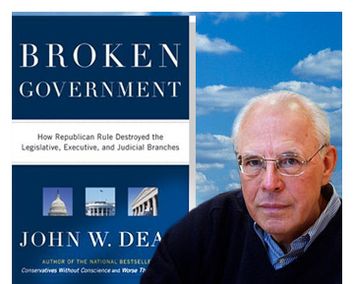
“Broken Government”

I never thought that the GOP posed a threat to the well-being of our nation. But these days, I no longer recognize my old party.

  • more
    • All Share Services

In almost four decades of involvement in national politics, much of them as a card-carrying Republican, I was never concerned that the GOP posed a threat to the well-being of our nation. Indeed, the idea would never have occurred to me, for in my experience the system took care of excesses, as it certainly did in the case of the president for whom I worked. But in recent years the system has changed, and is no longer self-correcting. Most of that change has come from Republicans, and much of it is based on their remarkably confrontational attitude, an attitude that has clearly worked for them. For example, I cannot imagine any Democratic president keeping cabinet officers as Bush has done with his secretary of defense, Donald Rumsfeld, and attorney general, Alberto Gonzales, men whom both Democrats and Republicans judged to be incompetent. Evidence that the system has changed is also apparent when a president can deliberately and openly violate the law — as, for example, simply brushing aside serious statutory prohibitions against torture and electronic surveillance — without any serious consequences. Similarly, but on a lesser scale, Alberto Gonzales faced no consequences when he politicized the Department of Justice as never before, allowing his aides to violate the prohibitions regarding hiring career civil servants based on their party affiliation, and then gave false public statements and testimony about the matter. When the Senate sought to pass a resolution expressing “no confidence” in the attorney general, the Republicans blocked it with a filibuster. The fact that Bush’s Justice Department has become yet another political instrument should give Americans pause. This body was created by Congress to represent the interests of the people of the United States, not the Republican Party, but since the system of law no longer takes account when officials act outside the law (not to mention the Constitution), Republicans do so and get away with it.

In the past the White House (whether occupied by Republicans or Democrats) placed tight restrictions on who could contact the Department of Justice regarding pending business. It was typically limited to only the president, the vice president, the White House chief of staff and White House counsel, who were authorized to speak with the attorney general, the deputy attorney general or the top assistant and associate attorneys general. However, in the Bush White House no less than a startling 471 White House aides are authorized to speak with 30 senior Justice Department officials. It is not an exaggeration to say that the Bush administration has made the Justice Department a political extension of the White House in the area of law enforcement, which is unprecedented and seriously dilutes the credibility of the government when it goes to court. It will take years to depoliticize the Justice Department, and countless nonpolitical career attorneys — including some of the most experienced and able men and women ever to serve in the department — have left because of the way Bush’s people run it. Ironically, when Republicans find Democratic officials with even a toe across the line, they raise unmitigated hell for that official. But when a Republican official crosses the line, Republicans close ranks around the miscreant, as they have done with the former chief of staff to the vice president, I. Lewis “Scooter” Libby.

Libby, a sophisticated Washington attorney, leaked Valerie Plame Wilson’s covert CIA identity. Libby had leaked her name as part of the effort to discredit Valerie Wilson’s husband, former ambassador Joe Wilson, who had traveled to Niger to determine for the CIA if Saddam Hussein had purchased uranium — a claim that would be made by the Bush White House. When Ambassador Wilson wrote a New York Times op-ed putting the lie to that claim, Scooter Libby led the attack against him, notwithstanding the fact that he was telling the truth. One of his tactics was to claim that Wilson’s wife, a covert CIA operative, had sent him on a boondoggle. Libby, as Cheney’s national security adviser, was quite familiar with the potentially dire circumstances of leaking the identity of a covert agent. When special counsel Patrick Fitzgerald (the U.S. Attorney in Chicago) was appointed to investigate, Libby lied to the FBI and then to the grand jury about how he had learned of Valerie Wilson’s CIA connection, claiming a newsman had told him, when, in fact, he had been told by the vice president. Although Special Counsel Fitzgerald found no criminal statute had been violated in leaking Valerie Wilson’s name, he indicted and convicted Scooter Libby for false statements, perjury and obstruction of justice. Even before federal judge Reggie Walton (a Bush appointee) sentenced Libby to 30 months in prison and a $250,000 fine, Republicans were demanding that Bush pardon him.

Republicans have offered an array of explanation and justifications for a Libby pardon, but when one cuts through the smoke, what they are really arguing is that one of their own should not be punished criminally. It is an absurd position. Conservatives once claimed they stood for law and order, and that no person was above the law, but their words belie their true beliefs as expressed in their actions. Frankly, I hoped that Bush would pardon Libby, as it would have served as a particularly egregious and conspicuous example of the Republican double standard — the authoritarian’s “do as I say, not as I do” mentality. Voters understand hypocrisy, and another solid abuse of process (and power) could only help the Democrats get back into the White House.

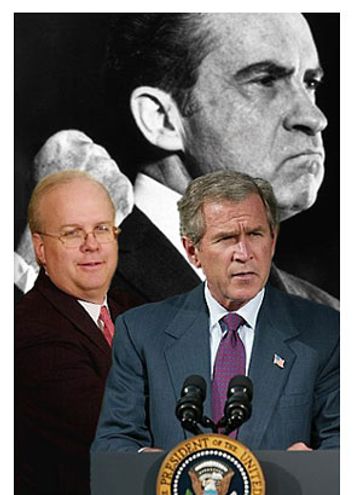
Having watched the GOP’s evolution as it embraced the radicalism of authoritarian conservatism, slowly ceding control to its most strident faction, the authoritarian conservatives, I can no longer recognize the party. These new conservative leaders have not only sought to turn back the clock, but to return to a time before the Enlightenment when there were no clocks. As former vice president Al Gore nicely stated it, the Republicans have undertaken an “assault on reason.” Indeed, they have rejected their own reasoned philosophy by ignoring conservatism’s teachings — based on well-documented history — about the dangers of concentrations of power. They have done so by focusing on the presidency as the institution in which they wish to concentrate the enormous powers of the federal government. Nixon led the way, and Reagan, Bush I, and Bush II learned from his mistakes. Nixon scowled as he scolded and secretly investigated his opponents in the name of national security; his GOP successors have smiled and reassured Americans they are operating to protect them as they have proceeded to convert the American presidency into an elective monarchy, with its own high council, which was once known as the federal judiciary.

Fortunately, the power of the authoritarian conservatism that has so dominated the Bush/Cheney presidency is waning, although it is not likely there will ever be less than about one in four Americans who will follow such authoritarian leadership without question. For authoritarian conservatism to win another presidential contest, its candidate would have to attract independent voters in addition to their hardcore base. But polling of independents reveals that they have largely become disgusted with the Republicans, and lean heavily toward the Democrats. In surveying all of the Republican contenders for the GOP nomination, I have found that to the man, they all are far more authoritarian than even the most authoritarian of the Democrats. This raises the almost certain likelihood that, regardless of how great a distance any of these GOP candidates might attempt to place between himself and the Bush/Cheney presidency during a general election campaign, in fact, if elected he is going to continue in the vein that has already caused this nation so much trouble. (There is no doubt that the GOP will select an authoritarian standard-bearer, because these are the people who are most active in the primaries and the most devoted workers in the general election. It is almost impossible for a non-authoritarian to win the Republican nomination, as the party is now structured.)

As I was writing this closing section an old friend from the Nixon White House called. Now retired, he is a lifelong Republican who told me that he voted for Bush and Cheney twice, because he knows them both personally. He asked how my new book was coming, and when I told him the title, he remarked, “I’ll say the government’s broken.” After we discussed it, he asked how I planned to end the book, since the election was still a good distance away. I told him I was contemplating ending midsentence and immediately fading to black — the way HBO did in the final episode of the Sopranos, but that I would settle for a nice quote from him, on the record. He explained that he constantly has to bite his tongue, and the reason he does not speak out more is because one of his sons is in an important (nonpolitical) government post, and we both know that Republicans will seek revenge wherever they can find it. How about an off-the-record comment? I asked. That he agreed to.

“Just tell your readers that you have a source who knows a lot about the Republican party from long experience, that he knows all the key movers and shakers, and he has a bit of advice: People should not vote for any Republican, because they’re dangerous, dishonest and self-serving. While I once believed that Governor George Wallace had it right, that there was not a dime’s worth of difference in the parties; that is not longer true. I have come to realize the Democrats really do care about people who most need help from government; Republicans care most about those who will only get richer because of government help. The government is truly broken, particularly in dealing with national security, and another four years, and heaven forbid not eight years, under the Republicans, and our grandchildren will have to build a new government, because the one we have will be unrecognizable and unworkable.”

These comments summed up our current situation — and our possible future — as eloquently as anything I could have wished.

Guessing game

The revelation of Deep Throat's identity has only created more mysteries.

  • more
    • All Share Services

The Bush administration prosecutes government officials who leak sensitive information, even when that information is not classified — as I noted in my column on Jonathan Randal. The administration is also prepared to send reporters to jail when they refuse to reveal their sources to a grand jury, as I noted in another column.

I doubt the Justice Department will go after W. Mark Felt — the 91-year-old former deputy director of the FBI — even if he is the greatest leaker in American political history. Still, in the context of the administration’s stances on leaking, the surfacing of Deep Throat at this time is rather ironic.

Bob Woodward (and Carl Bernstein) have confirmed the Vanity Fair story, identifying W. Mark Felt as their legendary Watergate source. The best-kept secret in Washington, for three decades, is no more.

But this is not to say the mystery is resolved. To the contrary, while Mark Felt is alive, his memory for the details of his relationship with Woodward seems to be all but gone. So the revelation of his identity raises many new questions that it seems Felt himself will not be able to answer.

The game of guessing the identity of Deep Throat, which moved from the parlors of Washington to serious inquiry during the last 30 years, is over. A number of us who were fascinated by the inscrutability of it all have been forced into retirement.

Adrian Havill, a freelance author who did some good digging, most recently thought Deep Throat could be no less than former president George H.W. Bush.

Leonard Garment, my successor as Nixon White House counsel, focused his considerable intellect and keen intuition on the issue, and first thought Deep Throat must have been former Nixon White House aide John Sears. Later, however, Garment was convinced that Deep Throat had to be a composite (a hypothesis that has yet to be shown to be incorrect — but has been denied by Woodward and Bernstein).

Similarly, yours truly (the senior Deep Throat sleuth) has made several incorrect runs at Throat’s true identity. (In my 2002 Salon e-book, “Unmasking Deep Throat,” I wrote, “I don’t believe there is any way Felt could have been Deep Throat,” and concluded, “While I have personal knowledge about each of the remaining candidates — [Pat] Buchanan, [Steve] Bull, [Ray] Price, [Jerry] Warren and [Ron] Ziegler — as well as hunches about them, I’m not going to play a guessing game. Ever since throwing out Earl Silbert’s name years ago, I have refused to guess, and now is not the time to start.”) So I tip my hat to former Los Angeles Times reporter Jim Mann, who figured it out, and wrote about Felt in a 1992 Atlantic Monthly essay. Tim Noah of Slate was not far behind, forcing Felt to deny.

When I took a hard look at Felt years ago, I concluded he could not have known what Deep Throat knew when the information was given to Woodward, particularly since he was gone from the FBI at the end, and scratched him off the list of viable candidates.

In fact, so sure was I that, even after reading the Vanity Fair piece and before Woodward had confirmed Felt’s identity, I bet an NBC News person $100 it was not Felt the morning the Vanity Fair story broke.

Fortunately, though, I knew my bet was covered, for I’d made an early wager, also for $100, with former Chicago Tribune investigative reporter William Gaines. Gaines, who now teaches journalism at the University of Illinois, has used Deep Throat sleuthing as a teaching tool, but I was confident that he was wrong in naming my former Nixon White House deputy, Fred Fielding, as Throat.

Woodward disliked this sleuthing. Now that the issue of Deep Throat’s identity appears resolved, I suspect Woodward is going to be even less enchanted with those who focus on his journalism. And Deep Throat himself, Mark Felt, is going to be probed as he might never have dreamed.

I’m among those who believe Woodward is truly one of the great journalists. (It’s not an opinion shared by many of my former White House colleagues.) No Washington reporter has so consistently had access to those in power — meaning Woodward has often had uniquely compelling stories to tell. And Woodward’s reporting is fair and honest — one reason he may maintain the access he has.

Still, Woodward’s use of unidentified sources — a controversial practice, and one now banned at Newsweek after the Quran desecration debacle — has been extreme. And because Woodward’s key Watergate source was unidentified, until now no one could test his Watergate reporting.

Bob once told me that when I learned who, in fact, Deep Throat was, all my questions would be clarified. That, however, has not happened. To the contrary, I only have more questions now that I know Deep Throat was Mark Felt.

I raise a few of them here, in the hope of getting some answers, while Woodward is still out and about doing talk shows.

But first, for those not following this story closely, a little background is in order:

At the time of Watergate, Mark Felt was the deputy director of the Federal Bureau of Investigation. Former Director J. Edgar Hoover, who had elevated Felt to this post, had died only weeks earlier. President Nixon had selected the assistant attorney general of Justice’s Civil Division, L. Patrick Gray, to serve as the acting director of the FBI.

Even before Hoover’s death, however, Felt was for all practical purposes running the FBI — as Hoover wanted it run, with a few exceptions. For example, when Hoover wanted to end surreptitious black-bag jobs (entries onto premises without a court warrant), Felt continued them.

Later, Felt would be indicted and convicted by President Carter’s Justice Department for continuing the practice of illegal searches, only to be pardoned by President Ronald Reagan for the practice. One wonders if Felt would have been pardoned by Reagan had it been known he was Deep Throat. Plus, I seriously doubt former President Richard Nixon would have testified on Felt’s behalf — as indeed he did — during his trial had he known of Felt’s actions as Deep Throat. Deep Throat had earned top ranking on Nixon’s post-presidency enemies list (one notch above yours truly.)

When Pat Gray became acting director of the FBI, I don’t believe he had a clue how to run the place. In fact, he did not really focus on trying to do so. Rather, he spent much of his time traveling throughout the country literally campaigning at various FBI field offices to win the support of rank-and-file FBI agents for the job of director. Thus, during much of the Watergate investigation, Gray was not even in Washington.

When I talked to Gray during the Watergate investigation, he typically said he would have to check with Felt and get back to me. No one at the Nixon White House believed Gray had any control whatsoever of the FBI. To claim otherwise, as Felt apparently did with Woodward, is absurd.

Notwithstanding the article in the Washington Post (from his forthcoming book) about Mark Felt, Bob Woodward, so far, has told us little of his working relationship with Felt. Given Felt’s aging memory, which is widely acknowledged to be less than razor sharp, it will be Woodward’s story — not Felt’s.

Yet we do know something about the information Felt, as Deep Throat, provided to the Washington Post from Woodward’s book, “All the President’s Men.” Woodward reports some 14 meetings (depending on how they are counted).

Recently, I went through the book again, and pulled out every fact — or factoid — that Throat/Felt shared with Woodward, and noted when the information exchange had occurred. For a list of these facts — and an indication of which of them I believe may well be untrue — see the appendix to this column.

This summary of what Deep Throat told Woodward and when, according to “All the President’s Men,” is particularly illuminating now that we know Deep Throat’s identity. It, along with a few more clues Woodward has dropped since confirming Felt’s role, raises new questions about the Watergate investigations and about Felt’s leaking to Woodward.

Here are just a few questions that need to be answered:

In his position as the No. 2 man in the FBI, and the man running the Watergate investigation for the FBI, Felt saw virtually all the raw data from the FBI’s field investigations. In the few days since the revelation of his identity, I have not had an opportunity to compare the material from the FBI’s Watergate investigation with the information that Felt gave Woodward to see if it is possible to determine how he got it wrong. But such a comparison will doubtless be fascinating.

Woodward, it appears, was seldom in a position to correct information that Felt gave him that was wrong. But when writing “All the President’s Men,” he did correct one major false statement from Felt. Sometime in early May 1973, Felt told Woodward, “In early February, [Patrick] Gray went to the White House and said, in effect, ‘I’m taking the rap on Watergate.’ He got very angry and said he had done his job and contained the investigation judiciously, that it was unfair that he was being singled out to take the heat. He implied that all hell could break loose if he wasn’t able to stay in the job permanently and keep the lid on. Nixon could have thought this was a threat, though Gray is not that sort of guy. Whatever the reason, the president agreed in a hurry and sent Gray’s name up to the Senate right away. Some of the top people in the White House were dead set against it; they couldn’t talk him out of it.”

It appears that Felt has invented this statement out of whole cloth — or was seriously misinformed. It never happened this way, as the Nixon White House tapes make clear.

To reflect this, Woodward did add a footnote in this instance, stating that Pat Gray’s attorney advised Woodward that the suggestion Gray had pressured or blackmailed Nixon was “outrageously false.”

But most of Felt’s bad information has never been corrected. In fact, a few writers about the period have quoted Felt’s bad information as historical fact. As can be seen from the appendix, some of these inaccuracies are minor (although I doubt not so minor to persons erroneously maligned by Felt). But some are not.

Given the complexity of Watergate, it is not difficult to understand how Felt made some mistakes when meeting with Woodward in the dead of the night. Yet in other instances, it is not easy to comprehend how the No. 2 man in the FBI could have provided such bad information, knowing it could become public. And why has Felt let this bad information sit in the historical record for the past three decades?

My opinion as to which information, provided by Felt, is wrong is based on my many years of reviewing great swathes and stacks of documents about the Watergate investigation. The appendix speaks for itself. But here, allow me to flag just one (of several) particularly egregious sessions where Felt gave Woodward appalling information, apparently to try to manipulate Woodward and the Washington Post.

It must be noted, according to Woodward’s reports, that Felt frequently told Woodward — falsely — that he and the Washington Post were under surveillance. And based on Woodward’s recent article about Felt, it seems Felt equated Nixon with Hitler, and that he saw the Watergate investigation as a Nazi hunt (harking back to his pre-FBI days in the military).

A month before Felt retired from the FBI, he had one of his more remarkable sessions with Woodward. On May 16, 1973 (as reported at Pages 317-18 of “All the President’s Men”), Woodward says Felt has become “transformed” by the Watergate investigation, and talks to him almost in a monologue. When finished, Felt departs; Woodward wrote it all down in a notebook, which he later typed out for Bernstein.

It is one of the most dramatic scenes in the movie of “All the President’s Men”: With a Rachmaninoff piano concerto playing in the background, a frightened Woodward types his notes from this session with Felt. Woodward’s dread is understandable. The No. 2 man at the FBI has told him — now, it clearly seems, falsely — “Everyone’s life is in danger … electronic surveillance is going on and we had better watch it. The CIA is doing it.” The CIA role in Watergate was investigated, and had this occurred, it would be known today.

The report continues: “Dean talked with Senator Baker after [the] Watergate committee formed and Baker is in the bag completely, reporting back directly to [the] White House.” This is absolutely false. I never spoke with Baker. And Baker certainly was not in the bag.

Felt says that the president “threatened Dean personally and said if he ever revealed the national security activities the President would insure he went to jail.” This never happened, a fact that can be corroborated by Nixon’s tapes.

As my appendix notes, the flow of false facts continued. At one point Felt says, “The covert activities involve the whole U.S. intelligence community and are incredible,” although he refused to give Woodward any details, claiming “it is against the law.” In fact, no such operation was ever directed out of the Nixon White House.

Even more absurd are Felt’s claims that those involved in the Watergate coverup were “chipping in their own personal funds. And Mitchell couldn’t meet his quota [so] … they cut Mitchell loose.” Absurd, too, is his claim that “these guys in the White House were out to make money and a few of them went wild trying.”

Because Woodward could not quote Felt directly, none of the surprising number of false statements highlighted in my appendix made their way into the Washington Post, but apparently Woodward believed them sufficiently to include them in his book.

If Felt was not trying to manipulate the Post, it is not clear what he was doing. Surely, he had to know — or, at least, should have known — that much of his information was worse than speculative; it was plain wrong.

In short, the amount of bad information that Felt gave Woodward is alarming. How and why did it happen?

Woodward reports — in the Washington Post story recently excerpted from his forthcoming book on Throat/Felt — how he and Felt devised a system indicating that Woodward needed to talk to Felt, since Felt did not want him calling his office.

“If you keep the drapes in your apartment closed, open them and that could signal me, [Felt] said. I could check each day or have them checked, and if they were open we could meet that night at a designated place” (emphasis added). But because Woodward liked to keep his drapes open, they agreed that Woodward would place a flowerpot with a road construction flag in it on his balcony as the signal.

Clearly, Woodward suspects that Felt, who would have been extremely busy running the day-to-day activities of the FBI, was not checking his apartment balcony daily himself. Woodward writes, “How [Felt] could have made a daily observation of my balcony is still a mystery to me  The Iraqi Embassy was down the street, and I thought it possible that the FBI had surveillance or listening posts nearby. Could Felt have had the counterintelligence agents regularly report on the status of my flag and flowerpot? That seems highly unlikely, if not impossible.”

I don’t think it is impossible at all. To the contrary, I believe that Felt had to have one or more persons working with him. Thus, others in the FBI must have known Felt was feeding the Washington Post.

This is evident from the last reported conversation in “All the President’s Men” between Deep Throat and Woodward. Felt retired from the FBI five months before this last contact, during the first week of November 1973. As a result of the conversation, Woodward (breaking his prior agreement not to quote Felt directly) uses his words in the Post story, which told of gaps of “a suspicious nature” in Nixon’s secret tapes that “could lead someone to conclude that the tapes have been tampered with.”

How did Felt, no longer in the FBI, get information that “one or more of the tapes contained deliberate erasures”? And when reporting this story in the Washington Post, on November 8, 1973, why did Woodward quote Felt as an anonymous “White House source”? Was Woodward by this time aware that Felt had an agent inside the White House, or a mole?

There has been much discussion since the revelation of Deep Throat’s identity, on television in particular, as to whether Mark Felt is a hero or villain, not to mention what his legacy will be now that we know Throat’s identity. Clearly, he is history’s supreme whistleblower.

Because of my own involvement in Watergate, my knowledge of how those who sought to discredit my testimony (particularly before the Nixon tapes surfaced) operate, and my knowledge of the historical record, I know that Nixon apologists will attack Felt — and Woodward.

These attacks will be senseless. (But that has long been the operative word with Watergate.) It is time to learn from what happened, not refight battles Nixon has, for good reason, lost.

As my appendix shows, the quality of Felt’s information — at least as reported so far and as found in “All the President’s Men” — is of questionable value given the amount of misinformation. It seems it was Felt’s position alone that gave Woodward, and in turn, Woodward’s editor at the Washington Post, Ben Bradlee, confidence in pursuing a story that other news organizations at first largely ignored. (Initially, Bradlee only knew Woodward had a source who was a high official in the Department of Justice — and Bradlee did not learn more until after Nixon had resigned.)

To me, a true hero of Watergate is Ben Bradlee, who not only supported Woodward and Bernstein but had the trust of the Post’s owner, Katharine Graham. Initially, the rest of the national media and the nation ignored the story. Although the Washington Post never “cracked the case,” its keeping the story in the news within the Beltway had a great influence on the Congress, making it an important story. Had Bradlee not done so, history might have been much different.

We still need to know much more about Mark Felt’s activities, not to mention his accomplices, to understand the Byzantine workings of the FBI of that era. I hope Bob Woodward will answer these questions — about which he has knowledge — sooner rather than later, while there is still interest in the story. For it is information that is as uniquely relevant today — with the current White House hellbent on returning the presidency to the imperial status it occupied before Watergate.

Continue Reading Close

Why did Ashcroft remove himself from the Valerie Plame Wilson inquiry?

Signs suggest a key witness may have come forward in the leaking of a CIA agent's identity.

  • more
    • All Share Services

Recently, Attorney General John Ashcroft removed himself from the investigation into who leaked the identity of covert CIA agent Valerie Plame Wilson. Since the announcement, there has been considerable speculation as to why this occurred, and what it means.

Some think the move suggests the inquiry will be scuttled — and Ashcroft is ducking out early to avoid the heat. But that seems unlikely. The new head of the investigation, Patrick J. Fitzgerald, is a high-profile, well-respected U.S. attorney who runs one of the more important offices in the country, Chicago’s. Fitzgerald is also a close friend of Deputy Attorney General James Comey, who announced his appointment. It seems unlikely that Fitzgerald was brought in merely to kill the case.

Others believe that Ashcroft’s decision to remove himself suggests that the investigation must be focusing on people politically close to Ashcroft, and that Ashcroft thus pulled out because he knew he would be criticized whatever he did. That is certainly possible.

But as I will explain, I have a slightly different take on what has occurred and why. Here is what the latest positioning of the tea leaves tells me.

The Recent Progress of the Plame Investigation

All signs indicate that the Plame leak investigation has been gaining steam.

As readers may recall, it was in a July 14 column that journalist Robert Novak revealed that Valerie Plame Wilson was a CIA covert agent. As I discussed in a prior column, the leak is potentially a felony and could violate several laws.

According to the Washington Post, on Dec. 23, Senate minority leader Tom Daschle, and the ranking Democrat of the Senate Armed Services Committee, Carl Levin, sent Ashcroft a letter. The letter demanded a status report on the Plame investigation and urged the appointment of a special counsel. So Democrats have kept the heat on, but that does not strike me as the probable reason for Ashcroft’s decision.

On Dec. 26, the Post reported that the investigation was, in fact, gaining momentum, and the Justice Department had added a fourth prosecutor “specializing in counterintelligence” (which I translate as meaning he had all the security clearances needed to work on a case like this). It also reported that “FBI agents have told people they have interviewed that they may be asked to testify before a grand jury.” Empaneling a grand jury empowers prosecutors both to serve subpoenas and to gather testimony under oath.

On Dec. 30, Deputy Attorney General Comey held a press conference to announce that Ashcroft had removed himself from the investigation. Comey said that the investigation would instead be headed by Fitzgerald. Of note to me was Comey’s comment that “this has come together really in the last week” — meaning, apparently, the week of Dec. 22-26 — the Christmas holiday week during which the FBI raised the prospect of a grand jury.

As Comey explained, given Fitzgerald’s U.S. attorney status — which will be continuing concurrent with his “special counsel” status — there will be no interruption in the investigation. Comey noted that if Fitzgerald “needs to issue a subpoena involving the media, for example, or if he wants to grant immunity to somebody,” he will not have to obtain approval of the Justice Department. (The reference to the media certainly hints at subpoenaing Novak’s phone records or calling him before the grand jury — again suggesting progress in the inquiry.)

On Jan. 2, NBC News reported that the FBI was focusing on the White House as the probable source of the leak. It also reported that the FBI had asked White House staffers “to sign a form releasing reporters from any promises of confidentiality they may have made to their sources.”

Not only does none of this activity indicate an investigation that is being scuttled, but it also clearly implies something noteworthy has happened in the investigation.

The New Phase of the Investigation

Not wanting to hype the situation, all Comey said was that Ashcroft withdrew because, in an “abundance of caution,” the attorney general “believed that his recusal was appropriate based on the totality of the circumstances and the facts and evidence developed at this stage of the investigation.” Comey added later in the press conference that the “recusal is not one of actual conflict of interest that arises normally when someone has a financial interest or something. The issue that he was concerned about was one of appearance.”

What facts would raise serious questions of the appearance of a conflict of interest here? I’d bet that the investigation is focusing on at least one target whom Ashcroft knows more than casually, or works with regularly. After all, Novak did identify his sources as two “senior administration officials.”

What explains the timing of Ashcroft’s removal? Recall that the removal occurred as a result of events that took place in the same week the Post reported that the FBI had told potential witnesses they might have to face a grand jury.

Some of those witnesses very probably hired lawyers as soon as they heard the news. Especially likely to hire a lawyer would be a middle-level person with knowledge of a leak by a higher-up. And such a lawyer would likely have gone immediately to the prosecutors to make a deal.

Who might the lawyer be? It’s pure speculation, but former U.S. attorney Joe diGenova, or his wife and law partner, Victoria Toensing, are likely candidates. Toensing, as chief counsel to the Senate Select Committee on Intelligence, worked on one of the laws that may have been violated — the law protecting the identities of undercover agents. Who better to defend a leaker who might be subject to a law than the person who drafted the law?

Moreover, Toensing was quoted in a recent Washington Post story explaining that it is possible that any leak “could be embarrassing but not illegal” — suggesting that a leaker might have a possible defense. (Unfortunately for the leaker, however, as I noted in the earlier column, more than one law may have been broken.)

When the lawyer — diGenova, Toensing or someone else — went to the government seeking immunity for his or her client, Ashcroft would have heard that the middle-level person was offering to finger the high-level leaker. At that point, he would have realized he himself knew the high-level leaker, decided to recuse himself from the case, and let Fitzgerald take over.

After all, as Comey pointed out at the press conference announcing Fitzgerald’s appointment, Fitzgerald — as a U.S. attorney — would not have to consult with anyone at the Justice Department before making an immunity deal. Accordingly, Fitzgerald could “flip” the middle-level person — offering him or her immunity to testify against his or her superior — without the permission, or even knowledge, of Comey, let alone Ashcroft.

If There Is a Knowledgeable Witness, What Next?

If there is a witness willing to testify against one — or both — of the leakers in exchange for immunity, what then? It seems likely that Fitzgerald will move very quickly to find out if there is indeed a case to be made against the leakers. To bolster his case, he may call Novak and others to the grand jury or, as noted above, subpoena Novak’s (and others’) phone records over the relevant period. Even Ashcroft himself could in theory be called to the grand jury.

If this case does not make headlines in 90 to 120 days, it will be quite surprising. There has been too much high-level action, and Comey, a presidential appointee, knows that politically it would be better for Bush & Co. to have the matter flushed out within the next few months, than to have it arise just before the November election.

Needless to say, this could be an interesting year for the White House, with more than reelection to worry about.

This column originally appeared in FindLaw’s Writ. Reprinted with permission.

Continue Reading Close

Three cheers for the Democrats’ filibuster

It's time to depoliticize the judicial appointment process.

  • more
    • All Share Services

Three cheers for the Democrats' filibuster

Most news accounts of the U.S. Senate’s planned 30-hour talkathon — or filibuster, or reverse filibuster, or whatever this exercise in through-the-night speechifying should be called — have evoked references to Frank Capra’s “Mr. Smith Goes to Washington.” But I keep thinking about Stanley Kubrick’s “Dr. Strangelove, Or How I Learned to Stop Worrying and Love the Bomb.” No question it’s theater — that’s why the Republicans are staging it — but what’s the script?

Ostensibly, Senate Republican leaders are forcing this oratorical marathon to highlight the Democrats’ success in using the mere threat of a filibuster to block President Bush’s ultraconservative judicial nominees. In fact, the Democrats have only used this threat in four instances, with the Senate confirming 168 of Bush’s judicial nominees. Still, Republicans are pouting and pissed, even though they played the same kind of serious hardball with President Clinton’s judicial nominees.

Republicans denied confirmation to more than one-third of Clinton’s nominees for the Court of Appeals, and in many instances the Republican-controlled Senate during the Clinton years refused to even hold hearings on judicial nominees. Yet by effectively blocking four appellate court nominees — Miguel Estrada (who has now withdrawn), Charles Pickering, Priscilla Owen and Bill Pryor — the Democrats have put the Republicans into a tizzy, so they’re determined to provide Americans with a 30-hour C-SPAN tantrum.

They claim they plan to talk about the obstructionist Democrats. But I wonder if more could be at stake. For months, rumors have been circulating on Capitol Hill that not only are the Republicans unhappy about the ability of the Democrats to block four of Bush’s judicial appointments, but also that they are even more concerned that Democrats may similarly be able to successfully filibuster a Bush nominee for the Supreme Court. Is it possible Republicans are planning to “go nuclear,” as they have threatened?

Here’s what that means: Senate rules place no limit on debate. The only way to stop a debate, if one or more senators who have the floor refuse to do so, is with a “cloture” vote. Under current Senate rules it takes three-fifths of the Senate, or 60 senators, to invoke cloture — and end a debate. That’s how you stop a filibuster. But Republicans today don’t have 60 votes.

Bill Frist, the Republican majority leader, has suggested changing the rules on cloture voting, with graduated reductions from a “super-majority” of three-fifths down to a simple majority, or 51 senators. But Democrats are not about to buy that, because Republicans have 51 votes. Republicans can’t change the Senate rules without Democratic support, because it takes a two-thirds vote, or 67 Senators, to change the Senate rules.

Enter Dr. Strangelove, or in this instance Vice President Dick Cheney. He has the power to drop a nuclear device — in the form of a ruling — that could change the Senate’s rules. Senate Rule XXII, which provides for a cloture vote, could not be invoked for nominations until 1949, for nominations were what was considered “executive business,” as opposed to “legislative business.” Apparently, it was a ruling of the chair — the vice president is the president of the Senate, pursuant to the Constitution — that changed Rule XXII in 1949, making it applicable to both the legislative and executive business of the Senate.

Thus, since the 1949 ruling, nominations have been subject to Rule XXII, and cloture. All Cheney need do is say that the ruling was wrong, and that would become the rule — because, under the controlling parliamentary procedures, it takes a majority of senators to overrule the chair, which Democrats don’t have.

Such an action by Cheney has been described on Capitol Hill as “going nuclear,” for it would be an extreme ploy, certain to be accompanied by a “nuclear winter” in the Senate. The Senate, by long tradition, has been a highly collegial body, operating largely by unanimous consent. This sort of tactic would break all tradition. If it is part of a secret Republican agenda, tonight or beyond, it will forever change the way the Senate operates.

In truth, the successful use of the filibuster to block extremist judicial appointees is one of the healthiest developments since our founding fathers required presidents to get the Senate’s “advice and consent” to fill judicial seats. Federal judges are given lifetime appointments; thus their influence extends long past the term of the president who selects them. To require a super-majority discourages either party from engaging in politicalization of the judiciary.

During the past four decades, selecting judges and getting them confirmed has become far more contentious. According to a report of the Congressional Reference Service, filibusters and clotures have been involved in 35 nominations, most of them since the late 1980s.

Notwithstanding the finger-pointing by the Republicans for filibustering four Bush nominees, this practice started in 1968 with Republicans, with the help of Southern Democrats (who now come to the Senate as Republicans), filibustering President Lyndon Johnson’s nominee for Chief Justice, Abe Fortas. Republicans blocked Fortas so Nixon could get the chief justice appointment, assuming, correctly, he would be elected.

It was pure politics, and it began the game that is now being played out. Indeed, Frist, the mastermind of this stunt in the Senate tonight, voted against cloture (and for filibuster) during the battle over one of President Clinton’s court appointees. But what is a little hypocrisy when wasting the Senate’s time pointing fingers?

We need to move beyond the game of playing politics with the federal bench, deliberately trying to influence the philosophical bent of justice. The judiciary was to be the nonpolitical branch, yet for the last four decades both presidents and Congress have worked to politicize it. Studies show that the outcome of lawsuits and prosecutions can be increasingly predicted by the political affiliation of the judges.

There’s a way to depoliticize judicial appointments: Both parties in the Senate should adopt the use of the filibuster, not in exceptional cases but as a standard operating procedure for all judicial nominations. Require a super-majority for all judges. A super-majority represents the will of the people, while a one- or two-vote advantage simply jams the will of a slight majority down the throat of the minority. The Constitution requires super-majorities to approve treaties, to override a presidential veto, and to remove an official who has been impeached by the House of Representatives. The Senate has super-majorities in its rule. By imposing a super-majority requirement — with the threat of a filibuster — it will end this practice, never contemplated by the nation’s founders, of presidents stacking the judiciary.

If Dr. Strangelove shows up at the Senate, however, to pull the trigger on what would be its own form of political terrorism, we will have entered a new era in the Senate, and there is no saying what will happen. But it won’t be pretty.

Editor’s note: This story has been corrected since its original publication.

Continue Reading Close

More vicious than Tricky Dick

John Dean says the Bush team's leaks are even viler than his former boss's -- and that Plame and Wilson should file a civil suit.

  • more
    • All Share Services

More vicious than Tricky Dick

I thought I had seen political dirty tricks as foul as they could get, but I was wrong. In blowing the cover of CIA agent Valerie Plame to take political revenge on her husband, Ambassador Joseph Wilson, for telling the truth, Bush’s people have out-Nixoned Nixon’s people. And my former colleagues were not amateurs by any means.

For example, special counsel Chuck Colson, once considered the best hatchet man of modern presidential politics, went to prison for leaking false information to discredit Daniel Ellsberg’s lawyer. Ellsberg was being prosecuted by Nixon’s Justice Department for disclosing the so-called Pentagon Papers (the classified study of the origins of the Vietnam War). But Colson at his worst could barely qualify to play on Bush’s team. The same with assistant to the president John Ehrlichman, a jaw-jutting fellow who left them “twisting in the wind,” and went to jail denying he’d done anything wrong in ordering a break-in at Ellsberg’s psychiatrist’s office, where the burglars went and looked for, but did not find, real information to discredit Ellsberg.

But neither Colson nor Ehrlichman nor anyone else I knew while working at the Nixon White House had the necessary viciousness, or depravity, to attack the wife of a perceived enemy by employing potentially life-threatening tactics.

So let me share a bit of history with Ambassador Wilson and his wife. And, well aware that gratuitous advice is rightfully suspect, let me also offer them a suggestion — drawn from some pages of Watergate history that till now I’ve only had occasion to discuss privately. Long before Congress became involved and a special prosecutor was appointed, Joe Califano, then general counsel to the Democratic National Committee and later a Cabinet officer, persuaded his Democratic colleagues to file a civil suit against the Nixon reelection committee. And that maneuver almost broke the Watergate coverup wide open. In seeking justice from the closed ranks of the Bush White House, Wilson and Plame should follow a similar strategy.

The hardball politics of Nixon and his people, of course, first surfaced with the bungled break-in and attempted wiretapping at the Watergate offices of the Democratic National Committee (DNC), when the head of security of Nixon’s reelection campaign was arrested there along with a small army of Cuban Americans. These activities were, of course, only the tip of an iceberg, a first bit of public evidence of a White House mentality oblivious to the law.

DNC chairman Lawrence O’Brien, an experienced political operator, correctly suspected the worst. He had been harassed by the IRS, deducing (correctly) but not knowing for certain that the audit was being pushed by Nixon himself. After the Watergate break-in, O’Brien quickly realized that Nixon’s Department of Justice was not likely to expose this criminal activity, so he filed a civil lawsuit. In his memoir, he later explained why:

“We wanted to get to the bottom of [the Watergate break-in] — we wanted the whole story, no matter where it led. There was reason to suspect that the break-in and wiretapping had been authorized by the officials of the CRP [Nixon's reelection committee]; and there was the possibility that the trail might even lead higher. We wanted the facts, and we knew they would not be easily attained. One decision we made, acting on [DNC general counsel] Joe Califano’s legal advice, was to file a lawsuit against CRP. In this way, the judicial process would help us get to the truth.”

Few appreciate the significance of this lawsuit in the unraveling of Watergate. It has been largely overlooked by history. A few years ago, I told Joe Califano about the impact his lawsuit had: Within the White House, it was considered one of the most difficult problems to deal with during the investigations of Watergate. The FBI was no problem — no one has to talk to an FBI agent. And no Department of Justice is going to haul White House aides before a grand jury. But a subpoena demanding the production of documents, or an appearance to give testimony under oath at a deposition — that was a serious threat. It also troubled the FBI and Justice Department, keeping them on their toes. It was remarkably effective.

Regardless of whether or not a special prosecutor is selected, I believe that Ambassador Wilson and his wife — like the DNC official once did — should file a civil lawsuit, both to address the harm inflicted on them, and, equally important, to obtain the necessary tools (subpoena power and sworn testimony) to get to the bottom of this matter. This will not only enable them to make sure they don’t merely become yesterday’s news; it will give them some control over the situation. In the case of the DNC’s civil suit, Judge Charles Richey, a good Republican, handled it in a manner that was remarkably helpful to the Nixon reelection effort. But any judge getting a lawsuit from Wilson and Plame today would be watched a lot more carefully.

While I have made no effort to examine all the potential causes of action that Wilson and Plame might file, several come to mind. For example, given the fact that this leak was reportedly an effort to harm them, a civil action for intentional infliction of emotional distress could be appropriate. (Because I am not aware of their residence — the District of Columbia, Maryland or Virginia — I will only state the law generally.)

Typically, there will be a statute to this effect: “One who by extreme and outrageous conduct intentionally or recklessly causes severe emotional distress to another is subject to liability for such emotional distress, and if bodily harm to the other results from it, for such bodily harm.” Most often, these actions fail because the conduct is not sufficiently outrageous. But blowing the cover of a CIA operative by anyone with access to such classified information is outrageous by any standard. By way of comparison, it’s been found outrageous for a doctor to refuse to treat an unconscious infant and leave mother and child out in the cold; it has been ruled outrageous for a mortician to mishandle a corpse and lie about it; and it was considered outrageous to recklessly issue a report of a person’s death that had not happened.

Also, there is an entire body of law relating to civil actions based on criminal statutes and constitutional activities. Suffice it to say that there are a number of potential causes of action, and I have no doubt that a good civil litigator can fashion a powerful lawsuit for Ambassador and Mrs. Wilson.

A key question is: Who would they sue? No one has admitted to the dirty deed. In Watergate, the DNC had a hook: They named not only the burglars arrested in their offices but also the Nixon reelection committee, charging a conspiracy to deny the civil rights of Larry O’Brien and other Democrats. From a tactical standpoint, as any lawyer will tell the Wilsons, what’s vital is to survive a motion to dismiss, or other such summary action, so that they can conduct all the necessary discovery to find everyone who should be named. Newspaper accounts suggest the first potential defendant might be Karl Rove, who, Ambassador Wilson has been told by reporters, has repeatedly said Wilson’s wife was “fair game.” And we know this is not the first time Rove might have leaked to Robert Novak, who broke the Wilson story; Rove was removed from the 1992 George H.W. Bush campaign for just such a smearing leak, according to many reports (which Rove has denied).

An attorney will only file such a lawsuit for the Wilsons if he can, in essence (as required under the federal court rules), attest that to the best of his or her knowledge, information and belief, formed after an inquiry reasonable under the circumstances, the lawsuit has not been filed for an improper purpose, that the claims aren’t frivolous, that the claims are based on solid law, and that the allegations have evidentiary support — or will have such support after a reasonable opportunity for further investigation or discovery. In short, while there is a minimum threshold for filing such a suit, it is not a very high barrier. I have little doubt such a lawsuit could be fashioned with little difficulty.

If the Bush White House is anything like the Nixon White House — and there is increasing evidence of the similarities — it will respond to such a lawsuit like a stuck pig. Leaking the name of a CIA official can under no circumstances be considered a part of any potential defendants’ official duties, so they will not be given representation by the Department of Justice. But how about Wilson and Plame: Should they have to bear the expense of a lawsuit to deal with the harm they have suffered and get to the bottom of what happened? I don’t think so, and after talking with several lawyers in Washington, I find I am not alone. I have good reason to believe that one or more law professors in the area might handle the case pro bono, or one or more of the public interest groups might underwrite the lawsuit. Needless to say, that will only cause more squealing by those who want this to go away. They will cry that it’s all politics. This is an empty contention — it was the attack on the Wilsons that was pure politics. But the Bush folks appear to have messed with the wrong man (and woman).

Time after time, Nixon tried to stem Watergate by declaring it was pure politics. But what were his people doing in the Democratic headquarters? Was that not merely dirty politics? To fight the investigations of Watergate, the White House and the Republican National Committee, the Nixon reelection committee kept their surrogates working full time. Democrats who criticized Nixon for not getting to the bottom of who was involved in the DNC break-in were endlessly accused of playing politics with nothing but “a third-rate attempted burglary.” This sort of defense, of course, has already commenced from the Bush White House, with the president’s surrogates similarly downplaying this vile act of political revenge against the Wilsons. Apparently, they don’t realize how Nixonian this behavior is, and Nixon and his aides did not exactly set the gold standard for conduct for any presidency.

Bush’s Justice Department, not unlike Nixon’s, faces insidious conflicts of interest when investigating the White House. Given the close ties of those on the White House staff with the political appointees at Justice, the conflict is real, not merely an appearance, and actually more serious for the Bush administration’s people than Nixon’s because there are many more longstanding ties. Equally troubling, the Justice Department has a poor record in this area. For decades, it has been notorious for its inability to uncover leaks, and it has only prosecuted cases handed to it by other agencies that have taken on the work of flushing out leakers. The CIA, for example, refers leaks regularly to Justice, but nothing ever happens. As those familiar with this dismal performance can tell you, one reporter at the Washington Times has printed over 200 classified national security secrets. How the Justice Department has failed to uncover even one is stunning.

But when it is important, the source of a leak can be found. A good example is that of former chief judge Norma Holloway Johnson, who during the Clinton administration’s Whitewater/Lewinsky investigations became exasperated with grand jury leaks (since grand jury information is equal to highly classified national security information). The leaks were coming from the office of independent counsel Kenneth Starr, so rather than have Justice probe the leak, Judge Johnson appointed a special master, who found the leaker — Starr’s deputy, Charles Bakaly. The judge tried Bakaly, in a non-jury trial for contempt, and then let him off the hook. She’d made her point. Her inquiry also makes the point that when there is a will to find a leaker, there is a way.

As for claims by the Bush administration that it can avoid conflict-of-interest problems by turning the investigation of leaks about Plame over to career professionals rather than to Bush political appointees, that’s nonsense. That would merely turn the clock back to the initial Watergate investigation, which was conducted by career professionals. Years ago, I testified about how helpful those career attorneys were, and as the White House tapes later proved, these professionals (men with impeccable credentials) kept the Nixon White House fully informed of their investigation, as did the FBI, thereby facilitating the coverup.

Of course, Attorney General Ashcroft should appoint an independent prosecutor, or even two, as Calvin Coolidge did (a Republican and a Democrat) to investigate Teapot Dome. That would be the smart move, with a staggering 70 percent of Americans saying he should appoint a special prosecutor, and 83 percent of those polled saying this is a serious matter, according to the Washington Post.

But most importantly, I believe that Wilson and Plame hold the keys to resolving this matter: with a civil lawsuit. This was one of the hidden keys to Watergate, though it was never fully turned. But had Joe Califano’s lawsuit not been slowed down by a Nixon-friendly judge, Watergate would have ended much earlier. So can this scandal — if the Wilsons choose to take that route.

Continue Reading Close

Worse than Watergate

If Bush lied about the reasons for war it could be an impeachable offense.

  • more
    • All Share Services

President George W. Bush has got a very serious problem. Before asking Congress for a Joint Resolution authorizing the use of American military forces in Iraq, he made a number of unequivocal statements about the reason the United States needed to pursue the most radical actions any nation can undertake — acts of war against another nation.

Now it is clear that many of his statements appear to be false. In the past, Bush’s White House has been very good at sweeping ugly issues like this under the carpet, and out of sight. But it is not clear that they will be able to make the question of what happened to Saddam Hussein’s weapons of mass destruction (WMDs) go away — unless, perhaps, they start another war.

That seems unlikely. Until the questions surrounding the Iraqi war are answered, Congress and the public may strongly resist more of President Bush’s warmaking.

Presidential statements, particularly on matters of national security, are held to an expectation of the highest standard of truthfulness. A president cannot stretch, twist or distort facts and get away with it. President Lyndon Johnson’s distortions of the truth about Vietnam forced him to stand down from reelection. President Richard Nixon’s false statements about Watergate forced his resignation.

Frankly, I hope the WMDs are found, for it will end the matter. Clearly, the story of the missing WMDs is far from over. And it is too early, of course, to draw conclusions. But it is not too early to explore the relevant issues.

President Bush’s statements on Iraq’s weapons of mass destruction

Readers may not recall exactly what President Bush said about weapons of mass destruction; I certainly didn’t. Thus, I have compiled these statements below. In reviewing them, I saw that he had, indeed, been as explicit and declarative as I had recalled.

Bush’s statements, in chronological order, were:

“Right now, Iraq is expanding and improving facilities that were used for the production of biological weapons.”

– United Nations Address
September 12, 2002

“Iraq has stockpiled biological and chemical weapons, and is rebuilding the facilities used to make more of those weapons.”

“We have sources that tell us that Saddam Hussein recently authorized Iraqi field commanders to use chemical weapons — the very weapons the dictator tells us he does not have.”

– Radio Address
October 5, 2002

“The Iraqi regime … possesses and produces chemical and biological weapons. It is seeking nuclear weapons.”

“We know that the regime has produced thousands of tons of chemical agents, including mustard gas, sarin nerve gas, VX nerve gas.”

“We’ve also discovered through intelligence that Iraq has a growing fleet of manned and unmanned aerial vehicles that could be used to disperse chemical or biological weapons across broad areas. We’re concerned that Iraq is exploring ways of using these UAVS for missions targeting the United States.”

“The evidence indicates that Iraq is reconstituting its nuclear weapons program. Saddam Hussein has held numerous meetings with Iraqi nuclear scientists, a group he calls his “nuclear mujahideen” — his nuclear holy warriors. Satellite photographs reveal that Iraq is rebuilding facilities at sites that have been part of its nuclear program in the past. Iraq has attempted to purchase high–strength aluminum tubes and other equipment needed for gas centrifuges, which are used to enrich uranium for nuclear weapons.”

– Cincinnati, Ohio Speech
October 7, 2002

“Our intelligence officials estimate that Saddam Hussein had the materials to produce as much as 500 tons of sarin, mustard and VX nerve agent.”

– State of the Union Address
January 28, 2003

“Intelligence gathered by this and other governments leaves no doubt that the Iraq regime continues to possess and conceal some of the most lethal weapons ever devised.”

– Address to the Nation
March 17, 2003

Should the President get the benefit of the doubt?

When these statements were made, Bush’s let-me-mince-no-words posture was convincing to many Americans. Yet much of the rest of the world, and many other Americans, doubted them.

As Bush’s veracity was being debated at the United Nations, it was also being debated on campuses — including those where I happened to be lecturing at the time.

On several occasions, students asked me the following question: Should they believe the President of the United States? My answer was that they should give the President the benefit of the doubt, for several reasons deriving from the usual procedures that have operated in every modern White House and that, I assumed, had to be operating in the Bush White House, too.

First, I assured the students that these statements had all been carefully considered and crafted. Presidential statements are the result of a process, not a moment’s thought. White House speechwriters process raw information, and their statements are passed on to senior aides who have both substantive knowledge and political insights. And this all occurs before the statement ever reaches the President for his own review and possible revision.

Second, I explained that — at least in every White House and administration with which I was familiar, from Truman to Clinton — statements with national security implications were the most carefully considered of all. The White House is aware that, in making these statements, the President is speaking not only to the nation, but also to the world.

Third, I pointed out to the students, these statements are typically corrected rapidly if they are later found to be false. And in this case, far from backpedaling from the President’s more extreme claims, Bush’s press secretary, Ari Fleischer had actually, at times, been even more emphatic than the President had. For example, on January 9, 2003, Fleischer stated, during his press briefing, “We know for a fact that there are weapons there.”

In addition, others in the Administration were similarly quick to back the President up, in some cases with even more unequivocal statements. Secretary of Defense Donald Rumsfeld repeatedly claimed that Saddam had WMDs — and even went so far as to claim he knew “where they are; they’re in the area around Tikrit and Baghdad.”

Finally, I explained to the students that the political risk was so great that, to me, it was inconceivable that Bush would make these statements if he didn’t have damn solid intelligence to back him up. Presidents do not stick their necks out only to have them chopped off by political opponents on an issue as important as this, and if there was any doubt, I suggested, Bush’s political advisers would be telling him to hedge. Rather than stating a matter as fact, he would be say: “I have been advised,” or “Our intelligence reports strongly suggest,” or some such similar hedge. But Bush had not done so.

So what are we now to conclude if Bush’s statements are found, indeed, to be as grossly inaccurate as they currently appear to have been?

After all, no weapons of mass destruction have been found, and given Bush’s statements, they should not have been very hard to find — for they existed in large quantities, “thousands of tons” of chemical weapons alone. Moreover, according to the statements, telltale facilities, groups of scientists who could testify, and production equipment also existed.

So where is all that? And how can we reconcile the White House’s unequivocal statements with the fact that they may not exist?

There are two main possibilities. One is that something is seriously wrong within the Bush White House’s national security operations. That seems difficult to believe. The other is that the President has deliberately misled the nation, and the world.

A desperate search for WMDs has so far yielded little, if any, fruit

Even before formally declaring war against Saddam Hussein’s Iraq, the President had dispatched American military special forces into Iraq to search for weapons of mass destruction, which he knew would provide the primary justification for Operation Freedom. None were found.

Throughout Operation Freedom’s penetration of Iraq and drive toward Baghdad, the search for WMDs continued. None were found.

As the coalition forces gained control of Iraqi cities and countryside, special search teams were dispatched to look for WMDs. None were found.

During the past two and a half months, according to reliable news reports, military patrols have visited over 300 suspected WMD sites throughout Iraq. None of the prohibited weapons were found there.

British and American press reaction to the missing WMDs

British Prime Minister Tony Blair is also under serious attack in England, which he dragged into the war unwillingly, based on the missing WMDs. In Britain, the missing WMDs are being treated as scandalous; so far, the reaction in the U.S. has been milder.

New York Times columnist Paul Krugman has taken Bush sharply to task, asserting that it is “long past time for this administration to be held accountable.” “The public was told that Saddam posed an imminent threat,” Krugman argued. “If that claim was fraudulent,” he continued, “the selling of the war is arguably the worst scandal in American political history — worse than Watergate, worse than Iran-contra.” But most media outlets have reserved judgment as the search for WMDs in Iraq continues.

Still, signs do not look good. Last week, the Pentagon announced it was shifting its search from looking for WMD sites, to looking for people who can provide leads as to where the missing WMDs might be.

Undersecretary of State for Arms Control and International Security John Bolton, while offering no new evidence, assured Congress that WMDs will indeed be found. And he advised that a new unit called the Iraq Survey Group, composed of some 1400 experts and technicians from around the world, is being deployed to assist in the searching.

But, as Time magazine reported, the leads are running out. According to Time, the Marine general in charge explained that “[w]e’ve been to virtually every ammunition supply point between the Kuwaiti border and Baghdad,” and remarked flatly, “They’re simply not there.”

Perhaps most troubling, the President has failed to provide any explanation of how he could have made his very specific statements, yet now be unable to back them up with supporting evidence. Was there an Iraqi informant thought to be reliable, who turned out not to be? Were satellite photos innocently, if negligently misinterpreted? Or was his evidence not as solid as he led the world to believe?

The absence of any explanation for the gap between the statements and reality only increases the sense that the President’s misstatements may actually have been intentional lies.

Investigating the Iraqi war intelligence reports

Even now, while the jury is still out as to whether intentional misconduct occurred, the President has a serious credibility problem. Newsweek magazine posed the key questions: “If America has entered a new age of pre-emption — when it must strike first because it cannot afford to find out later if terrorists possess nuclear or biological weapons — exact intelligence is critical. How will the United States take out a mad despot or a nuclear bomb hidden in a cave if the CIA can’t say for sure where they are? And how will Bush be able to maintain support at home and abroad?”

In an apparent attempt to bolster the President’s credibility, and his own, Secretary Rumsfeld himself has now called for a Defense Department investigation into what went wrong with the pre-war intelligence. New York Times columnist Maureen Dowd finds this effort about on par with O. J.’s looking for his wife’s killer. But there may be a difference: Unless the members of Administration can find someone else to blame — informants, surveillance technology, low-level personnel, you name it — they may not escape fault themselves.

Congressional committees are also looking into the pre-war intelligence collection and evaluation. Senator John Warner (R-VA), chairman of the Senate Armed Services Committee, said his committee and the Senate Intelligence Committee would jointly investigate the situation. And the House Permanent Select Committee on Intelligence plans an investigation.

These investigations are certainly appropriate, for there is potent evidence of either a colossal intelligence failure or misconduct — and either would be a serious problem. When the best case scenario seems to be mere incompetence, investigations certainly need to be made.

Senator Bob Graham — a former chairman of the Senate Intelligence Committee — told CNN’s Aaron Brown, that while he still hopes they find WMDs or at least evidence thereof, he has also contemplated three other possible alternative scenarios:

“One is that [the WMDs] were spirited out of Iraq, which maybe is the worst of all possibilities, because now the very thing that we were trying to avoid, proliferation of weapons of mass destruction, could be in the hands of dozens of groups. Second, that we had bad intelligence. Or third, that the intelligence was satisfactory but that it was manipulated, so as just to present to the American people and to the world those things that made the case for the necessity of war against Iraq.”

Senator Graham seems to believe there is a serious chance that it is the final scenario that reflects reality. Indeed, Graham told CNN “there’s been a pattern of manipulation by this administration.”

Graham has good reason to complain. According to the New York Times, he was one of the few members of the Senate who saw the national intelligence estimate that was the basis for Bush’s decisions. After reviewing it, Senator Graham requested that the Bush Administration declassify the information before the Senate voted on the Administration’s resolution requesting use of the military in Iraq.

But rather than do so, CIA Director Tenet merely sent Graham a letter discussing the findings. Graham then complained that Tenet’s letter only addressed “findings that supported the administration’s position on Iraq,” and ignored information that raised questions about intelligence. In short, Graham suggested that the Administration, by cherrypicking only evidence to its own liking, had manipulated the information to support its conclusion.

Recent statements by one of the high-level officials privy to the decision making process that lead to the Iraqi war also strongly suggests manipulation, if not misuse of the intelligence agencies. Deputy Secretary of Defense Paul Wolfowitz, during an interview with Sam Tannenhaus of Vanity Fair magazine, said: “The truth is that for reasons that have a lot to do with the U.S. government bureaucracy we settled on the one issue that everyone could agree on which was weapons of mass destruction as the core reason.”

Worse than Watergate? A potential huge scandal if WMDs are still missing

Krugman is right to suggest a possible comparison to Watergate. In the three decades since Watergate, this is the first potential scandal I have seen that could make Watergate pale by comparison. If the Bush Administration intentionally manipulated or misrepresented intelligence to get Congress to authorize, and the public to support, military action to take control of Iraq, then that would be a monstrous misdeed.

As I remarked in an earlier column, this administration may be due for a scandal. While Bush narrowly escaped being dragged into Enron, it was not, in any event, his doing. But the war in Iraq is all Bush’s doing, and it is appropriate that he be held accountable.

To put it bluntly, if Bush has taken Congress and the nation into war based on bogus information, he is cooked. Manipulation or deliberate misuse of national security intelligence data, if proven, could be “a high crime” under the Constitution’s impeachment clause. It would also be a violation of federal criminal law, including the broad federal anti-conspiracy statute, which renders it a felony “to defraud the United States, or any agency thereof in any manner or for any purpose.”

It’s important to recall that when Richard Nixon resigned, he was about to be impeached by the House of Representatives for misusing the CIA and FBI. After Watergate, all presidents are on notice that manipulating or misusing any agency of the executive branch improperly is a serious abuse of presidential power.

Nixon claimed that his misuses of the federal agencies for his political purposes were in the interest of national security. The same kind of thinking might lead a President to manipulate and misuse national security agencies or their intelligence to create a phony reason to lead the nation into a politically desirable war. Let us hope that is not the case.

This story has been corrected since it was originally posted.

Continue Reading Close

Page 1 of 3 in John W. Dean