Ken Maguire

Is a Greek debt default still inevitable?

The bailout will avert a euro zone breakup for now, but many worry it won't be enough to fix the nation's economy

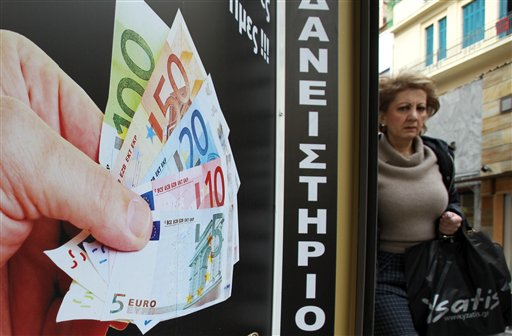
A pedestrian passes outside a pawnshop in Athens, Tuesday, Feb. 21, 2012(Credit: AP Photo/Thanassis Stavrakis)

ATHENS, Greece — They contemplated a divorce but ended up having another baby.

Global Post

Greece and its euro zone partners saved their marriage by agreeing on a $170 billion bailout, but it hasn’t squashed talk of a messy breakup.

Some analysts see a Greek debt default as inevitable. Even Greece’s lenders fear the program is “accident prone,” as they said in a report for euro zone finance ministers before they approved Tuesday’s bailout.

It’s far from a universal opinion. Greek leaders lauded the agreement, naturally, saying it saved the country from a chaotic default. Others add that Greeks — despite the occasional violent protest against austerity measures — grudgingly accept that reforms are necessary.

Still, more of the same won’t cut it, said Costas Michalos, president of the Athens Chamber of Commerce and Industry.

“It’s a bad rescue package,” he said. “It’s not the right mixture of economic policies. If we follow the same economic policies of the past two years, there will be no other option than default, which I’m sure no one wants.”

The new loan package — Greece’s second massive bailout in as many years — aims to finally fix the country’s debt problems and restore its battered economy. It requires wage cuts and public sector layoffs, and strives to make the economy more competitive, which would attract investment.

A Eurogroup statement issued after the vote Tuesday in Brussels said the program is a “comprehensive blueprint” for debt sustainability by 2020 and economic growth. The success, it noted, “hinges critically on its thorough implementation by Greece,” no doubt a reminder of the country’s track record of missing reform targets.

“One can’t help but get the feeling that everyone involved is going through the motions, doing what they feel they have to do, rather than what they want to or what they believe in,” Sony Kapoor, managing director of Re-Define, a London-based think tank, said in a statement. “Confidence in the success of what has been agreed is rather low.”

Greece “will almost certainly” need yet another bailout, Kapoor added. “The troika have had to do some arithmetic gymnastics in order to make the numbers add up but their optimistic assumptions are unlikely to hold.”

Yet, for all their tough talk about cutting off the free-spending Greeks, the euro zone countries ultimately chose the safe route. The “comprehensive blueprint” helps Greece but also safeguards financial stability “in the euro area as a whole,” the Eurogroup statement said.

The new package hinges in part on private bondholders taking a nominal 53.5 percent loss, which will wipe out more than $140 billion from Greece’s overall debt. The IMF warned back in December that unless there’s near-universal voluntary participation by the bondholders, it would be hard to achieve debt sustainability by 2020.

Greece is expected to take extraordinary efforts to repay its creditors. It plans to amend its constitution to prioritize repayments. Also, the lower-valued bonds to be issued to private investors will be governed under English law. That provides stronger protections for investors.

Prime Minister Lucas Papademos has been criticized in some circles for conceding those guarantees, but University of Piraeus finance professor Dimitris Malliaropulos sees the other side.

“That, for me, is a guarantee that Greece will stay in the euro,” he said, adding that the commitment to the euro should improve investor sentiment.

Countries that default usually can devalue their currency, which makes exports cheaper, boosting growth. But with Greece ensuring euro repayments to lenders, there’s no incentive to default, Malliaropulos said.

“If you leave the euro, you should do it now — before the debt exchange,” he said.

The swap is scheduled to be complete in early March. If that and other conditions are met, Greece expects to receive bailout cash — avoiding default — before nearly $19 billion in bond repayments are due later in the month.

Petros Doukas, a former deputy finance minister, said he’s confident Greece will stay on course. He advocates for a larger debt write-off and a Marshall Plan-style spending package by the European Union and the United States — an idea he acknowledges is unlikely to occur.

The optimism, he said, stems from acceptance by politicians and average Greeks that there’s no turning back.

“Whoever thought that pensions and salaries could be reduced? It was unprecedented thinking,” Doukas said. “People complain about it, but they accept it.”

A potential curveball is an election planned in late April. Papademos is an unelected technocrat whose job is to shepherd Greece through the bond swap and bailout negotiations. He’s currently leading a coalition government that includes Greece’s two large parties, the conservative New Democracy and the Socialist PASOK.

Leaders of both parties have signaled their post-election commitment to carry out the reforms demanded by international lenders. Polls show New Democracy leading, but likely in another coalition government.

“The politics are a major risk for the Greek economy,” Malliaropulos said. He noted that Greece has had only a few coalition governments and “they didn’t go very well.”

The EU’s leadership crisis

At the start of yet another summit to save the euro, many fear Merkel and Sarkozy aren't up to the task

French President Nicolas Sarkozy, left, smiles as he greets German Chancellor Angela Merkel prior to their meeting at the Elysee Palace in Paris, Monday Dec. 5, 2011(Credit: AP Photo/Remy de la Mauviniere)
This article originally appeared on GlobalPost.

ATHENS, Greece — Over the next two days, leaders struggling to save the euro are holding yet another summit to end all summits.

Global Post

German Chancellor Angela Merkel and French President Nicolas Sarkozy will be in the spotlight, attempting yet again to forge a robust solution to the euro zone’s debt crisis. They have proposed bold changes to the way the euro zone governments spend money, with tough oversight they hope will ensure fiscal stability. The French president has tried to speak convincingly of guaranteeing “the future of Europe.”

If successful, the leaders will be hailed as saviors. But will this really be their finest hour? Will they finally manage to achieve the overarching goal of restoring confidence in the battered euro, saving Europe and the world from another devastating recession?

Many political observers are pessimistic. For nearly two years, summit after summit has failed to produce a solution, in large part because of weak leadership, they argue. Unlike the towering visionaries who created the common market and its currency, Merkel and Sarkozy just don’t seem to be up to the task, they say.

“They’re not outright disasters but they’re not great leaders and visionary strategists,” Klaus Larres, a German who is professor of history and international affairs at the University of Ulster, said of Merkel and Sarkozy.

A “tear down this wall” moment would go a long way toward rallying support, Larres said. Passion and charisma have been missing from past summits, in which euro zone leaders have focused on technical solutions to the crisis – boosting bailout funds, and enacting austerity measures, for example.

But ultimately, the crisis is fueled by rising bond yields on government debt, which reflect the lack of confidence in leaders’ willingness and ability to do what’s needed. Europe has many trillions of dollars worth of debt to pay back; of course it needs adequate economic backstops. But the markets must also be convinced that this marriage of 17 disparate countries (or 27, when the non-euro countries are included) can make tough decisions in a crisis, and unanimously support them.

“This has been a case of very poor leadership,” said Roberto Castaldi, an international relations lecturer at Sant’Anna School of Advanced Studies of Pisa.

Castaldi, in a paper published shortly after Greece received a $150 billion bailout in May 2010, argued the response showed a “complete lack of European leadership.” He wrote there is “glory waiting around the corner” for European leaders who create a true fiscal union and European treasury.

The current Merkel-Sarkozy proposal doesn’t strive for such financial unity. After meeting Monday in Paris, the two leaders said that they’ll push for a new or revised EU treaty that imposes penalties on governments that violate debt and budget limits. They also want the changes written into state constitutions.

Sarkozy, who faces a reelection fight next year, is reluctant to relinquish sovereignty to a fiscal union favored by Merkel. The German leader, meanwhile, opposes Sarkozy’s desire to unleash the European Central Bank as a lender of last resort.

“Merkel is on the right path but doesn’t see the urgency,” Castaldi said. “Sarkozy sees the urgency but he’s on the wrong path.”

As if they needed more pressure, Standard & Poor’s credit ratings agency warned late Monday that it may downgrade euro zone countries, including Germany and France, if there’s no progress. It later said it may also downgrade the EU’s top rating.

World leaders have exerted extreme pressure on Merkel, in particular, for a solution. She’s the head of Europe’s largest and strongest economy. Any fix needs the support of Germany. But her failure to act has made things much worse.

What began as a comparatively small debt problem in Greece — which accounts for just 3 percent of all euro zone public debt — has become a crisis threatening to decimate the global economy.

Most economists agree that the ECB could save the euro by acting as a lender of last resort to indebted governments shunned by the bond market. Mario Draghi, the ECB president, hinted last week — in central banker-speak — that if there’s a “fiscal compact” that “other elements might follow.” The bank’s governing council meets Thursday in Frankfurt.

But Merkel, who warns that an ECB buying spree would spark inflation, said last Friday that the solution is more akin to a marathon than a sprint. A quick fix wouldn’t address “fundamental flaws in the construction of the euro,” she said, alluding to a monetary union that lacks a treasury.

Of course, things didn’t end well for the original marathoner. The Greek messenger who ran to Athens to deliver news of the Athenian victory over Persians at the Battle of Marathon dropped dead after completing his task, legend has it.

The euro may await a similar fate unless leaders quickly agree on a blueprint for a fiscal union and treasury, argues Castaldi. Broad support now for this long-term goal would be enough to calm market fears, he said, adding he agrees with German reluctance about inflation because it’s “the worst of the taxes. It punishes the poor.”

Still, the “Merkozy” plan for constitutional changes and tougher budget oversight is “better than the current situation,” he said, and it’s “promising” that they set a March deadline for treaty changes.

And Larres is confident that “a solution will be found. One wonders if it could have been found earlier in the crisis.”

Despite the criticism, Merkel and Sarkozy are seeing better poll numbers at home. Sarkozy’s numbers are up several points to 37 percent, according to French media reports. That still leaves him far behind Socialist challenger Francois Hollande in May’s election, however.

In Germany, a recent poll for ZDF Television showed 56 percent of respondents said Merkel is handling the crisis well, and 78 percent believe the euro will survive.

But do Merkel and Sarkozy possess the charm and persuasiveness needed to sell a plan to potentially skeptical peers?

“An aura of personal gravitas always helps,” said Larres, author of a book about Winston Churchill’s leadership skills. “That is lacking in Merkel and Sarkozy.”

Great leaders guide public opinion rather than follow it, Larres said, noting that Merkel has been criticized “for looking too much at the opinion polls.”

“To be fair, she doesn’t incorporate that strong pro-European outlook that Helmut Kohl and other leaders have had,” Larres said. “It’s not in Angela Merkel’s blood.” Merkel, the daughter of a Protestant pastor, grew up behind the Iron Curtain in east Germany. She speaks Russian.

Castaldi adds that Sarkozy and Merkel “are from a younger generation.”

“They are not those who have seen the war, which has always been the basic inspiration and reason for European integration,” he said.

The euro, he said, “is not their history and this was not their battle. They are there, though and they cannot choose. They have the crisis and the only positive answer is to go for more Europe, to go for a political union.”

Earlier this year, Kohl criticized Merkel in the German media, saying there can be “no excuse for having no view or idea where you belong and where you are going.”

The revered former chancellor who led Germany through reunification and later into the euro used his aura of gravitas to successfully advocate for his ideas despite public resistance.

“It was very difficult to convince the Germans that they had to give up the Deutsche mark, but he did it, with good reasons and good arguments,” Castaldi said.

“It would have been much better,” he continued, “if Ms. Merkel had taken the lead at the beginning. We would not be here in the first place.”

Specifically, when Greece sought aid to avert bankruptcy in early 2010, the greatest fear was that debt concerns would spread to other weak euro nations. Europe’s plan was simple: Fix Greece and the crisis is contained.

But Merkel’s government held out until the last minute before approving its share of a $150 billion bailout. Paying Greece’s generous pensions was deeply unpopular among Germans. Merkel was accused of stalling to avoid a backlash in a regional election, which her party lost anyway.

In a dramatic speech in Berlin last week, Polish Foreign Affairs Minister Radek Sikorski told German leaders that it is up to them to fix the problem.

“Because of your size and your history you have a special responsibility to preserve peace and democracy on the continent,” he said. “I fear German power less than I am beginning to fear German inactivity. You have become Europe’s indispensable nation. You may not fail to lead.”

Future generations “will judge us by what we do, or fail to do,” he said.

“As a Pole and a European, here in Berlin, I say: The time to act is now.”

Continue Reading Close

The obvious solution Europe won’t embrace

The euro zone crisis is crushing economies across the globe. Why don't leaders push for a lender of last resort?

U.S. President Barack Obama talks with German Chancellor Angela Merkel during a working session at the G20 Summit in Cannes, France Friday, Nov. 4, 2011(Credit: AP Photo/Charles Dharapak)

ATHENS, Greece – Think you got problems? Cape Verde spent the past decade fighting its way out of poverty to achieve “middle-income” status.

Global Post

But the escalating euro zone crisis is jeopardizing that accomplishment. The West African island nation’s top trading partners? Portugal and Spain.

Contagion – meaning collateral damage from direct or indirect exposure to the problem – is not just a euro zone headache. Much of the world is linked through financial markets and trade. The danger is investors run to safe havens, economies shrink, and unemployment rises. The U.S., China and India have all weighed in on its perils. U.S. states have reason to be concerned about the local impact.

Even tiny countries like Cape Verde, with populations of a half-million can’t escape, as they confront lower demand for exports and less foreign investment.

“Without a solution to the euro zone crisis, the world economy could be swept into a downward spiral of collapsing confidence, weaker growth, and fewer jobs,” International Monetary Fund director Christine Lagarde said Sunday. “This would affect all nations and so we all have a stake in resolving that crisis.”

German Chancellor Angela Merkel said on Monday that Europe is facing its “toughest hour since Word War II.”

What’s frustrating for many countries is that they can only watch as euro zone leaders struggle to find a cure.

So what can Europe do to contain the crisis?

Many experts have called for the European Central Bank to assume the role of lender of last resort – just as the U.S. Federal Reserve did during the mortgage meltdown. Prominent leaders — including U.S. President Barack Obama, British Prime Minister David Cameron and Russian Prime Minister Vladimir Putin — have urged the ECB to do this as well. And with good reason.

“The ECB is the only institution in the euro zone that can contain the crisis,” said Dimitrios Malliaropulos, an analyst at Eurobank EFG in Athens. “They have unlimited firepower. If you know the central bank has enough reserves, you don’t go against it because the central bank will break you.”

Buying large amounts of government bonds, especially those of Italy and Spain – much more than the limited buying ECB has done recently — would ease market fears and bring down their borrowing costs, the argument goes.

But economic and euro zone powerhouse Germany says that’s a recipe for higher inflation, and that it removes incentives for bloated governments to reform their economies. Jens Weidman, the president of Germany’s powerful Bundesbank, has rejected the idea, arguing that such intervention would violate European law, and that only politicians can solve the crisis.

Germany also disapproves of a French plan to treat the euro zone’s new rescue fund – called the European Financial Stability Facility – like a bank, which would allow it to borrow ECB funds.

Michael Schroeder, senior analyst at the Centre for European Economic Research in Mannheim, Germany, said inflation “is a very large negative side effect.” Structurally, Italy and Spain are in much better shape than Greece, he said.

“There are some very strong disturbances in the bond markets, but I don’t see the need for Italy to need any help right now,” he said. “It’s not time to do anything else but to stabilize their own government.”

It’s not just Germans who are reluctant to go on a buying spree, however. The new ECB president, Mario Draghi, said in his introductory press conference on Nov. 3 that it’s the job of governments, not the central bank, to maintain financial stability.

Draghi told governments “first, put your public finance in order and, second, undertake structural reforms” to grow their economies. He said it’s “pointless” to think that interventions like ECB bond-buying could lower sovereign borrowing costs for any “protracted” period of time. He cautioned that any buying is temporary and “limited in its amount.”

It’s not within the jurisdiction of the ECB to become the lender of last resort for governments, he added. “The real answer is actually to count on the countries’ capacity to reform themselves with the right economic policies,” Draghi said.

Last month, euro zone leaders agreed to nearly double the rescue fund to about $1.4 trillion, but even that wouldn’t be enough to bailout Italy, Europe’s third-largest economy.

Greece, Ireland and Portugal have received bailouts but the debt crisis in Greece escalated as EU officials realized that their first rescue package was insufficient. Continued fear of a Greek default then turned to worries about Italy’s ability to service its debts.

Italy’s borrowing costs on Tuesday pushed past the key 7 percent mark — the same level that forced Ireland, Portugal and Greece to seek bailouts. Rates also rose Tuesday on Spanish and French debt.

Anxiety is evident around the world. In New Delhi last week, Indian and Chinese officials met for economic talks that were dominated by the euro crisis.

In a joint statement, the world’s two most populous nations said the global economy is at a “critical phase” because of “uncertainty over the sustainability of sovereign debts in some advanced economies.”

“In emerging markets, where growth is relatively stronger, there are clear signs of a slowing as developments in advanced economies begin to weigh on these economies,” the statement said.

U.S. Federal Reserve Chairman Ben Bernanke said the euro zone crisis is partly responsible for the “frustratingly slow” pace of economic recovery.

“Unfortunately we can’t disassociate ourselves from Europe,” Bernanke said at a Nov. 2 press conference. “The things that are happening there do affect us. That’s an unfortunate fact. I hope very much that Europeans will find a set of solutions that will allow markets to calm down and take off some of the head winds from the U.S. economy.”

Lagarde, the IMF chief, also warned of a “lost decade,” adding: “No country can be immune under the present circumstances, no matter how developed or how emerging or how far away it is.”

While not immune, Latin America appears well positioned. Fitch Ratings said recently that in most Latin American countries, subsidiaries of European banks hold less than 20 percent of assets. Interactions with parent banks “show none of the interdependence” that exposes other emerging markets to contagion risk, the ratings agency said.

Malliaropulos, the Eurobank analyst, said Greece was “just a trigger” for the crisis and that Italy “was an easy victim like Greece was” because of the architecture of the euro zone.

“They have to make up their minds whether they want a fiscal union,” he said.

Merkel hinted at proposed EU changes in a speech Monday to her Christian Democratic Union party. She said there needs to be improvement in “the handling of budgets” in Europe and that those countries may need to “do more” to help themselves.

Continue Reading Close
www.salon.com/writer/ken_maguire/index.html