Larry Blumenfeld

Band on the run in New Orleans

Police have cracked down on funeral processions, a time-honored cultural tradition in the historic black neighborhood of Treme. But musicians vow to play on.

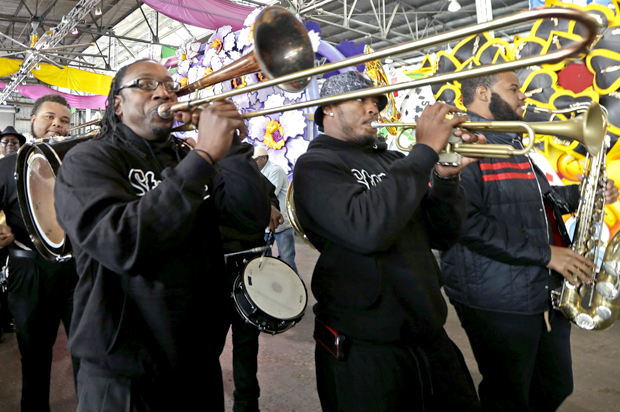
On the evening of Oct. 1, some two dozen of New Orleans’ top brass-band players and roughly a hundred followers began a series of nightly processions for Kerwin James, a tuba player with the New Birth Brass Band who had passed away on Sept. 26. They were “bringing him down,” as it’s called, until his Saturday burial. But the bittersweet tradition that Monday night ended more bitterly than anything else — with snare drummer Derrick Tabb and his brother, trombonist Glen David Andrews, led away in handcuffs after some 20 police cars had arrived near the corner of North Robertson and St. Philip streets in New Orleans’ historic Tremé neighborhood. In the end, it looked more like the scene of a murder than misdemeanors.

“The police told us, ‘If we hear one more note, we’ll arrest the whole band,’” said Tabb a few days later, at a fundraiser to help defray the costs of James’ burial. “Well, we did stop playing,” said Andrews. “We were singing, lifting our voices to God. You gonna tell me that’s wrong too?” Drummer Ellis Joseph of the Free Agents Brass band, who was also in the procession, said, “They came in a swarm, like we had AK-47s. But we only had instruments.”

The musicians were no longer playing but instead singing “I’ll Fly Away” when the cops converged and the cuffs came out. A New Orleans police spokesman claimed the department was simply acting on a neighborhood resident’s phoned-in complaint. And the department maintains that such processions require permits.

But when they busted up the memorial procession for a beloved tuba player, arresting the two musicians for parading without a permit and disturbing the peace, they didn’t just cut short a familiar hymn — they stomped on something sacred and turned up the volume in the fight over the city’s culture, which continues amid the long struggle to rebuild New Orleans.

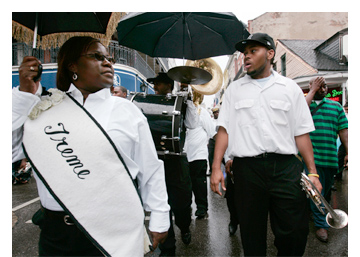
In that fight, Tremé is ground zero. Funeral processions are an essential element of New Orleans culture, and the impromptu variety in particular — honoring the passing of someone of distinction, especially a musician — are a time-honored tradition in neighborhoods like Tremé, which some consider the oldest black neighborhood in America. For black New Orleans residents who have returned to the city, these and other street-culture traditions — second-line parades and Mardi Gras Indian assemblies — offer perhaps the only semblance of normalcy, continuity and community organization left. In a changing Tremé, within a city still in troubled limbo and racked by violent crime, long-held tensions regarding the iconic street culture have intensified. The neighborhood, the breeding ground for much of this culture, has a history of embattlement. And now more of that history is being written.

“I’ve been parading in the Tremé for more than 25 years, and I’ve never had to deal with anything like this,” said tuba player Phil Frazier, who leads the popular Rebirth Brass Band. He’s brother to James, who died of complications of a stroke at 34. “I told the cops it was my brother we were playing for, and they just didn’t seem to care. He’s a musician and he contributed a lot to this city in his short life.”

Katy Reckdahl, a reporter for the New Orleans Times-Picayune, had rushed to catch up with the Monday-evening procession when her 2-year-old son Hector heard tubas in the distance. What she didn’t expect was a sudden flood of patrol cars, sirens blaring. Her front-page, full-banner-headline report two days later described police running into the crowd, grabbing at horn players’ mouthpieces, and trying to seize drumsticks out of hands. “The confrontations spurred cries in the neighborhood about over-reaction and disproportionate enforcement by the police, who had often turned a blind eye to the traditional memorial ceremonies,” she wrote. “Still others say the incident is a sign of a greater attack on the cultural history of the old city neighborhood by well-heeled newcomers attracted to Tremé by the very history they seem to threaten.”

It’s unclear who called the police that night. But it’s easy to sense the difference, longtime residents say, between North Robertson Street before and after the storm. With its proximity to the French Quarter and historic architecture, Tremé, which was not flooded, is newly attractive to home buyers within the city’s shrunken post-Hurricane Katrina housing stock. Meanwhile, as in most of New Orleans, rents have sharply increased. Derrick Jettridge, who was born and raised in the Tremé, now lives in the Mid City section. “I’d never find something in Tremé for the $500 I was paying before,” he says. On her New Orleans Renovation blog, Laureen Lentz wrote recently, “Since Katrina, the Historic Faubourg Tremé Association has gathered a lot of steam. Our neighborhood is changing as people have begun to realize that this area is prime, non-flooded real estate … So much is happening in Tremé, it’s hard to convince people that aren’t here. You have to see it to believe it.”

Home prices in Tremé rose nearly 20 percent immediately following the flood, settling at approximately 12 percent above pre-Katrina rates, according to Al Palumbo, branch manager for the historic districts office of Latter & Blum Realty. “Tremé, especially the area around North Robertson and St. Peter, would certainly be among my first choices for return on investment in New Orleans,” he says.

But what might such development in the neighborhood ultimately cost? The intensity of the police response during the Kerwin James procession prompted a second-line of print voices, so to speak, in the Times-Picayune’s pages.

“If somebody is blowing a horn in Tremé and somebody else is calling the police,” wrote columnist Jarvis DeBerry, “only one of those people is disturbing the peace, and it isn’t the one playing the music.”

Nick Spitzer, creator of the public-radio program “American Routes,” wrote in an Op-Ed piece, “in a city where serious crime often goes unprosecuted and unpunished, jazz funerals make the streets momentarily sacred and safer.”

“New Orleans Police Department declared a resumption of its war against our city’s culture,” declared columnist Lolis Eric Elie.

The day following the skirmish, discussions between community leaders and 1st District police Capt. Louis Colin yielded a temporary agreement. The evening after the arrests, Andrews, Tabb and other musicians were back on those same streets, leading another procession, this time protected by a permit, which some residents viewed as a disappointing compromise. “We don’t need anyone’s approval to live our lives,” one resident told me.

Efforts to curtail these neighborhood processions as well as the more formal Sunday afternoon second lines hosted by social aid and pleasure clubs, who apply for official permits, continue to threaten traditions already weakened by the loss of residents in Katrina’s aftermath. Participants view this as deeply hypocritical, given that so much promotion of tourism for New Orleans includes images of brass-band musicians and second-line dancers.

In April, a federal lawsuit on behalf of a consortium of social aid and pleasure clubs, aided by the American Civil Liberties Union, protested the city’s hiking of police security fees — triple or more from pre-Katrina rates — for second-line parades held September through May. The suit invoked the First Amendment right to freedom of speech and expression, claiming that parade permit schemes “effectively tax” such expression. “Should the law not be enjoined,” the complaint stated, “there is very little doubt that plaintiff’s cultural tradition will cease to exist.”

At a street-corner press conference a few days after the musicians’ arrests, Jerome Smith, who runs the Treme Community Center just a block from that scene, recounted the history of an embattled neighborhood. He invoked the memory of heavy-handed police intimidation at the 2005 St. Joseph’s night gathering of Mardi Gras Indians, after which Allison “Tootie” Montana, the “chief of chiefs,” famously collapsed and fell dead of a heart attack while testifying at a city council meeting. He referenced the “open scar” of nearby Louis Armstrong Park, for which the city demolished 13 square blocks of the Tremé. He spoke of how, in 1969, the creation of Interstate 10 replaced the stately oak trees of Claiborne Avenue, the neighborhood’s main thoroughfare, with concrete pillars.

On the Sunday following the arrests, Councilman James Carter held a meeting with residents at Smith’s center. One neighborhood activist, Al Harris, brought an enlarged copy of a photo, mounted on posterboard, of a Tremé second line in 1925. “We’ve been doing this a very long time,” he said. Carter said that “under no circumstances is it acceptable for police to violate our cultural traditions.” He announced plans for a task force organized through his Criminal Justice Committee to propose new city ordinances protecting the cultural practices under fire, and to initiate education and sensitivity training for officers and new residents of Tremé.

Such education could have easily been found in some documentaries screened last week during the city’s 18th annual film festival. “Faubourg Tremé: The Untold Story Of Black New Orleans,” created by filmmaker Dawn Logsdon and Elie, the Times-Picayune columnist, offered a powerful reflection of Tremé as a place of creative ferment and political resistance for some 300 years, which included Paul Trevigne’s Civil War-era founding of the country’s first black newspaper, and the unsuccessful 1896 Supreme Court challenge, in Plessy v. Ferguson, to racial segregation. At one point Elie wondered in the film’s narration, “How can our past help us survive this time?” Glen David Andrews, one of the men arrested Oct. 1, was featured playing his horn and as an interview subject.

Andrews also figured in “Shake the Devil Off,” filmmaker Peter Entell’s chronicle of a particularly cruel twist in modern Tremé history: Six months after Katrina, the Archdiocese of New Orleans decided to close the neighborhood’s St. Augustine church and to remove its pastor. The historic church was founded in 1841 by slaves and free people of color. After a 19-day rectory sit-in, the parish was restored, provisionally, though its long-term fate remains in question. Near the film’s climax, after footage of Jerome Harris and Jesse Jackson speaking to a crowd, the camera moved in on Andrews, who launched into “I”ll Fly Away,” offered as call-to-arms rather than memorial.

A question-and-answer session following a screening of “Tootie’s Last Suit” — filmmaker Lisa Katzman’s gloriously insightful look at the world of Mardi Gras Indians through the story of Tootie Montana’s final days — drew some discussion of the recent Tremé arrests.

“We won’t bow down,” said Sabrina Montana, daughter-in-law of the film’s main character, quoting a familiar Indian-song lyric. “This has nothing to do with our disrespect for authority and everything to do with our self-respect. Until what we do is on the city charter, second-line and Mardi Gras Indian assemblies will continue to be threatened by the whims of those who are in authority.”

Following the public outcry, Sgt. Ronald Dassel of the New Orleans Police Department was quoted in the Times-Picayune saying, “We don’t change laws for neighborhoods.” But in fact the city does and always has. Special legislation protects the tourist-rich French Quarter, for example. The mostly white Mardi Gras carnival parades command a long list of specific ordinances (including much lower permit fees than for second lines). And a recent judge’s order, which some critics consider unconstitutional, delineated police arrest and release protocols for municipal offenses specifically by neighborhood — with the Tremé among the neighborhoods subject to the sternest treatment.

Recently, I was walking along the bayou with Andrews when he ran into a friend. “Did you hear what they’re calling you two?” his friend asked, referring to Andrews and Tabb. “The Tremé 2! We’re making T-shirts.”

Andrews winced. “I’m not looking to be somebody’s martyr,” he said.

Sure enough, a couple of T-shirts emblazoned with “Free the Tremé 2″ could be seen at Vaughn’s bar during a Saturday fundraiser for attorney Carol Kolinchak, to support her pro bono work for Mychal Bell, one of the defendants in the Jena 6 case. Kolinchak is also representing Andrews and Tabb, who are due to appear in court in early December.

“Of course, I wouldn’t compare the situation they are facing to Mychal Bell’s,” said Kolinchak. “However, the discretionary decisions by law enforcement and prosecutors — on how and when to enforce the law — require attention in both situations. And those issues lie at the heart of the problems surrounding culture in New Orleans.”

Tabb, the drummer who plays in the Rebirth Brass Band and is raising money to create a nonprofit music school, recoils at the thought of children watching musicians hauled off by police for making music. And he says he thinks Andrews may have been singled out by authorities; in addition to leading his Lazy Six band, Andrews is a ubiquitous presence not only at second lines, but also at civic rallies.

New Orleans after Katrina may never fully return without its iconic street culture. And its renewal — financial as well as spiritual — may be more closely tied to those traditions than city officials grasp. But those who practice the traditions know it. On Friday, Oct. 5, the nightly memorial procession for Kerwin James wove through the neighborhood, culminating on the very spot of the arrests prior that week. Andrews put down his trombone and sang “I’ll Fly Away,” as Tabb snapped out beats on his snare. A tight circle surrounded the musicians, as a middle-aged black woman turned to the man next to her. “They say they want to stop this?” she asked softly. “They will never stop this.”

“It ain’t easy in the Big Easy”

While well-meaning programs seek to restore New Orleans' battered "cultural wetlands," two years after Katrina many musicians still struggle to survive.

Ronald Lewis, a retired streetcar-track repairman with a homemade culture museum in the backyard of his restored Lower Ninth Ward house, doesn’t think much about anniversaries. “But if it helps people understand my life and the lives of other people here in New Orleans,” he said on Sunday, “if it makes them think about why we’re here and we won’t leave, let ‘em have an anniversary.”

There are fewer media folk in New Orleans gearing up for Wednesday’s second anniversary of Hurricane Katrina than were here for last year’s commemoration. Maybe that’s a good thing — the first time around most locals seemed genuinely annoyed by the drop-in presence of so many cameras and commentators, many of whom knew little of the city and craved simply a good setup shot and a ticket out of town. (“Get me some blight,” they might as well have said at last year’s media center, and very nearly did, “and a black man with a trumpet.”) I remember one Ninth Ward family who stood by and watched as an anchorwoman held her microphone in front of their devastated home: “The producer said he doesn’t want us in the picture,” the father told me, holding his baby in his arms. This year, those disaster images now seemingly played out, maybe the coverage will get further beneath the surface, down to nuances of the issues that linger: housing, education, crime, federal and state aid, and culture.

But those who live in New Orleans — by even optimistic estimates, around 60 percent of pre-Katrina population level, or nearly 300,000 — hardly need to mark calendars. Every day is an anniversary, a stark reminder of nature’s wrath and more so of the very unnatural disasters of levee failures, insurance shortfalls, and a tide of bureaucratic red tape that rivals even the water for its ability to stall lives. Two years after the storm, only about one-third of those residents approved for their “Road Home” awards from the Louisiana Recovery Authority have received payments.

The number of press people may be down, but the politicians have been out in force this year. And there has already been much talk, a good deal of it in conferences with impressive, even hopeful, titles. At a Hope and Recovery Summit hosted by Louisiana Sen. Mary Landrieu Monday, presidential candidates took turns at public interviews with news commentator Soledad O’Brien. Democratic Sens. John Edwards and Hillary Clinton both pointed fingers of blame at the Bush administration for slow and inadequate response; each supported the idea of investing some $40 billion to $50 billion to rebuild the levees to Category 5 standards.

Edwards described the federal response to Katrina, then and now, as “a national embarrassment” and spoke of the need for “a high-level person reporting to the president every morning about what was done in New Orleans the previous day.” Clinton, addressing the Kafkaesque scenarios resulting from recovery bureaucracy, said simply, “You can’t make this stuff up. It’s beyond satire.” She presented a 10-point recovery plan that, again, began with one Cabinet-level figure in charge. Both candidates praised the efforts of private citizens as the real backbone of recovery.

Republican Rep. Lindsay Hunter took that citizen-action theme one rather disturbing step further. “Government is inept,” he said. “Bureaucracies are inept. I see a great future for New Orleans based not on what government does for people but what free people do for themselves.” At one point, O’Brien asked, straight-faced, “We appreciate that you appreciate that firemen and old ladies in church groups have come down here to help, but you don’t think they can rebuild the levees, do you?” Moments later, discussing the problems with police protection, Hunter said frankly, “To the people of New Orleans, I have to say that’s a local issue. I can’t help you with that.”

A day earlier, Sen. Barack Obama spoke at an early morning Sunday service at First Emanuel Baptist Church in Central City. Picking up on the fire and urgency of the Rev. Charles Joseph Southall III and his stirring choir and six-piece band, Obama matched their cadences, invoking the Sermon on the Mount, with its admonition to Christians to build on a rock of faith in order to withstand life’s storms. “I know I’m not the only person that’s going to be in town this week,” he said in allusion to his fellow candidates, and spoke of an “empathy deficit,” the need to “rebuild a trust that’s been broken,” and most notably and specifically, about a plan to create a funding pool from private insurers to be drawn on for catastrophic losses.

The most interesting discussions of the past week were those at Saturday morning’s executive session of the World Cultural Economic Forum, hosted by Lt. Gov. Mitch Landrieu at the French Quarter’s Le Petit Theater, the oldest community theater in the country. “I don’t know that we did not take for granted the cultural riches we have here,” Landrieu said, “until after the international community gasped when they thought about what might be lost.” In fact, a focus on culture in New Orleans — on what might be lost as well as on how culture holds important keys to many aspects of recovery, be they economic, civic or spiritual — may prove to be the essential ingredient for productive conversations about New Orleans right now.

Erosion of our coastal wetlands may have paved the way for the natural disaster that hammered this city. But the least-mentioned aspect of the resulting devastation — the erosion of what ethnographer Michael P. Smith once called “America’s cultural wetlands” — should be of primary concern. The resilient African-American cultural traditions of New Orleans, famously seminal to everything from jazz to rock to funk to Southern rap, also contain seeds of protest and solidarity that guard against storm surges of a man-made variety. Erasure of these wetlands exposes many to the types of ill winds that shatter souls.

Landrieu’s forum gathered wisdom from many local and national experts on cultural programming, funding and studies, and it attracted officials from some 20 foreign nations. At one point, Denis G. Antoine, ambassador to the U.S. from Grenada, said, “If we’re taking about rebuilding New Orleans, we have to ask: Which New Orleans are we talking about? We have to talk about social values and an ancestral past. There is an anthropological aspect to the nurturing of a new New Orleans and this will help direct what is appropriate and what is not.”

One more modest example of cultural education and economy could be found Saturday afternoon at the peach-colored house of Cherice Harrison-Nelson, one in the row of new homes within the Ninth Ward Musicians’ Village complex. Harrison-Nelson is the daughter of Donald Harrison Sr., a celebrated Mardi Gras Indian chief; this was a weekly session of the Guardians Institute, conceived and run by Herreast Harrison, Donald’s widow, and temporarily held at Cherice’s home until Herreast’s is rebuilt. Herreast envisions her institute as “a safe haven for children, and a place where cultural traditions are supported and authentically transmitted.” Cherice, who has worked as a teacher and a school administrator, explained, “Something deep within your soul calls you to do this. It just calls you and you’ve got to do it for your mental and physical survival, and for the welfare of those around you.”

At her house, women sat sewing beaded patterns of eagle heads onto canvasses, practicing for the creation of Mardi Gras Day costumes. Kevin Cooley Jr., the 5-year-old chief of the Young Guardians of the Flame group, sat with a half-dozen other children and learned the bamboula and other African rhythms that had been played in Congo Square, just off Rampart Street, more than a century ago. There were discussions of tradition, book reports and finally, $25 paychecks for a performance the previous week. “If Katrina did anything good,” Herreast said at one point, “it gave new meaning to all of this. And it changed our expectations: We don’t want the same old thing. We want something better.”

For all the talk and all the music of the past few days in New Orleans, the most emphatic statement about post-Katrina life, and particularly about cultural economy, was silence.

Sunday’s Musicians Solidarity Second Line found members of the Treme Brass Band and some two dozen other musicians, instruments in hand, assembled for a traditional second-line parade. At a typical second-line, a brass band plays, and supporters follow along, dancing and clapping out rhythms. The events, held nearly every weekend from September through June, are powerful expressions of community and culture. Since Katrina, they have taken on deeper meaning as assertions of determination and domain. But on Sunday, not a note was played, not a step danced. And the message was clear: New Orleans’ musicians need better support, lest the music that lends this city its identity one day fall silent.

The only other time I’d experienced a noiseless second-line parade was seven months ago. Hundreds gathered at the gate to Louis Armstrong Park. The silence — unthinkable throughout the hundred-plus-year history of this raucous tradition — was a carefully thought-through statement. It addressed the violence afflicting the city, the desperately slow process of post-Katrina recovery, and the enabling power of jazz culture for disenfranchised (in many cases, still displaced) communities. Two miles into that procession, not far from where M.L. King Boulevard meets South Liberty Street — the statement having been made — the men of the Nine Times Club (in lime-green suits and royal-blue fedoras) and the Prince of Wales Club (in red suits and mustard-colored hats and gloves) started jumping and sliding to the irrepressible sounds of the Hot 8 and Rebirth Brass Bands.

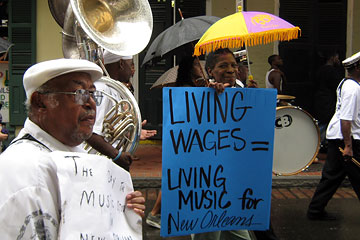
On Sunday a slow, steady rain lent dramatic drips to homemade signs that read: “Living Wages = Living Music,” “Imagine a Silent NOLA,” “Keep Our Story Alive.” But this day, the procession didn’t explode into music. When it reached the French Quarter’s Jackson Square, Musicians Union president “Deacon” John Moore, a guitarist who played on several seminal R&B hits during his career, addressed the small crowd. “It ain’t easy in the Big Easy,” he said. “Our musicians are suffering. We hate to come out here like this but we have no alternative.”

Benny Jones Sr., the drummer and founder of the Treme Brass Band, has been making music in New Orleans for some 50 years. “It’s always been a bit of a struggle,” he said, “but now it’s become a losing proposition.” At issue were the pressures of a hard-hit tourism industry, the increased cost of living in New Orleans, and the need for musicians to demand better pay and some element of nurturing during tough post-Katrina times. Several nonprofit organizations — the Musicians Clinic, the Renew Our Music Fund, and Sweet Home New Orleans — have risen to the latter task in the past two years. But while the need they serve remains daunting, the flow of contributions has begun to ebb. Sweet Home director Jordan Hirsch estimates that of the approximately 4,500 working musicians and others in the New Orleans cultural community, “about a third are back and doing OK, a third have yet to return, and a third are here but in unstable situations.”

“Historically, musicians have been taken for granted here because it’s so common and pervasive,” said Scott Aiges, a director at the New Orleans Jazz and Heritage Foundation and a former city government official, who walked along the parade route. “It’s such an intrinsic part of our culture that, when we hear a brass band it’s just another day.” Aiges thinks there are public-policy solutions to some of the musicians’ problems, ranging from promotional strategies to zoning ordinances, and especially tax and other incentives to those who employ musicians. “See, New Orleans culture developed out of a hustle and will always be a hustle,” said Ellis Marsalis, the pianist and patriarch to the New Orleans jazz scene, the other night in between sets at the Snug Harbor club. That hustle won’t suffice, it seems, during the slow crawl of recovery: Some public policy may be in order.

I went back to Ronald Lewis’ house the other day, and he showed me his House of Dance and Feathers, the small museum of artifacts he’s collected through his years of involvement with Mardi Gras Indian tribes, Social Aid and Pleasure Clubs, and jazz musicians: There are books and photos, fans and feathers, masks and drums, most of which were assembled anew after Katrina wiped out his original collection.

“They say we’re dumb, illiterate, poor people. They chose to put those labels on us. But this is a blue-collar community. We bought houses, raised families, came back,” Lewis told me. “I’ll draw you in with my culture, but really I want to have a conversation about my community, who we really are.”

Tomorrow marks two years since the city was devastated. There’s still a great deal of work to do to right wrongs, rebuild homes, and ensure a safer future. President Bush is scheduled to speak at some point, though ever since his infamous Jackson Square address, with its yet-to-be-fulfilled promises, his words are largely unwelcome in this city. A Day of Presence march — among the many events, some somber, some angry, some celebratory, that dot the day — will convene at the Ernest Morial Convention Center, the site of last month’s Essence Festival. “We’re going to demand a regional Marshall Plan,” said Edrea Davis of the National Coalition on Black Civic Participation, “to restore New Orleans and the Gulf Coast.”

But beyond the rhetoric, immense challenges remain for the city’s artists. As Grenada’s Ambassador Antoine said at the cultural economy forum: “New Orleans is a perception. When we talk about safety: How safe do you feel? It’s not just about crime, it’s about how safe do you feel to be you?”

Continue Reading Close

Barack Obama in New Orleans

The candidate and the black middle class meet up in the Superdome at the Essence Music Festival.

By 10:20 Thursday night, when Barack Obama took to the Essence Music Festival main stage, some 20,000 assembled at the Superdome had already witnessed well-choreographed song-and-dance (Ciara), heard hard-hitting rap (Ludacris), and received fiery faith-filled invocations (the “McDonald’s Inspiration Celebration” with gospel singers Smokie Norfil and Vanessa Bell Armstrong). And they were soon to get a double dose of old-school pleas and promises from the Isley Brothers and the O’Jays.

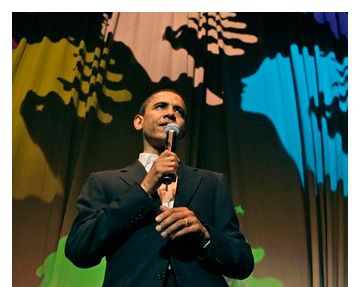
So the crowd needed none of the above: Instead, calm and friendly straight talk fit the bill. That’s what the senator from Illinois brought; dressed in a black suit and an open-collared white shirt, Obama was introduced in semi-frenzied fashion by author Michael Eric Dyson as the “next president of the United States … rooted in his blackness but not restricted by his race.” That last bit, with its implications about Obama’s much-discussed “electability,” prompted especially loud applause.

“How’s it goin’?” Obama began, pacing the stage comfortably with a cordless mike. The crowd issued an emphatic cheer. And for the local contingent, the unspoken response was “at least a little better,” because the annual event, forced to relocate to Houston last year due to the slow pace of post-Katrina rebuilding in New Orleans, had returned to its customary site. Since its inaugural in 1995, the festival, three days and nights of concerts, speeches and “empowerment seminars” hosted by Essence magazine, has drawn a predominantly black, largely female audience to New Orleans. The crowd at the Superdome on Thursday night was a blend of the national and the local, heavy on the black middle class that New Orleans is struggling to keep, and festival organizers expect to match or exceed their 2005, pre-hurricane total of 230,000 attendees by the end of the event. That’s a little lower than the Crescent City’s current population (down from the 454,000, pre-Katrina) and not quite the campaign-leading 258,000 donors registered to date for Obama’s presidential campaign.

Obama may be the rock star of the presidential campaign, but at Essence he fit more neatly into the proud legacy of African-American expression on display, from R&B and soul to rap and reaching yet further back to traditional brass-band funeral marches and African purification rituals. Not lost on anyone, especially Obama, was the fact that 22 months ago, this venue was the gathering spot of last resort for an even larger crowd, also mostly black: Katrina evacuees.

“Everywhere we go, I’m met by magnificent crowds like this one,” said Obama. “And people are telling me that they want change. People have decided it is time to turn the page.” Yet this would not be a night for breakthrough sound bites and detailed agenda setting. Neither was it a moment to dwell too long on the post-Katrina sufferings of New Orleans. It was, after all, “a party with a purpose,” as the promo materials put it, and Obama seemed simply to want a welcome seat among the revelers — and a sense of shared purpose.

He found one easily enough, dovetailing with the Essence Festival’s focus on family, and on building hope and opportunity for children. In a city where some 70 schools are yet to reopen and where a staggering number of young black men have served jail time, this theme is more resonant than any long-held note or kicking bass line.

Obama talked of his wife, Michelle — “an Essence kind of woman” — and of the difficulties of the campaign trail, of time away from his two daughters. “Michelle and I don’t want our daughters to grow up in a country in which people who are poor or vulnerable,” he said, “or old are left to fend for themselves. We don’t want them to know that lack of compassion.”

He took a brief swipe at the Bush administration’s No Child Left Behind education program — “but they left the money to fund it behind” — and an even more pointed jab at the compassion theme. “I am my brother’s keeper, my sister’s keeper,” he said. “That’s something this White House doesn’t seem to understand.”

He leaned on his record of having opposed the authorization to go to war in Iraq from the start. “We’re funding both sides of this war on terror, and contributing to an environmental crisis in the process.” And he knew the power of quoting the war’s price tag, $275 million a day, in a city where so many price tags — for levee repair, public housing and rebuilt schools — seem cruelly out of reach.

Some have doubted Obama’s broad-based appeal to the African-American community; at the Superdome, he engaged the crowd but failed to captivate, as have Jesse Jackson and Bill Clinton in the past. Audience attention drifted at times during Obama’s 15-minute talk, but he provoked strong applause by demanding federal attention to New Orleans. “We need a president that will wake up every day and ask, ‘How will New Orleans be rebuilt?’ And one who has someone specific in charge of that task, reporting directly to the White House.” He also hit the right notes on the recovery checklist: leaning on insurance companies to pay their share; following through to make sure that federal “Road Home” program money is distributed; seeing to it that infrastructure and affordable housing are replaced and not abandoned.

Obama was at his strongest when he referenced the civil rights struggle in Selma, Ala., drawing on a speech he delivered in March, in commemoration of “Bloody Sunday,” and the Selma voting rights march. “An amazing thing happened in Selma,” he said. “People looked at each other and said, ‘That’s not who we are. That’s not what we’re about.’ And that led to a mighty stream of marchers. Our children are waiting for us to take the same kind of action.”

He contrasted such energy with the post-Katrina reality in New Orleans. “After Katrina hit, we had to realize that we were no longer the America we had hoped to be. All the hurricane did was lay bare the fact that we had not dealt with the problems of racism and poverty. The biggest tragedy was that desperate hardship was known here before the hurricane. Poverty double the national average was here before the storm. But here’s the good news: America was ashamed and shocked. Our conscience was awakened. We realized that our politics were broken. Suddenly, the curtain was pulled aside to reveal all that.”

His was a gentle passion, knowing all too well the real rage that seethed beneath these issues for this crowd. But at times, he also appeared downright tentative: More than once, he said, “when the next president takes office,” paused, then replaced the thought with, “when I take office.” Bidding the audience goodnight, Obama fumbled a bit to find the opening in a stage curtain through which to exit. “If I can just find which way to go,” he said softly, still miked.

It was less a signal moment on the campaign trail than a getting-to-know-you session between a core constituency and a candidate still finding his way. And, as always, the specter of the Democratic Party’s front-runner, Sen. Hillary Clinton, was close at hand: She speaks today, at one of the festival’s empowerment seminars.

Soon, Obama had found his exit, and the Isley Brothers were onstage, opening with their classic, “Who’s That Lady?”

Continue Reading Close

Not your father’s Ramadan

Sengalese superstar Youssou N'Dour, who protested the Iraq war, talks about the beauty of Africa, Sufism and his fight against fundamentalism.

On Sunday evening at New York’s Carnegie Hall, Youssou N’Dour was caught between an elderly Senegalese griot and an unhappy soundman. Seems the xalam, a five-stringed Senegalese folk lute, wasn’t easy to mike. The opening concert of his four-night series just hours away, N’Dour nonetheless radiated calm.

N’Dour — the most popular singer in Africa and the archetypal world-music star — is used to reconciling antiquity with modernity. Besides, he’s negotiated trickier divides.

In March 2003, on the eve of the most ambitious American tour of his career, N’Dour simply canceled. “As a matter of conscience,” he wrote in a press statement, “I question the United States government’s apparent intention to commence war in Iraq. I believe that coming to America at this time would be perceived in many parts of the world — rightly or wrongly — as support for this policy.”

N’Dour’s sinewy tenor, dazzling vocal melismata, and urgent, engaging lyrics (mostly concerned with social responsibility and cultural memory) are the face of mbalax (um-balak), the popular Senegalese music that blends centuries-old praise-singing and percussion with Afro-Cuban arrangements and guitar-based Western pop. His band, the Super Étoile, has held sway over Senegalese fans since its formation in 1979. He’s since captured the ear of a worldwide audience, first with his singing on Peter Gabriel’s hit “In Your Eyes,” then through a series of wide-ranging, acclaimed albums for American labels.

N’Dour’s music is the perfect amalgam of old and new, indigenous and foreign. His music’s instrumentation ranges from talking drum (a staple of Senegalese music) to drum loops and synthesizers. His lyrics, sung mostly in his native Wolof, concern basic things — the need for hard work, respect for women, love of God and of fellow man — as well as more complicated issues — political struggles over electrical service in Dakar, or the need to remain connected to one’s home. 1990′s “Set” (which means “clean” or “pure” in Wolof) was a motivating cry for young Senegalese to clean up their environment and to demand “transparency” in politics and business.

Wednesday night at Carnegie Hall, N’Dour performs the music of “Egypt,” a dazzling CD that won a Grammy Award last year and is his most ambitious work to date: original songs about Senegalese Sufi tradition, performed with an Egyptian orchestra accented by Senegalese vocals and percussion. (N’Dour brings this music to seven more American cities through Nov. 13.) The orchestral setting coaxes his voice into heightened tenderness, but his messages are pointed as ever. Senegalese Islam is largely Sufi: “These songs celebrate the caliphs, saints and sages of my faith,” N’Dour told me, “to praise the tolerance of my often misunderstood religion.”

“Who better than Muslim artists to assume a kind of duty now,” he wrote in a Carnegie program book, “to protect Islam, and all the beautiful cultures of Islam, from its slanderers at both poles of the malicious, ignorant, ideologically inane morass of speech which passes for a ‘dialogue of religions’ in these challenging times?”

With Carnegie staffers, three publicists, and an independent film crew buzzing around N’Dour, stealing time to speak at a nearby hotel suite proved a challenge. But once seated, N’Dour, who spoke mostly in French through a translator, was eager to reflect on his new music and his return to the United States.

Looking back, are you glad you canceled your tour when you did?

If I had it to do again, I would do it again. I didn’t make the decision simply because there was a war mounting against a Muslim country. I did it because the war that was mounting was unjust. I could not bring the joy that I bring to my audiences in that context and in that environment. There were a lot of violent events that took place here in New York before this war, but I think the bringing on of the war was an attempt to weaken the United Nations.

Now, do you arrive with any ambivalence?

No, I don’t have a problem. Even though the conflict is still going on in Iraq, I think the U.S. is a great country with a lot of great people. And now, I know a lot of people who say now that we may have been right — that it was not right for the United States to invade Iraq. I know that I’m not Bruce Springsteen. But it was a symbolic statement that I wanted to make.

Is the music of your “Egypt” CD an attempt to counter the face of Islamic fundamentalism?

I don’t dwell on the effect of the music in terms of politics or about how people are going to perceive this tour. I am not overly interested in that. It is music meant to be beautiful and fun and it has pan-African content. It’s a great musical opportunity. It’s not as if I am a lawyer for any cause.

But don’t you find the messages of Muslim fundamentalists who command headlines at odds with your message in “Egypt”?

I think that in all religions you find fundamentalism and, for me, it’s always a minority — even if they are in the limelight now, getting the attention of the world. Every religion has its extremists. I think the majority of Muslim people are of the same frame of mind as I am.

Yes, but not the majority of those in power…

Those who are in power don’t always or even usually speak for the majority, and we need to remember that. This may be as true in your country as in the Middle East.

This album is surrounded by a message, it contains a strong message, but I did not create this message. It is the message of my faith, shared by many. It is something that some people are ignorant about, and I am trying to make those people aware. Some may have forgotten it and I am trying to remind them.

How did the music of “Egypt” come about?

It was a personal thing, really — just for me and those close to me. During the Ramadan, we have prayers, and every night we talk about our religion, Islam. And one day, I had the idea to play while we talked about it. And that idea brought back memories of how, when I was 10 years old, my father used to play recordings of Um Kulthum [the beloved Egyptian singer]. The two ideas began to merge for me in my mind, and then I talked to someone about finding Egyptian Arabic musicians to help me with this music. He mentioned Fathy Salama, who did the orchestral arrangements.

I always had some conflict over how to sing praises of a religious nature. I always had in mind to find a different form for this kind of praise singing. I wanted to sing about all the leaders of the brotherhoods. We have six famous brotherhoods, and I wanted to describe them all. I talked about the leaders, their stories, their families, and how they participated in the social development of Senegal.

Is there something distinct about the Senegalese experience of Islam? How does it differ from Islam in the Middle East?

The promotion of Islam in Africa may have begun with spokesmen from the Arab world, but in Senegal we have our own guides who have created their own turuq [Arabic for "ways" or "pathways"].

But I think that Sufism fits all over the world. The concept is not anything that fits standard Western ideas — it’s always related to culture, to music, to religion. It is a dominant religion in Senegal. The music that it creates calls into question the idea that the Muslim religion is not only a matter of Arabs or that it does not belong only to the Arabs. In the West, you have always associated the Islamic faith 100 percent with Arab culture. This in itself is a fundamentalist attitude and it is mistaken.

Does the act of working with Egyptian musicians in a largely Arabic musical style signify outreach on your part?

I’m not playing with Egyptian musicians to attain an Arab public. There’s content, there’s subject matter that’s common to us. And this record is a contribution to that commonality, an affirmation of that commonality.

If you wish to correct the view in the West of Islam, are you also talking about our images of Senegal, or all of Africa?

I think people should know more of Africa in terms of its joie de vivre, its feeling for life. In spite of the images that one knows about Africa — the economic poverty, the corruption — there’s a joy to living and a happiness in community, living together, in community life, which may be missing here in America. And I think America can learn from that. It’s a face of Africa that is not commonly shown in the news media, and if it were, I think Americans could learn a lot.

Considering the prevalent image Westerners have of African governments as corrupt, I wonder how you see the current American political environment?

The corruption, the corrupted and the corrupters are the same thing. Sometimes the money that is tied to the corruption process in Africa ends up here, you know. I think America is a great country that should have in its head a conscience and a responsibility that is equal to its achievements. I like the various movements that I see here in America. People here don’t leave action to the government. Action is not the exclusive province of the government. I like that idea very much.

This quality of Africans I’ve mentioned, to be happy in spite of trouble, despite challenge, is a force for development — and it could very well make Africa develop very rapidly in a way that people may not expect.

The question of modernization is central to disturbances in the Middle East and in Africa. Everyone is after modernization, no matter where they come from. But you have to be careful about it, and more importantly, you have to have sense about it. A comedian told me a story recently: He was in a rich Arab country and there were all these air conditioners in one spot. He looked up and there was no ceiling. There was air conditioning, but no roof.

The four-night series you curated for Carnegie Hall spans ancient musical styles to the freshest Senegalese pop. Is it fair to say that all of your music has at its core the tension between tradition and modernity?

My music is like a spinning ball. It can turn in one direction, and then it comes back to origins. And I think I am in a moment in my musical life where I’m feeling more sure of myself, and I think I’ve found a mix that suits me and makes me feel confident. I feel free of the expectations that people had of me, the symbol that perhaps I had become earlier in my career.

The symbol that I’d become created a tension between people interested in my music who favored a modern approach and people who favored a traditional or conservative approach, and between these two camps there was a lot of fighting. And now I think I’ve reached the point in time where the fighting is less important to me, less important to anyone, and people are more apt to sense the music on its own terms. Something that comes back to me is the experience of Miles Davis, who at a point in time was free to express himself without the fetters of people wanting one particular Miles or another. And I don’t know why, but somehow I sense that I’m in the same place that he might have been.

What does the griot mean in modern-day terms?

We’re always tempted by the weight of the present. But we need to think about history too. When we step outside of the day-to-day, that’s when we are able to share the most. Sometimes I am content to be immersed in the present moment. But not too much of the time. The griot is a bridge. If you want to go to Senegal the griot can take you there — through music, through dance, by telling stories.

Is there a special meaning or poignancy to performing this music, which was conceived during one Ramadan, in the U.S. during another Ramadan [which runs through Nov. 3]?

It’s very interesting: There was a big debate on Senegalese radio, with professors, Islamic leaders, musicians and rappers about making music and performing during Ramadan. The moderator was an Islamic studies specialist, and he asked, “Why during Ramadan is there no music? If you’re stopping your music during Ramadan, then aren’t you saying that the music is not acceptable for the religion?” This was a very important point for me.

I’m sorry, but I don’t remember reading anywhere that you can’t play music after sundown during Ramadan. People like me have decided to ask ourselves, “Why?” Maybe we’ll do something different. Maybe it is time to do some things differently.

Continue Reading Close

America’s new jazz museum! (No poor black people allowed)

Jazz musicians warn against the Disney-fication of New Orleans.

It took a Category 5 hurricane to do it, but Katrina managed to blow jazz back onto the American radar screen. Those TV montages of physical devastation and desperate souls were accompanied by strains of New Orleans jazz, those benefit concerts filled with saxes and trumpets; the reporters arriving to cover it all flew into Louis Armstrong Airport. Save for the media-friendly efforts of trumpeter Wynton Marsalis and PBS poster boy Ken Burns, jazz rarely gets such play.

Much as we Americans like to pay lip service to jazz as “our national music,” with the Crescent City its seminal home, we tend to favor jazz’s quality as aural decoration over its contents as oral history; we stock up on classic reissues of past masters but rarely consider the music’s meaning in our current lives.

The many high-profile jazz-based Katrina benefits — including a five-hour Lincoln Center affair hosted by Marsalis, with Burns among its stars — brought more than just jazz’s sound into our lives. Placed in stark relief was whether jazz — which Burns’ 19-hour PBS series famously cast as a signal of American values and virtues on the order of the Constitution — still carries currency when it comes to the issues Katrina raised: cultural identity, race, poverty, and basic decency.

Jazz has always had a complex role in our national image: Louis Armstrong caused a stir in 1957 when he rebuffed President Eisenhower and canceled a U.S. State Department tour to the Soviet Union because of riots in Little Rock, Ark., over school integration. “The way they are treating my people in the South,” Armstrong told newspaper reporters, “the government can go to hell.” Armstrong’s very words were on the lips of quite a few Americans (and not just Kanye West), especially African-Americans in New Orleans’ Ninth Ward — not too far from Armstrong’s birthplace — where the worst of the devastation occurred when the Industrial Canal levee was breached.

The jazz community has now been freshly sparked into practical activity, raising money and manpower, but also into deeper consciousness-raising regarding the truths dredged up in Katrina’s wake and the potential for irretrievable cultural loss. Political activism among jazz’s ranks — think Charles Mingus’ 1959 “Fables of Faubus” (denouncing racist Arkansas Gov. Orval Faubus), or Max Roach’s 1960 “Freedom Now! Suite” — has been largely in response to racial injustice, but it also has concerned the tough moral and metaphorical questions about American identity — and it is more acutely focused than in decades.

Through both his trumpet and his role as artistic director of jazz at Lincoln Center, Marsalis, our most recognizable living jazz musician, has spoken loudly and repeatedly about New Orleans’ (his hometown) role in establishing (and fixing) the American identity. These statements have often been taken as mere bromides: Jazz as a civics lesson about democracy in action; the blues as source material for all things American. But Marsalis’ themes took on newfound resonance in his nuanced essay for Time magazine.

“We should not allow the mythic significance of this moment to pass without proper consideration,” he wrote. “Let us assess the size of this cataclysm in cultural terms, not in dollars and cents or politics. Americans are far less successful at doing that because we have never understood how our core beliefs are manifest in culture — and how culture should guide political and economic realities.” In an interview with BBC-TV, Marsalis went further, describing the black faces on CNN looking for lost mothers and fathers as calling up a historical memory of Southern slave families torn apart.

And at Marsalis’ “Higher Ground” benefit, the tone was more pointedly political than is customary at Lincoln Center. “When the hurricane struck, it did not turn the region into a third-world country,” actor Danny Glover said from the stage. “It revealed one.” Singer Harry Belafonte, at his side, declared, “Katrina was not unforeseeable. It was the result of a political structure that subcontracts its responsibility to private contractors and abdicates its responsibility altogether.”

“This is how I feel about my country,” Jon Hendricks announced before singing a bossa nova with the refrain “Somebody tell me the truth.”

New Orleans trumpeter Irvin Mayfield played the hymn “Just a Closer Walk With Thee” at that benefit in dedication to his father, who, he said, “is still missing down there.” Mayfield has yet to locate his father. At home, he leads several bands, including the nonprofit New Orleans Jazz Orchestra. Two years ago he was appointed cultural ambassador for the city, a position that involves working closely with Mayor Ray Nagin and Gov. Kathleen Blanco.

“I’ll tell you, in terms of the response to this hurricane, the local government gets a big F,” he said. “The federal government gets an F. The country gets a big fat F. When the levee was breached the culture was breached, and not that many people seemed to care.”

Mayfield is incensed too at mainstream coverage of the storm’s aftermath. “Looters? Anyone who grew up in New Orleans like I did knows that drugs run rampant here. How are you going to relocate those folks? Who do you think was shooting at planes?”

Another New Orleans-bred trumpeter, Terence Blanchard, found success in New York in the 1990s but eventually returned to the Crescent City. His Garden District home is intact, he says, but he and his family have temporarily relocated to Los Angeles. Blanchard was watching C-SPAN’s coverage of former FEMA director Michael Brown’s testimony when he spoke to me over the phone from Los Angeles. “It’s insulting,” he said, “that someone can have such a lack of compassion for a situation and try to explain it away in such an arrogant manner and expect me not to know the difference — expect me not to understand the political game that’s going on. It’s too early to process all this right now, but I think you’ll see in coming years that jazz musicians will create works that will speak directly to what’s gone on here.”

It’s not only New Orleans natives and African-American musicians who are speaking up. Bassist Charlie Haden’s politics often spill into his art. I caught up with Haden at New York’s Blue Note, where he was fronting his Liberation Music Orchestra, an ensemble he convenes whenever a Republican president is in office; the group’s new CD, “Not in Our Name,” features a minor-key rendition of “America the Beautiful.”

“I guess it took something like this hurricane to blow the mask off the Bush administration,” said Haden, “and to fully expose its cruelty and ugliness and cynical indifference. Playing with this group is my way of demonstrating, and expressing things a lot of us are thinking and feeling through music. And this sort of expression is suddenly, sadly, more appropriate than it has been in decades.”

Nor is it just the lack of prompt and caring response to Katrina that the jazz community is concerned with, but the future of the wellspring of their art form. Musicians and supporters worry that reconstruction plans will amount to a whitewash or Disney-fication of one of the seats of African-American culture. More than one jazz musician spoke to me of his outrage and disgust when House Speaker Dennis Hastert questioned the logic of rebuilding New Orleans, saying, “It looks like a lot of that place could be bulldozed.” We now know that New Orleans will be rebuilt: But what will be saved and what will be bulldozed? And who will make those calls?

“See, what Bush wants,” said poet Amiri Baraka, after performing at a free jazz benefit in Manhattan’s Lower East Side, “is to make New Orleans like his mother — shriveled and colorless.”

“Are we going to rebuild the Ninth Ward?” asked singer Cassandra Wilson backstage at a Central Park benefit, after performing with Allen Toussaint and Dr. John. “That’s the question in the new battle for New Orleans, which is just beginning to take shape.”

“A battle is afoot, no doubt,” said Ned Sublette, a scholar and musicologist who spent last year at Tulane as a Rockefeller fellow researching New Orleans’ cultural roots. “And if the plans for the future of the city don’t include its humblest residents, I fear that the communities that created jazz in the first place will be dispersed — and the country will have lost a good bit of its soul. These communities — the Social Aid and Pleasure Clubs, the various Carnival organizations, the Mardi Gras Indians — have been developing continuously in one place for 300 years. Already there’s a growing diaspora — to Lafayette and Baton Rouge, La., to Houston, even to Utah. We’re not just watching history disappear; history is watching us disappear.”

Jazz has been declared dead many times in the past few decades: It wasn’t and isn’t. Even out of commercial culture’s spotlight, the music thrives — and mostly in places far from New Orleans, like New York. But we’d best take care in rebuilding New Orleans and in righting Bush’s wrongs in general lest we cut out jazz’s heart, along with a chunk of our own. The musicians know that. They’re speaking up loudly. Will we put down our iPods filled with vintage reissue jazz long enough to listen?

Continue Reading Close
www.salon.com/writer/larry_blumenfeld/index.html