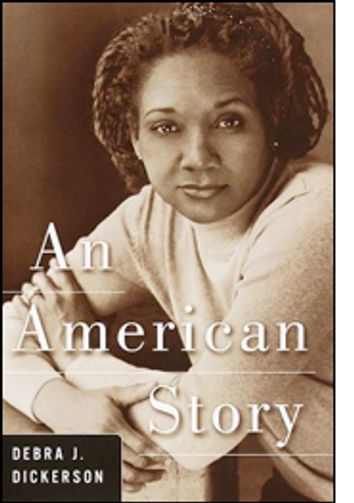
Almost no one is exempt from Debra Dickerson’s scrutiny: not Democrats or Republicans; not African-Americans, leftists or gun-toting homeboys. As a journalist, she has exposed the contradictions and inconsistencies of these groups and many more in the New Republic, U.S. News & World Report, Salon and other publications.
Now in her memoir, “An American Story,” Dickerson dissects the people she grew up with and met during her years as an Air Force officer, as a volunteer with the Democratic National Committee and as a Harvard law student. But much of the appeal of “An American Story”‘ is that Dickerson levels an equally tough gaze on her own ideas and choices.
As an adolescent in St. Louis’ ghetto in the 1970s, Dickerson could have been a right-wing poster girl. Black, smart and articulate, the daughter of former sharecroppers, she believed poverty was a choice. To succeed, everyone just needed to work hard — like her. On a visit to a welfare office with her mother, she scoffed at the unwed mothers, corrected the English of the social workers and refused to sit in the “germ-ridden chairs.”
But nothing in Dickerson’s memoir, or her life, is static — least of all her politics. In less than 40 years, she moves from being passionately right wing to left wing to somewhere in between. She’s not a dilettante, but an eager student, hungry to uncover nuances and hypocrisies, even after she has fallen in love with an idea or group of people.
This relentless inquisitiveness makes Dickerson a complicated character. So does her amalgam of anger, insecurity and ambition, which, as Dickerson explains, was fueled by her family as well as by race and class. As a girl, she devoured writings by Maya Angelou, Dickens and C.S. Lewis, and earned A’s in a school for gifted students, but still internalized the limited expectations of her family and her community. Her father, a former Marine and ruthless disciplinarian, suggested she’d be better suited for waitressing than lawyering. And school counselors did nothing to dispel that notion: They never suggested that a bright student shouldn’t spend half of her days in vocational-tech class, polishing her typing and shorthand. And they never mentioned college to her; she received a PSAT application only by accident.
Excelling on the exam wasn’t enough, however, to convince her she was college material. She dodged letters and calls from the admission officers at Duke, Washington University and Bryn Mawr. “I wouldn’t last a week at a university before I’d be found out as the unworthy upstart I was and thrown out … So what if I got good grades? I was blue collar. No one had to tell me I couldn’t go to college because I was poor and black. I told myself.” Her mother, glowing with pride, also viewed the letters as “lovely non sequiturs” and stuffed them in a small drawer. From the start, Dickerson was her own evidence that hard work, in fact, isn’t always enough.
In the Air Force, the potential for a different life dangled in front of her — white music, white friends, tangible rewards for hard work and middle-class security, which is why she was mortified by reminders of the life she tried to leave behind. When a black airman mangled his verbs, Dickerson writes, “all I saw was the sharecropper speech patterns. All I saw was the gold teeth.”
Ideas like these get repetitive in “An American Story” and Dickerson has an unfortunate tendency to interrupt narrative streams with analytical quips. She’s most powerful when she lets her stories, particularly those about her family, speak for themselves. For most of her life, for example, Dickerson was dismissive of her brother, labeling him and his friends as stereotypically failed black men. She’s well into adulthood before she unravels the more complicated story: her brother’s relationship with their father, the abuse he received from neighborhood thugs, his troubles at school. And as she understands the nuances, she feels less threatened by her roots: Her brother becomes her “race consultant,” teaching the strait-laced Dickerson a language and a style that she once shunned.
Through her reconciliation with her brother, her feelings of racial isolation and other events, Dickerson gravitates, emotionally and politically, toward the ghetto again. By the time she becomes a lawyer (and a Democrat), it’s in part to connect with the black community, this time by helping change it. Even still, Dickerson defies categorizing. She may be a liberal African-American but she won’t shrink from challenging the stances of Harvard’s Black Law Students’ Association, which she calls “a fashion show, a politburo meeting, a hotbed of revolution, a social club, a refuge from the white world we’d chosen.”
But despite her boldness, Dickerson is oddly withholding about some aspects of her personal life. She mentions boyfriends long enough to tell us that they are white — piquing our interest for her take on interracial relationships — but then drops the subject completely. On one hand, a memoir written by a woman that doesn’t focus on the agonies and obsessions of love is refreshing. Yet if the rest of her life is any indication, Dickerson’s views on relationships are probably unpredictable, and would have added to the book. You may not like her opinions or the way she expresses them, but it’s hard not to admire Dickerson’s determination and her relentless passion for teasing ideas apart and then putting them back together in her own, atypical way.
Obsessions can be fascinating or tiresome. Diane Simon’s obsession with hair, which has engendered her prodigiously researched “Hair: Public, Political, Extremely Personal,” is both. Unfortunately, Simon devotes more than 50 pages of that book to exploring electrolysis, waxing and other nifty hair removal tricks. The result: a cross between a Mademoiselle how-to article and a rambling American culture dissertation.
Simon does have lofty ambitions. She offers a sweeping examination of hair symbolism, culture and history dating back to the Romans. In his First Letter to the Corinthians, Paul wrote: “Does not nature itself teach you that for a man to wear long hair is degrading to him, but if a woman wears long hair it is her pride?” Since then hair has been an emblem of social order and a symbol of gender distinctions — with occasional disruptions. In the 1920s, for instance, women traded their time-consuming tresses for the loose, androgynous bob. During one week in 1924, Simon reports, 3,500 women had their hair sheared at a New York salon; smelling salts were on hand for the many who fainted as their locks fell to the floor. Turns out others needed the salts, too: One hair guru warned that the haircuts would weaken women’s scalp muscles and lead to baldness. And a Pennsylvania school board awarded $100 bonuses to teachers who left their hair intact.
Simon fast-forwards to contemporary hair issues with tours of African-American braiding salons in Harlem, N.Y., and of Orthodox Jewish wig stores in Brooklyn, N.Y. She travels to Florida to talk toupees (or “hair systems”) with Sy Sperling, president of the Hair Club for Men. And she chats with an untold number of women as they shave, wax and pluck.
Simon introduces a cast of men and women saddled with every hair problem imaginable. They have too much or too little. They have the wrong kind or they have it in the wrong place. Some blame their mothers for inflicting hair shame; others blame society. And though a few characters are sympathetic (the bald men more so than the waxing women), after this endless parade, readers may forswear ever complaining about their hair again.
Among the hair gripers is one Leslie, whom we meet at a bridal shower and whose hair intimacies we’re quickly privy to: She found her first armpit hair at age 12; she still hasn’t forgiven her mother, who gossiped about the aberrant hair to her bridge group; and currently she sometimes shaves her legs but never plucks her chin. “Her mother, like many mothers, believed in ‘neat,’ ‘clean,’ and hairless,” Simon writes. And as Leslie complains, “She gets extremely upset if one pubic hair is peeking out of the bathing suit … I don’t think it looks bad, and I don’t think it’s that important!”
It’s unclear why readers would think this information is important either. After several chapters we get hungry for the big picture. Simon tries to offer it with extensive reporting, historical analysis and personal stories. But it’s as if she’d tossed all these hair tidbits in the air, hoping they would fall into a sophisticated thesis. Instead, they just hang flat.
Continue Reading
Close
“I‘ll be arriving in Paris tomorrow evening,” Napoleon wrote to Josephine. “Don’t wash.”
Napoleon wasn’t the only connoisseur of a strong sniff. In France, armpits were once known as “spice boxes.” A Victorian courtesan made a fortune by selling handkerchiefs kept between her bed sheets. And some Austrian girls still wear slices of apples under their arms to create fragrant gifts for their suitors.
Lyall Watson’s new book, “Jacobson’s Organ and the Remarkable Nature of Smell,” is a witty journey into the mysterious land of scent. Whether we prefer the aroma of the unwashed or of the spray bottle, Watson argues, smell is the most provocative, sensual and misunderstood of the senses.
Smell allows us to distinguish strangers from loved ones, good food from rotten, disease from health. With a finely tuned nose, a man may be able to pinpoint when a woman is fertile. And enemies at war are able to sniff one another from a distance.
Scientists, Watson tells us, haven’t completely figured out how smell works. But he does an admirable job of pointing out why the sense is so important. He maps its link to evolution and to self-protection. When mule deer suspect a stranger among the herd, they obsessively sniff each other’s knees until the intruder is detected and ousted; then each deer urinates down its hocks, bathing itself in a familiar odor and creating a group bond. Smell is equally important in mating. Deprive the pig of his olfactory bulb and he’s clueless about sex: He can’t tell a boar from a sow.
If Watson had kept his book to an exploration of the role of smell in social information, survival and emotions, it would be a compact, tantalizing olfactory travelogue. Unfortunately, his theories are sometimes grander than his research, particularly on the title subject: Jacobson’s organ. Discovered by the 19th century surgeon Ludwig Levin Jacobson, the organ is a secondary smell system in bats, snakes and many mammals.
In garter snakes, for instance, the organ — a pair of tiny pits in the roof of the mouth — detects mates and prey. Scientists have also identified the pits near the nasal septum in humans. But there’s little consensus on how the organ functions. For years, doctors and scientists believed it was vestigial. But some recent studies on humans suggest that it detects chemical signals affecting emotions and sex.
With this sketchy evidence in hand, Watson plunges into fanciful prose that reads more like hype than like science. Jacobson’s organ, he says, could become our sixth sense and “the most important key to unraveling the mysteries of our minds since the discovery of the unconscious.” We’d be able to sniff “a snake under the porch,” “when the figs are ripe,” “who is coming through the orchard” and “when the girl next door ovulates.” How would we train our nose to sniff out these things? And why would we want to track our adolescent neighbor’s ovulation cycle? (To keep the boys away?) Watson doesn’t tell us.
But in his valentine to smell, he does convince us that loss of smell, or anosmia, is a dreadful fate. For one thing, it’s dangerous: Without smell we couldn’t detect a gas leak or sniff out stale or poisonous food. But worse, as Napoleon understood, life without pungent sniffs would be very bland indeed.
Continue Reading
Close
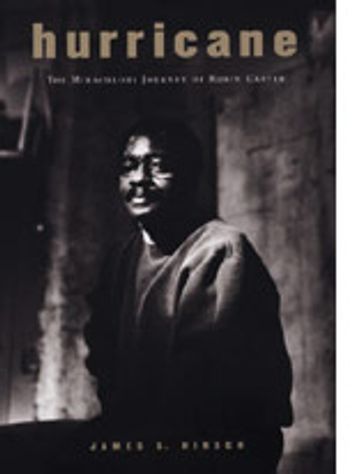
The story of Rubin “Hurricane” Carter has all the makings of a page-turning American saga. There’s violence, injustice and courtroom drama; there’s sex and celebrities; there’s damnation and, of course, redemption. Bob Dylan recognized these ingredients when he wrote his 1975 ballad “Hurricane.” The media, too, lapped up the tale: Articles and books were written, TV programs and Web sites created. This month Hurricania begins anew with the release of a movie starring Denzel Washington and James S. Hirsch’s biography, “Hurricane: The Miraculous Journey of Rubin Carter.”
As a middleweight contender in the 1960s, Carter was the anti-Joe Frazier, the Dennis Rodman of his day. Sporting a shaved head, a Fu Manchu mustache and sharkskin suits, he cruised Paterson, N.J., in his black El Dorado with his name engraved in the headlights. He swilled vodka and womanized. He became a black-power advocate and a gunrunner for Stephen Biko and was put under surveillance by the FBI. Then one summer night in 1966, the New Jersey cops arrested Carter and 19-year-old John Artis and accused them of savagely murdering three whites in a local bar. Both were convicted and sentenced to life in prison.
The case against Carter was thick with racism and thin on evidence. A catwalk of celebrities — Dyan Cannon, Ellen Burstyn, Stevie Wonder, Burt Reynolds, Johnny Cash — lent their names and money to his case, for a while. In one memorable scene in the book, a friend of Carter’s visits the “Saturday Night Live” set to try to renew Bob Dylan’s interest. But Dylan has shed his troubadour-of-social-causes image. Dressed in white patent-leather boots and sunglasses with “BD” inset in rhinestones, Dylan reads a letter from Carter. Then he looks up and points to the TV, where roller skaters are performing. “Do you like roller-skating?” he asks. “Look at the stuff they do.” Perplexed, Carter’s friend asks Dylan if he plans to write Carter a letter in response. “Tell him I’ll be down there in the springtime of my life,” Dylan says, and then he begins reciting a passage from the Bible.
Hirsch, a former reporter for the New York Times and the Wall Street Journal, dutifully details the celebrities, the trials and appeals, Carter’s prison life and his relationships with members of a commune in Canada, including a scrappy 16-year-old named Lesra Martin who helped win Carter’s freedom. But though the book brims with facts, too often the narrative lacks momentum.
Part of the problem is Hirsch’s reverence for Carter. The biographer is unwilling or unable to offer much meaningful critical analysis of his subject. And his writing occasionally suffers from clichis about Carter’s transformation from bad guy to enlightened self-help thinker. When Carter falls for the leader of the Canadian commune, Hirsch writes: “Initially, Rubin told Lisa that his call was ‘strictly business.’ But clearly it was more than that. They had met on a higher spiritual plane while discussing human nature and the universe.” And later: “But he also realized they had developed a ‘learned helplessness,’ a dependence on Lisa to survive. That may have been fine for the others, but Carter was a solitary spirit who could never conform to a group or attach his star to another person.”
To his credit, Hirsch tries to stretch his book beyond the well-publicized criminal case. He attempts to explore the intimate life of Rubin Carter — the story that few of the celebrities, lawyers or journalists understood. Apparently one exception among the celebrities was Dylan, who met Carter in Trenton State Prison before writing “Hurricane.” “Dylan was not simply probing his innocence or guilt,” writes Hirsch. “To Carter, the folksinger was searching for something else entirely, as if he were asking, ‘Who are you, man? What are you? Are you what I see?’” Unfortunately, after reading Hirsch’s book, readers may still be asking those questions.
Continue Reading
Close
“The Last Life” is so convincingly narrated by a 15-year-old Algerian-French girl that it’s easy to forget that Claire Messud is American; the prose feels thick with the languid air of the Riviera. And unlike many coming-of-age novels by American writers, “The Last Life” isn’t confined to an adolescent’s internal musings. Instead, the book is anchored by the political history of the Algerian-French and the scars of their repatriation.
The novel revolves around Sagesse LaBasse and her family, who fled their homeland for France during the Algerian War in the early 1960s. The LaBasses have tried to reinvent themselves among the vacationing bourgeoisie of the Riviera, where Sagesse’s grandfather Jacques has built the Hotel Bellevue. Jacques, however, is a tyrant with a temper: One night he fires his rifle into a group of teenagers swimming in the hotel pool. The bullet not only wounds Sagesse’s friend, it destroys her social life, humiliates her family and begins unraveling the myth of the family’s indestructibility.
Their problems, however, begin well before the gunfire. Exile — whether forced or self-imposed — haunts the LaBasses and the novel. Sagesse’s mother, Carol, a meek Massachusetts expatriate, sports tight chignons and Louis Vuitton handbags as she tries to disappear into her adopted country: “Invisibility has always been vital to my mother; it is her cloak, her security. Was it Flaubert who said that ‘Not to be like one’s neighbor — that is everything’? For Carol the inverse was true.”
But at least Carol has chosen her exile. In flashbacks to Algiers in the 1960s, Messud describes Sagesse’s father, Alexandre, an idealistic young man who clings to Algeria — his home — throughout the country’s war with France. But as France withdraws from Algeria, Alexandre has little choice but to follow his parents in flight. By the late 1980s, when Sagesse is an adolescent, Alexandre’s life stacks up to a series of misfortunes and failures: His marriage is empty; his son, Etienne, is disabled; and he himself is a mediocre businessman employed by his father. His only relief is a string of nameless mistresses.
Learning of the affairs, Sagesse chooses sides. And the domestic scenes between her and her parents deliciously evoke the anger of a tenacious adolescent hungry to unveil the family secrets. But Sagesse’s adult voice enriches the novel, too; when she is older she sees her parents as more than one-dimensional players in her own story. Though Messud’s prose can be needlessly dense, through Sagesse she gets at the stain of exile and at the complexity and disappointment of the truth:
When I was a little girl, I had believed that if you looked long and hard enough at a picture you might enter into it, leave behind the faded furniture of everyday and walk in oil-bright fragrant glades among eighteenth-century picnickers, or join windblown fishermen along some ageless rocky shore. I didn’t muse on how one might get back from within the frame, just stood and willed and waited for another story, another life, to begin around me.The painting Sagesse had chosen showed the Bay of Algiers before the war — she had longed to leap into it and change the historical events that set her family on its painful course. But “The Last Life” doesn’t allow for tidy endings or epiphanies. And by the time Sagesse has become an adult, she doesn’t, either.
Continue Reading
Close
Simone de Beauvoir probably would have agreed with Natalie Angier’s theory of feminism — with one exception. De Beauvoir believed women were the biological runners-up in the gender wars; Angier, the stylish, Pulitzer Prize-winning science writer for the New York Times, takes the contrary view. In “Woman: An Intimate Geography,” she argues that women’s bodies are complex, versatile and powerful, and that they often surpass men’s. To prove her point, she takes us on a tantalizing, witty journey through female biology, debunking many entrenched stereotypes and myths and a lot of questionable science.
Equipped with an eye for detail and a sure grasp of science, Angier maps the female body — eggs, uterus, breasts, hormones, brain — enlisting a remarkable array of studies and little-known facts, as well as examples from history and literature, to offer a feminist take on biology. She explains, for instance, that the clitoris has 8,000 nerve endings, twice as many as the penis. “All this,” she gloats, “and to no greater purpose than to subserve a woman’s pleasure. In the clitoris alone we see a sexual organ so pure of purpose that it needn’t moonlight as a secretory or excretory device.” She details the power of estrogen on the brain and heart and the complexity of the female chromosome, which boasts thousands of genes, compared to the male counterpart’s puny two dozen.
Though Angier toys with some fringe theories about women’s biology, including one that suggests female orgasms enhance fecundity, she saves her most trenchant arguments for the evolutionary psychologists, offering a refreshing rebuttal to the gender stereotyping of Robert Wright (“The Moral Animal”) and David Buss (“The Evolution of Desire”). Women, these writers believe, are innately less interested in sex, less aggressive and more invested in relationships than men are. Angier unearths numerous exceptions and alternative explanations. DNA studies, for example, show that female chimpanzees risk “life and limb” and the lives of their offspring to cheat on their possessive mates. And if women have lower sex drives than men, Angier argues, you can’t blame biology: Cultural mores across the centuries have punished women for their carnal interest.
Unfortunately, Angier has a propensity to engage in cheerleading about everything female, and the result can be sisterhood mush. In a chapter on menstruation, she implores women to celebrate this rite of passage together: “When your daughter or niece or younger sister runs to you and crows, ‘It’s here!’ take her out for a bowl of ice cream or a piece of chocolate cake, and raise a glass of milk to the new life that begins with blood.” Moments like this make you wonder whether you’re reading an early edition of “Our Bodies, Ourselves.”
Still, this is a minor quibble about a meaty book. Angier challenges readers to question assumptions about women’s bodies and minds. She prods us to understand biology as a feminist tool. And her book provides the analysis and the ammunition with which to do just that.
Continue Reading
Close