Michael Erard

Pimping a Ph.D.

A new graduate program turns Chaucer scholars into money-grubbing entrepreneurs.

  • more
    • All Share Services

Pimping a Ph.D.

Since September I have spent one afternoon a week in a classroom with
13 other graduate students. But we don’t talk about semiotics or Chaucer
or the Mexican Revolution or motivation theory or any of the
myriad other arcane topics that have filled our heads since our academic
careers began. Instead, we talk about leveraging opportunities, meeting new
challenges and assessing risk.

Welcome to the new world of graduate career development.

The course, designed by JoyLynn Reed, a perky Ph.D. who also works as a
consultant, offers a potent cocktail of remedial business education, guest
lectures, interview assignments and pitch practices. The class is part of
the innovative Graduate Professional Development Program at the
University of Texas, which has begun to garner attention from educational
media
and administrators across the country because it’s the first program
intended to help young scholars
sell their skills outside of the university. Other courses include grant
writing, professional communication and advanced teaching methods.

Though we come from diverse departments, we’re all bored with our
disciplinary monocultures. We’re also aware that Austin, our high-tech city,
booms around us while we scrimp, save and give away our specialized
training. A
generation ago, graduate students who shared discontents would have formed
solidarity committees and conspired in pseudo-revolutionary plots. In 1999,
the response is different: We’re striking out individually to grab our
piece of
American capitalist pie.

Nowadays many graduate students take for granted that
planning life beyond graduation means empowering your entrepreneurial
self. Some, like me, are writing dissertations; most of us will
be on the
job market within the year. But the question is, which job market? Sure, the
academic job market sucks, but other sectors value Ph.D. skills, too.
Unfortunately, “professional development” in
the traditional sense — lab time, library time, papers, conferences,
attempts to publish — presumes you
want nothing but a job in academia. It also perpetuates the notion that a job
in government or business is “alternative,” an accidental substitute for the
professorship you desired most of all.

Our first speaker is Chad, a strategic consultant with Boston Consulting Group who takes the stage and begins talking about cookies. To a roomful of
B-school undergrads, he’s just another trim, confident young guy in khakis and
polo shirt, but to a roomful of graduate students peering beyond the walls of
academia, Chad is Marco Polo, full of tales about exotic lands and
fabulous
riches. His talk is particularly grabbing because he has a Ph.D. in math and left academics when he realized “I didn’t want
to spend the rest of my life working on my small set of abstruse math
problems.” Nevertheless, these analytical skills, honed by years of
problems sets and conference papers, were immediately applicable at BCG
where, among other tasks, he helped Nabisco executives set the price of
Chips Ahoy cookies. For a moment the ivory tower shadow of incredulity and
snobbery overwhelms me. This guy thinks about cookies all day! He rattles
on about how his job offers “challenge and variety.” But I remain
unconvinced; we believe
in teaching, research and Ideas.

Then he mentions that a Ph.D.’s first-year salary at BCG can top $100,000.

The class goes silent. Do we believe in public service?
Ideas? Anyone? I look around the room, where my classmates are slapping
their
foreheads and rubbing their lips with the backs of their hands. One woman
places her head on her desk. For the next week I entertain the idea of
moving
to Dallas, buying a cell phone and never
writing another word on my dissertation.

This must be what it feels like to arrive in America.

For the next few weeks, my classmates and I are giddily commercial. All our
questions revolve around money: Will you charge for your service? How
much?
Per hour or by the job? Should you accept stock options as compensation?

Later in the semester we learn about ethics, conflict resolution and
management strategy, some of which pose as poetry. Herb Rubenstein,
president of Growth Strategies Inc. in Washington, flies down to teach us
everything he knows about strategic consulting (and to plug his book,
“Breakthrough, Inc.”)

“We don’t solve problems,” he says, looking someone straight in the eye,
“we create the future.” I scribble madly as he speaks, trying to remember
what he’s just said and realizing that his phrases and sentences are
evaporating from my mind like cotton candy in a rainstorm. Vapidly profound
and
profoundly vapid, such maxims operate as the motivational brain candy of the
managerial class.

When such high-powered consultants visit, the class becomes a sort of
cultural
contact zone where academics and business types meet and mingle. A good
humanist, I had a notion that business people seek profit instinctively,
like a paramecium goes to the light, but I learn that business is also an
ascetic
practice in the way it minimizes liabilities. Not many good humanists will
admit this, but at that moment I feel a rapport with business
people.

Eventually Reed punctures our fantasies with a simple expense list: Taxes,
liability insurance, computer resources, phone lines and letterhead.
Business
cards, she points out, are going to cost so much money that we’ll have to
gross three times what we want to net. “Our image of consultants is that they go
fishing or golfing,” she says. “In fact,
the
run-of-the-mill consultant isn’t doing those things. They’re working.”
The room becomes visibly deflated.

Still, we’ve already begun to put price tags on our know-how,
thrilled
to discover that our knowledge is valuable, and suddenly aware that its
value must
be maximized in order to survive.

Clearly, this is a good thing, because academics are undervalued. Often
we’re expected to give away our knowledge rather than sell it. An English
professor told me he regularly receives calls from lawyers for free
grammar advice, but he’d never call a lawyer for free legal
advice.

Can this attitude compensate for how much academics hurt their own cause by
undervaluing themselves? As
the
notoriously short-sighted Texas Legislature showed in 1997, such
academic
isolationism has serious consequences. On top of slim appropriations,
state-supported universities in Texas now operate under two additional
burdens:
One 1997 law mandates reviews for tenured professors, while another caps the
number of doctoral hours a student can take. If academics don’t define the
ways in which they’re accountable, the agents of the public will do it for
them.

Although Reed’s syllabus, even the whole program, may attempt to turn
graduate students into flexible tools of capital, many of my classmates
want to
do nonprofit consulting. As it turns out, improving corporate profits isn’t
the
next logical destination for academic expertise. Howard wants to consult
with
water resource nonprofits and Larry wants to improve hiring and retention
practices at a Catholic nursing home. As I listen to students rehearse
their
pitches, I realize that the class puts us in touch with why we chose
graduate
school in the first place: because we love ideas, we love to learn, analyze
and
synthesize and because we’re not risk-takers by nature.

So the semester’s over. What did I learn?

Always ask for the top money; don’t deliberately undervalue yourself. (This
has
already come in handy. Recently asked to work as a writing coach, I was
initially shy to request the hourly rate I deserved. Screw that, I thought,
and
upped the rate. My client agreed without blinking.)

Act like modern corporations — outsource. Learn how to pimp. You can
multiply the number of hours you’re making money if you farm out jobs
and skim money from the top.

Stop giving information away. If there’s going to be a quid pro quo, ask up
front. When you make a pitch, never give away all your stuff. For
instance, tell them you have a dozen strategies but detail only one.

Students are still powerful. It is possible to call up nearly anyone and
get
information from him or her, if you say you’re a student.

Most of all, I learned that you can make consulting work an engine of social
change, not solely an opportunity for self-advancement. Yes, anyone can
appoint
him- or herself an expert; go get yourself a Power Point presentation and a
business card and you too can be a consultant. For graduate students,
however,
consulting might be the ticket to an intellectual career beyond the
university’s
vaunted halls. I’ve always known that such a career would be desirable;
Reed’s class showed me how it was possible.

I’d love to tell you more about how to leverage the lifestyle of an
intellectual
entrepreneur (TM), but as we say in the biz, let’s talk first about my fee.

Heavy petting

Learning to love my girlfriend meant learning to live with her dog.

  • more
    • All Share Services

Heavy petting

After four months of dating, Lina and I were at the stage where we were having a lot of sex in the mornings, before coffee even, that kind of daylight sex that imprints another person’s face on your brain and flavors the e-mails you exchange during the day. The alarm would go off and we would begin kissing, throwing back the bed sheets. I would grope under the pillow for the condoms I’d put there, all the while keeping a wary eye on Violet, her dog.

I should have known better. When our mutual friend Christina had first set us up, she’d described Lina in an e-mail: smart and serious, had family in Colombia, graduate student in history, was fond of whiskey and lived with an energetic, somewhat unpredictable dog named Violet. Without elaboration Christina added: “Lina’s in denial about her dog.” At the time, I took this to mean that Lina and Violet had a relationship that Christina didn’t understand. I never thought about what it would mean for us.

As one date turned into two, three, four, I gradually learned about Lina’s strong attachments to her dog, whom she described in such glowing, loving terms I imagined Violet as a Lassie; on dates five and six, I finally met an obviously cunning dog, the kind who’ll let you starve in the collapsed mineshaft for your foolish curiosity. After seven dates, I figured out that Violet’s love for Lina was a jealous love. Lina admitted she felt guilty for spending too many nights out away from Violet, who sometimes misbehaved when she didn’t get enough attention. Lina also admitted she’d never been as strict as she could have been, never provided the kind of Alpha dog leadership that socializes a dog for human households. At that point, it occurred to me that Violet seemed less like a dog and more like a spoiled chimpanzee that knows where the keys and petty cash are.

One night after a movie, Lina and I made out on the dewy grass of the university quad and told each other secrets from our romantic pasts. I found out she’d gotten Violet as a puppy from a Chilean soccer player who discovered too many times the hard way that his pretty, red puppy liked to chase down soccer balls, tackle them and chew them until they exploded in her astonished face. On and on it continued: The more intimate we became, the more I learned about Violet. By the time we were sleeping together, Lina confessed that Violet had once bitten a child in the face, and Lina was afraid she’d have to euthanize her dog.

By that point, Violet had spread trash throughout the house while Lina and I were out; she also disappeared a five-pound bag of dried beans. I’d also seen her bristle and charge other dogs, barking ferociously as if she were protecting her territory, even when we were in the park. Sometimes while chasing a Frisbee, her ears flattened, her eyes widened in devil-dog fashion and her lips curled berserkly. Great, I thought, my girlfriend’s dog is Cerberus. And when Violet chewed my credit card up into tiny slivers of gray plastic and chewed off the buttons of my jeans, I remembered what Christina had said: Lina was in denial about Violet.

In the context of this emotional triangle, sex started to get strange. Once when Lina and I were having sex, Violet circled shark-like at the edges of the bed. To be fair, Violet was used to getting a walk every morning at 7:30 and recently it had been as late as 11. The inevitable result was that increasingly we found ourselves having sex with the dog.

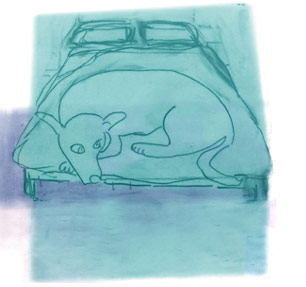
When Violet thought we were not looking, she would sneak both paws onto the mattress, first one and then the other, and lean on the bed like a praying child. With the same imploring eyes, she would lay her chin down and watch. The canine voyeur.

Because of Lina’s inscrutable relationship with her dog, there was an added emotional dimension to Violet’s intrusions, but even when we escaped to my house, my cat made her presence known. Jumping onto the bed, she perched on the pillow, staring at our bodies with a blank expression. It was the same look with which she approached her reflection in the mirror: I see a shape, two shapes … I think … but I can’t be sure …

But unlike my cat — who sees nothing at all — Violet sees very well. No puzzlement crosses her fuzzy face as she watches, no shame, no disgust. She watches intently. I like to think it’s the universe regarding us benevolently through her attention, a reminder that what we’re doing is a wholly unique moment as well as a reiteration of billions and billions of seamlessly similar moments in the life of the species. Some days I take pleasure in the reassuring disinterest of Violet’s eyes; I lean closer to her so that I can see Lina’s pale body, curved and distorted, shining in her dog’s glistening eyes.

But Lina pulls me away — trying to get me to concentrate on her. Even though she is emotionally preoccupied by Violet, she still finds it disturbing to see me similarly preoccupied. Afterwards, while my grad school girlfriend and I are lying together, discussing quietly how we’ll each spend our days, the dog whines nearby. Then, all of a sudden, she’s on the bed, towering over us triumphantly. “Violet!” I scream: “Get off!” Her eyes screw around psychotically and she bolts away. And just as we begin to postpone breakfast for another half hour, there’s Violet again, back on the bed and standing over us impatiently. What is taking so long?

Let’s face it: Though we live with and often love our animals, we can’t expect them to understand our erotic nature. For any animal motivated by species preservation, not individual desire, the notion of matins extravagance is ill-advised. Hurry up! The lions are coming! And barring the sexually evolved bonobo, most non-human organisms don’t engage in the face-to-face screw — they don’t stare into each other’s eyes; they don’t take their time. Human sex is too complicated and dangerous for most animals.

The kinkiness of “pet” and “sex” in the same sentence underscores the prevailing taboo about our intimate relations with animals. The pet books don’t ever mention it; nor do psychologists who study human-pet relationships. But this omission is also rather curious. As with humans, we expect to receive physical and emotional pleasure from our relationships with animals. We keep pets because we like how they feel, and we like how our bodies interact with theirs. A good cat is one that’ll curl in your lap when you read, purr when you scratch it, know when play is play, knead you with it claws in and lick you once in a while. This may not be erotic, per se, but it’s not something one would normally allow a platonic friend — much less a stranger — to do. For most people such physical intimacy is limited to lovers, infants and — yes — pets.

Lina and I are still together — which means that Lina and Violet and I are still together as well. And Violet still climbs on the sheets, puts her paws on us, sticks her snout in our faces and collapses long beside our tangled bodies. As long as her wet snout stays away from our
crotches, I’m not ashamed to admit that I don’t always push her off. If Lina has her denial, I have my grudging acceptance — as long as Violet
and Lina have the relationship they do, Violet’s presence in the bedroom
is unlikely to change.

And I know there’s nothing I can do about the nights I don’t sleep over, when I suspect that Violet’s sleeping and cuddling on my spot on the bed.

Continue Reading Close