Nick Kowalczyk

Blood, gore, tourism: The ax murderer who saved a small town

100 years ago, someone killed 8 people in an Iowa home. Can unsolved brutality revive a dying town?

  • more
    • All Share Services

Blood, gore, tourism: The ax murderer who saved a small town (Credit: viliscaiowa.com)

This is a story of murder and tourism and ghosts. Of civic failure and the illusion of certainty. It’s a Midwestern story that begins in 1912, before the state of Iowa became a patchwork of vanishing villages, before Interstate 80 and the World’s Largest Truck Stop. It is the year the John Deere company begins building tractors and Arizona enters the Union and a surprising number of Republicans believe in progressive ideals. It is the year of a new group called the Girl Scouts and two years before a world war. In this year the ocean swallows a ship called Titanic, a college professor becomes president, and Americans begin eating Oreos. And in Villisca, Iowa, it’s morning, a Monday, June 10, 1912.

The Iowa Touring Atlas has just touted Villisca, a town of less than two square miles surrounded by farmland and the forks of the Nodaway River, one of the finest cities in the state. “Metropolitan.” “A social center.” “Religious.” “Methodist.” “Presbyterian.” “Rare beauty.” “Pleasant View.” Villisca in 1912 has 50 retail stores, no saloons and banks “as strong as the rock of Gibraltar.” There is a two-story armory being built that symbolizes the community’s patriotism and pride. More men work as auctioneers than lawyers. The Chicago, Burlington & Quincy Line brings 24 passenger and freight trains here every day.

At 5 in the morning, Mary Peckham, age 63, gets out of bed. Her first chore is hanging her laundry. Outside it’s overcast and humid; her neighbor’s house is unusually quiet. Joe Moore, one of Villisca’s most prominent and successful young men, often cares for his horses in the backyard before walking to his farm equipment store in the center of town. Sarah Moore also tends to awaken their four young children before sunrise, and with the oldest Moore child age 11, and the youngest one, age 5, Mary Peckham expects to hear the usual morning noise.

By 8 a.m., she approaches the Moore house. The windows are closed and blocked by curtains and shades. No one answers when she knocks. She tries the door but it’s locked. Walking back to her house she reasons that Joe Moore’s parents have been ill. Perhaps tragedy struck them in the night and her neighbors are dealing with the grandparents’ sickness or death.

Her curiosity gathers two men to the house: Joe’s brother Ross and one of Joe’s employees. Mary Peckham greets both men separately, as the employee arrives first, can’t get inside and promises to send another worker to milk Joe’s cows. Through her window Mary sees Ross arrive. They walk onto Joe’s porch and Ross raps on the windows and shouts. Though not normally a visitor here, he opens the door with a key. Inside, he notices the neatness of the parlor. The silence of the rooms. His footsteps creak on the wood floor.

It is by today’s standards a small house, with only three rooms downstairs — a parlor, a kitchen and a small bedroom — and a tight, narrow staircase that leads to the parents’ bedroom, an attic and the children’s room.

Ross opens the door to the downstairs bedroom. The room is dark because the window shades are drawn. White, blood-covered bed sheets have been pulled over two little girls. One of them lies a third of the way down the bed, her arm sticking out from the covers.

Immediately Ross runs out of the house. “I did not wait long enough to see anything else,” he later will tell a grand jury.

“Get Hank over here,” he tells Mary Peckham, as he sits down breathlessly on the porch. Back in her house, Mary Peckham telephones Joe’s store and talks to the same employee who already stopped by. The employee says he just saw the city marshal, Hank Horton, talking with businessmen on the town square. He chases after Horton, a rather inept police officer with a large belly.

The employee and Horton find Ross Moore distraught on the porch. He says, “Something is terribly wrong in there,” and the city marshal and the employee go inside. In the downstairs bedroom the marshal pulls away a curtain to let in the sun. He notices a cloth covering a mirror. A bloodied ax leans against the wall near an unlit lamp. Underneath the bed is a white dress the killer used to wipe his hands, and a slab of uncooked bacon the killer maybe used as a lubricant to masturbate.

The employee runs from the house.

Whose are the bodies? Horton wonders.

He cannot recognize Lena and Ina Stillinger, respectively 11 and 8 years old. He doesn’t know that Lena and Ina had attended the same Presbyterian church service last night as the Moores, doesn’t know J.T. and Sarah Stillinger allowed their children to spend the night. To Horton these bodies are nameless, he doesn’t think to look at their Bibles inscribed and set somewhere inside this sickening room, to give Lena and Ina back their names.

“The rooms upstairs were dark, for the curtains were securely drawn,” Horton later will tell a grand jury. One imagines a match quivering in his hands as he walks up the narrow stairs.

He pulls the shade at the top. It’s a small room with a dresser and a bed beneath an angled ceiling. Joe lies on his back with his left hand on his chest. A 43-year-old man, six feet tall and 195 pounds, Joe is lifeless, with his head, once very handsome, with wavy dark hair, now marmalade. A coroner will say the bodies look like they’ve been dead for five hours, putting the time of the murders between midnight and 3 a.m. Beside Joe lies Sarah, a woman of 39, with a fragile face and curly brown hair, whose head an undertaker will deem “the least pulpy.”

Horton looks at the blood on the wall near the bed and on the floor. Sees ax marks in the ceiling and a lamp on the floor with its chimney kicked under a dresser. He wonders how the killer went about this. In this house every noise carries, so if the two little girls downstairs were killed first, one of them probably screamed, which probably awoke Joe and Sarah, but the parents’ bodies (aside from their heads) don’t look disturbed.

Next Horton enters the south bedroom, the largest in the house, with a closet and four windows shaped like an upside-down T.

Horton pulls open the shades.

Under the angles of the ceiling he surveys one empty cot and three beds, with the bodies of four children in the beds. The eldest Moore child, Herman, 11 years old, lies on his stomach with an undershirt covering his brain and the place where his skull is unhinged. Another bed holds a girl — Katherine, 10 years old — who lies with her face mostly beneath a bed sheet and a dress curled up over her head. And the last bed holds two little boys.

Horton notices there isn’t a lamp in the room and runs outside.

“There is somebody murdered in every bed,” he says to Mary Peckham and Ross Moore. He locks the door. “Don’t let anyone inside.”

Horton runs for a doctor. On the way into town he tells a night watchman of the murders, asks him to keep order at the house. Seconds later he tells a city clerk to call the county sheriff, the county attorney, detectives in Omaha and the police in Beatrice, Neb., who raise the best bloodhounds in the Midwest. He tells Drs. Cooper, Lomas and Hough, and together they tour the house with a Presbyterian minister, the Reverend Ewing, who the night before planned with Sarah Moore the children’s Bible program that was Villisca’s major social event.

As opposed to today’s major social event — the murder scene — where eventually 50 to 100 people gawk at the bodies and disturb evidence.

Bruce Stillians, a druggist, takes photographs that he hopes the Omaha World-Herald will buy.

Dr. Hough sees ax marks in the children’s room.

Horton removes bloody clothing stuck to the Stillinger girls’ faces.

Someone notices Sarah Moore’s wedding ring still on her finger, decides there’s no evidence of robbery.

A crowd volunteers to pay for the bloodhounds.

All visitors to town become suspects.

The wife of Ross Moore poses for pictures inside.

Posses are formed and black people leave town out of fear they’ll be lynched.

J.T. and Sarah Stillinger receive a phone call that their children are dead.

Sarah Moore’s father learns his daughter is dead while running to her house.

One telephone operator tells another to keep quiet until more is known.

A drunk named Bert McCaull steals a piece of bone to display at his pool hall, claiming it belonged Joe Moore.

Ross Moore asks a soothsayer if her coffee grounds can say who murdered his kin.

Residents search every building.

The ax murders are deemed the worst murders ever in the Midwest.

Newspapers everywhere scream with the story, even the New York Times on page 20 the next day: EIGHT SLAIN IN HOME WHILE THEY SLEEP.

- – - – - – - – - – - – - -

Dig deep enough into any town’s history and surely you’ll find a good murder. Even the little town in the Adirondacks where I’m soon to be married — a perfect postage stamp called Inlet, N.Y.  —  was where Chester Gillette was arrested in 1906 for drowning his pregnant girlfriend in a case that inspired folk songs, ghost stories and “An American Tragedy.” But there’s no such as thing as an INLET DROWNING the same as the VILLISCA AX MURDER. The murder has become Villisca’s brand (789,000 search results for “Villisca Ax Murder” on Google) just as Dyersville has a field of dreams and Madison County has covered bridges, a bad novel and a good film. One hundred years after the murders, Iowa is a state begging to be visited, with plenty of Americana to offer. Hence the World’s Largest Cornstalk. The World’s Largest Strawberry. The World’s Largest Bullhead Catfish. The World’s Largest Swedish Coffee Saucer. Even the World’s Largest Cheeto. And the Midwest’s most gruesome unsolved murder, now a guest host for ghost hunters, who pay hundreds of dollars to bring a sleeping bag and set up on the old hardwood floors.

- – - – - – - – - – - – - -

After an hour of emptiness on this third-rate highway, amidst brown and eerie hills on an unseasonably cold, gray spring afternoon, the sign appears like a beacon. “The Olson-Linn Museum and Ax Murder House.” I turn onto U Street, where off to the side I see the Villisca Elevator (the only elevator in Villisca is a grain elevator), and down a few bridges and bumpy roads that turn to gravel and back to concrete, and suddenly I find myself in the town square. There are a few well-kept houses, a new-ish playground, a war monument, children playing baseball and a mother wearing a T-shirt from the local high school that last year graduated 28 kids.

The windows of the Olson-Linn Museum are cloudy. It’s a white building of cracked bricks and rain-damaged shingles and a brilliant red door. A sign with changeable letters says:


VILLISCA AXE MURDERHOUSE

TO RS

WEEKDAYS 9 AM TO 4 PM

SAT . & SUN 1 PM      4 PM

A note says the owner is out: “I am at the J B Moore house 508 E. 2nd Ave.”

Minutes later a 74-year-old man pulls up in a rickety sedan.

“Hi there,” he says. He wears overalls, a ball cap, a plaid shirt and a blue nylon coat.

“How you doing?”

“Just fine.” He outstretches a hand. “Darwin.”

All of his teeth appear silver.

“Nice to meet you.”

“Likewise.”

“So this is your museum?”

“Kinda,” he says, unlocking the door. “I guess museums are like people. They have different personalities. Come on in.”

Darwin’s museum is like the lovechild of an old barn and a grandmother’s attic. Dusty and smelling slightly of mold. Everything inside intensely local. Old pieces of clothing on the walls and murals of businesses and banks and doctor’s offices, few of which exist anymore. Black and white photographs everywhere, mostly portraits of stern-looking men. In a glass case, commemorative T-shirts: “Villisca Ax Murder 1912.”

Behind the counter Darwin asks if this is my first visit. (Darwin would die not long after my visit.)

I nod because yes, I’ve never been here before, but in many ways I feel like I have. There’s a sameness to the plight of dying towns.

He wags his finger at the painting on the T-shirt depicting a white gothic house at sunrise. “The fella who did that said he’d like to paint something historical, so I said why don’t you paint the Ax Murder House. He’d never heard of it. So I took him and we made a deal and a few days later I left him on the street with his painting tools and he wasn’t there very long when he came up here and said he wanted the house keys. I said what do you need those for? He said I’d like to check the attic. And well I said What do you want to get in the attic for? He said he wanted an original shingle. He said he’d grind it into the paint for the shingles. And then he said I’ve already found enough lead from the siding that I’ll use in the paint for the siding. So anyway,” Darwin chuckles, “the house is in the house, you know?”

“Do the locals in town still talk about 1912?”

“Oh, some,” the old farmer says. “But not too much.”

I ask if he’d take me to the house. Since I’m a writer he waives the $10 fee.

As I settle into his rickety sedan we talk about his buying the house.

“I’ve had it since ninety-four.”

“And you were a farmer before?

“That was fine for a while but it got to the point when small fellas like me either had to get way bigger or get out. And I didn’t have any children — I mean, I have two daughters and they didn’t have any interest — so I joined my cousin with the museum.”

“What made you buy the house?”

“I was drawn to it. My wife, Martha, didn’t want to buy it. Her mother was a good friend of the Moore family. But it was for sale and it’d been sitting for two years and the furnace had froze up and the pipes were broke and the neighbors were thinking of buying it and tearing it down.”

“They didn’t want the memory around?”

“No, it was an eyesore. Nobody had a problem with it being where the ax murders happened.”

“Normal families lived there?”

“For eighty years.”

Darwin stops at an intersection with two churches on either side of the street.

“That Presbyterian church is where the Moores were at the night they were killed. They went to a Bible school program.” He points to the other church, too. “And that was Sen. Jones’ church, the Methodist one — well, the building that Jones went to later burned down, but the new church is in the same spot.” It’s a story Darwin has told many times. “Yeah, there was a time when a Presbyterian kid wouldn’t play with a Methodist kid because of the murders.”

He keeps driving and points to a handsome Victorian house with an upstairs porch. “And here was Reverend Ewing’s house, where the little minister Kelly stayed that night. He probably was up there on that balcony, too, you know? In his weirdness he was probably looking for a window to peep into.”

“Do you mind if I ask how much you paid for the house?”

He laughs. “I gave $10,000 for it.”

“And then you de-modernized it to the night of the murders?”

“Yeah, you see the other owners had enclosed the porch and put in asbestos siding which was good because it kept it in shape 45 years before I got it. And there is Sen. Jones’ house, and that’s where his son Albert lived with his wife —”

“The one who was sleeping with Joe Moore, right?”

“Coulda been. Well, she was definitely having affairs.”

“All of these houses are big and beautiful. This was a wealthy neighborhood back then?”

“The town was a wealthy town.”

“So what’s the town got going for it now?”

“The house,” he declares. “There’s no retail downtown. A couple antique stores and a pharmacy and a grocery. But as far as a woman buying a dress or a man coming to buy parts for his vehicle, none of that’s here anymore.”

“Where do people work?”

“Clarinda. Red Oak. Corning, quite a few work in Corning,” he says.

As Darwin talks I scribble in my notebook while he parks in a cemetery.

He says, “We’re at the first stop.”

- – - – - – - – - – - – - -

The manhunt never yields a killer. At the funeral on the town square a quartet sings the song, “I Need Thee Lord.” Seven thousand people listen and weep; 300 journalists take notes. A few days after the murders the Stillingers give birth to a stillborn, and by the end of the year their house catches on fire, burns down. Many investigators come to Villisca, all of them with theories. One is named James Wilkerson and he is a Southerner by way of Alabama, then Texas, and he works for the Burns Detective Agency, which is a global investigative firm with offices in New York, Atlanta, Los Angeles and London. A tall and wavy-haired charmer, Wilkerson works in the Kansas City office and poses as a real estate agent. After a few months Wilkerson reveals himself to Ross Moore, who by this time — 1914, two years after the murders — is displeased with the state of Iowa’s investigations.

Wilkerson pins the ax murders on a state senator, Frank Hernando Jones, who owns the farm equipment store where Joe Moore worked before striking out on his own and taking with him the John Deere franchise. Jones’ motive, Wilkerson claims, was financial. (And what’s more, Wilkerson says, Joe also had been sleeping with the pretty wife of Sen. Jones’ dopey son Albert). A Presbyterian, and therefore more blue-collar than Jones, who’s a wealthy Methodist, Ross Moore believes Wilkerson’s theory; and so does J.T. Stillinger; and so do the rest of the Presbyterians. Among them, F.F. Jones has a priggish reputation. He came to Villisca before the Civil War and made his money in hardware and farm equipment, then entered banking and politics. He’s the superintendent of the Methodist Sunday school, a nondrinker, and some say a disciplinarian by nature. As a business owner he schedules his employees six days a week from 7 a.m. to 11 p.m., and sometimes without any breaks. And apparently he openly hated Joe Moore.

In 1916 Jones runs for state senate reelection and Wilkerson (along with Ross Moore and J.T. Stillinger) hosts revivals accusing Jones of hiring a man named William “Blackie” Mansfield for the job. Mansfield is a road crew worker and union organizer who also happens to be white despite a nickname that gets black people run out of town — yet again. On lampposts everywhere Wilkerson posts hundreds of flyers of Mansfield’s face:

This is the axe murder. He
murdered the Moore family at Vil
llisca. The hypocrite whose dirty
money paid for the hellish job
wants your support for the state
senate. Will he get it?

Obviously this bothers Sen. Jones. He sues Wilkerson for slander.

But Wilkerson hatches a plan — what if he puts Jones on trial instead? He packs the county courthouse with onlookers who crowd the aisles and the periphery behind the jury and judge. He calls four witnesses to testify against Jones. Vina Tompkins, a poor woman, says that shortly before the murders she’d seen Jones near the Nodaway River talking in the brush with three men about “getting a man out of the way” and promising money from an out-of-town bank. Alice Willard, a divorcee who lived near the Moores, says that on the eve of the murders she saw three strange men — one of whom was “Blackie” Mansfield — twice walk past the Moore house. Also says she later overheard Jones, Mansfield and Bert McCaull agree: “Get Joe first — the rest will be easy.” A real estate agent says he saw Albert Jones (the cuckolded husband) break into the Moore house while the family was away at the church service. And to this Wilkerson adds his own theory: the killer (or killers) hid themselves in the attic and closets. And finally a photographer says he’s overheard Jones, his son and Bert McCaull conspiring to kill Wilkerson for his ace investigations.

Jones loses in the court of public opinion, and loses the slander case, too. Mansfield, for his alleged role, gets arrested: He’s picked up in a Kansas City meatpacking plant where he works and he’s dangled by his feet from a bridge overlooking the Kansas River until he gives a confession.

In 1917 a grand jury convenes, but in that venue the case against Jones falls apart.

It turns out that Mansfield wasn’t in Villisca that night. From June 6-18, 1912, he worked for the Illinois Central Railroad roughly 500 miles away. And what’s more, Mansfield organizes unions and Wilkerson works for a notoriously anti-union agency, the news of which muddles the detective’s already questionable claims. Ultimately the case falls apart when all four witnesses change or recant their stories.

The resolution(s): Mansfield goes free, sues Wilkerson for slander, wins $2,225 in damages. And Jones, ousted from office, loses political and social prestige. Never humbled, always proud, he publishes a memoir called “Reminiscences” shortly before his death. In it he focuses on his achievements and defends his legacy — and “Reminiscences” becomes a book that nobody reads.

And another suspect enters the saga — a guy named George Lyn Kelly who’s an itinerant preacher from Nebraska. He’s named because he spent the night of June 9, 1912, in Villisca. The guest of the local Presbyterian minister, Reverend Kelly left Villisca on the 5:19 a.m. train the next day and later began writing detailed, obsessive letters to Ross Moore, the Iowa attorney general and the Burns Detective Agency (Wilkerson’s employer). But with the Jones investigation running hot in Villisca, Kelly fades as a person of interest until his name resurfaces in 1917. The evidence levied against him: 1) he is a known window-peeper, 2) it’s believed he sent a bloody shirt to an Omaha dry cleaner after the murders, 3) an old couple claims he told them of the murders on the 5:19 a.m. train — several hours before the bodies were found, 4) he’s eccentric and considered a sexual deviant. Authorities charge him with the murder of Lena Stillinger, whose body the authorities say Kelly sexually posed and touched while masturbating with bacon grease on his hand.

Surrendering himself, Kelly spends four months in jail refusing to talk. Then in late August Kelly is coaxed into a confession. For a few hours three police officers threaten him and place him in a cell with two men — a newspaper reporter and another police officer — posing as thieves. The two men berate Kelly until he confesses:

I went down stairs to the front door and left the house by the front door. I walked across to the Presbyterian Church. I did not intend to go any further but my mind was working on a sermon on a text called ‘Slay Utterly.’ As I had been hearing and reading sermons on that text, and a voice said ‘go on’ and I went on because I was in the grip of something I did not understand, and I felt God wanted me to slay utterly and I did not know where I was going or where I was. I got down near the end of the street and saw a shadow on the side of the house going from the back to the front and God told me to follow that shadow. I walked on a little bit further still thinking about my sermon and wanted to know where that shadow began. I went hunting the shadow, to the back of the house. I did not know who lived there, but I kept hearing that voice, ‘slay utterly.’ I said, ‘Yes, Lord, I will,’ [and I] was walking around in the darkness around the house trying to find the shadow and accidentally saw an ax. I picked it up and went to where the shadow went, for God wanted me to follow that shadow. I went around toward the front door. A voice says, ‘Go in, do as I tell you; slay utterly.’ I saw no light but I had to do as God told me and I dare not turn back because somebody was urging me on, I did not know who, I did not know where I was. I went right ahead because I heard that voice and as soon as I got in the house someone whispered ‘Come up higher’ out of the Bible and I went up a flight of stairs because I thought I was going up Jacob’s Ladder. I walked through the middle room into the further room. I don’t know what I went there for, only I was driven by an impulse and a voice. I saw some children lying there. The Bible says, ‘Suffer little children to come into me’ and I said ‘They are coming Lord.’ Before I knew what I was doing I started sending those children somewhere, I did not know, and I had to do as God told me and slay utterly. And so to obey God, I used the ax, and did not realize where I was hitting them, only I was trying to do what God wanted me to do. After killing the children, I went to the room where the parents were, and I don’t remember which of them I struck first, as my head was all wrong and I kept hearing voices, I slayed utterly, by using the ax, led by this impulse that I did not seem able to control. I then went downstairs, and wanted to lay down and rest and saw a room, and went in not knowing who was there, but I found two children in bed, and God said, ‘More work yet.’ Before I knew what I was doing, I had continued my sacrifices, by killing these two children, with the ax, as I had to offer blood sacrifices. To the best of my memory, I left the ax in the house and returned to the Ewing house, and went back to bed and I got up in the morning and caught the 5:19 train for Macedonia arriving home about 7:30.

With that confession in hand, the state of Iowa puts Kelly on trial, but the case falls apart the same as the one against Jones. Kelly’s attorney gives the jury reasonable doubt: the stained shirt wasn’t necessarily covered in blood; it could’ve been ketchup or paint or perhaps Kelly’s own blood from shaving. The old couple on the 5:19 a.m. train, when testifying under oath, can’t remember if they’d met Kelly at the time of the murders or two weeks later when he also stayed with the Ewings and was given a tour of Moore house. And Kelly is also a short man — could he really have hit the ceiling with an ax? The jury votes 11 to 1 for acquittal — and the case goes officially unsolved.

- – - – - – - – - – - – - -

At the cemetery, Darwin shows me the Moore family. They are buried in a large mass grave with a tall monument and a long flat stone. He points to some nickels and pennies on top of the Moore children’s names. “People like to play games,” he explains. “They like to come up here and see if they’ve been moved, and people do that at the house, too.”

“How many tours do you give in a week?”

“Oh golly, it varies so much. Saturday when I got to the museum there were seven carloads settin’ there waiting. That’s by far the largest. Three of them called ahead, the others were drop-ins. And then I had an overnight that night, too. But the overnight thing is the big deal. We got just about every weekend booked with that.”

Which means that almost every weekend Darwin makes $400 a night — which works out to an annual total of about $41,600, in a town with a median household income of $26,000. And it’s Darwin’s profits, along with a giant white sign that hangs from the house today, written in a dripping-blood script that says Villisca Ax Murder House, that makes him controversial in town.

He explains: “To be right truthful with you, the paranormal thing just happened. We never did recruit anybody for paranormal in this house. Never once have I recruited anybody. Never once in my life have I made a phone call and asked a paranormal investigator to come. They just come. It started the third or fourth year after I redone the house. This man from Nebraska called me and was all excited. He said he wanted to do a full-fledged paranormal investigation and I was like, ‘What’s a paranormal investigation?’ He said he’d bring infrared cameras and all kinds of equipment. It sounded neat to me, you know? He set a date to come and dummy me, I put it in the newspaper and I told everybody I saw. Honestly that night there was near a hundred people around the house.”

“Protesting?”

“No, just curious.”

“It got about 12 o’clock and the Nebraska man was perturbed because of the noise and so he let people in 10 or 12 at a time. And that was the first time I ever seen anything that really bothered me. About the second group there was a lady with a little girl. Just a really small girl. And this little girl kept tugging at her mother to go into the dark room, the one where the children slept. And I thought, that’s kind of funny. And so the tours went on a little longer, and with another group a little boy did the same thing. He was just tugging at his mother to go into the dark room. There was a psychic sitting across from me, and I asked her what’s the deal with the little kids. She said, ‘Oh Darwin, they’re children and their minds are open. They see the Moore children and they want to go in and play.’ I couldn’t buy that. But then I saw it happen again. And since then I’ve watched the children people bring into the house lay by the bed and play peek-a-boo under the covers with somebody who’s not there. I’ve seen them turn around and tell the air to quit pushing them. I don’t know.

“But I also don’t pay for advertising. It’s strictly word of mouth. The Internet has such a wide reach. I get between 200 to 300 visits a day to my website. I’ve been really lucky. To be right truthful I think this thing could be a gimmick for Villisca to survive.”

- – - – - – - – - – - – - -

As luck would have it, I meet some Ax Murder aficionados. I’m inside the house with Darwin after the cemetery tour. The house is cold and hollow and more depressing than scary. Decorated to look like a lived-in house, with tables and chairs and hand-stitched quilts and stuffed animals on the beds of the children, the house looks like any other on a historical tour, but it feels (given the circumstances) more inhabited by dead air. Not haunted in the way of ghosts, but of specters. The victims still suffering indignities.

Tracy and two friends unload their car for their 19th overnight visit. An employee at the University of Nebraska-Lincoln, she is a middle-aged woman carrying crystals. “They’re indicators of energy,” she explains. Her friend Bobbi is a young quiet woman, otherwise unnoticeable, who plans to sleep in the basement, whereas Connie, a redhead the same age as Tracy, carries flowers for the ghost of Sarah Moore. According to Connie, the fake flowers in the kitchen are all wrong  —Sarah told her as much.

“We always try to stir things up,” Tracy says. “The last few times we haven’t gotten a lot of activity, and I think it’s because we know the family and the family knows us. We’re comfortable, they’re comfortable. So tonight we’re splitting up and we got walkie-talkies because I’m not going anywhere without communication.”

Connie fluffs the flowers in the kitchen. “Do you want to spent the night with us,” she asks. “You could get one heck of a story if we get some activity.”

Darwin fights a smile as I decline.

Darwin, the ghost hunters, and I speak in the living room, which Darwin has decorated with a piano, a copy of DaVinci’s “Last Supper,” a Mexican religious candle, and a painting of a dog on a beach that Darwin says Sarah Moore painted in school.

Tracy recounts her and Connie’s first visit: “Connie was standing where you are [in the living room]. I had my crystal out and I was following this energy, this force, and every time I located it, it was moving. So I went all through the downstairs and I found it again, faintly, and then I said, ‘I’m just gonna leave it alone. I think it wants me to leave it alone.’ And Connie was standing where you’re at, and I came to walk out that door and it … it was like … it was like this force … I couldn’t tell you … it was like a hand … and it was this force on my shoulder and it pushed me into the door jam. And Connie saw it, and she goes, in this crazy quiet whisper, ‘Didyoujustgetpushed?!?!?!’ I was just laughing my head off because it was the neatest thing that had ever happened!”

Connie adds, “And in the summer, if you wear shorts, the little kids play with your legs.”

“How do you mean?”

“Like this,” Tracy says, her fingers wiggling like a spider.

Connie: “And if you sleep in the living room, you can feel them playing with your toes, and it’s like oooooohhh!”

Upstairs, in the children’s bedroom, Tracy whispers that she’s seen the real killers. She says there were two. We’re by ourselves when I startle at a noise from the closet and feel relieved when it’s just a draft in the ceiling. She saw the killers on an annual ax murder anniversary, she says, when Darwin threw a party at the Villisca Community Center, and Darwin’s webmaster said to Tracy and a woman from eastern Iowa that a hypnotist should visit the house.

Says Tracy: “So I turned to the lady from eastern Iowa and said, ‘You know how to do that, don’t you?’ and she said, ‘How do you know I can do that?’ and I said, ‘Don’t ask me that question. I can’t tell you. But I am a willing participant.’ And she said, ‘I don’t have any of my stuff.’ And I said, ‘It doesn’t matter. We can make this happen.’

“We came to the house, but I told her before we did anything I wanted permission. So I came upstairs and I asked Sarah, and Sarah said ‘maybe,’ and I knew it would be one of the women, because I am tied very closely to Sarah and Katherine [the 10-year-old], and I said to Katherine, ‘Will it be you?’ and there was a very eager ‘Yes! Yes! Yes!’ and so I said to Katherine, ‘OK, just a moment,’ and so I went back to Sarah and she said, ‘yes.’

“So I went downstairs and told them I was ready. I don’t remember a lot of what happened. I remember feeling relaxed and feeling like I was looking through glass. The floors … I remember shiny polish … cleanliness. But they told me what happened. I was upstairs, sitting on the potty. (A questionable scenario: in 1912 the house lacked indoor plumbing, but really, when it comes to the instincts of a ghost hunter, do the facts of the case really matter? I’m inclined to say no.) I heard footsteps coming up the stairs, and when someone asked what I was hearing, I said, ‘Daddy.’ But then I said, ‘No, that’s not Daddy.’ And later on it took me some time with research to figure out how she (Katherine) knew those weren’t Daddy’s footsteps. First of all, there would have been two sets of footsteps, and if there was only one, the person would have been wearing shoes — and Sarah did not allow shoes in the upstairs. So if Daddy was coming up the stairs — number one, Daddy was asleep — but if Daddy was coming up he’d have been barefoot. I figured all that out. There were things she told me I just had to figure out — how did Katherine know this? How would she know this? Well, she had shut the door. She was done with her business. Then she saw a light through the crack and heard thumping sounds. ‘There’s a thumping, there’s a thumping, and now Mom is awake’—these were the things she told me. ‘And now Mom’s screaming. And now Mom’s quiet.’

“The people watching me told me I was starting to cry, and to be scared, and at some point the boys must have started waking up, because they said I was trying to tell Paul, the little one, ‘Just be quiet Paul, please be quiet, please be quiet, please be quiet.’ He did the thumping here, he did the thumping there, and then an accomplice said something that Mom wasn’t dead. He had hit her but she wasn’t dead, and so I heard more thumping. They let me get to the point when Katherine opened the door, when I was saying ‘He’s looking at me … he’s looking at me … why is he looking at me!?!’ And that’s when they let me come out of it.”

Having nodded while she spoke, I stare at her awkwardly when she finishes. “You probably think I’m nuts,” she says. “But I’ve had a lot of experiences here. I take them all as information.” And I do, too. Later on, when I’ll transcribe this whole conversation, I’ll hear a strange noise at 9 minutes, 13 seconds on a tape I’ve labeled “Nutjob Visitor.” It could be a door closing slowly. It could be the wind. But it sounds like a moaning child, or something else coming to an end.

- – - – - – - – - – - – -

All of this talk of Villisca’s past — but what about its future? The woman who runs its historical society, a ghost hunter in her own right, says the town has no future without its past. It’ll always be a bedroom community for people who think towns of 10,000 are too big and corrupting for today’s youth. “We have other things besides the ax murder, you know,” she says when we meet at Villisca Foods. She’s 60 years old, maybe 70, and she carries milk slowly as if her knees or hips are worn down. A one-woman civic booster club, Mary hopes to raise $11,000 to rebuild the armory downtown. “In World War II we had a lot of soldiers, and if we have a museum that’s decent, people will come and we can bring up all of our heroes.” One of them is Lt. Col. Robert Moore, a nephew of the ax-murdered father, who won a Silver Star for leading his battalion back to safety through Nazi lines in Africa — “We walked past a German 88-millimeter gun position so close we could’ve touched the gun.” A newspaper photograph of him returning to his family at the Villisca depot won the Pulitzer Prize in 1944. But even as Mary talks about veterans and the armory and rural tourism as economic development, she can’t fake optimism. Like Darwin, the first place she shows me is the cemetery. “Villisca is going to be a nice place for people to grow old,” she says. “People with memories.”

Then she shows me the old train depot.

“So as you can see the depot isn’t here anymore. But my dad was a railroader, and that’s what he did and that’s what a lot of men did who came here. His job was here. But now the railroads don’t employ many people. Twenty-seven trains still pass through here every day. The only thing is that none of them stop.”

In 1956 Mary left Villisca to attend college and lived away for 50 years. A retired English teacher and a Presbyterian minister, she came back a decade ago to live in her childhood home and start the historical group.

“I can remember when this was a bowling alley,” she says.

“That was a filling station.

“We have this theater that’s very nice, the Rialto, which Johnny Carson gave us money years ago to maintain because he’s from around here,” she says, in the present tense, as if Johnny Carson is still alive.

“The Nodaway River is right down here near the apartments for seniors and low-income people. This is our swimming pool. This is our football stadium. And have you ever heard of the Tyler Brothers? They started a bottling company in Villisca and got a hold of the Coca-Cola recipe and they pretty much expanded Coca-Cola into Iowa.”

“Is that company still here now?”

“No. But they were big here in the ’50s and ’60s.”

“How many students go to the high school?”

“Well, that’s kind of a sad story. We don’t have enough students. The school might close.”

She drives onward and parks in a field. “We used to have an airport right here.”

“Where the corn is?”

“It was the Tyler Brothers’ airport because they had their own private plane and airstrip.”

“How long has it not been an airport?”

“Probably 30 years.”

“Mary,” I say. “All of this is very sad.”

“Sorry, it was great in the ’50s,” she sighs. “I was also going to take you to a wooded area around here where kids used to park, but now it’s hardly anything and I don’t think I could even drive there anymore. There used to be a lake where kids would swim and they would cut ice when it froze. But if you look up ahead, you’ll see there’s no room to turn around from where we’re at.”

A few hours later I drive from Villisca and further into the depths of the barren Midwest. On the radio there’s news of recession on Wall Street, but around here that’s hardly news anymore. In my inner ear I still can hear Mary, There’s no room to turn around from where we’re at.

Embedded with the reenactors

As thousands of reenactors stage a battle from the French & Indian War, an important question comes to mind -- why?

  • more
    • All Share Services

Embedded with the reenactors

“Well, I’ve wrestled with reality for 35 years, doctor, and I’m happy to state I finally won out over it.” –Elwood P. Dowd, in “Harvey,” by Mary Chase

Reveille

Cannon fire woke me up.

It was sometime around seven-thirty in the morning.

For hours I had listened half-asleep through my white canvas tent to a crowd of middle-aged men confabulating about their muskets, their outfits and the costs of their campfire boilers, but it was only after that big kaboom, the great wake-the-hell-up call for war, that I began heralding the day.

Immediately a question presented itself.

Was there time for me to walk a half-mile across the park to the outdoor, cold-water only showers near the swimming pool, or would I follow the advice of my tour guide, Old Hickory, who the day before said, “We generally don’t shower at events. We tend to use baby wipes for any special-needs areas.”

I looked at my modern-day timepiece.

I had a half-hour until the festivities began.

“War really is hell,” I said, rubbing my eyes and reaching for the moist towelettes.

The Battlefield

The fake date was July 6, 1759; the real one was July 3, 2009.

I was among 2,500 otherwise normal human beings dressed as if fighting in the French and Indian War. Our raison d’être was the Siege of Fort Niagara, which this year was happening once again. Every year this fort 30 miles outside of present-day Buffalo gets “taken” by re-enactors pretending to be British and Iroquois Indian from other re-enactors pretending to be French. The whole thing conjures up Santayana’s line that “Those who cannot remember the past are condemned to fulfill it” — which makes me wonder if historical reenacting is its own particular brand of doom. At any rate, though, I was at “the largest event of its kind in the world,” according to the French and Indian War Grand Encampment Council.

It was fun.

It’s not every 4th of July you get to be around nearly 3,000 people inhabiting an amalgam of time, and especially in a place as lovely as Fort Niagara State Park. The water in Lake Ontario actually was blue. And the fortification, now known as Old Fort Niagara, has been well-preserved even though it was built by the French in 1726 and took a 19-day pummeling in July 1759, when a few thousand British and Indians out-maneuvered 600 Frenchman sitting pretty in a big castle protected by cannons and stone walls.

But being on the battlefield exactly 250 years later, I couldn’t help but imagine the 348 people who died and the many others who were injured or suffered. When they trembled for their lives could they ever have imagined that a bloodless, G-rated recreation of their deaths eventually would become someone’s hobby?

Public Information

The summer of 2009 was particularly ugly. President Obama had just entered office and banks too big to fail had been saved. As a country, we were debating whether health care was a basic right for everyone. A few days earlier, the government in Iraq had declared a national “Sovereignty Day” after U.S. forces handed over security responsibilities following the six-year war for oil and the American empire. In Afghanistan that day, a U.S. soldier wandered off his base without body armor or a weapon and was kidnapped and three troops died in an attack on the eastern front. And back at home, one had the feeling of even uglier times ahead, with Tea Partiers and racists chipping away at the goodwill and hope of the president’s election, his vow to end torture and close Guantanamo Bay, and it seemed certain the superhero candidate abruptly would confront the limits of his power in this age of government dysfunction and concentrated wealth. All of these things were on the minds of the re-enactors at Fort Niagara.

Without the French and Indian War, I was told in one re-enactor’s cascading cause-and-effect lecture, the British never would’ve taken hold of the American colonies, never would’ve quartered soldiers and taxed tea and killed Crispus Attucks; without the F&I there would’ve been no Washington, no Jefferson, no Lincoln, and therefore no Civil War, and so on.

Winston Churchill called the F&I the real first world war, someone added.

“It’s truly our nation’s forgotten war,” another mourned.

“Now that the Democrats are in office they’ll fund every useless social program and gut the things that really matter, like the national parks system.”

Someone else said, “This battle here is the reason today we ain’t speaking French.”

And one re-enactor offered this insight: “We’re people with an appreciation for history. We don’t just take The New York Times and go glug-glug-glug.”

Very few, if any, re-enactors recycled their bottles and cans.

Battledress

Like drag shows, re-enactments hinge on sartorial panache. If a man’s otherwise period-correct outfit includes modern-day buttons or eyeglasses, it might as well have come from K-mart.

The outfit I borrowed from Old Hickory probably cost $500. The clothes were soft and baggy like elaborate pajamas, and they consisted of one puffy striped linen shirt; a pair of navy short pants; one black vest that hung past my hips; one long mustard coat; green wool thigh-high socks; two black leather garters; one brown leather belt; one pair of uncushioned moccasins; a navy linen scarf; and one blue, puffy wool bonnet.

I also carried a haversack for journalistic supplies: a tape-recorder, a camera, several notebooks, a few Ticonderoga-brand pencils in honor of the F&I battle there, a flask of whiskey, a one-hitter, and a modest supply of marijuana. Aside from hard-tack, I couldn’t think of anything else I’d need…

“You look like a natural,” Old Hickory said that morning.

He was drinking caffeine-free diet soda from a tin coffee cup. He corrected my scarf, which I’d assumed was an ascot, and he tucked in my overlong belt. Would a real frontiersman have cared about such things? Probably not. But Old Hickory was doing me a favor.

“Now you look spit and polished.”

In disbelief, I asked if he’d photograph me. As Old Hickory took the picture, a group of re-enactors walked past us and one of them teased, “So how’s it looking out of a camera from that end?”

Old Hickory grinned, but otherwise ignored the man.

He and I examined the photograph. Round-headed and with chipmunk cheeks, I looked like a twelve year-old colonial dork.

Old Hickory, by contrast, looked pretty good.

He was dressed as a Roger’s Ranger: the great-granddaddies of the U.S. Army Rangers, who in frontier times were badass guerillas who fought for the British and were commanded by a woodsman named Robert Rogers. My tour guide’s outfit consisted of a period-correct, perfectly stitched green wool coat and thigh-high boots atop skintight khaki breeches, with extra accoutrements that included a green wool bonnet, a powder horn, a knife, and a musket. Unlike me, he seemed to disappear into his clothes, which in effect was his goal.

Real life, as we all know, can be hell, too.

The Tour Guide

Old Hickory was a handsome man of 60. Lean and high-cheeked, with strikingly blue eyes, he had sandy-brown hair that he parted in the middle and combed onto his forehead. We first met when I worked as a journalist in Kansas City, roughly in 2004. I was at work one day when an editor took a call from a man suggesting we write about his performance in an upcoming History Channel documentary called “Andrew Jackson: Conqueror of Florida.”

We first spoke in his antiquarian house in the suburbs. I remember a console television and the musty smell of a used bookstore. He came to the door wearing a white button-down shirt tucked into blue jeans and, though obviously friendly and kind, he looked uncomfortable in his own skin. Expecting to meet a thespian, I pressed him for an hour to tell me about himself. He said he lived alone, and that he wasn’t an actor, but a re-enactor, and he only appeared in historical documentaries. He said he mostly portrayed the French and Indian War time period but occasionally dabbled in the War of 1812.

“No Civil War?” I asked.

“Nope, never ever,” he replied.

He explained his career in what he called “the movies.” After auditioning for the role of a historical figure named John Stark, he received the part from a historical documentarian who told him he looked like the Andrew Jackson on the $20 bill. This led to a title role as Jackson in another half-hour show, “The Decisive Battles: The Battle of New Orleans,” in 2000. By now he had played Jackson probably four times on screen, he said.

For many reasons, this surprised me.

Namely I was struck that Old Hickory seemed low-key and passionless, the antithesis of a 19th century general, duelist, president and Indian killer.

He was a difficult interview, too. Barely answering my personal questions, he preferred to talk about historical trivia and the hobby of historical pretending. The man who plays Thomas Jefferson at colonial Williamsburg, Old Hickory said, knows his subject so well he can tell you what Jefferson ate for lunch on a given day, which I thought, or rather hoped, was an exaggeration.

I’m still not sure.

But Old Hickory captured my imagination when he said that reenacting, in various ways, had given him his “credibility.”

“What did you do before this?”

He explained that he’d quit a pretty lucrative full-time job in the insurance industry, and that his decision now allowed him to reenact up to 20 weekends a year, in places as far away from the flat Midwest as the fantastic rolling hills of upstate New York.

My story about him appeared, and yet I remained intrigued. As a lonely child and teenager, I had lived vicariously through movies and television, sometimes even to the extent that I considered many movie characters my friends and role models. So being no stranger to the modern-day ambivalence of wanting to be a fully realized person and yet wishing desperately to be someone else, I corresponded off-and-on with Old Hickory for several years. Then as luck would have it I moved to central New York and offered Old Hickory an apartment sofa to sleep on instead of his normal accommodation: a bedroll in the back of his minivan.

On the way to Niagara, Old Hickory had explained that re-enactors always drive big vehicles because the airlines won’t let them fly cross-country with their muskets and period camp gear. “That’s probably a re-enactor there,” he said many times, pointing at other overstuffed SUVs, trucks, trailers, and vans on the highway. “See the tent poles sticking out?”

The Mess (as in Messdeck)

At an outdoor commissary, a few hundred re-enactors drank coffee and ate muffins and donuts. A man in a British red coat peeled a banana. A man dressed as a French marine yelled at his wife when she took out a cell phone from her 18th century dress. “Why can’t you understand we’re doing something important this weekend?!?” the husband snapped.

A few people talked about the night’s upcoming fireworks extravaganza.

“Bring out your dead!” crowed an old man in rags as he pulled a rickety wooden cart.

“Good morning, young scribe,” a large bearded man said when he saw me taking notes.

Luckily he didn’t see what I’d written: Why aren’t we repelled by the bloodshed that made and maintains the republic?

Staging Area

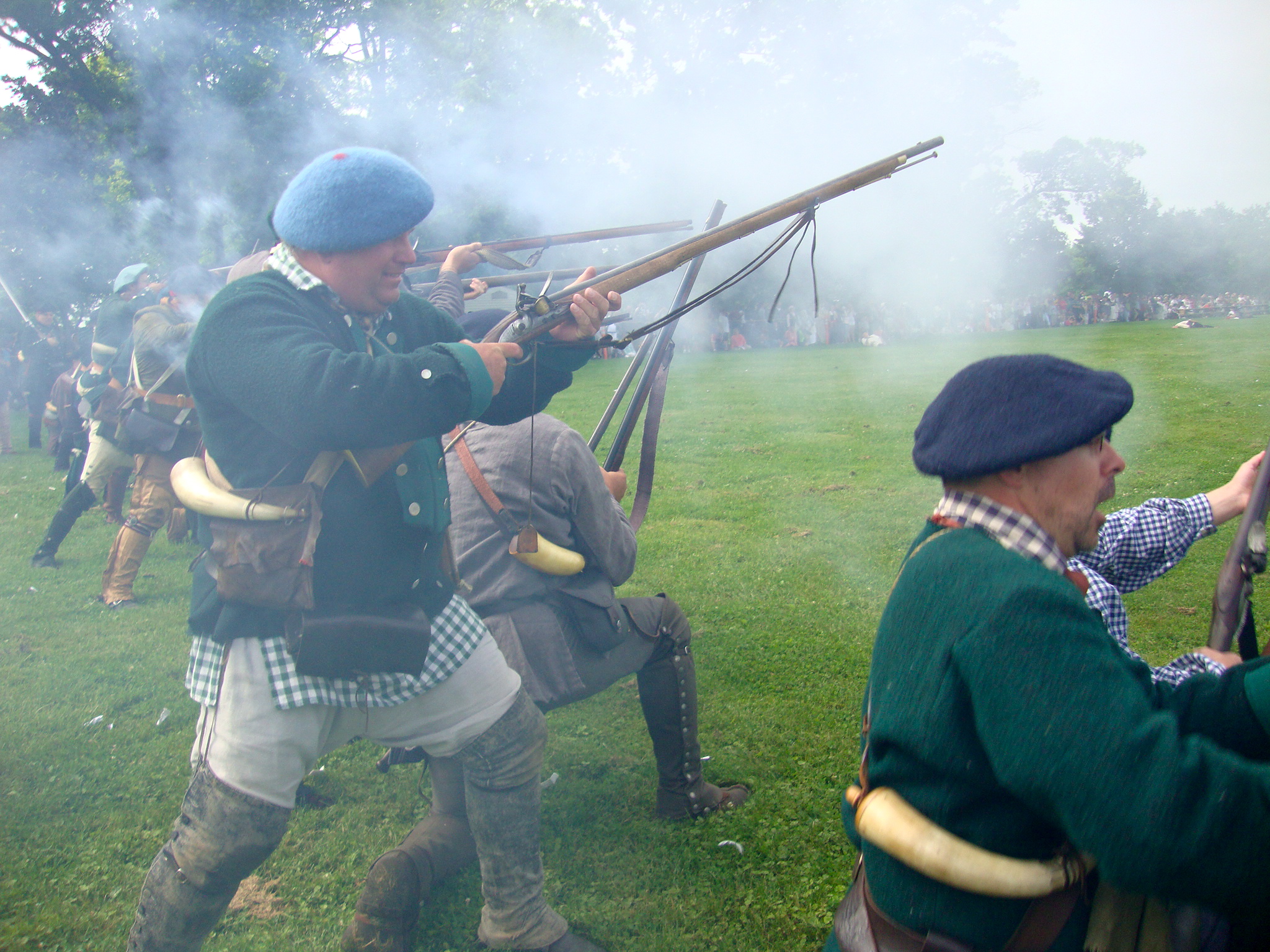
After breakfast I returned to the British Advance Camp, where the Rangers were bivouacked near a large maintenance shed. Fifty or so men and one woman dressed as a man already were marching toward the fort’s wonderfully curated museum. Their muskets were shouldered, their faces grim. Most of them were drastically overweight, and the median age for the group hovered at forty-five. (“As far as the war goes, we’re ancient!” one of them later told me). In a grassy patch they settled in three different formations and clumsily walked forward, turned right, left, wheeled around, and stood at attention. Their platoon leader sounded like a movie drill sergeant: “Poise your firelocks! Shoulder your firelocks! Rest upon your arms!” This went on for about an hour, with the soldiers showing little improvement as time passed.

As a captain lieutenant of his battalion, Old Hickory stood outside of the drill lines and chatted with the other officers. The plan for the morning was to drill like this and do safety inspections, then walk to the Battle on the Beach. As an officer his obligations were to pretend to whisper orders to the platoon leader who then relayed the messages to the men in a simulated version of chain-of-command, which made this rather tedious affair seem official.

During a pause in the action one of the privates asked who I was.

“A journalist,” I replied.

“We have an embedded reporter with us!?!” the man laughed.

“Where you from, son?” another asked.

“Ithaca, New York.”

“So you’re gonna just march around with us?”

“Yeah, Old Hickory brought me,” I said, thinking it would help me gain trust.

Ooooooooooooohhhh,” several of them cooed, causing Old Hickory’s face to redden.

They teased him like schoolchildren ragging on the kid at the head of the class for receiving yet another award.

“Well, thanks for joining us anyway,” someone said.

“I’m happy to be here,” I replied. “I hope it’s in the script that we win.”

Domestic Intelligence

People generally assume that any reenactment is a Civil War reenactment. It’s the most popular kind, for sure, but there are other time periods and conflicts. The Vikings. Rocky Mountain Fur Traders. Revolutionary War. World Wars One and Two. Korea. War of 1812. Vietnam. One imagines there eventually will be reenactors of Afghanistan and Iraq, too.

America’s earliest reenactments were arranged by real veterans. In 1822 some Revolutionary War soldiers revisited their 1775 conflict in Lexington, presumably to recognize the “first shot” that led to independence. Then some Crow Indians from the Battle of Little Big Horn commemorated their 1876 battle against General Custer with a bloodless redux in 1902. Probably there were others, too, but those are the most well-known.

Psychologically, those reenactments must have been a way of keeping past traumas real and under control; a means of talking about tough experiences with people who’ve been through the same. But I’ve never understood why anyone would reenact a war in which they’ve never fought.

Who are these people beneath their funny clothes?

Dossier No. 1

Old Hickory grew up in white, suburban Kansas City and enjoyed his childhood with his father, the quiet son of Swedish immigrants, who became a department store window dresser; and his mother, of British ancestry, who kept a tidy house and loved Old Hickory and his older brother.

Like other boys of the 1950s, he developed fantasies of frontier heroism and respect for the American story by watching Walt Disney shows about Davy Crockett and Daniel Boone. But in real life he avoided putting himself out there, as if resistant to risk and effort. Once he told me he loved the musical “South Pacific” because he’d watched his more-outgoing older brother practice the play with drama club friends in their living room, and he told this story with an undertone of self-knowing: at times his shyness can be stubborn, self-defeating.

He followed his brother to the same Kansas university and took pre-law classes but quit with just credits shy of a degree. He joined the National Guard to avoid becoming a soldier in the Vietnam War and ultimately finished college as a “C” student before returning to Kansas City. For three decades he worked in various jobs writing insurance policies. Around age 30 he tried being a marketing representative with a 10-state territory; it involved lots of travel, a company car, and an expense account — and he hated it. He also once moved to San Francisco, stayed a month, “hated every minute of that, too,” missed Kansas City and came home.

He’s never been married or had children or pets. “I don’t think I’ve ever truly been in love either,” he said on the way to Niagara. These days he’s looking for an attractive, independent, middle-aged, single woman interested in history, who reenacts the 18th century and sews. One imagines he may be looking for a while.

Shock and Awe

Once the men finished drilling, they waited for the order to begin marching. Contrary to the stereotype that reenactors spend their time running around like 5-year-olds, not once during that weekend did I see a man move faster than 3 miles per hour. The published schedule of events had the opening Battle on the Beach set to begin at 10 a.m., once the public parked their cars, bought their tickets, and meandered to the gawker’s fence near the Lake Ontario shore. According to the program, the reenactors were tasked to play out the following scenario: “A French hunting party from Fort Niagara discover that British forces have landed east of Fort Niagara. Rangers, Native American warriors, and French troops engage in combat. Both sides are reinforced until a major battle unfolds…”

As they waited for their marching orders, the men began looking restless. “We need to eat time,” Old Hickory told them. “Our whole purpose here is to save the skin of the guys already fighting on the beach because they’re getting pretty beat up.”

Of this sort of slip into fantasy, Old Hickory explains he never loses track of himself as a 21st century man — “I’m a little too practical, too down to earth,” he says — and so rather than succumbing to period rush he keeps in mind that he’s always being watched by the public and other reenactors, and he likes that. “I never forget that I’m a reenactor,” he once explained. “Even when I’m at a Civil War event I want to walk up to the guys and say, ‘Hey, I’m one of your brothers — I’m a reenactor, too,’ because I miss being identified the way I am when I wear my period clothes.”

Dossier No. 2

“In real life I’m just a wallflower,” he once confessed to me, before adding, on a brighter note, “but when I found reenacting everything changed.”

In 1992, at age 44, he took up black powder shooting and visited a War of 1812 site in Kansas called Fort Osage. There he met some F&I reenactors (anachronistic, yes, but who really cares), and he barraged them with questions. He bought clothes, a musket, and slept in his car at events. Some considered him “a suit” and “a mooch,” given his white-collar job and healthy diet, his constant requests for help and lack of handyman skills, but he paid those criticisms little mind. At events he was approached by the public, asked questions, even photographed. For the first time in his life he felt appreciated, like he had something to offer the world.

“Now when I’m in my street clothes I don’t feel like that’s my identity,” he said when I once asked him, Who are you outside of this?

In that conversation I drew a circle in my notebook and asked him to fill in the elements of his life — family, hobbies, friends, the job he’d quit, whatever — and to shade in the categories that involved reenacting. The exercise perplexed Old Hickory; he pushed my notebook away. “I don’t need to do that,” he said. “Reenacting is the circle. That’s it. There isn’t anything else anymore.”

Top Brass

The commanding officers were visited by the battalion’s co-founder. A circular, froggish man of 62, Tim wore a black tricorn hat and carried the title Battalion Adjutant. After Old Hickory introduced us, Tim and I spoke privately under an oak tree. For years Old Hickory had told me about the amazing history of Jaeger’s Battalion, how it’s the oldest and largest recreated Roger’s Rangers unit in the country, with members from 26 states, plus Canada and England, and more than 400 enlisted members. Old Hickory also considered Tim one of his heroes: “He’s been having fun with this all of his life, whereas I took 30 years off from ‘cowboys and Indians’ before starting again.”

When I asked how Tim got into reenacting, he said, “Back in the 1950s, the F&I was considered pretty obscure.” Immediately this made me chuckle: What does he think it is now? (There are only about 3,000 F&I reenactors compared to 40,000 in the Civil War, which itself remains a relatively fringe hobby). But Tim went on to say that in 1956, at age 9, he co-founded this battalion with his 11-year-old best friend John. They lived in the same neighborhood in Grand Rapids, Mich., and had seen a rerelease of 1940’s “Northwest Passage,” widely considered the F&I’s answer to “Gone with the Wind,” with Spencer Tracy as Robert Rogers and Walter Brennan and Robert Young as two buddies who help the famed woodsman wipe out Indian villages. Mesmerized by the movie, Tim and his buddy returned to the theater nine more times and began play-Ranging. (“I’m Robert Rogers!” “No, I am! You’re the Indian savage!” I can imagine them saying). Then as teenagers they shot muzzleloaders and began reenacting after college.

Hearing all of this I wanted to ask Tim if they’d signed their charter in a tree house, but when he said John died a few years ago, making him the commander, I didn’t have the heart to be ironic.

The author of several F&I books, as well as a memoir about Boy Scouting in western Michigan, Tim admired his fake troops: “We’re a family-friendly organization. Our members all look alike, they all get treated alike, but some of them are very interesting. That one over there is actually female; she’s a graduate of the Air Force Academy. Him over there, he’s a real Army colonel. Another is a meteorologist. Another is a schoolteacher. One’s a naturalist for the state of Ohio. And we have one young man with us on leave from Mosul in Iraq.”

“Which one is he?”

“He won’t be on the battlefield today.”

“Really?”

“Nope. He’s cooking with the women back in camp.”

Our conversation ended as all of my previous and future ones had and would: with me taking a picture of the reenactor. These people must have unwritten rules about photographs: They never smile or look at the camera, and they always try to look stern and important. As such, Tim stared off toward history and greatness, and he suggested that I capture the French fort in the background, because that’s the direction we were headed.

Flanking Maneuver

The route to the beach was a long one. Through the park, across soccer fields, past a swimming pool, and through the woods along shoreline cliffs. The reason for the distance, one reenactor said, was a “bunch of asshole French separatists.”

Earlier that year, a group of French-Canadians had threatened to ruin a reenactment near Quebec City of the Battle of the Plains of Abraham, in which the French were defeated and their foremost general was killed. The battle had been canceled over the plans of angry Quebecans still pissed off about France’s defeat, to storm the battlefield with paintball guns. As a result Niagara had swelled, bringing more reenactors and in turn more spectators whom we had to journey around; we didn’t want to shatter the public’s suspended disbelief, after all.

The reenactors’ physical conditions, ranging from bad feet to morbid obesity, led them to take many breaks. Yet unlike the masses, Old Hickory was physically fit. Just a few years prior, he and a few others had dressed in Revolutionary War clothing and walked almost 700 miles recreating the Washington-Rochambeau March (sans, of course, a land war in the background). Averaging 16 miles a day, they walked up hills, through strip malls and housing developments, and across water and countryside and rain swept cities. “We’d walk seven hours a day and set up our tents immediately. We’d sleep and then start walking again. We wore modern sneakers, but still the blisters hurt so bad every step hurt,” Old Hickory told me. “But we got celebrity treatment. Every town we stopped in there were people who appreciated us, thanked us. Journalists interviewed us I don’t know how many times. The Pentagon even let us inside. It was the greatest thing I’ve ever been a part of.”

Dossier No. 3

“My dream is trying to create Andrew Jackson in a 40- or 45-minute presentation, basically a one-man performance,” Old Hickory told me more than six years ago. We were talking in the Starbucks where every day he gets his social fix talking to baristas while he reads his history and reenacting books. At that time, Old Hickory already had paid a scriptwriter $1,000 to write him a Jackson monologue. He’d purchased a few thousand dollars worth of Jackson clothing and had a website and business cards, too. He was still riding high on the fact that he made the May/June 2000 cover of a reenacting magazine called Muzzleloader, on which he appeared as a gallant General Jackson sitting atop a horse at the Battle of New Orleans.

Since that Starbucks conversation, he’d also become the main men’s model for Cobb Creek Merchants (“purveyor of 18th Century fine clothing & accessories”); been profiled in another long Muzzleloader article about the filming of the PBS special “The War That Made America;” appeared in short films for Mount Vernon and Andrew Jackson’s hermitage in Tennessee (the latter is a low-budget movie called “An Encounter with Old Hickory,” now available on YouTube); and he modeled in a project called EPIC ART in which oil tankers outside of Houston were decorated with historical images four stories tall and 140-feet long, meaning that on a certain highway in Texas, Old Hickory can be seen as Andrew Jackson from literally a mile away.

But battle reenactments and photo shoots are one thing — real acting is another. Old Hickory doesn’t think he’s got the talent: “I’d really feel shy and self-conscious doing some kind of actor thing,” he told me. Plus, he’s too impatient for acting or public speaking classes. “I don’t want to be an actor,” he replies whenever anyone makes the suggestion. “I just want to be Jackson.”

Unanticipated Informants

The old man talking to Old Hickory called himself Captain Titus, and he was ghostly, with a turkey-like face and shoulder-length white hair. He wore a long red coat and a black tricorn hat and he carried a saber at his side and smoked a long, curvy corn pipe. (Later at this event, at the fireworks show, I would meet Captain Titus’ men. Five bearded and friendly middle-aged guys, they told me Titus often organizes multi-hour hikes during the winter, when most reenactors hang up their muskets. Apparently he leads his men through steep gorges in their period clothes and shoes, yelling at them to keep up. Another tale involved a time when Titus inspected a man’s musket and found it dirty. As punishment he pressed the man’s $2,000 gun into some mud, saying, “Don’t you just hate it when that happens?” You’ll never see a reenactor more hardcore than him, one of his men said).

Watching Titus talk to Old Hickory was like seeing a teacher and student; Titus was so lost in his character that nobody knew his real name, or if he had one.

“Did you enjoy yourself when we last engaged?”

“Yes, sir, I did,” replied Old Hickory, who told Titus he drove 30,000 miles for last year’s season of reenactments.

“My God, you go a distance for the cause, my boy!”

When they parted ways Captain Titus tipped his hat.

“Good luck killing the French!”

We crossed a four-lane divided highway to enter the woods that took us to the beach. A platoon leader yelled “Hold the road!” to some men who stood with their muskets across their chests while SUVs and sedans idled down.

At the highway, Old Hickory and I saw his pal Mike. A documentary filmmaker from Connecticut, Mike was one of the reenactors with whom Old Hickory marched the 700 miles. Claiming he was dressed as “Bobby Rogers” himself,  Mike sported a long gray ponytail that swayed as he stepped through trees and brush. He bragged that the Yorktown march damaged his knees so badly he now held railings whenever he walked on steps, but still he planned to march again someday. Of his obsession he explained that his relatives have fought in every American war since the F&I and the hobby brings him closer to his roots. For 20 years he researched his genealogy, even bought a computer program to manage its 3,000 names, and he boasted to me that his relatives include Abraham Lincoln, John Hancock, Paul Revere and 21 people who survived the Mayflower voyage.

Wanting to ask how much cannon fire he’d absorbed throughout life, I instead congratulated Mike on his discoveries. He added, “And my son and daughter-in-law just had a little boy. Some years ago I asked for all of her information, and after a lot of digging I found out she’s related to the first settlers of Jamestown, which means my grandson is the byproduct of the first people to settle this country. How about that for awesome, huh?”

“I’m sure he’ll have a lot to say at show and tell,” I said.

The crack of musket fire interrupted us.

We arrived at the Battle on the Beach.

Linear Warfare

Coming out of the tree line, the Rangers saw hundreds of spectators behind the gawkers’ fence that extended all 500 yards of the battlefield. The Rangers organized themselves in a long horizontal line — which I guess is how the guerilla forest warriors actually fought? — and negotiated several picnic tables and stationary barbecue grills. As we walked forward, I saw several reenactors (as frontier medics?) pretending to carry the dead and wounded off the field, with several of those men aptly moaning.

Slowly the Rangers advanced into the battlefield, knelt, fired on the distant enemy, and advanced again. As for me, I alternated between scribbling in my notepad and lying on the ground to take battlefield photographs.

On the drive up, Old Hickory had told me that battles can be exciting, with all sorts of things happening, but really, it was just a bunch of yelling, gunfire and smoke. With everything scripted, they’re a cross between goofy and dull. I got a kick out of making chit-chat with the dead soldiers and hearing a few of the commanding officers crack jokes. One man quoted a line from “Stripes”: “If we ever find ourselves in heavy combat, just know I’ll be right behind you guys the whole time.” Others, however, were hardcore: they shouted “Huzzah!” after firing every round.

After 20 minutes the battle was scheduled to wind down. “If you’re having musket problems, start dropping out as casualties!” a commander yelled.

Added another: “But wait for the next round of enemy fire! Don’t just suddenly die!!!”

“Nicely done, boys!” said another when the men managed to fire in unison.

“Two more rounds, hold your fire, and then we’re going right after them!”

To my right I saw French navy forces on the lake shoot at us with cannons and muskets. A few men dressed in loincloths loped around the shoreline, ostensibly pretending to be warring Indians but instead looking confused as they wandered toward and away from the war. Noteworthy, though, was their body paint: Depending on the man, it was either crimson red or soot-black, and it covered them mohawk-to-toe, including all over their bare middle-aged buttocks.

At some point Captain Titus emerged from a cloud of smoke.

“You’re not afraid are you, Nick?” he asked in his thick Southern drawl.

“No, Captain Titus,” I said, lying on the ground with my notebook. “I’m just fine.”

“That’s good,” he hollered. “I didn’t think you would be!”

Then after the French fired another round of blanks he shook his head and again turned to me, totally serious: “Boy, that was a close one, Nick!”

Sortie

After the battle ended, young girls in matronly outfits walked onto the battlefield carrying canvas sacks. “Would you like some water, sir?” one of them asked in a fake British accent nobody except the two of us could hear. I drank from a plastic squeeze bottle and surveyed the field. In accordance with the script, a Tambour-Major on the French side had declared, “La Retraite” and the Frenchmen and the Indians had run into the fort. Dead soldiers rose and walked away. Old Hickory wandered off to model for sculptors and painters who’ve used his image in all sorts of artwork. But I stayed behind watching the crowd applaud us, wondering why they’ve paid $25 a ticket, for this.

Among them was an attractive young mother with two little boys. One of them sat in a stroller and the other ran around pretending to be a soldier. Despite being in uniform, so to speak, I explained to her what I was doing and asked why she brought her family to a battle reenactment given the kind of message it imparts. She answered, “It’s just something to do. And this is what boys do anyway. They’re conquerors — they think they’re born to be conquerors. I used to get tired of them playing war games, but then I got tired of trying to redirect their imagination.” And together we watched her son pretend to kill an imaginary enemy as we walked off the battlefield.

The Aftermath

Later, and mildly depressed, I went to an ice cream shop inside the fort. As luck would have it, I sat beside two other mothers and their four little boys who were arguing. Naturally I eavesdropped.

They were civilians, and I assumed the mothers also had brought their children to foster an all-American, male fascination with fighting and war. But these boys didn’t care at all about the battles, the reenactors or the fort. Like the reenactors, but also unlike them, these children were somewhere outside of real life and real time.

“I’m Mario,” one of the boys yelled.

“No, I’m Mario,” another said.

“OK, can I be Luigi,” the third asked.

The whole thing went on for five minutes, until one of the exasperated mothers put down her fudge sundae and snapped. “Half a day! Just half a day,” she pleaded. “Can you guys please go one day without arguing who’s who in the video game world.”

Continue Reading Close