Peter Bebergal

Buried treasure

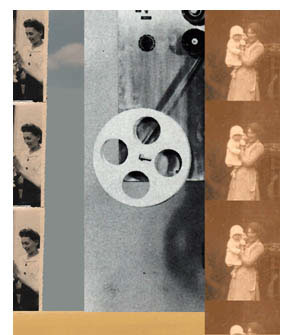
In ancient Super 8 movies I see my mother as I never knew her.

  • more
    • All Share Services

Buried treasure

There are many photos of my mother, a lifetime of photos, each one holding fast to a significant moment in her life: her first job in a record store, her wedding, my parents’ first apartment in Brookline, Mass., my mother at my own wedding, which was to be one of the last of her taken. They each resonate like a single note in a song, but the whole piece of music is never heard because some bars, some photographs, are missing, and no more will be taken.

My mother died in November 1999, succumbing to a lung cancer that was stronger than she but never stripped her of her beauty, her vanity or, I suspect, her desire to be photographed. Once she was gone, I searched for artifacts of her life, something more than snapshots. I opened closets and drawers, picked my way through jewelry boxes and old pocketbooks. Almost everything was as it had been when she died, even her robe hanging in the bathroom.

I found a box of Super 8 film reels in the basement. Unwieldy and practically ancient, they are hidden treasures not easily examined. The hassle of setting up a screen and cranky projector probably stops a lot of people from looking at their old family Super 8s. But an urgency swept over me as I made my find. I knew that in these reels were images of my mother that I had never seen.

We are, in the digital age, an anti-grain culture. We no longer tolerate snaps and pops in our music, static in our TV pictures or fuzzy edges in our photographs. Super 8 film is anathema in this new order. It is grainy as well as fragile, and it requires the most complicated of all home appliances: the movie projector, which has been mostly banished because of its tendency to be off kilter, out of focus and hot enough to ignite at any moment.

Still, I managed to find a projector and an editing machine at an online auction, and set about the task of putting the whole boxful together, reel by reel, into one long family movie, a movie I came to find out was mostly about my mother, filmed entirely by my father.

The small, unfocused and poorly lighted images of my mother convey the essence of who she was with tremendous clarity. The years are the early ’60s, and my mother wears a scarf and large round sunglasses. She is an American Jew, raised on the outer edges of Boston, who now plays house with her new husband. She is in love and she bears children and she is photographed and filmed incessantly by the man who loves her, also an American Jew, born in the city, building his new wife a home in the suburbs.

Anything but a Super 8 camera would have cut away the frayed edges of their lives, turning them into static, flat simulacrum. Instead, for all the grain and all the dust in the lens and this crappy machine I use to view them with, these are moments of incredible vibrancy.

In one film my mother carries one of my siblings on her hip, with two others at her side, and she brushes the hair from her face to make sure it is captured clearly. She must be able to hear the distinct clicking of the camera as the shutter opens and closes. Yet her face shows no sign of contrivance or acting. She turns her head and as the camera zooms out you can see they are on a pier, and my mother, for a moment, looks away from the camera at the water. My father keeps filming, waiting for her to turn back to him.

The popularity of Super 8 in the ’60s was a remarkable little cultural moment. Men in polyester all over the country were filming their new families as if the only way to make them real was to capture them on film. The chaos of politics, music and youth threatened stability, and the camera was a tool for creating proof of what they had and what they worked for — evidence that what they loved was real and permanent.

My own father joyously succumbed to the fervor. He bought a top-of-the-line German camera, a Bell and Howell projector, a collapsible screen, editors, splicing tape and reel-to-reel tape recorders for syncing sound. And on weekends, as my family roamed around New England and beyond, my father filmed it all. But now, seeing these films, I realize it was just an excuse to photograph my mother, to see her in the viewfinder without the distraction of the sprawling suburbs.

Here was a woman I had never known, who would later give birth to me. She would become my mother and then she would become a woman who no longer exists. Watching the home movies of this unknown yet completely familiar person made me feel as if she never existed except in these dozen or so three-minute intervals.

Now, as I wind my way slowly through the films, manually turning the reels, I am in control of the speed and I can turn linear moments into stills. Here is one: My mother walks with her head down. Her hair is pinned up. It seems as if she doesn’t know she is being filmed, but suddenly she raises her head and, seeing my father, she smiles. She smiles at me from the past, and I feel the loss of her with perfect clarity.

Last exit for education

A prodigal son of the community college returns to teach in the classrooms that once gave him his only chance to escape.

  • more
    • All Share Services

Sitting before me were three single mothers, all under 25; an African soccer player; a French-Haitian woman who spoke four languages; five guys named Mark, 18 to 20, none of whom had ever left the city they grew up in; a straight-edge skate punk who looked like a Marine; a white middle-class real-estate agent; and a female ex-con who stared at me like a gopher looking down the barrel of a hunter’s rifle. It was my first day of teaching composition at a community college, the same one where I had been a student, almost 10 years before. As I got up to write my name on the board, a young woman snapped her gum and asked snickeringly if I was the real teacher or just another temp. I assured her I was there to stay, although a month later, with only five people showing up regularly, I find myself wondering about this vow.

But when I look out across the fields of desks and Coke cans, I remember: This is where I came from and this is where I belonged.

One afternoon when I was 18 and attending 12th grade for the second time, the principal asked me to visit him in his office. He told me my attitude was not “conducive to learning” in the public high school. From his vaguely impatient bureaucratic air, I’m certain that if he could have, he would have expelled me on the spot. As an easily unimpressed smartass, I was just the sort of student who gives school administrators headaches. On that day, however, the principal simply set down a piece of paper that needed only my signature. I would be allowed to leave the school and finish my high school credits at the local community college. How could I say no? I imagined hot older women, who — having escaped the clutches of their illiterate, impotent husbands — enrolled in classes with no other intention than to drag some young high school dropout into their floral-sheeted beds. I imagined a life where the freedom was as intoxicating as vodka and abundant as air.

I soon found out that this attitude was not conducive to community college learning either. In fact, everyone expected more from me because everyone assumed that I had made a choice to be there. Instead of hot older women preying shamelessly on my 18-year-old body, I discovered serious people with serious lives trying to turn hopeless situations into fertile opportunities.

I soon flunked out.

At 23, I was selling lousy stereo equipment to families who couldn’t afford it, and one morning I woke to the sound of my own gasping breath. I wanted to go back to school. And the only place that would take me would be the community college. After begging a disciplinary committee to take me back, they told me that I would have to take every class over that I failed and that it would always be on my permanent record. But if I did well, I could redeem myself and they would do everything they could to help me.

Being treated like an adult when you are still a kid is as disconcerting as it is invigorating. Unlike typical four-year colleges, there are no dorms, no campus parties, no frats, no first time away from home distractions and no low expectations. Rather than expecting that I was to spend all my free time partying, the teachers assumed I was there to push myself. In high school all they wanted was attendance and discipline, and from freshman I knew at four-year schools, teachers there offered freedom without real accountability. I was living in the margin with other losers — people who had to deal with real responsibility, real freedom and their own fears that this was the last second chance they would ever get.

In the small smoking room located on the first floor, I began to make friends with people who were not really my peers, but were in the same place in their lives. Most were smart but something in their lives had forced them to choose not to pursue four-year college. Every Tuesday and Thursday morning I would meet a guy named Parker for coffee and cigarettes before our philosophy class to go over the homework. Parker was sullen and always wore long sleeves rolled down and buttoned. Gradually, it came out that he had spent most of his high school years in and out of mental institutions after having tried to kill himself when he was 14. One day he showed me his arms; they were covered in scars from wrist to elbow. After dozens of doctors and many more prescriptions, he was able to sit still for more than an hour and he decided to get an education. Community college was his only recourse. He had no high school record at all, and was able to collect government checks while he attended classes.

As it is for a lot of people, the obvious next step for Parker was to transfer to a four-year school. More than 30 percent of all
undergraduates transferred from a two-year college. But as state funding dwindles, some community colleges have begun to emphasize job skills over liberal education. Where once these tandem educational roles seemed to work well together, community colleges are now being pulled in two directions. While most people argue that vocational training helps people get off welfare and escape dead-end jobs, others warn that the community college system is one of the only surviving means by which students from poor, messed-up families can go to a four-year school and really rise in the economic ranks. But if you have a single, out-of-work mother and only enough money to choose either Excel or Milton, you shelve “Paradise Lost” in favor of a paycheck. At most community colleges you can still get an education for about $1,500 a year, but the horizons of the students are narrowing. Almost none of my students are even thinking about transferring. The one student who I thought might actually make it in a four-year school dropped out after his girlfriend announced her pregnancy.

But these horizons were not so clearly drawn for me. With only a semester left before I graduated, I was sitting in the smoking room talking to one of the administrative secretaries. She asked me what I thought I might do next. I told her I planned on finishing up at the local state college. She looked at me bemusedly and said that I could get into any four-year school I wanted. I was stunned. I thought my community college education, for all its merits, was still a lesser education. She told me these last two years were as good as any school — in fact, maybe better, because universities would know I was dedicated. I applied to three top schools and got into all of them. I ended up attending Brandeis and went on for graduate studies at Harvard. This is the only good thing to come out of my smoking habit.

Now as a teacher, I struggle with trying to remember this lesson — that even my humble composition class can be the ticket for some sleepy-eyed kid slumped at his desk to do something for his future that he cannot even imagine. I try not to lose faith in Paul, who rarely shows up, and when he does, he comes
hungover. Recently he turned in a descriptive essay about the bar he drinks in. The paper was actually pretty good and it was five pages long. The only problem was the last four pages were all exactly the same as the first. And I try not to lose hope for the serious ones who struggle with external barriers that I can hardly fathom — like Jessica, who wrote about her husband repeatedly berating her for thinking she could ever be more than a working-class, immigrant housewife.

As I near the end of my first semester as a community college teacher, even among the
five students who show up fairly regularly, there are still a lot of absences, and nobody even bothers with trying to give excuses. There is one young man, though, who has not missed a single class. He’s battling attention deficit disorder and a violent temper that has gotten him in trouble in the past. In his journal he writes raw accounts of holding himself in check when someone takes the wrong tone with his mother. Somehow he excels. He does not get pulled down by the things in his life that make studying seem futile, nor does he push them aside. He tells me that this might be his last chance to be something more than a raging inner-city kid who ends up in jail or part of some homicide statistic. Sometimes it seems that the salary isn’t worth the heartache, but he is the reason I stay.

Continue Reading Close

We've come a long way, baby

My mother isn't the only one bound to her addiction: Smoking is what makes her truly my mother.

  • more
    • All Share Services

There is an apocryphal tale in my family that while my mother was in labor, driving
to the hospital during a snowstorm in February, she insisted that my father
pull over so she could run into the drugstore to get cigarettes.

There is another, mostly true story that I was born weighing only four
pounds, eight ounces, and had to stay in the hospital. When my father called
my grandmother to tell her the news, my older sister, who was staying with
her, asked why I couldn’t come home. My grandmother went into the
refrigerator and pulled out a small uncooked chicken and said, “This is how
big your baby brother is.”

My mother learned to smoke at a time when young ladies did not and
continued to smoke when all the ladies did. She was not told during her
pregnancy to stop. One can even be reasonably certain that her doctor
smoked. And whether or not my small birth weight can be attributed to her
smoking, I know that my own love of tobacco and all things smoking is a
legacy passed on to me by either the nicotine in my amniotic fluid or by the
same chemicals that gave me and my mother similar facial structure.

I don’t think I became acutely aware of how much my mother’s smoking had
affected me until once, while I was eating breakfast with a lover, she asked me to
pass the arts section of the paper, and I was suddenly hit with her breath,
a creamy bath of coffee and cigarettes, and in a flash my entire childhood
of Sunday mornings swept over me like, well, smoke. Suddenly I was awash in
images of my mother eating a bagel with whitefish and drinking coffee, of her
and my father lightly bickering over the Times puzzle, and of course, a
cigarette burning in the ashtray beside her.

My whole family smokes or has smoked. And even those of us who no longer
smoke do not consider ourselves nonsmokers. It’s too much in the blood, too
much a part of who we are to ever really refer to it in the past tense when
referring to ourselves. Even my father, who has not smoked in more than 30
years, still has dreams of them, and sometimes, after a fine meal sipping a
VO and soda, would love to have a cigarette. The family smoking habit is
sort of like the way we are all Jewish. It is something you are born into.
You don’t need to practice to refer to yourself as part of the culture. And
to deny it would be to deny the very core of who you are. But it is my
mother’s smoking that makes her the matriarch of the habit, and while we all
wish she would quit, we all secretly know that she is bound to her
cigarettes by more than mere addiction, that something about it makes her
truly who she is and truly our mother. And it is not only a familial spirit
that haunts me, but an American one as well.

- – - – - – - – - -

The American affair with smoking is coming to its tragic close. Where
once there were nonsmoking sections, there are now entire states in the union
where you can’t smoke in restaurants. Even smokers’ havens are
slowly being taken away. Dunkin’ Donuts are more and more becoming
nonsmoking institutions. There was something so utterly American –
verging on the holy — about a cup of coffee and a cigarette in an all-night
shop. It reminded you that no matter who you were or where you were driving
from, you were allowed a moment of sanctuary. But now there are cigar bars,
the Disneyland of smoking, where people who don’t really smoke like to go to
pretend they do. Where once entire narratives revolved around smoking and
smoking paraphernalia (Cary Grant never would have fallen in love with
Deborah Kerr if it weren’t for his cigarette case), even the film industry
reflects the end of a once great romance. Now it seems only criminals and
cops smoke. But as America turns its back on cigarettes for possibly all the
right and noble reasons, there is still a lingering need, in the same way
that the lover who is most wrong for you is the one you continue to pine
for. It seems without cigarettes America may be healthy, but we are less
handsome.
It has been about three months now since I’ve had a cigarette, after
about 16 years of smoking, with almost two packs a day for the last 10, and while
certain old movies, coffee shops and Italian dinners make me shudder a bit,
it is only when I see my mother smoke that I can feel the craving engulf me. It
is as if there is, in the back of my throat, a small, almond-shaped hole that
sucks everything I am into it, and the only way to close it up is with a
cigarette. I quit simply because it was making me feel terrible and 40
years older. So while visiting my folks every week brings me much joy, I
have begun to dread it, knowing that watching my mother smoke is one
of my greatest pleasures, but it could also prove to be my downfall.
My mother, some have said, is a vain woman, a trait I’ve
inherited. Part of my reason for quitting was that I was obsessively worried
about the way cigarettes made me smell. But my mother’s vanity has kept her
beautiful. And the cigarette, like her rings and pocketbooks, is a necessary
accessory to the cause, each part playing its own fitful role in keeping the
whole going, a dynamic interplay of movements, sounds and smells. I can clearly see my mother reaching into her pocketbook, the crinkling of papers
trumpeting the retrieval of a soft pack of 100s. Then a deeper search that
uncovers an immaculate silver fuel lighter. Before she lights it, my mother
tends to talk with the cigarette bobbing in her mouth, and then the click of
the lighter and that first deep drag, as if it’s her first breath and her
last, and all the Bogart movies in the world could not make me crave a
cigarette more.
It is possible I have romanticized smoking and am using my mother as a
way out of my own folly, to blame her instead of my own insufferable
addiction. But I will admit that while I am not smoking now, I will always
be a smoker, and it is simply that I am now choosing not to smoke. And I
love cigarettes, so much that at the end I was rolling my own, each one a small
crafted ritual. But I truly cannot blame myself entirely. Once, seeing my
mother tending her plants, a watering can in one hand and a cigarette in the
other, I knew I was doomed to never hating cigarettes. And it is the hating
of them that might be a possible prerequisite to quitting forever.

My mother’s smoking is for me the last remnant of a time when all the
men wore hats and all the women smoked. It is odd to have a nostalgia for
someone else’s age, and yet I am so kindred to her, it only makes sense that
I would sentimentalize my mother’s history. And while I wish my mother would
quit so that I’d have more to be nostalgic about, her smoking so connects me
to her and to her own particular generation that I am bound forever to
her through it, much in the same way we are bound as Jews.

Two generations removed, great-grandparents took up smoking in the same
way they took up America. They gave up their old-world Judaism for things
like opera and communism, which they sought out in the cities where they passed
on to their children a Jewishness rooted in the actual, in the chaos of
America that actually seemed ordered when you simply remembered to eat
together on Passover. In my father’s family, his grandmother smoked her way
into modernity, passing on through the matriarchal line a seed that bore
witness that being a mother didn’t mean giving up worldliness. My mother
carried on this tradition, raising me and my siblings with her hair in a
scarf and a cigarette in her mouth. We were a family of the ’60s and
’70s; Eastern European orthodoxy was someone else’s memory. But my mother
made sure that Judaism echoed in our home. She lit the Friday night candles
as if every woman in her family were watching her. And after she cradled the
flames in her hands up to her eyes, she had a cigarette, a shared smoke with
all the mothers and grandmothers before her.

Continue Reading Close