Petra Bartosiewicz

Brownout at the EPA

The agency shuts down five public libraries full of environmental data, and employees and activists question the Bush administration's motives.

  • more
    • All Share Services

Brownout at the EPA

‘When Verena Owen wanted to block the construction of a sludge incinerator in her hometown north of Chicago, she went to the library. At the Environmental Protection Agency’s regional library in Chicago, Owen pored through archived microfiche records and paper reports on sludge and incineration and public comments on similar projects. Owen learned that just a fraction of a teaspoon of mercury could poison a 10-acre lake — and the proposed plant would have spewed 92 pounds of mercury into the air of Waukegan, Ill., annually. Her research proved pivotal in forcing the plant to relocate and vastly reduce its mercury emissions.

At the beginning of such a project, says Owen, a veteran clean-air activist for the Illinois Sierra Club, “you don’t always know exactly what you’re looking for. These were things I just needed to see.”

But now the library where Owen did her research is closed, as are similar facilities around the country. Announcing the closings with all the fanfare of a pin drop, the Environmental Protection Agency quietly began downsizing its 35-year-old library network earlier this month, shuttering its headquarters branch in Washington and three regional libraries in Chicago, Dallas and Kansas City, Mo. Hours and services are to be reduced gradually in the remaining 22 regional branches in the network. The agency’s budget has been slashed by $100 million for the fiscal year beginning this month, and the libraries have lost one-third of their $6.5 million annual funding. The EPA cites its money woes and a shift to an online model as the reason for the closures, but critics charge the move will erase vital chunks of institutional memory, and is more proof that the Bush administration has no interest in letting the EPA fulfill its role as an environmental watchdog.

“This is a way to keep EPA from being an effective organization,” says a former librarian with the agency. “Take away their research ability. Cripple them.” Adds Dwight Welch, a union official who represents EPA employees, “The closures seem like part of a general trend of hostility towards science by this administration. They don’t want to hear the facts on everything from global warming to raising drinking water standards.”

The library closings have caused distress among agency employees, who see the network’s trove of technical reports and scientific data as vital to their mission of proposing and enforcing the nation’s environmental laws. “It’s as if your local fire department was getting rid of their fire trucks,” said Suzanne Wuerthele, an EPA toxicologist with 22 years at the agency, who works at the regional office in Denver. “We won’t be able to fight our court cases; we won’t be able to inform the public; we will be much less effective, certainly less efficient.” But the closures are also a problem for civilian activists like Owen, who will have greatly diminished access to records that have proved instrumental in fighting grass-roots environmental battles.

In a process the agency terms “deaccessioning,” materials at the four closed libraries are being boxed up, labeled and shipped to three repository locations, where they are to be cataloged anew and eventually digitized. The headquarters library alone includes 16,000 books, 380,000 microfiche documents, and a vast array of technical reports and research monographs. The headquarters library — once staffed with librarians and open to the public — will now be one of the three repositories used to store materials until they can be dispersed to other libraries, federal agencies or universities. EPA staffers at all the closed libraries are being transferred, and an unknown number of contract employees have been fired.

And the Bush administration hasn’t finished. In addition to shuttering these libraries, the EPA plans to close its Prevention, Pesticides and Toxic Substances library in Washington, which contains unique holdings on pollution prevention, toxic substances and chemicals, and was used to research and craft important new regulations, such as tighter arsenic standards for drinking water in the 1990s. The closing has not yet been announced, but employees report that materials have already been boxed up and stored in the basement.

So far the EPA has been mostly close-lipped on the changes, making a stealth announcement of the headquarters closure in the Federal Register just 10 days before the doors were permanently shut.

The agency says the closures are part of its shifting its holdings to an electronic model in a climate of increased online access and tighter security measures at federal buildings. An EPA press release titled “EPA Expanding Library Info Access” says that retrieval of materials “will not only be more efficient but also [materials will be]  easier to locate by using the agency’s online collection and reference services.” Agency spokeswoman Suzanne Ackerman says the process will be complete by January 2007. “We have the scanning equipment, and the labor costs are pretty minimal. Even if we don’t have a huge budget, we have interns.”

Yet the agency’s own fiscal year 2007 library plan, released in August, is vague about time and money. “In FY 2006,” it notes, “some Regional libraries may begin dispersal of some of their physical collections. Other Regions may put their collections into stasis, i.e. neither fully operational nor fully closed, until funding for dispersion is available.”

Off the record, several EPA employees told Salon they are skeptical both about the timetable and about whether the agency’s material really will become available again in digitized form. For their own protection, some have referred their complaints, and leaked documents, to Public Employees for Environmental Responsibility, a nongovernmental organization that supports institutional whistle-blowers. Many internal EPA documents related to the closures are now on PEER’s Web site.

Jeff Ruch, PEER’s executive director, summarizes what EPA staffers have told him. “It’s almost like the EPA is having a fire sale. They’re not doing this with any kind of foresight and planning. They don’t have any money for digitizing, and even if they did have the money they don’t have the staff to catalog these materials. Literally hundreds of thousands of things are being boxed up without being cataloged. There’s no deadline, no budget and no staff.”

Moreover, even as the agency touts an increased online presence, it has canceled subscriptions to online data sources such as Greenwire, an environmental news service that received 125,000 hits from EPA staff last year. When asked to confirm the Greenwire cancellation, spokeswoman Ackerman initially said, “It would be almost hilarious for us not to have Greenwire … There may be days when we’d rather not read what they say, but I can’t imagine we’d cut that.” She later confirmed the cancellation of the service.

The agency’s employees lodged a formal protest this summer. At the end of June, union officials representing just over half of the EPA’s 18,000 staffers wrote Congress to demand the library funds be restored. The closures, the letter argued, would hinder emergency preparedness, antipollution enforcement and long-term research. The letter also lamented the loss of staff who provided critical support to enforcement officers, conducted detailed database searches and often served as the public’s main link to the agency. Library staff “allow EPA scientists to spend more time conducting inspections, writing public health and environmental policies and implementing the Agency’s regulations,” the letter said, adding that the “draconian manner” of the closures represents just “one more example of the Bush Administration’s efforts to suppress information on environmental and public health-related topics while cloaking these actions under the guise of ‘fiscal responsibility.’”

The letter to Congress and the unhappiness within the ranks have captured the attention of lawmakers. Last month three House committees — Science, Energy and Commerce, and Government Reform — asked the Government Accountability Office to initiate an investigation, citing “grave concerns” over the impact of the closures. “A shuttered library does not further open and transparent government,” Reps. Bart Gordon, D-Tenn., John Dingell, D-Mich., and Henry Waxman, D-Calif., wrote.

“It did seem to us that if you want to modernize and make things electronically available that’s fine, but you need a plan for that, and we don’t see one,” said a staffer in the office of Rep. Gordon, ranking minority member on the Committee on Science.

The GAO now says it plans to launch an investigation in the next two months.

Some EPA employees have also questioned whether the changes are really cost-effective, in both the short and the long term. An internal EPA study in 2004, for example, showed full library access saved the agency an estimated 214,000 hours in professional staff time, valued at some $7.5 million annually. The savings come not just from proximity to information that otherwise would have to be hunted down elsewhere but in the human capital of a library staff trained to assist the public with complex research.

Maureen Kiely, manager of EPA Region 8′s technical library in Denver, which is not slated for closure, said her librarians receive hundreds of questions each month. Some queries take as little as three minutes to answer, others as long as three days. In recent months librarians have researched requests on techniques for lead paint removal from a historic bridge, wastewater management in coal-bed methane production, and the concentration of the fungicide/insecticide hexachlorobenzene in bird eggs.

For the public, the libraries offer physically present data, something that is difficult to replicate through online searches. “It’s all reading between the lines when you’re doing research,” said Jim Schermbeck, a grass-roots activist and board member of Downwinders, a Texas clean-air group that opposes cement plant emissions. When Downwinders first started its work, the EPA’s library in Dallas, now closed, was indispensable in providing raw data on the cement companies the group was fighting. “You’re putting together pieces of a puzzle and getting a narrative you didn’t know existed,” said Schermbeck. “That’s the first step for anyone tackling an environmental problem, and without direct access to the documents, it’s a lot harder to piece together.”

From G.I. Joe to Tora Bora Ted

Since 9/11, a new generation of war toys has emerged -- action figures and accessories pegged to U.S. wars in Afghanistan and Iraq. Are they harmless patriotic playthings, or a shameless attempt to market combat to kids?

  • more
    • All Share Services

From G.I. Joe to Tora Bora Ted

The aisles of the Toys ‘R’ Us in downtown Brooklyn were nearly empty. With school starting the next day, most families were out shopping for notebooks and pencils, but a few lucky kids had managed to wrangle their parents to the toy store. Danny Escobar, 5, trailed after his mother and father, carrying his prize, a set of green foam Hulk Hands. Styled like boxing gloves, they roared and made the sound of shattering glass.

Danny’s father, William, 27, paused in front of a rack of G.I. Joe figurines. “I used to collect these from when I was 6 years old,” he said. Looking at a package containing a dozen plastic gun replicas to accessorize the G.I. Joe dolls, Escobar frowned. “They’ve changed,” he said, as he glanced from the G.I. Joes to a child-size plastic military command center with a battery-powered field phone that uttered phrases like “Blow up that bridge,” and “Direct hit.”

“[These toys] are basically trying to push the war on little kids,” he said. “They see war on TV and if they have those same toys, they’re going to think war all the time is a good thing.”

It seems there’s something for every shade of budding warmonger on the toy market these days: from the relatively tame World Peace Keepers Playset for ages 3 and up, currently available at J.C. Penney, to the less subtle “head of Osama bin Laden,” sold by Protect and Serve Toys of Indiana, and designed, as the Web site states, “to allow enthusiasts to enact what it may be like when we finally catch” the evil one.

Forget G.I. Joe. Since Sept. 11, a new generation of war toys has arrived — action figures and accessories pegged to the imperial zeitgeist and designed with historical specificity against a backdrop of U.S. military involvement in Afghanistan and Iraq. There’s Tora Bora Ted, a Ken-style doll manufactured by Dragon Models, who with his grenades and machine gun can help kids reenact the taking of Osama’s mountain aerie. The black-beret-clad Talking Iraqi Dis-Information Minister, sold by Herobuilders.com, proudly proclaims, “There are no American infidels in Baghdad!” For the more politically savvy youngster, Herobuilders recently rolled out a Talking Le Worm figurine whose choice phrases include “I vetoed you again, you stupid American cowboys,” “Go ahead, boycott France, I don’t care,” and “I’m a little puppet.”

Though war toys themselves are nothing new — G.I. Joe has been around for nearly 40 years and toy soldiers were popular as long ago as the Middle Ages — the recent trend of action figures custom-branded to current conflicts has child psychologists worried and consumer groups aghast. The new war toys, they say, are no mere blip in the toy continuum, destined to go the way of the Furby, but represent a troubling new paradigm in play itself.

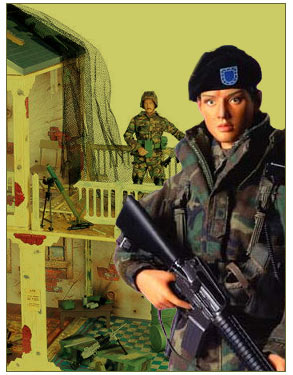
The phenomenon drew considerable media attention last Christmas with the rollout of the Forward Command Post, manufactured for ages 5 and up by Hong Kong-based Ever Sparkle. The Command Post, which appeared from a distance to be a modest single-family dollhouse with butter-yellow exterior, proved, on closer inspection, more ominous. The Oriental rug on the parquet floor in the living room was complemented not by sofa and coffee table, but by a machine-gun nest lined with sandbags; windows were blown out and the walls were scarred with bullet holes and scorch marks. A camouflaged soldier carrying an assault rifle stood watch on the back porch.

The Forward Command Post was greeted by an outraged public as the Barbie Dream House from hell and the nadir of post-9/11 war toys. Toy industry watchdogs denounced the item while customers expressed their disgust in a letter-writing campaign to retailer J.C. Penney. “Does this toy represent the values American parents want to instill in our young people?” asked Carrie Lybecker of Olympia, Wash., in a letter sent to company executives that was posted on the Olympia Movement for Justice and Peace Web site. “I do not want to contribute revenue to a company that profits from promoting these values.” Editorials in newspapers across the country, and coverage from major outlets ranging from the New York Times to the Washington Post to ABC News soon brought additional pressure on retailers. By mid-December J.C. Penney acquiesced and quietly pulled the Forward Command Post from its shelves and Web site and KB Toys chose not to restock the item. But the war toys phenomenon soldiered on, largely undaunted.

“The problem with toys like the Forward Command Post is that the context of play is in violence,” says Mike Brody, a child psychiatrist and the media-committee chair of the American Academy of Child and Adolescent Psychiatry. “This toy states to me: War is the only way.”

The question that child experts like Brody are asking is whether there is anything useful in such war-specific toys as Hasbro’s Israeli Defense Force Soldier (ages 5 and up), or Amy, U.S. National Guard — Homeland Security, a Dragon Models action figure equipped with flashlight and assault rifle.

Then there are the products that appear to have abandoned any pretense of play and moved directly into the realm of political cheerleading. The Topps Co., best known for its trading cards of sports heroes and entertainment figures, rolled out a hot-selling line of Enduring Freedom Picture Cards shortly after Sept. 11. The series featured “American heroes” President George W. Bush, former New York City Mayor Rudy Giuliani, and Attorney General John Ashcroft, among others, and had a clear message for its young audience: “Kids need to understand that the President (and his team) will keep them safe and that evil-doers will be punished,” the Topps Web site boasted. “Our cards deliver the details in a medium with which they are familiar and comfortable.”

Though war-play themes are common among children and can help them act out complex emotions, says Diane Levin, an early childhood specialist and professor of education at Wheelock College in Boston, “Kids need to create their own play that’s not controlled by highly realistic toys and scripts generated by adults.”

In the weeks following the Sept. 11 attacks, Levin, the author of two books on children’s fascination with war play, gathered hundreds of anecdotes of how children dealt with the event: “Lots of kids built towers and knocked them down with airplanes. But over time their play evolved and became more positive, losing the focus on the destruction. Some kids made a hospital; others rebuilt the buildings to be stronger so they wouldn’t fall. Some became victims themselves. Some said they wanted to build a safe New York City, so they surrounded their city with walls. Essentially, they were transforming the world into a better place.”

Child psychiatrists have long debated whether violent toys — be they guns, baby bazookas, or armed-to-the-teeth military action figures — incite violence among children, or if instead they are cathartic, allowing children to vent their aggression safely.

Addressing the catharsis question in a seminal 1992 study — the only one of its kind — Drs. Malcolm Watson and Ying Peng observed a preschool daycare center where half the children had toy guns at home, and half did not. “What we found was, the more kids played with toy guns, the more aggression they showed,” says Watson, a psychology professor at Brandeis University. The study, published in the journal Early Education and Development, was unable to quantify the degree to which external factors like parental abuse contributed to the aggressive children’s behavior. “In play, kids reflect their feelings and also play out roles they’ve seen their parents play,” Watson says. “Can I say for sure that playing with toy guns causes aggression? No, but the two are definitely associated.”

What the study’s findings clearly did show was that playing with toy guns did not in any case diminish aggression in children. “I think it tends to keep it on their mind rather than having a cathartic effect,” Watson says. “All kids are going to be aggressive at times, but I don’t think as adults we have to push them in that direction.”

The toy industry, understandably, has been less than eager to emphasize a link between individual toys and children’s violent behavior. “Based on the research that we’ve seen, it’s not the toy that creates violence, it’s about the child’s environment,” says Terry Bartlett, executive director of the Toy Industry Foundation. The foundation is the philanthropic arm of the Toy Industry Association, which represents hundreds of toy manufacturers and runs the annual International Toy Fair in New York.

“If you have a pirate ship or toy soldiers and you’re playing violent games, you know it’s make-believe. You can take two sticks and pretend they’re soldiers and bomb each other. The parent has to emphasize the distinction between reality and fantasy,” says Dorothy Singer, who with her husband Jerome heads the Yale University Family Television Research and Consultation Center.

Singer, an oft-quoted expert on the subject of the impact of mass media on children, recently completed a series of studies where she schooled parents around New Haven’s inner city in the art of play. “Parents are so busy that they’re buying the toys, handing the toy off to the child, and saying, ‘Go play.’ You need a parent to guide the play,” she says.

The problem, consumer watchdog groups argue, is that war-related toys are increasingly branded to actual wars playing out on television, adding a complicated political dimension to play and making it that much harder for children, younger ones especially, to distinguish between the real and pretend among killing fields.

“We’re lying to ourselves as parents and adults if we expect children, who believe in magical things, will also be rational,” says Daphne White, executive director of the Lion and Lamb Project, a group dedicated to curtailing the marketing of violence to children. Lion and Lamb puts out an annual Dirty Dozen list of toys to avoid, and the Forward Command Post topped last year’s round-up. “We can tell our children this is just play, but they don’t realize it’s just play,” says White.

- – - – - – - – - – - -

The toy industry is engaged in a delicate dance, one that involves putting the onus on parents as the arbiters of their children’s playthings, while at the same time bowing to the bottom line and indiscriminately and aggressively marketing their wares to parents too.

Clearly, the industry is doing something right. Sales of traditional (that is, non-video) toys reached more than $20 billion in 2002, and since Sept. 11, action figures have been among the brightest stars in the playland firmament. With sales of $1.26 billion in 2002, up 21 percent over 2001, they have made up one of the fastest growing segments in the toy industry. While traditional favorites like Barbie have stagnated, with sales falling 12 percent in 2001 and another 2 percent in 2002, G.I. Joe, whose manufacturer Hasbro is the second-largest U.S. toy retailer, posted a 46 percent sales increase last year, capping off a four-year run of double-digit growth. “A whole new generation has discovered G.I. Joe,” boasts Audrey DeSimone, Hasbro’s director of communications.

Assisting toy retailers in capturing the attention of this generation, one that is growing up in the theater of an indefinite war on terror, is the rapidly expanding children’s marketing industry. Expenditures for marketing to children have skyrocketed in the past decade, rising from $6.2 billion in 1992 to $12 billion in 1999, giving rise to a subgenre of hardcover marketing primers like “BRANDchild” and “Creating Ever-Cool: A Marketer’s Guide to a Kid’s Heart,” and propelling toy marketers to distill their strategies into a fine demographic science. The Toy Industry Association’s official 2001-2002 Factbook observes, “As the divorce rate grows  more children are members of two or more families. Therefore there are more family members to purchase playthings for children and an increase in the amount of money spent on toys.”

In an industry where marital strife is treated as a marketing opportunity, it’s hardly surprising that manufacturers like Hasbro, whose product is heavily war and military themed, have not pulled any punches in their sales pitches since Sept. 11. “G.I. Joe, obviously, is riding a crest of, you know, American patriotism, and we’ve tried to open on every front possible there,” Hasbro CEO Alan Hassenfeld told toy industry analysts in an early 2002 earnings conference call.

When it comes to war-related action figures and accessories, particularly those — like the “USA Freedom Force M-1 Tank,” manufactured by Toy State Industrial and carried by Toys ‘R’ Us — that are tailor-branded to real-life combat scenarios, the toy industry defends itself by saying they’re meant for a collector audience of adults. “The items are more detailed, more expensive, and companies spend a lot of time researching them,” explains Shannon Eif, spokeswoman for the Toy Industry Association. Still, Eif acknowledges, “that’s not saying kids won’t play with them.”

But while manufacturers argue they’re catering to a clientele of mature collectors, retailers are sending a deceptively mixed message. The figurines ostensibly aimed at this adult audience pop up regularly on toy store shelves and Web sites, shoulder to shoulder with items clearly meant for younger children. At the Toys ‘R’ Us store in Brooklyn, a machine-gun-toting U.S. Army Afghanistan figure (for ages 5 and up) was sandwiched between action figures from “The Simpsons” and “Star Wars.” In the same aisle was one last package of the much-maligned Forward Command Post, which Toys ‘R’ Us has discontinued.

Even the “recommended age” labels on toys can be misleading. Consumers are often unaware the designation is an industry safety rating, not an indication of age appropriateness. That a toy may be deemed physically safe for ages 5 and up bears no reflection on its emotional content.

“We sell a lot of military action figures near military bases, and parents look for specific military figures or vehicles. It helps the child understand what mom or dad is doing for the country,” says KB Toys spokesman John Reilly. “I don’t think it’s really our job to say you don’t want to buy that, that’s just for collectors. We really don’t want to be categorizing the items in the store. We’re in the business of selling the items.”

Nor surprisingly, Terry Bartlett of Toy Industry Foundation, agrees: “There are 125,000 types of toys out on the marketplace. If a consumer doesn’t like a particular type of toy, they shouldn’t buy it. The consumer has the ultimate power in determining and driving the success of that toy. I think the reason we’re fighting in the Middle East or wherever is to defend choice, in this case, consumer choice. Consumers have the ultimate power.”

Taken individually, perhaps the new war toys really are just another “consumer choice,” an easy marketing cash cow for retailers riding the coattails of foreign intervention, a trend filtered in among more innocuously war-themed toys like Hasbro’s G.I. Joe Search and Rescue Firefighter, or Fisher Price’s Rescue Heroes Jake Justice and Billy Blazes, that too have surged in popularity since the Sept. 11 attacks. But consider action figures like the 26th Marine Expeditionary Unit G.I. Joe. Modeled on one of the first U.S. units to enter Afghanistan after 9/11, the Hasbro doll “searches caves that pockmark hills to flush out hidden enemy fighters” and is “a certain force in an uncertain war,” a motto ripped straight from the 26th MEU’s Web site. Or you might have seen the guerrilla Easter baskets stocked by local Kmart and Walgreen’s stores earlier this year. Nestled among the jellybeans and chocolate bunnies were toy soldiers bearing machine guns, knives and grenades. Taken together, do these new war toys go beyond play and into the nefarious realm of selling war to children?

Though, the manufacturer discontinued the Forward Command Post in the wake of last year’s Christmastime controversy, the knockoffs have already arrived. KB Toys’ latest offering: a two-story copycat called Power Team Elite: Battle Command Post, which comes with gun rack, assault rifles and shotguns. “A great play environment,” says the company’s Web site, and a steal at only $59.99.

And next week, KB Toys will roll out an even hotter item, the George W. Bush Elite Force Aviator, a 1:6 scale replica of the president during his patriotism-soaked landing aboard the USS Abraham Lincoln earlier this year. Retailing for $39.99, the Bush doll has set record advance sales for collectible action figures on the KB Toys Web site and is back-ordered in stores until December.

KB Toys, which developed the Bush doll in conjunction with Blue Box is promoting the figure as a collectible item for “adults who believe in the president and in showing their support for the commander in chief,” says Reilly.

The company denied any political message was behind the doll.

“We don’t condone or endorse the president, but he fit the criteria of our Elite Force collection,” KB Toys spokeswoman Lauri Aibel told the Washington Post in August. “It would have to be somebody in uniform, a military hero of some kind.”

- – - – - – - – - –

Additional reporting for this piece was provided by Christopher Ketcham.

Continue Reading Close