Rachel Shabi

West Bank beer fest

A Christian-Palestinian microbrewery is defying the hardships of occupation -- and perhaps Hamas' vision for an alcohol-free Islamic state.

  • more
    • All Share Services

West Bank beer fest

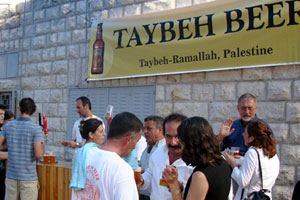
High up in the hills of the West Bank in mid-September, thousands of visitors arrived for a two-day village fair filled with music, folk dancing and local goods, from honey and oils to embroidery and olive-wood carvings. But the star attraction this year was a more surprising local offering: a German-style beer brewed here that bears the name of this small Palestinian village.

Located about 20 miles northeast of Jerusalem, Taybeh is a Christian enclave dotted with churches rather than mosques, but entirely surrounded by Muslim villages. The village festival is billed as an “Oktoberfest,” after the annual beer-lovers bash in Munich — although it takes place in September so as to avoid clashing with the Muslim festival of Ramadan.

Taybeh the beer is crisp, clean and very drinkable. It comes in light and dark versions, with a label that proudly reads “The Finest in the Middle East.” Its makers seem to have tapped an unlikely region for venturing into the beer business.

“Everybody thought I was nuts to build a brewery in a Muslim region,” said Nadim Khoury, the company’s master brewer, regarding the glaringly obvious problem that the Quran forbids the consumption of alcohol.

Yet Palestinian Christians, who make up just under 2 percent of the total population of the Occupied Territories, aren’t the only ones drinking Taybeh beer. “We produce 600,000 liters a year,” said Khoury. “Of that, 30 percent sells to Israel and the remaining 70 percent within Palestine.” Sales of Taybeh, he added, account for only 15 to 20 percent of total beer sales in the West Bank.

“I don’t want to say exactly that the Muslims enjoy the beer more than the Christians — but they do,” said Sayib Nasser, a member of the Fatah Party and deputy governor of the local council in nearby Ramallah. Nasser, who is a Muslim, took part in the festival’s opening ceremony. “The festival has our support and our blessing,” he said. “We are proud of it.”

Such sentiments might seem at odds with those of the Hamas Party, which is now predominant in Palestinian politics. Since victory in last January’s elections, Hamas officials have spoken of bringing Palestinian society into line with Islamic law, including ridding the nation of alcohol. Some officials have suggested the party would lead by example rather than by coercion. “With regard to Sharia, we can’t impose that because we don’t have a state,” said Mahmoud Ramahi, according to the London Times. The West Bank spokesman for Hamas, speaking shortly after the election victory, also said the party would not force women to cover themselves, or close restaurants that serve alcohol. “First let us liberate our land,” he said, “then we’ll hold a referendum to see if the people want an Islamic or secular state.”

With the ascendancy of Hamas, Gaza is now reportedly dry, and the West Bank could be next. For its part, the Taybeh Brewing Co. has an intriguing strategy to deal with the changing political landscape. According to Khoury, the company has plans to introduce a non-alcoholic version of its beer — including a Hamas-green label on the bottle.

But it also plans to keep producing the brews that have been successful to date. The first batch of Taybeh, which means “delicious” in Arabic, was brewed during the optimistic times of the Oslo peace process. Members of the Khoury family, who had migrated to the United States, returned to Taybeh in 1994, after spending the prior 20 years in Boston. They opened the brewery with the blessing of then Palestinian President Yasser Arafat, whose picture still adorns the buildings of the Fatah-run council in Taybeh. To ensure sales in Israel, the Khourys obtained a kosher certificate for the beer from the rabbi at the neighbouring Jewish settlement of Ofra (with which relations cannot otherwise be described as very good).

Nadim and his brother David — who is also currently the mayor of Taybeh village — put their life savings into the project, and it soon paid off. By 2000, just before the outbreak of the second Palestinian intifada against Israel, their brewery was reportedly producing 4,000 bottles of beer per hour.

Nadim Khoury declined to discuss certain details of the business, including revenue and profitability. But he suggested that the continued production of the beer, under the difficult circumstances of occupation and regional upheaval, are proof enough of its success.

These days, the logistics of brewing and selling a beer in the West Bank can be daunting. “We face a lot of difficulties getting the raw material from abroad because of the road closures, the checkpoints and the wall,” said Khoury. “I have a shipment tomorrow, and the truck that will take it to Haifa port will cost an arm and a leg because the driver will spend the whole day at checkpoints.”

The Khourys’ quest to “educate people’s taste buds” and get them buying a better class of beer seems to be working in spite of the formidable obstacles. “Every time one of our trucks passes a checkpoint, the Israeli soldiers want a beer,” Khoury said. Still, the flow into Israel has slowed, he said. Prior to the second intifada, two-thirds of Taybeh sales were in Israel; now the beer is available only selectively in bars of major Israeli cities and in Arab parts of Nazareth and the Galilee.

The beer is also brewed under license in Germany and Belgium, shipping from there to the U.K., home to a large Palestinian population. Khoury said the company also hopes to distribute the beer in select places in the United States starting sometime in 2007.

But a primary goal is to continue building a local market. The Khourys hope to steer Palestinian consumers away from popular Israeli brands such as Maccabee — not just because they think their all natural, German-standard beer tastes better, but to grow support for local products and the local economy. “We want Palestinians to have pride in their national product,” Khoury said.

Unemployment in Taybeh runs at approximately 50 percent, and its size has dwindled. The village currently has a population of about 1,300, after an estimated 9,000 of its residents picked up and moved overseas in recent years. “We feel so alone here, a minority, so it is so nice for us to see so many Christians here together,” said Majd Laisoon, a 23-year-old from Taybeh who attended the festival. The Khourys estimated the number of visitors during the festival to be around 8,000, the majority of them coming from other Palestinian Christian enclaves such as Bethlehem, and parts of Ramallah and Jerusalem.

The show of support had particular resonance on a weekend that was marred by attacks on churches in the West Bank, after the pope’s comments on Islam fueled anger across the region. “It was an intense weekend,” said Dr. Maria Khoury, another family member. “We were very worried that something might happen here, and very grateful that it was peaceful.”

David Khoury, the village mayor, emphasized unity. “We are Christians,” he said, “but we are Palestinians first.”

Legend has it that Jesus Christ was one of Taybeh village’s early visitors, and it is home to a Byzantine-period Greek Orthodox Church. In other circumstances it might well be bustling with Christian tourists. “Jesus made Taybeh village famous in history, and now the beer is making it famous,” said Nadim Khoury. “We don’t have a country yet,” he added, “but we have our own beer.”

Up against the wall

Israel continues building a mammoth barrier in the name of border security. Opponents charge that it's carving more land for Jewish settlements -- and assaulting Palestinians' human rights.

  • more
    • All Share Services

Up against the wall

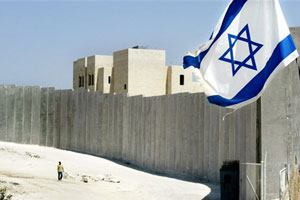
“We haven’t seen our land since January last year,” says Abdul Ra’uf Khalid, sitting in his home in the Palestinian village of Jayyus. The Khalid family’s 5.5 acres lie on the Israeli side of the separation barrier, which in Jayyus consists of a tall electric fence winding its way across the hilly, rural terrain. The Khalids have greenhouses, and olive, citrus and fruit trees, on the land but aren’t allowed to cross the divide to tend them. “The apricots and peaches are falling from the trees and rotting,” says Abdul’s wife, Itaf. Stuck here, restless and unable to work, the Khalids appear to be deteriorating in similar fashion.

Along much of the West Bank’s border with Israel a similar story is unfolding. It is a story of land, livelihood and a way of life lost to Israel’s rising barrier, known as the “security” or “separation fence” by its supporters and the “apartheid wall” by its opponents. In June 2002, the Israeli government approved the building of the first stage of a physical barrier separating the Jewish state from the West Bank. In July 2004, the International Courts of Justice deemed the wall illegal and called for its removal. Now, the wall — built from various combinations of concrete, razor wire and electric fencing — is 51 percent complete, and construction of the rest continues apace.

Israel says the barrier has succeeded in preventing terror attacks, the stated aim for its construction. But opponents charge that Israel is using it to steal land and develop desirable real estate for its own citizens. They also charge that the barrier is depriving whole groups of Palestinians of their human rights — including the freedom of movement and goods, access to work, educational and social opportunities, and other basics of daily life stopped cold by the concrete and wire and heavily fortified checkpoints. Yet, despite international censure and defiant protests on the ground, analysts agree that the barrier will almost certainly be built to completion.

According to the most recently approved plans, when the barrier is finished it will cover 436 miles of ground, even though the Green Line, the internationally agreed armistice border between Israel and the Palestinian territories, is less than half that length. This is because the barrier is quite often circuitous when, topographically speaking, it could run straight. Only 20 percent of the barrier’s path actually runs on the Green Line, while the rest juts east into occupied territory, in some locations as much as 13 miles.

Indeed, critics say that the plan for the barrier is to encircle Israeli settlements on the Palestinian side of the Green Line with a clear purpose. “We say it again and again,” said Ronen Shimoni at Betzelem, the Israeli human rights group. “The route of the fence is not for security but to gain more and more land.”

Around the city of Bethlehem, the approved barrier route cuts a large block of land off the West Bank to encompass Gush Etzion, a sprawling block of Jewish settlements with a population of more than 20,000. A 26-foot-high concrete wall has already been built around Palestinian East Jerusalem, securing the sprawling Ma’ale Adummim settlement. (While Israel speaks of Jerusalem as its “eternal and undivided capital,” East Jerusalem is internationally recognized as occupied territory, even by the U.S.) Farther north, the proposed barrier path takes two wide “fingers” of Palestinian land to gather in the settlements of Ariel, Barqan, Immanuel, Shomeron and Qedumim. Still farther north, a completed section carves loops of concrete into the West Bank, encircling the settlements of Alfe Menashe and Zufin. These loops have left the Palestinian village of Qalqilya surrounded by the barrier on three sides, with only a narrow exit to the east.

Lawyers currently involved in court cases challenging the barrier have discovered that its route also accommodates settlement expansion plans. “This is no longer a secret. It was proved in court in several instances,” said solicitor Michael Sfard, a Tel Aviv-based human rights lawyer. The Israeli Association for Civil Rights cites cases involving the settlements of Zufin (which borders Jayyus) and Sal’it. In some lawsuits, companies have already bought the rights to build on the land allocated for expansion; in such cases, lawyers say, these companies are a presence in court and weight is given to their appeals.

In a written statement, Israel’s Ministry of Defense said the following: “The Security Fence is not a land grab mechanism. It does not annex lands. Lands seized for the construction remain the property of their owners, who are offered compensation for use of lands and loss of crops (in cases where the lands were agricultural lands). The opinion of the Supreme Court repeated over and over in all its rulings is that the Fence is a security measure.” The Ministry of Defense added that the purpose of building it is “to counter terrorism of the most brutal kind, not to dictate a border that is and remains the subject of permanent negotiations. It is our hope that by building this fence its very function will become irrelevant and that one day it will be dismantled.”

But for the Palestinians whose lives the barrier cuts through, there is only one conclusion. “The aim of the wall is to force us to leave,” said Nidal Amer, mayor of Mas’ha, a village of 2,000 in the Qalqilya district of the West Bank. Eighty percent of Mas’ha’s land, 1,250 acres of agricultural land, is now on the Israeli side of the barrier. Before it went up, Mas’ha’s markets selling furniture, tiles and flowers were famous across the West Bank — and across the Green Line, too. “From Kiryat Shmona in the north [of Israel] to Beersheba in the south, Israelis would come to the market,” said Amer. “You couldn’t move for people.” In the past, he adds, there were good relations among the residents of the village and their Jewish neighbors. “It was quite common to find Israelis at wedding parties in the village,” he said. Today, the village is eerily quiet. Shops and workshops are shuttered, while empty restaurants bearing Hebrew signage wait in vain for customers.

It’s a similar story in Jayyus, where 72 percent of the village’s land currently lies on the wrong side of the barrier. A village of about 3,500, Jayyus is dependent on agriculture. Here, as in other rural areas, there are access gates along the barrier to allow Palestinian farmers through to their land on the other side. Unlike most other areas, the farmers gate at Jayyus is, according to observers, open all day. One of the soldiers guarding it when I visited described it as a “humanitarian gate.” He added: “It’s our job to help the civilians here.”

But to pass through the gate, farmers need a permit, and they face daunting regulations. Each farmer has to prove the land belongs to him personally, and not his father or grandfather — and with Israeli-approved documentation. More often than not, it is an impossible task. And where permits are allocated, it is usually on the basis of one per household, for land that requires several hands to work it. In many cases, the permit allocation process comes across as bizarre or just plain bungled. “At first, they gave 3-month-old babies, old grandmothers and dead people permits,” said Showqat Samha, the mayor of Jayyus. And there’s a legal factor that adds another dimension: If not cultivated for three years, land that is not registered as privately owned — as is the case in much of the West Bank — can be declared property of the Israeli state.

Then there are places like al-Mawahel, a village south of Ramallah and a five-minute drive north of Jerusalem. Most of its 1,200 Arab inhabitants have Israeli I.D. cards or passports. They came to the area in the 1970s from cities like Nazareth and Haifa in Israel, looking for a “quiet, clean place to live,” says Ali Shatera, a village resident. Shatera points to the concrete and fence barrier around the edge of his village, surrounding it on three sides. Only 42 of al-Mawahel’s residents have Palestinian citizenship — but now the logic of the barrier deems the entire population to be Palestinian. Al-Mawahel is one of the villages trapped in what the United Nations Office for the Coordination of Humanitarian Affairs describes as the “Bir Nabala enclave.” Most of the 15,000 Palestinian inhabitants of the enclave have long-standing ties to Jerusalem — work, family, and health and social facilities — but now they are closed off from the city and connected only to Ramallah.

Farther south, in Bethlehem, the barrier carves another strange path. Here, a concrete wall surrounds the north side, and entry to the city is through a formidable “international border crossing” center. International passport holders are fast-tracked through the center, while Palestinians have to wait. Critics say the real purpose of the barrier’s route here — which cuts a concrete corridor into the city instead of running along the city’s perphery — is to bring Rachel’s Tomb into Israeli territory and to make room for Jewish settlers wanting to move close to the tomb, considered the resting place of the biblical matriarch.

“No security expert would advise you to build a security wall like this,” said Leila Sansour, director of Open Bethlehem, an international campaign to save the city. The road on which the barrier now sits, she added, “used to be vibrant, rich, a busy main road filled with shops and restaurants. This was the historical route from Jerusalem to Bethlehem, the path of the patriarch.” Sansour, a Christian Palestinian, grew up in Bethlehem and is now watching the place she loves being strangled by the wall. “You realize that you are totally being put into a prison,” she said. “Instead of taking us to prison, Israel is building one around us.”

Bethlehem is testimony to the decline caused by the barrier in urban as well as rural parts of the occupied territories. The birthplace of Christianity, Bethlehem has always relied on tourism as a primary source of income. Now, tourism is in grave decline. The tourists who do visit come on Israeli-organized trips. They go straight to the Nativity Church in Bethlehem’s Old City and straight back out again — not even stopping for a coffee or to pick up a souvenir. “They see the wall and must have been told that it is for security, that ‘we’ are dangerous and shouldn’t be spoken to,” said Sansour. In a city where Christianity was the dominant religion, only 30 percent of this community now remains in Bethlehem, according to Sansour — anyone who can leave has done so. “Bethlehem is a living document of Christianity. A lot of rituals and practices here mimic biblical traditions that have been the same for 2,000 years,” she said. “But Christianity here is going to die.”

As we drove around the Bethlehem district in late July, we passed Cremizan, a serene forest winery and monastery — the only remaining green recreational space for the city’s residents. Three weeks before, according to Sansour, the Israeli army had come and chopped down trees along a strip of land nearby — usually a sign, she said, that the barrier is coming. Bethlehem’s residents fear that Cremizan, along with the historic and proudly maintained agricultural terraces alongside it will end up on the Israeli side of the barrier, for the nearby Israeli settlement of Gilo to enjoy.

Israeli analysts speak of a property boom reported in the Israeli press, to be found on the land just west of the barrier — land freshly annexed by Israel. “It’s a blurring of the Green Line,” said Gadi Algazi, a history professor at Tel Aviv University. Algazi says that such areas, having been made “secure” by the barrier, now appeal to Israelis seeking rural isolation close to the main cities. Har Adar is one example, he says — a settlement afforded stunning views by its location in the hills surrounding Jerusalem. Founded in the mid-’80s, this settlement is currently expanding rapidly, especially along its northern and eastern sides, where row upon row of new houses sit awaiting occupants, and teams of workers are busy building more.

This part of Har Adar borders the Palestinian villages of Biddu and Beit Surik; people from both villages say their land is currently being used to expand Har Adar, having been cut off by the barrier. Now that the barrier is up, the value of Har Adar property has risen by 15-20 percent, according to the Israeli newspaper Haaretz. According to Algazi, this settlement expansion represents a middle-class quest for quiet, gated communities, new houses with tidy lawns and great views. “These are upper-class settlers, without orange flags,” he said, referring to the trademark banner of the ideological settlers’ movement. He noted an additional irony: The barrier was built to keep the nearby Palestinians out for security reasons, but now that the barrier is up, the villagers are allowed back in — as laborers on the many construction sites.

According to Dror Etkes, who monitors the settlements for the Israeli group Peace Now, the majority of Israelis “see the barrier as an effective tool in preventing suicide attacks and are mostly not aware of the fact that it takes Palestinian land.” Most Israelis, he added, don’t know where Ariel and Kedumim, settlements deep in the West Bank, are in relation to the Green Line. These settlements draw the path of the barrier as far as 12 miles east of the line.

“It’s a hazy thing,” said Algazi. “Israelis may know that Palestinians are losing land here and there. But the political project, for most Israelis, is not being perceived.” Israeli public opinion has in principle turned against the hardcore ideological settlements in the heart of the West Bank, but in the aftermath of the Lebanon war, there has been little talk of pulling out of them. Indeed, the experience of both Gaza and Lebanon, in many Israelis’ eyes, is proof that disengagement and a retreat to internationally recognized borders do not bring peace to the Jewish state.

In villages that have been in the barrier’s path thus far, such as Mas’ha, Jayyus, Biddu, Abud and Bil’in, joint Israeli-Palestinian demonstrations opposing it typically have been met with tear gas, rubber bullets and declarations of a closed military zone by the Israeli army. People in Bil’in, staging weekly protests against the wall, have faced the gas and bullets for 20 months now, with many Palestinian but also Israeli demonstrators suffering a horrifying catalog of injuries. The Bil’in campaign helped push legal challenges to the barrier into court, and has become a symbol of joint Israeli-Palestinian struggle. Around half of Bil’in’s land has been engulfed by the barrier, and a new Jewish settlement, Matityahu East, has already been built on some of it, with heavy investment by Africa-Israel, one of Israel’s biggest construction firms.

But despite the protests and legal challenges — which may succeed in altering the path of the barrier here and there — few people doubt that the barrier will be completed. That the physical barrier has been an effective security measure is a powerful argument, although some opponents hold that it is impossible to say for sure, since there had been a cease-fire in place for much of the 18 months concurrent to the barrier’s construction.

“This is a massive project,” said Algazi. “The wall can be seen by satellite. It is not simply an object but a whole social system. It leaves the Palestinians with a feeling of total impotence and dependence. And the worst aspect is that it is not considered an act of violence.” There is an inert violence to the wall itself — the military signs all along it warning of “mortal danger,” and the fact that anyone who approaches it “endangers his life.” Army units, alerted by electric fences and surveillance cameras, are mobilized within minutes of anyone nearing the barrier, a broad, perpetual operation. The barrier therefore also stands as a heavy burden for Israel, Algazi noted. “The moment you construct a line of this sort it becomes an enormous liability. The Israeli army has to defend every single meter of it.”

Continue Reading Close

Come, see Palestine!

Upstart tours of Palestine are challenging fully paid "See Israel" holidays in a battle for the hearts and minds of young American Jews.

  • more
    • All Share Services

Come, see Palestine!

The fight is on for the hearts of young Jewish Americans. The battlefield is Israel and Palestine. It’s a hopelessly unequal battle — one side has considerably more clout and cash and, currently, appeal. But this struggle hits the core of what it means to be an American Jew in a modern political context.

This summer, record numbers of young Jewish Americans will travel to Israel — despite concern over security. Most of them will arrive courtesy of pro-Israel organizations that seek to reconnect Diaspora Jews to Judaism and Israel. They will be on a free tour of the Jewish state, presented to them as a gift, their “birthright.”

But others will travel with Palestine solidarity campaigners who hold that being both American and Jewish (as are nearly 6 million U.S. citizens) brings with it a responsibility to at the very least understand the Palestinian position. They’ll visit the West Bank and witness firsthand the effects of the occupation in Palestine. These latter tours are still in infancy but word about them is rapidly spreading through American campuses and Jewish networks. So, two camps with diametrically opposed intentions are targeting exactly the same audience of young American Jewry. And the cutting-edge cool tool on both sides of the terrain is a holiday. Well, of sorts.

The context is about six years old. Having identified Diaspora Jews as being hopelessly lapsed and in danger of intermarrying into extinction, two New Yorkers, Michael Steinhardt and Charles Bronfman, founded Taglit-birthright israel. Billionaire Bronfman inherited the Canadian Seagram’s liquor empire while Steinhardt made a small fortune as a Wall Street wizard. The latter, a self-proclaimed atheist, is nonetheless worried that Judaism is in danger of becoming obsolete. Both feature high up on a list of Israel’s most generous philanthropists.

“The vision is to ensure the continued existence of the Jewish people because of the very high rate of assimilation,” says Gidi Mark, Taglit’s director of marketing. He admits that what might appear to be a severe stance against multiculturalism is a “bold and ambitious plan.” But he believes it has “changed dramatically the attitude of Jewish young adults to Israel.” Taglit offers Diaspora Jews between the ages of 18 and 26 a free, 10-day tour of Israel, their “birthright” or “homeland” country, courtesy of the Israeli government, United Jewish Communities and private philanthropists. Since 2000, Taglit has taken 100,000 young Jews, 75 percent of whom are North American, to Israel. That’s an impressive figure, although one Israeli academic has noted that young American Jews might equally be interested in a free trip to the Bahamas.

But the Taglit organization is indeed a success story. Prior to it, around 1,500 Jews of the same cohort would come to the country each year. Now around 22,000 visit Israel annually on Taglit trips; places fill up rapidly and waiting lists are at bursting point. And these trips achieve what they set out to do. They are, says Mark, “the most effective Jewish educational project in the world.” That’s measured by polls that question former birthrighters on their feelings of connection to the Israeli state; those strong feelings don’t diminish even six years after Taglit trips.

Birthright trips to Israel are many-flavored — there are trek-focused, religious, secular or graduate and professional varieties. It’s a packed schedule, socializing is a key component and sleep-deprivation is a given. Traveling in groups of 40 in security-escorted buses, birthrighters might take in the Dead Sea, Tel Aviv nightlife, a trip to Masada or a kibbutz visit. But the essentials are the same. All trips in some way cover modern Israel, Zionism and the Holocaust; all have Israeli escorts. And absolutely non-negotiable is a visit to the Wailing Wall in Jerusalem — the remains of the second Jewish temple and therefore the holy of holies for Judaism.

Posters to the Taglit Web site enthuse about the birthright trip as a life-changing experience that showed them the “gift of being Jewish” and led them to conclude, as one trip alumini writes, “Wherever I stand, I stand with Israel.” They speak of the emotional charge and the effects on young Americans just beginning to define their own identity; for many, it is their first trip abroad.

But some former birthrighters say that there’s no such thing as a free holiday. They question whether Taglit may be pushing them a little too hard to have a profound experience, particularly at the Wailing Wall. “Our tour leader got everyone to close their eyes and put their hands on the shoulders of the person in front of them,” says one tripper. “He walked us all in a line to a spot where we could get a high-up view of the wall. Then he said something like, ‘Your ancestors were praying towards this wall for generations.’ And you open your eyes and there it is … and there are tears streaming down everyone’s faces.”

One 25-year-old graduate student from Chicago describes the last day of the trip, on a Tel Aviv beach. “It’s a really hot day and one guy from our trip runs into the water, and the sea’s beautiful, at a perfect temperature for swimming and he says, ‘OK, OK, I’m a Zionist!’ It’s facetiously said, but also ironic because that’s exactly what [tour leaders] want.” This graduate is still with the young Jewish woman he met while on the trip last summer. The matchmaking element is a key component of birthright trips, say past participants. After all, the idea is to stem the assimilation tendencies of Diaspora Jews.

What worries critics, however, is not the “I love being Jewish” outcome of a trip to Israel but the underpinning political goals of Taglit. Susan, a 27-year-old Seattle student, took the Taglit tour last year. She was struck, she says, by “the levels of Zionism” and the prevalence of anti-Palestinian comments during her trip, organized through the University of Washington (campuses often coordinate birthright trips). She didn’t like the tour leader expressing his view as universal truth while leaving out facts that supported the Palestinian side.

The Taglit tour might encourage tears at the Wailing Wall, but the 8-meter-high, concrete separation wall snaking through the West Bank is rarely mentioned. When it is, says Susan, the context is dismissive. “At one point I saw what looked like the [separation] wall in the distance and asked our guide about it,” she says. “The guide gave a very terse response about how, yes, that was the wall and, see everyone, the Palestinians are trying to drive ‘us’ from ‘our land’ and so we must keep ‘them’ out.” Taglit trips do not go beyond the Green Line marking the internationally recognized border between Israel and Palestine. According to one former birthrighter, the Green Line was not even marked on the map he was given on the tour.

The Taglit trip, one former participant says, does a good job of “tugging at one’s Jewish heartstrings,” and then seeks to equate being Jewish with the need for Israel to “protect us and all the Jews.” According to Susan, her attempts to redress the pro-Israel slant were not welcome. Group discussions were zealously facilitated and stuck to a narrow script that excluded any conversations about how participants felt about Israeli policy.

Aaron took the trip in December 2004 when he was 22; he’s now back in Canada where he lives and works in community radio. He believes Taglit aims to encourage pro-Israel activism overseas. His trip leaders, he says, “kept emphasizing how much we could do to help on campus at universities.” He adds: “This point was driven a lot: that Israel is suffering from constant insecurity and a state of war against them, and the way we can prevent that is to try and promote Israel’s good image back home.”

Taglit bats off any accusations of having a political agenda. “I don’t think it’s political for Jews to support Israel,” says Mark. “It should be an integral part of every Jew’s identity.” Mark draws a distinction between supporting Israel and supporting Israel’s policies. He adds that Taglit trips incorporate organizers and speakers from a variety of backgrounds and viewpoints. As to why Taglit trips don’t go to the West Bank, he first cites the security issue and then says, “We feel that people first of all should feel strong about their own identity and then know about other ethnic groups.”

For those who want a different experience of the region, there’s now an altogether different sort of trip on offer. Last year, around 30 young Jewish Americans took the first Birthright Unplugged trips to the West Bank. “It changed my world,” says Jessy Tolkan, 26, a political consultant from Washington, D.C., who was on one of the Unplugged trips last year. “Everything I had learned as a Jewish person prior to the trip was turned totally upside down.”

If Taglit trips gloss over the Palestinian experience, Unplugged trips live it. Traveling on Palestinian transport and staying in Palestinian homes, participants experience for themselves the difficulties of life under occupation.

“We are offering an opportunity for Jewish people to be exposed to a narrative and life experience that they would rarely encounter,” says Hanna Mermelstein, an American Jew who co-founded the project with Dunya Alwan, an American-Iraqi of Muslim and Jewish descent. Both are members of the International Women’s Peace Service, which supports the nonviolent Palestinian struggle against the Israeli occupation. An architect by training, Alwan became involved in social justice work prior to the first Gulf War, and by 2002 was engaged in human rights and education work in Palestine. Mermelstein has a degree in international and intercultural studies, women’s studies, and peace studies; she turned her energies to the Israel-Palestine conflict during the second intifada.

The two women met in Palestine in 2003. They both led various international delegations in the West Bank. As a result of those experiences, they identified a need to set up opportunities for Jews who cannot otherwise visit the area or are simply too afraid to. The conflict in Israel and Palestine has many distortions, one of which is the perception that Jews are not welcome in the territories. “We planned the itinerary with Palestinians and asked them, ‘Look, do you want American Jews to come here?’ They said, ‘Yes, these are exactly the people we want to come to our communities.’”

Starting with an orientation meeting in Jerusalem, Unplugged goes to Bethlehem and nearby Deheishe refugee camp, Hebron, Ramallah, the northern region of Salfit, and finally a destroyed Palestinian village on the Israel side of the Green Line. (The trips cost $350 excluding travel to Israel.) “Mostly, it just takes you to places and you see things with your own eyes, things that are self-evident and require no explanation whatsoever,” says one former Unplugged participant. It’s enough, he adds, just to see the effect of the separation wall and countless checkpoints on daily Palestinian life. Many Unplugged participants take the trip directly after a Taglit tour of Israel and recommend doing so. Of course, at this point, with less than 100 participants, the Unplugged Tour’s impact on young Jews is only a footstep compared to the stampede of the established Taglit tour.

To Taglit leaders, the birthright trips have had some unwanted consequences. Some participants have used the trips to either “birthleft” or “desert,” as they put it. Trippers ranging from a handful to hundreds, depending on whom you ask, have crossed the Green Line into the Occupied Territories after the Israel trip, to work with the International Solidarity Movement. This organization defines itself as “a Palestinian organization committed to resisting the Israeli occupation of Palestinian land using non-violent, direct-action methods and principles.” ISM delivers food and medicine to houses under curfew, supporting demonstrations — currently against the separation wall — and documenting violations of human rights. In March 2003, an American activist with ISM was killed by an Israeli bulldozer while trying to protect a home from demolition in the Gaza strip. The Israeli government accuses it of supporting terrorism and often refuses entry to its volunteers.

Jacob Rosenblum, a 22-year-old from Portland, Ore., traveled with Taglit in 2004. “I wasn’t there for the birthright trip,” he says. “It was just my vehicle to get to Israel and Palestine. After the trip, he participated in ISM training and volunteered in Nablus, Tulkarem and Qalqilya. Similarly, says Aaron, the Canadian radio worker, “My plan all along was to spend two months in the West Bank with the ISM.” While in the West Bank, he tried “to do as much independent radio journalism as possible,” while also involved with “general ISM things like accompanying farmers who face settler harassment and delivering bread and medicine to people under curfew.” Lora Gordon, 24, from Chicago, didn’t plan on taking such a course of action after her Taglit trip in 2002. But she ended up spending 10 months working with ISM in the then heavily invaded Gaza strip, engaging in media work, staying with families whose homes were threatened with demolition, and teaching English to high school students.

Taglit is not too thrilled with these developments, mainly because it funds the ISM volunteers’ travel to Israel. “It is taking advantage of the Jewish money that sends people to Israel, exploiting this money to promote an agenda which is not the agenda of the people who funded Taglit,” says Mark. Potential candidates who are discovered to have a “hidden agenda” are not allowed onto the trips.

But “birthlefters” have no qualms over misused money. They say the idea of a blanket Jewish birthright to Israel is fundamentally flawed, given that countless Diaspora Palestinians are accorded no such right. “Billions of dollars are used to give free trips to American kids and if the Israel government funds it then that comes through the U.S., people’s tax dollars,” says Gordon. She sees anti-occupation work as a good use of that money. Others point out that in the P.R. battle between pro-Israelis and pro-Palestinians, the former has huge resources while the latter “has to do bake sales to fund our next event.” Moreover, says Gordon, “If Birthright is going to weed people out according to politics, then it’s not really about Judaism anymore.”

And yet this emerging dynamic, between Birthright and those who seek to counter it or provide alternatives, is precisely about Judaism. It comes up time and again when speaking to birthlefters who say that, prior to visiting the region, they felt unable to find a voice in the Israel-Palestine conflict. Raised on Jewish Sunday school and years of Jewish summer camp, Jessy Tolkan says, “I purposefully stayed away from the Israel-Palestine argument, unable to reconcile myself with being a pro-Israeli Jew and also a left-wing person.” After seeing the situation on the ground in Palestine, she says she felt “sad and angry that I had been lied to by the Jewish community that I was and continue to be proud of.” Until that point, she says, she had been “using a different framework to view the Israel-Palestine conflict that I use to view everything else in the world.”

Many of those who traveled in both regions say they left with a deeper connection to Judaism, challenging one very sacred cow: that a loyal relationship to Israel is fundamentally a part of Jewish identity. Gordon speaks of discovering the “joyful way of being Jewish, that Shabbat can mean dancing on the roof and singing songs and having a wonderful communal meal and then having a day working on your inner self.” Jacob Rosenblum says he returned from Israel and the territories more committed to Judaism and engaged with more moderate Jewish political groups. “I got really into claiming Judaism as my own and finding the religious parts and practice that really speak to me as a political activist,” he says.

Continue Reading Close