The Internet blackouts to protest the pending Stop Online Piracy Act and Protect Intellectual Property Act legislation currently working their way through the U.S. House and Senate have ignited a much-needed discussion of the question of censorship in the United States — though the discussion ought to go much further than it has so far.
One of the most striking things about the debate around SOPA and PIPA, in fact, is that the question of censorship has drawn as much attention as it has partly because it is a byproduct of a battle pitting one set of American corporate interests against another: those who generate “content” against those who maintain the electronic infrastructure in which creative material (copyrighted and otherwise) can be produced, disseminated and accessed. Or, to be slightly more reductive about it, the struggle pits Hollywood (the Motion Picture Association of America, the Directors Guild, American Federation of Musicians, etc.) against Silicon Valley (Google, eBay, Facebook, Yahoo, etc.). It’s little wonder that the Electronic Frontier Foundation went so far as to say that SOPA finally gives Hollywood “a chance to break the Internet,” since that is how the legislative campaign is being pitched.
Ordinarily these kinds of arguments between powerful interests might simply be read by the rest of us with a sense of philosophical detachment — even, perhaps, as compelling evidence of the ongoing contradiction between what Marx once distinguished as the means and the relations of production, or in other words the gap that sometimes opens up between sheer technological capabilities and the social systems in which they are embedded, which, at pivotal moments (including our own), seem to impede technological innovation.
But in this case one set of corporations has been able to develop an alliance with those who advocate for free speech as a matter of intellectual and political principle rather than simply as a matter of corporate interest. And, indeed, even if, say, eBay’s credentials for (let alone commitment to) fighting censorship and advocating free speech are, to say the least, highly debatable, this battle among corporate titans does indeed have implications for the rest of us. At some point, the requirements of certain forms of commercial freedom actually do blend with those of intellectual and cultural freedom more generally.
That detestable — and yet so easily bandied-about — word, “content,” which is at the center of this debate, refers to the products of human creativity, and, for better as well as for worse, the Internet has become one of the main structures for the creation and dissemination of creative energies in our age, so anything that might interrupt or cut off altogether the flow of that energy is, or ought to be, cause for concern.
The consensus among critics of SOPA is that, even if the intention (which is, of course, hard or even impossible to actually scrutinize) of the legislation is not, in itself, to impose a censorship regime, that will be the end result. As Rebecca MacKinnon argues, the legislation would allow the attorney general to generate a blacklist of sites to be blocked by Internet service providers and search engines, without a judicial order, much less a trial. SOPA would allow companies to sue service providers for hosting material that supposedly infringes copyright, even if they do so unknowingly. This would force ISPs and websites to monitor user activity, which is to say, to censor it, necessarily erring on the side of caution. As CNET notes, the language of the bill could be used to blacklist the next YouTube or Wikipedia — not to mention already existing sites like WikiLeaks.
What is missing from much of the salutary anti-censorship activism around SOPA and PIPA, however, is a sense of where the legislation fits in amid other recent efforts in the U.S. to curtail freedom of speech and intellectual freedom more generally.
For legal efforts to curb intellectual freedom are an ever-present — indeed, even a mounting — threat. And what is at stake in these efforts is far more than merely “content” and the rights or legal obligations of Internet giants like Twitter and YouTube: It is the very freedom of expression that is vital to our intellectual as well as cultural life.
Probably the most visible recent examples of these legal efforts are the ever more persistent attempts by American supporters of Israel to use legislation, legal procedures and government bureaucracies to suppress free and open debate about Israel/Palestine on campuses across the country by, among other things, attempting to falsely conflate principled criticism of Israeli policy with anti-Semitism.
This effort has led, most recently, to the filing of a lawsuit against the University of California at Berkeley, and lobbying the U.S. Department of Education to open a formal investigation of the University of California at Santa Cruz, as well as undertaking a similar investigation at Barnard College in New York. Yes, the Berkeley lawsuit was recently dismissed by a judge, as was the Barnard investigation. These are welcome signs of judicial independence.
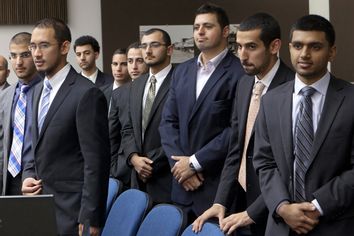
But other lawsuits that aim to chill open debate on campus, most notoriously in the trial of 11 U.C. Irvine and U.C. Riverside Muslim students who were found guilty of engaging in a campus protest, have been successful. No doubt other such attempts will be made in the future. This bundle of efforts is only the most recent incarnation of a variety of ideological projects over the past several years to impose different kinds of censorship on college campuses — which are, inevitably, key nodes for the production and circulation of ideas in the country.
Perhaps the most visible of those efforts was the campaign David Horowitz led in the early- to mid-2000s to impose state monitoring of universities, including intruding into such pedagogical matters as text assignments and course syllabi, and even coercing instructors into teaching specific points of view — all under the Orwellian banner of “student rights.” At one point, up to a dozen state legislatures were considering the Horowitz package.
At the federal level, legislation calling for the same top-down monitoring was (with the help of neoconservative and pro-Israel lobbyists) actually pushed through the U.S. House of Representatives in the form of HR 3077, which was designed to establish government monitoring of federally funded international studies programs at universities across the country, to check that their programs and curricula reflect “national needs related to homeland security.”
Some may take solace from the collapse of the Horowitz campaign and the demise of HR 3077. That would be premature, if not unwise. As more recent events attest, the same will to use the law to censor and silence dissenting viewpoints has not been abandoned — it has merely shifted form.
What these disturbing events have in common is the turn to legislation, to use the bureaucracy and the law on behalf of powerful interests who seem to have something to fear in the kinds of open exchange that are inseparable from a democratic society. It is important for those who are against SOPA and PIPA to see the connection of their cause in the commercial realm with the wider suppression of intellectual and cultural freedom that is taking place as we seem to hear what the poet William Blake once referred to as “mind-forg’d manacles” clamping shut all around us.
The United States and its allies were quick to go into damage control mode to try to contain the political and diplomatic fallout from a video posted on YouTube apparently showing US Marines urinating on the mangled corpses of dead Afghans,
A Pentagon spokesman, Captain John Kirby, told CNN: “Regardless of the circumstances or who is in the video, this is egregious, disgusting behavior. It’s hideous. It turned my stomach.” Afghan President Hamid Karzai agreed. “This act by American soldiers is simply inhuman and condemnable in the strongest possible terms.”.
It ought to go without saying that urinating on corpses, whether of Taliban fighters or Afghan civilians (or any one else for that matter), is disrespectful and degrading and ought to be condemned. What is interesting, and somewhat unsettling, about the outpouring of sentiment following this new scandal, however, is that it raises more questions than it answers.
Isn’t it odd, for example, that there seems to be more concern about urinating on these bodies than there is about the actual killing that transformed them from living human beings to splayed-out corpses in the first place? Is it really possible that peeing on dead bodies is seen as horrific, but killing people is perfectly acceptable? Isn’t something missing from this picture?
This seems an especially pressing question given that much of the US military (and related CIA) effort in Afghanistan and Pakistan so often seems to involve simply killing—or, to use the rather more circumspect military term, “degrading”—as many militants as possible, not necessarily in actual combat operations, but by twos and threes and tens and dozens, in bombings and air raids and drone attacks, as they sleep or drive or eat or pray or brush their teeth. Day after day we read reports of 8 militants being killed here, 5 being killed there , and 6 somewhere else. It is as though the earth keeps vomiting forth “militants,” who then simply need to be mown down like so much vermin in a “war” reduced to its lowest common denominator—killing for the sake of killing, without any kind of strategic aim or vision or logic, much less a sense of when it might end.
Sure, every now and then someone (very rightly) raises a question about how many civilians are being killed in air raids or drone attacks in Afghanistan or Pakistan; not that it makes any difference. There is even the occasional report about the “vast drone/killing operation” being conducted by the Obama Administration, and a few people, including Glenn Greenwald, have been warning of the menace that an unchecked, unregulated, program of extrajudicial executions means, or ought to mean, to Americans and others alike.
But, these exceptions aside, the routine, hum-drum slaughter of “militants” slips by far too readily without sufficient questioning, without enough people pausing to ask who these people are, what they want, what threat they really pose to the US with their AK-47s and RPGs, what plan, if any, there is to do something to stop their seemingly autochthonous emergence (by addressing its causes, for example) rather than merely mowing them down by the dozen after they emerge–or whether the plan really is simply to go on killing as long as there is a supply of living bodies to soak up our ordnance. After all, President Obama has deliberately chosen to kill rather than capture people because he knows that pictures like those that emerged from Abu Ghraib and Guantanamo are bad news—but that there will be few pictures and fewer questions about the endless slaughter of anonymous militants in the dusty backwaters of Afghanistan and Pakistan.
For all the furor, the current scandal proves that point all too grimly, precisely because the scandal consists in the urination rather than the killing itself.
Marine Commandant Gen. James Amos called the act of urinating on the corpses “wholly inconsistent with the high standards of conduct and warrior ethos that we have demonstrated throughout our history.” A NATO spokesman added, “This disrespectful act is inexplicable and not in keeping with the high moral standards we expect of coalition forces.”
But what does it mean to speak of a “warrior ethos” and “high moral standards” in a war when most of the killing is being done by remote control—and not in the heat, intensity and sweaty, adrenaline-driven fear of battle (which the very concept of a “warrior ethos” is supposed to describe), but rather clinically, in air-conditioned comfort, from the safe distance of 20,000 feet—or, rather, 10,000 miles?
It is all too easy to look at the young Marines urinating on the corpses in that video and condemn them (rightly) for their callous brutality. It is far more difficult, however, to put their adolescent action back in its fuller and more meaningful context and ask ourselves what it means that we hardly seem to attach more value to a human life than they do, and that we have come to accept the “reaping” of human lives—for it is not without reason that one of the biggest drones is called Reaper—as a matter to be dismissed with a careless flick of the morning newspaper or click of the mouse.
Continue Reading
Close
Following Rick Santorum’s sudden and unanticipated rise to prominence during the Iowa caucuses, there has been a rush to review the earlier and more obscure phase of his presidential campaign to see what newsworthy tidbits might have been overlooked when the spotlights were all shining on Newt Gingrich and Mitt Romney.
One of Santorum’s gems in the rough was initially uncovered back in November by the ThinkProgress blogger Eli Clifton and Philip Weiss, and returned to this week by a blogger at The Jewish Week . Santorum said, among other things, “all the people who live in the West Bank are Israelis, they’re not Palestinians.”
It was a reminder that two weeks before Newt Gingrich claimed that Palestinians are an invented people, Santorum had also denied their existence.
But whereas Gingrich’s vilification of the Palestinians was merely a nasty example of crude cynicism, Santorum’s seemed both more sincere and more intimately tied up with his ignorance not only of the question of Palestine but—more alarmingly perhaps—of American history as well.
In an informal discussion with a young man, which was aired on CNN, Santorum also said that Israel was the victim of an “aggressive attack on the part of Jordan and other countries,” that it had gained the West Bank in war—which is to say, fair and square. He said it is no more realistic to expect Israel to give back the West Bank than it is to expect the US to give “Texas and Mexico back,” since they too were gained through war.
That’s not a typo, not a verbal slip. Santorum refers to Mexico as part of the United States three separate times in the two-minute interview.
In fact, Santorum’s mangling of Palestinian history is the least interesting thing about his statement. It was so baldly false that it raised eyebrows even at the New York Times and the Washington Post. But it is still worth quoting in full in order to reveal what this vertiginous implosion of history, logic, syntax and grammar—a kind of Santorumian sublime—might tell us about what goes on inside the head of this man who would be president:
“The bottom line is, that [the West Bank] is legitimately Israeli country, and they [the Israelis] have a right to do within their country just like we have a right to do within our country; if they want to negotiate with Israeli, with Israelis—and all the people that live within the West Bank are Israelis, they’re not Palestinians, there is no Palestinian; there is, this is, Israeli land, and therefore they have a right to negotiate what they believe is in the best interests of their country, and they have a right to build things based upon their ownership of that land.”
A rough translation of Santorum’s statement might go something like this: Having captured the West Bank in a war with people who don’t exist, the Israelis have every right to negotiate with themselves—but, come to think of it, there’s nothing to negotiate because they have a right to build stuff there since they own it anyway.
Or one could be more charitable to Santorum and surmise that what he was saying is that the territories which Israel has militarily occupied for more than four decades are in fact an integral part of the state, and that everyone living in those territories ought to be considered a citizen of the state, there being no separate “Palestine.” As the Times and Post pointed out, this is precisely the argument proposed by Palestinian advocates of a one-state alternative to the two-state solution. They say the obvious way to resolve the question of Palestine is to create a single democratic and secular state in all of what had until 1948 been Palestine, or in other words Israel plus the Palestinian territories it has occupied since 1967. Unfortunately, the idea of a secular state of equal citizens is incompatible with the Zionist vision of an exclusively Jewish state, which is why Israel’s defenders in the US regard the one-state solution as the most dangerous threat of all.
Tempting as it is to think that a professed Christian like Santorum might actually have some faith in the core Christian values of sharing, forgiveness, selflessness, peace and justice (values that strangely seem never to play a role in what passes for so-called Christian politics in the US), it is unlikely that he is a sudden convertto the just peace outlined by advocates of the one-state solution.
It is far more likely that Santorum simply got lost as he wound himself up in a web spun of his own rhetorical knots.
Perhaps it was in retrospect that he realized that the rashly interjected word “negotiate” is what got him all knotted up in logical twists. If all the people in the West Bank are Israelis . . . and if the Israelis are (supposedly) negotiating about the future status of the West Bank . . . and if the West Bank is theirs . . . then they must be negotiating . . . with themselves. Or something like that.
Oh what a tangled web we weave…. But Santorum does not seem like the kind of guy who would actually practice to deceive. By all accounts, he actually believes what he says. And that is what is so disturbing about his pronouncements.
This is even more true of his pronouncements on American history than of his (mis-) pronouncements on Palestinian history.
“Is Mexico part of the United States?” he brazenly asks the young man in the interview.
“I don’t think so,” says his interlocutor, albeit somewhat quizzically. “It’s not. OK.”
After a pause allowing him to tactically redeploy his forces, Santorum tries again.
“Ah, is New Mexico part of the United States?” he asks. “I think it is,” comes the inevitable reply.
Santorum then launches into his claim that territory–United Nations Charter be damned–can be grabbed by virtue of the right of conquest, in modern times just as much as in the Bronze Age, with the American acquisition of “Texas and Mexico” (that annoying “New” dropped again as the superfluous prefix that it is) as his case in point. One can only wonder whether he also thinks it was acceptable for Germany to grab France in 1940 or for Iraq to take over Kuwait in 1990.
Since it’s not entirely clear whether Santorum realizes that there is a difference between Mexico and New Mexico, or that the difference—insofar as it exists at all—is of much significance, we had better leave that aside and stick with what he has to say about Texas.
A quick refresher: contrary to Santorum’s account, the United States did not absorb Texas in a war with Mexico. Mexico (unwisely) encouraged white settlers from the United States to settle in Texas, then one of its northern states. Eventually, those settlers rebelled against the Mexican government, and particularly against its prohibition of slavery, which was vital to the economic interests of the Texas settlers and their cotton plantations. That revolution led to the establishment of the slaveholding Texas Republic, which was later absorbed into the United States—by treaty, not by war.
So let’s see: violent and racist settlers trying to wrest control of a territory they occupy. There are questions of negotiations, treaties, and national rights. Sound familiar?
Obviously, what Santorum was trying to claim is that there is a kind of parallel between the history of the United States and of Israel—and he is right, though for the wrong reasons. In his view, just as “we” took Texas and Mexico, “they” took the West Bank; and if we are right, they must be right too: it’s kind of an extension of the logic of Manifest Destiny to Israel.
Apart from historical accuracy, what’s missing from Santorum’s account of the history of the southwestern US, of course, is the enslavement of African Americans (which the founders of Texas sought to extend) and the extermination of American Indians. They didn’t exist, for the forebears of Santorum and Gingrich, just as Palestinians don’t—or might as well not—exist for those who pledge their unreserved support for Israel today.
Slavery, settlement and extermination are undoubtedly part of the history of the United States. But there is another history to this country as well, involving a broad array of struggles for recognition and rights, by American Indians, by African Americans, by women, by minorities, including gays and lesbians so manifestly reviled by Santorum and his so-called Christian allies. And maybe, just maybe, we can take some comfort from Santorum’s reference—however unknowing and unintended—to the history by which slavery and brutality were eventually transformed into something more befitting a nation founded on the principles of rights and justice.
Or perhaps not; perhaps we ought to recognize that historical niceties have little role to play in presidential campaigns, and that correcting the absurdities streaming out of the various GOP campaigns is a pointless intellectual exercise for which the vast majority of voters have neither the time nor the patience—historical niceties being among the hallmarks of the despised “liberal elite” from whom men like Santorum and women like Sarah Palin and Michele Bachmann offer to deliver the people. There is something terrifying about the possibility that a contender for the White House can actually proudly cling to ignorance as one of his or her outstanding qualifications for the job.
Continue Reading
Close