Sebastian Strangio

Myanmar’s forgotten ethnic conflict

New democratic reforms have done nothing to stem the bloody ethnic battle that rages in the nation's north

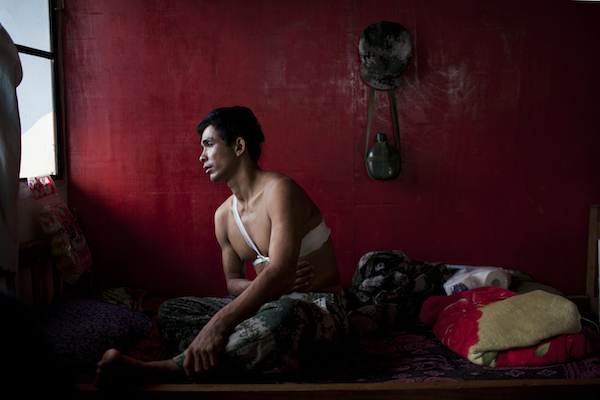
Saw Htet Aung, a 42-year-old soldier in the Kachin Independence Army, recovers at Laiza Military Hospital, near Laiza, Burma, March 30, 2012. Saw Htet Aung was shot in the torso while on patrol in Ban Dawng, on March 21, 2012. (Credit: Will Baxter/GlobalPost)

LAIZA, Myanmar — There’s little sign of a democratic awakening in Laja Yang.

Global Post

Despite the political reforms that have captivated attention in other parts of Myanmar, this dusty village remains a ghost town, abandoned last year when clashes broke out between the Myanmar military and ethnic Kachin rebels, who began their fight for independence in the 1960s.

With most of its residents gone, the village now lies along a bloody ethnic fault-line in the country’s north, a fortified encampment threaded with foxholes and trenches.

Last week, the election of democracy icon Aung San Suu Kyi to parliament triggered scenes of jubilation across Myanmar, but little of this optimism has trickled through to Laja Yang.

From fortified bunkers, troops from the Kachin Independence Army (KIA) maintain their tense daily vigil, eyeing off a Myanmar army post across the valley. The KIA is the military arm of the Kachin Independence Organization (KIO), a political organization made up of ethnic Kachins.

The soldiers were on high alert one morning last week after gunshots rang out behind enemy lines. That time, at least, it was a false alarm — Myanmar troops were soon spied hauling a freshly-slaughtered cow back to camp — but the wider conflict in Kachin State, which lies along the Chinese border in northern Myanmar, shows no sign of abating.

Clashes have been raging here since June 2011, when a 17-year ceasefire between the KIA and the Myanmar government collapsed into armed conflict. Fighting since has been sporadic but deadly. More than 150 KIA troops have been killed in hundreds of jungle skirmishes, and tens of thousands have been driven from their homes.

“They came into the village and burnt everything down,” recalls La Htaw La Ring, a 39-year-old KIA soldier whose home in Nam San village was destroyed by government troops in October. “Everything they saw in the village they shot — even the dogs.”

Since gaining independence in 1948, Myanmar (formerly Burma) has been in a state of near-constant civil war with a raft of ethnic militias seeking independence or autonomy from central control. But the stakes are especially high in Kachin State, a region rich in jade, gold and timber, with surging rivers that are being dammed by Chinese hydropower projects.

Under a 1994 cease-fire agreement, large swaths of the state were controlled by the KIA, which claims to have up to 20,000 men under arms, while the KIO used tax revenues to fund an autonomous statelet in the mountainous territory along the Chinese border.

At the moment, however, the Kachin rebels are under siege. Since June, the Myanmar military has forced the KIA back into its core regions along the Chinese border. As the fighting has escalated, the zone has been put on a war footing. The KIA has shifted its command headquarters to a hotel in Laiza, the Chinese border town that serves as the capital of independent Kachinland, while men and women of all ages have volunteered for military service.

Shang Hting Tang is one of 225 new recruits graduating from the KIA’s basic military training course — a 56-day boot-camp in which volunteers learn basic military maneuvers and attend lectures on Kachin history.

But there are few fresh faces in this crowd of cadets. Like Shang, many of the recruits are middle-aged farmers driven from their land by the fighting. “I don’t want to kill Burmese troops, but I want to defend our country,” the 42-year-old says after the one-hour graduation ceremony, which comes to a close with a full-throated rendition of the Kachin national anthem.

Since the outbreak of fighting, human rights groups have accused Myanmar troops of pillaging and destroying Kachins’ property, and shooting at unarmed villagers with small arms and mortars. Around 75,000 Kachins have fled their homes since June, according to a recent report by the US-based Human Rights Watch, hiding in the jungle or seeking refuge in some 30 camps for the displaced in KIO-controlled areas.

Despite a recent visit by United Nations officials, the Myanmar government continues to block outside aid to the KIO areas. At Jeyang, a camp outside Laiza that houses 5,800 displaced people, food, building materials and other supplies are beginning to run low.

“Some people have fled to the Chinese side, but the Chinese authorities don’t take care of them,” says Doi Pyi Sa, the head of the KIO’s relief operations. “If the conflict lasts much longer, there will be many difficulties. We can’t survive without international help.”

Many outside observers, however, are paying more attention to developments elsewhere. Since March 2011, President Thein Sein, the country’s first civilian leader in half a century, has captivated international attention with a series of political reforms that are pushing many Western nations to relax long-standing economic sanctions.

There has also been the appearance of progress on the ethnic front. In January, the government signed a historic cease-fire with the Karen National Union, the world’s longest-lasting insurgency. It has concluded a similar agreement with the 7,000-strong Shan State Army (South), in addition to smaller ethnic Chin, Mon and Karenni groups.

In a state of the union speech delivered last month, Thein Sein called for an end to “misunderstandings and doubts” among Myanmar’s ethnic groups, and made unprecedented calls for ethnic equality.

But whatever the progress elsewhere, relations with the Kachin have deteriorated under Thein Sein. Three months after he took office in June, fighting with the KIA erupted close to a Chinese-built hydropower project and quickly spread to other parts of the region.

In December, a presidential order for the Myanmar military to halt fighting ahead of peace talks was apparently ignored, casting doubt on whether Thein Sein, a former general, has any control over Myanmar’s powerful military.

Meanwhile, Kachin leaders doubt the sincerity of Thein Sein’s ethnic charm offensive. Samlut Gam, the KIO’s head negotiator, says the Myanmar government is pressing hard for a cease-fire agreement it can present to Western nations as proof of “progress” on the ethnic issue. “They want us to sign a cease-fire agreement quickly, but we want to make a political dialogue and sign a more permanent kind of agreement,” he says.

KIO spokesman Kumhtat La Nan says that the government’s strategy is to force the KIA and other ethnic groups to disarm and abandon their push for self-determination. As a stick, it prevented Kachin parties from registering for the November 2010 national election and postponed last week’s by-election vote in Kachin constituencies, citing the security situation — something he denies would have prevented voting.

“The military guys just changed their uniforms, but they’re using the same strategy,” he says, sitting in the KIA’s command headquarters under a banner that proclaims “God is Our Victory.”

But while the recent talks with ethnic groups are overt signs of progress, a recent briefing by the Burma Center for Ethnic Studies argues that overcoming six decades of conflict could take years.

“For the last 60 years all parties have been so heavily involved in waging war that they have little understanding of what is required to maintain peace,” it states.

In the meantime, the Kachin are digging in for a long fight.

After 10 days of being battered by mortar and small arms fire, a tranquil calm prevails at a small KIA post behind the Nam Sam front. Off-duty troops strum a guitar and sing military songs as the light fades, sipping a traditional cocktail of rice whisky and fresh deer blood.

Like elsewhere, many of the troops here are recent civilian recruits, including several KIA veterans who dusted off their old uniforms and re-enlisted after the fighting restarted. One of the them is Capt. Len Aung, 64, a 38-year veteran of the KIA, who seems unfazed at having his 10 years of retirement interrupted by a return to the barracks life.

“We can’t stay here peacefully,” he says, “so I’ll keep fighting until my last breath.”

Inside Bangladesh’s organ market

In what is supposed to be a microfinance mecca, many go to extreme measures to pay off debts

23-year-old Mehdi Hassan, from Bamongram village in northeastern Bangladesh, sold part of his liver to an black market organ broker and received nothing in return (Credit: Sebastian Strangio/GlobalPost)
This article originally appeared on GlobalPost.

JOYPURHAT, Bangladesh — Mehdi Hasan’s scar runs in a wide arc from his waist to a point just beneath his rib-cage.

Global Post

The jagged pink laceration still aches, the 23-year-old says, a daily reminder of the operation he underwent in the capital Dhaka five months ago, in the hopes of raising some quick cash.

In exchange for 60 percent of his liver, an illegal organ broker had promised him 300,000 taka ($3,960) — a royal sum in Bamongram, his small village of mud-brick homes and verdant rice paddies in Bangladesh’s northeast.

But when the broker failed to show up after the 10-hour operation, Hasan found himself stranded in Dhaka with nothing but mounting hospital bills and chronic pains in his chest and abdomen.

“He didn’t pay me a single penny,” Hasan said.

In Bangladesh, the trade in internal organs is big business. Each year, hundreds put their body parts up for sale in the underground organ bazaar hoping to escape the clutches of poverty, only to be short changed by brokers or burdened with chronic health problems, according to police officials and residents.

The grisly trade made headlines here in August, when police broke up a network of organ brokers centered on Joypurhat, a district in the northeast of the country. The agents, led by one organ-seller-turned-broker, preyed on poor villagers — many plagued by mounting microcredit debts — promising them a ladder out of poverty.

Given Bangladesh’s reputation as the birthplace of Nobel Prize winner Muhammad Yunus’ Grameen Bank, it’s a rather ironic turn of events — one that exposes a dark side of the country’s microfinance success story.

Hasan, a rural day-laborer, said he hoped to use the payment as seed money for a small business. Though he eventually received 145,000 taka ($1,914) in compensation from the family of the sick man who received his liver, the money has nearly run dry, and the pain has impeded his ability to return to work.

“Plowing the land or digging the land is really tough with all this pain,” he said. Like the raised welt cutting a swathe across his belly, “I feel like I’ll have to carry this pain throughout my life.”

Police estimate that 43 people sold their kidneys in Joypurhat, with another 10 or so villagers in the pipeline when the ring leaders were arrested in late August.

Alamgir Chowdhury, a local television correspondent who has followed the story closely, says most people go to the operating table out of desperation. “To pay back the installments on [pre-existing] loans they took out new ones with local money-lenders. They got caught in a web of loans,” he said.

Selina Akter, from nearby Berendy village, went under the knife in July to pay down 400,000 taka ($5,280) in microfinance debts.

“I had a vegetable farming business and it went into loss, and then I had to take loans from another [microcredit] NGO to pay them back,” said the 25-year-old, who received 220,000 taka ($2,904) in exchange for her kidney. Three other members of her family — her husband, father-in-law and brother-in-law — also sold kidneys to alleviate the family’s debts.

In the case of Mahmuda Akter, who is not related to Selina, it was the constant, humiliating visits from debt collectors — pursuing 150,000 taka ($1,980) in microcredit debts — that finally pushed her over the edge.

“When the NGOs came here to collect money from me they harassed me and said bad things, things which cannot be repeated,” said Mahmuda.

She received 250,000 taka for her kidney after an operation in March. Though it helped eliminate her debt, she now regrets having the operation. “I heard from the neighbors that if you donate a kidney you can make some money,” she said. “I feel like I had to sell it because I was under too much pressure.”

According to Fazlul Karim, the police inspector who led the investigation into the Joypurhat organ-trafficking ring, the network was headed by a local man named Abdus Sattar.

While working at a garment firm in Dhaka, Sattar sold his own kidney to a sick man in 2005. Then, apparently seeing an opportunity to profit from the grisly trade, he allegedly returned to Joypurhat and started seeking out potential sellers.

Slowly, police say, Sattar and his agents built up a network that connected kidney patients in Dhaka with willing sellers in the villages, creaming off fat commissions in the process.

“The brokers roam around the diagnostic centers where kidney dialysis takes place. They know it’s a good hunting place for kidney patients,” Inspector Karim said.

Once a willing donor was identified, and brought to Dhaka for the necessary tests, brokers and hospital administrators produced legal documents fabricating a family relationship between the seller and the recipient. (Under Bangladeshi law, only family members are legally permitted to donate organs).

At his office in Joypurhat, Karim showed GlobalPost the documents that “legalized” Mehdi Hasan’s liver transplant — one claiming he was the nephew of the recipient, and another claiming he was the son of the man’s sister. The all-inclusive fee charged by Sattar and his associates would typically range from 400,000 to 500,000 taka ($5,280 to $6,600), but only a fraction of this was actually passed along to the seller.

So far, police have arrested nine people accused of involvement in the Joypurhat trade, including three in Dhaka, and are confident the local organ market has been shut down.

But some say Joypurhat is just the tip of the iceberg. Dr. Monir Moniruzzaman, an anthropologist from Michigan State University who has studied the Bangladeshi organ trade, estimates that roughly 250-300 people sell their organs in the country each year.

If anything, he said, that figure is likely to fall on the conservative side. “Joypurhat represents only a fraction of the trade of Bangladesh. The other parts of the country are unexposed, where the majority of the trade is going on,” he said. “If you combine it the picture is really grim.”

None of the accused were available for comment for this story, but Moniruzzaman said that in his own interviews with organ brokers, most claimed they were helping to save lives — that the sale of kidneys to the sick was “a win-win situation”.

Indeed, the exposure of the Joypurhat organ ring has prompted calls for the liberalization of Bangladesh’s organ-donor law.

Critics of the law say the scant availability of legal donors has created a flourishing black market. “We should make it liberal, so liberal that people cannot make profit out of it,” said Dr. Tareq Salahuddin, the health editor at the Daily Star newspaper. “If it’s open, there can be no way of making someone a loser.”

Mohammed Mozzamel Haque, the Joypurhat police superintendent, said the law needs to create a new regulatory board to establish family links between donors and recipients, utilizing DNA tests if necessary.

He argued that the law should also be amended to allow “emotional” donors — those with close non-familial relationships to recipients. “Sometimes blood relatives are not willing to donate kidneys, but friends should be able to donate a kidney. But the present law does not permit it,” he said.

Others warn that legalization would only succeed in turning the body parts of the poor into commodities for the wealthy. “It’s an unequal, unjust system where the rich can afford to buy [organs] and the poor are selling their own body parts,” said Moniruzzaman from Michigan State University. “It is expanding every year, so the law has to be stricter.”

He said the country’s demand for kidneys or other organs could easily met by establishing a cadaveric organ donation system similar to that in many Western countries — something he said would be a “moral and ethical” source of life-saving organs.

There are few studies showing the health effects of organ donation on the rural poor, but Moniruzzaman said that based on his interviews with organ sellers across Bangladesh, many suffer from post-operative pain, intermittent fever and body-weight problems.

But the most lasting cost he saw was often not medical, but psychological.

“Some sellers said they feel they are living like sub-humans,” he said, “as if they sold one of God’s gifts.”

Continue Reading Close
www.salon.com/writer/sebastian_strangio/index.html