Shoib Najafizada

“If we kill schoolgirls, you shouldn’t be surprised”

Responding to threats from the Taliban, at least 10 girls' schools have shut down in northern Afghanistan.

  • more
    • All Share Services

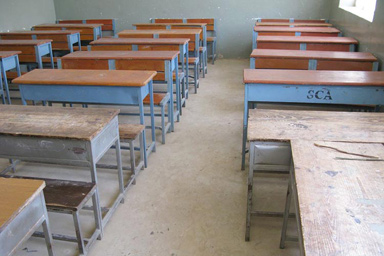
An empty classroom at the girls' school in Aqtash. Once the threats started coming, parents stopped sending their girls to school.

When the deputy director of Aqtash High School talks of the government, he isn’t referring to Hamid Karzai’s central government in Kabul. Nor does he refer to the provincial administration in Kunduz. “The Taliban are our government,” Bashir says. “They have taken over our region, their commanders give the orders here.”

Bashir is standing in a dusty classroom on the ground floor of his modern school, roughly half an hour from Kunduz by car. As recently as just one month ago, he says, some 400 girls were still coming to the school in three daily shifts to learn reading, writing and arithmetic. Figures and formula are still scrawled across the blackboard.

But now, the girls’ classrooms have been left to deteriorate. The desks and chairs are still laid out in neat rows, but a film of dust has collected, and Bashir stands helplessly in the middle of the room. “Parents in Aqtash are afraid to send their girls to school anymore, after the death threats,” he explains. The school director speaks quietly and carefully. He too is afraid, and several of his teachers double as informants for the Taliban. The bearded fighters, he says, would certainly not like it if they knew a reporter was at the school in Aqtash. “You should leave quickly if you want to get out of Aqtash alive,” he whispers.

“Apprehended and killed”

Bashir’s warning is hardly an exaggeration. Not 30 minutes after our arrival in Aqtash, located 15 kilometers northeast of Kunduz just off the main north-south arterial, a group of a dozen Taliban fighters, armed with AK-47s, gathers in front of the blue arch at the entrance to the school. “What do you want here?” one of the fighters calls. “This is our region, the Islamic Emirate of North Afghanistan.”

The trip to the Aqtash school is a trip into the heart of the empire of the Taliban, which controls large areas around Kunduz. Minutes pass before the fighters clear out of the way, allowing us to leave.

The trip out of Aqtash is hardly any less dangerous and provides a look at the situation not 15 kilometers from the German military camp in Kunduz. There are Taliban checkpoints all over the roads, and they are well armed. The Taliban commander in the region is a man named Khalid Salim. He is young and has a reputation for brutality. Salim is on the most wanted list for the region surrounding Kunduz. “Those who work for the government or for the Western soldiers,” says one of his men at a checkpoint, “are immediately apprehended and killed.”

The fate of the school in Aqtash, which received a new roof just one year ago, paid for out of German development funds, is hardly unique. At least 10 girls’ sections of schools located near Kunduz have been closed down in the last three weeks after receiving threats from the Taliban. Parents simply stopped sending their children to school because of the danger. And the closures haven’t just been in the region of Char Dara southwest of Kunduz, a well-known Taliban hot spot. Schools in three other districts have likewise ceased operation.

No German soldiers

It didn’t take long for news of the school closures to reach the highest echelons of government in both Kabul and Berlin. Stories about schools buckling to the Taliban are exactly what they hoped to avoid. On the one hand, it shows that the Taliban is increasingly gaining the upper hand right outside the front gates of the German military camp in Kunduz. Neither the German army, the Bundeswehr, nor the local police force are effective against the Islamist extremists. At the most, they can temporarily dislodge the Taliban, but they then move on to terrorize other areas where there are no German soldiers.

Most of all, though, the closures threaten one of the few successes that the Germans have had in Afghanistan. It is an achievement that has been repeatedly trumpeted by those in favor of continued engagement; hardly a German politician has refrained from mentioning how encouraging it is to visit a girls’ school in Afghanistan. Now, though, the schools — just like in the south where recent acid attacks against schoolgirls have hit the headlines — have become a potent propaganda tool for the Taliban. Western troops, so goes the message, can’t do anything to stop the Islamist fighters.

The tactics used by the Taliban are shockingly simple. Dozens of so-called night letters, which are affixed to the doors of schools in the dead of night, are piled on Muqim Halimi’s huge desk. Halimi is the commissioner of education for the Kunduz province and a crowd of men are waiting outside his office, most of them hoping to be able to bribe their way into good grades for their children. But when Halimi hears that a German reporter wants to talk about the closure of the girls’ schools, he clears the room so he can talk undisturbed.

After confirming the closures, he reads aloud from the Taliban night letters, as simply formulated as they are explicit. “As of today,” he reads from a message from Aqtash, “girls are no longer allowed to attend school.” The letter is marked with a logo of the Islamic Emirate of Afghanistan — in English, yet another indication of just how well organized the Taliban are in the German area of operation.

“If we now kill schoolgirls …”

Another threat letter depicts a schoolgirl at the gallows. “We have warned you,” reads the message. “If we now kill schoolgirls, you shouldn’t be surprised.”

Halimi is open in his description of the precarious situation the schools find themselves in. “There is no police there and even the army is afraid to go there,” he says. “What should I do, as a civilian, against the Taliban?”

Alarmed about the reports, Afghan Interior Minister Hanif Atmar has rebuked the Kunduz police chief over the phone. The school closures are a “disgrace for Afghanistan,” he says, demanding that something be done. But police chief Abdul Racak also doesn’t know what to do. Last week he tried to send a police patrol to Aqtash, but they came under fire almost as soon as they turned off the main road. Two police officers were killed in the attack.

The reaction from the German camp in Kunduz is also a mixture of dismay and helplessness. The security situation is so poor at the moment that neither the military nor their civilian assistants can visit Aqtash themselves. Realistically, though, there isn’t much they can do to combat the threats of the Taliban. There are some 650 schools in the region surrounding Kunduz and the German theater of operation is almost the size of the U.S. state of Massachusetts. With a German contingent of just 667 soldiers, security simply cannot be guaranteed.

Reports about the closures of the girls’ schools aren’t the only indications that the Kunduz region is at risk. The German military has noted that the Taliban threats began at the exact same time as attacks against German soldiers began to increase in both number and sophistication. Since the end of April, 19 patrols have come under attack, with one soldier losing his life in an April 29 attack. So far in May there have been four well-organized assaults with soldiers wary that the next one could come at any time. Nobody believes that the correlation between the school threats and the attacks is a coincidence.

The reaction to the threats has become almost routine in recent months. The Afghans, so goes the formula, have to use their army to establish security in threatened areas like Aqtash. The Germans have held talks with their Afghan partners in the hopes that they will launch an offensive in Aqtash. German troops will support the operation, but Afghan troops should be the ones at the front.

But it would surprise no one were further girls’ schools to shut their doors by the time such an operation is launched.

Still, the news isn’t all bad. At the girls’ school in Qosh Tappeh, likewise near Kunduz, the school director, a veteran of the mujahedeen, took things into his own hands. When the Taliban showed up to his school for the second time to present their threats, he found a uniquely Afghan solution to the problem. He told his visitors that, when it comes to fighting to the death, he is much more experienced than they. Should they like to find out for sure, he offered, he would be happy to accommodate them.

His threat seemed to have worked. The girls in Qosh Tappeh continue to attend school. 


This article has been provided by Der Spiegel through a special arrangement with Salon. For more from Europe’s most-read newsmagazine, visit Spiegel Online or subscribe to the daily newsletter.

Karzai won’t leave

Afghan President Hamid Karzai discovered the importance of adhering to his country's constitution at an awfully convenient political moment.

  • more
    • All Share Services

The news that Afghan President Hamid Karzai was considering resignation caused considerable agitation in Western capitals late last week. It was a sudden shift. The Afghan president, once installed by the United States and lauded as a torchbearer, is now identified as the scapegoat for the West’s lack of success in Afghanistan. Nevertheless, no one in the West has any idea how things could proceed without him.

The reports of his departure were more than just another product of the Kabul rumor mill. In their classified reports, intelligence agencies noted that something was cooking in Kabul, and yet they were unable to predict exactly what was about to happen there.

The uncertainty was finally laid to rest on Saturday afternoon, when Karzai issued a decree announcing his intention to hold the presidential elections in the spring, by April 21 at the latest. Always the statesman, the president, who lacks even the power necessary to protect Kabul from the Taliban, explained that he is bound to respect the Afghan constitution. Under Article 61, the election must take place at least one month prior to the end of a sitting president’s term. Karzai’s term ends on May 21.

In his decree, Karzai emphasizes that he wants to remain president. Instead of knuckling under to the West, he is provoking the NATO protective force and the United Nations — an approach that has always scored points among Afghans. “Even if I fail,” so goes an old motto of this proud Pashtun, “I will do so with my head held high.”

The United States distanced itself from Karzai’s decision to move up the elections. US State Department spokesman Robert Wood, speaking in Washington on Saturday, said that although the decree is based on the right principles, the US government still considers it advisable to stick to the Afghan Election Commission’s original plan to hold the election in August.

Karzai is driven by various motives. He has been under great pressure in Afghanistan, where he is criticized for having given in to the West. The election commission, paid for and controlled by the U.N., had ruled that the election should not be held until August. The tense security situation and the need to provide Afghanistan with more time to recover from what has been a harsh winter, the commission argued, would preclude an earlier election — and breaching the constitution, though unfortunate, would be necessary.

Experts Rule Out Earlier Election

The decision sparked massive resistance in the country, and Karzai was criticized by his opponents and supporters alike. They also made it clear that they would no longer recognize the president after the end of his regular term in office. Weeks ago, the Taliban warned all Afghans that anyone taking part in the vote, whether as a voter or a candidate, would be a legitimate target of attack. According to Western analysts, this threat makes elections virtually unthinkable, especially in the south.

These concerns remain valid today. The 17,000 U.S. troops and several thousand European ISAF soldiers meant to provide security for the vote will not be available until the summer. Besides, the preparations — voter registration and the compilation of candidate lists — are not yet complete. The U.N. has not even come up with the $200 million it needs to organize the election. It is still collecting donations.

Not surprisingly, reactions to Karzai’s decree were clear. “There will be no election in the spring,” said a U.N. insider in Kabul only hours after the announcement of the presidential decree, “even if that’s what Karzai suddenly wants.”

“The Buck Is Being Passed to the Evil West”

Perhaps Karzai is even hoping for the West’s predictable rejection of his plan. And perhaps Karzai reasons that if the West does not manage to organize a spring election, he will be able to claim that at least he tried to obey the constitution. “The buck is being passed to the evil West,” says an EU diplomat, “which leaves Karzai looking good.” If this happens, an interim regime — led by Karzai as the “father of the nation” — could be installed until a later election date. A key advantage of this option is that Karzai could still be ousted in the election.

The election commission, playing for time, has not commented on the decree yet. Commission officials say that they cannot make a decision until they have received the official letter from the presidential palace. ISAF’s official response has also been scant. Internally, however, Karzai’s announcement has been met with concern.

Karzai confronted the West’s concerns in his decree. In its four articles, he appealed to the Afghan security forces — namely, the military, the police and the NDS intelligence agency — which are still in the process of being assembled, to do everything possible to ensure a safe election. He also called upon the “enemies of Afghanistan” to take part in the elections. However, many in the West doubt whether local authorities will be capable of providing security.

Karzai’s decision is a signal to critics at home and abroad. Under pressure at home for being Washington’s puppet, the president is looking for ways to distinguish himself. After fatal mistakes were made during NATO bombing attacks on supposed Taliban camps, Karzai was quick to level sharp criticism at the West. It was so sharp, in fact, that last fall then-U.S. Secretary of State Condoleezza Rice issued an unmistakable warning: Unless Karzai’s criticism stopped, the United States would end its cooperative relationship with him.

“There Are Plenty of Qualified Afghans”

“I will not be silent, and I will not stop promoting the interests of my people and their children,” Karzai allegedly fired back — at least according to the version his palace broadcast. But the criticism did not stop when a new administration came into power in Washington. On the contrary, President Barack Obama has, in fact, identified Afghanistan as a priority more clearly than his predecessor did, no matter who is in office in Kabul.

U.S. statements in recent weeks sounded practically like Karzai’s notice of termination. For example, when U.S. Special Envoy Richard Holbrooke was asked whether the Obama administration even supports Karzai anymore, he replied: “There are plenty of qualified, impressive Afghans in the country.” Obama had been in office for several weeks before he called his new counterpart in Afghan. Bush, on the other hand, had conferred with Karzai every week.

The opposition is already taking shape in Afghanistan. Former Interior Minister Ali Ahmed Jalali is one of Karzai’s possible challengers in an election. Karzai had removed the 68-year-old politician from his position after Jalali took legal action against the Karzai family for its alleged involvement in the drug trade. Jalali, who was often in the United States in recent months, has strong connections to the conservative camp and is claiming the role of the clean candidate for himself.

There are rumors that another man is the current favorite in the United States. Ashraf Ghani, like Jalali, holds a U.S. passport. He was an adviser at the World Bank and later served in Karzai’s cabinet as finance minister. Even though Ghani himself is suspected of involvement in nepotism, he could become Washington’s new man. Minor flaws haven’t deterred the Americans in the past. Other possible candidates are the governor of Nangahar Province and Interior Minister Mohammed Atmar.

Secret Pacts With Taliban Leaders?

But all of these candidates will not stand much of a chance if Karzai succeeds in his push for early elections. With Karzai’s envisioned election day less than two months away, none of them would have enough time to gain sufficient name recognition in the country, not even with U.S. support. This, too, is likely to have prompted Karzai to issue his decree. Whether or not the elections actually take place in accordance with constitutional rules, Karzai now enjoys an advantage.

Karzai’s sudden fondness for the constitution seems implausible, especially after the many times the president has allowed the constitution to be breached when it suited him. One of the best examples regards Foreign Minister Rangin Dadfar Spanta. Even though the politician, who lived in Germany for many years, was voted out of office by the parliament several times, Karzai kept him in his position. In Spanta’s case, the constitution was merely an impediment.

Only a fool would bet on the outcome of this race, but it is already clear that Karzai will not go without a fight. He is believed to have concluded various pacts throughout the winter with high-ranking Taliban officials and tribal leaders in the south to secure him a majority of votes. No matter how big a role U.S. support and U.N. money play, a president still has to be elected, even in Afghanistan.

Continue Reading Close