Steven A. Shaw

A tale of two marathons

The Fat Guy snacks his way through the New York City Marathon.

  • more
    • All Share Services

In the fifth century B.C., without the benefit of Nikes, PowerGels or Gatorade,
a Greek herald named Phidippides ran the 26 miles from Marathon to Athens to announce the Greek victory over the Persians, after which he promptly dropped dead.

Today, more than 400,000 people run in more than 300 marathons in America each year (to say nothing of the 250 Mile Mojave Deathrace), and very few die (although thousands are injured, both in the races and during training).

About 30,000 of those people run in the New York City Marathon and, this
year, two of those were my wife, Ellen, and her brother, Jon. Their
challenge was clear: To run 26.2 miles, from the Staten Island side of the
Verrazano Bridge, through all five boroughs, to the finish line at Central
Park’s Tavern on the Green restaurant.

My job, as one of 3 million spectators, was to cheer my runners at as
many points on the course as possible while simultaneously avoiding the
boredom inherent in that mind-numbing task. And so, armed with a subway map and the information gleaned from several restaurant guidebooks, I devised a little competition of my own: a snacking marathon (“Snackathon,” if you will). Sure, there were no other participants in my Snackathon, but, as runners like to say, “I’m only competitive with myself.” Whatever that means.

My favorite part of the marathon is carbo-loading the night before (which
also marks the start of the Snackathon — perhaps the only place where these
two events dovetail). We chose Tony’s, a family-style Italian place on
Second Avenue, for our pasta feast. As I listened to five runners complain
of shin splints, Achilles tendonitis and iliotibial band friction syndrome,
it occurred to me that, were they all horses, I’d have to take them out
behind the barn and shoot them.

“I’m the only healthy person at this table,” I blurted. For at that time,
only I could have stood up and walked around the block without pain. Each of these runners (and, I suspect, nearly every participant in the marathon) had suffered a training injury in the past six weeks. And each planned to run anyway.

That night, my wife spent about two hours valiantly coughing up phlegm. In
addition to her hip injury, she was running with chest congestion.

On race day, I took Ellen to the bus at 6:30 a.m. for an early deportation to
Staten Island. This gave me 90 minutes to make myself breakfast prior to my own ridiculously early departure (the whole city closes down by 9:00 a.m. on marathon Sunday), and I knew I’d need a big one. I fueled myself with bacon and eggs, and at 8:00 a.m., my friend Emily picked me up in her car. (It’s a rare treat for a New Yorker to go anywhere by car.) As luck would have it, Emily goes to church in Bay Ridge, Brooklyn, every Sunday (her father is the minister) and I was allowed to come along for the ride. Luckier still, there are always good snacks at Emily’s parents’ house (they’re Lutherans, thankfully, and not Episcopalians).

The scene at 86th and Fourth in Brooklyn, two hours before the start of the
race, was pretty grim. It was me, a news crew, two cops and a drunk in a
Yankees cap who kept yelling “Hang in daaaaauh!” Eventually, as hypothermia crept through my extremities, the Achilles Track Club runners started to pass (these are disabled runners who are allowed an early start). I desperately wanted a cup of coffee and a sausage McMuffin with egg (one of the cops had just turned me on to a nearby McDonald’s), but I felt duty-bound to cheer the Achilles people. Somehow, their efforts seemed
valiant — as if they sought to prove, “I can be just as stupid with one leg
as anybody with two.”

Bringing up the rear were a few wheelchair-bound paralyzed competitors being pushed by able-bodied guides. To them I say, God bless you, for you are the only sane people in the race.

Just after 11:00 a.m., a small group of mostly Africans ran past like the wind, chasing a guy dressed in blue and yellow. The lead guy, a
Mexican runner named German Silva who has won the marathon twice, had recently undergone a wart-removal procedure and didn’t plan to race, so he
agreed to act as the “rabbit.” The rabbit runs as fast as he can for the first few miles of the race, and the others chase him, like greyhounds at a
dog track. Silva chose to run past his designated jumping-off point, and had
everybody scared for a couple of miles, but he eventually gave up and rode
the rest of the way on a camera truck.

A couple of minutes later, a second group of Africans and Mexicans ran by.
These were the female front-runners. Apparently they didn’t get a rabbit
because there were no women fast enough to do it. This gives an unfair
advantage to the men, the women say, because not only does the rabbit
provide psychological motivation but also he creates a windscreen for the
lead group (and on this blustery day, the runners needed it).

Then, after a seeming eternity, the other 30,000 runners came pouring off
the bridge and onto Fourth Avenue as in a scene from “Braveheart,” casting
aside their warm-up clothes (some nice stuff, I might add, although none of
it fit me) and smiling maniacally. I saw Jon and Ellen pass within a couple
of minutes of one another, although that gap would widen. At long last, I
dipped into McDonald’s for my sausage McMuffin (with egg) and ate it while
reading the abortion-clinic and laser-hemorrhoid-surgery ads on the R train
as I crawled through Brooklyn in the hopes of catching both of my runners
five miles farther down the course, near a falafel place on Atlantic Avenue
in Brooklyn Heights (which, it turned out, despite being in an Arab
neighborhood, makes lousy falafel).

- – - – - – - – - – - – - – - – - – - – -

Marathoning, we are told by the NYRRC (and dozens of other fanatical
pro-running organizations), is for everyone. But is the human body really
intended to run 26.2 miles at a stretch?

“A marathon is definitely not for the average person,” says Dr. Stephen
Lynn, director of the St. Luke’s-Roosevelt Hospital Emergency Department,
who has worked in the medical tent at the New York City Marathon finish line for the past 15 years. “I can’t imagine how or why people do this.”

Many obsessive runners are victims of either exercise addiction or fitness
(aka non-purging) bulimia. Exercise addiction is a phenomenon thought to be
caused by the release of endorphins (the body’s version of opium) during
exercise. Richard Benyo, author of “The Exercise Fix” and perhaps the
foremost authority on exercise addiction, says you’re an addict when “the
obsession with your running turns to an arrogance of mind over matter, where you confuse willfulness to overcome your body’s physical limitations with being strong-willed.” Sounds like most marathoners I’ve met.

Fitness bulimia, by contrast, is really an eating disorder. As described by Dr. Jerald Block of the New York State Psychiatric Institute, it’s the compulsion, in the wake of binge eating, to exercise excessively to burn every calorie ingested. It’s analogous to vomiting or laxative abuse, albeit far less visually offensive.

I submit that both sets of people — the exercise addicts and the fitness
bulimics (and of course you can be both) — are crazy. Yet society indulges
them. As a fat guy, if I require medical treatment for obesity-related illness, I’m considered a drain on society’s resources — a lazy slob dragging
down the nation’s medical economy. But if I injure myself through overuse of my body, I’m heroic. Obesity, the propensity to eat (as nature intended us
to do), is seen as a disease. Yet destroying oneself through exercise is
considered virtuous, even though the costs of easily preventable orthopedic
surgery, physical therapy and chiropractic care (which insurance companies
in many states are now required by law to support) are immense (though
undocumented by a medical establishment blind to the harms of overexertion).
The entire discipline of sports medicine owes its very existence to people’s
voluntary abuse of their bodies.

Although I now lead a blissfully sedentary life, I’m intimately familiar
with the fitness spiral. When I attended the University of Vermont, which is
one of those colleges where everybody loves the outdoors, I fell under the
influence of a friend, a bicycling and extreme-sports fanatic (and
philosophy major) named James (who was later killed in a kayaking accident). Under his careful tutelage, I became a fairly skilled cyclist. I got to the point where I could spontaneously ride 100 miles (a “century”) on any given day with no additional training. I got grouchy on days when I couldn’t ride (which, given the Vermont winters, were many) and I spent larger and larger sums of money on better and better bicycles.

When I moved back to New York, where open roads are few, that regimen became untenable and I slowly detoxed from cycling, picking up squash instead. Never a good player, I nonetheless managed to injure myself in many dramatic ways before I gave it up. Now, I limit myself to walking and, on occasion (and only when I’m goaded into it), playing sports with friends for fun. I feel much better.

- – - – - – - – - – - – - – - – - – - – -

The gap between my wife and brother-in-law (he’s the faster of the two, and
had fewer injuries) was growing, so Atlantic Avenue would be the last place
I could see both of them. After cheering with what little voice I had left,
I turned toward the No. 4 train station and braced myself for the
Manhattan leg of the journey.

And it was then that I saw him. I never learned his name, but he was tall
and blond. Just before Atlantic Avenue, he got a pained look on his face,
departed the racecourse and ran down a street and into an alley. He emerged, missing a sleeve. He winked at me as he returned to the race. “Much better,” said the tall blond man with one brown sleeve as he ran off.

Back in Manhattan, I barely had time to make it to First Avenue, where my
mother-in-law was watching on 80th Street. As I approached over a small
rise, I heard primal chanting and kept expecting to see Indians coming over
the hill. I had missed Jon — he was too fast for my snacking schedule — but I arrived just in time to eat a feather-light cappuccino-flavored macaroon that my mother-in-law had bought at La Maison du Chocolat and cheer Ellen at mile 18. I then made a beeline for the 90th Street entrance to Central Park, approximately mile 23, the last place I’d be able to see my wife run.

On the way, I was lucky enough to pass the Papaya King hot dog stand on 86th and Third, where I purchased one with mustard and sauerkraut. While overpriced at $1.39, it was quite tasty and easily portable. I also picked up a Snickers bar at a newsstand. This was all along my beeline.

You’re supposed to bring snacks for the runners, so I had a Zip-Loc bag full
of orange slices that had been leaking in my pocket all day. At mile 23, I
held out a few slices in my hand and, lo and behold, some passing runners
grabbed them and ate them. So I gave away some more, and I felt I was doing a public service. Then, all of a sudden, one guy (his name was “Go Russell Go,” according to his shirt) yanked the Snickers bar out of my other hand, mistakenly assuming it was for him, and ate it as he ran off. Luckily, I had a bag of potato chips as a backup.

The guy who stole my Snickers bar was no idiot. He understood about deriving pleasure from food. To the rest of the runners, who consumed thousands of packets of an evil substance called PowerGel, ingestion of nutrients had been reduced to its bare essentials: little colored gels with all the essential nutrients and no taste. This is food without enjoyment. Without chewing, even; it’s the closest thing to intravenous feeding you can get without sticking a needle in your arm. It made me want to yell, “Soylent green is people!”

While watching the pained looks on the runners’ faces at mile 23, it struck
me: These people are not happy. They’re driven not by pleasure, but rather
by pain. Indeed, the only happy people were the spectators, and they were
not as I would have imagined. I had assumed the marathon crowd would consist of fat people watching thin runners. But it turned out to be average people
watching average runners. Many runners were obese or out of shape — the
marathon may have been their only serious physical activity of the year (and, according to the latest AMA study, people who embark on massive exercise programs with little pre-training have a heightened risk of heart attacks). Many of the female spectators were
beautiful, healthy and rosy-cheeked, like cheerleaders in
sweaters. Most of the female runners were anorexic and unappealing.

And I saw the guy with one sleeve, now just ahead of my wife and well on his way to a respectable 4:20 finish, although by now he was missing both sleeves.

When I saw Ellen, I was so elated that she had made it to mile 23 that, in
an inexplicable paroxysm of poor judgment, I started to run parallel to her
along a nearby footpath. After four blocks running and cheering, I was
exhausted (in my defense, I was carrying a bag of clothes and snacks).

On the M96 cross-town bus, I caught my breath and amused myself by
copy editing the MTA’s near-illiterate public service posters.

The scene at the finish line was a gruesome one: 30,000 bodies, throttled to
within inches of their lives, staggering aimlessly or lying on the ground,
cramped and, in some cases, vomiting. The collective body odor was
overwhelming, and a few European runners lit cigarettes. They had been
running all day, and they looked terrible. I had been snacking all day, and
I felt great.

This year, 55 runners were treated by the Emergency Medical Service on race day and hundreds more received unrecorded attention in the finish-line
medical tents (and, of course, there are no statistics on runners who
discover injuries in the days or weeks following the race). As far as I
know, at last month’s New York Wine Experience (an annual
three-day oenological and culinary marathon, where more than 250 of the
world’s top winemakers display their finest at endless tastings and banquets), the only injury was a sprained ankle sustained when a
waiter, carrying too much champagne, fell down the stairs.

The mother lode of snacks was at my mother’s apartment, where the survivors assembled after the race. My mother had prepared her famous apple and custard pie, as well as a host of other favorites from my childhood (no stuffed cabbage, unfortunately). Later, we ordered Chinese food from Empire Szechuan across the street. My runners — “Shapiro E., 30, Female, 4:39:04, No. 20,050″ and “Shapiro, J., 33, Male, 3:30:20, No. 3463″ — had, on
account of their injuries, both finished about 30 minutes behind their previous best times and would spend most of the next week recovering from the race.

But there was a happy ending for the returning heroes, as well as for all
those who finished the marathon: This was perhaps the only day of the year
when they could eat whatever they wanted without guilt.

I'm obese, you're obese

The Fat Guy munches on doughnuts while figuring out whether he is fat or obese.

  • more
    • All Share Services

I'm obese, you're obese

I‘m obese, and according to the American Medical Association there’s a one-in-four chance you are too. Let’s find out.

Take your weight in kilograms and divide by the square of your height in meters. Just kidding — the government maintains a Web site that will perform this computation for you. This is your body mass index, or BMI. If your BMI is between 25 and 30, you’re overweight — that’s 42 percent of men and 28 percent of women. If it’s 30 or more, you’re obese (mine is 35.9; Pavarotti is 42; Princess Di on a good day was probably a 19; the average fashion model is probably an 18), along with 21 percent of men and 27 percent of women.

That’s a grand total of 63 percent of men and 55 percent of women who are overweight or obese, according to Aviva Must, Ph.D., of Tufts University School of Medicine in Boston, lead author on the study published in the Oct. 27 Journal of the American Medical Association.

And thus it happened that on Oct. 27 Americans awoke to a barrage of sensationalist TV and newspaper stories triggered by an onslaught of AMA press releases delivering the same old news: Americans are getting fatter.

Rather than finding any joy in this achievement (try complaining to an African about the country where poor people are fat), the AMA struck a shrill, alarmist note. It proclaimed a public-health crisis and dispensed some bizarre, troublesome new recommendations (give fat people painful subcutaneous leptin hormone injections for life) and Dr. Strangelove-esque pleas for social engineering, including a call for “scientifically based interventions that address societal and individual attitudes and behaviors and their environmental context.” There was, as well, the same old harmless-but-ineffective advice (eat less; exercise more) we’ve been hearing for years.

It doesn’t take much imagination to predict the reaction to this latest public-health scare: Frightened citizens who still believe everything they read will crash-diet en masse, ultimately gaining more weight than they lose. Concerned mothers will sign up their kids at fat camp (there’s a special place in hell reserved for members of the fat-camp industry). And more than a few seemingly normal people will put their dogs, cats, iguanas and flying lemurs on diets.

After reading the press releases, I was first and foremost suspicious of this body mass index thing, and not just because it has an evil ring to it and was invented by a Belgian named Quetlet. Forget those old weight vs. height tables, the BMI people tell us — this new gender-blind index, based on correlation to mortality statistics, is the measure of the moment.

But how could the measure of ideal weight be the same for men and women? Aren’t men supposed to weigh more than women? Puzzled, I sat down with a box of doughnuts and my calculator and set out to deconstruct this statistic.

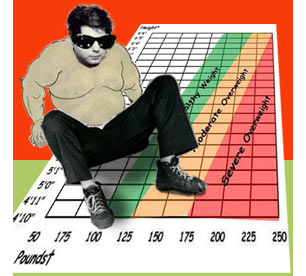
I dug out the old weight tables that were in widespread use 10 years ago (the good old days, it turns out, for fat guys). The tables divide people into male and female, and into small, medium and large frames. This makes intuitive sense — more so, to be sure, than dividing your weight by the square of your height. According to the old tables, a large-framed 5-foot 10-inch man can weigh 180 and still be “normal.” Yet according to the BMI calculation (which gives us 25.8), he’s overweight. For a woman of similar height and frame, the old tables say she’s overweight at 174. Yet her BMI of 24.8 keeps her in the normal ballpark. Minor differences, to be sure, but ones that will send armies of neurotic individuals into a collective panic.

So we’ve been defining obesity down for men, and up for women. That’s probably fair, since obesity is so much more upsetting to women than to men, but I wonder about the science. Indeed, when I pressed several scientists off the record, they did eventually come around to admitting that the statistical underpinnings of the BMI indicate differences for men and women.

The medical establishment decided, however, that the value of a uniform rule of thumb was more important than perfect accuracy.

But perhaps the BMI is too generous. Dr. Peter Abel of the Cardiovascular Institute for the South says, “I recall seeing weight tables from the first decades of this century that said a 6-foot man should weigh about 150 pounds. Today it’s well over 20 pounds higher, despite the fact that, as a nation, we lead more sedentary lives than our grandparents. That means the additional weight is likely to be fat, not muscle.”

Either way, it’s probably wise to be very suspicious of any medical diagnosis performed via the Web by a Teletubby-shaped JavaScript calculator with a big heart emblem drawn across its middle. And in the final analysis, measures of ideal weight are pretty meaningless, based as they all are on incomplete data (usually a snapshot of weight on one day of a person’s life with no follow-up measurement) and statistical correlations with no underlying reasons (anybody who thinks humans have an a priori affinity for these purportedly ideal weights has obviously never visited an art museum).

Still, it’s clear, at least to most members of the medical profession, that being obese is unhealthy. Dr. David Allison of the Obesity Research Center at St. Luke’s/Roosevelt Hospital in New York estimates the death toll attributable to obesity at 280,000 annually. Likewise, the diseases correlated with obesity (diabetes, hypertension, coronary artery disease, etc.) are legion, and the AMA predicts that “our health-care system will increasingly be overwhelmed with individuals who require treatment for obesity-related health conditions.”

We all know at least one fat guy who has had a heart attack and is now trying to reform. It’s a familiar story: The fat guy has the heart attack and then, while lying in the hospital in fear of imminent death, the doctor (who has a too-infrequently indulged flair for the dramatic) appears. The doctor, in full angel-of-death mode, reads the fat guy the riot act: Go on a diet and start exercising … or die.

So powerful is this image in our culture that, whenever a fat guy has a heart attack, people simply assume it’s because he was fat. “He was a heart attack waiting to happen,” is what they’ll say about me if something else doesn’t get me first. But whenever a thin guy has a heart attack (as many thin guys do each day), people are overwhelmed by cognitive dissonance. When my father, thin as a rail and extremely conscientious about nutrition, died at age 58 after a 10-year battle with heart disease, everybody protested, “But he was so thin!”

But self-fulfilling prophecies are not facts; correlation does not prove causation; people are not statistics; and the AMA’s obsession with weight has virtually blinded it to other important factors. “Heart disease has a lot more to do with genetics and the lipid profile than with obesity,” says Dr. Felix Kolb, an endocrinologist and clinical professor at the University of California Medical School. “People don’t like to hear it, but there’s a very strong familial incidence of these problems.”

In other words, all men are not created equal and life is not fair. That these are the most obvious statements in the world, however, does not deter those who cling to the illusion of control. They refuse to accept that, in many cases, people’s genes have sentenced them to early death and that, thin or fat, there’s nothing they can do about it. People, Americans in particular, have achieved such a state of hubris that they demand control over death itself.

Even such an independent thinker as Kolb believes that obesity is harmful. But, he reflects, “I just wonder if all these efforts to cure obesity aren’t worse.”

The AMA is skilled at identifying and publicizing health problems, but the organization’s track record with respect to recommended solutions leaves much to be desired. In this case, the AMA’s extreme recommendations — particularly its implicit endorsement of leptin treatment — cast doubt on the credibility of the medical profession as a whole.

Americans, their doctors included, want a quick fix for every problem — a pill to make everything go away. I’m typically the last person in the world to defend Europeans, but in this case we have much to learn from them. Despite their goofy clothes and bad taste in music, Europeans at least understand balance, moderation and a healthy, hearty lifestyle. They eat until they’re full, drink until they’re sated, smoke lots of cigarettes and engage in physical activity only when it’s fun (you never see anybody, except an American, going for a run in Paris). Yet they live longer than we do.

The American panacea du jour is leptin. It’s a hormone that, while not fully understood, is thought to be involved in regulating body fat by modulating ingestive behavior (leptin is Greek for slender.) In a relatively minor study in New York, 70 fat people (and 53 lean ones, who we can only hope were well paid) were required to give themselves repeated, painful, subcutaneous injections of leptin (or, for some suckers, a placebo).

Some lost weight; others didn’t — and a few gained. Because of the study’s weak results, Amgen Inc., the corporate sponsor, chose not to manufacture the drug (although it’s now working on a second-generation drug with similar properties). Yet to read the AMA release and the next-day press coverage you’d think the next miracle weight-loss drug was about to hit the market. There’s little doubt that the AMA will take a “medicate everybody” approach when a seemingly effective weight-loss drug becomes available. It’s as though we learned nothing from the recent Phen-Fen and Redux disasters (to say nothing of the billions of dollars worth of unnecessary and often harmful medical treatment Americans have undergone in the past century).

So, for now, the AMA’s only concrete recommendations are the lame old mantras of diet (with a new, and surprisingly reasonable sounding, emphasis on fiber) and exercise. But pretty much everybody, the AMA included, acknowledges that diets don’t work. We’re talking about failure rates in the 95-percent range. Plus it is well documented that those who fail at dieting often gain to a higher weight. Thus we have the conundrum of obesity: Everybody agrees it’s a problem, and nobody knows what to do about it. So our family doctors, taking their cues from the AMA, continue to prescribe diets even though they know it’s irresponsible to do so. And, given the known failure rates, it may even be unethical to put a patient on a diet.

Moreover, and perhaps more importantly: I hate people on diets. They’re insufferable, self-righteous and invariably cranky. Empowered by the moral imperative of dieting, they believe they are entitled to suspend all rules of etiquette and right conduct. They become bad dinner guests and nightmare restaurant customers, demanding that special meals be prepared for them. They shamelessly comment on other people’s eating habits while self-consciously rambling on about their own. And, when they fail, which they all do, they expect everybody to sympathize, forgive and pretend none of it ever happened.

In a way, medically imposed dieting is a form of torture — the culinary equivalent of sleep deprivation — and dieters are its victims. I forgive them up to a point, because I know their obnoxiousness is largely non-volitional.

I speak from experience. I must confess I’ve been on nearly every diet known to humankind (and some known only to me). Back when I still bought into the myth of dieting, I followed Weight Watchers, the Zone, Dr. Atkins and Dr. Dean Ornish (today, the trend is to be a single-issue dieter: Eat carbs; eat protein; eat both, but never at the same meal). I thrilled to the rapid weight loss of the Atkins diet, wherein I ate two pounds of bacon a day, lost 30 pounds in a month, produced the world’s stinkiest perspiration and tested my urine with keto sticks. I starved myself on Weight Watchers and went to meetings where I weighed in, got a gold star on my “passport” every time I lost 10 pounds and sat around for an hour a week with a bunch of whiny losers who were begging for excuses and absolution.

Throughout my dieting years, I lost and regained dozens of pounds every few months, and my emotional well-being and disposition hinged on a number on a scale.

And, in the end, I concluded that it’s better to be fat and happy than thin and miserable.

Continue Reading Close

“Fat guys kick ass”

If I ate less, I'd lose weight. But I don't, because I love food.

  • more
    • All Share Services

That the world is run by fat guys is no secret (more on this later), yet Americans devote a tremendous amount of time, effort and money to losing weight without ever stopping to consider the advantages of obesity. And the advantages are many — not least of which is that you can eat whatever you want.

I’m a fat guy — always have been. I’m not “big-boned” (surprise, there’s no
such thing), I don’t “carry it well,” and I’m neither “husky” nor “just a
little heavy.” There’s nothing wrong with any of my glands. I’m not a victim
in any way. I’m a fat guy because I eat too much. If I ate less, I’d lose
weight. But I don’t, because I love food (and I even eat food I don’t love,
because I love the mere act of eating). I’m a fat guy, as in I could lose 50
pounds and still be fat, as in I’m 5-foot-10 and 250 very apparent pounds (plus or minus 10 pounds depending on what I ate that day). I’m a fat guy, and I’m not alone.

According to a study published in the May 29, 1998, issue of Science, 54 percent of American adults (and 25 percent of children) are overweight (and that figure is likely skewed downwards by all the people who crash-diet the week before their annual physicals because they know they’re going to get weighed). We, the fat, are the rapidly expanding majority. (The fat population has grown by 33 percent since 1978.) It is the thin who are abnormal.

I enjoy being a fat guy, although I must confess I wouldn’t want to be a fat
girl. The societal deck really is stacked against them (unfairly, I might
add, because fat girls are in many ways superior to skinny ones). But being
a fat guy is great. I’ve never felt that my weight kept me from getting a
job or a girl, or from gaining admittance to a club. And it has many, many
advantages.

Fat guys are strong. Ask any bar owner who hires bouncers, or anybody who
gets in a lot of fights, or any high school wrestler. They’ll all tell you
the same thing: Don’t fuck with fat guys.

Despite the propaganda of 10,000 suburban strip-mall tae kwon do
“academies” and health-club self-defense classes, the simple truth is that
victory in a fight is largely a matter of inertia. “The 300-pound
tub-of-lard beats the 165-pound musclehead every time,” says Navy Lt. Jonathan Shapiro, my brother-in-law and all-around physically fit tough-guy, who spends much of his life recovering from various exercise-related injuries. “Fat guys kick ass.”

In competitive wrestling, if one guy outweighs another by a few pounds, they put him in a different weight class — the match wouldn’t even be fun. Every fat guy is inherently strong, but the ultimate weapon is the fat guy who knows how to fight (aka the sumo wrestler).

Fat guys aren’t as slow as you think, either. I don’t have time to explain
all of Newtonian physics to you, but remember that a body in motion tends to remain in motion. Fat guys may have trouble turning on a dime, but they can move in one direction with great alacrity and effectiveness, as demonstrated repeatedly in every NFL game.

Still, the fat guy is essentially a peaceful creature. War is for the thin.
Fighting requires effort, and minimum effort is the mantra of the fat guy.
Efficiency and economy of movement are the fat guy’s greatest allies. The
thin think nothing of bounding up four flights of stairs, running to catch a
bus or invading a Caribbean nation, but fat guys plan their days around
avoiding these very situations.

But they don’t avoid dating. Dating is eating. Nearly every date centers around a meal, and fat guys are far and away the best dining companions. They are uninhibited eaters, they know all the best restaurants and they know how to cook. Therefore, fat guys are the best dates.

The thin choose restaurants based on ambience; fat guys choose restaurants
because the food is good. The thin may know how to operate a grill (badly)
and make breakfast (badly), but every fat guy intuitively knows how to truss a capon, bake a wedding cake and roast a whole hog.

The fat guy’s love life is inextricably linked to his love of food. For the
fat guy, food and sex are two points on a continuum. No fat guy would ever
dream of making a move on a girl without first feeding her a nice meal — it’s
just not done. And when you’re out with a fat guy you don’t have to worry
about looking like a pig. You can eat whatever you want, because nothing
makes a fat guy hornier than a girl who can devour a big steak (although fat
guys also appreciate skinny girls because they represent leftovers). As an
aside, fat guys can hold their liquor. This is a simple biological fact.
Remember those charts they show you in driver’s ed? How much you can drink is a direct function of how much you weigh.

And who better to bring home to mom than a fat guy? Mothers, especially
immigrant mothers who speak little English and have yet to be co-opted by
American neuroses, love men who can eat. They (correctly) equate eating
prowess with intellect and potential for success.

The fat guy wages a stealthy seduction. The woman sees the fat guy as a
confidant. She thinks the relationship is platonic. Eventually, she marries
the fat guy. Sound familiar?

When it comes to sexual prowess, women in the know prefer fat guys because fat guys are better in bed. The thin and the fit like to demonstrate their manliness by getting on top and banging away, but no fat guy in his right mind would do the equivalent of 100 pushups when he has the opportunity to lie on his back. Plus, do you know what the odds are of a girl getting off in the missionary position? If I have to tell you, you’re obviously not a fat guy. But do you know what the odds are of a girl getting off when she’s on top? Pretty damn good. And with minimal effort (i.e., reach down and help out with your fingers), you can make that a virtual lock (if that doesn’t work, it’s her problem — not yours). For every hard-bodied two-pump-chump out there, there’s a fat guy ready to lie back and provide an erect instrument for as long as need be.

Fat guys are particularly well-suited to being passive sex partners for
fit-and-trim athletic girls who have the stamina to ride all night. You’ve
seen the couples; now you know why. If you want a man who will make the
earth move, a fat guy is still your best candidate (see inertia and
Newtonian physics, above). Remember when Chris Farley and Patrick Swayze had a dancing contest on “Saturday Night Live”? Yeah, you know what I’m talking about.

The best thing is that fat guys sincerely appreciate women who deign to
sleep with them, because every fat guy harbors the deep-seated fear that he’s unattractive. And really, what many women want (more so even than great sex) is to be appreciated. Fat guys are particularly appreciative of
fellatio, because it’s the ultimate in minimum-effort sex, even less
strenuous than masturbation. And fat guys are themselves masters of oral
sex, because their mouths are so agile and in such good shape from all that
eating (and because all they think about is sex, food and maybe Seven of
Nine on “Star Trek: Voyager”).

There was a time in history when, to get respect, you had to be fat. It
meant you were affluent. It meant you were healthy. Now it’s all twisted
around: You can never be too thin or too rich, they say. But while it’s
possible nowadays for anybody on food stamps to maintain an impressive body weight by eating potato chips and Entenmann’s chocolate doughnuts, the fat-as-healthy stereotype is making a comeback — at least in the gay
community — and it’s only a matter of time before straight people catch on.

It’s simple: As my friend David, they gayest guy I know, put it to me,
“Everybody knows fat guys don’t have AIDS. In the gay community, fat is in.”

I pity the thin. They spend their lives fighting the inevitable weight gains
that come with age, butting heads with their chubby destinies. When they
finally get fat, which they all do, they become inconsolable. Their spouses
and partners, terrified by this harbinger of what is to come for them, are
likely to up and leave. The formerly thin die miserable and alone, raging
against the injustice that has befallen them.

The lifelong fat guy experiences no such problems. He’s a rock, a source of
stability for all around him. He was fat as a child and remains fat. He
looks no worse in middle age than at age 20, and therefore his lifetime of
fatness keeps him looking young (plus, it is well-known in the
dermatological community that fat equals fewer wrinkles).

I was a fat kid, and I took some flak for it. But now, as I enter my
30s, all my formerly svelte friends are getting fat — and I’m having the
last laugh. As my long-lost friend Andy said to me 10 years after we
graduated from high school, “You guys who were fat in high school are the
only happy people at the high school reunion — we’ve all gotten fatter; you
look the same.”

Now, I’m enjoying my life, whereas my slowly ballooning friends are consumed by the battle against fat. They climb pretend stairs, “spin” on pretend bicycles and run for dear life on treadmills. They deprive themselves of bodily pleasure, engage in self-indulgent and self-righteous fad dieting (no meat one month; no carbohydrates the next) and are otherwise miserable companions. They are particularly insufferable at the dinner table, because they are driven by an irresistible impulse to deliver a running commentary on the nutritional and medical ramifications of every bite they (and I) eat.

Yet, self righteous though they may be, the joke’s on them. Thinness is an
unattainable goal. We’ve all seen the charts and tables — you know, the ones
that say the “ideal weight” for a 5-foot-7 man is 138 pounds. Maybe that’s what people weigh in television fantasyland, but, according to Kathryn Putnam Yarborough, a therapist at the Center for Eating Disorders at St. Joseph Medical Center in Towson, Md., “Less than 5 percent of the
population, healthfully and genetically, can expect to achieve the shapes
and sizes the media portrays as ideal. The media holds this unrealistic goal
up to us and suggests that we try to reach it. No wonder so many men and
women are struggling with body-image dissatisfaction.”

I have a seemingly convincing excuse for being fat: I’m a restaurant
reviewer. I’m supposed to be fat. But being fat requires no excuses and,
truth be told, most restaurant reviewers are skinny — which perhaps accounts in part for the current sorry state of the food press. Never trust a skinny chef, even less a skinny restaurant reviewer. Would you believe it has now become commonplace for restaurant reviewers to negotiate gym memberships as part of their employment agreements? It’s a latter-day myth of Sisyphus.

Speaking of myths, Western culture’s belief that thin is better is a rejection not only of common sense but also of basic human instinct. Children and animals (the most anthropologically pure subjects available) love fat guys. Watch the baby’s face light up when it sees a fat guy. Watch the dog beg for a fat guy’s attention. They understand.

Non-Western cultures, which invariably have less emotional baggage than ours, revere fat guys. The fat Buddha is worshiped the world over. Only in
self-flagellatory Western religions are our idols so anorexic. Look how
skinny Jesus was. Look what happened to him.

- – - – - – - – - – - – - – - – - – - -
-

But, you say, being fat is unhealthy.

The thin see this as the trump card in any discussion of weight. But even if
the statistics are true, even if being fat is unhealthy, can we really do
anything about it? Despite the $33 billion a year that Americans spend on
weight-loss programs, the Federal Trade Commission reports that 95 percent of the 50 million Americans who will go on diets this year will fail. Even better, according to the Center for Eating Disorders, “33-50 percent of these people gain to a higher weight,” which means we’re talking about a serious waste of money.

Although near-constant attention is paid to the health risks of being fat
(the National Institutes of Health says that “someone who is 40 percent
overweight is twice as likely to die prematurely as an average-weight
person,” and the American Heart Association calls obesity a “major risk
factor” in heart disease), the consequences of the war on fat are largely
ignored. Yet the unquestionable harms of eating disorders and
diet-drug abuse surely must be weighed against the largely speculative harms attributable to weighing more than the “ideal” weight. For example, The Center for Eating Disorders’ records indicate that 8 million Americans suffer from anorexia, bulimia and various other disorders — and 20 percent of these people experience premature death.

Moreover, the one statistic glaringly missing from most mortality studies is
quality of life. How much happier is the person who lives life free of the
constant pressure of negative body-image and fad dieting? How many days,
months or even years of life is that happiness worth?

Still, perhaps there is another explanation for the statistics.

Have you considered that the so-called evidence on weight and mortality has
been fabricated? That a secret brotherhood of fat guys has engineered what
can only be described as the most effective disinformation campaign in human history? That fat guys want to keep you thin, miserable, afraid and
powerless so they can enjoy the fruits of your labor?

Think about it. Fat guys sit around and eat whatever they want. Meanwhile,
they tamper with the statistics and use fear of obesity to sap the thin of
their energy and will. They keep the thin exercising and distracted, like
rats in a maze, like gerbils on a Habitrail.

This master plan also includes a carefully cultivated image that allows fat
guys to manipulate the thin into doing their work. The fat guy sits behind a
desk all day, most likely screwing his secretary, while the secretary’s
athletic husband is out fighting fires (fat guys have made it very difficult
for themselves to pass the firefighters test), protecting democracy (fat
guys have arranged it so that the military will not accept overweight
recruits) or otherwise creating wealth for fat guys to exploit. The fat guy
holds the ladder while the thin ascend, risking life and limb to do the fat
guy’s bidding.

Actors are thin; producers are fat. Candidates are thin; chiefs of staff are
fat. The fat guy retreats from the spotlight, content to be served. Content
to rule the world.

And so, the next time you see a fat guy eating a double cheeseburger or
struggling up a flight of stairs, do not pity him. Be afraid. Be very
afraid.

Continue Reading Close

Page 2 of 2 in Steven A. Shaw