It’s after midnight aboard the glittering pleasure boat Nile Maxim when the Nubian lounge singer finally finishes his set with a quavering rendition of “Feelings.” Abruptly the lights dim, and the musicians switch off the electronic keyboard to take up the ancient rhythms of the reque, the rebaba and the tabla drum.
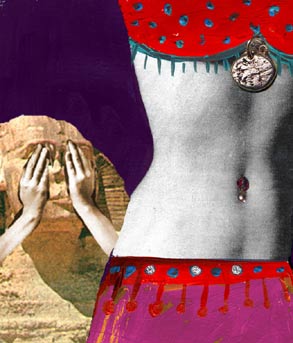
As the audience begins clapping, the Queen of the Night glides barefoot onto the stage, arms floating above long, auburn tresses, red-painted fingers flickering like snakes’ tongues in the smoke-filled air. Considerable cleavage quivers within the confines of a silver-beaded bikini top whose central tassel shimmies and shivers in a little dance above the siren’s navel. Dusky thighs flash from a gauzy slit skirt, while one hip, then the other, circles forward, accelerating into thrusts so violent and impudent that an Egyptian man seated next to the stage suddenly starts backward as if struck.
A quick costume change, and the dancer returns with a rhinestone-encrusted cane, swinging it overhead, balancing it on her left breast, left hip and the curve of her buttocks. Grasping the tips between her fingers, she rolls the cane up and down over her lower pelvis then arches her back underneath, finally balancing it over her fishnet-stockinged belly button for a series of suggestive lifts. Once performed by peasants with staffs cut from the sugar-cane fields, this 21st-century dance looks less like an ancient fertility rite than a time-warped vaudeville act, a combination of cheerleader baton twirling, a Caribbean limbo contest and masturbation.
It’s all entertaining enough, especially for tables of foreign tourists who have no idea that the dark-haired, dark-eyed belly dancer prancing before them is no genuine Oriental houri but a self-trained British import, Liza Lazizah.
“Cairo[, Egypt] is the mother, the central nervous system of Oriental dancing,” Lazizah tells me over a cigarette after the show, describing her career trajectory from minor clubs in Syria, Tunisia, Jordan and Abu Dhabi, United Arab Emirates, where she was finally spotted by an Egyptian agent. A throaty voiced Joan Collins lookalike from London, where she first danced at a Lebanese restaurant near Regents Park, she’s finally made it to the big leagues at the age of 36. “I’m not interested in going around tables, getting money stuffed down my bra,” she says, sniffing at foreign dancers who angle for tips from sex-starved fans. “Oriental music gives me goose pimples. When I first heard it I was totally mesmerized. It was like a call from God.”
Cairo may be to belly dancing what Hollywood is to movies and Broadway is to theater, but go to any dinner club these days and the belly dancer is likely to be an ingenue from Russia, Australia or Scandinavia. It’s not so much that today’s fans prefer foreign talent but that Egyptian women are abandoning the profession in droves.
In 1957 some 5,000 belly dancers were registered with the Egyptian government, compared to just 372 today. Islamic fundamentalism has forced a generation of Egyptian performers to retire and take the veil, and while package tours remain a captive audience, local interest is drying up because youngsters raised on MTV think belly dancing is old-fashioned and prefer to dance their nights away in discos.
Dwindling economic returns have led every five-star Cairo nightclub but one to close their doors, forcing the three most famous Egyptian dancers, including the 50-something Fifi Abdou, to branch into films and lucrative private weddings. Their fees — $10,000 an hour and up — are so high that rich Cairene families have been known to save money by flying in entire Brazilian dance troupes or American music groups like Kool and the Gang.
At a handful of remaining belly-dancing venues — dinner cruise boats, second-rate hotels and a string of seedy nightclubs along the main road between the Nile and the Pyramids — Egyptian impresarios increasingly showcase foreign Pygmalions. The growing cadre of outsiders includes Samasim (Little Sesames), a voluptuous blond from Sweden; Soraya, a former medical doctor from Uzbekistan; and Asmahan, an Argentine with a Latin backup band.
Connoisseurship requires a peripatetic nocturnal lifestyle and dedication verging on outright masochism. The low point of my survey of the belly-dancing scene takes place in a dive called the Cave des Rois. Swatting mosquitoes, I down Tylenol gelcaps and $15 beers while listening to a Ricky Martin clone belt away in Arabic. At 2 a.m., a silicone-enhanced Venus with Botticelli hair wiggles onto the stage. Scrunched into lime-green spandex, her Vaseline-smeared breasts conspicuously fail to jiggle along with the rest of her anatomy. Her gum-chewing performance is so lackluster that a bored client from the Arab Gulf, who has been waiting all night to throw money at her feet, grumpily tosses his wad of Egyptian 10-pound notes and leaves.
While die-hard fans wax lyrical about the great Egyptian stars of the past, the better foreign dancers are bringing respectability to a profession most Egyptians view as one veil short of prostitution. “Ninety percent of Egyptians see belly dancing as shameful,” says Essam Mounir, a 37-year-old agent who has taken on Russian dancers for lack of local talent. “Foreign women are educated, they are not maids or poor girls looking for rich husbands and they show up on time and love to dance,” he says. “But as for feeling our music, not one of them really gets it.”
“I book foreigners for variety’s sake and because they cost less,” says Samy Saad, 47-year-old entertainment manager at the Nile Maxim who pays foreign dancers $220 a night, including their musicians’ fees. But he snorts at rivals who hire dancers from, of all places, Japan. “Those Japanese girls have pretty faces, but they are so little you can barely see them under their costumes. I’m sorry to say it, but size matters.”
As a result of foreign influence, the authentic raqs al-sharqi, or Oriental dance, has given way to a weird hybrid incorporating flamenco riffs, hand gestures from Tashkent, Uzbekistan, or the techniques of Martha Graham. But it’s by no means the art form’s first era of cultural cross-fertilization.
Derived from ancient fertility rites, professional belly dancing enjoyed its first seedy heyday in ancient Rome, where the satirist Juvenal described Syrian dancing girls as “nettles to whip rich men to live.” The hypnotic dance was “very different from what I had seen before,” commented English traveler Lady Mary Montagu in 1717. “Nothing could be more artfull or proper to raise certain Ideas, the tunes so soft, the motions so Languishing, accompany’d with pauses and dying Eyes, halfe falling back and then recorvering themselves in so artfull a Manner that I am very positive the coldest and most rigid Prude upon Earth could not have look’d upon them without thinking of something not to be spoke of.”
The eroticism of the dance itself didn’t disturb Egyptians. What scandalized them instead was the shame of Muslim women performing unveiled (and often naked) before infidels. Inspired by Napoleon’s 1798-1801 expedition, a flood of Western travelers arrived in Egypt in the early 19th century. So many dancers crossed the line into prostitution that in 1834 Mohammed Ali, Egypt’s Ottoman ruler, exiled them from the capital to towns in Upper Egypt, where they became as much a tourist attraction as Pharoanic temples.
On March 6, 1850, the Damascus-born dancer-courtesan Kuchek Hanem entertained Gustave Flaubert at her house in Esna. He praised her lovemaking but found her dancing “brutal … far less good than Hassan el-Belbeissi, a male dancer in Cairo.”
Turkish boys in drag filled the belly-dancing vacuum in Cairo until 1866, when Mohammed Ali’s successor, Ismail Pasha, brought female dancers back to the capital to boost the national economy. Recognizing that dancers were earning huge sums from foreign tourists, he taxed their wages, earning the nickname “Pimp Pasha” from expatriates. About the same time, Western showmen began bringing Eastern dancing girls to Europe and America, culminating at the Chicago World Exposition of 1893, where the performances of Little Egypt attracted more notice than a 70-ton telescope.
Belly dancing became hip again in Egypt in the 1930s, not so much as the rediscovery of an ancient art but as a Hollywood-influenced nightclub act. The dance achieved a new Golden Age in the 1940s and ’50s, fed on the flowering of Egyptian cinema and the showstopping charisma of stars Samia Gamal and Tahia Carioca.
Today, the purist Oriental dance probably survives in Middle Eastern homes, where men as well as women still learn the sensuous moves and listen to the lovelorn music from childhood. But the bad-girl reputation remains so deeply entrenched that few women would dream of dancing on stage.
Egyptian government regulations underscore this ambivalence. Belly dancers may not appear on television, speak during live performances or join customers after a show. A vice squad conducts nightly inspections to make sure costumes are decent, meaning that no thigh should show when the dancer is standing still.
“I’m a woman like any other with a husband, a child and a profession that requires a lot of hard work and sacrifice, and yet the government won’t let me appear on TV,” laments Dina Talaat Sayed, an Egyptian star with a master’s degree in philosophy from Aim Shams University, who routinely breaks the law by lip-synching Arabic love songs with her navel. (The government officially requires full belly-button coverage.)
“I’ve never done anything immoral in my life,” she tells me over tea in her tony apartment, cradling her 4-month-old son. “I’m invited to give workshops in Finland, and yet here I’m treated like a bad person. No wonder there’s no new generation.”
In contrast to the conservative Middle East, belly dancing has become a fad in the body-conscious West, judging by the number of Internet sites celebrating belly dancing as a form of aerobic exercise, a path to spiritual fulfillment and even a child-birth technique. Foreign teachers flock to Cairo with their students, hooking up with local travel agents to promote belly-dancing package tours.
“It’s one of the few dances where you have more to give as you get older,” says Angela Tromans, the British Embassy’s raven-haired Cairo receptionist, who moonlights as a belly-dancing teacher for Rubenesque expatriates. “All the bittersweet things of life can be expressed. It’s not about being Egyptian or foreign, it’s about music, sensuality and improvisation.”
And about dressing up. Overseas demand for “I Dream of Jeannie” harem pants, hand-beaded bustiers and slit skirts is now so high that the handful of remaining belly-dancing couturiers are growing rich off exports. “Ninety-five percent of my customers are foreign,” says Ahmed Dia el Dine, the John Galliano of costume designers, waving a sheet of faxed orders from Australia in his atelier on Cairo’s Mohammed Ali Street.
“It’s true the style is no longer truly Oriental,” he sighs, showing me an antique Turkish costume made from strings of rose-cut diamonds and an old piece of embroidery with the word “Allah” sewn in silver sequins. “Thirty years ago it took 35 meters [38.5 yards] of fabric just to cut the skirt for a dancer; it wasn’t about naked thighs but the swirling of the cloth around the female body. The overseas customer just wants to show her flesh. I can design a costume that uses just two meters of fabric, but I struggle to avoid pornography.”
“Still, I wish more Egyptians shared this enthusiasm for Oriental dancing,” he says, pointing to autographed photos of grateful clients in Israel, Denmark and Austria. “But the situation has started to improve. I know this because Egyptian brides have started coming to me. They order belly-dancing costumes for their trousseaus.”
Climb to the top of the 13th century Qalaun mosque, in the heart of Fatamid Cairo, and survey the intersecting worlds of faith and commerce. Hundreds of Islamic monuments — a pointy hodgepodge of pepper-pot towers and pumpkin-domed minarets — punctuate a maze of alleys with names like “the street of the coppersmiths” and “the street of the tent-makers.” Along with the muezzin’s call to prayer, sounds from the Khan al-Khalili bazaar rise into the mote-filled air. The melodic exhortation “Allah-hu Akbar” (God is great) mingles with a chorus of touts perpetually eager to sell perfume and busts of Queen Nefertiti to a parade of dazed Western tourists.
Now let us descend from our minaret balcony to the Moski, a vast market where devout Muslims come to shop after noontime prayers. Dodging water-sellers and small boys carrying trays of sweet Arabic coffee, groups of veiled women browse among baskets of spices, bolts of cloth and gold jewelry for dowries.
The women pause before a pushcart bearing a mountain of colored silk and nylon. What’s that woman holding up? Why, a G-string and a black-lace teddy.
That’s right, an open-air sexy underwear souk thrives in the heart of Islamic Cairo, a few brazen footsteps from the Sayyidna al-Hussein Mosque. The mosque is home to the largest congregation in Egypt and a shrine where a head, believed to be that of the Prophet Mohammed’s grandson, Hussein, is interred. To a Western eye, the contrast seems shocking, as if Frederick’s of Hollywood had opened an outlet right next to the Vatican.
Jumbled on pushcarts or hanging from shop fronts is enough lingerie to dress a millennium’s worth of Playboy centerfolds or, given the prevalence of size XXXL, the entire buxom oeuvre of film director Russ Meyer. We’re talking bras with silver nipple tassles, plunging bustlines and feather boas. We’re talking see-through bathrobes, skimpy nighties and fire-engine-red panties with thigh slits up to here.
The vixens shopping for these alluring undergarments prefer a more conservative fagade: even in 95-degree heat they’re wearing shapeless floor-length dresses, tightly fitting headscarves, long sleeves and even gloves. More than a fashion statement, this is a dress code: no exposed flesh, no uncovered hair.
The West generally associates the veil with fundamentalism and repression, with the public morality police in Iran, Saudi Arabia and Talaban-run Afghanistan. But for veiled Egyptian women, it seems there’s no contradiction between public decorum and private eroticism.
And why should there be? Classical Arabic has more than 60 words for love, connoting all the pleasures and pangs of its experience, from longing and insomnia to raw passion and quenched desire, from galantry and seduction to nostalgia and regret. Medieval Arabic literature is full of erotic verses, such as this one from the “Tales of the Thousand and One Nights”: “She wavered her garments, exuding saffron, amber, musk and sandal … he took her feet and kissed them and, finding them like fresh cream, pressed his face on them.”
Nineteenth century Europeans lapped up all this voluptuous exoticism and regarded the veil as the talisman of a hidden and powerful sexuality. This impression was no doubt aided by the enthusiastic accounts of French author Gustave Flaubert, who arrived in Cairo in November 1849, and immediately went trolling for prostitutes, and by the works of British explorer and Arabist Sir Richard Burton, who entertained a generation of sex-starved Victorians with annotated translations of Oriental sex manuals, including a 15th century Arabic handbook, “The Perfumed Garden.”
Isabelle Burton considered “The Perfumed Garden” particularly pornographic. Upon her husband’s death she cloistered herself in his room and burned his master copy, along with three decades’ worth of notebooks and private journals. This massive act of censorship took her 16 days and superceded the actual funeral arrangements. She apparently found Burton’s unexpurgated translation of “The Thousand and One Nights” less objectionable. Despite detailed accounts of copulation, this six-volume work survives, along with innumerable ribald passages, such as “He sheathed his steel rod in her scabbard … whilst she with him ceased not from inclination and prostration and rising up and sitting down, while accompanying her ejaculations of praise and of ‘Glory to Allah!’ with passionate movements and wrigglings and claspings of his member …”
Late-20th century Egyptian society remains deeply conservative, especially where relations between the sexes are concerned. Women aren’t ordered to remove their lipstick as in Iran, but Egyptian law does require belly dancers to cover their navels. Explicit sex scenes in movies? Forget it. A court recently charged Egypt’s most popular actress, Youssra, with adultery and public indecency after she appeared in bed with a male actor in a publicity shot for the film “Hassan and Aziza: A State Security Case,” despite the fact that the movie itself had already been vetted by government censors. Islamic lawyers also took her to task for wearing a sheer outfit in an earlier film, “Birds of Darkness.”
“It is important to consider the context under which a movie poster features a man and a woman in one bed,” says the 43-year-old screen siren, who denies that the main idea was to suggest an unmarried man and woman making love. “They are shown terrified, surrounded by policemen toting guns. There is no way that the scene will arouse lust.”
Though such Draconian interpretations of Islamic Sharia law might suggest otherwise, the Koran contains no restrictions on married sex (or almost none, as the Muslim holy book discourages fornication with the head or rear end facing Mecca and expressly forbids necrophilia with one’s spouse). Indeed, the Koran praises physical beauty as an attribute of God; according to its precepts, sex is a duty and an act of faith — so long as it is conducted between husband and wife.
Though the Koran commands women to lower their gazes and “throw their veils over their bosoms” in public, it encourages them to shed such inhibitions in the home. The prophet, who took at least seven wives, promoted marital tenderness and sexual enjoyment. According to the hadith — the massive body of anecdotal traditions and sayings compiled by his followers — he even advised Muslim men to engage in foreplay: “When any one of you has sex with his wife, then he should not go to them like birds; instead he should be slow and delaying.”
Judging by Cairo’s underwear souk, today’s faithful are happy to obey their prophet’s call to conjugal bliss. Happy to the tune of $10 million in annual sales, according to Adel Akl, marketing manager of the French-Egyptian joint venture Valisere, which commands 60 percent of the Egyptian lingerie business. “Only 20 percent of our models are conservative,” he says. “The rest, how shall I put it, are more daring.”
Not surprisingly, many sexy underwear shoppers in the Moski claim to be preparing for their honeymoons.
“My fianci asked me to get something nice,” says Nagla Al-Safi, a dark-eyed 22-year-old from Port Said who has come to the Egyptian capital with her mother and niece to pick out a dozen nighties and bathrobes for her trousseau. “As he’s my future husband, I don’t feel embarrassed,” she says, checking the price tag on an emerald green negligee. “God doesn’t restrict the relationship between man and wife.”
“They don’t just buy one thing, they buy several, and the mother usually takes the opportunity to buy a little something for herself,” confirms Sarwat Munis, a 24-year-old salesman who moves about $15,000 worth of merchandise each month. The most popular item in his shop is a violet lace bodice, accented with hot pink fringe. It sells for 25 Egyptian pounds, or just over $7.
Munis doesn’t see any problem helping an Islamic woman pick out a hot little number for a night of love. “I don’t get embarrassed,” he says. “First of all, I’m Christian. Second, I tell myself, this woman is like my sister.”
“Naturally, not every woman is a youngster, and not every woman who says so is a bride,” winks Salah Al-Shaboul, a grandfatherly merchant who has been selling teddies with names like “Fires of Jealousy” from the same pushcart for 40 years. “There are certain principles of the sexual relationship that I cannot discuss in detail. There are women who like to let their hair down and some who don’t. But that doesn’t have anything to do with Islam. It has to do with flirting.”
“In Europe today,” he continues, “sex is out in the open, but it is cold and faceless, and you can see it at the movies or do it in the street. In our country it has remained something intimate and secret, and therefore it’s more appreciated.”
Continue Reading
Close
It’s called the City of Light, but as my husband, young daughter and I
discovered when we moved here three years ago, Paris is also a city of
carousels. One of our favorites spins in a corner of the Champ de Mars,
the old military parade ground, between a playground and a small
refreshment stand. On Wednesday afternoons and weekends, two dozen
hand-painted wooden horses bearing names like “Baba” and “Bijou” emerge
from their “stable” (actually a locked green shed) to be suspended from
hooks off a circular wooden frame. Built in 1913, this antique carousel
remains powered by a simple hand crank. Pint-sized riders can request a
wooden stick or “baguette” to joust with the ring man, who stands on a
platform loading dozens of tin circles into a medieval-looking feeder.
Visit the Mona Lisa in the Louvre or all those Impressionist masterpieces
in the Musie d’Orsay? Our 6-year-old daughter, Sophie, still prefers the
ring game. Fortunately, almost every park and public square in the French
capital features a “manhge,” or merry-go-round, including at least a dozen
survivors from the Belle Epoque. We’ve evolved a family quid pro quo: An
afternoon of museum time or other culturally enlightening indoor fare, or
simply a long, lingering Paris walk, earns a side trip to a carousel.
We like the manhge in Luxembourg Garden, whose turn-of-the-century,
weathered wooden menagerie includes a camel, an antlered reindeer and a
solemn gray elephant, none much larger than a golden retriever. While my
husband and I munch sugar crepes and keep lookout for French movie stars
and their offspring, Sophie buckles a leather safety strap around her waist
and concentrates on spearing rings at high speed (an electric motor has
replaced the carousel’s original hand crank). In the leafy Jardin des
Plantes, we’ll follow a tour of the the newly renovated Natural History
Museum, the Mineral Museum or the dinosaur-filled Hall of Paleontology with a
turn on a contemporary merry-go-round of extinct and endangered creatures
featuring a wistful Dodo, a bright green Tyrannosaurus Rex and a leaping
phalanx of proto-giraffes. At the foot of the Eiffel Tower, flower-draped
donkeys cavort with palanquin-bearing lions under a midnight-blue canopy
painted with golden stars. Just across the Iena bridge, not far from the
Trocadero and the Museum of Mankind, we sometimes find newlyweds posing on
a double-decker carousel of prancing horses, wooden swings and rocking
sea-scallop carriages.
At eight to 10 francs (about $1.30-$1.60) per ride, an afternoon of Paris
carousel-hopping isn’t cheap, especially when all three of us want
multiple spins. But just as on the Metro, you can usually buy a packet of
tickets at a discount. On our outings my backpack is a jumble of plastic
tokens. Just as spearing rings has gotten easier with practice for Sophie
(current record: 17), I’ve developed a system of color-coded envelopes that
help me keep track of which ticket goes with which merry-go-round in which
arrondissement.
Our carousel expeditions brighten the long, gray winters, and
Christmas brings a special treat: The Mairie of Paris, which allocates
citywide merry-go-round concessions to private owners, offers a week of
unlimited free rides between Christmas and New Year’s as a holiday gift to
“les citoyens.” Foregoing museums altogether, we head for the Place
Willette, at the foot of the Sacre Coeur steps, to line up for free turns
on an Italian-built carousel, whose painted ceiling features Venetian
canals, but whose stampeding horses (made of plastic) boast pink and blue
eagle feathers and an American Wild West theme. In the Place
Saint-Sulpice, Philippe Campion, head of an amusement park dynasty, sets up
a merry-go-round built in England in 1871, at the beginning of the steam
era, a precursor of the giant “salon” carousels popular at the end of the
19th century. The elaborately decorated wooden chargers have wild, flaring
eyes and double-seated saddles, and they rotate clockwise, contrary to their
continental counterparts. This summer, as always, this migrating
merry-go-round has reappeared in the Tuileries Garden, site of an annual
July-August carnival called the Foire du Trone.
American cities have one or two merry-go-rounds, if any. In Paris,
carousels are so much a part of the landscape that you find them not just
in parks and squares but inside supermarkets and fast-food restaurants like
McDonald’s. When our list of outdoor favorites reached 25, I began to
wonder, why such a cornucopia? The answer, it turns out, has to do with a constellation
of factors, including France’s reverence for tradition, a clement Parisian
climate, a habit of indulging small children and, of course, history.
“The carousel is a French invention,” says Zeev Gourarier, a curator at
the National Museum of Folk Art and Popular Traditions in the Bois de
Boulogne. Children across the capital and in towns and villages throughout
the country ride wooden horses and play the “jeu de bagues” because of a
tragedy that occurred in 1559: the accidental death of Catherine de
Medici’s young husband, King Henri II, during a jousting tournament. To
make equestrian games safer, says Gourarier, Renaissance knights stopped
jousting against one another and turned their energies to spearing rings,
scything the heads off effigy Turks and seeing how long they could
make a straw dummy spin.
The idea of mounting wooden horses on a rotating frame dates to the
17th century; the word “carrousel” (the French spelling of “carousel”), if not the actual invention,
dates to an immense equestrian festival Louis XIV held in the courtyard –
the Place du Carrousel — of the Louvre. Partly to entertain 15,000
cooped-up nobles when he moved his court from Paris to Versailles, the Sun
King had his engineers design the first documented rotating merry-go-round,
a four-seater with gilded chairs for ladies and horses or swans for the
men. Indeed, Versailles, with its fireworks, dancing fountains and other
royal amusements, was the Sun King’s private Coney Island: The world’s
first roller-coaster, a huge, gilded chariot pulled along a rail, made its appearance there, as did the gondola swing sets called Bateaux des Pirates
that are still found in many Parisian parks today.
By the end of the 18th century there were merry-go-rounds in at least
three public gardens in the capital; in the wake of the French Revolution,
the merry-go-round, like other aristocractic entertainments, was finally
becoming accessible to the masses. According to Gourarier, the current
plethora of permanent carousel emplacements stems from the Second Empire
and Baron Haussmann’s green campaign (he added 24 squares and three large
parks to the city), as well as from the traditional sites of “fjte
foraines,” seasonal carnivals that originally sprouted up across the city
during the Middle Ages but reached the height of their popularity at the
end of the 19th century.
“Of course no one today remembers any of this,” Gourarier sighs as we
pour over engravings of the Sun King’s contraptions in his office. “France
is a hierarchical society, which values the fine arts in museums like the
Louvre. Our children ride them every day without realizing that carousels
also represent a valuable and interesting part of our patrimony.”
Interest is so lacking that the Museum of the Fjte Foraine, at Bercy,
which houses one of the world’s best collections of merry-go-rounds, does
not receive enough vistors to justify daily opening hours. It’s worth a
visit by private appointment to see the many examples of the different
styles of merry-go-round animals that developed throughout Europe and to
experience 30 rare but still-working 19th century amusement park
attractions, including 14 carousels, one of which is made entirely of
wooden bicyles.
In between curating duties, Gourarier spends much of his time trying to
convince the French government to block the export of dismantled carousels
to private collectors in the United States. When I hand him a map
of Paris, he points out surviving public merry-go-rounds of museum quality:
a cavalcade of horses at the Forum des Halles hand-carved in 1900 by the
Limonaire brothers, also known as manufacturers of carnival organs; a
carousel in the Bois de Vincennes whose every animal (mainly pigs) is the
work of Gustave Bayol, the French merry-go-round master, active in Angers
from 1887 to 1909; and the merry-go-round in the Square de Batignolles built
by Bayol’s successor, Henri Devos. Originally a glove-maker from Belgium,
Devos worked in Bayol’s atelier but was also influenced by 20th century
popular culture, particularly early animated Disney films. The Batignolles
carousel is a strange but charming amalgam, with a canopy hand-painted
with roses and portraits of Belle Epoque children and a menagerie of
scraggly 1920s Plutos and Mickey Mouses.
On a recent summer Sunday we embarked on a mission to see how many
carousels we could ride in a single afternoon. We started in the
16th arrondissement on a Bayol carousel in the Jardin de Ranelagh,
and then headed for the Tuileries, where a pink and white wedding cake
carousel recalled the animated one ridden by Julie Andrews in
“Mary Poppins.” In the Place de la Ripublique, another double-decker
merry-go-round displayed a fin de sihcle fantasy of charging black bulls
and twin-tailed mermaids (though its more recent sound system blared the
Macarena). After lunch we crossed to the left bank of the Seine to check
out carousels by the Gare Montparnasse and in the Parc Montsouris. The
Metro journeys between each carousel took an average of 15 minutes, far
shorter, we noted, than the wait for most rides at Disneyland Paris.
Our last stop was the merry-go-round in the Parc des Buttes Chaumont,
Baron Haussmann’s eccentric landscape of grottoes and waterfalls carved
from an old rock quarry in the 19th arrondissement. The carousel,
which according to the
gray-haired attendant has been in the same spot for more than 50 years, features oversized versions of small animals –
rabbits, cats and foxes — and fraying strings for tying toddlers to their
backs.
Until this point I had been focusing on differences in canopy styles, music
and menageries. But as we joined the neighborhood’s immigrant Muslim and
Orthodox Jewish families watching smiling children spin past us in the late
afternoon sun, I was struck by my own powerful nostalgia. From the tourist
quarters and the bastions of the French elite, to the Place d’Italie, where
Vietnamese and Chinese families had gathered near a 1950s-era
merry-go-round of helicopters and flying space ships, different communities
had been sharing this same pleasure. The carousel is one of the many
miracles of Paris: a royal toy transmuted not just into a democratic
symbol, but into one of the most enchanting and enduring of our common
childhood memories.
Sophie’s legs almost reached the ground when it was finally her turn to
mount a red-ribboned black kitten. She can always go to the Louvre on a
rainy day, I thought. Thanks to this city of carousels, she’s learning
that culture and history are living entities, and that in Paris children
have their own moveable feast.
Continue Reading
Close
It’s Friday night in Paris, and the cold drizzle has become a driving winter rain, but that hasn’t dampened the spirits of the skaters clumping up the Metro stairs or gliding along the boulevards converging in the Place d’Italie. The Etoile Charles de Gaulle with the Arc de Triomphe may be a tourist icon, but it’s this cobbled traffic circle, in the 13th Arrondisement, that has become a Friday night beacon for thousands of roller-blading Parisians. Under the glare of street lamps and the eyes of a motorcycle-mounted police escort, the group soon evolves into a crowd, a mob, a wobbling horde. Just after 10 o’clock, three sharp whistles signal our departure, and we’re off on a three-hour roller tour of the French capital, tentatively negotiating rough paving stones before whizzing down the rain-slicked asphalt of the Avenue des Gobelins. I notice with some alarm that hardly anyone is wearing a helmet. An ambulance brings up the rear.
The high-spirited pack comprises all the Parisien tribes: teenagers from the banlieues sporting baggy jeans and sweat shirts, middle-aged yuppies kitted out in whole catalogs of expensive sports gear (including sophisticated portable drinking systems, but few helmets) and muscled guys from the Marais wearing earrings, tight shorts and not much else at all. There are families from nearby Chinatown, cigarette-smoking philosophy students and a whole cast of costumed characters who seem to have escaped from some alternative Disney parade: the guy with the Batman cape and mask, the guy with the kilt and bagpipes, the girl with the illuminated cross and skull headband and the guy with the Goofy ears and the portable fanny stereo belting out “I Will Survive.”
I haven’t noticed it before tonight, but the Avenue des Gobelins runs downhill, and as we gain momentum I begin to wonder whether I will survive “Le Friday Night Fever,” as these weekly three-hour roller marathons are known. A flier distributed by yellow-shirted guides advises novices like me not to participate unless braking skills are up to par. A childhood ice skater, I’ve been leisurely blading up and down the quays along the Seine in daylight, practicing my stops by grabbing onto 19th century wrought-iron lamp posts. Now at 20 miles per hour I’m frantically trying not to clip anyone with my wheels. Keeping my eyes down, looking out for warped pavement and broken glass, I narrowly avoid slamming into a parked car.
A blue-uniformed roller cop packing a pistol, handcuffs and a bottle of Evian water on his belt appears at my elbow, telling me to lean forward more and bend my knees. I feel an immediate bond, since, like me, he’s wearing knee pads, elbow pads and a helmet; patiently, he demonstrates the most efficient technique for “le stop,” dragging one skate perpendicular behind the other. I want to thank him for the tip, but my roller savior sprints off to tell some skaters ahead of us to get off the sidewalk, “S’il vous plait!” My mouth falls open, not because I’m panting with effort, but at the irony of a French cop politely ordering citizens to take to the streets and block traffic.
While the government has pledged to create 150 kilometers (about 93 miles) of Paris bike paths by 2001, roller blades have taken the city by storm at the cusp of the millennium. The size of the Friday rallies has grown from 500 to 5,000 in the last 18 months, and the numbers keep getting bigger, even with the onset of winter. The Prefecture de Police, as well as the officials of the 13th Arrondisement, have enthusiastically supported the rallies despite complaints from taxi drivers who say the resulting traffic hampers business.
The roller blade may be an ’80s American invention (the first roller
skate was invented in the 17th century by an eccentric Belgian, Joseph
Merlin), but in Paris the sport has evolved into an amalgam of recreation and public demonstration, all subject to much philosophical analysis. As the roller crowds grow larger,
legislators have been debating whether “les rollers” should be officially
defined as a pedestrian means of locomotion (under article 217 of the Code
Civil), as a means of transport (article 1384) or as something
entirely new. Editorialists, meanwhile, have been discussing the pros and
cons of in-line transportation. “It’s fast, silent and non-polluting!”
endorsed the pro-environment Le Figaro.
“Le roller is not only the pleasure of skating together, but a
philosophy and a social phenomenon,” sums up Boris Belohlavek, a 27-year-old
computer engineer and the president of Pari-Roller, the group that
runs the Friday rallies and maintains a Web site devoted to roller blade
events. “In Paris more than other places, people
feel a need to take to the streets as an expression of freedom,” he tells
me. “They also want to relax after a hard week of work and commuting, to
get out of their offices and especially out of their cars. People from
many walks of life can find themselves together in an atmosphere of
conviviality. That’s the ambience we’re trying to preserve.” Not content
to let all this feel-good energy go to waste, Belohlavek and his associates
recently organized a roller telethon for muscular dystrophy and an AIDS
awareness night, in which hundreds of skater-activists distributed condoms.
“French society has become fragmented, with a certain feeling of
crisis and malaise, and people feel a need to find their way out of their
sense of dissatisfaction and isolation,” suggests sociologist Gerard Mermet
when I ask him to explain the roller mob mentality. Mermet links the
continuing popularity of the roller rallies to France’s World Cup victory
last June, when more than a million people turned out on the Champs Élysées to
joyfully celebrate a French triumph rather than the usual protest sob story
of job cuts, union strikes and other economic woes. “French people are
longing to reunite, to exist as a single group,” Mermet continues. “Yet
roller blading also enables people from different backgrounds to break free
from the dominant social mold. Young people want to be modern and break
with tradition, executives want to feel more dynamic than their colleagues,
parents want to show their children they can adapt with age and the police
want to lessen their image of repression.”
Just a few years ago, roller blades were a rare sight in Paris; skaters,
mainly youngsters, preferred the traditional, less expensive four-wheel
“quad” variety. It took the month-long transportation strike in December
1995 to crack the market, as hundreds of thousands of grown-up commuters
were forced to explore alternative ways of getting to work. In 1997, 1.5
million pairs of roller blades flew off the shelves at Paris stores. The
Friday night rallies, started by a small group of friends, grew from a few
dozen participants in 1994 to more than 5,000 last June. The numbers
inspired the prefecture to create the world’s first roller blade national
police unit.
“It’s the French mentality to control things rather than forbid them,”
says Gerard Chauvet, the cheerful commandant in charge of the eight-man
roller brigade. Chauvet recruited a French
Olympic speed-skating champion to coach the roller cops, whose skills
include blading up and down flights of Metro stairs and making arrests on
wheels. On Friday night the unit divides into two-man teams to
escort the in-line masses, interacting with skaters, irritated
automobilistes and the occasional skateboard anarchist while trying to
prevent accidents. The officers spend the rest of the week patrolling the
capital, dispensing skating tips and catching pickpockets and other
roller delinquents.
“I can really say I’m at harmony in my work,” smiles 36-year-old
Brigadier Pascal Fubini, a former beat cop who now spends eight hours a day
on his Rossignol skates, the nifty sneaker kind with detachable in-line
wheels, which enables him to also pursue people on foot. “I’d like to do
this until I’m 60, if my knees don’t give out,” he laughs. Listening to
him talk about roller blading with his 8- and 14-year-old sons on the
weekend, I reflect that I’ve rarely met a cop who seems to be having so much fun
combining work and pleasure.
Whether you’re chasing criminals, preventing accidents or taking in
the sights, the Friday night skates are a sublime way of getting around
the world’s most beautiful city. After the first 15 minutes of terror,
I’m gliding and slaloming with the pack, the wind in my face, the rush
strangely akin to that of skiing. The route changes weekly, but tonight
we’ll do a 15-mile loop past Notre Dame, Montmartre, Pigalle and the
Place Bastille, winding up back at the Place d’Italie shortly before 1 a.m.,
in the nick of time to catch the last Metro. Hearing that the organizers
get monthly permission from the police to swoosh down the (cobbled)
Champs Élysées, I vow to make Friday night a regular roller date.
We stop for 10 minutes at the foot of the Montparnasse tower to allow
the mile-long crowd to bunch up again, making it easier for the
walkie-talkie linked police and yellow-T-shirted Pari-Roller volunteers to
block intersections and clear away vehicular traffic. While many skaters
take the opportunity to sip mineral water from plastic bottles, even more
are lighting up cigarettes. No head protection, smoke-clogged lungs: It’s
the Gallic concept of health and fitness.
We’re off again into the euphoric night, speeding down the Boulevard
St. Germain, taking a hard left onto the Boulevard St. Michel. Crossing
cobbled bridges to the Right Bank of the Seine, our Tour de France-style
turn onto the Rue de Rivoli inspires cheers and whoops from the roller
crowd. With Christmas lights sparkling in store windows and the rain
glittering off the pavement like an impressionist painting, a spontaneous
shout — “On n’est pas fatigue!” (We are not tired!) — rises into the damp air.
Stunned tourists emerging from late-night brasseries snap our picture,
while on the upper floors of Haussmann-era buildings, bemused weekend
party-goers wander out of lighted rooms onto rain-soaked balconies to wave
and chant with us. It occurs to me that, coming from so many parts of
Paris and so many different walks of life, we could just as well be waving
the tricolor and shouting, “Liberté, Égalité, Fraternité!” The French
spirit thrives on these in-line wheels, on the biggest moving block party
in town.
Continue Reading
Close
“Excuse me, where’s the nearest place I can buy some Tampax?” I whisper.
I’m in Sana’a, capital of Yemen, about to set off on a two-week November desert drive. “My little friend” (and I don’t mean my travel buddy) has arrived earlier than expected. I’ve gone down to the front desk of my hotel to see the reception clerk, who, thank God, is a woman.
“Tampax? What’s that?” she asks, loud enough for two oil workers checking in next to me to overhear.
“Um, you know, tampons. For when you have your period.”
“You mean pads.”
“No, not pads, tampons. The ones you insert.”
She looks at me, pity in her eyes. “Madam,” she confides in a low voice, “in Yemen we do not insert.”
OK, we’re not talking rape, death or dismemberment here, but a Tampax nightmare is one of the worst travel experiences a woman can have. (Men, you may not want to read further.) Tampons inspire insane brand loyalty; one girl’s best friend is another girl’s leaky sponge. But not only does Yemen not have my preferred brand of tampon, they do not appear to have any tampons at all.
In desperation I ask our guide, Mohammed, a tribesman with a curved dagger in his belt and an automatic pistol in his glove compartment, a man who is prepared to protect us from kidnapping, who will keep us safe against thirst and scorpions in the Empty Quarter, who we’ve hired to drive us 10 hours in a Toyota 4-by-4 to the top of a roadless mountain to a fortress village called Shahara — I ask this white-robed man of the desert to take me to a Sana’a pharmacy.
Ten pharmacies, in fact, none of which have tampons, and whose clerks treat me, when I ask for tampons, as if I’m morally and physically tainted. A true gentleman, Mohammed can see my mounting frustration, but I’m too embarrassed to tell him what I’m looking for. “Whatever is troubling you, chew this,” he says kindly, handing me a bouquet of qat. “Qat solves everything.”
A mild stimulant, the Yemeni equivalent of a stiff drink, Qat’s green leaves bind you up, which partly solves another feminine problem: how to shit with dignity in the desert. Squat toilets and rock toilets I’m prepared to handle. And thanks to qat, I don’t have to shit that much at all. But the prospect of going native when it comes to period control is making me crazy, making me consider curtailing this trip. It’s a hot country, Yemen. I’ve packed lots of white.
For a moment I debate going to the American embassy, to ask the diplomats if they have any tampons, or if they can give me a list of expatriate women residents to whom I can appeal for a sisterly loan. Finally I call the Sheraton, an American-owned hotel chain, and ask the guest relations director where I can buy insertable feminine hygiene products. “I don’t use them myself,” she says amiably (she is from Pakistan), “but I believe you can buy them in the big department stores here. Try City Market on Az-Zubeiry Street.” Mohammed and I get back in the 4-by-4, and I ask him to take me to City Market. It’s not so big after all. Zip.
By now I really am desperate, so I give in and buy pads. Not mini-pads with wings, or even pads with adhesive strips. These maternity ward-sized pads have string belts. Like the kind Mom used to use. One word sums up my situation. That word is: yuck.
Even though we stand on the cusp of the new millennium, we women
continue to deal stoically with this immutable fact of our biology, this
evolutionary hand-me-down, euphemistically called the curse, my little
friend, that time of the month or, as the French say, in a revealing
cultural put-down, “les Anglais.” Why do we endure this monthly mess, this
cramp- and bad mood-producing event? Evolutionary biologists believe
periods are the ultimate female weapon in the battle of the sexes, a red
banner telling us when we’re fertile, enabling us, unlike any other
species, to deny sex and children to unsatisfactory males. All I can say
is, too bad they didn’t have home-pregnancy and early ovulation prediction
kits back in the days of Australopithecus.
Ladies, I think you’ll agree: Tampax is the greatest invention of the
20th century. (The tampon was actually invented by the ancient Egyptians,
who made theirs out of shredded linen and gum arabic. Tampax, the first
mass-produced tampon, came into being in 1936 after a Denver physician,
Earl Haas, patented the idea of a cotton plug on a string.) Yes, Jonas
Salk’s polio vaccine has saved millions, and the cell phone and the
personal computer have brought previously inconceivable levels of
convenience to daily life. But could you survive without tampons? Would
you ever leave home without them?
Astronauts don’t (NASA has developed special space feminine protection),
and neither, according to marine experts, should any woman considering
snorkeling or scuba diving in shark-infested waters. Ditto safari camps,
where lions, leopards and hyenas have been known to pull women off trails
and from their beds.
According to Advertising Age magazine, 70 percent of American
women prefer tampons to pads. Unfortunately, that view isn’t always shared
by women in other countries. In Latin America and some Islamic nations,
many women still think tampons will spoil a girl’s virginity. Feminine
hygiene giants Proctor and Gamble, Kimberly-Clark and Johnson and Johnson
are still battling to penetrate the former Soviet Union and China, to boost
their share of the $2 billion global tampon market. Distribution
can be problematic in remote or rural parts of Africa and Asia, where
popular feminine protection consists of rags or handfuls of dried moss. So
if you’re traveling anywhere exotic, without 24-hour pharmacies, pack an
adequate tampon supply.
Here are some international tampon travel tips. In Japan, buy big
sizes; tampons there run small. In France, another popular American
tampon, O.B., goes by the brand name “Nett” (short for Nettoyer, or Clean). According to that bible of women’s health issues, “Our Bodies, Ourselves
for the New Century,” if you’re truly, seriously desperate (or put off by
pads), homemade tampons made of natural sponges or sterilized cotton will
do the trick.
Alas, tampon nightmares don’t end there. There’s technical failure. Use
and abuse. A friend of mine, who understandably wishes to remain
anonymous, was about to go on a romantic sailing weekend with a brand new
boyfriend and his best friends, a married couple who owned the boat and
whom she hadn’t met. The “little friend” came along too. She figured she
could keep her beau at first base, but silly girl, she flushed a used
tampon down the loo. A bunged-up toilet delayed the departure. A plumber
was called out to the boat, and after hours of probing, announced to
everyone what he’d found. Trip canceled, new friends pissed off, romance
ruined.
And what about customs inspections. Ever looked a Syrian border guide
in the eye while he unwraps your Tampax from its packaging? “What is this?
A cigar?” He unwraps another, trying to solve the mystery of the
cardboard tube, cotton package and that funny little string. “Strange
American lady,” he seems to say, though in reality he barks: “What are
these for and why do you have so many?”
Managing menstruation is not that big a deal. Like Nike says, “Just Do
It.” But let me tell you about my other worst Tampax nightmare, which
happened in Lebanon, in 1983, during a tank battle in downtown Beirut. I
was a freelance reporter working out of the offices of the Lebanese
newspaper An Nahar, and when the shooting started I knew I’d be taking
shelter in the basement for a while. Guess who picked this inconvenient
time to arrive? This is a real nightmare: convincing a panicky pharmacist
shuttering his shop to take time out to rummage around for some boxes of
Tampax Super Plus. He’s only got Regular and shoves them at me over the
cash register. “Take them, take them,” he hisses. I quickly decide I can
live, shrapnel being the immediate threat, with less than my desired Tampax
absorbency. Then I discover there’s no toilet in the newspaper’s basement,
only a printing room. Amid the muffled thump of incoming missiles, a brave female
colleague shields me from view while I insert.
For years I thought no one could top this story, until I mentioned it
to my friend Johanna, a graphic designer living in Japan. “Tampons, ha!
What about diaphragms?” she laughed. “A Sudanese customs guy took mine out
of my makeup bag at the airport in Khartoum and waved it in my face. I
didn’t have the heart to tell him what it was or where it had been.”
Continue Reading
Close