Tom Bradley

Turning Japanese

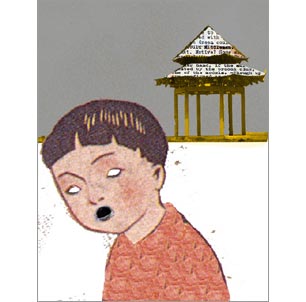
Are Japanese institutions designed to squash curiosity and spawn model citizens?

  • more
    • All Share Services

Turning Japanese

Picture, if you will (as Rod Serling used to say), 75 to 100 narcoleptic zombies. Packed on plywood benches in a room big enough for half that many bodies, they congregate once a week, for 90 un-air-conditioned minutes, for an English conversation class. Maybe Jesus Christ could feed them all lunch with half a bag of potato chips and a can of Pepsi. But I don’t know any mere mortal teacher — regardless of how many master’s degrees he has earned in TEFL and TOOFL and TAWFUL — who could accomplish anything in that situation beyond simpering and adjusting his tie.

Even under optimum conditions these particular narcoleptic zombies would be ineducable. This is Japan, where university students’ inner beings have been reamed out in junior high and high school. Haitian voodoo is no more effective than Japanese secondary education in producing the living dead. Needless to say, the joy of learning is nothing but a one-liner in the universities. And it gets worse.

With the graying of this society (potential baby makers would rather window-shop), there has been a lowering of college entrance standards, unbelievable as that may sound. I used to be the only blue-eyed redhead in the room. But far-Eastern motorcycle punks and their molls love to alter their appearance with bleach and henna and contact lenses of bizarre coloration. When the class bell rings, it looks like the St. Patrick’s Day parade. Or maybe the morning after.

These are kids so deep in the underclass that they have tuberculosis with symptoms. I’m living the national health crisis. I stay hunkered behind the teacher’s desk, next to an open window. I don’t circulate and I accept no papers. It’s impossible to get homework out of them, anyway. You’re not supposed to ask for homework, or any other kind of work, from these zombies. College is the only period of repose they get between the cradle and the crematorium. They’re not expected to learn anything. It’s considered inhumane to ask them to do more than sleep or chat on their walkie-talkies with coevals across the corridor.

The companies that will enslave them upon graduation pay attention only to the numerical standing of the universities that churn them out. The employers assume, correctly, that their new recruits know absolutely nothing, and simply train them from the ground up, starting with proper groveling techniques.

Here’s an anecdote that shows how Japanese universities foster literary endeavor. This short parable will shed some light on perhaps the saddest country in the world, but a happy place for a confirmed scribbler like me, who craves time to write about other, less pointless places. You’ll recall, a few years back, a pair of eggheads at the University of Utah announced that they’d effected cold fusion on a table top. For a couple of days, even respectable members of the scientific community were suspending disbelief. Cold fusion was touted globally during those two days. We were told that the energy needs of the human race had been permanently satisfied by the most important technological breakthrough since Prometheus showed us how to harness fire. The Kingdom of Heaven had finally been established on Earth. It was to be fueled by cold fusion, and it was centered at the University of Utah.

Now, as it happened, on the very days when those tidings of comfort and joy were being trumpeted, I was preparing a group of college students here in Japan to go to a study-abroad program at — you guessed it — the University of Utah. My pupils were to stay at a dormitory located coincidentally within spitting distance of the laboratory where the miracle was bubbling and simmering away on its famous table top. I had only just arrived from teaching in the People’s Republic of China, where students consider education the most fabulous privilege of their lives, and are fond of reminding themselves and each other that it takes the sweat of four peasant families to support one college kid. My Chinese charges were real, honest-to-God university scholars, the type who can be engaged on a roughly equal footing as fellow adults, who give as much as they take from their professors. In the land of Mao Zedong, I had an actual subject matter (literature, not EFL), and I came to know what real teaching is; how walking into class is a pleasure you anticipate all week, and walking out you feel shot full of methedrine.

Naive as I was, coming straight from the genuine higher education system of the Asian mainland, I assumed that my new Japanese students would have similar attitudes and capabilities, and that cold fusion in particular was something that would excite them. Unlike my beloved disciples whom I left behind to die on Tiananmen Square, these Japanese kids had cars and motorcycles, which they cherished and polished. And I figured the radical transformation of the world’s energy supply would be of personal interest to them.

So I mounted the professorial podium with a big grin on my face and began to talk about all the important and exciting things that lay in store on the other side of the Pacific Ocean. I was as brief as possible, because I fully expected to be mobbed at any moment by grateful and thrilled and adoring little people. But I couldn’t seem to get a rise out of them. They only sat there, passive. I was puzzled. Were Japanese as inscrutable as the old stereotype claimed?

I had been emphasizing the scientific and economic angles of cold fusion. Maybe that was a little too tough for them at first. So I tried a different approach. I said (or perhaps shrieked), “Think of it, kids! You’ll be at the nerve center! Electronic broadcast media types from all over the world will be camped right under your dormitory windows!” Not a single eyelid fluttered. It was as if I’d just informed them that the cafeteria was serving fish and rice for lunch.

For maybe the first or second time in my life, I was stunned into speechlessness. They took advantage of that moment of silence to ask a couple of questions: Would MTV be available in the rooms and was there a shopping mall nearby?

And the scales were lifted from my eyes. I suddenly understood this whole archipelago. I had a downright Joycean epiphany, and grasped an essential fact about the land of Pokimon and karaoke. All at once I knew the answer to the question that plagues every foreigner who comes here. How does Japan turn its people into, well, into Japanese? How do you drain a whole people of psychic vigor? How do you render them incurious and intellectually languid, with only nervous energy and shallow greed to fill the mental vacuum?

I already knew why this was done. Everybody knows why. Such people are easy to govern. They’re made-to-order dupes for contemptuous plutocracies, such as the one that runs this country so badly. The answer to the question of how this is done lies in the secondary schools. The educational system is deliberately and cynically designed to serve this end. Starting in junior high, through sadistic amounts of homework and relentless cramming of the short-term memory with arbitrary data, young souls are reamed out like melon pulp, and young minds are robbed of curiosity, which we Homo sapiens are supposed to share with the higher, and even mid-level mammals. Once you’ve killed curiosity, you’ve killed the cat, to turn the proverb upside-down. By the time the poor saps get to college, they are ineducable. Their professors couldn’t have an easier job. It’s like being the night-shift nurse on a narcoleptic ward.

The very term “Japanese university” is an oxymoron, in the sense that, properly speaking, universities exist to stimulate independent thought and lifelong curiosity — the very qualities that, if unloosed on Japan, would cause this whole edifice to crumble. Scrutiny is one thing Asian oligarchies have never been able to stand. An ignorant and incurious populace is a basic requirement for Japanese society, and the educational system couldn’t be better designed to serve such ends. Needless to say, that study-abroad program at the University of Utah flopped as badly as cold fusion, right there on the same campus. But nobody cared or even noticed. It was just another somnambulistic gesture, a riddle with no answer signifying the regulation Zen emptiness. The puerility and sloth of the students, the pure nothingness of the curriculum: It’s all sham and mummery, gutless as a haiku poem.

But I had plenty of time to write this article.

I’ve found a niche in these languid institutions that the natives call, with hardly a smirk, “daigaku,” which means “big schools.”

“Parasite” is such an unpleasant term. I prefer “opportunistic organism.” Where dead things exist, there will be happy worms.

Bathtub revolutionary

An American creative writing teacher in China torches his students' work in the tub rather than hand it over to "the leaders." Was it piety, or the fantasy of a heroic reception back home?

  • more
    • All Share Services

One morning in the middle of my second year in China, the dean of the foreign languages department came tapping at my door with an ultimatum from “the leaders.” I was to surrender my students’ fiction, and be quick about it.

Democracy, or at least the kids’ notion of it, was all the rage. The whole country had been jostled the night before by several mild examples of the demonstrations that would eventually climax in the massacre in Tiananmen Square. A lot of people in China were tense, especially my old dean, who’d lived through several political “movements” and bore the lumps and bumps to prove it. The poor guy was on the verge of apoplexy at my vestibule. After all, he was the one who invited me to this 10th-rate university in the frozen industrial wasteland of the remote northeast, and he was supposed to be keeping an eye on my comportment in the classroom.

Between workshops, a few select graduate students and I had been discussing our pirated offsets of “1984.” Intoxicated by the illusion of freedom that had briefly entered their lives, they’d been writing stories about fat, tyrannous bus conductors, and small-town party hacks lining their pockets in the name of the glorious revolution. These stories, inept as most of them were, had now apparently become objects of intense curiosity for “the leaders.”

The previous year I’d taught in China’s deep south, where the bare mention of Marxism, Leninism or Mao Zedong could be relied upon to brighten a dull lecture with hoots of derision from the back row. My subtropical undergraduates did have a party representative charged with their political and moral nurturing, but he hardly ever showed his face. Those two semesters in the sun had made me complacent, and it wasn’t until the dean showed up at my door that I realized my seminars here in the north had been infiltrated by party spies, who held mere deans on a short leash.

The old man started moaning in my face from the blackness of the corridor. “We are colleagues and good friends, are we not, Dr. Bradley? I’ve told you many times how much I suffered in the so-called Cultural Revolution. The Red Guards made big-character posters about me and placed me under house arrest. They burned all my poems and broke my legs. They forced me to write self-criticisms for a whole year. You are, I suspect, a reasonably intelligent man, and you must understand that you place me once again in a difficult situation. I will be criticized severely for not keeping watch over my foreigners.”

I had heard this at least a thousand times already. Until today it had only been on occasions as innocuous as dinner invitations. But this time, though the words were verbatim, the delivery was different: pure terror. More was at stake here than just his apartment on the fifth floor, where the rats were a little less dense. The dean knew firsthand what “the leaders” were capable of. The adolescent fury of the Red Guards had merely been a surgical instrument in their hands.

“I’ve always dealt honestly with you in all our work together,” he was saying. “And I give you my solemn word, as a fellow scholar and teacher and lover of the English language, that none of your pupils will be persecuted in any way for what they have written.”

I knew that last bit was an outright lie. The leaders did not want to read the stories for their aesthetic value. But I was nevertheless tempted to comply with the order.

I couldn’t afford to be disassociated from the dean and all his editorial connections. He could be a forest-flattening dynamo, despite his dynastic birth date. We may have had our minor differences at the moment, but he and I both preferred collaborating on scholarly articles to doing just about anything else. Back in the good old days, we were quite a duo. Of course, that was before the occidental aberration called democracy came along and spoiled everything. That was before the young people’s spirits were polluted with thoughts of Pepsi and Rambo and disco marathons on Stalin Square.

And now, if I failed to deliver up the stories and, along with them, my pupils, my half of the byline would be purged from all our pending publications. I’d have to retract the fat vita I’d sent to every university and junior college in the free world, and trim it back down to a page and a half. There’d go any justification for dragging my poor, blameless wife to China in the first place.

And what would become of us? Foreign experts detained in the People’s Republic? Interviews on Voice of America, maybe even the BBC World Service? Book contracts? Tenure-track appointments in major first-world English departments? Before I knew it, I found myself praying that the communists would pack me off in chains for a brief but grueling stint at the Qinghai forced-labor camp. My wife could be re-educated in a stuffed toy factory. Think how svelte and employable we’d be upon release! Our deportation could be a big international incident.

Being a husky male WASP from a prosperous far-Western community, and a late baby boomer to boot, I didn’t have much experience with this sort of thing. I was still in high school when the draft ended, and only got in one anti-Nixon demonstration. My experience with police officers was limited to the night I got stuck somewhere outside Provo, Utah, and a highway patrolman gave me a can full of unleaded and $5. So thumbing my nose at totalitarianism — or at least inciting my disciples to thumb theirs — was a new and exciting experience for me.

Occasionally, during those cold Manchurian nights, I’d calm down a bit and ponder the real pedagogical questions that should have been my main concern all along. For example, why had the grad students requested a course in creative writing in the first place? China, after all, is a country in which most full-time novelists and poets live on government salaries, and write accordingly.

This is not to say there weren’t plenty of opportunities for freelance fiction translators. One publishing house after another was bringing out series like the highly successful “Contemporary Masterpieces of American Literature,” featuring Arthur Hailey and Sidney Sheldon and other artists of that caliber. On Saturday afternoons my students would track me down for help in deciphering lists of “culturally loaded” terms that had stymied their progress through works such as “First Blood, Part II,” “Iacocca” and “Nancy and Ronnie, a True-Life Love Story.”

Cheap Mandarin versions of Freud’s more titillating works were being hawked in street stalls, and Lady Chatterley could be had in Shanghai. There was a corresponding flowering of literary magazines, which were responsive not only to the loosening of censorship but to actual market forces. The formula at that time demanded just a little sex. Some of my students were trying to make a few yuan on the side pitching stories to these magazines, and they needed to be coached in the techniques of the soft pornographer. We devoted one whole class period to that very topic.

But was it possible the kids had purer interests in the fiction workshops? Did they actually have something they wanted to say? I considered this possibility with dread, having been indoctrinated in American creative writing programs, in which form equals content and preferably replaces it.

I wasn’t the only one reluctant to deal with kids with a message. The same dean who was now twitching at my door had earlier that year asked me to “introduce Derrida to China” by writing an article for the university journal. Nothing would have pleased his tired soul more than to see English majors all across China safely off the streets, wrapped up in fluffy hermeneutic conceits, penning unintelligible — therefore apolitical — vignettes about their tiny navels.

I obliged him with a dozen or so pages of nonsense, just for the vita stuffer. But somehow my article did not generate much interest among the students. The babblings of lit-critters have little pertinence under conditions of actual political oppression. The inscrutability of texts is nothing but a non sequitur to young people whose heart and respiration rates can be visibly quickened by reciting Orwellian mottoes. They scoffed at the notion that all language is inherently repressive. How could something so exhilarating be repressive? They’d laugh in the face of their dorm monitor, and misquote Big Brother loudly in one voice: “Animals and English majors are free!”

In the halls and the dorms, even in the restrooms, big-character posters suddenly appeared in English, Chinese, Japanese and Russian:

WAR IS PEACE

FREEDOM IS SLAVERY

IGNORANCE IS STRENGTH

I knew exactly who’d painted and posted these incendiary da zhi bao, and I was delighted to have been taken into the confidence of such stout freedom fighters. I felt like one of the boys.

So, obviously, I burned their stories in my bathtub and invited the old codger to come in and stir the ashes with the toe of his rubber galosh.

The dean came in. He mourned, unaffectedly and without haste, the Victory-brand porcelain. “These ashes mean nothing to you, Dr. Bradley,” he said quietly. “You gorge on Chinese rice and puff up your risumi with Chinese publications. And you pray for the personal fame which the declining bourgeoisie crave as a substitute for the self-respect that capitalism fails to provide. Soon you will return to your country and lay your head down in peace. But we have to stay here and try to keep from smothering each other. This is your 40 days in the wilderness. For us it’s been 40 centuries.”

The dean somehow managed to make it out of the apartment on those unlucky old legs of his, but not before quavering ominously, “I can tell you the leaders will consider this an unfriendly act.”

But in this far corner of China, it didn’t quite require the People’s Liberation Army to put the kibosh on such subversive high jinks. Northeasterners might come on strong at first, but they roll over easily, for they’re accustomed to being pushed around by bullies. Russia, Japan and the Guomindang all occupied that very town in living memory. Almost overnight the jackboot came down on my kids’ faces, but so subtly that I scarcely noticed.

Immediately after the conflagration in my tub, their stories began to mysteriously depoliticize; their persuasive essays started to sink to innocuous topics like child rearing and get accepted for publication by the op-ed folks at China Daily, where they’d formerly been rejected out of hand. By the beginning of the second semester, their creative work had completely dried up. To pound the final nail in the coffin, our supplementary reading moved on from 20th century dystopias to contemporary novels in verse, as my syllabus had given ample warning it would. Our mimeographs of the equally verboten “Pale Fire” turned out blurry, and the class flopped.

Unfortunately, I wasn’t imprisoned or tortured or deported. All that happened was that I served out my appointment and was unable the next academic year to find another job in a country where, only two semesters before, department chairmen had been traveling hundreds of miles by hard-seat to recruit me. I had been one of the few renegade American Ph.D.s in the Middle Kingdom, with absolutely nothing to go back to in the States. By the time the tanks rolled out onto Tiananmen Square, I was comfortably ensconced in the suburbs of Hiroshima, gaining weight and teaching Business English Skills to the grandsons of Hirohito’s baby-impaling imperial troops.

Today, the magazines that once held out hopes of artistic fulfillment to my students nowadays devote most of their pages to articles on how to pass the TOEFL. I hear that English majors have become a rarity, and MBAs are crawling out from under every rock. Nobody mentions democracy anymore, but no matter: The economy is fattening like a pig. They’re even developing an illegal alien problem with their unhappily democratized neighbors to the north. For the first time in recent history, ice people are waiting tables, mopping floors and spreading their thighs for sun people.

If the 21st is to be the Pacific Rim century, it will also be a golden opportunity for American humanities departments. Now’s the time to send entire regiments of graduates to proselytize the Middle Kingdom, with metafictionists and Foucaultians marching as to war.

I’m sure that, given an adequate grounding in post-structuralism, the future compradors of China can be relied upon to write and think and say nothing to unsettle their deans or incite their classmates to misbehavior. China’s most favored nation status will no longer be jeopardized by videotapes of students dead on the cobblestones, and our economic wagon will remain guiltlessly hitched to the red star that rises from the far shore of the only ocean that matters anymore.

Besides, with all the new Ph.D.s gone among the heathen, their professors back home will no longer be troubled in restaurants and taxis by that embarrassing question: Exactly how much do you tip someone whose graduate committee you served on?

Continue Reading Close