Tony D'Souza

Crescent City blues

A breathtaking issue of the New Orleans Review should win awards for capturing the city as no place else has: Entirely through the eyes of its native writers.

  • more
    • All Share Services

Crescent City blues

The editors at the New Orleans Review have put together a post-Katrina issue that avoids easy responses to the disaster, withholds simple prognoses for the future, and inhabits its moment of most-relevance so surely that its collective voice rises high above the din. And what a disheartening din it’s been. Whether it was Anderson Cooper’s repeated public tears, Celine Dion’s Marie Antoinette-esque sound bite “Let them touch those things!” President Bush’s Potemkin photo ops, or, later, Ray Nagin’s helpless racial buffoonishisms, the culture hasn’t managed to deal with the hurricane in any significant way. Perhaps we’re all still too shocked. And why shouldn’t we be? We lost one of our most beloved and mythical cities, a psychological escape of libertinism and subversion — whether we’ve been there or not — from our prudish, puritanical country.

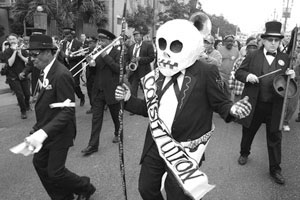
No literary journal has ever been called upon to react specifically to the loss of its place of genesis, and what more could have been expected from this collection than page after page of horror and sorrow? But after the first four poems without a mention of Katrina anywhere, I understood that something very different was being done. Look at these lines from Ralph Adamo’s poem “New Orleans Elegies”: “I wish once we could sleep like two horses/ standing side by side after a twilight feed,/ eyes lashed for the night, forelegs atremble,/ but just barely, with being so strongly still.” And again from Brad Richard’s poem “St. Roch Camp Santo, New Orleans” a few pages later: “I would kiss his dark sore if it would give/ either of us solace, if it would bring back whole/ companions who died from the wrong touch,/ whatever killer stole their love” And from “Memento N.O.” by Srdjan Smaji: “me kneeling & you kneeling/ me pressing into you/ in the alley behind the bar…/ we return repentant/ two prodigals all apologies/ & our friends plug us back/ into the same conversation.” The first 112 pages of the review are full of stories and poems like these, not of Katrina, not disaster, but of people, of their desires, loves, losses, of their small lives frankly lived in a city we all recognize within a few words, the first glimpse of an image: New Orleans, our New Orleans, even if it wasn’t ours. Cajun, jazz, the French Quarter, Canal Street, Bourbon Street, Algiers, Louis Armstrong and, of course, Mardi Gras. David Rae Morris’ photograph on Page 92 of a New Orleans brass band marching beside a death-head wearing a “Constitution” sash is an image understandable only in the context of that one place.

That place is gone. Whether intended or not, the first half of the New Orleans Review has the feeling of walking around in a Holocaust museum: all of those head shots, all of those piles of shoes. This is the lost New Orleans we knew and took for granted. From Aliisa Rosenthal’s story “Mambo”: “I light one feminine cigarette under the languish of saxophones and cellos. There are debutantes in the gutters here. The dirty blonde and rusting beauties decay in hot puddles. But we’re all sipping mint juleps and our feet are leveraged into stilettos and we know how to limbo our words into a drawl with lusty undertones, until the boys lunge at palmettos in the dark lantern light.” And from Tara Jill Ciccarone’s “Wait for Me, Susanna”: “the men drinking their beers in front of the little grocery stores, saying How ya doing with sex in their eyes always, the young women, curvy and without makeup in flowered dresses, blooming themselves, the heat that slowed the body, teaching the body not to fight so much, to give in to the needs of the flesh and take it slow, and the guitar players on the sidewalks outside the coffee shops not wanting to go to work.” And from C.W. Cannon’s “Fools Rush In”: “The kid’s cornet was right on the thermostat, frowning and threatening and ignoring all supplicants, sending the mercury up, up. The band started chanting Talk Dat Shit Now and Say What?! and pointing at the dancers, pushing them to march harder. The boy blowing into his horn through the side of his mouth found some undiscovered and previously unused muscle in his face or his belly and started swinging and leaned into it, bumped the volume up one more decibel, and treated the air in front of his cornet to a righteous, vicious pummeling.”

It’s wonderful stuff, like a vault full of the literary art of Atlantis. Reading it in the context of Katrina is to almost hear these characters and places cry out, “We existed. We existed like this.” But the work is so good that it transports the reader at times away from the fact of pre-Katrina New Orleans’ own existential end, no one piece more so than C. Morgan Babst’s story “Other Real Girls.” With early lines like, “The cheese man liked their school skirts, and they would unbutton their second buttons and pull their Wigwams up to their knees for him … Lille turned up her turned-up nose at him because he was a Yat. He came from the West Bank … Allie had tried to keep from getting a crush on him,” Babst creates a world quick to seduce. Complete in its universe, it leaves no ground to wonder whether Allie or Lille or any of the often nasty teenage girls of a certain New Orleans privileged upper class captured here are anything but real. “Other Real Girls” should win an award, as should the whole issue. Interviewing Christopher Chambers, editor since 1999 of the New Orleans Review, about what happened to him, his staff and his city after Katrina, I received this e-mail: “I am so tired of talking about Katrina, yet living here there is no way not to talk about it. We used to joke that New Orleans was like a third world country … it is no longer a joke. City services are unreliable, leadership and a coherent plan for recovery nonexistent, violent crime back to pre-K[atrina] levels with one third of the population. Looting continues … not sure why this has been swept under the rug … Everyone here has been traumatized, and there is an undercurrent of bad energy. Recklessness, rage, and hard drinking like even this town has never seen.”

Chambers and the NOR’s poetry editor Katie Ford deserve credit for the artistic achievement of their editing. Running only work that’s set in the days before Katrina in the first half of the issue, they ground and contextualize the loss and drama of the post-Katrina second half. And they manage to make the turn from the “pre” to “post” landscape feel as sudden and dramatic as it was in life. Though there are warnings of impending disaster, they are as easy to ignore as were all of those 1950s-era levee warnings. The excerpt of Walker Percy’s 1968 essay “New Orleans Mon Amour,” which opens the issue, reveals that the city has always suffered corruption and a certain sense of doom, and James Nolan’s poem “Acts of God” admits that the city had been flooded by hurricanes past. Of all the lively poems and stories about New Orleans nightlife and Mardi Gras, almost none can be said to end joyfully.

And still, on Page 113, when Katrina appears almost out of nowhere in Anne Gisleson’s essay “The Chain Catches Hold,” we’re not prepared. Gisleson’s essay seems to be a quaint walk through interesting neighborhoods of the city. It’s not. Like the whole of the issue itself, Gisleson’s essay is a bait and switch: Here’s New Orleans, here’s New Orleans taken away. She writes about bars, brawls, a decaying mural, quietly decaying fences. Interesting but innocuous stuff. And then comes this entry: “Fall 2005. The razor wire rolled back, the concrete barricades moved to the side, the Bywater was opened back up to us officially in early October. On one end of Clouet Street at the river, a block from our house, a fire, started by either looters or the police, depending on whom you talked to, had raged for several days during the aftermath and destroyed six blocks of riverfront warehouses and wharves … thousands of propane tanks were being stored inside … during the fire many of them exploded and shot all over the neighborhood into houses, throughout streets. You can still come across their dented blackened carapaces, in gutters, on sidewalks and untended yards, pocked with rust, puckered holes.”

Katrina happened like that. As with everything else in the city, the storm brought to a halt production of the New Orleans Review. Among the better of the literary journals in the country, the NOR regularly had work reprinted in Best American Poetry, the Pushcart Anthology, Poetry Daily and the Utne Reader. Katrina scattered the staff to Baton Rouge, Austin, Texas, Portland, Ore., Washington and Boston. Some have left New Orleans for good.

Chambers says, “In the first few weeks after, I can’t say that I gave the magazine a thought. I spent my days sitting stunned in front of CNN for hours on end, drinking steadily, and searching the Internet for news of friends and colleagues. I remember the dates I returned to the city: September 15, October 2, October 30. Otherwise those months are a blur. At some point, late September I guess, I started to think about how New Orleans Review could respond to this unfolding disaster. Everywhere I turned … people were writing about New Orleans. Much of it was good and accurate, but there was also a lot of bullshit written by people who did not really know or understand the place. It occurred to me that now was the time for the magazine to publish an issue on New Orleans, by New Orleans writers. By this time, my wife and I had moved into a tiny ramshackle garage apartment in Houston. I compiled a list of all the local writers I could find, sent out a call for submissions, asked them to forward it around.

“I began receiving submissions immediately. My vision for this issue was that it would be a celebration of New Orleans, a chance for the writers and poets of the city to respond to the disaster. And I saw it as an elegy, for I knew by this point that the New Orleans I had left no longer existed, and that though the city might survive, it would never be the same. In March, there were already a slew of New Orleans and Katrina books in the stores. There must have been people signing book contracts before the waters receded. I feel we had a little more critical distance, and were able to put together something that was more thoughtful and coherent.” The post-Katrina half of the issue looks at how the storm hurt the city, and how seeing the injured city hurt its people. It’s imagistic and visceral, and of special note are the nine photographs by David Rae Morris that range from an accounting of the graffiti that blossomed in the flooded city, from both an official “Possible Body” sprayed on a home to a less official “9 Ward RIP,” to evocative images of humanity’s remnants underwater. Yes, there are some simple laments here that don’t add much to what’s already been said about New Orleans, though these are few and almost serve as a brief record of that genre of contemporary literature.

The best part about this Katrina writing is how quirky and unexpected it is. Lyrical, often funny, the second half of the issue even includes a science fiction story. From Moira Crone’s “The Great Sunken Quarter”: “September, 2132. The sun started to come up behind the clouds, turning the sky from pink to white, and then the Ponchart Sea was all silver. Port Gramercy shrank into a line on the horizon. The Islands of New Orleans were thirty miles distant, and not yet visible. We were headed for the greatest of the wonders there, the Sunken Quarter.” Wry, witty, often angry edging toward bitterness, this Katrina-inspired art is decidedly postmodern, clearly distrustful of traditional forms, confrontational, impatient, and there is almost enough of a theme here to announce a new school. These lines, for example, from Elizabeth Gross’ “Delta”: “The video store is broken. I mean,/ closed for good, the tapes all sold,/ or else boxed up and taken home/ by those bird-eyed men who/ used to run the place.” And this from Robin Kemp’s “Body” on the facing page: “the Dumaine Street Bridge/ …now it’s snagged itself/ just another face-down man/ right there where I used to walk the dog.” How about this little gem from Abraham Burickson’s “Soft and Splinter”: “She called to say she wasn’t coming back/ …to say that he could keep the fish, keep the television, the house,/ that Texas is a big ol’ pile of rock/ and she’s gonna stay…”

Then there’s Andrei Codrescu. As Jeffrey Chan writes in the issue’s penultimate essay — a who’s who of the recovering N.O. literary scene — Codrescu is “the famous New Orleans author in some people’s opinion … one of New Orleans’ literati and editor of a terminally hip pub called Exquisite Corpse. His distinctive Romanian accent can be heard on NPR … I think he’s in the Ozarks now. He’s written several books … including “Road Scholar,” the mandatory haywire road trip book which takes him across this oh-so-kooky country. [I]t was quite a bore…”

Why is Chan taking shots at Codrescu? Admittedly, Codrescu’s contribution to the issue was the only one of the more than 40 pieces that gave me real pause, because while I clearly am no fan of lament for lament’s sake, flippancy doesn’t seem appropriate at all. What was Codrescu up to in his poem “The Good Shepherdess of Nether,” a Dadaist experiment that he wrote jointly with Dave Brinks? While Brinks’ stanzas come across as searching for meaning in all of this, Codrescu’s are more like the ADHD kid in the back of the class who clearly is in his own world, here again offering little more than confirmation of his well-known morbid fascination with bugs. Brinks begins: “when hurricane names reach/ the greek alphabet/ it takes us a long way away from the theory/ of original sin/ and the common housefly.” Codrescu responds, “all the way to common sin/ of wishing it was not the way it is/ and the original fly/ did you ever see one this blue, Dave?” Chan closes his essay with a parting salvo at the eminent one, “As for you, Codrescu … oh, whatever. You get published, get on the air, get to be the king of the freak parade, and slouch for Ferlinghetti. More power to you.”

One New Orleans has passed, another begun. And if the writers are already sniping at each other, then the writers are returning to normalcy. Whatever dark or bright thing it will eventually be, the new New Orleans will find a normalcy as well. This remarkable issue of the New Orleans Review ends with an outward look, beyond the flooded city and its own black and nighttime cover, to the plight of the greater world in the new era of weather chaos. As Gisleson had written earlier in the collection, “In the hard blue fall sky two jet contrails had crossed each other, and for a moment it wasn’t just our houses, or city but the whole sky, the world itself, marked for search and rescue.”

“Brief Encounters With Che Guevara”

This superb debut story collection travels to Colombia, Sierra Leone and the U.S., examining the damage capitalism has wreaked on the world.

  • more
    • All Share Services

Ben Fountain’s debut collection of stories, “Brief Encounters With Che Guevara,” has one of the nattiest covers of the year, a graceful riot of birds, scattered through with actual punch-hole perforations that reveal the blood red color of the hardcover beneath. The patterning of the holes suggests that someone has used the illustration for target practice. The central bird, a cute yellow-breasted flycatcher of some foreign sort, has taken one right through the chest. This serves as an apt metaphor for what’s contained in the book.

The natural world in these eight stories is exploited to the point of extinction by men with the guns for material gain. The best of Fountain’s villains practice evil so coolly they conjure the officers in that scene from “Apocalypse Now” when Willard is ordered to exterminate Kurtz. The hot room, the ominous turn of the metal fan, the cigarette butts in the tray, the latent glamour of all that impending death. Of a diamond trader in civil war Freetown, Fountain writes, “[H]e was deep in conversation with a glistening black man, but not so deep that he couldn’t manage a little irony for Jill, a smug shadowing around the corners of his lips. They were talking diamonds, probably, though it could be anything, palm oil, bauxite, shrimp, titanium, rubber — for a country with a ruined economy, there were an awful lot of deals around, and Starkey, who’d lived here on and off for years, seemed to have a paying role in most of them.” And of an American deal maker in final negotiations over natural gas extraction with the foul junta generals in Rangoon, “His voice had an airy William Buckley trill, the adenoid lilt of gentlemen sailors and champagne sippers.”

Fountain takes shots throughout “Brief Encounters,” at Buckley, at George W. Bush, at Texas in general, at the U.S. military, at the folks here at home who like those things. This book has politics, and pounds its point home again and again: Capitalism causes pain and suffering for most of the people of the world, and no one, no matter what they do, has the ability to change it. The title itself alludes to this: Each of these stories is a brief encounter with someone who wants to do good in the world, even if that good is brought about by a morally repugnant act. Who exemplifies this logic more thoroughly than Guevara, espousing as he did such a love for humanity that he waged war for its betterment? Yet Fountain often also admits, as he does in the title story, “I’ve spent a lot of energy and many years trying to learn a very few basic things, which may turn out to be mostly crude opinions anyway. There’s so little in the world we can be sure of, and maybe it’s the lack, that flaw or deficiency, if you will, that drives our strongest compulsions.”

These are urgent stories, end-time stories, where mass graves fill with the bodies of the silenced, where a kidnapped ornithologist in Colombia sends his FARC-like captor shimmying up trees to count the last mating pairs of Purpureicephalus feltisi in the world. Even the war-scarred rebel is moved to a lucid moment of feeling by the silly antics of the Crimson-capped Parrots. Nonetheless, his insurgent group will soon attempt to sell the forest to U.S. logging companies to finance their corrupt campaign.

“Brief Encounters” is part jaunty travelogue — we visit Haiti numerous times, as well as Colombia, Myanmar, Sierra Leone, the good ole USA (a military base, no less) and late 19th century Central Europe in a tacked-on finale — and part brilliant reportage: “Tintanyen was a wide plain of shitlike muck held together by a furze of rank, spraddling weeds. You entered through a pair of crumbling stone portals — the gates to hell. The mosquitoes at Tintanyen were like no others, an evil-looking, black-and-gray jacketed strain that seemed to relish the smell of insect repellent. [The O.A.S. observers] would tramp through the muck, sweating, swatting at the murderous bugs, hacking away the weeds until they came on a body, whatever mudcaked, hogtied, maggoty wretch the de factos had seen fit to drag out here. From the shade of the trees bordering the field a pack of feral dogs was always watching them, alert, anticipating a fresh meal.”

The writing is literary and earnest, full of foreign languages and settings, and unusual and lovely words — Fountain chooses Magyar, for example, when Hungarian would have been just fine. His prose is baroque, patient, precise and wry. It’s also often very funny. A riotous scene in a story called “Bouki and the Cocaine” sees a troupe of abused local fisherman dress up as Papa Gédé, the Haitian god of trickery and death, to outsmart the men with the guns, and “Asian Tiger” watches a hapless John Daly-esque golf pro lose his wits as he’s asked to help design a golf course in the middle of a live-fire war zone.

These stories display a fluency with what’s going on in our world that’s sure to elevate Fountain to the lofty realm of Douglas Unger (“Looking for War”), P.F. Kluge (“Biggest Elvis”) and the current titleholder, Bob Shacochis (“The Immaculate Invasion,” “Easy in the Islands”), with their literary antecedents being, most notably, Hunter S. Thompson, Evelyn Waugh and Katherine Anne Porter. However he’s attained his material, Fountain knows the Third World; he captures Myanmar, for example, with a precision that suggests firsthand knowledge: “Myanmar  what they used to call Burma, down in the heat-rash crotch of the world. Not the most politically correct place you’ll ever see, they were on everybody’s shit list for human rights and most of the world’s heroin was grown there. It was your classic Third World basket case, complete with drug mafias, warlords, mind-bending poverty, and a regime that made the Chinese look carefree, plus a genuine martyr-saint they kept under house arrest, that sexy lady who won the Nobel Peace Prize — whatshername? On the other hand the generals who ran the country were nuts for golf.” His characters may not know Aung San Suu Kyi’s name, but we know that Ben Fountain does, as he soon reveals in the story.

Occasionally, Fountain manipulates his characters too heavily in pursuit of a point, such as in the lead story, “Near-Extinct Birds of the Central Cordillera,” where the ersatz hero slips into lyrical soliloquies with a gun pointed at his head. And in one of the most sexually charged stories of recent memory, “The Good Ones Are Already Taken,” a U.S. Special Forces sergeant on patrol in Haiti “marries” Erzulie Dantor, the black goddess of love, for some pretty darn good dream sex. Then he comes home to his wife. The potency of what Fountain sets up in the story, alas, becomes a non-event as the sex stays good only in the dreams.

Fountain has taken a lot of risks here. To witness the deal-makings of the end of the world from the front, he’s set himself the hard task of putting characters in situations they wouldn’t likely be in: an OAS observer smuggling rare paintings out of Port-au-Prince, Haiti, a World Aid Ministries worker smuggling diamonds through Sierra Leone. Not that those things don’t happen all the time, but it’s the nature of these individual characters as Fountain has created them that makes his task hard: They are genuinely good people. Would they really have done that?

In “The Lion’s Mouth,” the collection’s best story, the answer is a resounding yes. Deep in the war-torn bush, Jill must decide between friends counting on her to smuggle contraband diamonds into the capital, or using the stones to barter for the lives of dozens of people. No matter what she decides, people are going to get hurt. The scenes in this story are startling and great; the rebel soldiers when they step out of the trees, the nun who keeps falling down, the refugees as they walk on the road, all of them are real. The sentiment feels truer here, and what makes this story so good is that in the final irony of what happens to Jill and these people she’s saved, the reader feels that Fountain has released his grip on his message to achieve a deeper truth. This story goes beyond politics to illustrate the exhausting failure of even our finest decisions.

Ultimately, these are stories about people, mostly American innocents abroad, who want the world to be other than it is, who pay the price for that hopeless desire. One would love to think that anyone in contemporary government, especially the Foreign Service, would chance to happen upon this book. But those who really need to learn its lessons are the ones who will pick it up for their attraction to that name in its masterly title: Che Guevara, the romanticized philosopher-warrior who so many of us wish in the depths of our nights hadn’t been the killer that he was.

Continue Reading Close

Destination: Havana

Santeria, drinking, baseball and struggle -- glimpse Habanero life with work from G. Cabrera Infante, Ada Ferrer and the late, brave Reinaldo Arenas.

  • more
    • All Share Services

Destination: Havana

A salty friend who sails the strait twice a year from Key West to the Marina Hemingway had these words before my trip to Havana: “You don’t need anything down there but greenbacks, your liver and your cock.” From long-legged rumba with tall, black jineteras on the rooftop of the Hotel Inglaterra, to giggling over daiquiris with bronzed mulattas on the warm sands of the Playas del Este, to rum-soaked stumbles along the Malecon with a girl on each arm and the Gulf crashing against that historic stone promenade with what seemed like the full force of American antipathy hurled south from Miami, I found this to be true.

“Three Trapped Tigers,” G. Cabrera Infante’s 1958 masterpiece, captures Havana as it was, a place of Santeria and frantic drinking, of mystical black women and handsome young men in their best outfits with not much to do under the oppressive shadow of politics. Half a century later, not much has changed. The things the thugs in power on both sides of the strait can’t control continue to be the starry Havana nights, the hectic energy of the Habaneras, the rum, and the brassy music that sets everything off once the sun goes down. Infante, who at first embraced the Revolution, but later died in exile, knew that love is possible at every turn in Havana, especially if it’s only for one night. This novel, the best the city has ever produced, is an anatomy of the fecund Havana we dream of finding, and if we possess the bravery to go there in these times, we still do.

But of course Habaneros are more than just their parties. Race and struggle define the Cuban soul. Ada Ferrer’s “Insurgent Cuba: Race, Nation, and Revolution, 1868-1898″ details the essence of the Cuban Revolution from 60 years before it happened. Soon after “discovery” in 1492, Columbus’ ruthless enslavement of the indigenous Taíno set the stage for the sugar cane factory that chewed up imported African slaves like a juicing machine, which Cuba quickly became. There’s a reason why Castro’s Revolution, which at one point was only himself, and as he famously quotes, “one other guy,” hiding in the Sierra Maestra, went on to defeat the U.S.-trained and -equipped forces of Batista. Ferrer reveals the secret: Cuba has always been a minority white privileged class and a majority of disenfranchised blacks. Ever wonder why the angry exiles in Miami who influence so much of American policy are all white? Ferrer explains it.

Castro is no hero either, though it’s hard to find a Habanera who will admit this in public (just as it’s nearly impossible to find a Habanera who won’t say that José Martí, Cuba’s national poet, is really just a jingoist). Reinaldo Arenas, though, had the bravery to, and he paid the price with decades of police harassment, and a constant ban on his works. The gay boys who look for love in the shadows of Plaza Don Quixote all know his name, and his novel “Farewell to the Sea” tells us why. On display here is a human heart, tender and longing, trapped by a political system that won’t let it be what it is, and the strained marriage it forces that heart into. Arenas’ own tragic demise reflects the one his narrator can’t escape in this poetic requiem.

The folk, however, need their pastimes, and in Roberto Gonzalez Echevarria’s “The Pride of Havana: A History of Cuban Baseball,” we get at once a detailed and colorful timeline of Havana’s preferred sport, as well as a fine description of why the Habanero heart yearns north. Cuba and America desire each other in the schizophrenic way that France and England do. In Havana, the U.S. national sport is played with poetic skill and, more important, followed by old men in wicker hats with a familiar earnestness, pointing to how much the embargo has stolen from all of us. Not to be missed in this vein is Jim Shepard’s masterly short story “Batting Against Castro,” which is found in his collection of the same title, and uses the cover of béisbol to reveal how the headstrong people of the city can seduce even a hardened gringo.

As the days pass and the initial romance of Havana fades into hangover, worry and repetition, one comes to know Cuba in a deeper way, the way that provokes one to ask, “Why do all these girls give it up for money? Who do they really give their hearts to?” It also helps if one of them steals your wallet. Only the most determined foreigner doesn’t begin to see that Cuba isn’t a party for everyone. The 31 stories in “The Voice of the Turtle” admit this. This is the broad and definitive collection of modern Habanera voices, and G. Cabrera Infante’s title story, of a cagauma turtle on its back that’s abused by two dimwitted young men, is a metaphor of a troubled country to rival any story of its kind in the world. Featured here are Octavio Armand, Carlos Montenegro, Lourdes Casal and Lydia Cabrera. The quiet frustration of Alfonso Hernández Catá’s “I Sent Quinine” is a particular treat.

Ultimately, the great literary art of modern Havana hides in the alleys of that decayed city like the most fearful of dissenters. Contemporary Habanera writers have no safe outlet and their cautious work reflects that. The exiles have long since lost their claim. What we are left with are the echoes, the memories of those humid and wondrous Havana nights, of the women we met and loved, whom we paid and wrote to, and who of course never wrote back.

Continue Reading Close