William J. Astore

This election’s true winner

It won't be Obama or Romney; it'll be the U.S. military -- and it's going to cost us a lot of money

(Credit: nex99 via Shutterstock)
This piece originally appeared on TomDispatch.

Now that Mitt Romney is the presumptive nominee of the Republican Party, the media is already handicapping the presidential election big time, and the neck-and-neck opinion polls are pouring in.  But whether President Obama gets his second term or Romney enters the Oval Office, there’s a third candidate no one’s paying much attention to, and that candidate is guaranteed to be the one clear winner of election 2012: the U.S. military and our ever-surging national security state.

The reasons are easy enough to explain.  Despite his record as a “warrior-president,” despite the breathless “Obama got Osama” campaign boosterism, common inside-the-Beltway wisdom has it that the president has backed himself into a national security corner.  He must continue to appear strong and uncompromising on defense or else he’ll get the usual Democrat-as-war-wimp label tattooed on his arm by the Republicans.

Similarly, to have a realistic chance of defeating him — so goes American political thinking — candidate Romney must be seen as even stronger and more uncompromising, a hawk among hawks.  Whatever military spending Obama calls for, however much he caters to neo-conservative agendas, however often he confesses his undying love for and extols the virtues of our troops, Romney will surpass him with promises of even more military spending, an even more muscular and interventionist foreign policy, and an even deeper love of our troops.

Indeed, with respect to the national security complex, candidate Romney already comes across like Edward G. Robinson’s Johnny Rocco in the classic film Key Largo: he knows he wants one thing, and that thing is moreMore ships for the Navy.  More planes for the Air Force.  More troops in general — perhaps 100,000 more.  And much more spending on national defense.

Clearly, come November, whoever wins or loses, the national security state will be the true victor in the presidential sweepstakes.

Of course, the election cycle alone is hardly responsible for our national love of weaponry and war.  Even in today’s straitened fiscal climate, with all the talk of government austerity, Congress feels obliged to trump an already generous president by adding yet more money for military appropriations.  Ever since the attacks of 9/11, surging defense budgets, forever war, and fear-mongering have become omnipresent features of our national landscape, together with pro-military celebrations that elevate our warriors and warfighters to hero status.  In fact, the uneasier Americans grow when it comes to the economy and signs of national decline, the more breathlessly we praise our military and its image of overwhelming power.  Neither Obama nor Romney show any sign of challenging this celebratory global “lock and load” mentality.

To explain why, one must consider not only the pro-military positions of each candidate, but their vulnerabilities — real or perceived — on military issues.  Mitt Romney is the easier to handicap.  As a Mormon missionary in France and later as the beneficiary of a high draft lottery number, Romney avoided military service during the Vietnam War.  Perhaps because he lacks military experience, he has already gone on record (during the Republican presidential debates) as deferring to military commanders on decisions such as whether we should bomb Iran.  A President Romney, it seems, would be more implementer-in-chief than civilian commander-in-chief.

Romney’s métier at Bain Capital was competence in the limited sense of buying low and selling high, along with a certain calculated ruthlessness in dividing companies and discarding people to manufacture profit.  These skills, such as they are, earn him little respect in military circles.  Compare him to Harry Truman or Teddy Roosevelt, both take-charge leaders with solid military credentials.  Rather than a Trumanesque “the buck stops here,” Romney is more about “make a buck here.”  Rather than Teddy Roosevelt’s bloodied but unbowed “man in the arena,” Romney is more bloodless equity capitalist circling high above the fray in a fancy suit.

Consider as well Romney’s five telegenic sons.  It’s hard to square Mitt’s professions of love for our military with his sons’ lack of interest in military service.  Indeed, when asked about their lack of enthusiasm for joining the armed forces during the surge in Iraq in 2007, Mitt off-handedly replied that his sons were already performing an invaluable national service by helping him get elected.

An old American upper class sense of noblesse oblige, of sons of privilege like George H.W. Bush or John F. Kennedy volunteering for national service in wartime, has been dead for decades in our otherwise military-happy country.  When it comes to sending American sons (and increasingly daughters) into harm’s way, for President Romney it’ll be another case of chickenhawk guts and working-class blood.

For election 2012, however, the main point is that the Romney family’s collective lack of service makes him vulnerable on national defense, a weakness that has already led Mitt and his campaign to overcompensate with ever more pro-military policy pronouncements supplemented with the usual bellicose rhetoric of all Republicans (Ron Paul excepted).  As a result, President-elect Romney will ultimately find himself confined, cowed, and controlled by the national security complex — and he’ll have only himself (and Barack Obama) to blame.

Obama, by way of contrast, has already shown a passion for military force that in saner times would make him invulnerable to charges of being “weak” on defense.  Fond of dressing up in military flight jackets and praising the troops to the rafters, Obama has substance to go with his style.  He’s made some tough calls like sending SEAL Team 6 into Pakistan to kill Osama Bin Laden; using NATO airpower to take down Qaddafi in Libya; expanding special ops and drone warfare in Afghanistan, Yemen, and elsewhere, including the assassination of U.S. citizens without judicial process.  America’s Nobel Peace Prize winner of 2009 has become a devotee of special forces, kill teams, and high-tech drones that challenge the very reality of national sovereignty.  Surely such a man can’t be accused of being weak on defense.

The political reality, of course, is different.  Despite his record, the Republican Party is forever at pains to portray Obama as suspect (that middle name Hussein!), divided in his loyalties (that Kenyan connection!), and not slavish enough in his devotion to “underdog” Israel.  (Could he be a crypto-Muslim?)

The president and his campaign staff are no fools.  Since any sign of “weakness” vis-à-vis Iran and similar enemies du jour or any expression of less than boundless admiration for our military will be exploited ruthlessly by Romney et al., Obama will continue to tack rightwards on military issues and national defense.  As a result, once elected he, too, will be a prisoner of the Complex.  In this process, the only surefire winner and all-time champ: once again, the national security state.

So what can we expect on the campaign trail this summer and fall?  Certainly not prospective civilian commanders-in-chief confident in the vitally important role of restraining or even reversing the worst excesses of an imperial state.  Rather, we’ll witness two men vying to be cheerleader-in-chief for continued U.S. imperial dominance achieved at nearly any price.

Election 2012 will be all about preserving the imperial status quo, only more so.  Come January 2013, regardless of which man takes the oath of office, we’ll remain a country with a manic enthusiasm for the military.  Rather than a president who urges us to abhor endless war, we’ll be led by a man intent on keeping us oblivious to the way we’re squandering our nation’s future in fruitless conflicts that ultimately compromise our core constitutional principles.

For all the suspense the media will gin up in the coming months, the ballots are already in and the real winner of election 2012 will be the national security state.  Unless you’re a denizen of that special interest state, we know the loser, too. It’s you.

William J. Astore, a retired lieutenant colonel (USAF), is a TomDispatch regular.  He welcomes reader comments at <em>wjastore@gmail.com. To listen to Timothy MacBain’s latest Tomcast audio interview in which Astore discusses how the two presidential candidates are sure to out-militarize each other in the coming election campaign, click here or download it to your iPod here.

Whose army is it?

The 99 percent has become dangerously removed from the military-industrial complex that controls our remote wars

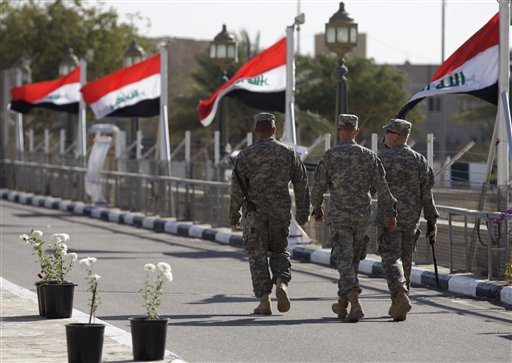
Iraqi flags wave as U.S. soldiers leave Al Faw palace at Camp Victory on Thursday, Dec. 1, 2011 (Credit: AP Photo/Khalid Mohammed)
This originally appeared on TomDispatch.

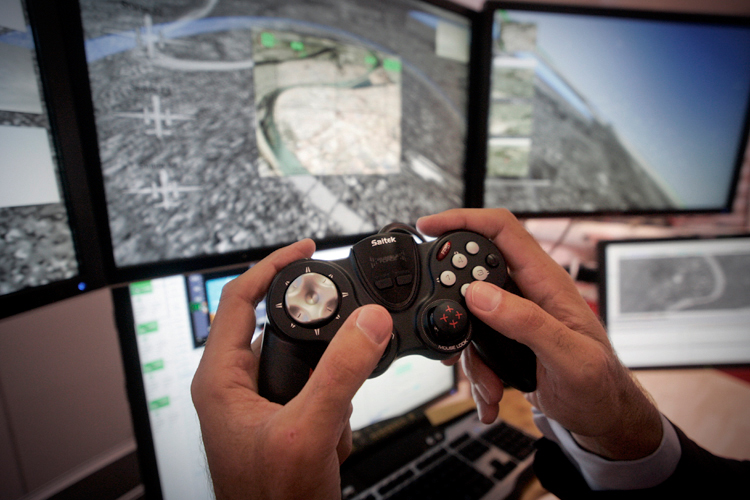
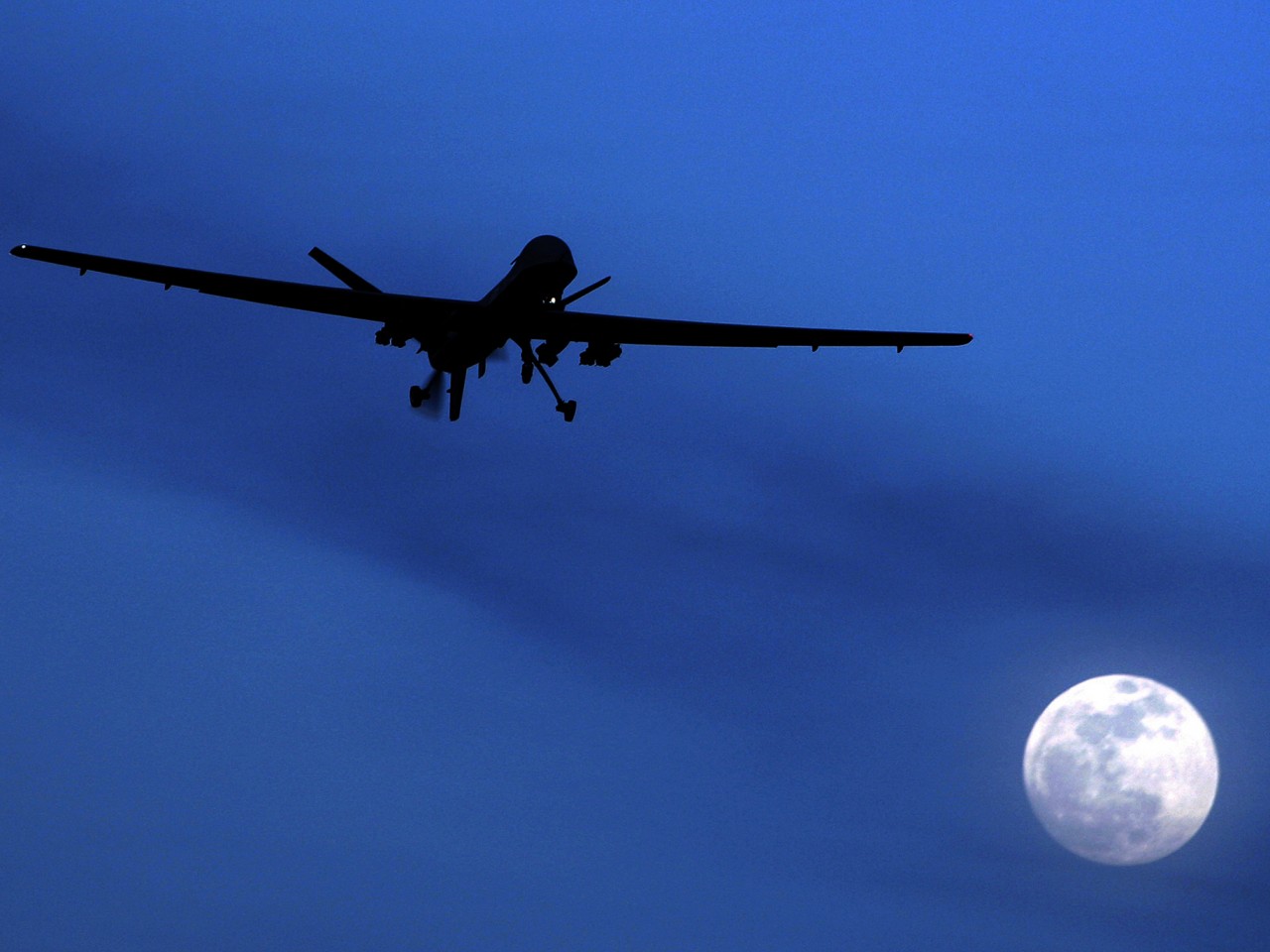
America’s wars are remote.  They’re remote from us geographically, remote from us emotionally (unless you’re serving in the military or have a close relative or friend who serves), and remote from our major media outlets, which have given us no compelling narrative about them, except that they’re being fought by “America’s heroes” against foreign terrorists and evil-doers.  They’re even being fought, in significant part, by remote control — by robotic drones “piloted” by ground-based operators from a secret network of bases located hundreds, if not thousands, of miles from the danger of the battlefield.

Their remoteness, which breeds detachment if not complacency at home, is no accident.  Indeed, it’s a product of the fact that Afghanistan and Iraq were wars of choice, not wars of necessity.  It’s a product of the fact that we’ve chosen to create a “warrior” or “war fighter” caste in this country, which we send with few concerns and fewer qualms to prosecute Washington’s foreign wars of choice.

The results have been predictable, as in predictably bad.  The troops suffer.  Iraqi and Afghan innocents suffer even more.  And yet we don’t suffer, at least not in ways that are easily noticeable, because of that very remoteness.  We’ve chosen — or let others do the choosing — to remove ourselves from all the pain and horror of the wars being waged in our name.  And that’s a choice we’ve made at our peril, since a state of permanent remote war has weakened our military, drained our treasury, and eroded our rights and freedoms.

Wars of Necessity vs. Wars of Choice

World War II was a war of necessity. In such a war, all Americans had a stake.  Adolf Hitler and Nazism had to be defeated; so too did Japanese militarism.  Indeed, war goals were that clear, that simple, to state.  For that war, we relied uncontroversially on an equitable draft of citizen-soldiers to share the burdens of defense.

Contrast this with our current 1 percent wars.  In them, 99 percent of Americans have no stake.  The 1 percent who do are largely ID-card-carrying members of what President Dwight D. Eisenhower so memorably called the “military-industrial complex” in 1961.  In the half-century since, that web of crony corporations, lobbyists, politicians and retired military types who have passed through Washington’s revolving door has grown ever more gargantuan and tangled, engorged by untold trillions devoted to a national security and intelligence complex that seemingly dominates Washington.  They are the ones who, in turn, have dispatched another 1 percent — the lone percent of Americans in our All-Volunteer Military — to repetitive tours of duty fighting endless wars abroad.

Unlike previous wars of necessity, the mission behind our wars of choice is nebulous, confusing, and seems in constant flux.  Is it a fight against terror (which, as so many have pointed out, is in any case a method, not an enemy)?  A fight for oil and other strategic resources?  A fight to spread freedom and democracy?  A fight to build nations?  A fight to show American resolve or make the world safe from al-Qaeda?  Who really knows anymore, now that Washington seldom bothers to bring up the “why” question at all, preferring simply to fight on without surcease?

In wars of choice, of course, the mission is whatever our leaders choose it to be, which gives the citizenry (assuming we’re watching closely, which we’re not) no criteria with which to measure success, let alone determine an endpoint.

How do we know these are wars of choice?  It’s simple: because we could elect to leave whenever we wanted or whenever the heat got too high, as is currently the case in Iraq (even if we are leaving behind a fortress embassy the size of the Vatican with a private army of 5,000 rent-a-guns to defend it), and as we are likely to do in Afghanistan sometime in the years after the 2012 presidential election.  The choice is ours.  The people without a choice are of course the Iraqis and Afghans whom we’ll leave to pick up the pieces.

Even our vaunted Global War on Terror is a war of choice.  Think about it: Who has control over our own terror: us or our enemies?  We can only be terrorized in the first place if we choose to give in to fear.

Think here of the “shoe bomber” in 2001 and the “underwear bomber” in 2009.  Why did the criminally inept actions of these two losers garner so much attention (and fear-mongering) in the American media?  As the self-confessed greatest and most powerful nation on Earth, shouldn’t we have shared a collective belly laugh at the absurdity and incompetence of those “attacks” and gone about our business?

Instead of laughing, of course, we allowed yet more American treasure to be poured into technology and screening systems that may never even have caught a terrorist.  We consented to be surveilled ever more and consulted ever less.  We chose to reaffirm our terrors every time we doffed our shoes or submitted supinely to being scoped or groped at our nation’s airports.

Our distant permanent wars, our 1 percent wars of choice, will remain remote from our emotions and our thinking, requiring few sacrifices except from our troops, who grow ever more remote from our polity.  This is especially true of America’s young adults, between 18 and 29 years of age, who are the least likely to have family members in the military, according to a recent Pew Research Center study.

The result?  An already emergent warrior-caste might grow ever more estranged from the 99 percent, creating tensions and encouraging grievances that quite possibly could be manipulated by that other 1 percent: the powerbrokers, money-makers, and string-pullers, already so eager to call out the police to bully and arrest occupy movements in numerous cities across this once-great land.

Our Military or Their Military?

As we fight wars of choice in distant lands for ever-shifting goals, what if “our troops” simply continue to grow ever more remote from us?  What if they become “their” troops?  Is this not the true terror we should be mobilizing as a nation to prevent?  The terror of separating our military almost totally from our nation — and ourselves.

As Admiral Mike Mullen, former Chairman of the Joint Chiefs of Staff, put it recently to Time: “Long term, if the military drifts away from its people in this country, that is a catastrophic outcome we as a country can’t tolerate.”

Behold a horrifying fate: a people that allows its wars of choice to compromise the very core of its self-image as a freedom-loving society, while letting itself be estranged from the young men and women who served in the frontlines of these wars.

Here’s an American fact: the 99 percent are far too remote from our wars of choice and those who fight them.  To reclaim the latter, we must end the former.  And that’s a war of necessity that has to be fought — and won.

To stay on top of important articles like these, sign up to receive the latest updates from TomDispatch.com here.

Continue Reading Close

Does America really have the finest military in the world?

The retired officer in me warms to the sentiment, but the historian in me begs to differ

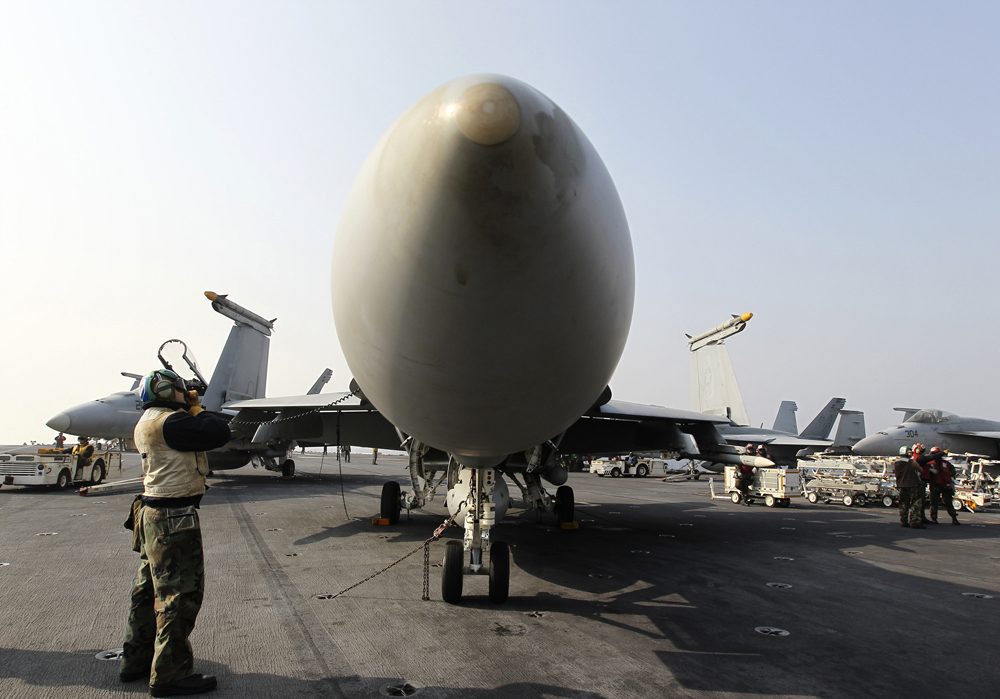
An F/A-18 Hornet fighter jet sits onboard the U.S. Navy's USS George Washington aircraft carrier during joint military drills between the U.S. and South Korea in the West Sea November 29, 2010. The U.S. and South Korean militaries started a massive drill on Sunday. South Korean President Lee Myung-Bak said he felt responsibility for failing to protect citizens from North Korea's shelling last week and warned the North against further provocations. REUTERS/Lee Jong-geun/Korea Pool (SOUTH KOREA - Tags: MILITARY POLITICS) SOUTH KOREA OUT. NO COMMERCIAL OR EDITORIAL SALES IN SOUTH KOREA(Credit: © Pool New / Reuters)

This originally appeared at TomDispatch

Words matter, as candidate Barack Obama said in the 2008 election campaign. What to make, then, of President Obama’s pep talk last month to U.S. troops in Afghanistan in which he lauded them as “the finest fighting force that the world has ever known”? Certainly, he knew that those words would resonate with the troops as well as with the folks back home.

In fact, this sort of description of the U.S. military has become something of a must for American presidents. Obama’s predecessor George W. Bush, for example, boasted of that military as alternately “the greatest force for freedom in the history of the world” and “the greatest force for human liberation the world has ever known.” Hyperbolic and self-promoting statements, to be sure, but undoubtedly sincere, reflecting as they do an American sense of exceptionalism that sits poorly with the increasingly interconnected world of the 21st century.

I’m a retired U.S. Air Force officer and a historian who teaches military history. The retired officer in me warms to the sentiment of our troops as both unparalleled fighters and selfless liberators, but the historian in me begs to differ.

Let’s start with the fighting part of the equation. Are we truly the world’s greatest fighting force, not only at this moment, but as measured against all militaries across history? If so, on what basis is this claim made? And what does such triumphalist rhetoric suggest not just about our national narcissism, but Washington’s priorities? Consider that no leading U.S. politician thinks to boast that we have the finest educational system or health-care system or environmental policies “that the world has ever known.”

Measured in terms of sheer destructive power, and our ability to project that power across the globe, the U.S. military is indeed the world’s “finest” fighting force. Our nuclear arsenal remains second to none. Our air forces (including the Navy’s carrier task forces, the Army’s armada of helicopter gunships, and the CIA’s fleet of unmanned aerial drones prosecuting a “secret” war in Pakistan) dominate the heavens. Our Navy (“a global force for good,” according to its new motto) rules the waves — even more so than old Britannia did a century ago. And well should we rule the skies and seas, given the roughly $1 trillion a year we spend on achieving our vision of “full spectrum dominance.”

But this awesome ability to exercise “global reach, global power” hardly makes us the finest military force ever. After all, “finest” shouldn’t be measured by sheer strength and reach alone. First and foremost, of course, should come favorable results set against the quality of the opponents bested. To use a sports analogy, we wouldn’t call the Pittsburgh Steelers “the finest team in NFL history” simply because they annihilated Penn State in football. Similarly, we can’t measure the success of today’s U.S. military solely in terms of amazingly quick (if increasingly costly and ultimately dismal) “victories” over the Taliban in 2001 or Saddam Hussein’s Iraqi forces in 2003.

To carry the football analogy a few yards further, one might ask when our “finest fighting force” had its last Super Bowl win. Certainly, 1918 and 1945 (World Wars I and II) were such wins, even if as part of larger coalitions; 1953 (Korea) was a frustrating stalemate; 1973 (Vietnam) was a demoralizing loss; 1991 (Desert Storm in Iraq) was a distinctly flawed win; and efforts like Grenada or Panama or Serbia were more like scrimmages. Arguably our biggest win, the Cold War, was achieved less through military means than economic power and technological savvy.

To put it bluntly: America’s troops are tough-minded professionals, but the finest fighting force ever? Sir, no, sir.

We’re Number One!

Americans often seem to live in the eternal now, which makes it easier to boast that our military is the finest ever. Most historians, however, are not so tied to nationalistic rhetoric or the ceaseless present. If asked to identify the finest fighting force in history, my reaction — and I would hardly be alone in the field — would be to favor those peoples and empires which existed for war alone.

Examples immediately spring to mind: the Assyrians, the Spartans, the Romans, the Vikings, the Mongols, and the Nazis. These peoples elevated their respective militaries and martial prowess above all else. Unsurprisingly, they were bloodthirsty and ruthless. Unstinting ambition for imperial goals often drove them to remarkable feats of arms at an unconscionable and sometimes difficult to sustain cost. Yes, the Spartans defeated the Athenians, but that internecine quarrel paved the way for the demise of the independent Greek city states at the hands of Philip of Macedon and his son, Alexander (soon enough to be known as “the Great”).

Yes, the Romans conquered an empire, but one of their own historians, Tacitus, put in the mouth of a Celtic chieftain this description of being on the receiving end of Roman “liberation”:

“The Romans’ tyranny cannot be escaped by any act of reasonable submission. These brigands of the world have exhausted the land by their rapacity, so they now ransack the sea. When their enemy is rich, they lust after wealth; when their enemy is poor, they lust after power. Neither East nor West has satisfied their hunger. They are unique among humanity insofar as they equally covet the rich and the poor. Robbery, butchery, and rapine they call ‘Empire.’ They create a desert and call it ‘Peace.’”

Talk about tough love.

The Romans would certainly have to be in the running for “finest military” of all time. They conquered many peoples, expanded far, and garrisoned vast areas of the Mediterranean, North Africa, and what would become Europe, while their legions marched forth, often to victory (not to speak of plunder), for hundreds of years. Still, the gold medal for the largest land empire in history — and the finest fighting force of all time — must surely go to the thirteenth century Mongols.

Led by Genghis Khan and his successors, Mongol horsemen conquered China and the Islamic world — the two most powerful, sophisticated civilizations of their day — while also exerting control over Russia for two and a half centuries. And thanks to a combination of military excellence, clever stratagem, fleetness of foot (and far more important, hoof), flexibility, and when necessary utter ferocity, they did all this while generally being outnumbered by their enemies.

Even the fighting power of the finest militaries waxed and waned, however, based in part on the quality of those leading them. The Macedonians blossomed under Philip and Alexander. It was not simply Rome that conquered Gaul, but Julius Caesar. The Mongols were at each other’s throats until Genghis Khan united them into an unstoppable military machine that swept across a continent. The revolutionary French people in their famed levée en masse had martial fervor, but only Napoleon gave them direction. History’s finest fighting forces are associated closely with history’s greatest captains.

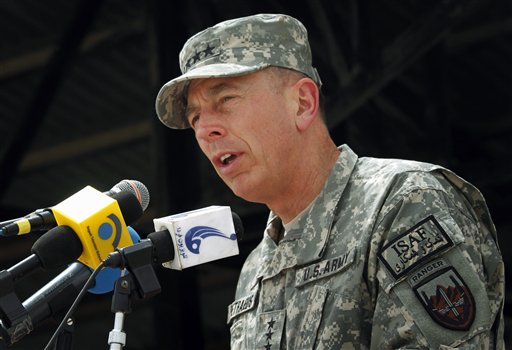
Measure that against the American military today. General David Petraeus is certainly a successful officer who exhibits an enviable mastery of detail and a powerful political sense of how to handle Washington, but a Genghis Khan? An Alexander? A Caesar? Even “King David,” as he’s been called both by admirers and more than a few detractors, might blush at such comparisons. After all, at the head of the most powerfully destructive force in the Middle East, and later Central Asia, he has won no outright victories and conquered nothing. His triumph in Iraq in 2006-2007 may yet prove more “confected” than convincing.

As for our armed forces, though most Americans don’t know it, within U.S. military circles much criticism exists of an officer corps of “tarnished brass” that is deficient in professionalism; of generals who are more concerned with covering their butts than leading from the front; of instruction at military academies that is divorced from war’s realities; of an aversion “to innovation or creativity… [leading to] an atmosphere of anti-intellectualism” that undermines strategy and makes a hash of counterinsurgency efforts. Indeed, our military’s biting criticism of itself is one of the few positive signs in a fighting force that is otherwise overstretched, deeply frustrated, and ridiculously overpraised by genuflecting politicians.

So I’m sorry, President Obama. If you wish to address the finest fighting force the world has ever known, you’ll need a time machine, not Air Force One. You’ll have to doff your leather Air Force-issue flight jacket and don Mongolian armor. And in so doing, you’ll have to embrace mental attitudes and a way of life utterly antithetical to democracy and the rights of humanity as we understand them today. For that is the price of building a fighting force second to none — and one reason why our politicians should stop insisting that we have one.

“The Greatest Force for Human Liberation”

Two centuries ago, Napoleon led his armies out of France and brought “liberty, equality, and fraternity” to much of the rest of ancien régime Europe — but on his terms and via the barrel of a musket. His invasion of Spain, for example, was viewed as anything but a “liberation” by the Spanish, who launched a fierce guerrilla campaign against their French occupiers that sapped the strength of Napoleon’s empire and what was generally considered the finest fighting force of its moment. British aid to the insurgency helped ensure that this campaign would become Napoleon’s “Spanish ulcer.”

The “Little Corporal” ultimately decided to indirectly strike back at the British by invading Russia, which was refusing to enforce France’s so-called continental blockade. As Napoleon’s army bled out or froze solid in the snows of a Russian winter, the Prussians and the Austrians found new reasons to reject French “fraternity.” Within years, Napoleon’s empire was unsaddled and destroyed, a fate shared by its leader, sent into ignominious exile on the island of Saint Helena.

Like Napoleon’s fired up revolutionary troops, the American military also sees itself as on a mission to spread democracy and freedom. Afghans and Iraqis have, however, proven no more eager than the Spaniards of two centuries ago to be “liberated” at gun (or “Hellfire” missile) point, even when the liberators come bearing gifts, which in today’s terms means the promise of roads, jobs, and “reconstruction,” or even cash by the pallet.

Because we Americans believe our own press releases, it’s difficult to imagine others (except, of course, those so fanatic as to be blind to reality) seeing us as anything but well-intentioned liberators. As journalist Nir Rosen has put it: “There’s… a deep sense among people in the [American] policy world, in the military, that we’re the good guys. It’s just taken for granted that what we’re doing must be right because we’re doing it. We’re the exceptional country, the essential nation, and our role, our intervention, our presence is a benign and beneficent thing.”

In reporting on our wars in Iraq and Afghanistan, Rosen and others have offered ample proof for those who care to consider it that our foreign interventions have been anything but benign or beneficent, no less liberating. Our invasion of Iraq opened the way to civil war and mayhem. For many ordinary Iraqis, when American intervention didn’t lead to death, destruction, dislocation, and exile, it bred “deep humiliation and disruption” as well as constant fear, a state of affairs that, as Rosen notes, is “painful and humiliating and scary.”

In Afghanistan, Rosen points out, most villagers see our troops making common cause with a despised and predatory government. Huge infusions of American dollars, meanwhile, rarely trickle down to the village level, but instead promote the interests of Afghan warlords and foreign businesses. Small wonder that, more than nine years later, a majority of Afghans say they want to be liberated from us.

If the U.S. military is not “the greatest force for human liberation” in all history, what is? Revealingly, it’s far easier to identify the finest fighting force of history. If put on the spot, though, I’d highlight the ideas and ideals of human dignity, of equality before the law, of the fundamental value of each and every individual, as the greatest force for human liberation. Such ideals are shared by many peoples. They may sometimes be defended by the sword, but were inscribed by the pens of great moralists and thinkers of humanity’s collective past. In this sense, when it comes to advancing freedom, the pen has indeed been mightier than the sword.

Freedom Fighters for a Fading Empire

The historian John Lukacs once noted: “There are many things wrong with the internationalist idea to Make the World Safe for Democracy, one of them being that it is not that different from the nationalist idea that What Is Good for America Is Good for the World.”

In our post-9/11 world, whatever our rhetoric about democratizing the planet, our ambitions are guided by the seemingly hardheaded goal of making Americans safe from terrorists. A global war on terrorism has, however, proven anything but consistent with expanding liberty at home or abroad. Indeed, the seductive and self-congratulatory narrative of our troops as selfless liberators and the finest freedom fighters around actually helps blind us to our violent methods in far-off lands, even as it distances us from the human costs of our imperial policies.

Though we officially seek to extinguish terrorists, our actions abroad serve as obvious accelerants to terror. To understand why this is so, ask yourself how comforted you would be if foreign military “liberators” kicked in your door, shouted commands in a language you didn’t understand, confiscated your guns, dragged your father and brothers and sons off in cuffs and hoods to locations unknown, all in the name of “counterterror” operations? How comforted would you be if remotely piloted drones hovered constantly overhead, ready to unleash Hellfire missiles at terrorist “targets of opportunity” in your neighborhood?

Better not to contemplate such harsh realities. Better to praise our troops as so many Mahatma Gandhis, so many freedom fighters. Better to praise them as so many Genghis Khans, so many ultimate warriors.

At a time of feared national decline, our leaders undoubtedly prescribe military action in part to comfort us (and themselves) and restore our sense of potency and pride. In doing so, they violate the famous phrase long associated with the Hippocratic Oath: First, do no harm.

William J. Astore, a retired lieutenant colonel (USAF) and professor of history, is a TomDispatch regular. He welcomes reader comments at wjastore@gmail.com. To listen to Timothy MacBain’s latest TomCast audio interview in which Astore discusses the military nightmares of a fading empire, click here or, to download it to your iPod, here.

Continue Reading Close

In the military we trust

Progressives who want to disarm U.S. militarism must first understand the nation's faith in the military -- one of our least elitist, most diverse institutions.

Recent polls suggest that Americans trust the military roughly three times as much as they trust the president and five times as much as their elected representatives in Congress. The tenacity of this trust is both striking and disturbing. It’s striking because it comes despite widespread media coverage of prisoner abuse at Abu Ghraib, the friendly-fire coverup in the case of Pat Tillman’s death, and alleged retribution killings by Marines at Haditha. It’s disturbing because our country is founded on civilian control of the military. It’s debatable whether our less-than-resolute civilian leaders can now exercise the necessary level of oversight of the military and the Pentagon when they are distrusted by so many Americans.

What explains the military’s enduring appeal in our society? Certainly, some of this appeal is obvious. Americans have generally been a patriotic bunch. “Supporting our troops” seems an obvious place to go. After all, many of them volunteered to put themselves in harm’s way to protect our liberties and to avenge the terror attacks of Sept. 11, 2001. For this, they receive pay and benefits that might best be described as modest. Trusting them — granting them a measure of confidence — seems the least that could be offered.

Before addressing two other sources of the military’s appeal that are little understood, at least by left-leaning audiences, let’s consider for a second the traditional liberal/progressive critique. It often begins by citing the insidious influence of Eisenhower’s “military-industrial complex,” throwing in for good measure terms like “atrocity,” “imperialist,” “reactionary” and similar pejoratives. But what’s interesting here is that this is often where their critique also ends. The military and its influence are considered so tainted, so baneful that within progressive circles there’s a collective wringing of hands, even a reflexive turning of backs, as if our military were truly from Mars or perhaps drawn from the nether regions where Morlocks shamble and grunt in barbarian darkness.

If you want to change anything — even our increasing propensity for militarism — you first have to make an effort to engage with it. And to engage with it, you have to know the wellsprings of its appeal, which transcend corporate profits or imperial power.

Despite often compelling evidence to the contrary, Americans like to think of their societal institutions as being open, fair-minded and democratic. If you look without prejudice at our all-volunteer military, you quickly realize that it truly is one of the least elitist, most diverse institutions of power in American society. Most progressive voices fail to recognize this. Yet it’s my belief most Americans do and it’s a big reason why they say they trust it.

Our military is demonstrably diverse — racially, by class, and even more politically than most critics imagine. As a retired military officer who now finds himself a liberal arts professor in academia, I’m struck by the relative conformity of the latter, at least when contrasted to the diversity I found in my former life. Racial minorities from the lower classes are well represented in our military. (Some critics have claimed that they are over-represented, at least in front-line infantry units.) I’ve seen more black or brown faces in positions of authority within our military than in academia. (In my last job in the Air Force, my boss was a black female colonel.) Indeed, until very recently in American society, our military was one of the few places where African-Americans and Hispanics routinely bossed around whites. (Louis Gossett Jr.’s drill instructor in the 1982 movie “An Officer and a Gentleman” was not exceptional; many times I’ve witnessed real versions of him in action.)

Politically, our military tends, of course, to be conservative, though not necessarily monochromatically Republican. Again, the world of academia provides a stark contrast, especially in liberal arts departments in top-tier colleges and universities, which do tend to be overwhelmingly Democratic and left of center. To cite only one example, of 42 professors in the English, history, sociology and political science departments at Brown University who registered to vote, all registered as Democrats.

Ordinary Americans trust the military, in part, because the “have-nots” have direct access to it — far more access than most will ever have to elite universities, elite law firms, mainstream media outlets, Washington lobbying outfits, or other institutions of influence and power. Indeed, our military remains deeply rooted in the broad middle- and working-class elements of society. Our Ivy League schools, our white-shoe law firms, Boston’s Beacon Hill, New York’s Upper West Side have little presence in it. Yet everywhere you go in small-town and rural America, you bump into ordinary people who know someone in the military: a nephew, a cousin, a close buddy from high school, even, these days, the girl next door.

If you were to place yourself among the rank-and-file of today’s military, you’d find yourself among young people (many of color, some of them recent immigrants) who more accurately mirror the composition of our old small towns and new inner-city neighborhoods than nearly any other institution of power. In that sense, the military is a grandly successful social mélange, with, of course, a notable exception. Women. The all-volunteer military is predominately male and will remain so, at least for the foreseeable future. Military service remains largely a gendered activity, commonly associated within academia with retrograde notions of aggressive (and disreputable) masculinity and therefore dismissed as outmoded, even pathologically so.

Of course, supporting — and trusting — the military is hardly the same thing as joining it. Increasing numbers of Americans, not just academics or the obvious critics, no longer see joining its ranks as part of anyone’s citizenly duty. This is now well known in a society where the first urge of a commander in chief/president, when it comes to the public, is not to mobilize them for duty in what he’s termed “war time,” but to urge them to visit Disney World and keep on spending. Nonetheless, surprising numbers of young men do continue to join up, despite increasingly unpopular wars in Iraq and Afghanistan.

This leads me to the second blind spot in the academic/progressive critique of our military — the failure to recognize the enduring attractiveness of military service to young men seeking to construct their own identities. To many of these potential recruits, American culture today appears feminized — or, at least demasculinized — a mommy-state, a risk-averse society with designer drugs and syndrome-of-the-day counselors to ease our pain. In response, what we’re seeing is a romantic yearning among young men for the very hardness, the brutality even, epitomized by military service and warfare.

In talking to young men in the rural, conservative area of Pennsylvania where I live, what strikes me is how many of them have seen all 10 episodes of the HBO World War II series “Band of Brothers,” and how many admire the bravery, camaraderie and sacrifice it depicts in portraying paratroopers of the 101st Airborne fighting their way across France and into Germany in 1944-45. Seasoned Marines, a colleague reports, confess that one thing working to sustain recruiting, despite the war in Iraq and regular news reports on an overstrained and exhausted military, is young men who, raised in self-esteem-touting, gender-bending environments (on TV, if nowhere else), sign up to experience “the other side.”

It’s easy to dismiss such yearnings as Neanderthal. The irony is that that very dismissal creates an inviting taboo for a whole segment of young American males to challenge. For academia and progressives, war is today what sex was to society in the Victorian age, involving as it does emotions nice people don’t feel and acts nice people don’t opt to commit. Yes, many volunteers join the military with educational or career possibilities in mind, but among young men who enlist, there is also a certain element, conscious or unconscious, of taboo-breaking — and of self-affirmation.

For women, gender identity is often shaped by biological rites of passage: menstruation, pregnancy, menopause. Male identity is arguably less secure and defined more by the gaze of other men — you’re a man when other men, men you respect, say you are. Men have gender too — and many seek to construct and assert their maleness within the military, a cultural setting they perceive as patriotic, meritocratic, and sanctioned by the trust and respect of friends, family, and community.

The challenge for progressives is to recognize this and then to work to create viable alternatives to military service in which masculinity and patriotism can be demonstrated in non-lethal settings. An example is my father’s service as a forest laborer and firefighter in the Civilian Conservation Corps in Oregon from 1935 to 1937. There could be many opportunities for our young men to assert their masculinity in non-military and nonviolent settings — fixing our nation’s roads and bridges, rebuilding our inner cities, rescuing places torn apart by disaster, natural or otherwise, like New Orleans; and from these, too, funded educational openings and future career possibilities could arise.

The point is this: It’s not enough simply to rail against the military or militarism, however enlightened it makes you feel. There are powerful reasons why Americans trust our military and continue to join its ranks. Unless these are grasped, efforts to redirect our nation along less militaristic lines will founder on the shores of incomprehension.

After all, isn’t the full media story not only that our all-volunteer military is having trouble meeting its recruiting goals — hardly surprising, given two major, exceedingly hard wars in which victory, however defined, remains frustratingly out of sight — but also that the military is nonetheless close to meeting those goals? Admittedly, recruiting standards have been relaxed, signing bonuses increased, and waivers and promotions liberally granted. Even so, our military is not just signing up the rural poor, urban dead-enders, or knuckle-dragging hayseeds (though some critics seem to think otherwise, judging by the unfortunate title of a recent piece in Slate, “Dumb and Dumber”). The comment by John Kerry in 2006, to the effect that students who can’t make it in college end up “stuck in Iraq,” struck many Americans as grossly unfair precisely because military service still remains a proud first choice for many young Americans.

If the operating equation is military = bad, are we not effectively excusing ourselves or our children from any obligation to serve — even any obligation simply to engage with the military? Indeed, are we even patting ourselves on the back for the wisdom of our non-choice and our non-participation? Rarely has a failure to sacrifice or even to engage come at a more self-ennobling price — or a more self-destructive one for progressive agendas.


This piece originally appeared on TomDispatch.com.

Continue Reading Close
www.salon.com/writer/william_j_astore/index.html