
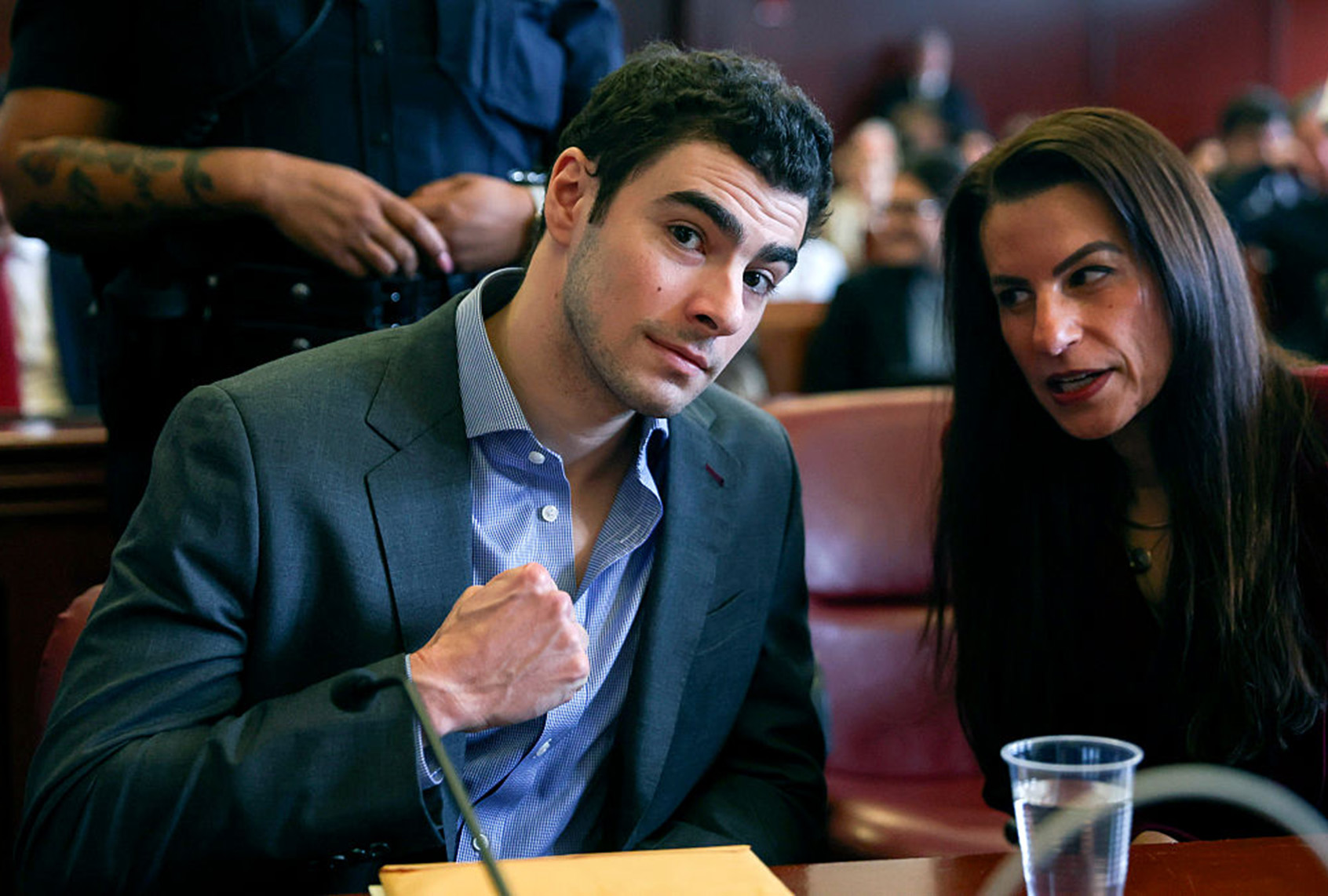

An inordinate amount of proverbial ink has been spilled trying to psychoanalyze Luigi Mangione, who is in court this month, accused of killing Brian Thompson, the UnitedHealthcare CEO who was fatally shot this time last year. Articles and documentaries with titles like “Inside the mind of Luigi Mangione” and “The mind of a killer” abound, which is perhaps typical when an alleged assassin gets such a high profile.
But the analysis is remarkably different from other recent gunmen, such as Tyler James Robinson, Charlie Kirk’s alleged killer, or Thomas Crooks, who attempted to assassinate President Donald Trump on the 2024 campaign trail. Far fewer people are making memes with excerpts of their thoughts or selling biographies of their rise and fall. It’s hard to imagine “giddy, whispering fans” showing up in court with messages of support for most notorious killers, yet that’s precisely what major outlets report is happening this month for Mangione.
What is it that makes Mangione so magnetic? Perhaps it’s the conviction that some project onto him, that he is a vigilante who attempted to send a violent message to a violent industry. Perhaps it is a feeling of vindication knowing that virtually everyone, including myself, know someone whose life was unnecessarily cut short by incompetent, profit-driven, inadequate care. It could even be as trivial as his conventional attractiveness, which is in stark contrast to a typical shooter with an agenda.
Mangione, who is 27, also seems to care about how the public perceives him. During testimony last week, Tomas Rivers, a correctional officer from State Correctional Institution Huntingdon, where Mangione was first held, described conversations he had with the accused, according to Rolling Stone:
Rivers testified that he and Mangione spoke about private versus nationalized healthcare and said Mangione was interested in how the public was perceiving the United Healthcare shooting. Rivers said he told Mangione what he perceived, which was, “Mainstream media and traditional TV news focused on the crime, whereas people on social media were talking about wrongdoings, potential wrongdoings in the healthcare industry.”
So let’s talk about why Mangione, who has pleaded not guilty, may have actually done it. To recap, in the early morning of Dec. 4, 2024, Thompson was shot twice by a masked assailant who’d been waiting for him outside the New York Hilton Midtown hotel. Thompson was attending the annual UnitedHealth Group investors meeting. Three words — “delay,” “deny,” “depose” — were written on spent bullet casings found at the scene, an echo of common tactics in the insurance industry to avoid paying claims. A five-day manhunt ensued, with Mangione being arrested at a McDonald’s in Altoona, Pennsylvania.
Even before many of these details were released, the internet became flooded by people projecting their own perceived motives onto the killing. Because the target in this assassination was the head of UnitedHealthcare, a company accused of cruelty and corruption toward sick and dying people, it was easy to see this as fighting back.
UnitedHealthcare is a company accused of numerous offenses, from ignoring doctors’ advice and denying claims for services they deemed not “medically necessary” to extracting overpayments from the federal government. Last year, a ProPublica investigation found that UnitedHealthcare denied critical treatment for kids with autism — which even the company acknowledged as “gold standard treatment” — all in an effort to maximize profit.
“Thompson and his co-workers didn’t put a gun to anyone’s head, but in many ways, the result is the same.”
UnitedHealth Group, the parent company of UnitedHealthcare, denied about 1 in 3 insurance claims in 2023. The company is even accused of offloading these decisions to AI-driven algorithms. Make no mistake, these bureaucratic decisions cost lives. And these effects are not felt evenly, with poor and marginalized groups experiencing more denials. Thompson and his co-workers didn’t put a gun to anyone’s head, but in many ways, the result is the same. Systemic violence — like the gutting of USAID by the Trump administration, which by some estimates has killed more than 600,000 people and counting — is excused by our society because it’s not as dramatic or flashy to watch someone wither away in a hospital bed versus bleed out on a Manhattan sidewalk.
If it’s true that Thompson’s killing was an act of vengeance, it doesn’t seem like it accomplished much, as I argued it wouldn’t last year in Salon. It’s not hard to predict that violence won’t undo violence. Maybe it’s too early to tell, but it definitely seems like public health and access to health care in America is much worse than it was a year ago.
Right now, Congress is still squabbling over Affordable Care Act subsidies, which are set to expire by the start of the new year. The vote, which has yet to be set, is expected to fail, making this concession to reopen the government another Democratic surrender. (Meanwhile, a $901 billion defense bill is considered “must-pass” legislation.) The result is expected to spike premiums for tens of millions of Americans, which is already happening across the nation while covering even less.
Congressional Republicans have yet to produce a coherent health care plan to replace what’s being lost. The various rumors of what may or may not be voted on soon doesn’t feel comprehensive. Meanwhile, President Donald Trump has let Robert F. Kennedy Jr. “go wild,” as he put it, doing everything to erase the public from public health. This has included attacks on vaccines, massive funding cuts at the Department of Health and Human Services, and laying off thousands of government employees tasked with surveilling and treating disease.
We need your help to stay independent
The Trump administration’s response to Mangione’s case is to try to kill him. One of Trump’s first actions during his second term was to reinstate the death penalty, which his Department of Justice has specifically sought to wield against the accused. It goes without saying that capital punishment is counterproductive, but of course, it does nothing to improve the lives of Americans either.
Health care in America remains the most expensive in the developed world and fewer and fewer people can afford it. That means more people will skip coverage, see doctors less and forgo prescriptions as minor health problems that are not caught early balloon into bigger, deadlier and costlier conditions. Greater strain has been felt on hospitals, especially in rural areas, as critical staffing shortages are predicted to continue for the next decade. So even for the people who can afford care, quality has dropped. All of this makes the U.S. especially vulnerable to a major emergency like another pandemic, which is deeply concerning considering the nation is about to lose its measles elimination status, COVID-19 still hasn’t fully gone away and diseases like bird flu may unleash another health crisis.
Would a few bullets reverse all or even some of these trends? It seems incredibly unlikely. It’s not even reasonable to expect violence to bring attention to these issues, because most Americans are already well aware of this situation: they’re living it. It’s not even clear that UnitedHealth Group has suffered many consequences from the fallout of Thompson’s death. In the past year, the company’s stock dropped tremendously, but has since rebounded slightly. Some investors in the company actually sued, accusing the conglomerate of shifting its business practices in response to public outcry. In other words, denying fewer claims and thus hurting profits. However, that doesn’t seem to have actually happened.
“If Americans want a better system, they simply have to demand it — and not by using guns.”
As Slate reported in May, this probably has little to do with Mangione: “UnitedHealth is struggling because too many customers are using their insurance too much. It has kept growing its revenue, but it has started spending much more than it used to—about $8 billion more on medical costs in the first three months of 2025 than in 2024. Elderly people seem like a particular problem, as the company is seeing ‘higher senior care activity,’ with its Medicare Advantage customers proving a vexing group. UnitedHealth has had to put more of customers’ premiums back into their care, though the company’s insurance division has remained profitable.”
Indeed, UnitedHealth’s third-quarter earnings report, its most recent, detailed consolidated revenues of $113.2 billion, up 12% year-over-year, while UnitedHealthcare revenues specifically grew 16% year-over-year to $87.1 billion. The Target boycotts over rescinding their DEI policy have been more effective at actually harming a corporation’s bottom line.
The most that can be said was accomplished by Thompson’s death is that it shifted the Overton window, the spectrum of ideas on policy and social issues considered acceptable by the general public. Again, no one needs reminding that health care in the U.S. is abysmal.
Start your day with essential news from Salon.
Sign up for our free morning newsletter, Crash Course.
So what can we actually do to fix this broken system? Universal health care is the place to start. Numerous studies have rigorously examined the issue and found that it would be a savings boost that would cut drug prices and save lives. A 2020 study in The Lancet reported “a single-payer, universal health-care system is likely to lead to a 13% savings in national health-care expenditure, equivalent to more than U.S. $450 billion annually.” In the context of the COVID pandemic, a 2022 study in PNAS found “a single-payer universal healthcare system would have saved 212,000 lives in 2020 alone. We also calculated that US$105.6 billion of medical expenses associated with COVID-19 hospitalization could have been averted by a Medicare for All system.”
We also need to rebuild our primary care and public health capacity — basically the opposite of what Kennedy is doing. That means addressing physician shortages and easing the cost of medical school while erasing the administrative red tape (like excessive prior authorization demands). Until then, we’ll keep paying vastly more for lower-quality health care.
If Americans want a better system, they simply have to demand it — and not by using guns. By some estimates, a nationwide general strike would be enough to hobble the economy in about a week. From there, activists could demand almost whatever they want: action on climate change, an end to mass surveillance and ICE raids, or an equitable health system that heals instead of mangles.
The U.S. has a long history of such action, but much of it is decades old. Some argue we’re overdue for the “people’s veto.” The increasingly poor conditions of working Americans are making such an option more and more attractive, with Chicago Mayor Brandon Johnson calling for a general strike in November, but it won’t be easy to pull off either. It would require immense coordination across a nation divided by algorithmic outrage and petty politics. Given that the other option is sending us off a cliff, maybe enough people are finally fed up to make it work. If such a feat is actually accomplished, it will be thanks to collective, nonviolent power and solidarity — not a lone man with a gun.
Read more
about health care
