


Two years ago, a viral trend tore through TikTok wherein women asked the men in their lives how often they thought about the ancient Roman Empire. Much to the surprise of their loved ones, the common answer can be summed up as, “Way too much.”
My household missed this craze, but the recent debut of “Spartacus: House of Ashur” – the latest installment reviving the “Spartacus” franchise that ran four seasons – gave me reason to put the question to my husband. And I quickly regretted it. He’s been prattling on about Marcus Aurelius’ “Meditations” and sharing Facebook nonsense about centurions ever since. According to him, midlife pushes a man’s historical obsessions down one path or another: “It’s either this or World War II!”
The allure is powerful, and for men, living vicariously through Nick Tarabay’s Ashur, an up-by-his-sandal-straps hero for the ages, is easy to do. I know this because I also think about ancient times more frequently than I’d admit. Each time I open the refrigerator, in fact, courtesy of a “Xena: Warrior Princess” magnet plastered at eye level. In the late ‘90s, millions cheered Lucy Lawless’ heroine as she slashed her way across the ancient world.
Xena even had a brief affair with Julius Caesar (played by a young Karl Urban!) along the way, although that soured quickly. The climax of the 1998 episode “When In Rome” saw her squabble up in a gladiatorial match with two of his men. The Warrior Princess emerged victorious, but it was a sandy, dirty feat.
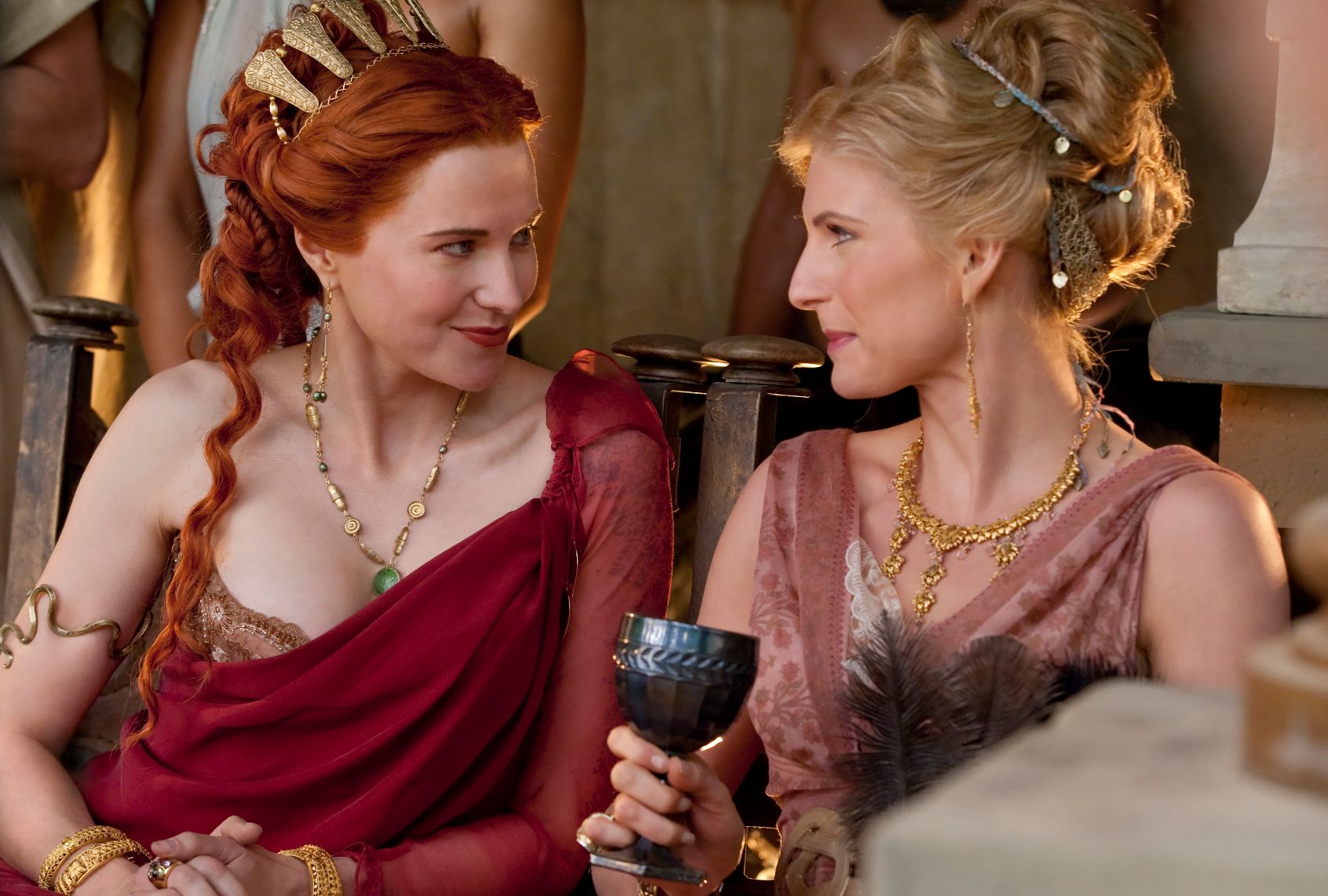
(Starz) Lucretia (Lucy Lawless) and Ilithyia (Viva Bianca) in “Spartacus”
A dozen years later, Lawless traded in her blade and leather bustier for a noblewoman’s silks and jewels in the original “Spartacus” season, “Blood and Sand,” contradicting the passive vision of high-born Roman femininity codified in movies like Ridley Scott’s “Gladiator” and Stanley Kubrick’s 1960 version of “Spartacus,” posing them in draped fabrics and statement necklaces.
As Lucretia, domina of the House of Batiatus, Lawless’ Capuan noblewoman was barred from participating in politics.
Nevertheless, she is one of the series’ most formidable characters and the model of resolute ambition. Women like Lucretia set apart “Spartacus” in all versions from other modern fantasies of antiquity, including Scott’s moribund 2024 sequel “Gladiator II.”
Want more from culture than just the latest trend? The Swell highlights art made to last.
Sign up here
In “Blood and Sand,” she advises her social climber of a husband, Quintus Lentulus Batiatus (John Hannah), on how to grasp the kind of power he would never attain without her cutthroat strategy. She eventually manages to outlive him, fueled by a burning vengeance to take what’s owed to her, even if it means sacrificing everything.
In Lucretia’s Rome – or, rather, Capua – we’re invited to marvel at the women wielding influence from the shadows. But a few, including the heroine of “Spartacus” creator Steven S. DeKnight’s latest chapter, seize their shadow of glory defiantly and in full view of those who would deny it to them.
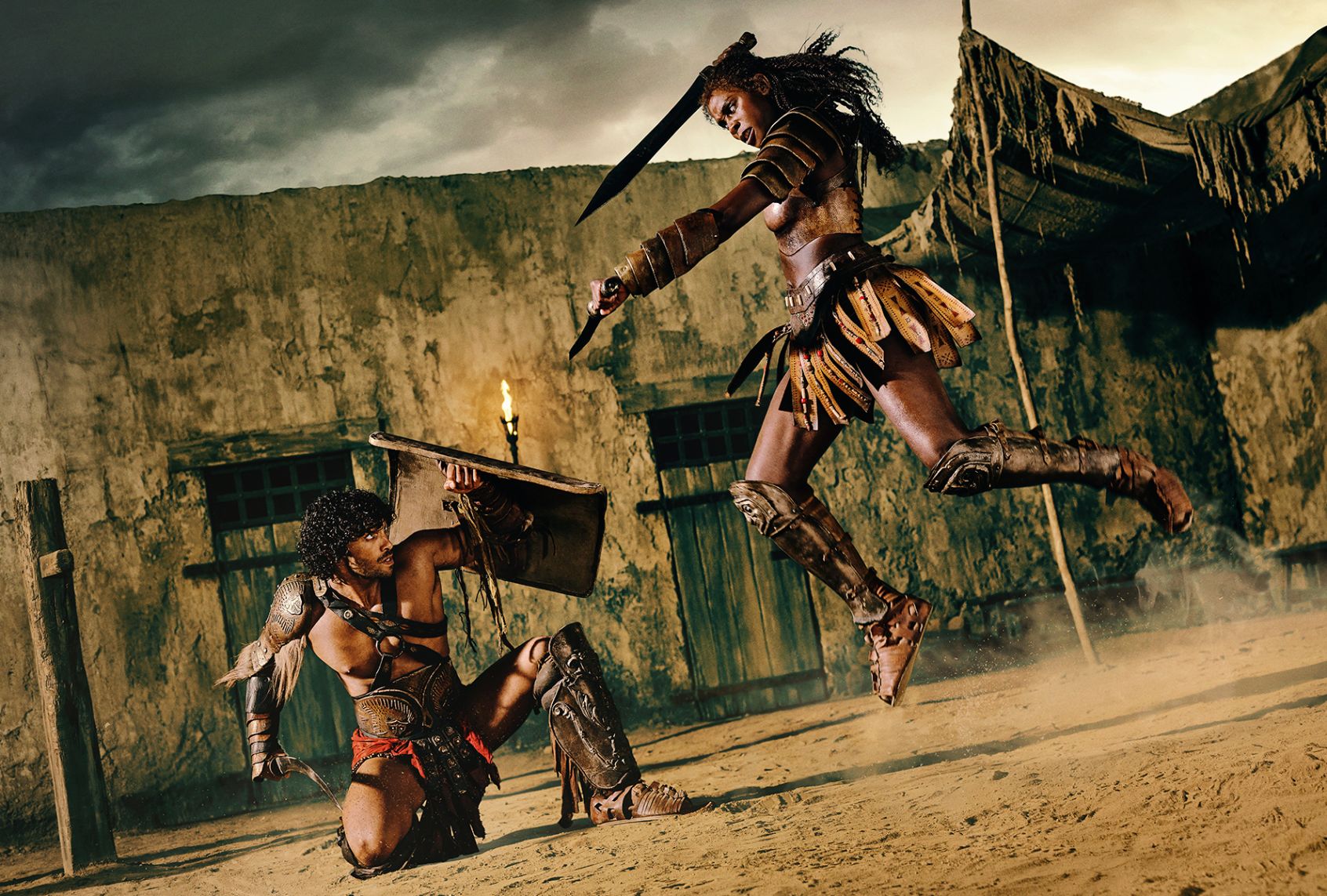
(Starz) Jordi Webber as Tarchon and Tenika Davis as Achillia in “Spartacus: House of Ashur”
The “House of Ashur” alternate timeline shows Ashur’s formerly enslaved Syrian having won his freedom and the patronage of Marcus Licinius Crassus, one of the triumvirate of generals uneasily sharing power. With Lucretia and Quintus long dead, Crassus bestows upon Ashur the House of Batiatus, the illusion of standing and a couple of buxom house slaves to wait on him hand, foot and, ahem, third leg.
But when he’s challenged to come up with a spectacle worthy of gaining placement in upcoming gladiatorial games, he finds a suitable diversion in the muscular form of a Numidian captive named Neferet, whom he intends to forge into a deadly gladiatrix known as Achillia, Goddess of Death (Tenika Davis).
Far from the visions of alabaster pillars and polite stoicism that conservatives conjure when claiming the Roman Empire as civilization’s peak, DeKnight presents it as sweaty, stinky, kinky and corrupt. Sex in those days was a proverbial double-edged sword, viewed as a birthright and shame-free pleasure when it wasn’t wielded as a weapon by both men and women.
And Achillia’s arc captures all that, dropping her into a den of desperate and egocentric men who, at best, want nothing to do with her. At worst, they want to see her broken, defiled and decimated – and to think, they’re all supposed to be fighting for the same team.
In a scene where the gladiator ludus’ doctore (i.e. its coach and mentor), Korris (Graham McTavish), asks her what she sees as she’s angrily slashing her wooden sword at a sparring dummy, she pauses and answers, “Those who hold me unworthy.” For a woman in ancient Rome, that covers just about everybody.
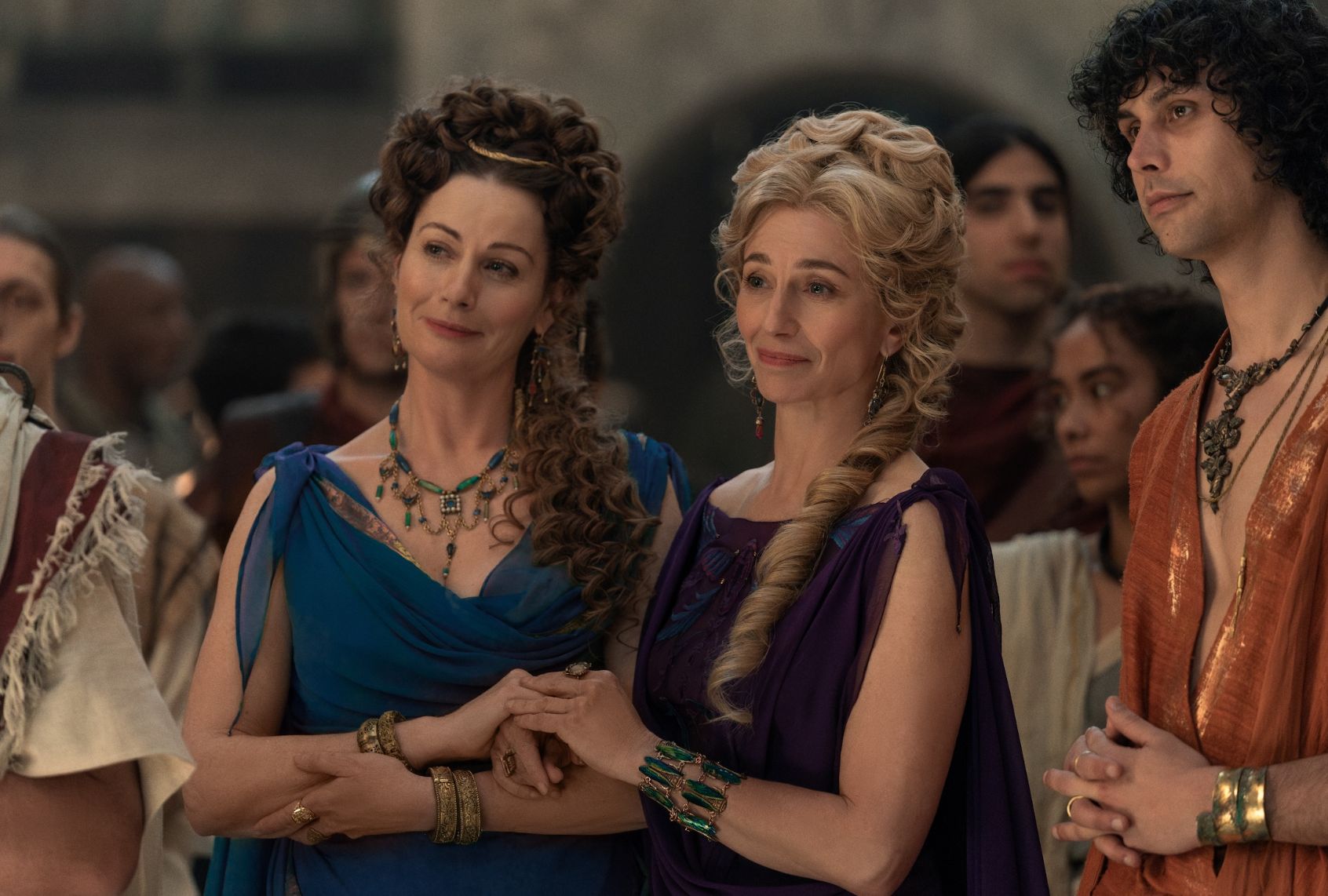
(Starz) Claudia Black as Cossutia and Arlo Gibson as Opiter in “Spartacus: House of Ashur”
When one’s thoughts wander to Rome, they often include visions of men squaring off into some mythical arena. The Colosseum is evoked on Wall Street and in courtrooms by bros inspired by its combatants’ kill or be killed ethos, acknowledging that it’s preferable to be among the rich men watching from the stands instead of one of the lugs slugging it out in the sand.
Few, if any, poems exist hailing the fortitude of Roman women like Lucretia and her equivalent in “House of Ashur,” Claudia Black’s Cossutia. The victories won by gladiatrixes like Achillia, meanwhile, are all but lost to the mists of ages. In fact, an upcoming episode of the PBS series “Secrets of the Dead” titled “Queens of Combat” presents them as a possibility that has yet to be definitely proven.
We need your help to stay independent
At the time of the Third Servile War, women had none of the legal status men held and were commonly limited to the roles of wife and mother. Instead, they had to be calculating and ruthless, making DeKnight’s Real Housewives of Capua far more interesting to follow over the long haul than, say, Connie Nielsen’s Lucilla, the “Gladiator” movies’ delicate, doomed matriarch.
Throughout the first three seasons of “Spartacus,” however, Lawless’ Lucretia demonstrates that she knows her worth – although in this pitiless world, she behaves as the opposite of what some today would characterize as “a girl’s girl.”
She schemes to blackmail her supposed best friend, Ilithyia (Viva Bianca), into doing her bidding by arranging for the rebel Spartacus (Andy Whitfield) to sleep with her and having an envious rival walk in on them in flagrante delicto.

(Starz) Naevia (Cynthia-Addai Robinson) in “Spartacus: War of the Damned”
And when she finds out her personal slave Naevia (played by both Lesley-Ann Brandt and Cynthia Addai-Robinson) is engaged in a secret affair with one of her house’s top gladiators, Crixus (Manu Bennett), she designs a brutal, psychologically scarring fate for Naevia from which Crixus eventually saves her.
But even in that turn, DeKnight refuses to make his male heroes white knights, crafting Naevia’s recovery journey as one of a subjugated victim turned fearsome, free warrior who learns to fight to ensure no one will take advantage of her ever again.
Aesthetics influence our fascination with the glory of ancient Rome; Western culture worships the gladiator’s oiled physical and savage ferocity as the locus classicus of masculinity figures such as Cato and my spouse’s fave Marcus Aurelius to represent the zenith of wisdom.
But if the once-dismissed “Spartacus” continues to win new viewers, it is because the series acknowledges that women can be warriors, queens and, in their way, formidable politicians. “Proper is a word forged by men who would seek to enslave us with it,” Lucretia counsels Ilithyia. Thank the gods, and this series, that few of its women adhere to that limiting supposed virtue.
“Spartacus: House of Ashur” streams Fridays at 9 p.m. on Starz, on the Starz app and on-demand platforms.
Read more
about the Roman Empire
