

When Donald Trump returned to power last January, he had the energy of a conquering hero. As he promised during the 2024 presidential race, he launched his shock-and-awe campaign against American democracy and its institutions on day one. It was devastatingly effective; the so-called resistance was left reeling.
A year later, the political battlefield is starting to change. Trump and his MAGA forces are finally encountering substantive resistance after failing to fully consolidate power. With November’s midterm elections approaching, their window to do so is rapidly narrowing.
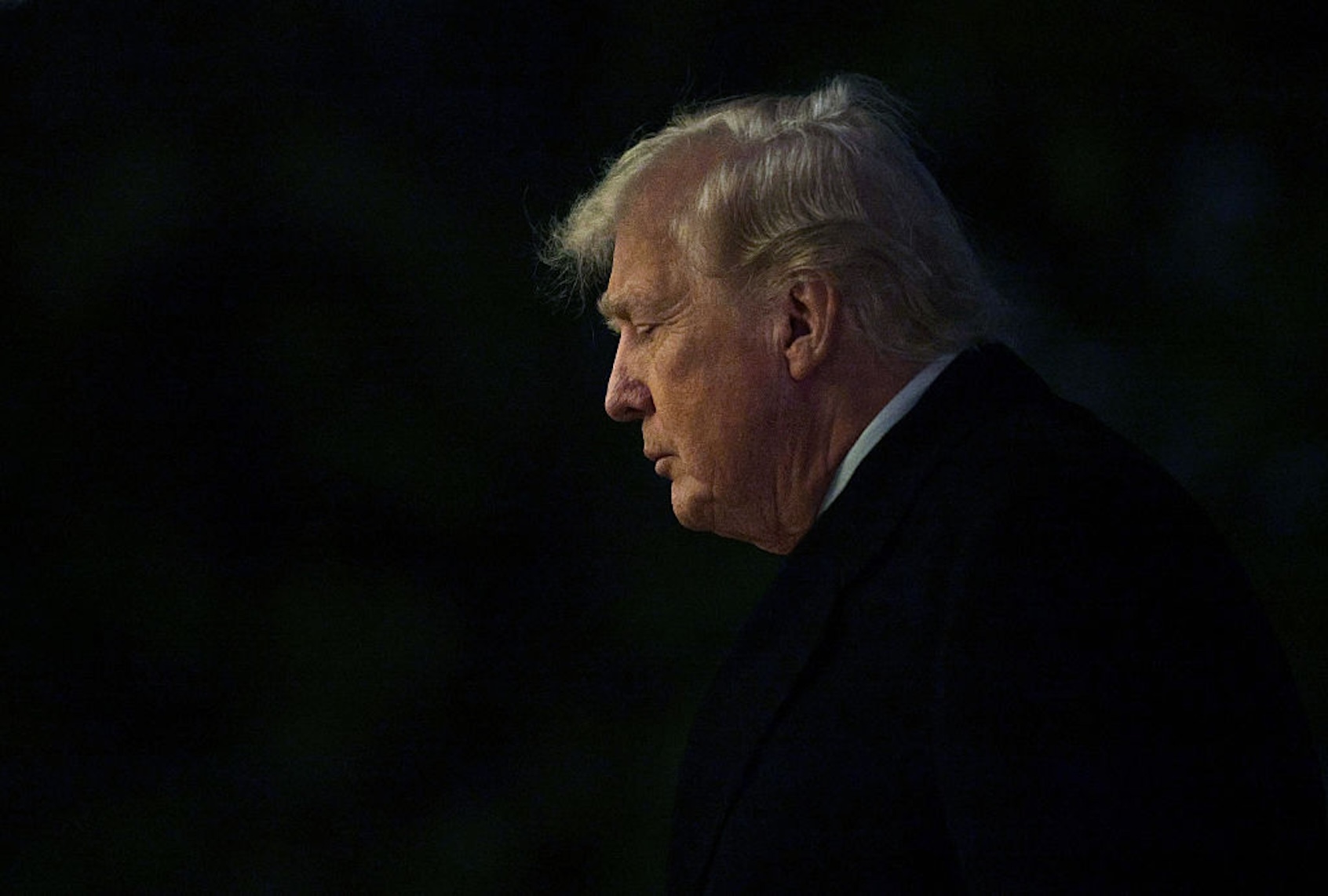
Instead of rising to the challenge, Trump appears to be losing energy; the human dynamo is winding down. During Cabinet meetings, press availabilities in the Oval Office and a recent signing ceremony, he looks like he has fallen asleep. In a recent Wall Street Journal interview, the 79-year-old president explained that he was just resting his eyes or blinking.
These dynamics are compounded by growing public concern about Trump’s physical and mental state. He has repeatedly bragged about passing cognitive tests and undergoing a battery of comprehensive physical examinations, which have apparently included a CT scan. Some medical professionals have expressed concern, and in an interview with The Hill, former White House physician Jeffrey Kuhlman questioned how much time the president spent undergoing tests at Walter Reed National Military Center.
Trump needs help to get his swagger back. His launch of a “splendid little war” against Venezuela in the early hours of Saturday morning may have provided him with a prime opportunity to do just that.
As a political strongman, Trump’s personalist style of rule is heavily dependent upon force and energy — and on controlling the master narrative. With his approval ratings also in decline, Trump needs help to get his swagger back. His launch of a “splendid little war” against Venezuela in the early hours of Saturday morning may have provided him with a prime opportunity to do just that.
After months of escalation — which has included a series of strikes on vessels in international waters that resulted in the extrajudicial killings of more than 100 alleged drug traffickers, a de facto blockade and the assembly of a massive U.S. military force in the region — Trump launched an air strike and ordered commandos to seize President Nicolás Maduro and his wife, Cilia Flores, who were flown to New York and arraigned Monday on narco-trafficking charges. In a court appearance, the dictator Maduro proclaimed his innocence, telling the judge he had been “kidnapped” and was a “prisoner of war.” According to Attorney General Pam Bondi, they “will soon face the full wrath of American justice on American soil in American courts,” despite the fact that the operation violates the basic norms of American justice.
During a Saturday morning press briefing at Mar-a-Lago, where he was flanked by Defense Secretary Pete Hegseth, Chairman of the Joint Chiefs of Staff Dan Caine and Secretary of State Marco Rubio, Trump basked in his role as commander in chief of the world’s most powerful military. “It was an assault like people have not seen since World War II,” he said of the action, and warned that America’s enemies should be afraid. “The United States military is the strongest and most fearsome military on the planet, by far. With capabilities and skills, our enemies can scarcely begin to imagine.”
Trump offered no politically correct veneer for the real motivations behind what the Pentagon dubbed Operation Absolute Resolve. He made it clear the action was about oil and money. When he was asked about next steps, the president was direct: “We are taking over the country.”
Trump — both the man and the character — and his MAGA movement are products of reality television and an attention economy where, as media theorist Neil Postman famously warned, the American people are “amusing themselves to death.” As the president continued his victory lap over the weekend, he appeared thoroughly entertained by how the military expertly completed such a complex operation. It was “like I was watching a television show,” he told “Fox & Friends” on Saturday morning. “If you would have seen the speed, the violence…It was an amazing thing.”
On Sunday night, despite Rubio’s attempts over the weekend to moderate his threats, Trump reiterated that he planned for the U.S. to take control over Venezuela. “[W]e are in charge,” he told reporters aboard Air Force One during his trip back to Washington from Florida.
The president has no plans to stop with Venezuela. He and his representatives are now threatening Cuba, Mexico, Colombia, Iran and Greenland, with Venezuela serving as an object lesson of what may happen if a country dares to disobey his wishes.
As the U.S. was reminded by the decades-long disasters in Iraq and Afghanistan, nation-building and regime change are among the most difficult tasks a foreign power can engage in, usually requiring an open-ended commitment of financial, administrative and military resources.
Want more sharp takes on politics? Sign up for our free newsletter, Standing Room Only, written by Amanda Marcotte, now also a weekly show on YouTube or wherever you get your podcasts.
Trump’s action also sends an important signal to other strongmen around the world. As the New York Times’ M. Gessen pointed out, Maduro’s abduction “is a victory for [Russian President Vladimir] Putin, because it is a blow — quite likely fatal — to the new world order of law, justice and human rights that was heralded in the wake of World War II.”
But if Trump intended to reclaim his swagger with his action against Venezuela and Maduro, his performance at Mar-a-Lago may have backfired. Reading the president’s remarks is a very different experience from watching his performance.
Trump sounded tired and unwell. As Caine spoke, the president’s eyes appeared closed, as if he were fighting off sleep while standing up. Symbolically, if Trump the strongman ruler is made to look mortal and fully human, then the inevitable victory and permanence of the movement itself — which has its own collective, physical and emotional energy and life — is called into doubt.
Although the Trump administration’s attempts to fully consolidate authoritarian power are encountering difficulties, the country’s democracy crisis remains existential. Ultimately, in the Age of Trump, politics do not, to borrow from the principles of American statecraft during the Cold War, “stop at the water’s edge.”
We need your help to stay independent
But Trump’s military action does recall an era of “gunboat diplomacy” when the U.S., during the late 19th and early 20th centuries, used military force to “discipline” weaker nations in the name of empire and profit. Since 1898, the United States has attempted to overthrow governments in Latin America at least 41 times. The legendary Marine Corps Maj. Gen. Smedley Butler participated in several of those operations, and he grew increasingly disillusioned by how American troops were being sacrificed for imperialism and the interests of big money and the corporatocracy — a ruling class that rarely, if ever, sacrificed its own children.
In his famous 1935 book “War is a Racket,” Butler described his career without illusion or self-deception: “I served in all commissioned ranks from Second Lieutenant to Major-General. And during that period, I spent most of my time being a high class muscle-man for Big Business, for Wall Street and for the Bankers. In short, I was a racketeer, a gangster for capitalism.”
Trump’s military misadventure in Venezuela fits squarely within that tradition. While he brags, it is others who have to carry out his orders and, far too often, make the ultimate sacrifice.
Despite his certainty, the outcome of Trump’s gambit in Venezuela — and potentially beyond — is very much in doubt. Swagger often dissolves when it encounters reality. The question then becomes, will Trump pivot, or will he instead let himself continue to be possessed and flattered by his own version of MAGA machismo on the international stage?
Read more
about this topic
