
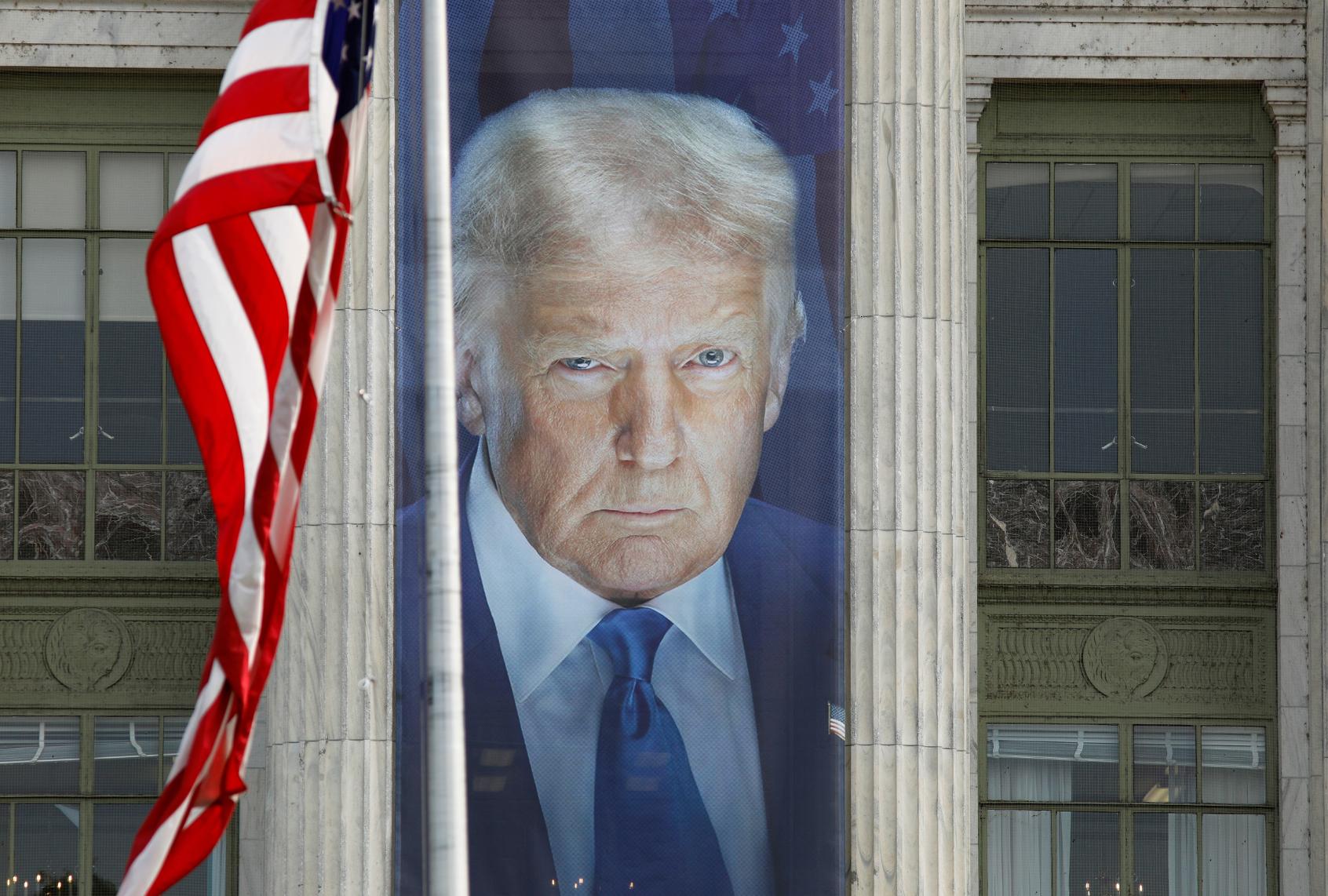

Two weeks into the new year, the Trump administration has already deposed a foreign leader, bombed several countries, threatened to invade several more, unleashed a secret police force on the city of Minneapolis — killing one protester, shooting an immigrant in the leg and brutalizing many others — and started a criminal investigation, based on bogus evidence, on the chair of the Federal Reserve. It’s a lot. So perhaps it’s not entirely surprising that Donald Trump giving a two-hour interview to the New York Times has been somewhat ignored.
That’s too bad. Considering all those events and more, the conversation is an interesting insight into his thinking. As much as we think we know about how his mind works, the president’s interview with four Times reporters showed that he has evolved into something much more dangerous than he was in his first term.
Many Americans have finally wrapped their minds around the idea that we are dealing with a presidency and political movement that can be defined as authoritarian, and even fascist. But after observing Trump over the past year and seeing how he responds to an interview in which the reporters have the time and opportunity to ask follow-up questions, it is clear that those are not the underlying principles that are guiding this presidency.
The better definition for Trumpism is an ancient word that should nonetheless be familiar to anyone who recalls the founding ideals of this country: tyranny.
The better definition for Trumpism is an ancient word that should nonetheless be familiar to anyone who recalls the founding ideals of this country: tyranny. Plato saw it as an inevitable consequence of democracy, when a quest for freedom leads to excess and the populace demands a strongman. He defined it, more or less, as rule for himself rather than the common good, maintained under a system of fear and violence, and characterized by repression of the citizenry — particularly those who are educated and ethical — while relying on lackeys to carry out the tyrant’s wishes and whims.
Plato’s student Aristotle agreed that tyranny was the worst of all possible worlds, but he disagreed that it was the unavoidable outcome of democracy, stressing that the rule of law could mitigate the excesses of the people and tyrant alike. Centuries later, having studied the classics, many leaders of the American Revolution saw King George III as a classic tyrant, and so they fashioned the Constitution around the Aristotelian idea that systems and laws could prevent their new democracy from drifting into tyranny.
The United States has been remarkably lucky that, throughout its 250-year evolution, that assumption had not been seriously tested by any of its leaders until now. Certainly, there have been imperious, corrupt, domineering leaders in our past, but no one has embodied that special brand of ignorance, ego and total self-interest that Donald Trump is bringing to the Oval Office in his second term as president. The rule of law, and our system of checks and balances, have turned out to be quite weak in the face of a man who has no concept of what those are and who operates purely out of greed and self-regard.
You can see this in Trump’s character every day. He is not interested in ideology or philosophy. The president believes in himself and himself alone, and he has been so successful at evading all accountability for everything he’s done in his life that he sees himself as invulnerable. That has freed him to rule completely by whim.
The Times interview, at more than 23,000 words, is a long slog featuring all the usual self-aggrandizement, insults about his enemies — he mentions Joe Biden in derogatory terms 28 times — incessant blaming and whining, and all manner of lies and fantasies that are untethered from the real world. At times, such as when he is talking about his plans for a White House ballroom, Trump sounds ridiculous, and he often seems to be out of the loop. But there is something new in this interview that we haven’t ever seen so plainly expressed, and it’s important.
Katie Rogers asked, “Do you see any checks on your power on the world stage? Is there anything that could stop you if you wanted to?”
Trump replied, “Yeah, there is one thing. My own morality. My own mind. It’s the only thing that can stop me, and that’s very good.”
“Not international law?” Zolan Kanno-Youngs asked.
“I don’t need international law,” the president said. “I’m not looking to hurt people.”
Following that exchange, Trump carried on about how he deserves the Nobel Peace Prize for ending eight wars and proving, at least in his mind, that he can be trusted to always do the right thing.
Want more sharp takes on politics? Sign up for our free newsletter, Standing Room Only, written by Amanda Marcotte, now also a weekly show on YouTube or wherever you get your podcasts.
When asked why he feels the need to “own” Greenland rather than use the existing treaties to get the same benefits, he replied that ownership was psychologically important for him and that he’s always been right about everything. He indicated throughout the interview that he sees no constraints upon him by courts, treaties, agreements or laws, signaling that he plans to act where and when he chooses. And if there is any impediment, he will either ignore it or go around it.
Trump is making billions as president, and he isn’t trying to hide it. When asked why he reversed course from his first term and is allowing his family company to make deals all over the world in blatant and direct conflicts of interest, he said simply, “Because I found out that nobody cared. I’m allowed to.”
There are dozens of examples in the interview illustrating his belief that he can do anything he wants, and we are seeing that played out every day in Washington and around the country. The president has unleashed thousands of masked, armed officers on the streets of American cities, and they are battering immigrants and citizens alike, creating a climate of fear that he and his followers use to push even more boundaries. He claims they are doing it for the public good, ginning up one phony crisis after another to justify his actions.
This is not ideology at work. It certainly has a fascistic and authoritarian character, and there are people around him who fit that description perfectly. But Donald Trump is the ultimate decider, and he cannot be said to have any belief in anything but himself. He is ruling by threats and extortion, period.
He is a tyrant.
We need your help to stay independent
We’ve witnessed the capitulation of the Republican Party and institutions such as law firms, media companies and universities, and we’ve observed opportunists playing the system for their own ends — all of which proves that, for all their world-weary skepticism about humanity’s inherent virtue, the founders greatly overestimated the strength of the average politician or the businessman’s ego and ambition. They thought those who were in competing spheres of power would fight for their own prerogatives, but it’s clear that’s actually quite a rare occurrence when it comes to facing down a tyrant. The most ambitious among them just want a piece of the action.
The real courage is coming from ordinary people on the streets who are facing down Trump’s secret police and brandishing nothing more than cell phones to document the officers’ savage behavior. It may just be that the average citizens who are brave enough to fight for their prerogatives to pursue life, liberty and happiness are the honorable leaders Plato believed were the only ones capable of running a virtuous state. If so, this suggests that while democracy may have its weaknesses, it is also the best hope for saving itself.
Read more
about this topic
