
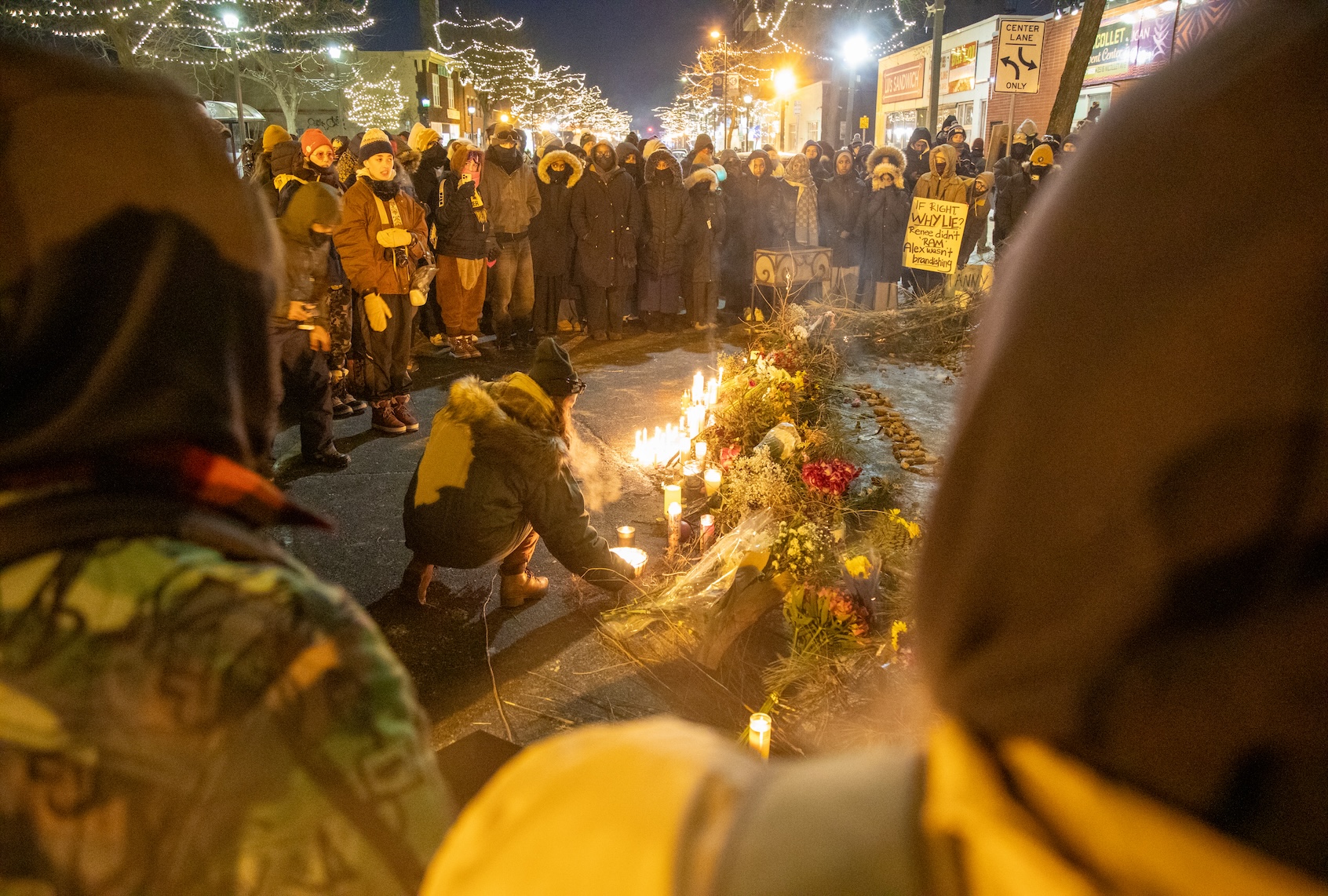

Social media feeds show different narratives of what’s happening with Donald Trump’s immigration crackdown in Minnesota, causing many of us to experience a rollercoaster of emotions. First, there’s the violence, including videos of two American citizens, Alex Jeffrey Pretti and Renee Good, being killed in broad daylight by federal immigration enforcement, sparking fear and despair. The second is the AI-generated misinformation being spread by the White House on what is happening, sparking outrage and anger. The third is how the Minnesota community is coming together to resist ICE, protect and support each other — and while we can absolutely be outraged and anguished by the former, we must also find hope and strength in the latter.
As a health reporter, I’ve been fascinated for years by how communities come together in the wake of a crisis. From natural disasters like a wildfire to the COVID-19 pandemic to a political crisis, time and time again — despite what Hollywood movies like to portray — when humans face a crisis, it brings out the best in people. In an era when self-care has become yet another form of individualism where people are told to buy a certain product or experience to feel better inside, I find it interesting that in times of crisis people take a different approach to self-care — taking care of each other and their communities.
In sociology, there’s a term to describe this phenomenon: “bounded solidarity.” Alejandro Portes, a prominent sociologist at Princeton University, first introduced the term in a paper published in The Annual Review of Sociology in 1998. It’s used to describe when a community is bound by a crisis, and during this time, it can lead to extreme acts of altruism and kindness that aren’t usually seen in non-crisis times.
We are seeing this in Minnesota right now. Multiple media reports have highlighted the ways in which the community has come together. Volunteers are delivering groceries so immigrants can hide at home. People are raising money to help Minnesotans cover rent because they haven’t felt safe to go to work. People are taking each other’s kids to school, organizing shifts for people to stand guard and protect immigrants in their neighborhoods. As NPR recently reported, when a preteen got her period for the first time — a preteen who hadn’t felt safe enough to leave the house to go to school — a community rallied together and launched an underground operation to get her pads. Minnesotans have been braving the below-freezing cold to show up for protests and denounce the violence in their communities for weeks.
“It’s not about politics, it’s about human decency and simply caring about one another.”
These acts of kindness and solidarity matter because it’s exactly what people need to move through a crisis, build resilience, and transform a community for the better. Daniel Aldrich, a professor at Northeastern University teaching disaster resilience, and a survivor of Hurricane Katrina, once told me that when it comes to a disaster, his research found that community-based responses are more successful than individual-based ones.
For instance, a hurricane evacuation is more likely to be effective in a community that already has stronger social ties when compared to one that doesn’t. In fact, Aldrich has even found that the difference between “resilience and disrepair” in a community depends on the “depth of communities’ social capital,” meaning the networks and strength of relationships people have in a community more when it comes to overcoming a crisis.
This isn’t the first time we’ve seen a community come together like this in the wake of a crisis. But unfortunately, bounded solidarity doesn’t always last. When writing my book, I asked experts how did it fade? Why couldn’t this sense of solidarity last after a crisis? The answers I received boiled down to one common theme: we live in a society based on scarcity. People have to return to their everyday lives and be part of the structures that have been built to pit us against each other instead of bringing us together.
We need your help to stay independent
But something different is happening in Minneapolis. This isn’t their first crisis. As detailed recently in the The Atlantic, many of the ways in which Minneasotans have organized are derived from what happened after police officer Derek Chauvin killed George Floyd in 2020. That crisis connected everyone in Minnesota, as one organizer told the magazine, baking in community resilience. But I’m also noticing a change in how people talk about why they’re speaking up and taking action to protect their communities. It’s not about politics, it’s about human decency and simply caring about one another.
Yelena Kibasova, a mom living in a suburb of the Twin Cities who posts about parenting and fitness on Instagram, told me in a phone interview recently that she usually doesn’t speak up much about politics online, but she’s been posting about what’s happening in Minnesota because in her opinion, what’s happening is not “political at all.”
Start your day with essential news from Salon.
Sign up for our free morning newsletter, Crash Course.
“If we separate this issue from politics, what you’re left with is just a suffering community,” Kibasova said. “I think that’s why a lot of moms decided that we are going to step up and speak, because we are in the headspace of protecting our communities and protecting our children.”
If we focus on our shared humanity, perhaps it will be a catalyst for the deeper connections we need to foster resiliency in future crises. And Minnesota is showing us what is possible, leaving us with real hope that transformation can happen in a positive way, and that more resilient communities can be built if we prioritize kindness and caring for each other.
Read more
about ICE and immigration:
