

There’s a particular awkwardness to modern neighborliness. We live stacked on top of one another—sharing walls, elevators, package rooms — yet often remain total strangers, bound only by the mutual recognition of each other’s dogs or preferred laundry times.
Because it seems, somewhere along the way, “being neighborly” acquired the same emotional weight as “hosting a dinner party”: high effort, high expectation and therefore perpetually postponed. We tell ourselves we’ll introduce ourselves properly someday. We wave instead. We nod. We smile. We pretend not to notice how long someone’s delivery has been sitting in the lobby.
And yet, when the ice finally breaks, it’s almost always over food. A loaf. A jar. A container passed hand to hand with a quick smile and a promise to return it someday. Food does what small talk so often can’t: it lowers the stakes, signals goodwill, and creates a tiny bridge where there was previously just a hallway.
What follows is a collection of low-pressure ways to make that hello feel natural — ideas for welcoming someone new, reconnecting with neighbors after time has passed and creating the kind of easy, repeatable rituals that make a place feel like home.
The welcome basket that doesn’t feel like homework
(Ashlie Stevens ) A jar of jam
When someone new moves in, food becomes a language of warmth before words. It says I see you, I’m glad you’re here, no need to chat if you’re tired—this is just a hello. It’s an offering that doesn’t require perfect timing, small talk, or even a shared schedule. You can leave it at the door. You can tuck a note alongside it. You can let it speak for you.
The key is not to overdo it. This isn’t about assembling a Pinterest-perfect welcome basket; it’s about choosing one or two things that feel doable, generous and unmistakably human. A small gesture, thoughtfully chosen, goes much further than a grand one you’ll never quite get around to (guilty; see the section below).
I also like to keep welcome gifts what I think of as “airplane- and pre-K–safe,” meaning I tend to avoid ingredients that aren’t allowed in those spaces, like peanuts, tree nuts and shellfish. If something does contain common allergens like eggs, dairy or gluten, I’ll note it on the card. It’s a small detail, but it makes the gesture feel more universally welcoming.
A few easy, flexible ideas to borrow from:
Something shelf-stable + personal: granola, jam, salted cookies, spiced nuts (if you know they’re safe) or artisanal popcorn.
Something cozy + simple: bread (this pumpkin-citrus-chocolate number has become my go-to), muffins, a soup starter kit or a cute hot chocolate mix.
Something snacky + local: fruit, gourmet crackers, local crisps, or a small bag from a neighborhood bakery or market.
Something festive but low-pressure: a bottle of fancy nonalcoholic cider or sparkling juice—celebratory without assuming anything.
Pick what fits your energy, your schedule and the season you’re in. The gesture matters far more than the format.
And a quick pep talk, if you need one: most neighbors are genuinely happy to meet you! A 30-second hello builds immediate rapport — it turns strangers into friendly faces and makes a building, block, or street feel safer and more human. You don’t need a long conversation. A simple “Hi, I’m Ashlie from down the hall—just wanted to say welcome” is more than enough.
If they seem busy or uninterested, you can always wave, smile, and say, “Have a good day.” No harm done. And don’t stress about names; you can always reintroduce yourself later. The goal isn’t perfection. It’s connection.
The “we’ve lived here forever and just met” offering
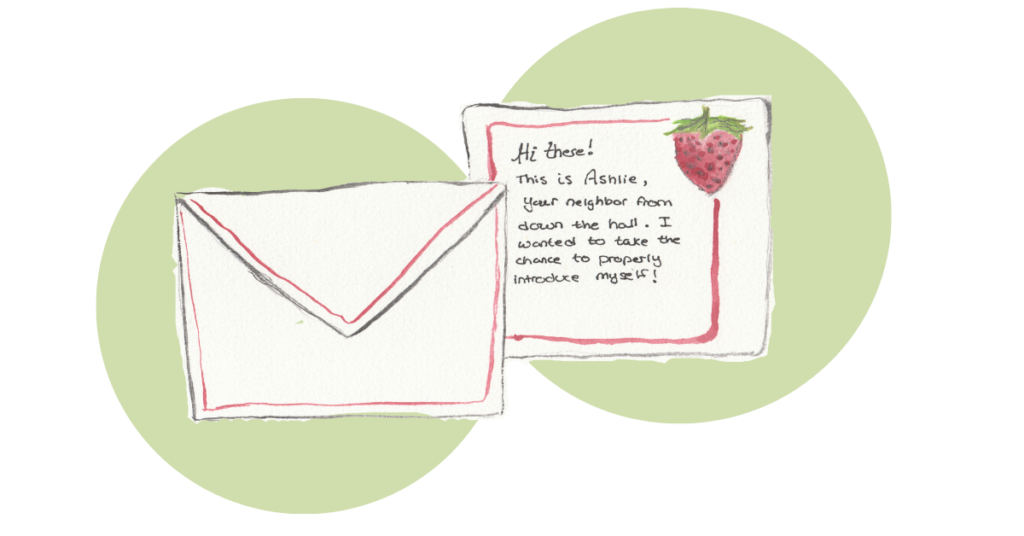
(Ashlie Stevens) Welcome note
But what if — hypothetically — you’ve lived in your neighborhood, or on your street, or in your apartment building well past the window in which anyone could reasonably be considered “new”… and you somehow never introduced yourself? To that I have two things to say. One: it happens. Two: there is no statute of limitations on friendliness.
I say this from experience. I’ve lived in my apartment for several years now, but we moved in during the pandemic, lured by a virtual tour conducted by a masked office manager. At the time, it felt wildly inappropriate to go door-to-door introducing ourselves. When I took Otto out for morning walks, I noticed nurses coming home in scrubs after overnight shifts at the nearby hospital—clearly headed straight for well-earned sleep. Knocking on doors felt intrusive at best, inconsiderate at worst.
So I just… didn’t.
I learned the first names of my immediate neighbors through brief elevator rides and laundry room small talk. And then enough time passed that it began to feel slightly mortifying to say, “Hi, I realize I should have introduced myself years ago, but here I am!” So I let that slide, too. Until last year, when I realized that being a better neighbor was something I genuinely cared about — and that the first step was, predictably, actually getting to know my neighbors.
Last year also happened to be the year I became a full-on snail mail obsessive. So I broke out some miniature greeting cards — one featuring a loaf of bread and a stick of butter holding hands, another embossed like a tin of sardines — wrote a short introduction, included my phone number, and lightly suggested it might be nice to grab a coffee sometime.
To my absolute delight, everyone responded (save for one very quiet couple—you can’t win ’em all). And my sense of community has, in fact, deepened. I now know everyone’s last names. I’m the designated spare-key holder for one neighbor and the backup cat-sitter for another. These are small things, but they add up.
All of which is to say: if you’ve been wanting to do something similar, don’t let the passage of time stop you. It’s a bit like that saying: The best time to plant a tree was 20 years ago; the second best time is now. The same goes for walking a cute jar of pickles — or any of the aforementioned welcome basket ideas — down the hall with a card.
And if it helps, here’s a simple card template you’re welcome to borrow:
Hi there!
I realized I never properly introduced myself, even though we’ve been neighbors for a while—so hello! I’m [Your name], and I live in/at[apartment number/address/ “down the street”].
If you ever feel like grabbing a coffee or saying hi, I’d love that. No pressure at all—just wanted to put a friendly face (and number) to the name.
Warmly,
[Your name]
[Phone number]
The beauty of low-pressure hospitality
(Ashlie Stevens ) Olives
When I was in kindergarten, my family moved to a little cul-de-sac outside Atlanta. We were only there for a couple of years before heading back to the Chicago suburbs, so my memories are few, but vivid. One of the first came right after we arrived.
We were still living out of moving boxes when a neighbor popped over. Blonde hair, broad smile, arms glistening with sweat from the heat, she didn’t hesitate: she hugged us immediately. “Sorry, a little sticky,” she laughed. “The heat. Still not used to it.”
She told us she and her family had moved to the neighborhood a few years before, and for almost that long, they’d hosted regular gatherings: monthly barbecues, as the weather allowed, with drinks and some sides provided, while her husband tended the Big Green Egg. And then, as if it were the most natural thing in the world: “BYOM!” she called over her shoulder. “Just bring your own meat!”
My mom was staggered. She still laughs about it now, whispering to my dad back then, half-horrified, half-amused: “BYOM? They want us to schlep raw meat to their house. Is that… something people do?” The idea of inviting people over and having them provide the main course felt a little audacious, almost rude — but the next month, we dutifully showed up with a cooler of burgers and dogs, and it was a blast. My parents mingled with the neighborhood adults (without standing over a grill), while the local kids ran through sprinklers and watched Green Anoles basking on the sidewalk, flicking their tiny tails.
Over time, all initial skepticism faded. My parents came to see that the neighbors had created something rare: a ritual built on consistency, generosity, and a few essentials—party-sized chips, charcoal, a Publix sheet cake. Hospitality wasn’t about doing everything; it was about making space.
And that’s really the heart of the low-pressure hang. The idea is to pivot from “dinner party” to “get-together where there will be food,” creating formats that reduce host overwhelm, invite participation, and turn food into a collaborative ritual.
Potlucks are classic, yes — but they don’t have to be a casserole parade. Structure them lightly: salty snacks, olive bar favorites, dips. Taco night? You handle the basics, guests bring their favorite toppings. Dessert bar? You provide the coffee and whipped cream, guests bring the sweets.
The magic is in lowering the barrier, for both you and your people, so that you might actually want to do it again. And if you do? That’s how neighbors become a real community.
The “set it and forget it” standing invite
(Ashlie Stevens ) Dutch oven
A slight sharpening of the ideas above — and one I’ve found especially useful — is what I think of as the “set it and forget it” standing invite.
Recently, I’ve been reading “24/6: The Power of Unplugging One Day a Week” by Tiffany Shlain, which chronicles her family’s decade-long practice of unplugging for Shabbat. That book sent me down a parallel path, reading about people who — often as part of their own digital Sabbaths — have folded a standing dinner invite into their week.
Regardless of religious background, something about these accounts made my shoulders drop a full two inches. The scenes were strikingly similar: people finishing work, heading home, turning off their devices. After a little kitchen reset, they’d open the door to spaghetti night, or roast chicken with challah, or a big pot of stew—same night, every week. No texts to send. No logistics to negotiate. Everyone knew the rules: phones down, doors open.
It also reminded me of a story I heard recently on Kendra Adachi’s “Lazy Genius” podcast. A caller shared that what finally unlocked regular entertaining for her was a simple garden flag. If the flag was out, she told her neighbors, it meant she was having drinks and porch hangs — BYOB. If people stopped by, wonderful. If not, she still got to enjoy a drink in peace. The invitation existed either way.
I love both of these examples because they point to a particular strain of hospitality — the set it and forget it invite — that works especially well for building neighborly connections. A standing Shabbat dinner. A flag on the porch. These small signals remove the social friction of scheduling. The invite is already baked in.
You might be thinking, But Ashlie, is that really necessary? And I suppose it depends on how often you’ve watched perfectly good social plans wither on the vine as everyone retreats to their corners to consult calendars, propose alternate dates, and apologize profusely for being busy. For me, it happens often enough that this approach feels less like overkill and more like mercy.
Some variations that excite me: Tuesday tea on the stoop. “Wine if the porch light’s on.” A monthly potluck with a single shared theme. Or — my personal favorite — Sunday soup hour: you make a big pot; everyone else brings either appropriate accoutrement (crackers, good bread, a simple salad) or just themselves.
This story originally appeared in The Bite, my weekly food newsletter for Salon. If you enjoyed it and would like more essays, recipes, technique explainers and interviews sent straight to your inbox, subscribe here.
Read more
about this topic
