
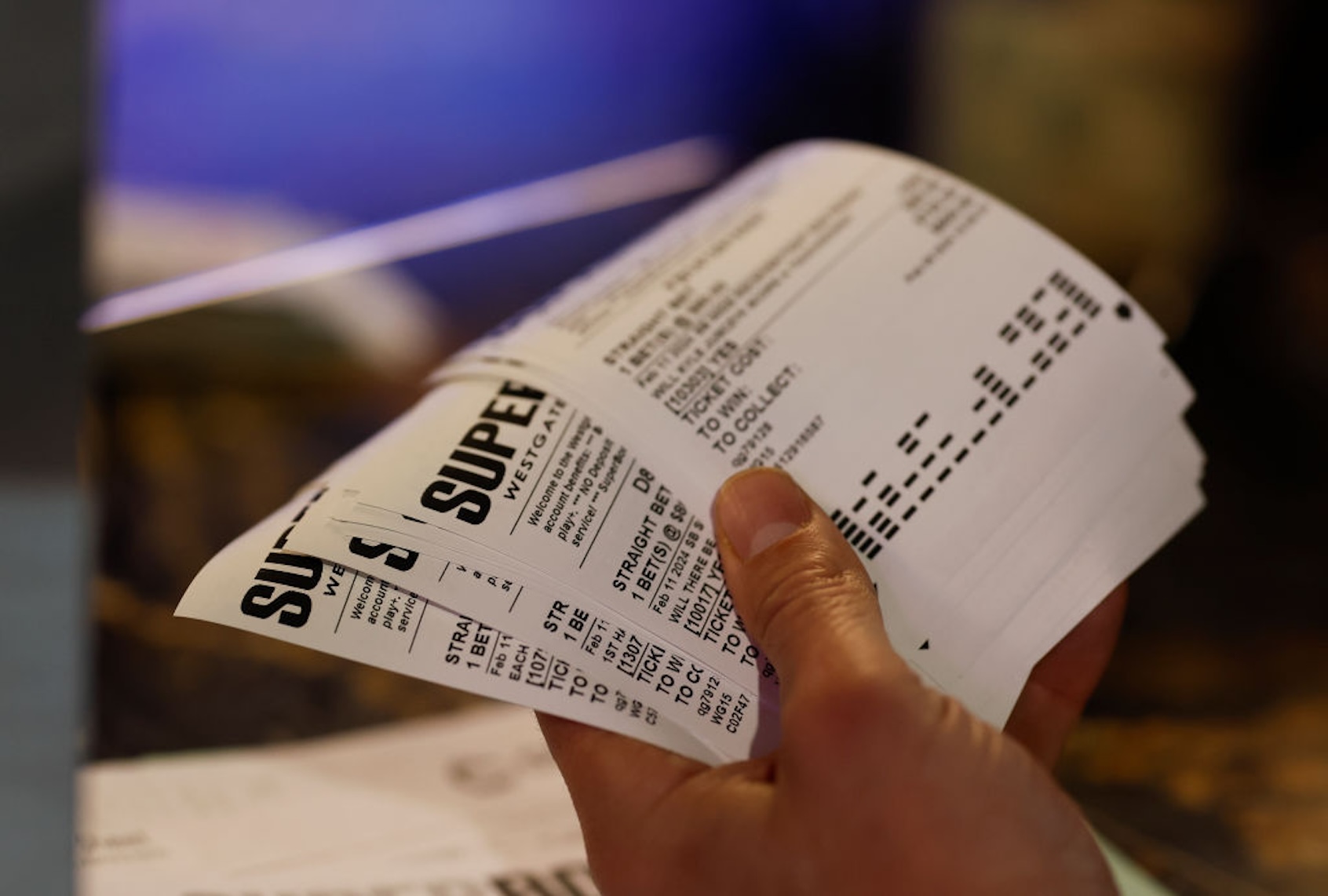

In 2013, Eddie Roberson and Talif Crowley, two Black New Jersey residents, made a bet on the outcome of the Super Bowl game between the San Francisco 49ers and the Baltimore Ravens. Roberson, 31, bet the 38-year-old Crowley $700 that the 49ers, who Las Vegas bookies had as 4.5-point favorites, would prevail. When the 49ers lost the game 34-31, Crowley tried to collect. But Roberson refused to pay up, believing his 49ers had been cheated. An unprecedented blackout had delayed the game, arguably shifting momentum toward the Ravens. So Crowley shot Roberson six times.
Roberson’s death, one of multiple instances of Black people in America killed in the aftermath of gambling, is a crystallization of the precarity of Black life — and of the violence that sports and unchecked corporatism often evoke off the field.
Industry analysts estimate that a record $1.76 billion will be legally bet on today’s game via U.S. sportsbooks. And if history is any indication, Black people, and Black men in particular, will watch the game more than any other group — and sportsbooks’ advertising will dominate the telecast.
Super Bowl Sunday is by far the biggest day of both legal and illegal sports betting in America. Industry analysts estimate that a record $1.76 billion will be legally bet on today’s game via U.S. sportsbooks. And if history is any indication, Black people, and Black men in particular, will watch the game more than any other group — and sportsbooks’ advertising will dominate the telecast.
Tune into any given professional or college sporting event on TV, and there’s a decent chance you’ll be prompted to visit an online sports betting site within about five to ten minutes. The prompt will come by way of snipes — those graphic overlays on the TV screen — venue signage and color commentators, each subtly presenting betting as not only an exciting appendage to the game but also as virtually essential to truly experiencing it.
In addition to being major ambassadors of online sports betting, Black celebrities have become the very face of it. This isn’t altogether surprising considering that the sports most bet on in America — football, basketball and boxing — have been dominated by Black athletes and have a disproportionately high number of Black viewers. Marketers, in short, know their audience, and they are unabashed in showing it.
In 2020 the gambling company DraftKings announced, to much fanfare, that basketball legend Michael Jordan was becoming one of its special advisers, pushing shares up 8%. The choice was apparently made with a complete disregard for optics. Jordan was ensnared in multiple gambling-related scandals in his otherwise legendary career, and some believe they led directly to his brief hiatus from the NBA in 1993. He has denied this.
Kevin Hart, LeBron James, Marshawn Lynch and Jamie Foxx are just a small sampling of Black celebrities who have since aligned with major online sportsbooks as ambassadors, gleefully appearing in ads for them. A common feature unites the ads’ styling. Cartoonish confidence and humor present gambling as pure revelry, aiming to circumvent, if not dilute, viewers’ fears about the hazards.
Gambling has long been a fixture in Black diasporas in America, cherished and bemoaned in equal parts, going back to the 18th century. Enslaved people engaged in simple contests — guessing games and strength challenges — as a way to boost their mood and self-esteem, and to bond with one another. Following Reconstruction, Black people staged formal card games and cockfighting events, allowing participants to network while acquiring small but quick bursts of cash as economic opportunity languished. In the early 1900s, entrepreneurial-minded Black people arriving in the North during the Great Migration frequented gambling houses, in some cases even running them in conjunction with white powerbrokers in government and mafiosos, eluding the grip of Jim Crow to build wealth and garner political power.
Even then, the benefits of gambling have always gone hand-in-hand with its risks. Those in the throes of problematic gambling — betting that’s broadly damaging to one’s wellbeing or livelihood — are more likely to engage in illegal behaviors like theft and financial fraud, and a study conducted by researchers at the University of Michigan and Rice University found that legal sports betting is linked to a substantial increase in violent crime. Whatever the case, we know for certain that the bigger the games are, the higher the financial and personal stakes.
Want more sharp takes on politics? Sign up for our free newsletter, Standing Room Only, written by Amanda Marcotte, now also a weekly show on YouTube or wherever you get your podcasts.
As an addiction researcher, I’m curious about things that are designed to keep people coming back, whether that be club drugs like molly, TikTok, matcha or sports entertainment. Working with Black people deep in the throes of various kinds of addiction, I’ve become particularly attuned to how even casual forays into new physical or digital worlds can inflict on them and their families with years of emotional and financial pain. And gambling addiction is both underdiagnosed and undertreated in racial minorities.
Years of research underscore that people who engage in problematic gambling have substantially poorer mental health and lower quality of life than those who don’t gamble. Studies have further shown that pathological gamblers are more likely to smoke a pack or more of cigarettes a day and be obese.
According to a 2025 Pew poll, 30% of Black people and 27% of Hispanics have personally bet on sports in the last year, compared to just 19% of white people. The same poll showed that 31% of Black people and 37% of Hispanics view legal sports betting as bad for society, compared to 46% of white people. With the ascent of online sports betting, these dynamics are poised to change in ways that our public health system currently isn’t prepared to handle.
Gone are the days when one had to connect with a bookie to place a bet or head to the racetrack: Around 94% of modern-day sports betting takes place online.
Gone are the days when one had to connect with a bookie to place a bet or head to the racetrack: Around 94% of modern-day sports betting takes place online, with gamblers needing little more than a smartphone, internet connection and a few bucks — and sometimes not even that — to get started.
Following a 2018 ruling from the Supreme Court that overturned a longstanding federal law banning state-authorized sports betting, the number of states with legal sportsbooks grew from one to a staggering 39 in 2025, alongside Washington, D.C., and Puerto Rico. That judicial decision paved the way for the likes of PrizePicks, FanDuel and DraftKings, the largest online sportsbook that claims 4.8 million average monthly unique paying customers, to partner with America’s largest sports leagues to deliver their platforms to the masses. The ruling also enabled them to promote their wares broadly and with scant regulation on where, when or how they’re marketed.
Some of the most pronounced and consequential sportsbook advertising is done in the digital realm, where a younger, more diverse and loyal audience can often be found, which serves as a red flag. Studies have shown that being from a racial or ethnic minority group is significantly associated with an earlier age of initiating gambling. Popular Black influencers like Druski and Funny Marco, and entertainers like Drake, regularly plug online sportsbooks to their young audiences on livestreams and podcasts where regulation is virtually nonexistent, capitalizing on the parasocialism that typifies modern celebrity-fan interactions. Drake is currently under investigation for RICO gambling violations owing to his connection to Stake, which bills itself as the world’s largest online casino and sportsbook.
We need your help to stay independent
None of this is particularly new. In the 1950s and 1960s, baseball legend Jackie Robinson and multihyphenate entertainer Sammy Davis Jr. were prominent ambassadors for Chesterfield cigarettes. In the 1970s, actor Billy Dee Williams was the iconic face of Colt 45 malt liquor. Following them were the likes of P. Diddy who, before his public fall from grace and legal troubles, fronted Cîroc vodka in the early 2000s. His endorsement touched off the trend of Black musicians — including Jay-Z (D’Ussé cognac) and 50 Cent (Le Chemin du Roi champagne) — linking with or acquiring significant stakes in alcohol brands.
Sportsbook operators’ modern gambit is just the latest evolution of corporations leveraging partnerships with Black celebrities to enter into untapped Black markets — and convincing Black celebrities to become willful, if not blissfully ignorant, allies.
Online sportsbooks are now poised to be to modern gambling what drones are to warfare — a remarkable, unchecked multiplier of pain and gain. With the rapid shift of gambling to the virtual sphere, much of the cultural stigma that once acted as a control may soon be gone. But gambling’s social perils are storied and certain. It remains to be seen if or when the online sports betting bubble will burst. When it does, Black people will be left holding the bag, but not the one they’d hoped for.
Read more
about sports betting
