
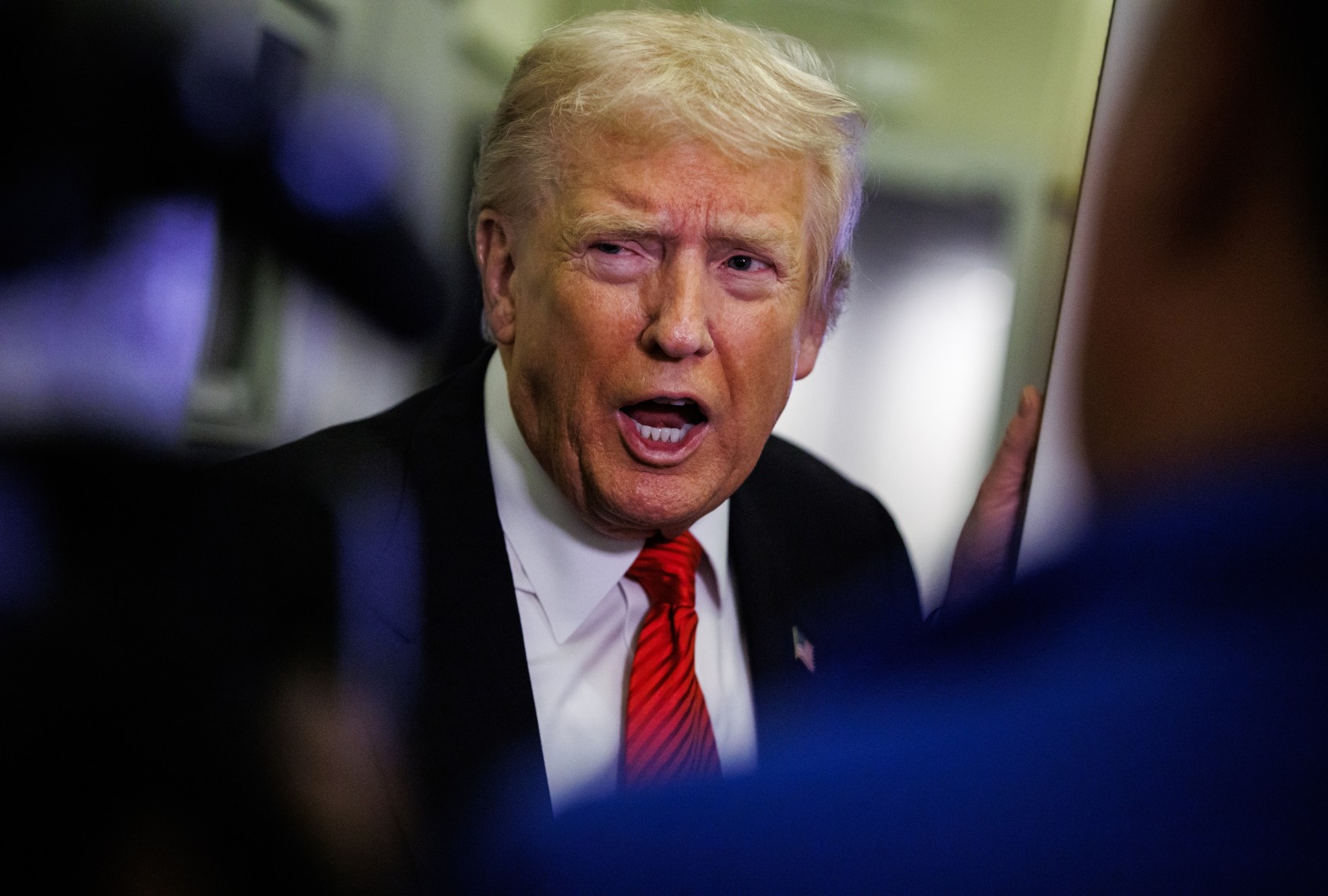

Donald Trump wants to “nationalize” America’s elections. The word sounds neutral — bureaucratic, even benign. It is not. As a verb, “nationalize” implies action. And so does Trump.
The president’s statement, which came during a Feb. 2 interview with former FBI Deputy Director Dan Bongino, was ominous and direct. “The Republicans should say, ‘We want to take over.’ We should take over the voting in at least 15 places,” Trump said. “The Republicans ought to nationalize the voting.”
In the 12 days since he made these comments, the president has continued to raise similar demands. During a meeting on Feb. 3 in the Oval Office, he bulldozed the GOP’s supposed belief in states’ rights. “The state,” he said, “is an agent for the federal government in elections.” Flanked by Republican lawmakers, Trump seemed to give an implicit order. “If a state can’t run an election, I think the people behind me should do something about it.”
The following day, in an interview with NBC Nightly News, he tried to dance around his earlier statements. But he again revealed what many election experts believe to be his true intent: to suppress the vote in cities with large Black populations such as Atlanta, Detroit and Philadelphia, which are notably located in the swing states of Georgia, Michigan and Pennsylvania.
The Constitution mandates that elections are administered by the states. If Trump and his MAGA Republicans were to succeed in nationalizing elections, it would trigger a constitutional crisis. Given the Supreme Court’s 6-3 right-wing majority, which includes three justices that Trump himself appointed, there is a strong possibility he would find a receptive audience for his attempts.
“Nationalize” has become part of a much larger vocabulary used by the Trumpists and the larger right-wing to advance and legitimize their goal of replacing American democracy with a form of white Christian nationalist authoritarian plutocracy.
“Nationalize” has become part of a much larger vocabulary used by the Trumpists and the larger right-wing to advance and legitimize their goal of replacing American democracy with a form of white Christian nationalist authoritarian plutocracy. Terms like “fraud,” “election security,” “ballot integrity,” “drop boxes” and “mail-in ballots” operate as racialized code for Black and brown people. By focusing his rhetoric and actions on cities with large populations of color, the president’s implication is clear: such votes are presumptively illegitimate and need to be thrown out. (In MAGA rhetoric, “high-quality votes” has come to stand for “real Americans,” or white people who support Trump and the Republican Party.)
Under this framework, as we saw on Jan. 6 and with the larger attempts to overturn the 2020 presidential election, democracy becomes legitimate only when Republicans win; any defeat by Democrats is prima facie evidence of fraud.
None of this is by accident; Trump and his agents have repeatedly demonstrated that they are highly skilled in using language to redefine reality. As George Orwell famously warned in his seminal essay, “Politics and the English Language,” “Political language is designed to make lies sound truthful and murder respectable, and to give an appearance of solidity to pure wind.”
In January, Trump’s Department of Justice and the FBI raided election offices in Fulton County, Georgia, in search of non-existent voter fraud in the 2020 election. The act was less about relitigating 2020 than about obtaining voter data that could facilitate a purge of Black and other likely Democratic voters ahead of the midterms and the 2028 presidential election, making Georgia a template for a nationwide voter purge and voter nullification campaign.
Republicans in Congress have also taken action by advancing the SAVE (Safeguard American Voter Eligibility) Act, which would require a passport or birth certificate to register to vote in federal elections. An estimated nine million Americans lack ready access to proof of citizenship. It’s unlikely that the SAVE Act, which leading voting rights expert Michael Waldman has characterized as a “power grab in legislative garb,” would pass the Senate since doing so would require 60 votes to break a Democratic filibuster. The longer-term danger is that the legislation represents another step in eroding democratic institutions and norms, which is a common strategy in a failing democracy like the United States, where malign actors use the country’s legislative institutions to advance their authoritarian agenda.
Steve Bannon, the right-wing thought leader who formerly served as Trump’s chief strategist during his first administration, recently called for ICE agents to be stationed at polling places in Democratic-led cities and battleground states to stop “fraud” and to arrest immigrants. Such an action would almost certainly constitute unlawful voter intimidation — a tactic designed to suppress Democratic turnout through fear.
Election law expert Joshua Douglas, who serves as a professor at the University of Kentucky Rosenberg College of Law, told me that “one of the biggest threats to the 2026 election is people’s belief that Trump can do whatever he wants to control how the election will be run.” That misinformation, he said, “almost creates this feeling of inevitability.”
Want more sharp takes on politics? Sign up for our free newsletter, Standing Room Only, written by Amanda Marcotte, now also a weekly show on YouTube or wherever you get your podcasts.
This could very well be the point of Trump’s threats. “But the Constitution is very clear: the President does not have the authority to administer elections,” Douglas said. “That is up to the states, though Congress can also step in. So, instead of worrying every time Trump says he might do something, we should clearly explain how his plans are unconstitutional, and we should expect the courts to rule accordingly — as they did regarding his previous executive order on elections.”
Indeed, on Tuesday a Trump-appointed federal judge stopped an attempt by the Justice Department to access Michigan’s voter information files. But it doesn’t appear that this ruling or similar defeats will slow Republicans and so-called principled conservatives who love to wave high a huge banner for states’ rights as they condemn federal overreach and big government.
In practice, appeals to states’ rights have historically been situational — invoked when they are most convenient and subsequently discarded when they are not. Getting and keeping power to impose the right’s agenda is the ultimate goal.
The Constitution and rule of law have often become inconveniences to be ignored or misinterpreted when it serves the needs of Donald Trump and his MAGA movement.
A parallel logic is applied to the Constitution and the rule of law. Conservatives and other members of the right are strict constructionists and textualists — when it serves their interests. As we have seen repeatedly throughout the Age of Trump and the country’s worsening democracy crisis, the Constitution and rule of law have often become inconveniences to be ignored or misinterpreted when it serves the needs of Donald Trump and his MAGA movement.
Few Republican and conservative leaders, for example, oppose the administration’s mass deportation campaign and the brutal methods used by Immigration and Customs Enforcement officers and other federal agents in violating the constitutional rights of the public. If a Democratic president were to take similar actions, Republicans would be howling about states’ rights and an oppressive federal government. The GOP has also refused to curb Trump’s blatant abuse of power in seeking to deny federal funding to Democratic-led cities and blue states.
So-called conservatives especially love big government when they can use it to violate the rights of women, the LGBTQ community, Black and brown people, disabled people, the poor and other marginalized groups.
As the New York Times’ Jamelle Bouie sharply observed in a 2023 essay, “When it comes to the demands of capital or the prerogatives of the ‘right’ kind of Americans, Republicans believe, absolutely, in the light touch of a ‘small’ government that stays out of the way. But when it comes to Americans deemed deviant for their poverty or their transgressions against a traditional code of patriarchal morality, Republicans believe, just as fervently, that the only answer is the heaviest and most meddlesome hand of the state.”
We need your help to stay independent
This tendency was illustrated recently by House Speaker Mike Johnson, who was asked by reporters about Trump’s desire to nationalize elections. His defense of the president was unequivocal: “What you’re hearing from the president is his frustration about the lack of some of the blue states, frankly, of enforcing these things and making sure that they are free and fair elections.”
Then Johnson went one step further, supplicating himself to Trump and amplifying the Big Lie. “We had three House Republican candidates who were ahead on election day in the last election cycle,” he said, “and every time a new tranche of ballots came in, they just magically whittled away until their leads were lost, and no series of ballots that were counted after election day were our candidates ahead on any of those counts. It just looks on its face to be fraudulent.”
Johnson’s claims had no basis in fact. They instead served to underscore what many suspect is Trump’s true desire: to turn the United States into what political scientists describe as competitive authoritarianism. In such a system, elections still occur. But the outcome is rarely in doubt.
Read more
about the Big Lie
