
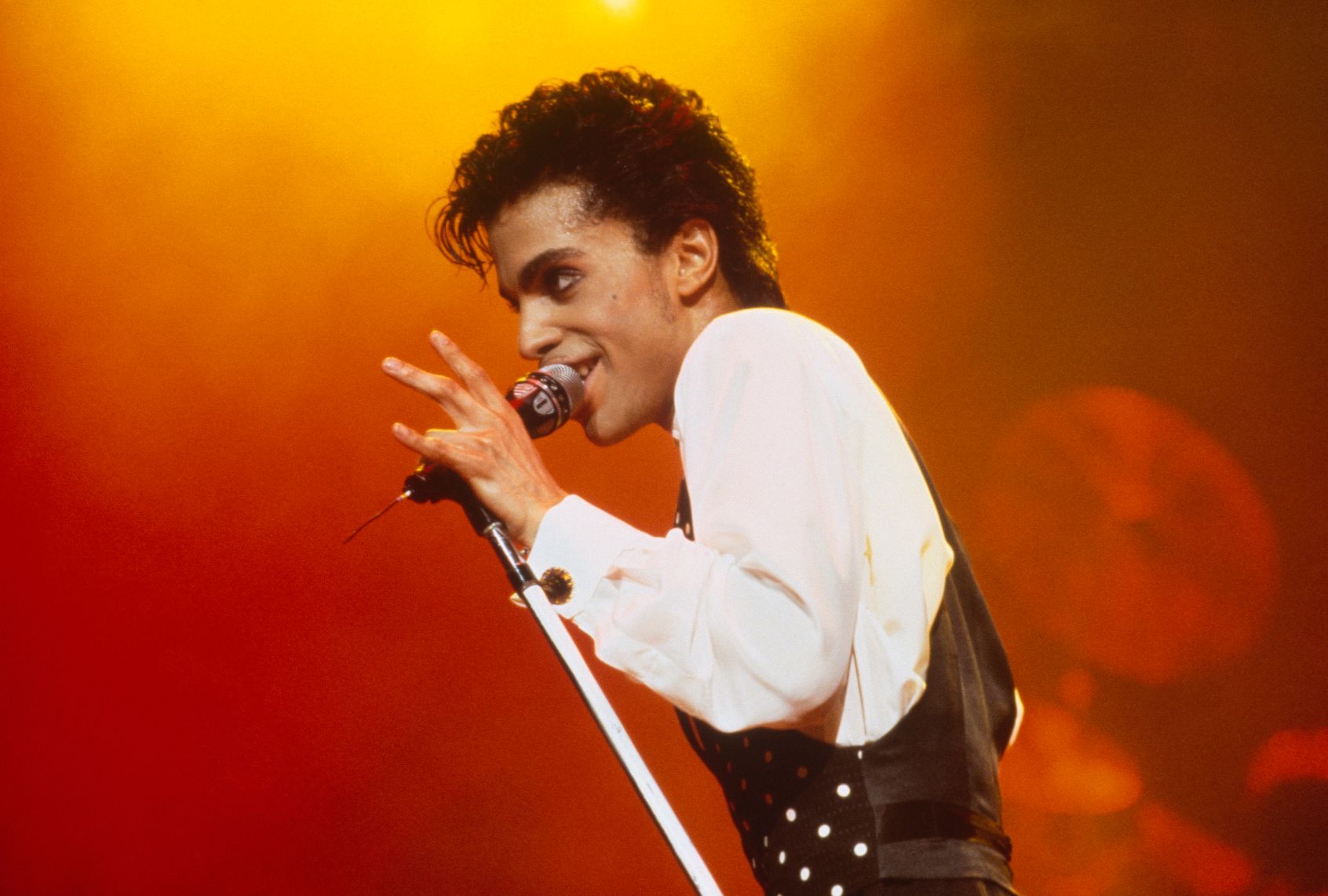

In matters of sex and sensuality, no one compares to Prince. His lyrics are ripe with forward descriptions of fantasies he’s had or ones he’s hungry to realize. Some he spelled out in juicy detail, like when he told us what Nikki was doing in that hotel lobby in the second line of her song. Other more radio-suitable singles leave the specifics to the imagination, like his rainy-day tryst with the girl wearing the raspberry beret.
There are the cuts blaring their horny intent in their titles: “Gett Off.” “Erotic City.” “Head.” His 1985 collaboration with Sheena Easton, “Sugar Walls,” made the Parents’ Music Resource Council’s “Filthy Fifteen” list, landing in the No. 2 slot behind, yes, “Darling Nikki.”
Then, sweet loves, there is “Kiss.”
“Kiss” is flirtatious fun that plays up PG-13-rated romance (“You got to not talk dirty, baby, if you wanna impress me”) and” only dares to hint at a strip tease (“You can’t be too flirty, mama, I know how to undress me”).
In a Top 40 radio lineup lousy with songs about barely legal lovers, here was a ditty where one of the sexiest men alive announced his appreciation for maturity (“Women, not girls, rule my world”) and warned against childish tantrums (“Act your age, mama, not your shoe size, maybe we could do the twirl”). The song holds next to none of the grinding desire throbbing through most of The Artist’s oeuvre. There are allusions to what he wants, of course; it wouldn’t be a Prince joint if there weren’t.
But this promise of a naughty good time comes with no expectations that his lover do or be anything that isn’t natural to them, or try to be anything they aren’t. “You don’t have to be rich to be my girl/ You don’t have to be cool to rule my world/ Ain’t no particular sign I’m more compatible with/I just want your extra time and your . . . kiss…”
Next to the lush power of 1984’s “Purple Rain” and the candy psychedelia that defined 1985’s “Around the World in a Day,” “Kiss” is a clean, minimalist A major revelation, the key that Baroque-era German composer and poet Christian Schubart associated with innocent love and satisfaction.
Whether Prince picked his pitch with that in mind is anybody’s guess . . . probably not; doesn’t matter. “Kiss” makes us feel all those things.
We need your help to stay independent
Along with boasting one of the most easily recallable and down-to-Earth refrains in popular music, “Kiss” has a noteworthy history. It was the lead-off single to “Parade,” the full soundtrack album to Prince’s 1986 vanity lap “Under the Cherry Moon,” in which he directed and starred, and premiered months after “Kiss” became a hit. But since the song’s popularity couldn’t save the movie from being deemed one of the 20th century’s prettiest, most ridiculous bombs, the movie with which we more closely associate “Kiss” is 1990’s “Pretty Woman,” thanks to Julia Roberts’ screechy yet somehow winning bathtub performance.
Subtext spotters may recognize the underlying significance in the track’s inclusion, since Roberts’ sex worker sets a “no kissing” boundary with her clients. If we hadn’t already predicted she was going to break it for Richard Gere’s financier, this bubbly moment was our crystal ball glimpse into their eventual happy ending.
Rewind much farther, however, and we might marvel at its origin as a track that didn’t quite work. Prince handed it off to Mazarati, a funk band he co-produced with Revolution bassist Brownmark. Mazarati cracked the code only for Prince to reclaim it. (Yes, this happens, and yes, Brownmark had feelings about it.)
A bit of tinkering – stripping the original’s heavy bassline, tossing in his lithe falsetto and a playful guitar to hold everything aloft – made the one-time throwaway into something immortal. Warner Bros. balked at releasing it, but Prince pushed it to the public anyway on Feb. 5, 1986.
Want more from culture than just the latest trend? The Swell highlights art made to last.
Sign up here
History proves his instincts were correct. Forty years later, “Kiss” holds a vaunted place atop the hierarchy of the Purple One’s discography, ranked by Billboard as his and The Revolution’s second most popular title behind two of the “Purple Rain” soundtrack’s main load-bearing titles, “When Doves Cry” and “Let’s Go Crazy.” “Kiss” has been blessed by American Songwriter, Rolling Stone, NME and a slew of other authorities as one of Prince’s best songs and, more than that, one of the greatest songs of all time.
Our ears are always the ultimate arbiters, and hundreds of millions still bend to the song’s unvarnished, pure pleasure even now.
Prince’s tracks have been covered by tens of artists – sometimes with his blessing and occasionally and very stridently despite his protest. The Art of Noise’s mechanical, synth-heavy 1988 cover, featuring Tom Jones, may be the most successful tribute to date. Along with introducing “the Voice” to a new generation, the song earned that year’s MTV Video Music Award for breakthrough video and gave the group their highest charting hit ever.
But there’s only so much glow that the ‘60s icon could siphon from the original, and it’s admirable that Jones knew that. Instead of trying to compete with the Prince video’s gliding choreography, the Welsh showman punctuates the lyrics’ sly ambiguity with a few gyrations and groin thrusts, giving him the aura of a buzzed, funky uncle.
Beyond that, “Kiss” has been subjected to jazz, country and even an industrial dance treatment – none of which, to our knowledge, irked Prince as much as the version Maroon 5 featured on the deluxe version of their 2012 album “Overexposed.”
“Art is about building a new foundation, not just laying something on top of what’s already there,” Prince famously huffed to Billboard in 2013.
It seems incredible that such a simple tune could hold so much power until, maybe, you find out that not even Prince could explain it, according to Duane Tudahl, author of 2017’s “Prince and The Purple Rain Era Studio Sessions: 1983-1984.”
In a reflection on the song’s origin that Tudahl shared with the MusicThing blog in 2013, Prince reportedly chalked it up to ascending to a higher plane of creativity. “They aren’t conscious efforts; you just have to get them out. They’re gifts,” he said. “Nothing in it makes sense. Nothing!”
But the sum of its parts absolutely hits us in the heart all these years later, moving us to spend extra time with his sonic Valentine, whether on the dance floor or as the sweet partner in one’s lovely solo parade.
Read more
from Salon’s culture newsletter, The Swell
