
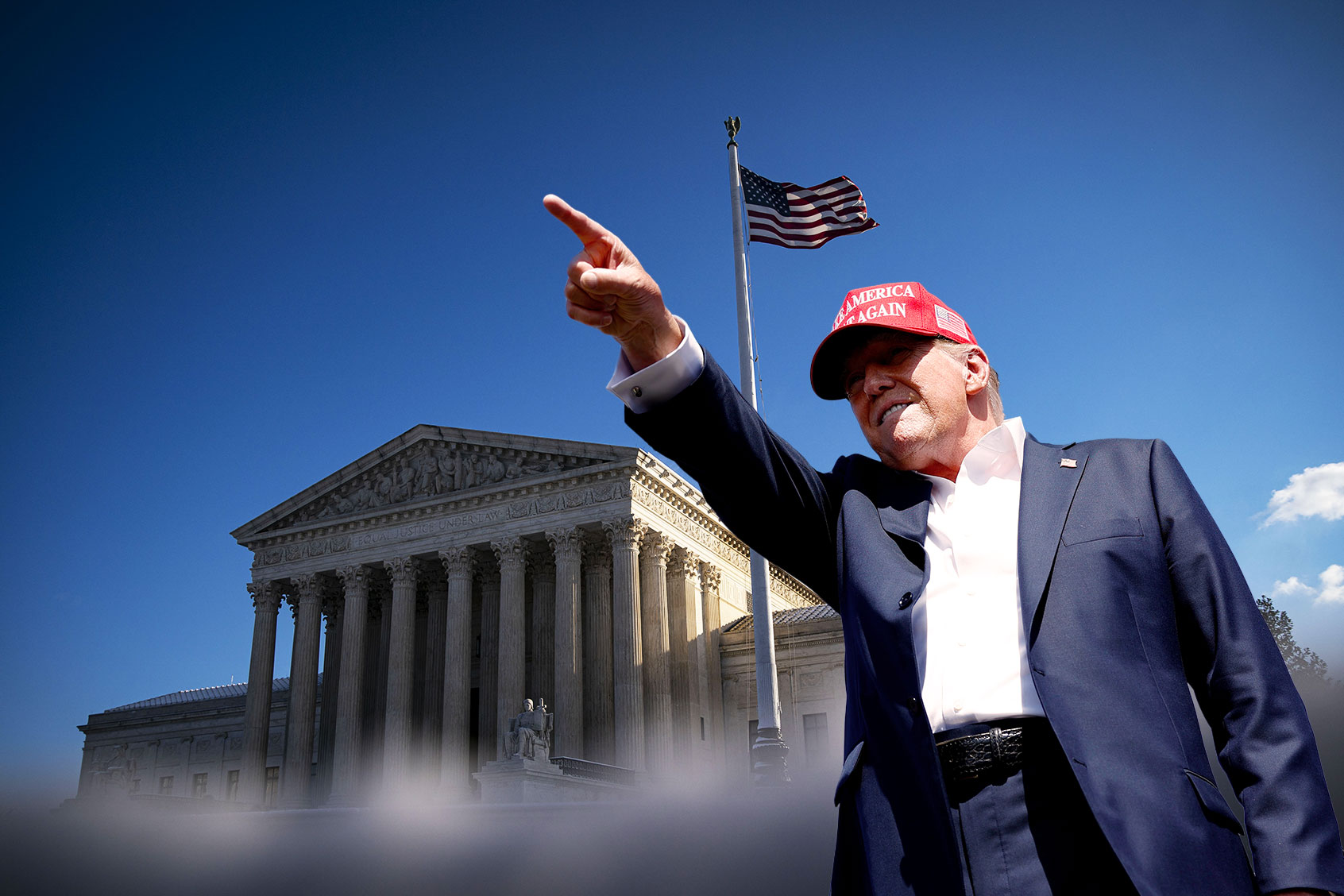

In Donald Trump’s mind, he is the state, and justice is whatever serves his interests. This is the logic of absolute monarchs, dictators and tyrants, and although it is antithetical to the Constitution and America’s founding principles, the president makes sure to put it on full display.
Following the Supreme Court’s 6-3 decision on Feb. 20 to declare many of Trump’s tariffs unconstitutional and illegal, the president responded with rage. He attacked the six justices who ruled against him — liberals Sonia Sotomayor, Elena Kagan and Ketanji Brown Jackson, along with conservatives Neil Gorsuch, Amy Coney Barrett and Chief Justice John Roberts — as “a disgrace to our nation.”
But he heaped special scorn on Gorsuch and Barrett. “They are very unpatriotic and disloyal to our Constitution,” Trump said of the two justices, both of whom he appointed. “It’s my opinion that the court has been swayed by foreign interests and a political movement that is far smaller than people would ever think.” Later, he said that their families should be embarrassed.
Trump views the courts as his personal servants, not as a co-equal branch of government. By attacking the justices and suggesting they are pawns of some non-existent foreign conspiracy, he is simultaneously imperiling their safety and undermining the Constitution.
Trump views the courts as his personal servants, not as a co-equal branch of government. By attacking the justices and suggesting they are pawns of some non-existent foreign conspiracy, he is simultaneously imperiling their safety and undermining the Constitution by suggesting they are traitors who are serving foreign interests, making them illegitimate.
Trump also publicly rebuked the Court, albeit in less personal terms, during his State of the Union address on Tuesday night. The justices looked on, stone-faced, as he lamented their “unfortunate involvement” in the “disappointing ruling” that shattered the cornerstone of his economic agenda. The president claimed that he plans to use older and much more powerful laws to reinstate his global tariff program. But according to legal scholars, Trump’s new tariffs — which he levied in the wake of the Court’s decision, first at 10% and then at 15% — are also illegal.
In his 1941 book on the rise of the Nazis and how they weaponized the law, Jewish legal scholar Ernst Fraenkel described such behavior — of a leader protecting their allies while punishing their perceived enemies — as the “dual state.” This system, as Pema Levy explained in Mother Jones, is “two-faced twice over: it is characterized by a bifurcation in the law, but also by the facade of normalcy obscuring the fact of an authoritarian state.”
Trump views the Supreme Court as a means of rubber-stamping his agenda to make his attacks on democracy “legal,” such as when the right-wing justices ruled that the president has king-like powers, so long as he invokes “presidential responsibilities.” But when a majority of the justices disagree with or oppose him, the Court becomes an enemy.
Beyond his attacks on Supreme Court justices, Democrats and American institutions, including the media, that have come to define his second term, Trump has allowed, in Levy’s words, “most people [to] enjoy a sense of normalcy while, for example, foreign students like Rümeysa Öztürk and green card holders like Mahmoud Khalil can be detained for their speech. Americans and immigrants alike can be terrorized by ICE, the federal government’s unleashed immigration force, if they speak Spanish, look nonwhite, or happen to be in the wrong place at the wrong time…”
Justice, of course, has never been blind in America. But Trump and his inner circle, along with others who have been able to curry his favor, have shattered that sacred civic myth. He has sought to rebrand the United States — and crucially, its justice system — in his own image.
The most blatant example of this came on Feb. 19 when a huge banner with Trump’s face was unfurled on the exterior of the Justice Department with the words “Make America Safe Again,” the slogan of the administration’s mass deportation campaign. Similar banners hang outside the Department of Labor and other federal buildings throughout Washington, D.C, symbolizing what’s happening at the Court and throughout the country.
In Florida, Aileen Cannon, a federal judge appointed by Trump, has consistently acted more like Trump’s personal attorney than a neutral judge in the classified documents case. Her most recent demonstration of fealty to Trump came on Monday when she permanently prohibited the release of former special counsel Jack Smith’s report on his investigation into the case. Cannon believes that Smith was improperly appointed when he prepared it.
In January, independent Black journalists Don Lemon and Georgia Fort were arrested by federal agents, ostensibly for disrupting a right-wing church in St. Paul, Minnesota, as part of an anti-Immigration and Customs Enforcement protest. But Lemon and Fort were not participants. They were reporters engaging in constitutionally-protected First Amendment speech.
Want more sharp takes on politics? Sign up for our free newsletter, Standing Room Only, written by Amanda Marcotte, now also a weekly show on YouTube or wherever you get your podcasts.
During a press conference on election security, Homeland Security Secretary Kristi Noem said that it is her job to ensure that “the right type of people vote” and elect “the right leaders to lead this country.” Her meaning was not vague or subtle: those “right leaders” and voters are followers of Trump and MAGA.
According to reports that originated with former Salon reporter Roger Sollenberger and NPR, the Justice Department is actively suppressing evidence of Trump’s alleged involvement in the Epstein scandal by withholding and removing documents related to the president, including a victim of Epstein who claims she was the victim of a violent sexual assault by Trump. (Being mentioned in the Epstein files does not necessarily indicate guilt or criminal wrongdoing.)
Under Trump, the dual legal state is not a warning. It is rapidly becoming the norm — and we are seeing the results in what has become a full-on legitimacy crisis in the United States.
The American people, by large margins, are losing faith in their government. This includes the Supreme Court, which has historically been the country’s most trusted democratic institution but has now lost much of its prestige and respect. An August 2025 poll released by Pew shows that slightly less than half of the American public holds a favorable view of the court. This is a dramatic 22% decline from 2020.
At the state and federal level, the courts have acted as an important roadblock against Trump’s authoritarian campaign, but their rulings possess limited enforcement power when the administration refuses to comply.
The Age of Trump has been a great stress test for America’s democratic institutions that most have failed. At the state and federal level, the courts have acted as an important roadblock against Trump’s authoritarian campaign, but their rulings possess limited enforcement power when the administration refuses to comply.
In the meantime, the American people and the leaders who will be doing the hard, decades-long work of democratic renewal in the aftermath of Trump should revisit the wisdom of Supreme Court Justice Robert H. Jackson. “The most odious of all oppressions are those which mask as justice,” he warned. “The common sense of mankind demands that law shall not stop with the punishment of petty crimes by little people. It must also reach men who possess themselves of great power.”
To survive this dark time, and to ultimately triumph over it, we Americans must relearn and internalize basic lessons about democracy and the rule of law such as accountability, transparency and serving the public interest and the common good — qualities that far too many of us, our leaders and other elites, either forgot or never learned in the first place.
We need your help to stay independent
The restoration of the rule of law in the wake of Trump will require structural reform. The imperial presidency must be checked and the constitutional balance of powers meaningfully restored. Reform must also extend to the judiciary — particularly to transparency, accountability and enforceable ethical standards at the Supreme Court.
Institutional reform, however, must extend beyond formal structures to the broader political and legal culture. The American legal system continues to privilege wealth and power while disadvantaging the poor and marginalized. Persistent racial and class disparities in policing and sentencing, along with what scholars and activists describe as the prison industrial complex, must be dismantled.
A genuine recommitment to the rule of law must confront these systemic inequities — not merely the excesses of a single administration.
But faith in the rule of law depends upon accountability. A defining feature of the Age of Trump is the normalization of cruelty, along with the administration’s assumption that it is above legal and constitutional constraint — an assumption reinforced when their wrongdoing carries few consequences.
In a democracy, the rule of law endures only when accountability and transparency are real, and not just rhetorical. Without them, public trust in American institutions cannot be restored.
This article has been updated
Read more
about this topic
