
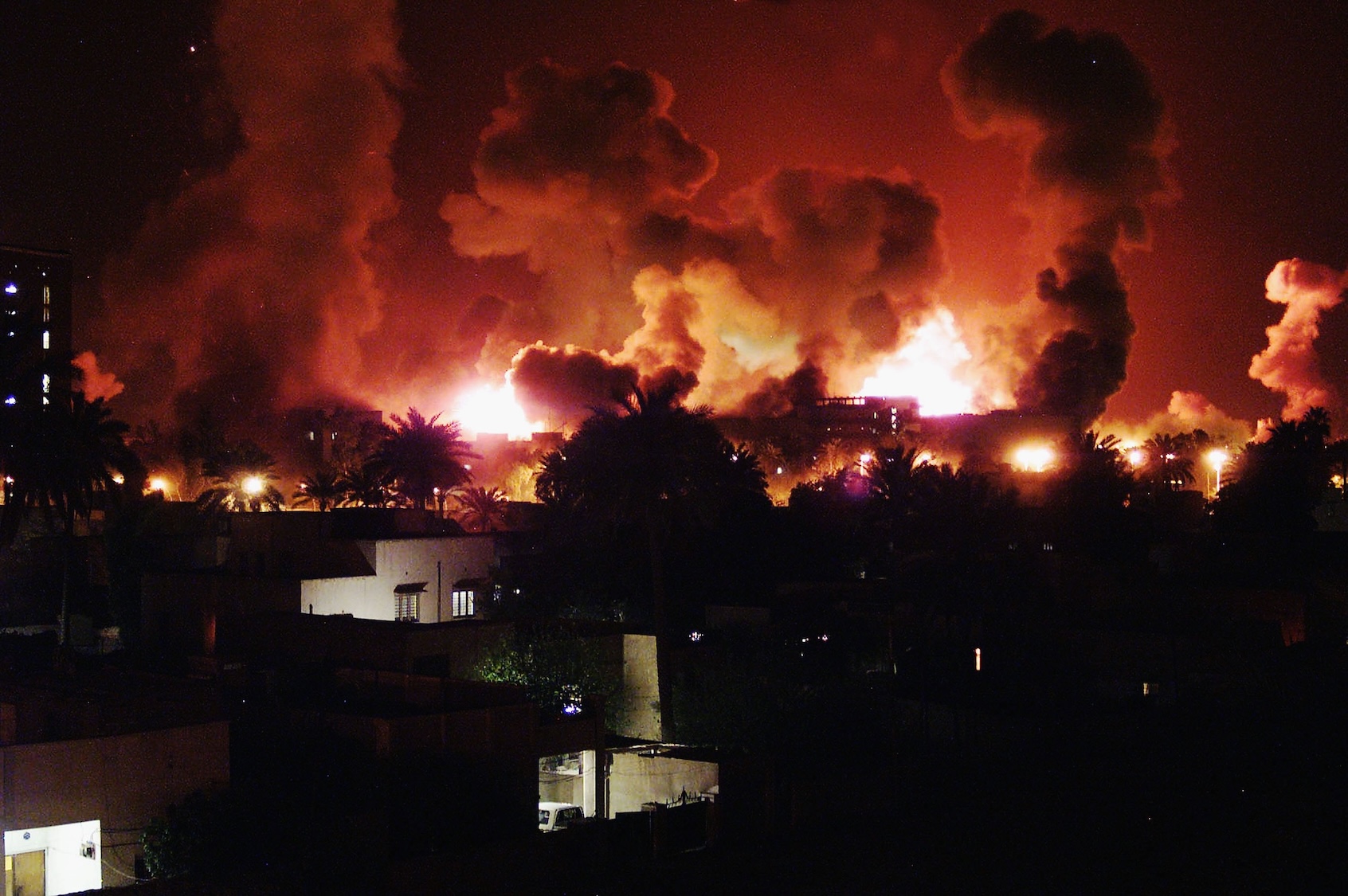

As the drums of war against Iran beat in Washington, I feel the same sadness and anger I felt when another Muslim country was targeted as part of the U.S.-led “War on Terror.”
Two weeks from today will mark the 23rd anniversary of the U.S.-led invasion of Iraq; it brings a profound feeling of déjà-vu for me.
On the night of March 19, 2003, I sat at home watching the news — tense, sad and angry. I held pen and paper in my hand, ordering my children to be quiet as they moved between playing and watching the screen. I had skipped dinner with them and my wife, and it was not yet bedtime for the little ones.
We were watching CNN. Like other American networks, they had positioned cameras on the rooftops of the Al-Mansur and Palestine hotels in Baghdad.
At first, the feeling was eerie; the cameras peered into a city with dimmed lights, shrouded in silence.
Then, at 8:35 p.m. Eastern time (4:35 a.m. in Baghdad), the Athan al-Fajr, or dawn prayer, suddenly rose from the darkness of the Baghdad feed. From the numerous mosques along the Tigris, the sound on the TV was a layered, overlapping chorus of multiple mu’adhins. It was melodic and haunting, even as the world waited for the “shock and awe” to begin.
CNN’s Wolf Blitzer in New York and Aaron Brown, on the ground in Baghdad, acknowledged the sound directly:
Blitzer: “Aaron, right now, we’re not hearing air raid sirens. We’re hearing the call to early morning prayers, the first prayer of the day for Muslims. Maybe I’ll be quiet for a second and you might be able to make it out behind me. Just listen for a second.”
Brown: “As you look at Baghdad, it is eerie… you don’t see any sense of panic in the city, any sense of movement in the city, or frankly any sense of war in the city.”
About an hour later, as the first strikes hit, Brown highlighted the surreal nature of this split-screen reality: “It is hard to imagine what it would be like to live in this city at a time like this, to know what had happened and what is likely to happen.”
When President George W. Bush appeared live, nearly an hour later, CNN used a “picture-in-picture” format, which was still somewhat unusual. On one side was the president’s face; on the other was the live, active bombardment of Baghdad.
Bush’s 48-hour ultimatum for Saddam Hussein to leave Iraq had just expired.
Bush declared: “At this hour, American and coalition forces are in the early stages of military operations to disarm Iraq, to free its people and to defend the world from grave danger.”
I stayed awake all night. My children were eventually put to bed, but my wife stayed up to watch with me for a few hours, her expression stoic.
It was too late for me to send reports for the following day’s edition of Asharq Al-Awsat, my London-based Arabic-language newspaper. Communication was not as advanced as it is today; the paper did not yet have an online edition, and we still used the telephone for routine contact.
We need your help to stay independent
When I went to my Washington office early the next morning, I saw parts of Saddam Hussein’s defiant speech, in which he declared: “The criminal, reckless little Bush and his aides committed this crime that he was threatening to commit against Iraq and humanity.”
My boss in London usually called me right after the daily reporters’ meeting, which drew up a blueprint for the day’s coverage.
When I picked up the phone, I began to weep loudly, repeating: “Al-Tatar dakhalo Baghdad” (“The Tatars have entered Baghdad”)
I must explain that the fall of Baghdad to the Mongols (or Tatars) remains a traumatic event deeply engraved in the Arab and Muslim mind as a definitive historical defeat. My boss was no less saddened, but our deadlines would not wait and we began to construct our coverage of the invasion.
During the period between that initial attack and the U.S. ground invasion, I covered press conferences at the White House and the State Department, and also experienced personal encounters, or perhaps confrontations, with Secretary of State Colin Powell and national security adviser Condoleezza Rice.
Powell had just returned from New York after his now-infamous presentation to the U.N. Security Council, where he held up a small vial of white powder to illustrate the alleged danger of Saddam Hussein’s biological weapons. “My colleagues,” he insisted, “every statement I make today is backed up by sources, solid sources. These are not assertions. What we’re giving you are facts and conclusions based on solid intelligence.” We now know that all of that was false, to Powell’s everlasting shame.
Start your day with essential news from Salon.
Sign up for our free morning newsletter, Crash Course.
I was one of five Arab correspondents invited to meet with Secretary Powell in his office. While seated to his immediate left at a conference table, I asked a question that clearly irritated him. He looked at me directly and said, “Your questions seem to be more about Islam; this has nothing to do with religion.” His tone remained civil and diplomatic, but the underlying friction was clear.
By that time, I had already reached the conclusion that the Bush administration’s “War on Terror” was, in many ways, a military campaign against Muslims in general
The following week, I interviewed Condoleezza Rice at the White House, alongside another Arab journalist. Rice was a primary architect of the Iraq invasion, famously warning about Saddam’s supposed nuclear program: “We don’t want the smoking gun to be a mushroom cloud.”
My déjà-vu experience today derives from the same kind of “shock and awe” I witnessed in 2003. Another American president is declaring, on dubious or threadbare evidence, that another Muslim country is endangering U.S. security.
I irritated her as well by “playing the race card.” I implied that, as a Black woman, she was an unlikely choice to lead the call for the invasion of a country in what we used to call the Third World. I also mentioned that Black American soldiers would certainly be among the casualties.
My déjà-vu experience today derives from that same kind of “shock and awe.” Indeed, the U.S.-Israeli bombing campaign against Iran is much larger than the initial stage of the Iraq war. Another American president is declaring, on dubious or threadbare evidence, that another Muslim country is endangering U.S. security.
The tragic cycle of history feels poised to repeat itself. America has eliminated Ayatollah Ali Khamenei just as it eliminated Saddam Hussein two decades ago, but just as much uncertainty hovers over what lies ahead. This current escalation suggests that the U.S. war machine is once again ignoring the human cost of “decapitation strikes,” as we saw with the apparent American missile strike on a Tehran girls’ school. For someone who wept at seeing the modern Tatars enter Baghdad, the prospect of a similar fate befalling Tehran is more than a strategic policy shift. It is the return of a recurring but never-banished nightmare about one civilization attacking another, driven by blind hatred.
Read more
from Mohammad Ali Salih
