

Presidents historically have at least paid lip service to the idea that they are supposed to consult Congress before launching a military action. While it’s usually obvious they will proceed anyway, they have nonetheless made the effort, if only to obtain the political cover they might need should things not go as planned. In the case of Donald Trump’s current misadventure in Iran, it’s becoming clear there was no plan — and since the president feels he is owed support for anything he does, he didn’t even bother with the niceties.
Since Vietnam at least, this dynamic has tended to put Democrats in a bind more often than Republicans. The reason for that is simple: The GOP has traditionally been unified in its zeal to go to war, while Democrats have been more divided. For a couple of decades, this caused Democratic presidential aspirants to twist themselves into pretzels trying to find a sweet spot between the party’s anti-war base and its more hawkish minority.
Now, as Trump’s war with Iran is intensifying and expanding, Republicans are being forced to confront their own intra-party divisions and rivalries.
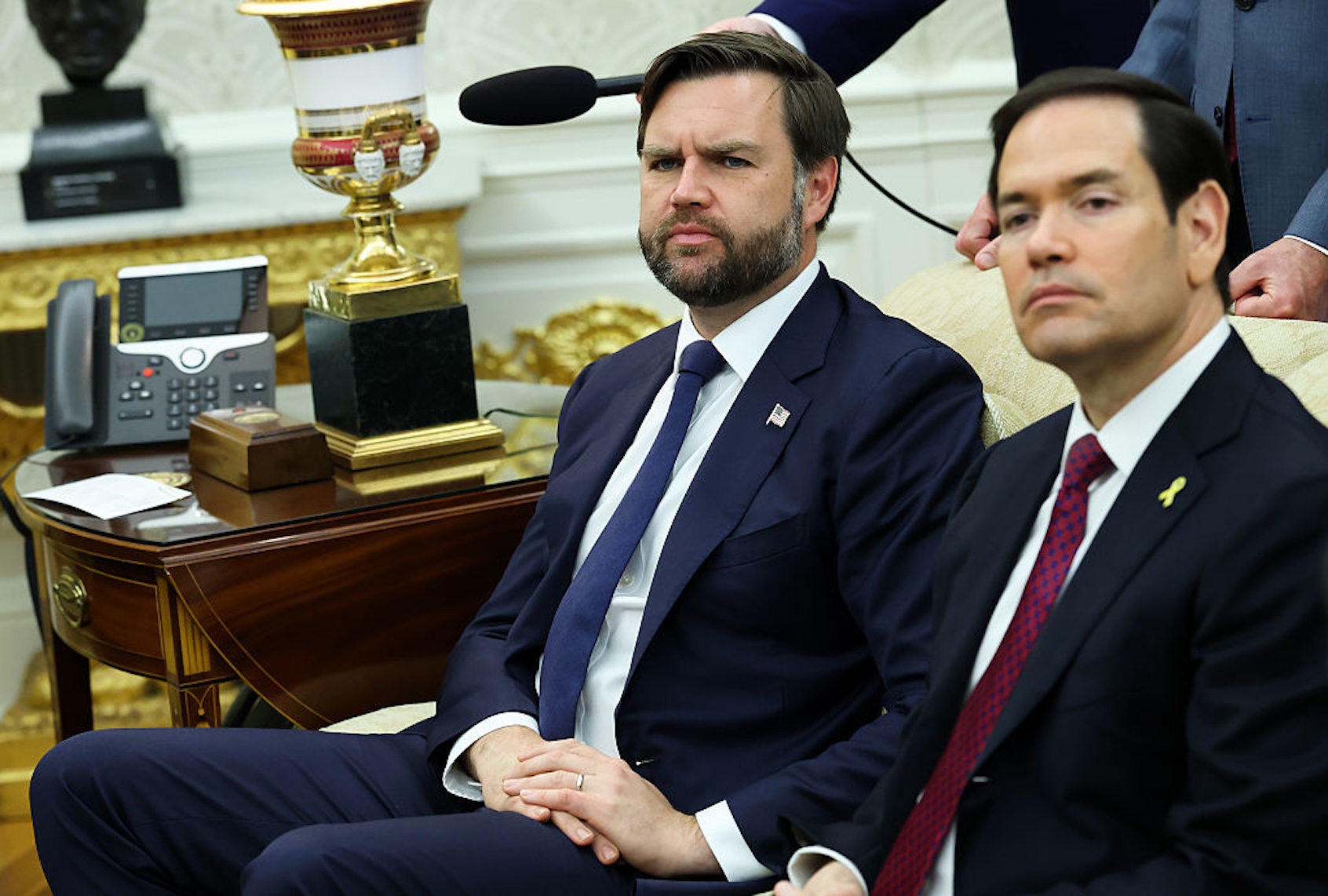
Now, as Trump’s Iran war is intensifying and expanding, Republicans are being forced to confront their own intra-party divisions and rivalries. This has become clear not as a result of some dramatic debate about the war and its aims — because there hasn’t been one. Instead this is best seen in the escalating rivalry between Vice President JD Vance and Secretary of State Marco Rubio, both of whom appear to already be vying for the Republican nomination in 2028.
Both Vance and Rubio would do well to remember how the Iraq wars played out for Democrats.
The run-up to the first Iraq war exposed the party’s divisions. In August 1990, Iraq invaded the neighboring country of Kuwait. After a flurry of diplomatic initiatives went nowhere, the United Nations issued an ultimatum that Saddam Hussein withdraw his troops, and a coalition of 39 countries, led by the U.S., mobilized nearly a million troops to the Kuwaiti-Iraqi border by January 1991 to enforce it. President George H.W. Bush asked for authorization to go to war as soon as Congress convened, which began an extended and torturous debate. The Senate voted 52-47 to authorize the use of military force, with ten Democrats joining with virtually unanimous Republicans in support. The House approved it 250-183.
That swiftly-executed war was considered a rousing military victory, and many Democrats who had planned a presidential bid and had voted against the war were tarred as unpatriotic in its wake. The eventual winner of the nomination, Arkansas Gov. Bill Clinton, was fortunate enough not to have had to make that decision.
As it turned out, the fates of those who had voted against that war played a big role in how Democrats would eventually vote in 2003, when the same decision was forced upon them by President George W. Bush and his crusade to “finish the job” Iraq. Many of the party’s presidential hopefuls voted in favor of the war, an equally poor decision since this time it turned out to be a disaster. Massachusetts Sen. John Kerry won the Democratic nomination in 2004, but he paid a price for his vote. Four years later, New York Sen. Hillary Clinton did as well.
Public opinion in both wars was initially divided, and then the public rallied around the flag once they started. In 1991, public approval for the war stayed relatively high throughout the operation. A decade later, as the second war dragged on, support shrank dramatically.
The lesson here is an easy one: When it comes to war and peace, political leaders should use reason, vote their conscience and let the politics play out as they will. Not only is it the moral thing to do, there’s just no way to predict the outcome of a war in any case.
Trump’s Iran war has been unpopular with the American public from the beginning. Those concerns didn’t stop Rubio, who has always been something of a hawk, from agitating for war. There was some tension in the early days of Trump’s second term, when Rubio was still hostile to Russian President Vladimir Putin while Trump was bending over backward to deliver Ukraine to him on a silver platter. That’s changed now that Trump has somehow found a way to think of himself as the world’s greatest peacemaker as he blows boats out of the water, seizes leaders of sovereign nations and starts wars halfway across the world — just because he can.
Want more sharp takes on politics? Sign up for our free newsletter, Standing Room Only, written by Amanda Marcotte, now also a weekly show on YouTube or wherever you get your podcasts.
Rubio is Trump’s closest administration ally in all these decisions, and as the bulk of the party rallies around Trump, the secretary is being seen in elite circles as his heir apparent. At a recent gathering of big donors at Mar-a-Lago, Trump reportedly asked who they would prefer he support in 2028. The group unanimously picked Rubio.
The secretary is already making his moves. Last week the New York Times published a story portraying Rubio as the visionary behind Trump’s foreign policy. Eschewing the gooey idealism of the neoconservatives, who pretended to care about freedom and democracy, Rubio’s innovation is what the Times characterizes as “destroy and deal,” but what it really is is a very old concept called conquest.
“It is about sustaining American military primacy, making other states fear and respect us,” Emma Ashford of the Stimson Center, a research group in Washington, explained in the article. Rubio underscored this in his recent speech at the Munich Security Conference, when he bemoaned the fact that the “great Western empires” had passed.
The vice president, on the other hand, has been seen as the frontrunner in most public polling for months. But he has been a cipher when it comes to the administration’s military “excursions,” as Trump calls them, and has reportedly even been exiled from the makeshift Mar-a-Lago situation room. Vance is known to be the voice in the room — at least when he’s there — who pushes against military action. He’s not coming out against these wars; Vance is not politically suicidal. But he’s playing it very close to the vest, seemingly waiting to see how it all shakes out.
We need your help to stay independent
This is tricky for Vance, who is often seen as the “one true MAGA” carrying on the philosophy of America First and “no new wars” philosophy, which is no longer operative with anyone except the elite MAGA influencers. But he can’t afford to overtly separate himself from Trump.
The machinations of both camps are coming into focus. By lashing himself to Trump’s foreign policy mast, Rubio has to hope that these wars go well if he is going to win the nomination. Trump is said to be favoring him, but the danger is that if things in Iran go south, the secretary will be the one Trump blames for the failure. Vance is trying to have it both ways. If things go well with the war, Rubio will reap the political benefits. So Vance is quietly rooting for the war to fail while keeping his fingerprints off any of it.
After watching Democrats’ experience with the Iraq debacle, Vance, Rubio and their fellow Republicans should have learned that staking one’s political fortunes on the outcome of war is a fool’s game. But with Trump in charge, they really have little choice. Good luck to whomever wins the prize. It’s likely not to be one worth having.
Read more
about Iran
