
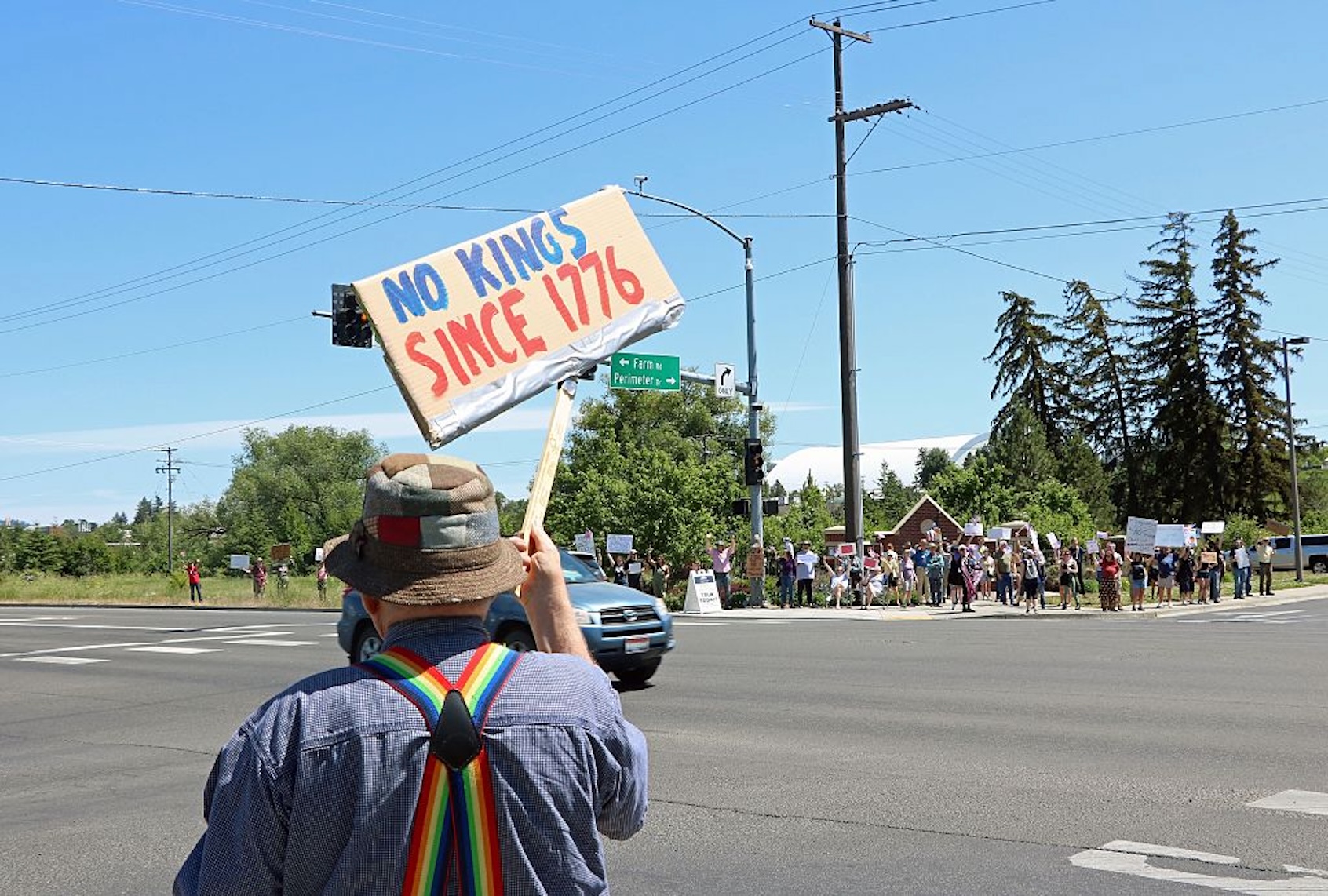

When Donald Trump returned to power in January 2025, he moved quickly to complete his autocratic takeover and rubblize American democracy in ways more consistent with an absolute monarch than a president. In its first year, his blitzkrieg on the country’s institutions, rule of law and political culture was remarkably effective. The American people were shell-shocked. Supposedly the ultimate check on power, many became the walking wounded, moving by instinct with a hand on the shoulder of the person ahead of them, like soldiers in the first world war.
A year later, the picture is more complicated — and, with important qualifiers, more encouraging in ways that matter. Trump has failed to fully consolidate power. With his popularity at an historic low for a president at this point in his term, his unfitness for office is undeniable to all but the most diehard members of the MAGA personality cult.
The resistance to Trump and his radical agenda, in a grossly underreported story, is taking place in unexpected places that greatly complicate the stale narrative of how America is neatly divided between red and blue, pro- and anti-Trump forces.
The American public is finally waking up from its slumber and beginning to push back. The resistance to Trump and his radical agenda, in a grossly underreported story, is taking place in unexpected places that greatly complicate the stale narrative of how America is neatly divided between red and blue, pro- and anti-Trump forces.
As expected, there is a sustained — and growing — resistance to the administration’s mass deportations carried out by Immigration and Customs Enforcement in Democratic-led cities such as Los Angeles, Chicago, Minneapolis and other blue parts of the country. The “No Kings” rallies were among the largest protests in the country’s history; the next is scheduled for March 28.
While conventional wisdom suggests that anti-Trump protest energy in red state America is marginal, recent research complicates that picture significantly.
According to Erica Chenoweth, director of the Nonviolent Action Lab at Harvard University’s Kennedy School, protest participation in counties that voted for Trump has increased by 60%. As these counties are more rural and less populated, the numbers are still small. Drawing on data from 2025, she found that, on average, 65 people per 10,000 total have engaged in anti-Trump protests.
More striking still is the geographic distribution. Chenoweth’s data shows a notable rise in protests in deep red areas — in some cases, organizers reported, the first anti-Trump events their towns and communities had ever seen. The scale of this shift, Chenoweth told an interviewer in October 2025, is “comparable to [the Black Lives Matter protests] in the summer of 2020 which, at the time, was the largest and broadest mass mobilization in U.S. history.”
The conclusion Chenoweth draws is qualified but powerful: “We do think we’re seeing a shift in the willingness of people in pro-Trump areas in the country to participate in a broader mass movement emerging in opposition to many of his administration’s policies.”
In West Virginia, resistance to ICE and mass deportations is growing, modeled on the mutual aid networks and organizing in urban centers. Eli Baumwell, executive director of the ACLU of West Virginia, puts it plainly: “[W]hat our state lacks in population density or large-scale demonstrations, we make up for in dedicated community groups willing to do hard work, day and night. Whether the work is loud and attention-grabbing, or quiet and impactful, there are countless attorneys, activists and pissed off people working to resist this onslaught, and their numbers are growing.”
The pattern extends beyond West Virginia. Resistance to ICE enforcement is emerging in more rural parts of red states, including North Carolina and Texas.
The Trump administration’s plan to spend billions of dollars on purchasing mega warehouses to serve as de facto concentration camps capable of holding 100,000 people is also generating unexpected resistance. Many of these detention centers will be in red states and other Republican-led parts of the country. Despite the economic argument for their presence, local organizing against them is real and growing. The motivations are mixed. Most notably, there is principled opposition to the Trump administration’s cruelty, and there’s also the “not-in-my-backyard” resistance. But whatever its motivations, the pushback is very real.
Want more sharp takes on politics? Sign up for our free newsletter, Standing Room Only, written by Amanda Marcotte, now also a weekly show on YouTube or wherever you get your podcasts.
Organizing against Trump and MAGA in red state America comes with risks not typically seen in blue cities and states. Protesters in more rural areas are more likely to know and have long-standing ties to their fellow community members, and their actions often come at a higher cost. They stand to be marginalized, lose their jobs, be denounced by family and friends and be kicked out of their churches. They could face intimidation, violence and be targeted for arrest and prosecution.
Large-scale protests like No Kings are critically important, but these smaller local gatherings matter as well. Just as they come with greater risks, there is also the potential for larger rewards. People get to know their neighbors, and they build the relationships and social capital necessary for the difficult, long-term political work of resisting and defeating Trumpism. Democrats should build on that.
“What’s needed is for the Democratic Party to have full-time, long-term organizers hired from rural places to organize in rural places,” political scientist Suzanne Mettler, co-author of the recent book “Rural Versus Urban: The Growing Divide That Threatens Democracy,” explained in a recent interview. “And they need to start out by listening, by asking rural people, ‘What are your needs here? What would you like a political party to be doing for you? Why are local people upset with the Democratic Party? And what can we do to regain your trust?’ And then to work hard over the long term to rebuild relationships. We think that is a very doable goal.”
We need your help to stay independent
Chenoweth’s own research suggests that sustained protests by just 3.5% of the population can produce serious political change. In America’s highly polarized political environment, that small percentage could easily determine the result of an election.
Beyond voting, the nascent protests and other forms of collective action in red states carry real symbolic power. They signal to their fellow Americans who oppose the Trump-MAGA revolutionary project that they are not alone — even if they too feel surrounded and at-risk behind enemy lines. If that awareness then becomes concerted action, a real resistance movement could bloom in red state America, Trump’s own metaphorical backyard.
Authoritarian movements get and keep power largely by creating a narrative that they are absolute, universal, inevitable and forever. The evidence emerging from Trumplandia tells a very different story.
By tearing away at that fiction, small protests by a few brave people in the heart of red state America can serve as a force multiplier for democracy. Whether that becomes something larger depends on what comes next — and on whether the Democratic Party, pro-democracy organizations and ordinary Americans choose to fuel it. Big things can have small beginnings.
Read more
about the Trump resistance
