
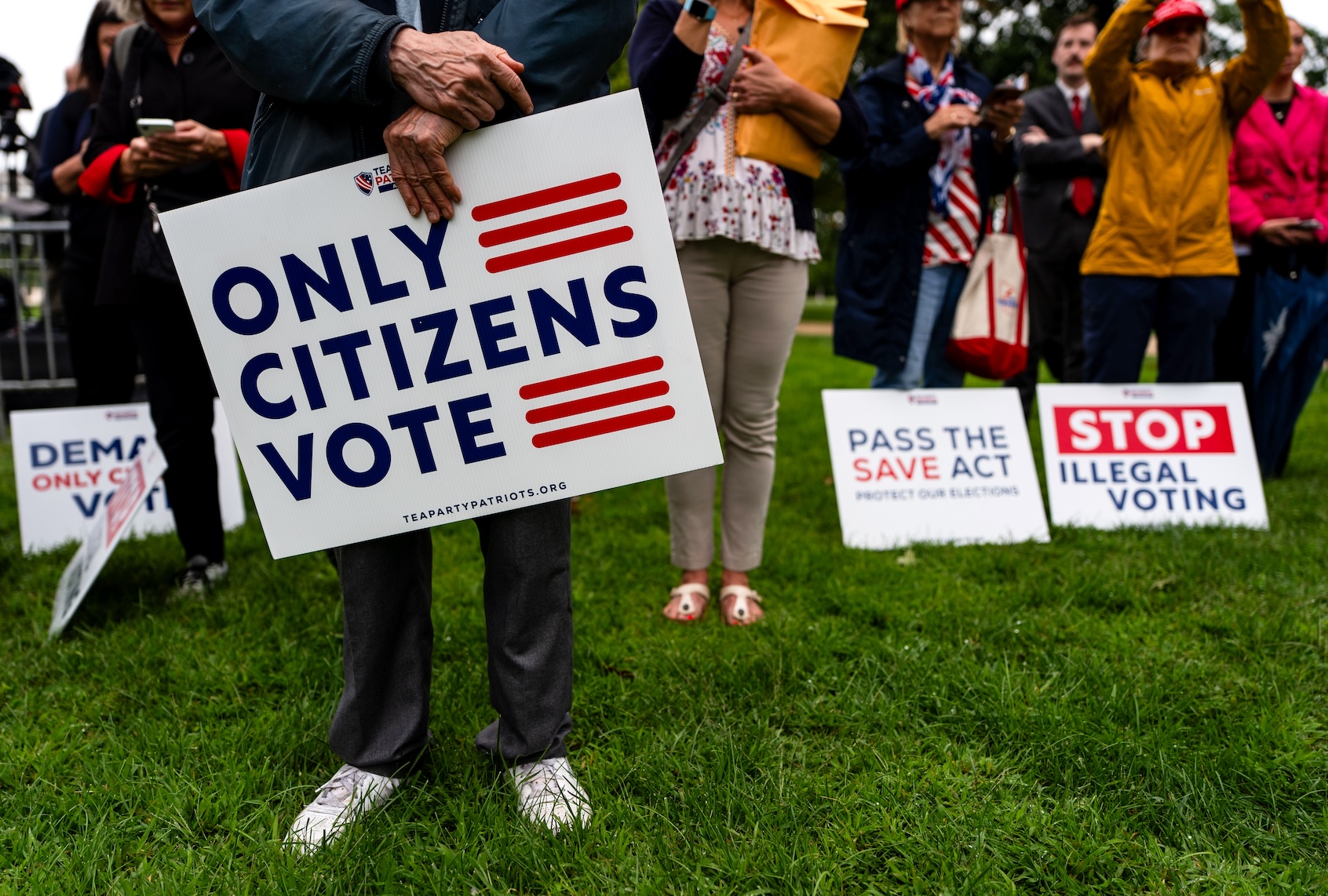

President Donald Trump campaign’s to influence the midterm elections is reaching a fever pitch, from FBI raids of Georgia election centers to posting conspiracy theories across his social media and using the Department of Justice to illegally access voter rolls. Now Trump has zeroed in on Congress.
On Tuesday, the Senate opened debate on the voter ID bill known as the SAVE America Act. The bill would require Americans to register to vote in person with documentary proof of citizenship — in most cases a birth certificate or passport. It narrowly passed the House on Feb. 11, a week after Trump called for Republicans to “nationalize voting.” It has little hope in the Senate unless Republicans go nuclear and kill the cloture rule that requires 60 votes to end debate of a bill, but the door for that extreme move is closed for now.
With debate now open, invoking cloture is the only thing that can end a filibuster, but Senate Republicans lack a three-fifths supermajority. If the filibuster were to be eliminated, Republicans could easily pass the SAVE America Act with their 53 vote majority. The biggest force standing in the way of that victory is the party’s leader, Sen. John Thune, S.D., who is adamantly opposed to dismantling the Senate rules to pass the bill.
“The votes aren’t there, one, to nuke the filibuster and the votes aren’t there for a talking filibuster. It’s just a reality,” Thune said last week. “I’m the person who has to deliver sometimes the not-so-good news that the math doesn’t add up, but those are the facts and there’s no getting around it.”
Instead, Republicans will try to drag debate on, forcing Democratic lawmakers to defend their position and hopefully exhaust opponents into joining a cloture vote.
The last time senators tried to end the filibuster was in 2022, but Senate Democrats led the charge. The similarities produce a déjà vu effect with Democrats trying to pass the For The People Act, a landmark voting and elections bill, but being held up by the filibuster and unable to produce 60 votes to end debate. With only one option to get the bill to a vote,, they tried ending the filibuster, only to be held up by members of their own party — Joe Manchin and Kyrsten Sinema.
The claims are not only unsubstantiated, but disproved by the federal government’s own tool to check voter rolls.
“The reason that didn’t pass was because Republicans filibustered it and moderate Democrats were unwilling to blow out the filibuster to get it passed — and now we’re seeing the inverse happen,” Travis Crum, a voting rights and election law professor at the Washington University in St. Louis, told Salon.
Of course, Senate Republicans were vehemently opposed to Democrats ending the filibuster in 2022.
“Power is fleeting, and at some point the shoe will always be on the other foot,” Texas Sen. John Cornyn said in January 2022. “Liberal activists may like the idea of nuking the filibuster today, but they’ll soon find themselves ruing the day their party broke the Senate.”
However, Cornyn drastically shifted his views on the Senate filibuster recently. Publishing an op-ed in the New York Post on March 11, he said the SAVE America Act “matters more than the filibuster.” This switch comes amidst Cornyn’s highly competitive primary run-off against Texas Attorney General Ken Paxton, in which Trump has yet to endorse either candidate. Trump threatened Tuesday that he would not endorse anyone who failed to support the SAVE America Act and called detractors of the bill “sick, demented or deranged people.” Trump has also said he will refuse to sign any other bill before the SAVE America Act reaches his desk.
“Not only are our colleagues trying to seize the authority given under the Constitution to the states to manage their own elections, they’re willing to take a wrecking ball to the United States Senate itself and, particularly, the Senate rules,” Texas Sen. John Cornyn said in 2022.
Start your day with essential news from Salon.
Sign up for our free morning newsletter, Crash Course.
While the filibuster conversations from 2022 and 2026 are both centered around voting and election bills, the Brennan Center for Justice’s voting rights and elections director Sean Morales-Doyle thinks the situations are not two sides of the same coin.
“ I think making the argument we should be able to pass pro-democracy, pro-voter reforms without being stymied by this rule that gives the minority way too much power is a substantively different argument than we should get rid of this one anti-democratic rule in order for us to pull off another anti-democratic policy,” he told Salon.
While the For The People Act would have eliminated any voter ID requirements, the SAVE America Act establishes the strictest voter ID provisions in the country, which many believe would disenfranchise millions of American citizens.
“ I should be clear that like the Brennan Center is opposed to the filibuster in principle,” Morales-Doyle said. “But as long as it’s there, I’m glad it’s for once it’s being used to stop anti-civil rights legislation rather than the other way around.”
The entire justification for the legislation is the claim that non-citizens are voting in national elections in large numbers, putting the integrity of U.S. elections at risk. The claims are not only unsubstantiated, but disproved by the federal government’s own tool to check voter rolls.
The Systematic Alien Verification for Entitlements, or SAVE, program was initially made to check if non-citizens were using government benefits, however it can also be used to check if they are on voter registration rolls. The Trump administration updated the system to scan the state’s entire voter rolls instead of individual searches of suspected non-citizens.
“We’re talking about a time period in which, conservatively, there were over 80 million votes cast in Louisiana, and they found 74 potential cases of non-citizens voting — so less than one in a million.”
“ Louisiana was the first to run their whole voter file against the SAVE program, and their results were that they found 74 instances of potential non-citizen voting going back to the 1980s,” Morales-Doyle said. “So we’re talking about a time period in which, conservatively, there were over 80 million votes cast in Louisiana, and they found 74 potential cases of non-citizens voting — so less than one in a million.”
Morales-Doyle said when Utah volunteered their voter roll to SAVE, zero instances of registered non-citizens came up. In situations where a fair amount more people on the voter roll are flagged, it was found to be incorrect. Even including false positives, the SAVE program has not shown a significant amount of suspected non-citizens registered to vote. If the SAVE American Act passes, all states’ voter rolls will be subject to quarterly checks with the SAVE program, which is more likely to purge eligible voters than find non-citizens.
A study from the Center for Democracy and Civic Engagement at University of Maryland and the Brennan Center for Justice found that an estimated 21.3 million eligible voters would be unable to register under the SAVE America Act because they either do not have or do not have easy access to documentary proof of citizenship. The act is not an average voter ID bill that requires photo identification like a state driver’s license, but the highest level of citizenship proof — a birth certificate or passport.
“Half of Americans don’t have passports and a large percentage of Americans don’t have access to the original copy of their birth certificate, especially older Americans or Americans who have moved far away from where they were born,” Crum said.
According to the U.S. Department of State, there are roughly 183 million passports in circulation as of 2025. The U.S. population, by contrast, is around 342 million — making the share of Americans possessing passports just above half the total population.
For Americans 16 years and older, getting a passport book for the first time costs $165, and an extra $30 to get a passport card. Passports for adults last 10 years and then must be renewed for $130. The top five states with the highest income per capita, Connecticut, Massachusetts, New Jersey, New York and California, also have the highest share of passport ownership in the country.
We need your help to stay independent
Crum added that married women who changed their last name will also face difficulty. The Center for American Progress found that over 69 million female citizens over 15 do not have a birth certificate that matches their legal name because of a name change or hyphenation.
Even if citizens have access to proper documentation, they must submit proof in person to an election official.
“Basically that requirement is going to put an end to mail registration and online voter registration because, no matter what, you have to go show your birth certificate or passport in person to an election official,” Morales-Doyle said. “So there’s a whole lot of people who may have the documents that they need to get registered, but that hurdle is going to actually mean that they don’t get registered or re-registered if their address changed.”
A proposed substitute amendment to the bill from Sen. Eric Schmitt, R-Mo., would further threaten mail-in ballots by getting rid of no-cause absentee ballots. The provision would, “end mail-in balloting with exceptions for military, illness, travel and disability.” This would disproportionately affect young adults who often live away from their permanent address for college or work. The provision, unrelated to voting laws, also includes language to “keep men out of women’s sports,” and “protect children from transgender mutilation surgeries.”
As debate opens on the Senate floor, Republicans hope to force Democratic lawmakers to justify their opposition, but Republicans themselves may also be put on the offensive when it comes to the extreme restrictions outlined in the bill.
“ I think we can confidently say that if the SAVE Act were to pass, millions of American citizens would be blocked from voting in the 2026 election and in elections beyond that,” Morales-Doyle said.
Read more
about politics
