


Launched in 2017, Proton VPN is a VPN service recognized for its commitment to privacy, transparency and open-source development. The company operates out of Switzerland, a jurisdiction renowned for its robust data protection laws and its exclusion from the 14 Eyes surveillance network. This alliance, which includes the United States, the United Kingdom, Canada, Australia and other countries, requires companies within its jurisdiction to share user data with intelligence agencies.
Proton VPN uses Secure Core architecture, a feature that routes traffic through multiple servers for enhanced privacy protection. It also has a no-log policy that has been verified through independent audits. Proton VPN distinguishes itself from competitors by offering a free version with unlimited bandwidth.
Proton is used by travelers seeking secure internet access on the go, people looking to bypass geo-restrictions and consumers concerned about online privacy. Proton VPN has consistently received high ratings for its security features and overall performance.
In this Proton VPN review, we examine Proton’s pros and cons, as well as its key advantages over competitors.
 (Salon)
Company background
Proton VPN was founded by scientists and engineers who worked at CERN, the European Organization for Nuclear Research. The service was created by the same team behind Proton Mail, a widely used secure email platform. With headquarters in Geneva, Proton VPN operates in a country with some of the world’s strongest privacy laws, including the Swiss Federal Data Protection Act, and is fully compliant with the EU’s General Data Protection Regulation.
Proton AG, the parent company, is privately held and emphasizes transparency through regular reports, open-source software and third-party security audits. These practices have earned positive Proton feedback from users and industry analysts..
Users and industry observers have noted Proton AG’s focus on scientific and ethical principles, as well as its emphasis on user privacy. The company’s research-based origins help differentiate it from other VPN providers. Proton’s open-source apps are subject to periodic security audits, which play a role in shaping Proton VPN’s development.
 (Salon)
Key features and technology
Proton VPN offers AES-256 encryption paired with 4096 RSA keys and HMAC SHA-512 authentication, standards widely recognized for their resilience against brute-force attacks and data interception. This encryption ensures user data remains secure, even on public or unsecured networks.
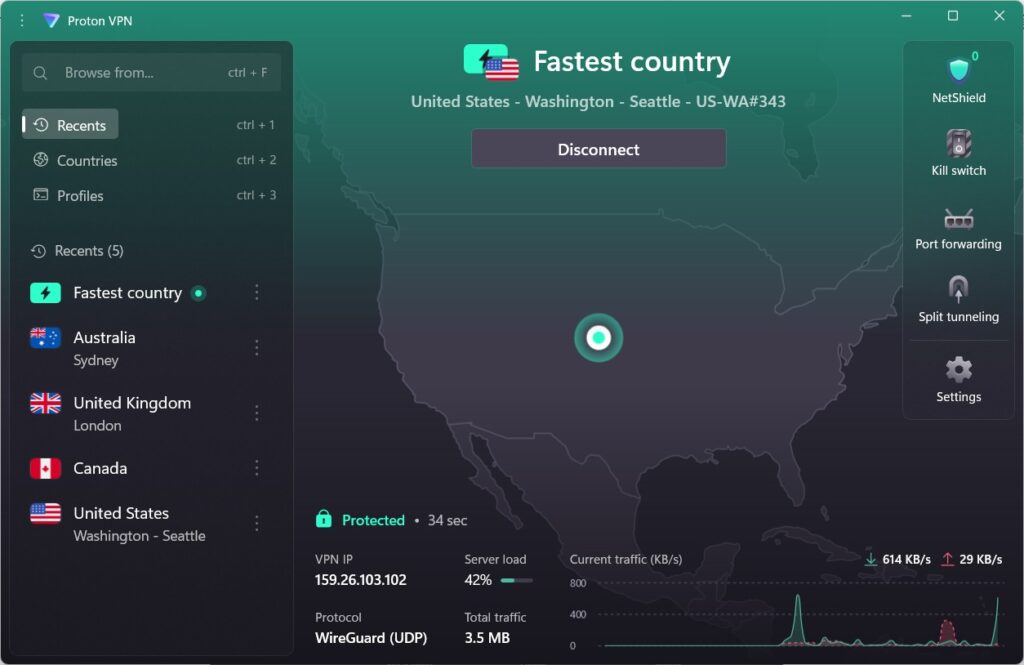
Proton VPN supports multiple security protocols, including WireGuard, OpenVPN and IKEv2/IPSec. Users can select protocols tailored to their specific needs. WireGuard is especially popular for its speed and efficiency, contributing to strong Proton performance for gamers and streamers.
Additional privacy features include a kill switch to prevent data leaks in the event of a VPN connection drop, split tunneling for selective routing and Secure Core servers that route data through privacy-friendly jurisdictions. Stealth mode helps users bypass censorship in restrictive regions, while DNS leak protection ensures third parties can’t track browsing history.
Proton VPN also offers NetShield, which blocks ads and malware, as well as Smart DNS for enhanced streaming. Users can connect up to 10 devices with one subscription. A dedicated IP address is available for an additional fee.
 (Salon)
Infrastructure and server network
Proton VPN has more than 12,000 servers in roughly 120 countries. This extensive infrastructure supports high-speed connections and low latency, contributing to favorable Proton VPN test results. The network includes both physical and virtual servers. Virtual servers provide local IP addresses for regions where physical servers are not hosted. Compared to other VPN providers, Proton VPN’s server count is among the highest. For example, NordVPN and Surfshark operate between 3,000 and 5,000 servers, while ExpressVPN maintains a smaller but globally distributed network.
A key feature of Proton VPN’s infrastructure is its use of RAM-only servers, which do not store user data and are wiped clean after each reboot. The company also offers specialty servers for specific use cases, including Secure Core. Streaming-optimized servers enable users to access content without regard to geographic restrictions, P2P servers support torrenting and Tor over VPN servers allow access to the Tor network without a separate browser.
Proton VPN’s infrastructure is known for its reliability and uptime. Independent evaluations consistently show strong performance across server types, making it a dependable choice for users who prioritize speed and privacy.
Performance across devices
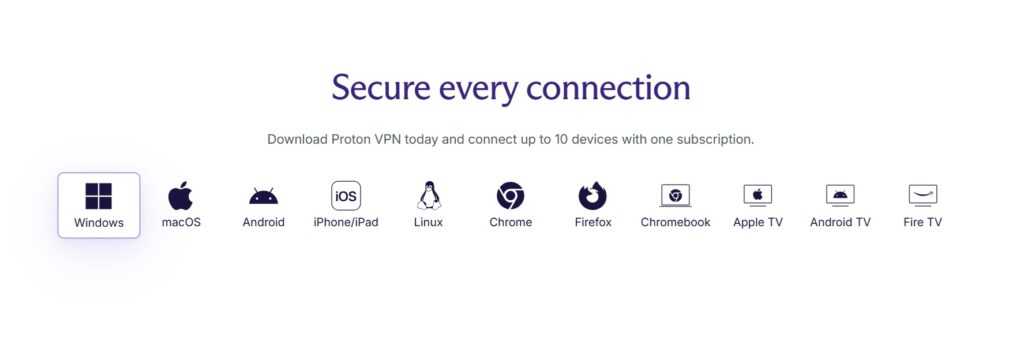
Proton VPN offers a seamless and consistent user experience across multiple platforms, including Windows, macOS, Linux (with a complete graphical interface), iOS, Android, routers and browser extensions. Its interface is clean and minimal, designed for both beginners and advanced users. Proton VPN maintains a consistent look across platforms, ensuring a familiar experience whether on mobile or desktop.
Both versions are easy to use, featuring a one-click connect button for instant protection and a QR code login option for mobile devices. Onboarding is intuitive, guiding users through essential and advanced settings while offering beginner-friendly defaults for quick setup.
 (Salon)
Speed and stability
Proton VPN offers solid performance, but it wasn’t the fastest VPN in our testing. While some independent benchmarks highlight its speed and privacy features, our internal Proton VPN test results showed that it lagged behind Surfshark and ExpressVPN, particularly on long-distance connections.
Download speeds ranged from 76 to 124 Mbps on local and nearby servers but dropped to 70 to 100 Mbps when connected to Europe and Australia. Upload speeds were generally stable, though ping times increased significantly on distant servers — reaching over 500 ms in Australia — which could introduce noticeable lag during gaming or video calls. In contrast, Surfshark and ExpressVPN consistently delivered higher download speeds (often exceeding 100 Mbps) and lower latency across the same regions.
Proton VPN uses the WireGuard protocol, which is designed for fast, efficient connections. It also offers Secure Core routing for added privacy, though this can reduce speed depending on the server path. While Proton VPN connects quickly and maintains solid uptime, it didn’t outperform competitors in terms of raw speed or latency.
Overall, Proton VPN is a reliable and privacy-focused option with a large server network and strong infrastructure. But for users who prioritize speed — especially for streaming or gaming — faster alternatives like Surfshark or ExpressVPN may offer better results.
 (Salon)
How good is Proton VPN at streaming and unblocking sites?
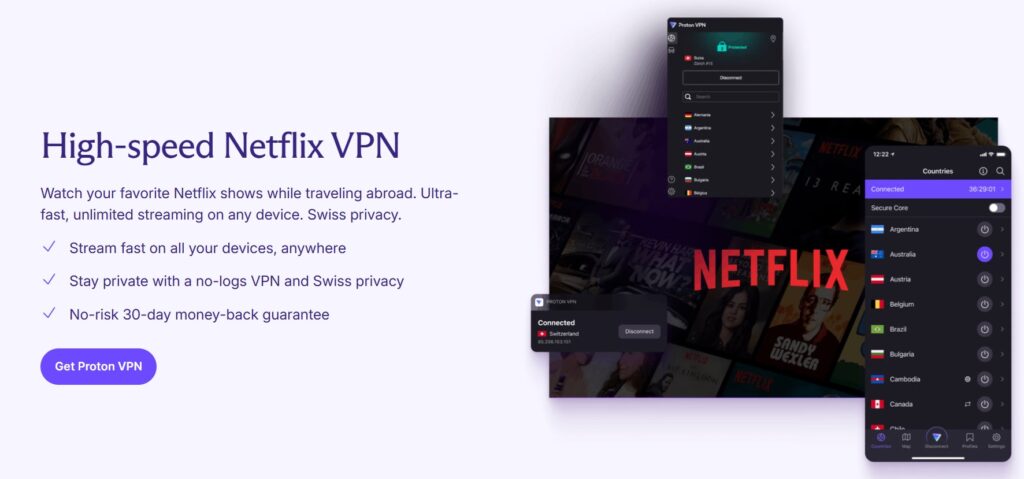
Is Proton VPN good for streaming? Yes—it reliably unblocks Netflix, Disney+, Hulu, Prime Video and BBC iPlayer. It doesn’t offer Smart DNS, but its streaming-optimized servers and WireGuard protocol help deliver consistent access across devices.
In speed tests, Proton VPN performed well on nearby servers, with download speeds ranging from 76 to 124 Mbps and upload speeds between 70 and 100 Mbps — more than enough for HD and 4K streaming. However, latency increased significantly on long-distance connections. Ping times to Europe and Australia often exceeded 300 to 500 milliseconds, which could lead to buffering or lag during high-bandwidth playback.
Compared to other providers in the same test suite, Proton VPN wasn’t the fastest. Avast VPN posted the highest speeds overall, while Surfshark and ExpressVPN maintained stronger performance across international servers. Still, Proton VPN’s privacy-first design and open-source transparency make it a dependable choice for users who value secure access to global content — even if it’s not the fastest.
 (Salon)
Privacy and security
Proton places a strong emphasis on privacy and security. It operates under a strict no-log policy, which means it does not store user activity, connection timestamps or IP addresses. This policy has been independently audited and verified. All of its software is open-source, which means third parties can inspect the code and verify that it performs as advertised.
Proton VPN’s Secure Core feature routes traffic through multiple servers, adding an extra layer of protection. The company publishes regular transparency reports as well as information on whether it has received any government requests for user data. These features contribute to a positive Proton VPN opinion among privacy-conscious users.
Despite these strengths, Proton VPN has some downsides. It does not offer malware or phishing protection, both of which are provided by some competitors. Some of its obfuscation tools, designed to bypass censors in restricted countries, have not performed well in highly restrictive environments like China and Russia. This may give users in high-risk regions pause.
Proton’s customer support
Proton’s customer support prioritizes self-service, which may not satisfy users who want immediate, hands-on assistance from actual humans. Support is provided through an email and ticket-based system, with no live chat currently available. Response times vary depending on the complexity of the issue and demand.
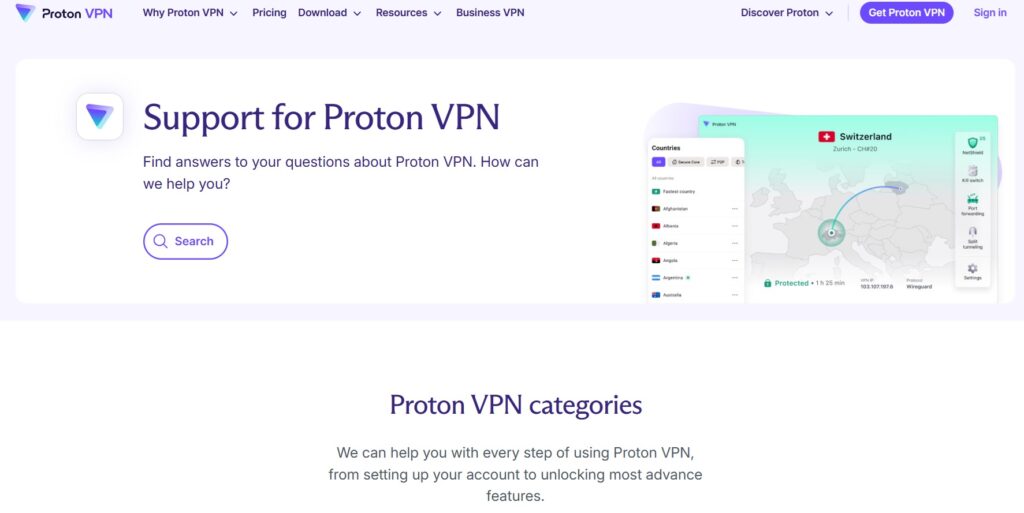
Proton VPN has an extensive and well-organized knowledge base that allows users to search for answers to their issues independently. This includes detailed setup guides, platform-specific instructions and solutions to common problems.
Overall, while Proton’s support model does not include live interaction, it has a solid foundation for self-guided troubleshooting.
 (Salon)
Breaking down Proton VPN’s pricing
Proton offers a flexible pricing structure for both casual and serious users, as well as a free plan that stands out from its competitors by providing unlimited bandwidth, access to multiple servers and all this without ads. This flexible pricing structure supports both casual users and those seeking a full privacy suite, making it a strong value for any Proton VPN evaluation.
For users wanting a full range of services, Proton’s paid plans are competitive. The monthly plan starts at $10, while the one-year plan is offered at $60, with a renewal rate of $80 thereafter. The two-year plan is the best value, priced at $108, with a renewal fee of $160 every two years. All plans include a 30-day money-back guarantee, though refunds are prorated.
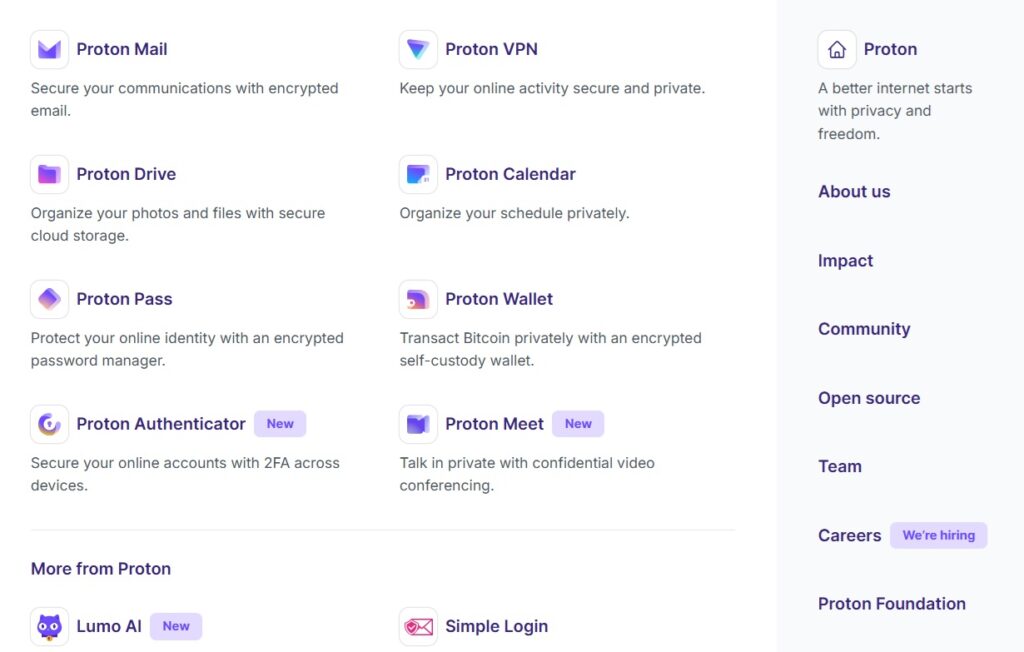
Proton has an impressive suite of add-ons for an additional cost, including a dedicated IP for enhanced security and access, Proton Mail Plus for encrypted mail, Proton Drive for secure cloud storage and Proton Pass, a password manager.
Below is a table that breaks down Proton’s plans.
| Plan Type | Cost | Renewal Rate | Notes |
| Monthly | $10/month | Same | Flexible, no commitment |
| Annual | $60/year | $80/year | Best value for most users |
| Two-Year | $108 for 2 years | $160 for two years | Long-term savings |
| Free Plan | $0 | N/A | Unlimited bandwidth, limited servers |
| Add-ons | Varies | Varies | Proton Pass, Mail Plus, etc. |
Pros and cons of Proton VPN
Proton VPN stands out from its competitors as a privacy-first VPN service that emphasizes transparency, technical rigor and user empowerment. It is committed to privacy, as evident by its open-source development, which is regularly audited. Proton’s Secure Core architecture routes traffic through servers in privacy-friendly jurisdictions, making it hard for anyone to trace user activity. RAM-only servers store no user data or user queries.
Proton VPN is a good choice for users who want to try a service without making a financial commitment. Its free tier offers unlimited bandwidth, access to multiple servers and no ads. Paid users get access to a service that has robust streaming capabilities and support for torrenting, all across various platforms.
However, Proton VPN has some downsides. It does not offer 24/7 live chat support, which may be frustrating for users who require it. While it offers a 30-day money-back guarantee, the refund is prorated rather than complete. Its renewal pricing is significantly higher than some competitors. Some of its obfuscation capabilities are limited in highly restrictive parts of the world, which may reduce its effectiveness in countries with extreme censorship. Unlike some competitors, it does not offer built-in malware or phishing protection.
Overall, Proton VPN is among the best services available for privacy-conscious users who value transparency. However, those who require real-time support and additional features may need to look elsewhere.
Proton VPN’s final rating: our take
Proton VPN is a top-tier VPN rooted in a privacy-first experience and a transparent, open-source development system. Its Secure Core architecture sets it apart from competitors by routing traffic through privacy-friendly countries. For journalists, activists and anyone who values privacy, this added layer of protection is a real safeguard against government surveillance and censorship.
Unlike NordVPN and ExpressVPN, Proton offers a free version that is ad-free and features unlimited bandwidth, making it one of the most generous free options available on the market. Its scientific credibility reinforces its reputation as an ethical VPN provider.
While it lacks live support and has a prorated refund policy, these drawbacks are minor. Renewal pricing is higher than with some competitors, but the value delivered justifies the investment.
Our Proton VPN rating: Proton VPN is highly recommended for users who want robust privacy protection and a commitment to open-source standards.
Salon has affiliate partnerships, which means we may get a share of the revenue from purchases made through links on this article.
