
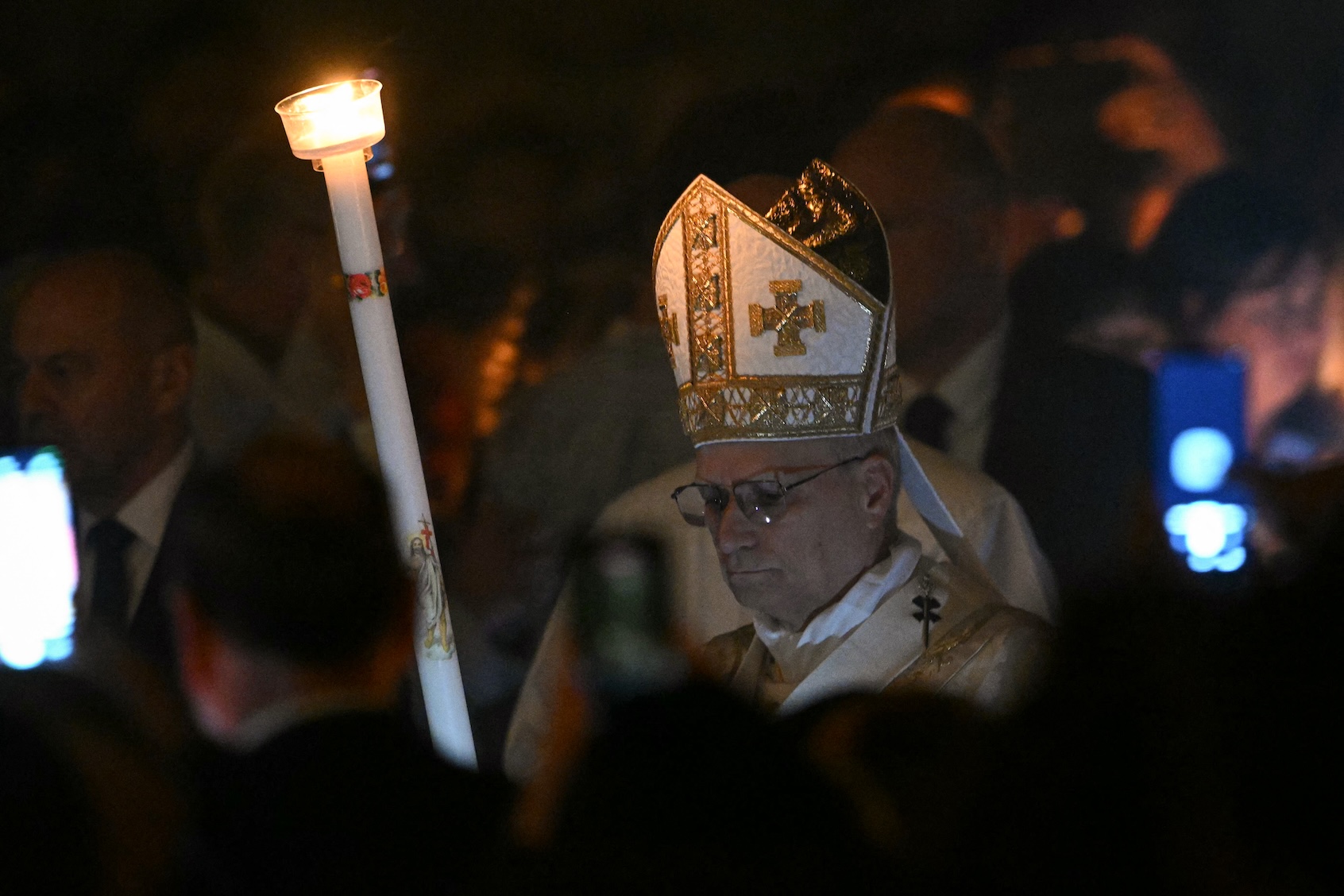

My adult children and I amused ourselves recently with an absurd fictional scenario in which we reach Karl Marx by spectral telephone in the afterlife — where he is no doubt surprised to find himself — and try to explain that right-wing Americans of the 21st century, with no apparent sense of irony, sometimes accuse the pope of being a Marxist.
Hang on a sec, we imagine Karl saying, this connection is terrible. You don’t mean the actual pope, the gentleman in Rome with the costumes, the smoke and the deliberately mystifying rituals? That’s right, we say, that guy, although the current pope is actually from Chicago and loves baseball. Then the conversation peters out as we try to explain what “woke” means, which is difficult enough even when you’re not talking to a dead 19th-century philosopher.
The “Marxist” part might be more confusing than the baseball part, honestly. (I can’t find any evidence that Marx knew about baseball, but it’s certainly possible: He read American newspapers avidly, and was a correspondent for the New York Tribune for several years.) Karl would understand readily enough, along with the rest of us, that Pope Leo XIV is not a Marxist, and that Catholic conservatives and their allies are airing their distress and disappointment in hyperbolic terms. What’s much more difficult to grasp, even for those of us now alive, is how we wound up in a world where that might happen.
On one level, the deepening right-wing antipathy toward Leo and his predecessor, Pope Francis, is easily understood. Neither of them made any substantive changes to core Roman Catholic doctrine, but when you’re the bishop of Rome and the head of the world’s largest single religious denomination, practice matters more than theory. Both Leo and Francis have subtly but noticeably downplayed the most unforgiving elements of church dogma on human sexuality and reproduction, while focusing far more visibly on issues like worsening global inequality, predatory capitalism, war, poverty and the fate of migrants and refugees.
Leo has often been described as a more conciliatory and less confrontational figure than Francis, who clearly emerged from what might be called the center-left of the Latin American church. But while the White Sox fan now in the Vatican almost never utters Donald Trump’s name, he has made little effort to conceal what he thinks of Trump’s mass deportation agenda, his support for the Israeli destruction of Gaza or the unprovoked U.S. war against Iran.
In his Palm Sunday homily last week, Pope Leo said that Jesus “does not listen to the prayers of those who wage war, but rejects them.” That sounded a lot like a rejection of Defense Secretary Pete Hegseth’s attempt to cast the Iran conflict as a Christian holy war, and his call for Americans to pray for victory “on bended knee … in the name of Jesus Christ.”
A few days later, in an extraordinary Holy Thursday homily on the painful contradictions of Christian history — which resembled a high-end Protestant sermon meant to teach a moral lesson more than by-the-numbers Catholic fare — Leo sounded a similar theme in more elliptical terms. The crucifixion of Jesus had disrupted “the imperialist occupation of the world,” he said, binding the body of Christ, a typical metaphor for the church, “to the poor, to prisoners, to those groping in the dark and to those who are oppressed.” Throughout history, he added, the Christian mission “has not infrequently been distorted by a desire for domination, entirely foreign to the way of Jesus Christ.”
While the White Sox fan now in the Vatican almost never utters Donald Trump’s name, he has made little effort to conceal what he thinks of our president’s mass deportation agenda, his support for the Israeli destruction of Gaza or the unprovoked war against Iran.
It’s hardly surprising that Americans on the MAGA-adjacent far right, whether inside or outside the church, experience that kind of language as a startling political betrayal. They have long understood the Roman Catholic hierarchy, especially the notoriously reactionary American cardinals and bishops, as a fellow-traveler force of unbending moral rigor, devoted to the persecution and suppression of liberals, radicals, socialists, feminists, LGBTQ advocates and other political or sexual nonconformists.
In broad historical strokes, they weren’t wrong. But it was precisely their flawed and monolithic understanding of history that failed them, a cognitive or epistemological error found in all varieties of authoritarianism or fascism. While American arch-conservatives, temporarily unified under the banner of Trumpism, have tried to push backward into some imaginary version of the past (there are so many! It’s like Pornhub for historical fantasists) the Roman Catholic Church has been trying, after its own limited, lumbering, behemoth fashion, to crawl toward the future.
It would be insulting to make broad categorical claims about the Catholic church as a whole. We’re talking about an enormous bureaucratic organization with 2,000 years of weird and troubled history, whose massive internal contradictions and bitter factional disputes are only partly visible to outsiders. If we claim that the church has become more progressive, well, what the hell do we mean, and on what time scale? More progressive than the institution that burned witches, crushed Galileo and ordered murderous crusades against Muslims? Sure. More than the one that supported brutal, repressive regimes in Spain and Latin America and largely pretended the Holocaust wasn’t happening? I guess so. More than the one that imprisoned and tormented Indigenous children in North America and tolerated or covered up the sexual abuse of hundreds of thousands of children around the world? There’s no satisfactory answer to that, although it’s fair to say that the papacies of Francis and Leo represent the first serious efforts to reckon with those more recent crimes.
I’m not doing P.R. for the current pope or the church here, by the way. I’m a heritage or vestigial Catholic, at best. (I was baptized but never confirmed; I go to Mass about once every two years.) Whether this pope or the next one or the one after that can shed the church’s retrograde teachings on sexual morality is doubtful, and none of my business. Maybe the right-wingers and “Catholic integralists” — kind of a highbrow intellectual version of Christian nationalism, with better aesthetics and less yelling — will stage a counterrevolution and reclaim the Vatican after Leo dies.
Those folks, who were big fans of the poisonous and desiccated Pope Benedict XVI, would be delighted to have a much smaller global church that claims to stand as a moral bulwark in a fallen world, preaching a bunch of unassailable and unfollowable doctrines that most actual Catholics have treated as optional for at least the last 100 years. That’s basically the imaginary version of the church that far-right dreamers hoped to find waiting in their imaginary past-as-future, although the MAGA-fied right-wing project is so incoherent that there are any number of competing or overlapping visions of what that might look like.
We need your help to stay independent
Many or most contemporary “conservatives” (a word that has nearly inverted in meaning) are eager to reverse the civil rights and social justice reforms of the 20th century, returning to an era of white supremacy, male dominance and full employment that resembles an AI-slop highlight reel pulled from the Eisenhower ‘50s, the Roaring ‘20s and the Gilded Age 1890s.
The Trump administration’s current assault on birthright citizenship envisions going much further, toward a total unraveling of the 19th-century foundations of liberal democracy and even a rejection of the 18th-century Enlightenment and the ideals of the French Revolution, which today’s “postliberals” and “national conservatives,” including the aforementioned Catholic integralists, see as a fatal wrong turn for Western civilization. Some of those folks, but not all, are too polite to specify which “cosmopolitan” social group is most directly to blame for those developments: You get one guess.
That speaks to what philosopher Ernst Bloch called the “perverted utopian promise” of fascism, a mass movement that could only have emerged in the age of consumer capitalism and modern media but claims to support “traditional values,” whatever those may be, and to despise contemporary culture. Fascism appeals to “an old and romantic antagonism to capitalism, derived from deprivations in contemporary life,” in Alberto Toscano’s phrase, but in practice (setting aside the integralists and other theocrats, who are not exactly fascists) it’s not interested in rebuilding premodern feudalism or absolute monarchy, which don’t sound like much fun. On the contrary, as Eric Hobsbawm writes, fascism invented something new and pretended it was old, “an entirely non-traditional leadership principle embodied in self-made men legitimized by their mass support, and by secular ideologies, and sometimes cults.” I know, right?
Perhaps it’s not surprising that a right-wing Catholic convert like JD Vance — whose relationship to the church seems more like a sexual fetish than a profession of faith — hasn’t noticed that the Vatican, laboriously and rather late in the game, has forged a truce with modernity, science and even democracy.
As I suggested earlier, one fatal flaw of the far right is a historical blindness or narcissism, manifested in the Hegseth-ian conviction that if you are sufficiently manly and awesome you get to dictate events, while everyone else sits around waiting or pees their pants in terror. (It does not seem to have occurred to Trump’s so-called military strategists, for instance, that the Iranians also had a strategy that made sense from their point of view.)
Perhaps it’s not surprising that a right-wing Catholic convert like JD Vance — whose relationship to the church seems more like a sexual fetish than a profession of faith — hasn’t quite noticed that the Vatican, laboriously and rather late in the game, has forged a truce with modernity, science and even democracy. Evolutionary theory is no longer heretical, Galileo has been issued a hall pass to heaven, and quite a few sincere if entirely inadequate apologies have been issued, mostly to people long dead.
As for the church’s supposedly new and “woke” social justice policies, those go back to “Rerum Novarum,” the famous 1891 encyclical on the “Rights and Duties of Capital and Labor” issued by Pope Leo XIII (from whom the current pope took his name). It not only proclaimed the rights of workers to form unions and seek fair wages, but specifically avoided any endorsement of capitalism. Even during the long papacy of John Paul II, a staunch conservative on both moral and political questions, the SJW component of Catholic teaching was strongly emphasized, if uneasily aligned with all the familiar doctrinaire views on women’s rights, abortion, homosexuality and so on.
Want more sharp takes on politics? Sign up for our free newsletter, Standing Room Only by Amanda Marcotte, also a weekly show on YouTube or wherever you get your podcasts.
After the death of Pope Francis, the American right briefly indulged in lurid fantasies of reconquest, culminating in the grotesque AI image of Donald Trump in the papal vestments. But if the grab-bag conservatives of the MAGA-sphere really thought they might get a new pope who would support an authoritarian crackdown on immigrants, proclaim that it was immoral to tax the rich or aid the poor, and issue an encyclical on the mandatory hotness of tradwives, that says more about them than about the church’s internal struggles. Alone under the covers at night, they may indeed yearn for a manly super-pontiff in Medieval Times gear who delivers thrilling broadsides against liberalism, democracy, Enlightenment, uppity women and gays and all forms of social revolution (not to mention the Jews). But they only want him as an AI chatbot or an artifact of banger memes; they don’t want to live in his reality.
Whether the path of cautious, clumsy liberal accommodation pursued by Francis and Leo can rescue the church of St. Peter, Augustine of Hippo, Thomas Aquinas and Mark Wahlberg from its profound global crisis is impossible to know. But it remains an astonishing fact of this upside-down decade that the first American pope was elected in a none-too-subtle rebuke to the current American president, as well as his ultra-Catholic or wannabe-Catholic supporters. Woke Marxist pope? Not quite. But whatever Leo XIV had to say in his Easter Sunday homily — after I file this article but before you read it — Donald Trump didn’t like it.
Read more
from Andrew O’Hehir
