

Donald Trump, a self-described Christian, issued a shockingly crude threat on Easter Sunday. Five weeks into his unnecessary war of choice with Iran, he ordered the country to “Open the F**kin’ Strait” of Hormuz to international oil tankers or he would bomb civilian infrastructure like power plants and bridges, a war crime that would have killed untold numbers of people. That the president’s intent was genocidal is indisputable, as he later threatened to destroy a “whole civilization.”
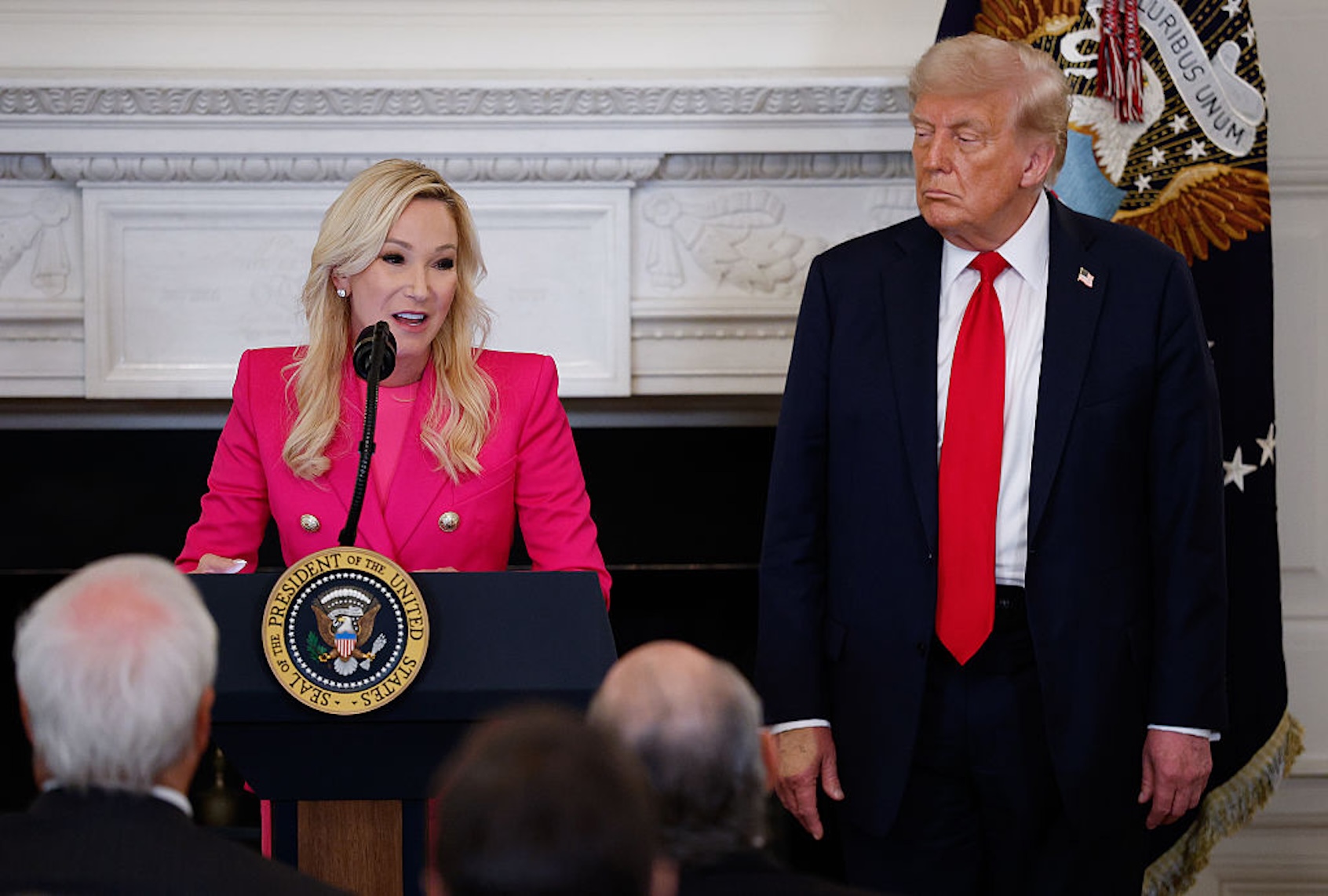
But just a few days before he invoked the mass murder of civilians, Trump hosted an Easter luncheon at the White House, where he enjoyed being compared to Jesus Christ by his friend Paula White, a popular evangelical minister who also heads the White House Faith Office. “Mr. President, no one has paid the price like you have paid the price. You were betrayed and arrested and falsely accused,” she said, even though there is no evidence that Trump’s dozens of indictments were based on false allegations. “It’s a familiar pattern that our Lord and Savior showed us.”
White, a millionaire whose dubious fundraising operations likely benefit from her proximity to the president, is hardly alone in her comparison. Conservative Christians may be struggling to outright defend Trump’s choice to start an unprovoked war with Iran, but they still keep finding a way to support the president with a familiar mindset.
As the Iran war continues to become an ever-bigger disaster, evangelicals are clinging harder than ever to the notion that because they need to defeat their fictional persecutors, Trump’s myriad flaws are excusable and forgivable.
For over a decade now, the Christian right has deflected criticism of Trump’s immorality and sadism by insisting they are facing persecution for their religious beliefs. In their minds, they are the real victims of a culture gone to hell, and they see the president as their only hope to beat back these imaginary forces of oppression. Nothing, it seems, can shatter this persecution complex. As the Iran war continues to become an ever-bigger disaster, evangelicals are clinging harder than ever to the notion that because they need to defeat their fictional persecutors, Trump’s myriad flaws are excusable and forgivable.
This ridiculous narrative was captured in a tweet by Erick Erickson, a D-list right-wing pundit who was responding to the president’s Easter Sunday threat. After admitting he wished Trump hadn’t debased the holiest day of the Christian calendar, Erickson wrote, “But if I have to choose between this and Trans Recognition Day or whatever on Easter, okay.”
For the blessedly unaware, Erickson was referencing an especially silly Republican conspiracy theory. The Transgender Day of Visibility is observed each year on March 31, which coincidentally fell on Easter Sunday in 2024. Fox News pundits accused then-President Joe Biden of “waging spiritual warfare against Christianity” and celebrating “demonic” forces of “godlessness.” Never mind that Biden is a devout Catholic who, unlike Trump, actually seems to understand the basic tenets of Christianity.
Even the pope himself is not exempt from the right’s paranoid anger. Pope Leo XIV, who was elected as the first American pontiff in May 2025, has been speaking out against the Iran war, both obliquely in his Easter sermon and more bluntly by condemning the president’s genocidal threats a “truly unacceptable” on Tuesday. Since then, there have been reports, including in the Trump-friendly Free Press, that Under Secretary of War for Policy Elbridge Colby told Cardinal Christophe Pierre, the Vatican’s ambassador to the U.S., that America “has the military power to do whatever it wants,” and then brought up a medieval period when the France controlled the papacy through force. The Pentagon has claimed the reports are exaggerated, but eyebrows have been raised since it emerged that Leo had canceled a planned trip to the U.S.
Regardless of what is being said in private to Catholic leaders, it’s clear that Defense Secretary Pete Hegseth and his allies are furious at the pontiff for undermining their efforts to frame this war as a Christian enterprise — and are suggesting that those who oppose it are the equivalent of Christ’s persecutors. After a military operation retrieved an American airman whose fighter jet had been shot down over Iran, Hegseth called him “a pilot reborn,” noting that the man’s plane went down on Good Friday and he was rescued on Easter Sunday. The secretary also claimed that the man’s first radio message to rescue forces was “God is good,” an account that can’t be verified as the pilot’s identity hasn’t been released. On Wednesday, Hegseth doubled down on the religious messaging, saying “God deserves all the glory” for what he called a “victory” over Iran in the form of a ceasefire that already seems on the verge of collapse.
Doug Wilson, who heads the denomination Hegseth belongs to, demonstrated how valuable the phony Christian persecution narrative is for conservatives who need an excuse to stick by the administration amid the Iran debacle. On Thursday, the pastor published a defensive blog post about the war and his church’s proximity to it. A frustrating writer, Wilson buries the indefensibility of his far-right positions under piles of pseudo-intellectual pondering. Still, even in a post laden with ten-dollar phrases like “jus in bello,” “ad bellum considerations” and “appropriate authority,” it’s clear that even he is wary of defending this war outright, likely because he’s smart enough to know it’s bound for failure.
But Wilson is also unwilling to criticize Hegseth, a well-situated church member who gives him access to the halls of power to push a Christian nationalist agenda. The pastor instead deflects responsibility by playing the victim card. Hegseth’s critics, he has said, have the “hubris” to think they can sit in judgment of a man who, he claims, is simply trying “to love God” and “do what he believes to be the right thing.”
That’s the magic of the Christian right’s persecution complex in a nutshell. In the real world, Hegseth is a belligerent official who relishes threatening Iranians with “death and destruction from above.” But in Wilson’s telling, the defense secretary is a humble servant of God, besieged on all sides by the faithless in their ongoing war against Christ’s followers.
Want more sharp takes on politics? Sign up for our free newsletter, Standing Room Only, written by Amanda Marcotte, now also a weekly show on YouTube or wherever you get your podcasts.
As the administration’s skirmish with Pope Leo shows, though, it’s getting harder for the Christian right to package the Iran war as a product of God’s love — even to followers who have a long history of swallowing all sorts of cruelty in the name of Christ. Dead children in a bombed-out school and helpless civilians joining hands around power plants while they wait to die can rattle the conscience that way. Some who have been among the president’s loudest supporters in the past, like former Georgia Rep. Marjorie Taylor Greene and podcaster Tucker Carlson, are now proclaiming that this war goes against everything Christians should stand for. In an effort to bring critics like these back in line, many evangelical leaders are clinging to false narratives of religious persecution.
At the Conservative Political Action Conference in late March, evangelical leader Franklin Graham noted the divisions that were stirring and begged Christians to stick with Trump. He pleaded with the audience to reject the “seeds of doubt” sown by the Iran war, and justified this call for a “united front” by claiming that the “Democrat socialist agenda” was “birthed in hell.” The evidence he used was mostly his hatred of trans people. Trump, he said, “stands up for Christians like no president we’ve ever had,” and to reject him, Graham implied, is to risk eternal damnation.
As he has done in the past, Trump is likely snickering at evangelicals who believe this. But he no doubt finds it quite useful, especially as white evangelicals remain his strongest base of support, even while his approval ratings with most other demographics are tanking. Still, there are signs of trouble with white evangelicals. The president’s approval numbers among the group slid from 78% to 69% between May 2025 and February 2026. Now that some prominent voices are criticizing the Iran war from an explicitly Christian point of view, those numbers could be worse.
We need your help to stay independent
So it’s no surprise that, when he wasn’t threatening war crimes against Iranian civilians, Trump spent Easter weekend shoring up this story about how he protects Christians from persecution. In an Easter Sunday press release, the White House celebrated his efforts to end “the systematic discrimination against Christians,” which were defined as allowing access to gender-affirming health care and abortion, blocking military chaplains from proselytizing to non-Christians and arresting criminals who attack abortion clinics. In other words, the so-called oppression experienced by Christians was actually limits on how much they could oppress others.
As transparent as that ploy is, it is still likely to work on most white evangelicals. Their definition of “religious liberty” has long been asserting a right to impose their faith on non-believers or people of other faiths — which is to say, the opposite of what the term itself actually means. But this false narrative of persecution has been recited for so long, many have come to actually believe it exists.
It’s very difficult, if not impossible, to muster a straightforward defense of Trump’s war on Iran. But for the Christian right, they don’t have to. All they need is to keep telling themselves they’re the real victims here, and that provides enough cover to ignore all the death and destruction their devotion to Trump is helping to infl.
Read more
about this topic
