
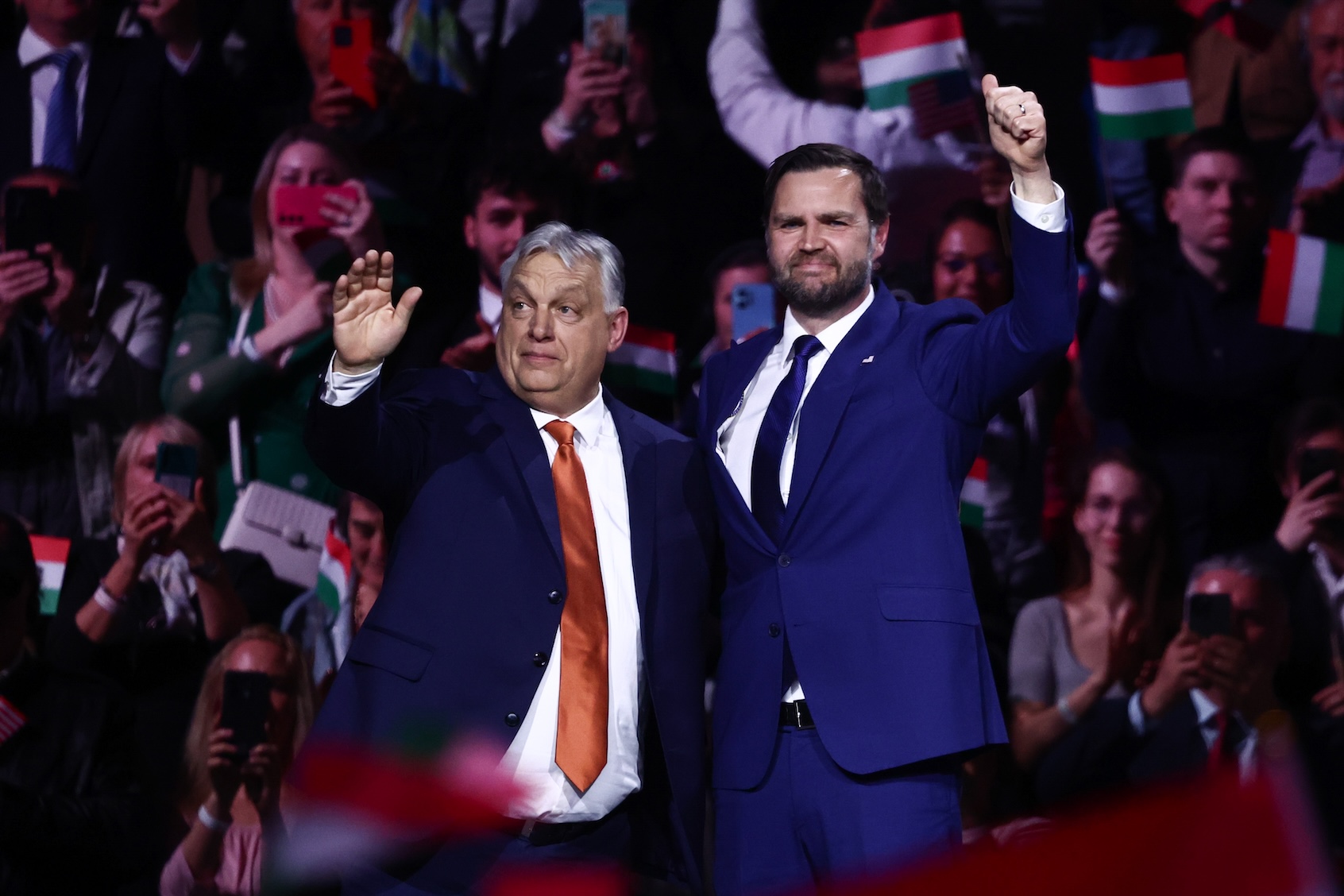

In an episode of MAGA gaslighting so absurd that the most avowedly neutral observers around the world found it irresistible, Vice President JD Vance visited Hungary last week to deliver a campaign speech for Prime Minister Viktor Orbán. It was “disgraceful,” Vance said — in his patented sad-but-outraged mode, suggestive of a junior college debate team’s second-best performer — that “outside forces” were trying “to put their thumb on the scale” of Hungarian politics.
“What has happened in the midst of this election campaign,” Vance later told a Budapest press conference, without the slightest glint of ironic self-awareness, “is one of the worst examples of foreign election interference that I’ve ever seen or ever even read about.”
Well, OK then! As a Reuters report put it, everything about Vance’s Hungarian visit “broke with the norms of prior U.S. presidential administrations of not openly campaigning in foreign elections, especially for a government that has maintained close ties with Putin.”
There are seven named reporters (!) and five editors (!) credited on that article, and whichever of them actually hammered that sentence together deserves a commendation: That “especially” carries a lot of weight, while also twisting the knife. It is not an irrelevant accident, of course, that Donald Trump’s surrogates are going all-in on a last-ditch effort to bail out the authoritarian leader of the only NATO member nation that is openly friendly with Russia and hostile to Ukraine. How we understand that convergence of interests, in a remote and landlocked Eastern European country that most Americans couldn’t find on the map with multiple guesses, is quite another matter.
On the most basic level, there’s not much mystery. Orbán has ruled Hungary for 16 uninterrupted years, for most of that time with an unassailable legislative supermajority. As reporters have told us endlessly over the past decade or so, he was “Trump before Trump,” and the truism is at least partly accurate.
As Hungarian journalist Ivan L. Nagy puts it, Orbán has survived and prospered through an ingenious pattern of “shadowboxing” against an ever-shifting cast of “make-believe enemies,” telling the conservative and nationalistic elements of the Hungarian public that only he can save them from dark-skinned immigrants, European bureaucrats, meddling American liberals, the globalist plots of Hungarian-born George Soros, LGBTQ activists, “gender ideology” and wokeness. It isn’t entirely fair to say he built his regime on veiled or coded racism, antisemitism, misogyny, homophobia and trans panic; for the most part, it wasn’t coded at all.
Since the Russian invasion of Ukraine began in 2022, Orbán’s principal target has been Volodymyr Zelenskyy, who is supposedly in league with Brussels apparatchiks and other sinister forces (all of them more or less identified as Jewish) in a conspiracy against the Hungarian economy, heterosexual marriage and so on. None of that has any logical coherence, but do I need to explain to Americans under the second Trump administration how little that matters?
Since 2022, Orbán’s principal target has been Volodymyr Zelenskyy, who is supposedly in league with Brussels bureaucrats and other sinister forces (all of them more or less identified as Jewish) in a conspiracy against the Hungarian economy, heterosexual marriage and so on.
This time around, it appears possible or likely that Hungarians are more concerned about their stagnant economy than about invisible gay Ukrainians under the bed. There are valid concerns that Orbán may try to cling to power after this weekend’s election, Jan. 6-style, but for the moment he faces apparent defeat against an opposition coalition led by Péter Magyar, a younger and more dynamic figure but a long way from anybody’s idea of a European progressive. Magyar only left Orbán’s Fidesz party amid a corruption scandal two years ago, and has largely avoided discussing Putin, Zelenskyy or inflammatory culture-war topics. In the most generous interpretation, he promises something like a return to boring, technocratic center-right normalcy.
Orbán’s potential downfall, however, looks like a dire calamity to various strands of the transatlantic right, especially to leading figures of the “national conservative” movement like Vance, Stephen Miller, Peter Thiel and Tucker Carlson, along with such ride-along intellectual boosters as Rod Dreher, Yoram Hazony and Adrian Vermeule. Having convinced themselves that they were riding the rising tide of history, the “post-liberal” NatCons embraced Orbán’s Hungary in much the same way would-be Marxist revolutionaries of the 1920s and ‘30s embraced Stalin’s Soviet Union: It was a test kitchen for the future of their own societies, a utopian dream being made reality and a noble but embattled experiment to be protected at all costs.
The American far right’s obsessive Hungarian romance is many things at once, but ultimately it doesn’t have much to do with Hungary. It seems inexplicable but also inevitable; it’s a bizarre side quest only tangentially related to the plot and also the secret key that unlocks everything. If we were characters in a Dan Brown novel trying to decode the sinister machinery behind current events (and I’m not saying we’re not!), Hungary would be the overlooked puzzle piece that ties all the nefarious schemes together.
The American far right’s obsessive Hungarian romance is many things at once, but it doesn’t have a whole lot to do with Hungary. It’s inexplicable but also inevitable; it’s a side quest only tangentially related to the plot and also the secret key that unlocks everything.
On one level, this was a pathetic act of projection, a vain effort to cast a perennially depressed European backwater and its pudgy, small-minded strongman as the future of humanity. At least the radicals of a century ago correctly perceived the Russian Revolution as a genuinely momentous world-historical event, even if the resulting “workers’ state” turned out to be a murderous dictatorship. Orbán forged his “illiberal democracy” on a comically tiny scale, in a country with a smaller population than the state of Illinois, a profound historical mistrust of the outside world and a language impenetrable to outsiders. (Hungarian is a non-Indo-European language with a distant kinship to Finnish and Estonian, but no relationship whatever to the Slavic, Germanic and Romance languages around it.)
Like the MAGA movement itself, Orbán’s Hungary has the distinct flavor of a con job. He built a garden-variety authoritarian state much as despots of the past have done, with a few 21st-century innovations. He has inexorably ground down press freedom, political opposition and the rule of law, but without quite canceling elections, shipping dissidents to the gulag or otherwise directly violating the European Union’s wobbly political and social norms. (EU officials have imposed various financial penalties and withheld development funding, giving Magyar one of his principal campaign issues.)
Whether Orbán anticipated the rise of Trump out of genuine ideological conviction or just by coincidence strikes me as irrelevant. There’s no meaningful difference, in our age, between political principle and shameless pandering, between a movement and a branding opportunity. He embraced the MAGA connection and the resulting influx of earnest NatCon tourism for any number of unsurprising reasons: It enhanced his prestige at home while releasing millions of dollars from right-wing think tanks to rain down upon Budapest. It thrust him onto the world stage as NATO and the EU’s obstructionist oddball, not to mention the push-pin on the world map marking the spot where Trump and Putin’s interests overlap.
We need your help to stay independent
We don’t need 2018-style conspiracy theories about “kompromat,” late-night events in Moscow hotel rooms or Putin-as-puppetmaster to make sense of this. Vladimir Putin’s understanding of world affairs is cold-blooded, but also rational enough on its own terms. It’s clearly useful to him to have a disruptive ally within both the EU and the NATO alliance, since he hopes to discourage and disempower both of them on his way to grinding out some form of victory in Ukraine. I don’t believe Putin has any serious interest in further European conquest, let alone the resources to do so. But he clearly wants to expand Russian prestige and influence in Europe, especially with the U.S. in seemingly permanent political crisis and spectacular global decline.
Compare that entirely instrumental logic to JD Vance’s grotesquely inflated rhetoric in Budapest:
Will you stand against the bureaucrats in Brussels? Will you stand for sovereignty and democracy? Will you stand for Western civilization? Will you stand for freedom, for truth and for the God of our fathers? Then, my friends, go to the polls in the weekend. Stand with Viktor Orbán.
That was the actual vice president of the United States suggesting that God and the fate of “Western civilization” are at risk in a Hungarian parliamentary election. (Putin, by contrast, never talks about God, and only mentions Western civilization to make clear that he’s against it.) We can’t even revert to Molly Ivins’ famous quip that it sounded better in the original German, because only a Trumpified American right-wing radical, immeasurably high on his own supply, could have said something like that.
The actual vice president of the United States suggested that God and the fate of “Western civilization” are at risk in a Hungarian parliamentary election.
For Vance and his NatCon fellow travelers, Orbán is (or was) the symbolic linchpin of a global right-wing resurgence. Princeton scholar Kim Lane Scheppele told Democracy Now! this week that Orbán’s party has been the leading funder of European far-right parties — with much of that money, in all likelihood, originating in America — and that he’s become the “kingmaker in Europe in terms of building far-right cohesion.”
That brings us to the unacknowledged protagonist of our story, notorious right-wing troll Sebastian Gorka, who was exiled from the first Trump administration but is now back in the White House as a counterterrorism official. As Scheppele noted, Gorka looks to be the central MAGA-world operative behind the Hungarian connection. He was raised in Britain as the child of Hungarian emigrants, and is simultaneously a key contact between the Trump and Orbán regimes, a likely co-author of the administration’s overtly NatCon-flavored National Security Strategy and the principal architect of a new State Department campaign to designate left-wing and antifascist groups around the world as terrorist organizations.
Want more sharp takes on politics? Sign up for our free newsletter, Standing Room Only by Amanda Marcotte, also a weekly show on YouTube or wherever you get your podcasts.
We cannot blame Vladimir Putin, in other words, for the MAGA-Vance-Gorka fever dream of building a new Fascist International out of Budapest, with the ultimate goal of destroying cross-border organizations like NATO and the EU, crushing what remains of the socialist or social-democratic left and pushing Europe’s “patriotic” parties (i.e., anti-immigrant or white supremacist) into power. It’s largely a homegrown fantasy operation, although Putin is delighted to play along, since he shares many of the same goals and the chaos spread by these fanatics can only work to his advantage. (I would be willing to bet, however, that he sees the true-believer American far right as hopeless idiots.)
No doubt Donald Trump was shown a dumbed-down PowerPoint version of all this at some point and, in broad strokes, generally approves. But as the end of his political career looms, Trump is doing his level best to leave the MAGA movement in ruins and render American power universally toxic. Vance’s appearance in Hungary does not appear to have shifted the campaign, with betting markets continuing to predict Orbán’s defeat. Whatever happens in Hungary, the story is depressingly familiar: The left is powerless or invisible, and the far right is its own worst enemy.
Read more
from Andrew O’Hehir
