
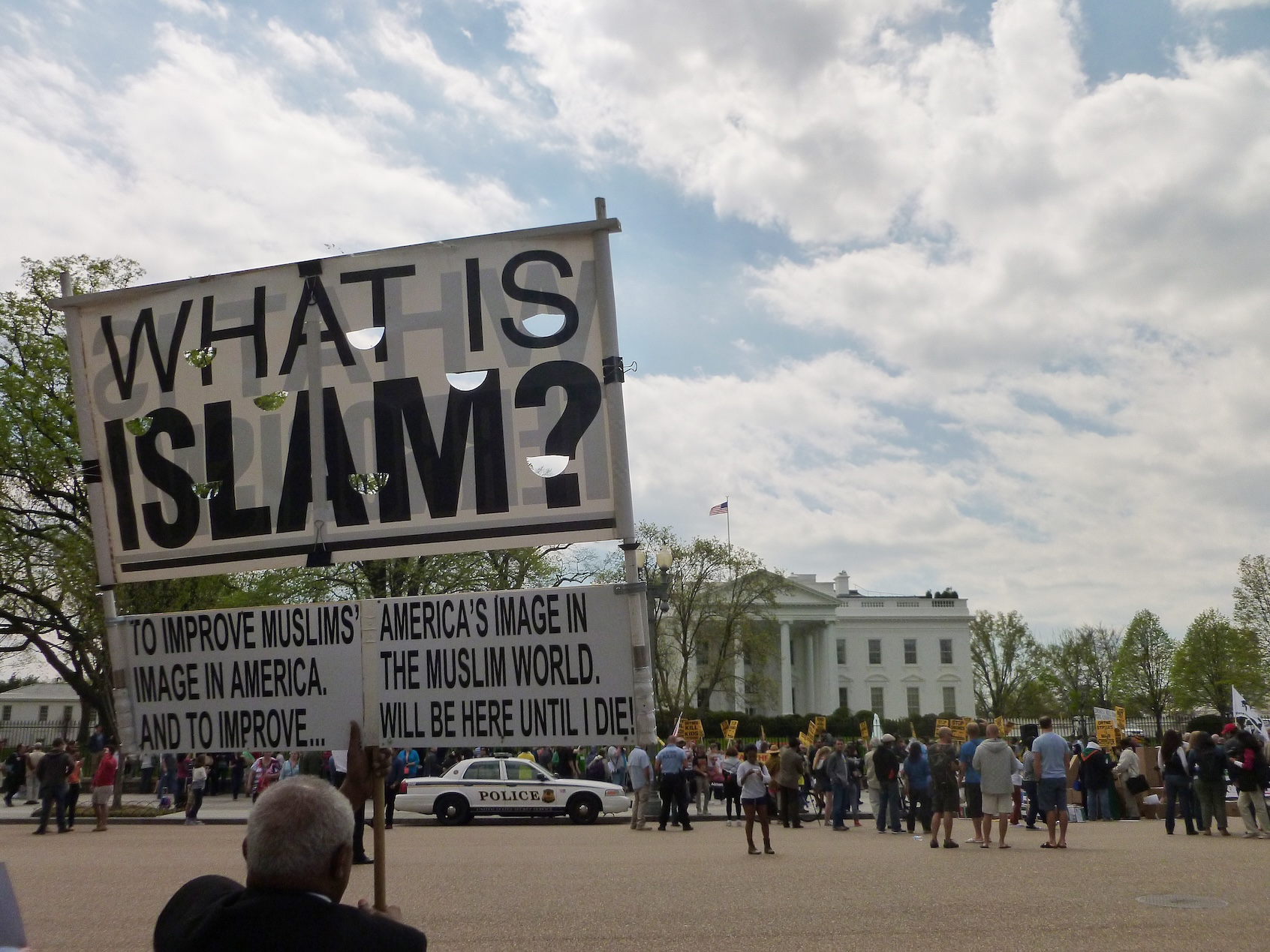

This coming week, I am planning to return to my White House vigil. I am an 84-year-old journalist who is Muslim, Arab and Black. I have lived and worked in Washington for 46 years.
I have done this before. I began my first vigil in 2008, appearing occasionally outside the White House. (See the image above this article.) I ended it in 2016, largely because Donald Trump’s attacks on Muslims during his presidential campaign gave me reason to be afraid. Those were followed, of course, by many anti-Muslim executive orders during his first term as president, and still more during his second term.
Nearly two months ago, Trump joined with Israel in launching devastating bombing attacks on Iran, a major Muslim country. More recently, over Easter weekend, Trump finally crossed my personal red line: He attacked Islam itself.
Many Arab and Muslim rulers are clearly afraid to criticize Trump, and apparently afraid to defend their own faith.
I may be a humble, elderly journalist, but I am not afraid.
I plan to return to stand in front of the White House, alone and silent. I will raise above my head a banner that reads, “What is Islam?” and “What is Terrorism?” In smaller print, it will say: “I Will Be Here Until I Die!”
Trump’s words and actions are no surprise. Throughout his political career, he has frequently used inflammatory rhetoric toward Islam.
During his first campaign, he issued an infamous press release that remains a cornerstone of this discussion: “Donald J. Trump is calling for a total and complete shutdown of Muslims entering the United States until our country’s representatives can figure out what is going on.”
In a CNN interview early in the 2016 campaign, Trump said: “I think Islam hates us. There’s something there — there’s a tremendous hatred there. We have to get to the bottom of it. There is an unbelievable hatred of us.”
Throughout his first term, he criticized his predecessors for not using the specific terminology “radical Islamic terrorism.” That language is favored by many American conservatives who argue that the religion itself is inseparable from terrorism.
I plan to return to stand before the White House, alone and silent. I will raise above my head a banner that reads, “What is Islam?” and “What is Terrorism?” In smaller print, it will say: “I Will Be Here Until I Die!”
Addressing a joint session of Congress during his first year as president, Trump declared: “We cannot let this evil continue. … We are going to defeat radical Islamic terrorism, just as we have defeated every threat we have faced in every age.”
His remarks over Easter weekend arguably went much further. He criticized those he believes do not share “Western values,” explicitly linking religious identity to civilizational conflict:
Happy Easter to all, except those who want to destroy our Country with their radical religions and ideologies. We are a Christian nation, and we will not let Islam or any other force replace our heritage. It’s a Crusade for survival!
As readers of Salon will no doubt remember, he went on to threaten Iran with both profanity and deeply offensive religious mockery: “Open the F**kin’ Strait, you crazy bastards, or you’ll be living in Hell — JUST WATCH! Praise be to Allah.”
Muslim leaders in the U.S. were outraged, and condemned this attempt to weaponize the sacred phrase “Praise be to Allah” (Alhamdulillah, in Arabic) in a vulgar and threatening context. Many Christian leaders, to be fair, were also outraged that the president would stoop so low on the holiest day of the Christian year.
We need your help to stay independent.
Then the floodgates opened, and inflammatory statements followed from other leading Republicans, starting with Defense Secretary Pete Hegseth, the public face of the devastating attacks on Iran.
While ending a Pentagon press briefing, Hegseth appealed directly to the public to pray for American troops in explicitly Christian terms: “To the American people, please pray for them every day, on bended knee, with your family, in your schools, in your churches, in the name of Jesus Christ.”
Only days later, during the monthly Christian worship service at the Pentagon — the first such service since the war with Iran began — Hegseth went further in attaching religious significance to the conflict. He recited a prayer that he said had been offered by a chaplain to U.S. troops before this year’s raid in Venezuela: “Let every round find its mark against the enemies of righteousness and our great nation.” He concluded with an explicit invocation for “overwhelming violence of action against those who deserve no mercy.”
Other Republicans have apparently felt liberated to express their bigotry. Sen. Tommy Tuberville, R-Ala., posted a split-screen photo on X juxtaposing the 9/11 attacks on the World Trade Center with an image of New York’s recently-elected mayor, Zohran Mamdani. Tuberville captioned the image: “The enemy is inside the gates.”
Rep. Andy Ogles, R-Tenn., has been even more direct: “Muslims don’t belong in American society,” he said last month. “Pluralism is a lie.” He went on to claim that “Muslims are unable to assimilate” in American society, and “they all have to go back,” without explaining where Muslims born in the U.S. should go. Any amount of immigration from Muslim-majority countries, Ogles said, poses a national security threat.
Rep. Randy Fine, R-Fla., may take the prize in this dubious category, however. “We need more Islamophobia, not less,” he wrote on X. “Fear of Islam is rational.” On another occasion, he declared that the choice between dogs and Muslims was not a difficult one, making clear that he prefers dogs.
Start your day with essential news from Salon.
Sign up for our free morning newsletter, Crash Course.
In the current political and religious climate, the distinction between criticizing individual Muslims or Muslim-majority nations and demonizing the entire religion of Islam has largely vanished in conservative rhetoric. What we are witnessing is nothing short of a move toward theological warfare, in which Islam itself is framed as a categorical and existential threat to Western civilization.
Many prominent evangelical voices have moved past previous language about “extremists” or “radicals to labeling Islam itself as a “wicked” or “lunatic” ideology that must be destroyed. In early April, the Rev. Franklin Graham, one of Trump’s most loyal evangelical supporters, said: “I pray for victory so Iranians can be set free from these Islamic lunatics. … It is time to pray for a free Iran to emerge. … The church in Iran is growing rapidly. … Wouldn’t it be great to one day see millions of Christians worshipping freely across Tehran?”
Last year, Albert Mohler, president of the Southern Baptist Theological Seminary, offered a theological underpinning for such views, saying that “Islamic civilization is a very different civilization than Western civilization. It starts with a radically different theology, and it ends up with a radically different vision of society.” In fact, he concluded, the two civilizations are “so radically different, they’re irreconcilable.”
While many Muslim groups in the U.S., along with defenders of civil and religious liberty, have strongly condemned these attacks by Trump and other Republicans, there has been a curious silence from the Arab and Muslim world, obviously for fear of angering Trump at this perilous historical moment.
While many Muslim groups in the U.S., along with defenders of civil and religious liberty, have condemned these attacks by Trump and other Republicans, there has been a curious silence from the Arab and Muslim world.
Nihad Awad, executive director of the Council on American-Islamic Relations, said that by “invoking the language of a ‘crusade'” and mocking a phrase sacred to Muslims, Trump was “no longer just debating policy; he is signaling that our faith itself is the enemy.”
But no such response was heard from the leaders of Saudi Arabia, the UAE, Qatar, Egypt, Bahrain or any other major Arab or Muslim-majority nation. Two major Islamic bodies, the Organization of Islamic Cooperation and Al-Azhar, issued statements that deplored the hateful rhetoric — but without making clear who had used it.
The Islamophobic language used in Washington has been a propaganda gift to Iranian state media, which seized on it to mobilize domestic support, arguing that the war is no longer about Iran’s nuclear technology but about the existence of Islam.
I am returning to my White House vigil in all humility, asking the same questions as before — “What is Islam?” and “What is Terrorism?” — but without offering definitive answers. I am not seeking to express an opinion as much as to call for a moment of silent reflection: Are we choosing a path of shared understanding, or a descent into a catastrophic clash of religions?
Read more
from Mohammad Ali Salih
